
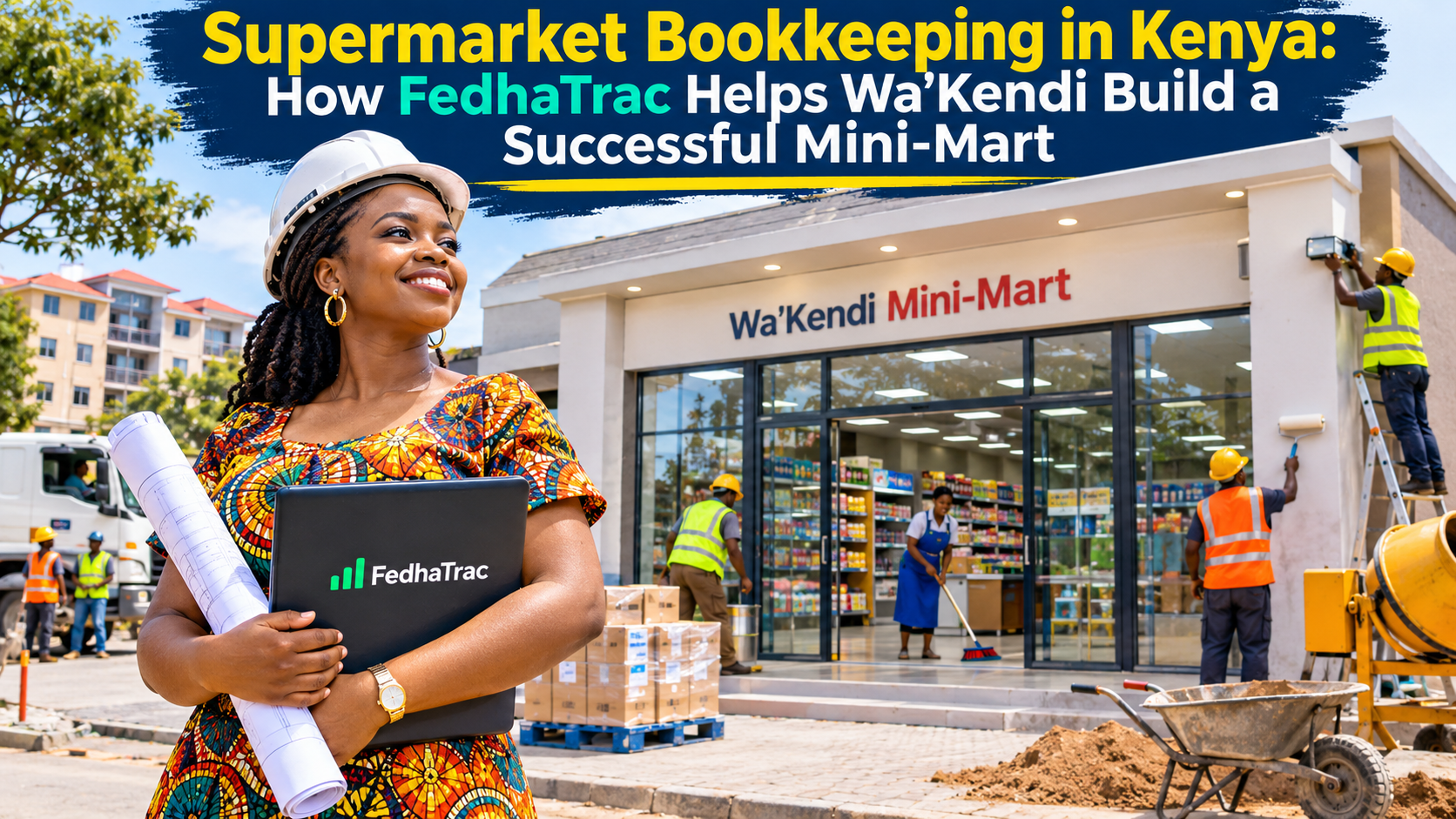
Wa’Kendi’s Dream: Open a Mini-Mart That Can Grow
Construction is almost finished. A mason checks tiles as the final shelving arrives. Wa’Kendi walks through the aisles, considering where to display flour, cooking oil, cereals, detergents and chilled products. Customers will judge her by convenience, prices and service; she must also judge the business by reliable numbers.
Supermarket Bookkeeping in Kenya begins before the first customer enters. If her construction bills, refundable rent deposit, shelving purchases and opening inventory all end up in one expense notebook, she may misunderstand her startup investment and future profitability. Their correct accounting treatment depends on the nature of each item and the applicable reporting framework.
FedhaTrac can help organise those records and build a suitable chart of accounts within an agreed engagement. Wa’Kendi still makes commercial decisions, signs contracts and supervises construction. The financial-support role is to help ensure that those decisions are supported by records she can trust.
1. Separate Construction Costs From Opening Stock and Operating Expenses

Kenyan mini-mart owner Wa’Kendi reviewing renovation invoices and opening-budget paperwork with construction workers
Wa’Kendi pays for painting, electrical fittings, shelving, a refrigerated display, signage and installation work. She also buys her first cartons of soap and beverages. These payments do not necessarily receive the same accounting treatment.
Build a documented startup budget
With Supermarket Bookkeeping in Kenya, she can retain contractor quotations, delivery notes, payment evidence and supplier invoices by project category. Qualified accounting support can help classify qualifying equipment and fit-out expenditure appropriately, distinguish stock held for resale, and track recurring costs such as electricity, security and rent.
A weekly budget comparison helps her see whether the finishing work is consuming money reserved for goods. FedhaTrac can assist with a financial review and cash-flow forecast; it is not presented as the construction contractor or physical project manager. Its accounting services guide explains the financial outputs a Kenyan SME should expect.
2. Set Up Reliable Daily Sales Records From Opening Day
On opening morning, Wa’Kendi hears the first barcode scanner beep. One customer pays cash, another uses M-Pesa, and another pays by card. A cashier issues receipts while a floor assistant replenishes bread. A busy till does not prove that every sale was recorded.
For Supermarket Bookkeeping in Kenya to work, every sale should have a consistent transaction trail. Wa’Kendi needs a retail point-of-sale process that can record products, quantities, prices, discounts, returns and payment methods. The shop is responsible for operating its tills and supplying complete records; FedhaTrac can use those records for bookkeeping and reconciliations under the agreed service scope.
Close the till every evening
At closing time, the cashier can produce a daily sales summary, count physical cash, reconcile the cash float, and identify approved refunds and voided transactions. A supervisor signs off discrepancies rather than quietly adjusting a spreadsheet. Supermarket Bookkeeping in Kenya becomes much more reliable when a dated cash count, POS report and mobile-money statement can all be reviewed together.
If the POS has no suitable export, a consistent daily report is better than guessing.
3. Keep Supplier Bills, Deliveries and Payments Under Control

Wa’Kendi with Kenyan supermarket staff checking delivered groceries against a supplier record at her estate mini-mart
Two days after opening, a wholesaler delivers rice, tissue paper and bottled water. Wa’Kendi’s receiving clerk counts the cartons while another worker checks the purchase order. The supplier invoice shows what should have arrived; the delivery note and physical count establish what actually arrived.
Effective Supermarket Bookkeeping in Kenya connects purchase orders, goods-received records, invoices and payment approvals. Where a delivery is short or damaged, the team should document the difference before finalising the supplier account. This helps avoid paying twice for one invoice or paying for goods never received.
FedhaTrac can assist with supplier ledger reconciliation, expense classification and an accounts-payable schedule. That schedule lets Wa’Kendi distinguish invoices due this week from purchases due later. She can review related expense tracking and invoicing practices when designing her own workflow.
4. Track Stock, Product Expiry and Shrinkage Without Guesswork

Wa’Kendi and a grocery employee inspecting the label of a chilled product in a colourful Kenyan mini-mart
A miniature supermarket sells products with very different shelf lives. Rice may remain saleable longer than fresh milk; a broken bottle or spoiled yoghurt cannot simply remain in the closing stock figure. Wa’Kendi needs staff to record incoming items, sales, returns, transfers, breakages, expiries and authorised write-offs.
Supermarket Bookkeeping in Kenya supports the accounting side of stock control by reconciling stock values, purchases and cost of sales against credible records. Staff and the store’s systems manage physical quantities and counts. FedhaTrac should not be described as physically counting shelves or guaranteeing that no stock is stolen.
Apply first-expiry-first-out where appropriate
For dated goods, staff can bring earlier-expiring stock forward and inspect shelves routinely. If twelve yoghurt tubs expire, the incident should be recorded, authorised and reflected in stock and financial records. Regular spot counts provide a check against errors, wastage and shrinkage.
Kenya Revenue Authority’s September 2026 stock-management notice reminds businesses to maintain accurate, current stock movement records while using TIMS/eTIMS. Supermarket Bookkeeping in Kenya helps Wa’Kendi maintain the financial evidence behind those movements, while the store retains responsibility for physical controls.
5. Reconcile M-Pesa, Cash, Card and Bank Receipts

Wa’Kendi and a cashier reviewing supermarket checkout receipts and recorded sales beside a point-of-sale terminal
One Friday evening, the checkout report appears healthy but Wa’Kendi notices a difference between expected takings and money received. A customer’s mobile-money payment was recorded against the wrong transaction, and a card settlement is still pending. These are ordinary reconciliation questions, not automatic evidence of dishonesty.
Supermarket Bookkeeping in Kenya can compare transaction-level sales reports with bank statements, M-Pesa settlement reports, cash counts and card-provider records. The objective is to account for timing differences, fees, reversals, refunds and unmatched transactions without double-counting income.
FedhaTrac offers reconciliation and bookkeeping support; Wa’Kendi must still retain access to original statements and ensure only authorised staff can handle payment credentials. Our M-Pesa bookkeeping guide and bank reconciliation guide describe the underlying recordkeeping discipline.
6. Measure Gross Profit by Category, Not Just Daily Turnover
Wa’Kendi’s neighbours may buy household essentials every day, yet some product lines will contribute more to profit than others. Promotional discounts can increase sales while reducing margins. A damaged carton can turn a promising product into a loss. Supermarket Bookkeeping in Kenya gives her a way to distinguish revenue, cost of goods sold, gross profit and operating expenses.
Consider a purely illustrative month, excluding VAT effects and other accounting adjustments:
| Illustrative monthly measure | Amount |
| Net sales | KSh 600,000 |
| Cost of goods sold | KSh 450,000 |
| Gross profit | KSh 150,000 |
| Operating expenses | KSh 100,000 |
| Illustrative operating surplus | KSh 50,000 |
The KSh 600,000 sales figure is not KSh 600,000 profit. Actual results depend on opening and closing inventory, returns, taxes, expenses and other adjustments. With Supermarket Bookkeeping in Kenya, Wa’Kendi can review whether staples, chilled foods and household products produce enough margin to justify their shelf space. Her accountant can explain the difference between gross profit and net profit.
7. Forecast Cash for Rent, Restocking and Supplier Payments
In the second week, a popular cooking-oil brand sells out. Reordering it makes commercial sense, but the business also faces rent, electricity, a supplier balance and planned refrigerator servicing. Wa’Kendi has to decide when to pay, which stock to prioritise, and what cash reserve to protect.
Supermarket Bookkeeping in Kenya should support a short rolling cash-flow forecast showing expected receipts, payments and the timing of replenishment. FedhaTrac can prepare or review financial information and support budgeting; the owner chooses purchases and authorises payments.
This is why profit and cash flow are not the same. Supermarket Bookkeeping in Kenya helps make that timing visible before a payment becomes overdue.
8. Maintain eTIMS Records and Determine the Correct Tax Obligations
Tax planning belongs in Wa’Kendi’s opening checklist, not in an envelope discovered at year-end. Kenya Revenue Authority explains that persons carrying on business are generally required to issue electronic tax invoices under eTIMS, including persons who are not VAT registered, subject to applicable rules and exceptions.
Supermarket Bookkeeping in Kenya can help her retain sales records, supplier invoices and appropriate tax classifications. FedhaTrac publicly lists Kenya-specific tax filing and compliance support, including VAT, Turnover Tax, income tax and eTIMS. Obligations depend on legal structure, turnover, supplies and current law.
VAT is separate from Turnover Tax
KRA states that a person supplying taxable goods or services worth KSh 5 million or more annually must generally register for VAT, with voluntary registration possible under conditions. Different goods may be standard-rated, zero-rated or exempt; Wa’Kendi should not apply one blanket VAT assumption to every grocery item. See KRA’s VAT guidance and FedhaTrac’s VAT registration guide.
Eligible resident businesses within the relevant turnover band may fall under Turnover Tax; KRA’s dedicated Turnover Tax page describes the currently published 1.5% rate, eligibility and exclusions. VAT registration, where required, is a separate question. Our Turnover Tax guide explains the distinction. Supermarket Bookkeeping in Kenya supplies the organised records necessary for an informed tax assessment.
Understand the 2026 income-and-expense checks
From January 2026, KRA began validating declared income and expenses against sources including TIMS/eTIMS, withholding-tax data and customs records for relevant income-tax filings, with legal exceptions. Wa’Kendi can read the official KRA public notice. Supermarket Bookkeeping in Kenya therefore requires traceable, supportable transactions rather than estimates created when a return is due.
9. Give Employees Clear Roles and Protect Business Records
Wa’Kendi hopes to employ a cashier, a store attendant and a supervisor. Clear responsibilities protect both employees and customers. The person receiving goods should not quietly authorise unexplained supplier adjustments; cash refunds should follow an approval process; and stock write-offs should have a documented reason.
Supermarket Bookkeeping in Kenya works best when access permissions, daily handovers, count sheets and review signatures match the shop’s size. A basic controls checklist can be practical without becoming bureaucratic: a named opener and closer, limited cash access, documented returns, routine stock checks and independent review of unusual transactions.
FedhaTrac can help interpret records and recommend financial controls within its engagement. Wa’Kendi remains responsible for staff supervision, employment decisions, physical security and compliant employment practices. Recording staff costs from client-supplied information does not imply that FedhaTrac provides payroll processing.
10. Use a Monthly Financial Review to Make Better Decisions

Wa’Kendi discussing income and expense reports with a professional financial adviser at the mini-mart
By the end of the first month, Wa’Kendi should be able to ask better questions than “Did we sell enough?” For example: Which categories tie up cash? Which suppliers offer reliable delivery? Why are chilled-food write-offs increasing? Are sales rising faster than the cost of stock?
A practical Supermarket Bookkeeping in Kenya monthly review can bring together a profit-and-loss statement, reconciled cash and bank balances, supplier payables, an inventory-value reconciliation, expense trends and a cash forecast. FedhaTrac’s value is in helping organise and explain the financial information so Wa’Kendi can act on it.
See monthly bookkeeping guidance for a repeatable close. Supermarket Bookkeeping in Kenya is more useful when management receives understandable figures consistently rather than impressive-looking reports long after decisions were made.
A Practical First-30-Day Plan for Wa’Kendi Mini-Mart
Here is an example of how Wa’Kendi and a bookkeeping partner might structure the opening month. Supermarket Bookkeeping in Kenya should adapt to the specific store, software and agreed scope rather than follow an inflexible template.
- Before opening: Collect setup invoices, assess the opening-stock listing, document supplier terms, establish the chart of accounts and confirm tax-registration obligations.
- Days 1–7: Test end-of-day till reconciliation, receipt retention, mobile-money matching, refund approvals and daily stock-movement records.
- Days 8–14: Check supplier statements, inspect exceptions between goods received and invoiced, and review expiries and discount records.
- Days 15–21: Review cash needs for rent, wages and replenishment; investigate POS exceptions and staff handover issues.
- Days 22–30: Reconcile accounts, review stock values, prepare management reports, verify applicable tax-filing tasks and hold a business review.
The store team performs physical work; FedhaTrac’s potential contribution is bookkeeping, reconciliations, reporting and tax support as agreed. Supermarket Bookkeeping in Kenya succeeds when both sides understand their responsibilities.
Why Wa’Kendi Might Choose FedhaTrac
An ambitious owner does not need to spend every evening reconstructing yesterday’s sales. FedhaTrac offers outsourced bookkeeping, accounting, reconciliations, financial reporting and Kenyan tax-compliance support. Its role could include helping Wa’Kendi structure pre-opening records, keep transaction books current, reconcile accounts, interpret margins, plan cash and prepare tax records where engaged to do so.
Supermarket Bookkeeping in Kenya should give Wa’Kendi clarity, not unrealistic promises. FedhaTrac does not have to replace her POS, run her stockroom or guarantee growth to provide meaningful financial support. A proposal should spell out transaction volumes, reporting frequency, system access, responsibilities, deadlines and fees. Explore accounting services costs in Kenya before requesting a tailored scope.
At its best, Supermarket Bookkeeping in Kenya helps a founder move from remembering transactions to reviewing evidence—and from reacting to bills to making informed decisions. Visit FedhaTrac or write to hello@fedhatrac.com to discuss the support appropriate for your retail business.
Frequently Asked Questions
Can FedhaTrac help before my supermarket opens?
Yes, an agreed accounting or advisory engagement can address startup-cost records, transaction categories, budgets and opening-stock accounting. Supermarket Bookkeeping in Kenya is useful before launch, although the shop owner remains responsible for construction, contracts, physical stock counts and operational decisions.
Does a small mini-mart need a POS system and a bookkeeper?
They serve different purposes. A POS captures retail transactions and, depending on the system, stock movements. Supermarket Bookkeeping in Kenya uses reliable sales, payment and purchase records to reconcile accounts and prepare meaningful financial information. A bookkeeper does not replace the store’s cashier or point-of-sale controls.
Will FedhaTrac manage all product expiry dates?
Not automatically. Employees should monitor physical products, expiry dates and waste, using suitable store processes and systems. FedhaTrac can help account for documented stock losses and reconcile financial values if included in the engagement. Supermarket Bookkeeping in Kenya depends on accurate information from the people handling goods.
Must Wa’Kendi register for VAT immediately?
Not solely because she opens a mini-mart. The answer depends on the nature and value of taxable supplies, expected turnover and registration rules. KRA publishes the general KSh 5 million annual taxable-supplies threshold, with voluntary registration subject to conditions. Supermarket Bookkeeping in Kenya helps maintain records to assess that position accurately.
How often should Wa’Kendi receive financial reports?
Daily till checks and weekly exception reviews are useful operational practices; a monthly financial close and management review provide a broader picture. The frequency of FedhaTrac deliverables must be agreed. Supermarket Bookkeeping in Kenya should produce reports early enough for the owner to use them when making purchasing and cash-flow decisions.
From the Building Site to a Business Built on Good Records
The last painter climbs down his ladder. Wa’Kendi smiles at the almost-finished sign: Wa’Kendi Mini-Mart. Soon the store will be full of shoppers, staff and cartons arriving from suppliers. Her dream deserves the excitement of opening day—and the discipline that makes the months afterward manageable.
Supermarket Bookkeeping in Kenya gives her a practical framework for tracking money, identifying mistakes, understanding profit and preparing for tax obligations. With good shop processes and the right professional financial support, she can focus on serving her estate while keeping a clearer view of the business she is building.


