

Expense Tracking and Invoicing in Kenya: 9 Proven Business Wins
 Kenyan SME owner reviewing customer invoices, M-Pesa payments, business expenses and cash-flow figures on a financial dashboard in a professional Nairobi workspace.
Introduction: Why Expense Tracking and Invoicing in Kenya Matter More Than Ever
A business can make impressive sales and still struggle financially. The reason is often hidden between the money coming in and the money going out. Rent, stock, transport, internet, software, bank charges, M-Pesa fees, packaging, marketing and supplier payments gradually consume revenue. At the same time, some customers may take weeks or months to settle invoices. Unless both sides of this equation are monitored, a business owner can see plenty of activity without knowing whether the company is genuinely profitable or whether enough cash will be available to meet upcoming obligations. This is why expense tracking and invoicing in Kenya should be treated as core financial-management processes rather than administrative chores.
The challenge is particularly relevant to Kenyan SMEs because transactions rarely pass through a single channel. A customer might pay through M-Pesa, another through a bank transfer and another in cash. Expenses may be paid through mobile money, cards, petty cash or directly from a bank account. Supplier credit introduces another layer because an expense can exist before money actually leaves the business. Similarly, issuing an invoice does not mean cash has been received. Without organised business expense tracking in Kenya and a reliable invoice-management process, information becomes scattered between statements, receipts, screenshots, spreadsheets and memory. FedhaTrac’s guide to the importance of financial management explains why bringing this information together is essential for stronger business control.
The objective of good expense tracking and invoicing in Kenya is therefore much bigger than producing neat records. Businesses need to know what they are spending, why they are spending it, who owes them money, when payment is expected and whether sales are actually translating into cash and profit. Good systems also create stronger records for bookkeeping, accounting and tax support. FedhaTrac brings these functions into a broader financial-management workflow, helping businesses organise transactions and use the resulting information to make better decisions. When expense records, invoices, payments and bookkeeping work together, owners can move from asking “Where did the money go?” to understanding “What should we do next?”
What Is Expense Tracking and Invoicing?
Expense tracking is the process of recording, categorising, supporting and reviewing money spent by a business.
An effective expense record should normally answer basic questions:
- When was the expense incurred?
- Who was paid?
- What was purchased?
- How much was spent?
- What business purpose did it serve?
- Which expense category does it belong to?
- How was it paid?
- Is there appropriate supporting documentation?
Invoicing deals with the other side of the financial cycle.
An invoice establishes what a customer has been charged for goods or services and provides information relevant to payment.
A proper invoice-management process should allow the business to determine:
- Which invoices have been issued
- How much each customer owes
- When payment is due
- Which invoices have been paid
- Which are partially paid
- Which are overdue
- Which customers require follow-up
Good expense tracking and invoicing in Kenya connects these two processes with bookkeeping.
9 Proven Business Wins from Expense Tracking and Invoicing in Kenya
1. Know Where Your Business Money Is Actually Going
One of the biggest financial problems facing small businesses is not necessarily excessive spending—it is invisible spending.
KSh 500 here, KSh 1,200 there and another KSh 3,000 somewhere else may not attract attention individually. Across hundreds of transactions, however, they can materially affect profit.
Good expense tracking and invoicing in Kenya makes those costs visible.
Instead of seeing one total figure for “expenses,” management can understand how much is being spent on categories such as:
- Transport
- Internet
- Marketing
- Software
- Rent
- Professional fees
- Packaging
- Delivery
- Bank charges
- M-Pesa fees
- Repairs
- Utilities
Visibility creates the opportunity to control expenditure.
FedhaTrac’s guide to the best expense tracker in Kenya explores this concept in greater detail.
2. Find Out Whether Your Prices Are Actually Profitable
A business can price a product or service too cheaply without realising it.
Consider a consultant who charges KSh 50,000 for a project.
At first glance, the project appears attractive. But suppose delivery requires:
| Project Cost | Amount |
|---|---|
| Transport | KSh 5,000 |
| Subcontractor | KSh 12,000 |
| Software | KSh 3,000 |
| Printing/materials | KSh 2,500 |
| Communication | KSh 1,500 |
| Total direct costs | KSh 24,000 |
The KSh 50,000 invoice does not represent KSh 50,000 of profit.
The business still needs to consider the KSh 24,000 of direct costs and potentially other overheads.
This is where SME expense tracking becomes strategically important.
Once businesses understand the real cost of delivering products and services, they can make better pricing decisions.
3. Collect Customer Payments Faster
Sending an invoice is only the beginning of the collection process.
A business should know when the invoice was sent, when payment is due and whether the customer has actually paid.
Without invoice management in Kenya, overdue invoices can quietly accumulate.
A structured process can classify invoices as:
Draft → Issued → Due → Paid / Partially Paid / Overdue
This makes follow-up considerably easier.
Instead of searching through emails or WhatsApp conversations to determine whether a customer paid, management has a clear record.
Good invoice management can therefore improve cash flow without requiring the business to make additional sales.
Sometimes the money the business needs is already earned—it simply has not been collected.
4. Improve Cash-Flow Visibility
Profit and cash are different.
A company might issue KSh 1 million worth of invoices during a month but collect only KSh 600,000.
Meanwhile, it may need to pay KSh 700,000 in expenses.
That business can appear profitable while experiencing immediate cash-flow pressure.
Good expense tracking and invoicing in Kenya brings both sides together:
Expected cash coming in versus Expected cash going out
Management can then anticipate shortfalls rather than discovering them when an important payment is due.
FedhaTrac’s guide to maintaining strong financial health provides additional guidance on managing the broader financial position of a business.
5. Create Better Bookkeeping Records
Expense tracking and invoicing should not exist separately from bookkeeping.
Expenses recorded during the month eventually feed into the company’s financial records.
Invoices create accounts-receivable information.
Customer payments reduce those balances.
Supplier payments affect expenses or liabilities.
M-Pesa and bank activity then needs to be reconciled against these records.
This is why professional bookkeeping services Kenya businesses use become considerably more effective when transaction information is already organised.
FedhaTrac can combine expense tracking with bookkeeping, accounting and tax support so that businesses do not have to reconstruct financial information from scratch every reporting period.
6. Build Stronger Supporting Records
A payment confirmation tells you that money moved.
It does not always tell you why.
Imagine your M-Pesa statement shows:
KSh 18,500 sent to John Mwangi.
Was that inventory? Repairs? Transport? A contractor payment? An employee advance? Something personal?
Without supporting information, someone reviewing the records months later may have no idea.
Strong business expense tracking in Kenya therefore connects transactions with supporting documents and descriptions.
Where applicable, businesses should maintain appropriate:
- Supplier invoices
- Receipts
- Electronic tax invoices
- Contracts
- Purchase records
- Payment confirmations
- Credit notes
- Relevant transaction references
This creates a stronger financial audit trail.
7. Make Better Financial Decisions
Financial management improves when management can ask better questions.
Instead of simply asking:
“How much did we spend?”
you can ask:
“Why did transport costs increase by 25%?”
Instead of:
“How much did we sell?”
you can ask:
“How much of those sales have customers actually paid?”
Instead of:
“Are we busy?”
you can ask:
“Which customers, products or projects are generating worthwhile margins?”
This is one of the most valuable outcomes of good expense tracking and invoicing in Kenya.
Financial records stop being historical paperwork and become management information.
FedhaTrac’s guide to developing strong financial management skills explores how business owners can develop this decision-making discipline.
8. Identify Waste Before It Becomes a Bigger Problem
Expenses naturally change as a business grows.
The important question is whether those increases are justified.
Monthly expense analysis can reveal:
- Unused subscriptions
- Increasing delivery costs
- Excessive bank charges
- Supplier price increases
- Repeated repair costs
- Poorly performing advertising expenditure
- Unexpected transaction fees
- Cost categories growing faster than revenue
The objective is not to eliminate every expense.
A business sometimes needs to spend more to grow.
The objective is to understand why costs are changing and whether they are producing sufficient value.
9. Create a Financial System That Can Grow With the Business
A founder may initially remember every customer and every expense.
That stops working as the business grows.
Ten monthly invoices become fifty.
Twenty expense transactions become five hundred.
One payment channel becomes M-Pesa, bank transfers, cards and cash.
A good expense tracking and invoicing in Kenya system creates financial infrastructure that can grow with transaction volume.
This reduces dependence on the owner’s memory and creates greater continuity as the company expands.
Expense Tracking vs Invoicing: What’s the Difference?
| Expense Tracking | Invoicing |
|---|---|
| Tracks money the business spends | Tracks money customers owe |
| Supports expense control | Supports revenue collection |
| Records supplier/business costs | Records customer charges |
| Helps analyse profitability | Helps monitor receivables |
| Supports bookkeeping | Supports bookkeeping |
| Helps forecast cash leaving | Helps forecast cash arriving |
| Requires supporting records | Requires invoice/payment records |
Neither process should operate alone. Together, they give management visibility over both sides of cash flow.
How Expense Tracking Works in Practice
A reliable expense process does not need to be complicated.
Step 1: Capture the Transaction
Record the expense when it occurs rather than waiting several weeks.
Step 2: Identify the Supplier
Record who received the money.
Step 3: Categorise the Expense
Use consistent categories such as transport, marketing, internet or professional fees.
Step 4: Record the Business Purpose
A short explanation can prevent confusion months later.
Step 5: Store Supporting Documentation
Keep appropriate receipts, invoices and other records.
Step 6: Match the Payment
Connect the expense to the relevant bank, M-Pesa, cash or card transaction.
Step 7: Review Monthly
Compare expense categories with previous periods and revenue.
This creates a much stronger foundation for small business financial management in Kenya.
How to Build an Effective Invoice Management System
A good invoicing system should follow the invoice throughout its entire life.
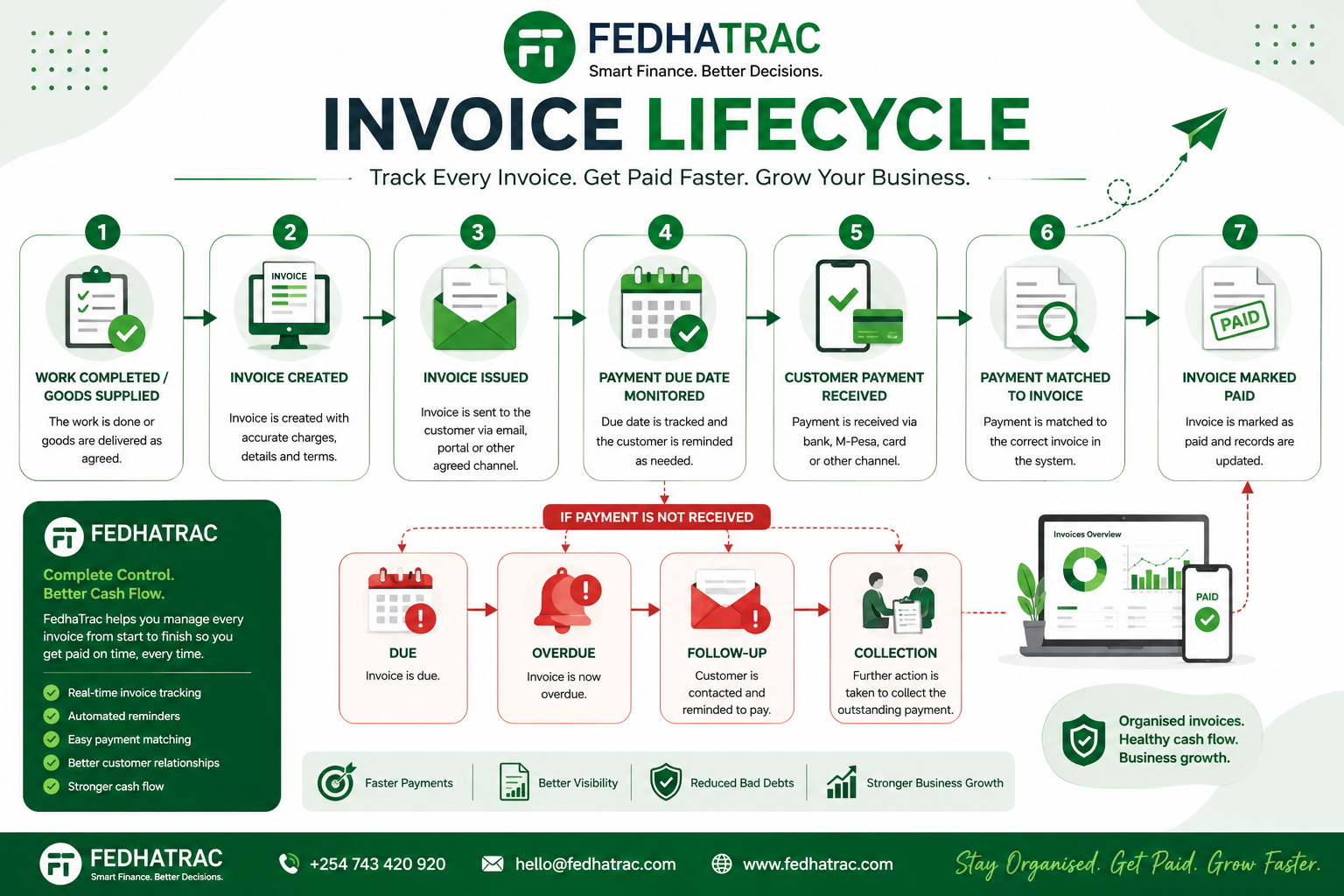 The Invoice Lifecycle
This is much stronger than sending a PDF and hoping the customer remembers.
M-Pesa, Bank and Cash: Bringing Everything Together
Kenyan SMEs frequently receive and spend money across multiple channels.
That makes reconciliation essential.
Suppose a customer pays a KSh 30,000 invoice through M-Pesa.
Three records now need to agree:
Invoice: KSh 30,000
M-Pesa receipt: KSh 30,000
Customer outstanding balance: KSh 0
If the payment is recorded as a new sale instead of being matched to the invoice, revenue could be duplicated.
Similar issues occur when funds are transferred between M-Pesa and bank accounts.
The business therefore needs a financial workflow where invoices, expenses, payments and bookkeeping records communicate with each other.
This is particularly important for M-Pesa bookkeeping, where high transaction volumes can quickly create reconciliation problems.
eTIMS and the Importance of Proper Business Records
Kenyan businesses also need to consider their invoicing and expense records within the applicable tax and electronic-invoicing environment.
The practical lesson for an SME is straightforward:
Do not wait until tax preparation to start organising transactions and supporting documents.
Good financial discipline means maintaining records throughout the year.
Businesses should ensure their invoicing processes, supplier documentation and expense records reflect applicable KRA requirements and obtain appropriate professional tax guidance for their circumstances.
FedhaTrac’s combination of bookkeeping, accounting and tax support can help businesses build processes where financial records are maintained consistently rather than reconstructed close to filing deadlines.
The Complete Expense Tracking and Invoicing Workflow
A strong SME workflow can look like this:
DAILY
- Record significant business expenses.
- Save supporting documents.
- Issue invoices promptly.
- Record customer payments.
WEEKLY
- Review unpaid invoices.
- Follow up overdue customers.
- Review new expenses.
- Identify missing documents.
- Check upcoming payments.
MONTHLY
- Reconcile bank accounts.
- Reconcile M-Pesa accounts.
- Review expense categories.
- Review customer receivables.
- Review supplier balances.
- Investigate unexplained transactions.
- Review financial reports.
- Assess cash-flow position.
This implementation rhythm is more important than having sophisticated software that nobody updates consistently.
Friday Financial Check: 20 Minutes That Can Save Your Month
A useful habit for SMEs is a short financial review every Friday.
Ask five questions:
- Who owes us money?
- What expenses did we incur this week?
- What bills must we pay next week?
- Are any documents or transaction explanations missing?
- Do we have enough available cash for upcoming obligations?
This simple routine turns expense tracking and invoicing in Kenya into an active management process rather than a month-end administrative exercise.
Common Expense Tracking and Invoicing Mistakes
Mixing Personal and Business Expenses
This makes profitability harder to determine and creates unnecessary bookkeeping work.
Waiting Until Month-End to Record Everything
Receipts disappear and people forget what transactions were for.
Sending Invoices Late
Every day an invoice is delayed can potentially delay collection.
Having No Clear Payment Terms
Customers should understand when and how payment is expected.
Failing to Follow Up
An overdue invoice should trigger action.
Recording Customer Payment as Another Sale
This can duplicate revenue where an invoice was already recorded.
Ignoring M-Pesa Charges
Frequent transaction charges can add up.
Keeping Receipts Without Categorising Expenses
Documents alone do not create useful financial information.
Tracking Sales but Ignoring Costs
High revenue means little if the business cannot determine its margins.
Service Businesses vs Product Businesses
Different businesses need different expense controls.
| Service Businesses | Product Businesses |
|---|---|
| Travel | Inventory purchases |
| Software | Delivery |
| Subcontractors | Packaging |
| Internet | Damaged stock |
| Communication | Returns |
| Professional tools | Warehousing |
| Project expenses | Supplier charges |
| Client-related costs | Discounts |
For service businesses, one major risk is underestimating the cost of delivering work.
For product businesses, the danger is assuming the difference between selling price and purchase price represents the entire profit margin.
Both require proper expense tracking.
DIY Spreadsheet vs Software vs Outsourced Financial Support
| Factor | Spreadsheet | Financial Software | Outsourced Support |
|---|---|---|---|
| Initial simplicity | High | Medium | High for owner |
| Manual work | High | Lower | Lower for owner |
| Expense categorisation | Manual | Structured | Professionally managed |
| Invoice tracking | Manual | Automated/structured | Managed |
| Reconciliation | Manual | System-assisted | Professionally handled |
| Financial expertise | Owner-dependent | Owner-dependent | Available |
| Scalability | Limited | Stronger | Strong |
| Best for | Very simple businesses | Growing businesses | Owners needing professional support |
The most interesting option for many SMEs is not necessarily choosing between technology or professional support.
It can be combining both.
How FedhaTrac Supports Expense Tracking and Invoicing in Kenya
 FedhaTrac is designed around a broader problem than simply generating invoices.
Businesses need financial information that connects.
A customer invoice affects revenue and receivables.
A customer payment affects cash and receivables.
An expense affects cash and profitability.
A supplier payment affects cash and potentially payables.
All these transactions eventually affect the financial reports management uses to understand the business.
FedhaTrac helps bring these activities into a more organised financial-management process.
More Than Expense Tracking Software
Some businesses simply need better tools.
Others need somebody to help maintain the financial records.
FedhaTrac can support both sides by combining financial technology with outsourced bookkeeping, accounting, tax and financial-management services.
This is particularly useful for SMEs that do not want financial administration consuming the owner’s time.
Instead of spending evenings trying to reconcile transactions and determine which customers have paid, owners can concentrate on customers, operations and growth while still having access to organised financial information.
When Should You Consider Outsourcing?
Consider professional support when:
- Expenses regularly go unrecorded.
- Customer invoices are not followed up consistently.
- M-Pesa and bank balances do not reconcile.
- Several months of bookkeeping are behind.
- The owner spends excessive time maintaining records.
- Financial reports cannot be trusted.
- Tax preparation requires reconstructing transactions.
- The business has grown beyond simple spreadsheets.
This is where outsourced bookkeeping for SMEs in Kenya can complement expense and invoice software.
The objective is not to remove financial visibility from the owner.
It is to improve it.
Search Intent Guide: What Does Your Business Actually Need?
| Your Problem | Likely Solution |
|---|---|
| “I don’t know where our money goes.” | Expense tracking |
| “Customers keep paying late.” | Invoice management |
| “I don’t know who still owes us.” | Accounts receivable tracking |
| “My M-Pesa doesn’t match my records.” | M-Pesa reconciliation |
| “Our books are several months behind.” | Catch-up bookkeeping |
| “Existing records contain errors.” | Bookkeeping cleanup |
| “I don’t understand whether we’re profitable.” | Bookkeeping + financial reporting |
| “I spend too much time doing this myself.” | Outsourced bookkeeping |
| “I need organised records for tax work.” | Bookkeeping + tax support |
| “I need all of these.” | Integrated financial-management support |
Frequently Asked Questions
1. What is the best way to track business expenses in Kenya?
The best system is one that captures expenses consistently, categorises them correctly and connects them with appropriate supporting records. Businesses should also separate personal and business expenditure and reconcile payment channels such as M-Pesa and bank accounts. Whether you use spreadsheets, software or professional support depends on transaction volume and complexity. Consistency matters more than choosing the most complicated tool.
2. Why should Kenyan SMEs track unpaid invoices?
An invoice represents money the business expects to receive, not necessarily cash already available. Tracking unpaid invoices allows management to identify overdue customers, follow up collections and forecast cash more accurately. Without proper invoice management in Kenya, businesses can make strong sales while still experiencing cash-flow shortages because customers have not paid.
3. Can expense tracking help my business become more profitable?
Yes. Expense tracking allows management to identify rising costs, unnecessary expenditure and the real cost of delivering products or services. This can support better pricing and cost-control decisions. It does not automatically increase profit, but it provides information management can use to protect margins and reduce avoidable expenditure.
4. How does M-Pesa fit into expense tracking and invoicing?
M-Pesa can be both a payment collection channel and an expense payment channel. Customer receipts should be matched to the appropriate invoices, while business payments should be categorised correctly. Transfers between M-Pesa and business bank accounts also need appropriate treatment to avoid duplicating income or expenses. Regular reconciliation helps ensure the records match actual account activity.
5. Can FedhaTrac handle more than invoicing and expense tracking?
Yes. FedhaTrac’s role can extend beyond expense and invoice organisation to outsourced bookkeeping, accounting, tax support and wider financial-management assistance. This allows businesses to connect daily transaction records with reporting and professional financial support instead of managing each function separately.
Final Thoughts: Turn Every Expense and Invoice Into Useful Business Information
Good expense tracking and invoicing in Kenya should give a business more than a collection of receipts and customer invoices. It should provide visibility. Management should be able to understand where money is going, which customers still owe the company, which expenses are increasing and whether sales are translating into cash and profit. When these processes are maintained consistently, financial information becomes much more useful for pricing, budgeting, cash-flow planning and business decisions. This is why expense tracking and invoicing should form part of the wider financial-management system rather than being tasks reserved for tax season.
The process does not have to begin with complicated technology. Start by separating business transactions, recording expenses when they occur, retaining appropriate supporting records, issuing invoices promptly and reviewing unpaid balances every week. Then incorporate M-Pesa and bank reconciliation into the monthly bookkeeping cycle. As transaction volumes increase, software and professional support can make the process more manageable. FedhaTrac’s guide to mastering the principles of financial management provides additional context for businesses that want to develop stronger financial systems rather than simply maintain records.
FedhaTrac helps Kenyan SMEs connect the pieces. Expense tracking, invoicing, bookkeeping, accounting, tax support and financial reporting should ultimately help answer the same question: What is really happening financially inside this business? If you regularly lose receipts, struggle to determine who owes you money, cannot reconcile M-Pesa or only discover your true expenses months later, the financial process needs attention. Establishing reliable expense tracking and invoicing in Kenya today gives the business something far more valuable than organised paperwork—it creates the financial visibility needed to manage tomorrow with greater confidence.
CTA: Bring Your Expenses, Invoices and Books Together
Stop managing your business finances across disconnected receipts, M-Pesa statements, spreadsheets and unpaid invoices. Talk to FedhaTrac about expense tracking, invoicing, bookkeeping, accounting and tax support designed for Kenyan SMEs.
Visual Briefs
Featured Visual
Description: Kenyan SME owner reviewing expenses, customer invoices, M-Pesa payments and cash-flow information through an organised financial dashboard.
Alt text: Expense tracking and invoicing in Kenya with FedhaTrac
Visual 2 — Comparison
Description: Split comparison showing disorganised receipts, forgotten expenses and overdue invoices on one side and organised expense categories, paid invoices and clear financial records on the other.
Alt text: Poor vs organised expense tracking and invoicing in Kenya
Visual 3 — Invoice Lifecycle
Description: Green FedhaTrac-themed illustration showing the journey from customer purchase to invoice creation, payment due date, M-Pesa or bank payment, reconciliation and completed collection.
Alt text: Invoice management process for Kenyan SMEs
Visual 4 — Expense Workflow
Description: Business expense moving through five stages: payment, receipt capture, expense categorisation, bookkeeping reconciliation and financial reporting.
Alt text: SME expense tracking workflow in Kenya
Visual 5 — People and Financial Management
Description: Kenyan business owner and finance professional reviewing customer receivables, expense trends and cash-flow information together on a laptop.
Alt text: Financial management and bookkeeping support for Kenyan SMEs
Official references: KRA eTIMS guide: kra.go.ke eTIMS. KRA filing notice for 2025 income tax returns: kra.go.ke 2025 filing notice.


