
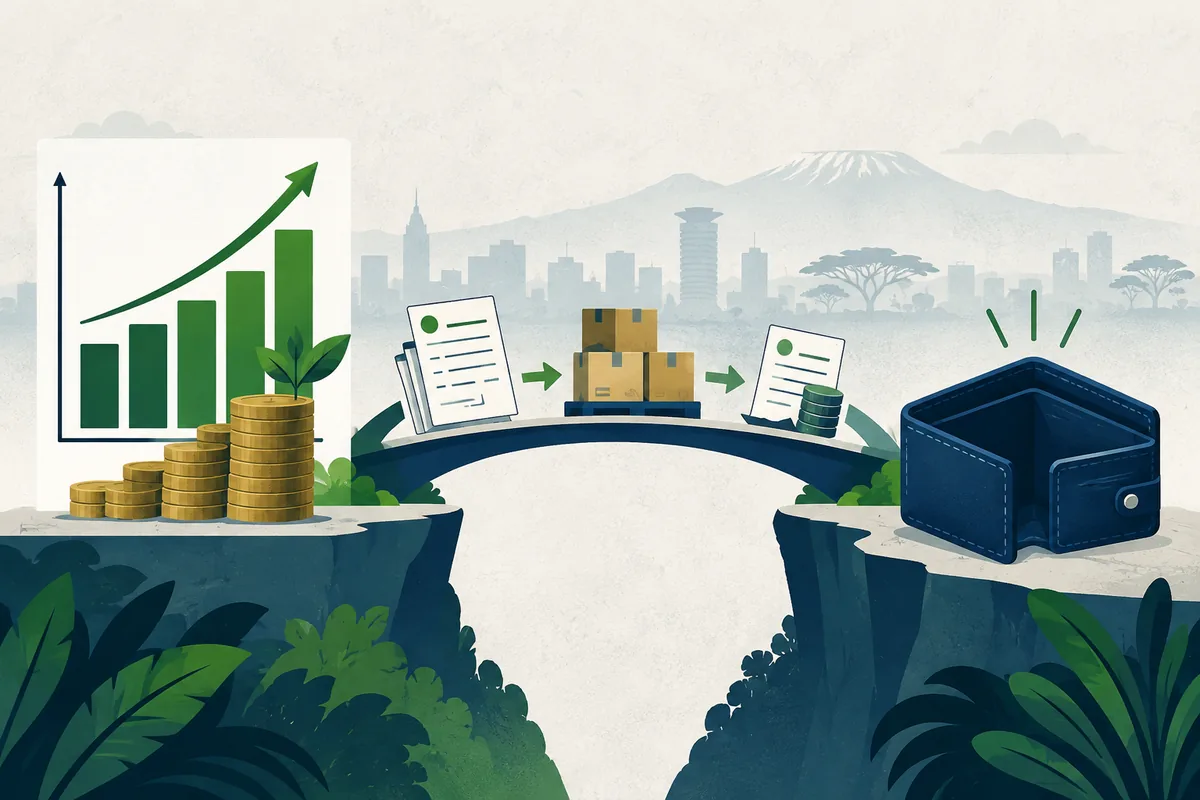
Profit vs Cash flow is a practical management subject, not terminology reserved for accountants. It helps an owner answer a precise question: If the business is profitable, why can it still struggle to pay suppliers, taxes or other obligations? Kenyan SMEs make sales through bank accounts, M-Pesa, cash, card channels and credit invoices, while costs may be paid immediately or recognised later. Without disciplined records, those timing differences make otherwise familiar numbers difficult to trust.
This guide explains profit vs cash flow in plain professional language and then moves into implementation. You will see the accounting logic, a worked KES example, the review questions management should ask, common errors and the monthly workflow required to produce reliable information. The aim is not to turn an owner into a technical accountant. It is to make the report useful enough that management can challenge unusual figures, assign action and recognise when specialist judgement is needed.
The guide forms part of FedhaTrac’s Accounting for Kenyan SMEs cluster. It builds on bookkeeping fundamentals and the wider accounting and financial-reporting overview. Where formal reporting is required, the applicable framework and entity circumstances matter. The IFRS Foundation’s IFRS for SMEs resources explain the purpose and scope of the standard, while ICPAK’s illustrative Kenyan SME statements provide a useful local presentation reference.
Profit vs Cash Flow: Two Different Measures
Profit vs Cash flow compares accounting performance with actual money movement. Profit is revenue earned minus expenses recognised for a period. Cash flow records when money is received and paid. Both are essential, but they answer different questions: profit asks whether the business model creates value, while cash flow asks whether the business can meet obligations when they fall due.
The difference is largely timing. A Kenyan SME may issue a KES 1,000,000 invoice today, recognise the sale and earn KES 250,000 profit, yet allow the customer 60 days to pay. Suppliers may require KES 600,000 this month. The sale is profitable, but it creates an immediate funding gap. That is not an accounting contradiction; it is working-capital timing.
Why a Profitable Business Can Run Out of Cash
| Cause | Effect on profit | Effect on cash |
|---|---|---|
| Credit sales | May increase revenue and profit now | No cash until the customer pays |
| Inventory growth | Unsold stock may not yet reduce profit fully | Cash leaves when stock is purchased |
| Equipment purchase | Cost is generally spread through depreciation | Large payment may occur immediately |
| Loan principal | Principal is not an ordinary P&L expense | Repayment reduces cash |
| Supplier credit | Expense may already be recognised | Payment happens later |
Rapid growth often magnifies these gaps. More sales can require more inventory, labour and delivery spending before customers pay. A company may therefore become more profitable and less liquid at the same time. Owners should not conclude that growth is always bad; they should calculate how much working capital each additional shilling of sales requires.
Diagnosing a Profit Cash Gap
Start with net profit, then trace the major reconciling items. Add back non-cash expenses such as depreciation. Examine whether receivables and inventory increased, because both can absorb cash. Review payables: delaying suppliers may temporarily preserve cash but cannot be treated as permanent funding. Include equipment purchases, loan principal, owner drawings and tax payments. This bridge explains why the bank balance moved differently from reported profit.
Example of growth consuming cash
A distributor earns KES 400,000 monthly profit but adds KES 700,000 of receivables and KES 300,000 of inventory while supplier credit increases by only KES 200,000. Working capital absorbs KES 800,000, twice the reported profit. Unless the company begins collecting customers faster or arranges funding, it can struggle despite a healthy margin.
How to Protect Both Profit and Liquidity
- Set customer credit limits and follow up overdue invoices promptly.
- Request deposits or staged payments for large orders.
- Track inventory days and stop buying slow-moving stock automatically.
- Match supplier terms with the customer collection cycle where possible.
- Forecast equipment, tax and debt payments separately from operating expenses.
- Review owner drawings against both profit and available cash.
Cutting prices to accelerate cash can damage margin; refusing all credit can damage sales. The objective is balance. Management needs profitable pricing, disciplined credit, an inventory plan and a dated cash forecast. Profit vs cash flow should therefore be a joint commercial and financial discussion, not a choice between two reports.
 Five Scenarios That Separate Profit from Cash
1. A profitable credit sale
A consultancy completes KES 800,000 of work and recognises revenue, but the client pays after 60 days. Staff and contractors must be paid this month. Profit improves before cash does, so the business needs sufficient working capital or staged billing.
2. Stock purchased ahead of demand
A retailer pays KES 1.2 million for inventory. Only part is sold during the month, so the P&L recognises only the cost attached to sold items while cash has already left for the full purchase. The remaining value sits on the balance sheet.
3. Equipment paid for immediately
A vehicle costing KES 2 million may be recorded as an asset and depreciated over several periods. Cash falls by KES 2 million at purchase, but current profit may include only a portion through depreciation. The investment can be sound and still create near-term liquidity pressure.
4. Loan proceeds received
A new loan increases cash and liabilities, not sales. The bank balance looks stronger even if the business is loss-making. Later, interest affects profit while principal repayment affects cash and reduces the liability.
5. Supplier bills recorded but unpaid
An expense can reduce profit before payment. Supplier credit temporarily protects cash, but the obligation remains on the balance sheet. Treating delayed payment as a cash-flow solution can lead to sudden shortages and damaged relationships.
Build a Profit-to-Cash Bridge
Begin with net profit. Add back non-cash expenses such as depreciation, then deduct increases in receivables and inventory because they absorb cash. Add increases in payables because suppliers temporarily finance the business. Finally, include equipment purchases, borrowing, principal repayments and owner drawings to explain the total cash movement. A bridge makes the difference visible without implying that either figure is wrong.
| Movement | Effect on cash relative to profit | Owner question |
|---|---|---|
| Receivables increase | Reduces cash conversion | Which customers are overdue and who owns collection? |
| Inventory increases | Absorbs cash | Is stock growth supported by demand? |
| Payables increase | Temporarily preserves cash | Are suppliers being paid within agreed terms? |
| Capital expenditure | Uses cash outside current operating profit | How will the asset be funded and repaid? |
Objections Owners Commonly Raise
If the sale is profitable, taking more orders must help. Only when the business can fund the gap between delivery and collection. The bank balance is positive, so cash flow is fine. The balance may include loans, customer deposits or tax money. Customers always pay eventually. Timing still matters when wages, suppliers and KRA obligations have fixed dates. A cash forecast is just a guess. It is an explicit set of assumptions that can be tested and updated, which is more useful than an unstated hope.
Decision Rules for Sustainable Growth
Estimate the working capital required for a new contract before accepting it. Use deposits where the business must buy materials or reserve capacity. Price credit terms as part of the commercial offer. Tie owner withdrawals to both retained profit and forecast cash. When borrowing is needed, match the facility to the purpose: short-term working capital differs from long-term asset finance.
How to Tell Whether the Problem Is Profit or Timing
If gross margin and operating profit are consistently weak, the underlying economics need attention; faster collections alone will not repair an unprofitable offer. If margins are healthy but receivables and inventory absorb cash, the problem is cash conversion and working-capital design. If both profit and cash are weak, management may need a wider turnaround covering price, volume, cost, collections and financing.
Trend analysis is more informative than a single month. Plot net profit, operating cash flow, receivable days, inventory days and payable days for at least six to twelve periods. A widening gap between profit and operating cash should be explained. The explanation might be planned growth, but the funding requirement still needs approval and monitoring.
Tax and owner drawings
Profit can create tax obligations before owners feel cash-rich. Estimate and reserve applicable taxes rather than treating every positive bank balance as spendable. Owner drawings or dividends also require care: accounting profit does not guarantee that cash is available after working capital, debt service and upcoming obligations. Agree a distribution policy that considers both retained earnings and forecast liquidity.
When external finance is appropriate
Financing can bridge a temporary, measurable gap caused by sound growth or asset investment. It is less suitable for recurring losses with no corrective plan. Before borrowing, quantify the need, match the facility term to its purpose and model repayment under a downside case. Finance should support a credible operating model, not postpone recognition of a structural problem.
FedhaTrac Business Tip
The Reports to Review Together
The P&L explains earnings, the balance sheet shows receivables, stock, suppliers and debt, and the cash forecast reveals upcoming timing pressure. FedhaTrac can connect these reports through reconciled bookkeeping, ageing schedules and monthly management review so that an owner knows whether the problem is weak profitability, slow cash conversion or both.
Frequently Asked Questions
Is profit money in the bank?
No. Profit includes earned revenue and recognised expenses, some of which have not yet been received or paid. The bank balance reflects cash timing and financing as well as trading activity.
Can a business have cash but make a loss?
Yes. It may have borrowed, received owner capital, sold assets or collected old invoices. Those inflows can support cash even when current-period operations are unprofitable.
Why does growth cause cash pressure?
Growth often requires stock, labour and delivery spending before customers pay. The faster sales grow, the more working capital may be required.
Which report explains the gap?
Use the P&L, balance sheet and cash flow statement together. Receivables, inventory, payables, equipment and debt usually explain most of the difference.
Should an SME prioritise profit or cash?
Both. A company needs an economically sound model and enough liquidity to operate. Protecting cash by accepting permanently unprofitable work is not sustainable.
How far ahead should cash be forecast?
A rolling 13-week forecast is useful for short-term control, while monthly or annual forecasts support longer decisions. The right horizon depends on the trading cycle and risk.
 Final Thoughts
profit vs cash flow becomes valuable when management understands the logic, trusts the data and acts on the result. The strongest report is not necessarily the longest. It is the one that reconciles to evidence, uses consistent classifications, explains material movements and leads to a clear decision.
Build the process from dependable records. Reconcile cash, review control accounts, maintain supporting schedules and close the month on a defined timetable. Then compare performance, investigate exceptions and assign actions. This discipline turns accounting from a year-end compliance exercise into an operating system for the business.
For Kenyan SMEs, the practical goal is financial visibility without unnecessary complexity. Start with the decisions that matter, agree the minimum reliable reporting pack and improve it as the organisation grows. When a transaction or accounting judgement is material, seek qualified advice rather than forcing an uncertain answer into the report.
profit vs cash flow: management summary
- Profit vs cash flow is a timing and classification question, not a contradiction.
- The profit vs cash flow gap often begins with credit sales and unpaid customers.
- Inventory purchases can widen the profit vs cash flow gap before goods are sold.
- Equipment and loan repayments affect the profit vs cash flow relationship differently.
- A profit vs cash flow bridge explains where reported earnings went.
- Management should review profit vs cash flow every month, not only when cash becomes tight.
- Forecasting collections helps control the profit vs cash flow gap.
- Supplier terms and tax dates also shape profit vs cash flow.
- Understanding profit vs cash flow prevents owners from spending earnings that have not become cash.
- A disciplined profit vs cash flow review protects liquidity while the business grows.
- A monthly profit vs cash flow discussion keeps timing risks visible.
- profit vs cash flow should be reviewed with evidence and clear responsibility.
- A consistent profit vs cash flow process supports confident SME decisions.
- Use profit vs cash flow to turn financial evidence into a specific management action.
Turn the Report into a Monthly Decision
Gather the last three months of bank, M-Pesa and accounting records, identify the balances you do not trust, and list the five decisions management needs the numbers to support. Then speak with FedhaTrac about a proportionate bookkeeping, accounting and reporting workflow for your SME.


