
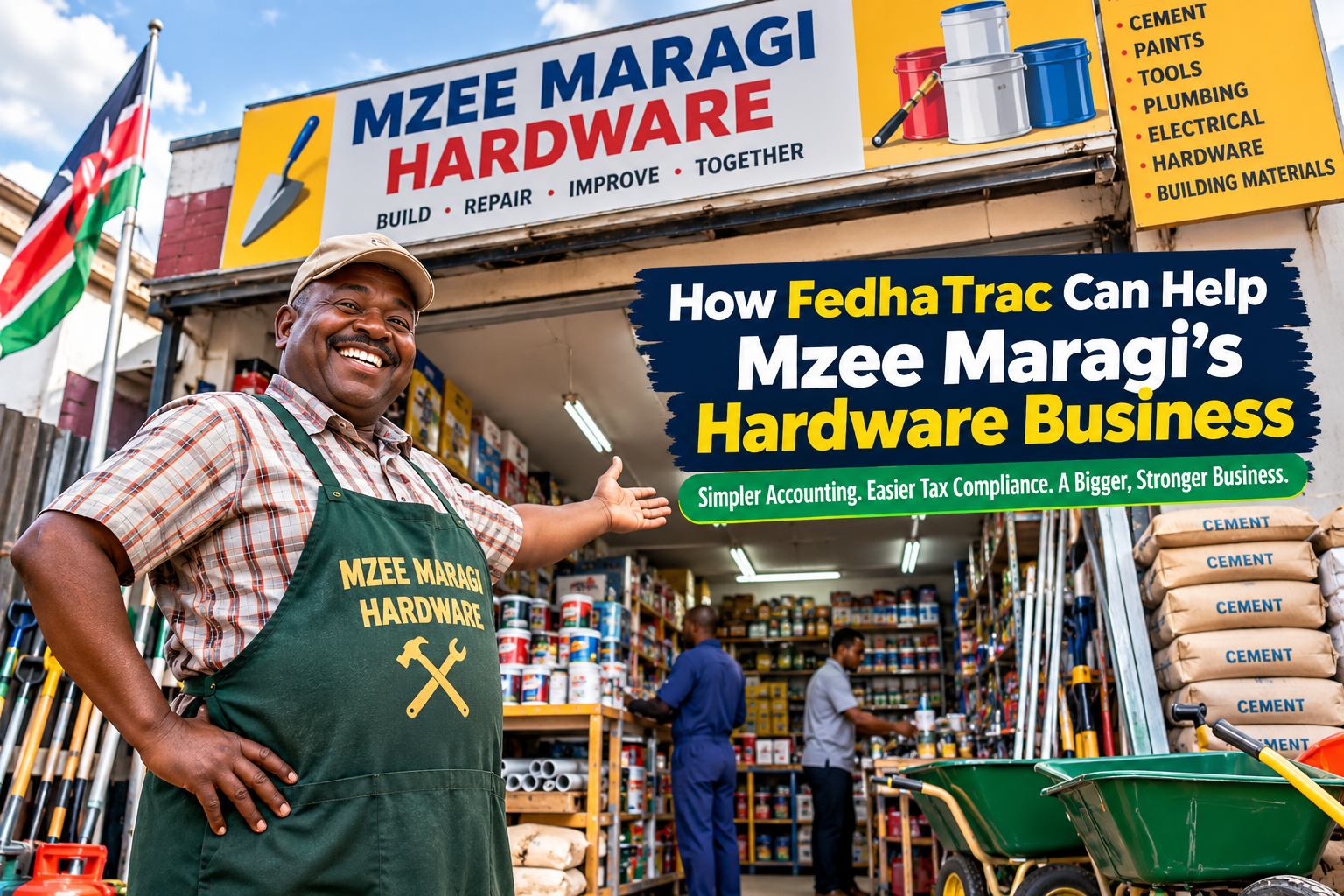
Hardware Store Bookkeeping in Kenya: How FedhaTrac Helps Mzee Maragi Thrive
Mzee Maragi knows the price of a bag of cement, the customer who always buys paint on Friday, and the fundi who needs another box of screws before his site closes. In his fifties, cheerful and proudly pot-bellied, he stands outside his busy Kenyan hardware shop and points to the shelves he has spent years building. But at day’s end he still wonders: is the shop making the profit he thinks it is?
Sales can be strong while cash is tight, particularly when customers pay later than suppliers expect. Hardware Store Bookkeeping offers a practical way to replace guesses with usable figures. That is where FedhaTrac can help, through outsourced bookkeeping, reconciliations, financial reporting and Kenya-specific tax compliance support.
Mzee Maragi and his hardware shop are an illustrative business scenario, not a claim about an actual FedhaTrac customer or achieved results. The figures below are examples, not his real accounts.
Meet Mzee Maragi: A Busy Hardware Store With Hidden Financial Questions
At opening time, Mzee Maragi’s team sweeps the entrance, rolls out wheelbarrows and starts moving timber, pipes and paint. His cashier accepts cash and M-Pesa. A store assistant checks cement bags, while another worker prepares an order for a building site. By noon, receipts are tucked into a drawer, handwritten credit notes sit beside the till, and a supplier calls about an outstanding balance.
Maragi cannot instantly tell which products earn the best margins, what customers owe or how much cash is available for restocking. Hardware Store Bookkeeping puts these questions into a repeatable monthly process. It records sales, purchases, credit, expenses and payments and connects them to actual supporting documents.
FedhaTrac’s published services include transaction recording, bank and mobile-money reconciliations, financial statements, and bookkeeping cleanup. The scope is agreed with each client; Mzee Maragi does not have to replace every tool he already uses to benefit from better records.
1. Record Every Sale, Not Just the Money in the Till
Hardware Store Bookkeeping begins at the counter. A sale should have an appropriate invoice or receipt, a payment method and a record of what was supplied. Cash sales, M-Pesa payments, bank transfers and credit sales should be distinguishable. Two instalments must not become two new sales.
If a contractor buys paint on credit, the sale may create revenue and a receivable before payment, depending on the accounting basis. If that contractor later pays by bank transfer, the payment settles the outstanding balance; it is not a second sale. FedhaTrac can help reconcile these entries with invoices, customer records and banking information.
For Mzee Maragi, Hardware Store Bookkeeping also reveals quieter patterns: weekend spikes in paint sales, repeated small cash expenses or discounts that staff sometimes forget to record. It turns a crowded till into information he can inspect and discuss.
2. Know What Is on the Shelves—and What Has Gone Missing

Mzee Maragi and Kenyan hardware employees counting plumbing fittings and stock on shop shelves
A hardware business can hold hundreds of products in different sizes, grades and units. A PVC fitting is not interchangeable with a steel elbow; a 20-litre paint tin should not be treated as a five-litre tin. Good Hardware Store Bookkeeping depends on credible stock movements, but accounting support is not the same as promising a fully managed warehouse operation.
Mzee Maragi’s workers should record purchases received, quantities sold, returns, damage, breakages and transfers. They should periodically count the physical stock and investigate differences. FedhaTrac can use reliable inventory summaries and purchase records supplied by the business to support cost-of-sales calculations and financial reporting, within the agreed engagement.
In September 2026, the Kenya Revenue Authority stated that businesses must maintain accurate stock records, including goods received, sold, returned, adjusted and otherwise disposed of. Hardware Store Bookkeeping helps keep the commercial records that should support compliant electronic invoices; a shopkeeper should confirm the appropriate eTIMS stock solution rather than assume every mobile app handles stock.
3. Understand Suppliers, Deliveries and the True Cost of Stock

Mzee Maragi with a hardware worker checking a delivery of cement and construction supplies outside the shop
A supplier invoice may cover cement, transport, handling charges and several product lines. Mzee Maragi needs to know which goods actually arrived, what was returned and what remains payable. If a lorry delivers 80 bags but the purchase document lists 100, that difference needs an explanation before the books are finalised.
Hardware Store Bookkeeping links purchase invoices, delivery notes, goods-received records and payment confirmations. A supplier statement can then be reconciled against the shop’s payable balance. This reduces the risk of accidental duplicate payments, unrecognised credit notes and disputes about deliveries.
FedhaTrac’s accounting and bookkeeping support can organise supplier bills and payable records, helping Mzee Maragi see upcoming obligations. His staff still confirm the physical delivery and quality of goods. A delivery checker should not also approve its payment without oversight. In Hardware Store Bookkeeping, practical controls protect both the business and its people.
4. Reconcile Cash, M-Pesa and Bank Transactions

Mzee Maragi reviewing hardware shop sales receipts and a ledger with a Kenyan cashier
One customer pays cash for nails, another uses a till number for paint, and a contractor transfers money directly to the business account. Meanwhile, Mzee Maragi pays a supplier by bank and a delivery rider by mobile money. Unless records are checked against statements, some receipts may be missing, duplicated or attributed to the wrong invoice.
Hardware Store Bookkeeping works best with daily till summaries and regular reconciliations. The cashier should record total sales and receipts by payment method, note refunds and hand over an independently checked cash count. Mobile-money and bank statements should be compared with the sales ledger, not treated as a substitute for it.
FedhaTrac describes M-Pesa reconciliation as part of its bookkeeping support. Mzee Maragi can also read the FedhaTrac guide to M-Pesa bookkeeping. Hardware Store Bookkeeping distinguishes money received from money earned and flags unexplained differences for investigation.
5. Stop Customer Credit From Becoming a Cash Crisis
Construction projects often require repeat supplies. A known contractor might ask Mzee Maragi to deliver steel, cement and electrical materials on credit. Offering credit can support relationships, but unchecked balances can make a busy shop short of working capital.
Under a sensible Hardware Store Bookkeeping routine, each approved credit sale carries the customer’s name, invoice, payment terms and due date. The shop maintains a receivables list showing current, overdue and disputed amounts. An ageing report makes follow-up more consistent. The owner decides who receives credit and on what terms; FedhaTrac can help organise the bookkeeping and reporting around those decisions.
Suppose a contractor has an illustrative KSh 62,000 balance due within 30 days. When the deadline passes, Mzee Maragi needs a record he can discuss with that customer—not a memory of a conversation outside the shop. Hardware Store Bookkeeping does not eliminate late payments, but it makes the exposure visible before the next delivery leaves the yard.
6. Find the Difference Between Revenue, Gross Profit and Cash

Mzee Maragi checking hardware inventory records while staff sort plumbing fittings
Big sales do not automatically produce a healthy margin. For a hardware retailer, the cost of stock sold must be separated from normal operating expenses such as rent, electricity, transport and wages. Buying stock is not necessarily the same thing as immediately recognising the whole purchase as a cost of goods sold in financial reports.
This hypothetical example excludes tax and assumes stock costs have been correctly determined.
| Illustrative monthly item | Amount (KSh) |
| Sales revenue | 500,000 |
| Cost of goods sold | (350,000) |
| Gross profit | 150,000 |
| Operating expenses | (90,000) |
| Profit before tax | 60,000 |
If a customer has not paid, reported profit does not mean the same amount is sitting in the bank. Hardware Store Bookkeeping makes that distinction visible. FedhaTrac can prepare or support management reports that Mzee Maragi uses to compare gross margins, operating costs and cash-flow pressures. For more context, see its profit and loss statement guide.
7. Budget for Restocking and Everyday Expenses
Mzee Maragi may want to buy a new cement shipment while paying salaries, electricity, rent and an outstanding wholesaler invoice. Spending based only on today’s till balance can leave a business unable to meet tomorrow’s commitments. Hardware Store Bookkeeping provides the dependable starting figures for a simple cash-flow forecast.
He can list expected customer collections, supplier payments, fixed expenses and upcoming stock orders by week. This is especially useful when the shop must pay deposits for bulk goods long before the final customer pays. A forecast is a planning estimate, not a guarantee; the assumptions need regular updating.
FedhaTrac’s financial reporting and reconciliation services can help Mzee Maragi review the information behind such forecasts. Hardware Store Bookkeeping then supports decisions about which stock to replenish first, when to chase overdue accounts and whether to postpone a non-essential purchase. The separate cash-flow guide for Kenyan businesses gives useful background.
8. Make eTIMS and KRA Records Part of the Routine
Tax compliance should not begin the evening before a filing deadline. Hardware Store Bookkeeping can organise sales invoices, purchasing documents, credit notes and stock information so that the business can review its tax position throughout the month.
The KRA eTIMS guidance says persons engaged in business generally must onboard and issue electronic tax invoices, subject to the relevant rules and exceptions. For a shop selling physical goods, the choice of eTIMS solution matters: not every service-only option is suitable for stock-based retail. KRA also announced that from January 2026 it would validate certain income and expense information in returns against eTIMS, withholding-tax and Customs records, with statutory exceptions. See the official income-and-expense validation notice.
FedhaTrac publishes Kenya-specific tax filing and eTIMS support. It can assist with preparing accurate records and relevant filings within the services agreed. Hardware Store Bookkeeping does not itself determine whether Mzee Maragi owes VAT, Turnover Tax or another tax. That requires examination of his legal structure, turnover, taxable supplies, transactions and current law. Explore FedhaTrac’s VAT registration guide and Turnover Tax guide rather than selecting a tax regime by guesswork.
9. Protect the Business With Sensible Staff Controls

Mzee Maragi and a shop assistant verifying receipts and payment records at the hardware counter
A busy hardware team needs clear, practical controls rather than unnecessary paperwork. Hardware Store Bookkeeping is stronger when responsibilities are documented and unusual transactions can be checked respectfully.
For example, Mzee Maragi might require a second person to approve sizeable refunds, ensure every stock adjustment has a reason, and compare a daily till summary with banked cash. Staff can number delivery notes and check credit limits. No single worker should control every step from ordering to receiving to paying a supplier without independent oversight.
These are sound internal-control recommendations, not claims that one checklist guarantees fraud prevention. FedhaTrac can support reconciliations and reporting, while Maragi and his management team implement shop-floor rules. Hardware Store Bookkeeping works when the accounting evidence matches what really happened in the hardware store.
10. What Mzee Maragi’s First Month With FedhaTrac Could Look Like
Imagine Mzee Maragi deciding that he wants better records before expanding the store. An illustrative engagement might follow this sequence, subject to FedhaTrac’s assessment and written scope:
- Week one — Understand the business. Review how sales are made, where invoices are kept, whether stock records are reliable and which accounts, M-Pesa statements or spreadsheets are available.
- Week two — Organise the evidence. Gather transaction reports, supplier statements, delivery notes, credit records and expense receipts; identify missing items and agree who provides corrections.
- Week three — Reconcile and review. Compare bank and mobile-money movements with recorded sales and payments; inspect customer and supplier balances and discuss material discrepancies.
- Week four — Report and decide. Prepare agreed management figures, flag unresolved records, and discuss gross margin, cash obligations, overdue receivables and compliance tasks.
Hardware Store Bookkeeping becomes much easier when it follows a predictable monthly rhythm. FedhaTrac does not need to promise that every historical problem will disappear in 30 days. The timetable and deliverables depend on the condition of the starting records and the scope Mzee Maragi purchases.
11. A Hardware-Specific Checklist Mzee Maragi Can Use
Mzee Maragi can ask his team to follow this short routine even before meeting a bookkeeper. Hardware Store Bookkeeping is a shared process, not something that happens only at month-end.
| When | Hardware-store action | Why it matters |
| Daily | Record sales by payment method and save source documents | Supports complete sales records |
| Daily | Check cash counted against the till summary | Flags unexplained differences promptly |
| On delivery | Match supplier invoice to goods received | Prevents wrong quantities and unverified bills |
| Weekly | Review customer credit and due payments | Protects working capital |
| Weekly | Check fast-moving and high-value stock | Helps identify shortages and errors |
| Monthly | Reconcile bank, M-Pesa, supplier and customer balances | Supports reliable reports |
| Monthly | Review financial performance and KRA obligations | Improves planning and compliance readiness |
For Hardware Store Bookkeeping, the best checklist is one the team actually follows. FedhaTrac can work with existing spreadsheets or accounting systems where appropriate, rather than demanding an unnecessary change of platform. The separate bank reconciliation guide explains one of these essential controls in more detail.
12. Why FedhaTrac Fits a Growing Kenyan Hardware Business
Maragi’s strengths are customer service, sourcing and trust—not untangling bank entries every evening. Hardware Store Bookkeeping gives him the financial visibility to ask better questions while his staff continue running the store.
FedhaTrac offers bookkeeping, reconciliations, financial reporting and Kenya-specific tax filing support. It can work with existing records and systems, with the exact deliverables agreed before work begins. This is not a claim that FedhaTrac automatically installs a retail POS, conducts physical stocktakes, guarantees higher profits or replaces Mzee Maragi’s responsibility for operational decisions.
His team records shop-floor activity; FedhaTrac can turn suitable records into reconciled information. Hardware Store Bookkeeping becomes a management habit rather than a pile of receipts. Business owners comparing services can read what SMEs should receive from an accounting provider and explore FedhaTrac’s published services.
Frequently Asked Questions About Hardware Store Bookkeeping
Does a small hardware store really need formal records?
Yes. Hardware Store Bookkeeping helps owners track sales, stock costs, amounts owed and operating expenses. Appropriate tax invoices and records are also important for complying with the law. The system can be proportionate to the shop’s size and complexity.
Can FedhaTrac work with handwritten receipts or Excel records?
FedhaTrac says it works within existing client systems, including Excel-based workflows. The quality, completeness and suitability of the records still need assessment. Hardware Store Bookkeeping can begin with organising the evidence before moving to a more formal workflow.
Does FedhaTrac manage stock physically?
Not necessarily. Mzee Maragi’s team should receive, count and safeguard goods. Financial reporting can use accurate stock information supplied and verified by the business, subject to the agreed engagement. Hardware Store Bookkeeping does not replace warehouse supervision.
Is every hardware store required to register for VAT?
No. Registration depends on the business’s qualifying taxable supplies and current rules. KRA’s VAT guidance describes a general annual taxable-supplies threshold of KSh 5 million, with additional conditions and exceptions. Hardware Store Bookkeeping supports the records needed to evaluate the position; it is not a substitute for individual tax advice.
Can better bookkeeping guarantee higher profits?
No. Hardware Store Bookkeeping cannot guarantee demand, lower supplier prices or customer payment. It can provide better information about margins, overdue balances and costs, making decisions more informed and weaknesses easier to address.
From a Busy Shop to a Better-Informed Business
Picture Mzee Maragi once again standing outside his hardware shop, laughing with a customer and proudly pointing to the paint, tools and building materials behind him. The shop may be just as busy as before. The difference he is working toward is greater confidence about what that activity means: which invoices are outstanding, what suppliers are owed, what stock records show and how the business is performing.
Hardware Store Bookkeeping gives that confidence a foundation. With reliable source documents from Maragi’s team and properly scoped professional support, FedhaTrac can help organise the books, reconcile payments, prepare useful reports and improve tax readiness. Mzee Maragi remains the decision-maker, now better equipped to guide his business.
For an initial discussion of your own hardware or retail business, visit FedhaTrac or email support@fedhatrac.com. Ask about bookkeeping, reconciliations, management reporting and the specific compliance support appropriate to your business.


