
Table of contents
- What the service should achieve
- Accounting services in Kenya: the core deliverables
- An example from a small wholesale business
- What to agree before work starts
- How to assess the first month
- How FedhaTrac can help
- Frequently asked questions
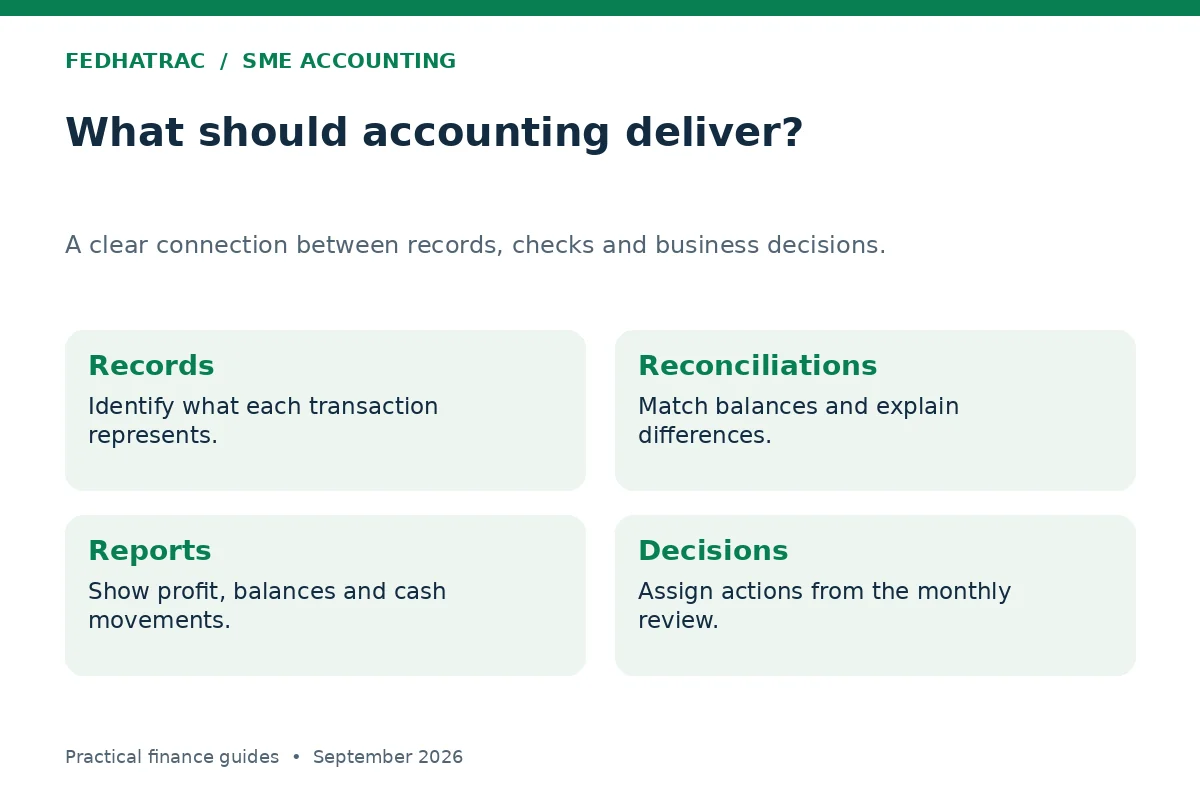
Accounting services in Kenya should help an SME turn business records into reliable figures and useful decisions. Depending on the agreed scope, that can include transaction recording, reconciliations, financial reports, tax support and explanations of what needs attention. The important question is what you will receive, when you will receive it, and what information you must supply.
Imagine closing your shop after a busy month. Your till has received money, suppliers have been paid and the bank balance looks reasonable. Yet you cannot confidently explain your profit, the value of stock remaining, or how much customers still owe. An accountant should help resolve those questions through evidence, rather than simply emailing a spreadsheet headed “monthly accounts.”
This guide explains the work behind the service, the outputs to request and the responsibilities that remain with you as the owner. The examples are illustrative; they are not FedhaTrac client results or a promise of a particular outcome.
What the service should achieve
Good accounting services in Kenya should do more than record transactions. They should help business owners understand what the figures mean and identify issues that require attention..
A useful accounting arrangement connects three things: the transaction, its supporting evidence and its treatment in the books. A bank payment shows that money moved. An invoice explains what was bought. The accounting entry explains whether it was an expense, stock, an asset, a repayment or something else.
Without that connection, a business can have neatly entered records and still have misleading reports. A loan received may be counted as sales. A transfer from the business bank account to its own M-Pesa account may appear as an expense. Stock bought but not yet sold may be treated as though it has all been consumed.
Your service should therefore provide a repeatable method for checking the records, resolving questions and producing reports that reflect the business. If the distinction between daily recording and financial interpretation is unclear, start with our guide to bookkeeping vs accounting in Kenya.
Accounting services in Kenya: the core deliverables
1. Transaction recording and classification
Bookkeeping captures sales, purchases, receipts, payments and other business events. Classification puts each item in the right category. An SME needs categories detailed enough to answer practical questions, without creating dozens of nearly identical expense accounts.
For example, a catering business might distinguish food ingredients, packaging and delivery costs. Combining everything under “general expenses” makes it harder to see why a profitable-looking order delivered so little margin.
Ask for an agreed list of accounts, a document submission process and a record of unresolved transactions. An unexplained payment should be investigated, not quietly assigned to a convenient category. The owner may need to identify the supplier, explain the business purpose or provide missing evidence.
Reliable accounting services in Kenya should maintain consistent transaction classifications so that business owners can compare their financial performance from one reporting period to another.
2. Bank and M-Pesa reconciliations
For many SMEs, accounting services in Kenya should therefore include reconciliation of both traditional bank accounts and relevant M-Pesa payment channels. Reconciliation compares an account in the books with an independent statement and explains the differences. The aim is not to force two balances to match with an unexplained adjustment.
Suppose the books show a supplier payment of KSh 18,000 but the statement shows KSh 18,050. The difference might be a transaction charge. Alternatively, a recorded payment may not yet have cleared. Each explanation needs evidence and the appropriate treatment.
Request reconciliations for every relevant bank account, till, paybill and other payment channel included in the engagement. Ask who investigates outstanding items and how long they remain unresolved. Our bank reconciliation guide explains the process in more detail.
3. Customer and supplier balance reviews
Accounts receivable show amounts customers owe. Accounts payable show amounts the business owes suppliers. Useful reports identify individual invoices, remaining balances and due dates.
A customer who paid KSh 30,000 against a KSh 50,000 invoice should normally have KSh 20,000 left to settle, assuming no other adjustments. Recording the receipt as fresh revenue leaves the original invoice open and overstates sales.
Ask for an ageing report and an exceptions list. Which balances are disputed? Which payments are unallocated? Which supplier invoices appear twice? These reports support follow-up and payment planning, but the engagement should say whether the provider actually contacts customers or only supplies the information.
For SMEs using accounting services in Kenya, regular receivables and payables reviews can also make it easier to identify overdue customer balances, upcoming supplier obligations and transactions that still require clarification.
4. Month-end adjustments and balance checks
Monthly reporting may require more than adding receipts and payments. Under accrual accounting, costs and income are recognised in the appropriate periods, subject to the applicable accounting rules.
For example, an annual insurance payment may cover several months. Equipment may be recorded as an asset and depreciated over its useful life. Goods still held for sale require an inventory balance. An unpaid bill for services already received may need recognition even though no bank payment has happened.
Request supporting schedules for significant balances such as inventory, loans, fixed assets and prepayments. The accountant should explain material adjustments in language you understand. “The system calculated it” is not a substitute for a defensible accounting treatment.
This is why good accounting services in Kenya should include appropriate month-end reviews rather than relying only on the recording of money received and paid.
5. Reports matched to the owner’s decisions
The reports included in accounting services in Kenya should reflect the information the business owner actually needs to manage the business.
| Report or schedule | Question it helps answer |
|---|---|
| Profit and loss report | What income and expenses produced the period’s profit or loss? |
| Balance sheet | What does the business own and owe at the reporting date? |
| Cash flow report | Where has cash come from and where has it gone? |
| Receivables ageing | Which customer balances need attention? |
| Payables schedule | What supplier payments are approaching? |
| Budget comparison | Where are actual results different from the plan? |
A simple monthly management pack is not automatically a complete set of statutory financial statements. The applicable reporting framework and purpose determine the requirements. For example, IAS 1’s financial statement requirements extend beyond three headline reports to include other statements, notes and comparative information. Do not assume that every Kenyan SME uses the same framework.
Agree whether you need internal management reports, annual financial statements, a lender’s reporting format or donor-specific schedules. Our management accounts guide explains how to turn a monthly pack into an owner review.
6. Tax and eTIMS support with a defined scope
Where tax support forms part of accounting services in Kenya, the scope should clearly state which KRA obligations, returns and eTIMS-related tasks are included.
Tax support can include reviewing records, preparing calculations, filing specified returns and helping resolve information gaps. These are separate tasks. A package described as “tax-ready accounts” does not necessarily include submitting every return or handling a KRA enquiry.
Ask for a written list of the obligations covered, who reviews submissions, who authorises them and what evidence of filing you receive. Also establish who arranges payment. Preparing a return and paying the liability are different actions.
KRA’s eTIMS guidance explains electronic invoicing requirements and identifies excluded expense categories. An accountant should review documentation in context; neither an M-Pesa message nor the presence of an electronic invoice settles every tax question. For the operational background, see our eTIMS guide.
7. Interpretation and an action list
A report should lead to a conversation about what changed and what to do next. A rise in sales may have come with slower collections. A fall in gross margin may reflect supplier price increases, discounting, wastage or classification errors.
Ask for a short review that identifies the material changes, the evidence behind them and the next steps. Each action should have an owner and a review date. “Improve cash flow” is too vague. “Confirm payment dates for the five largest overdue invoices before Friday” is something a team can carry out.
An example from a small wholesale business

Accurate accounting helps small wholesale businesses understand sales, stock costs, expenses, profit and cash flow.
Consider a fictional wholesaler using accrual accounting. Ignore VAT and other tax effects in this simplified example. During one month it records KSh 800,000 of sales, with KSh 600,000 collected and KSh 200,000 still owed. Cost of goods sold is KSh 480,000 and operating expenses are KSh 210,000.
| Calculation | KSh |
|---|---|
| Sales recognised | 800,000 |
| Less cost of goods sold | (480,000) |
| Gross profit | 320,000 |
| Less operating expenses | (210,000) |
| Operating profit | 110,000 |
The KSh 110,000 is operating profit for the example, not the cash available to spend. Customer collections, opening balances, stock purchases, supplier payment timing and financing movements also affect cash.
This example shows why accounting services in Kenya should connect the underlying transactions, reconciliations and accounting treatment before presenting financial results to a business owner.
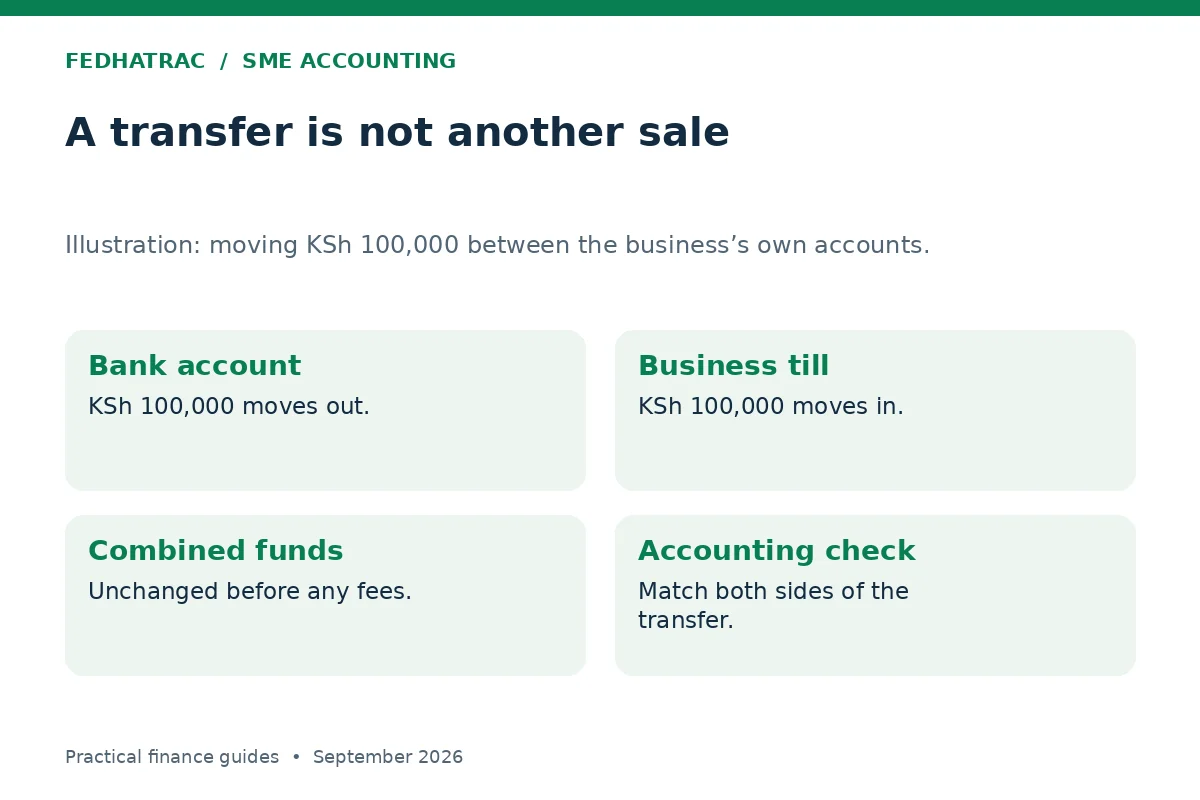
Now suppose the owner transfers KSh 100,000 from the business bank account to the business till. That is an internal transfer, not a new sale or an operating expense. If the books record it incorrectly, the reports can mislead the owner despite looking professional.
The accounting service should identify the transfer, reconcile both accounts, show the unpaid customer balances and explain the difference between profitability and liquidity. That is the value of checking the underlying records before discussing the figures.

What to agree before work starts
Before engaging accounting services in Kenya, agree on the scope, responsibilities, reporting timetable and information the business must provide.
Separate routine work from additional engagements
Write down the legal entity covered, reporting periods, payment channels, expected transaction volume and deliverables. Then distinguish recurring monthly work from catch-up bookkeeping, year-end reporting, forecasts, audit preparation and tax enquiries.
Audit preparation means organising records and schedules for an audit. It does not itself provide an independent audit opinion. Similarly, incorporating approved payroll totals into the books is different from calculating employee pay, deductions and payslips.
FedhaTrac does not provide payroll processing. Where relevant, client-supplied payroll figures may be incorporated into the accounting records. This boundary should remain clear even when staff costs are a substantial business expense.
Define your own responsibilities
Owners still need to provide complete records, confirm business purposes, approve decisions and resolve operational questions. The accountant cannot reliably identify a cash purchase if nobody records what was bought.
Agree a submission calendar and a secure document channel. Specify who maintains stock counts, confirms work delivered to customers and approves supplier bills. Give staff a clear escalation route when a document is missing or a transaction is disputed.
Clarify access, review and handover
Ask who can enter records, change them, approve payments and export data. Where possible, separate preparation from authorisation. A provider’s access to reports need not mean unrestricted authority to move money.
Also agree how you receive your records if the engagement ends. A useful handover includes current balances, outstanding questions and accessible supporting documents. The business should be able to understand its financial position without depending on one person’s memory.

How to assess the first month
Start by comparing delivery with the agreed scope. Have the specified accounts been reconciled? Are unresolved items listed? Can you trace the larger balances to supporting records? Do the customer and supplier schedules match the totals in the accounts?
Then test usefulness. Select one decision you need to make, such as whether to buy additional stock. Ask the provider to explain which reports help and which information is still missing. This reveals more than simply counting the pages in a report pack.
During onboarding, the first month may uncover old errors or missing documents. That does not automatically mean the service has failed. What matters is whether the issues are explained, prioritised and assigned a realistic resolution plan. Historical cleanup should not disappear into the current month’s numbers without explanation.
How FedhaTrac can help
FedhaTrac provides accounting services in Kenya designed to help SMEs organise their financial records, reconcile accounts and receive useful financial reports.
FedhaTrac’s accounting support combines human finance support with tools for organising records and viewing reports. Our scope includes reconciliations, financial reporting and review of customer and supplier balances. The appropriate package depends on your records, reporting needs and agreed responsibilities.
For SMEs looking for accounting services in Kenya, FedhaTrac can provide ongoing financial support based on the agreed scope, transaction volume, reporting requirements and condition of the business records.
When discussing support, bring a sample month’s records and describe the decisions you struggle to make. A business with tidy records and unclear reports needs a different starting point from one with six months of unrecorded transactions.
Frequently asked questions
Is accounting only necessary when filing tax returns?
No. Regular accounts help you understand profit, unpaid invoices, supplier commitments and cash needs during the year. Tax filing is one use of reliable records, not the only one.
Should every business receive the same monthly reports?
No. A small retailer may need stock and margin information, while a consultancy may need project income and customer collections. Agree the core reports and the additional schedules needed for your business.
Does an accounting package include an audit?
Do not assume so. An audit is a separate assurance engagement. Confirm whether a quote covers accounting, audit preparation or an independent audit, and who is responsible for each service.
Can I keep using M-Pesa?
Yes. Include the relevant statements, transaction references and supporting documents in the record process. Business and personal movements need to be identified accurately, especially where accounts have been mixed.
How quickly should monthly reports arrive?
Agree a practical timetable based on record submission and review requirements. There is no single delivery date that suits every engagement. Distinguish a preliminary report from one with reconciliations and outstanding questions resolved.
How can I check professional claims?
Ask for the relevant individual’s or firm’s details and verify claims with the appropriate professional body. ICPAK’s firm directory is an official verification resource; a website badge alone is not verification.
Choose a service you can assess
The right accounting services in Kenya should leave you with reliable records, understandable reports and a clear process for resolving financial questions.
Good accounting support gives you evidence, understandable reports and a dependable review process. Before signing, make sure the work, responsibilities and exclusions are explicit. You should know what you are buying and how to recognise that it has been delivered.
Contact FedhaTrac to discuss your records, reporting needs and the accounting support your business requires.


