

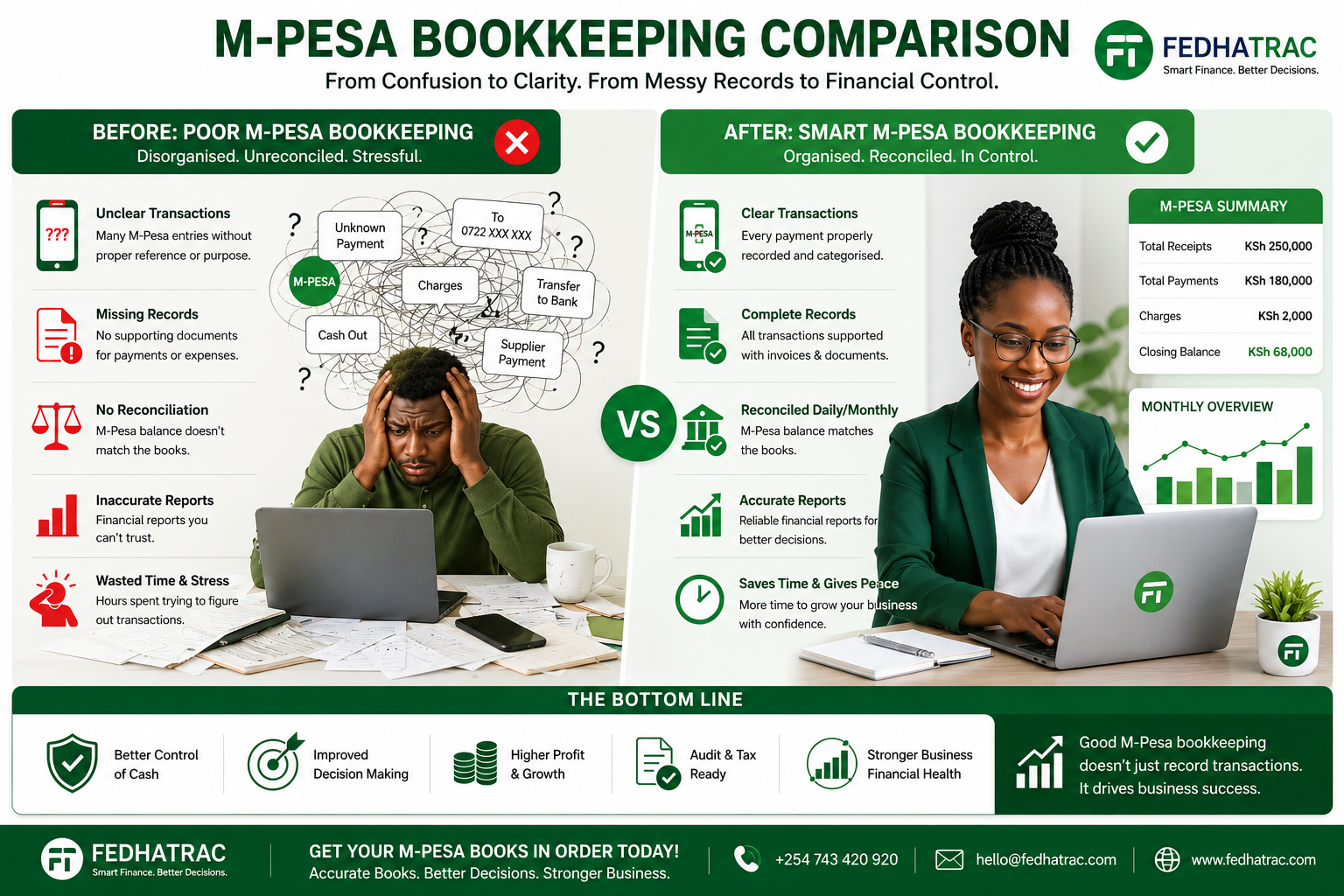
Introduction: Why M-Pesa Bookkeeping Matters for Kenyan Businesses
For many Kenyan businesses, M-Pesa is not simply an alternative payment method. It is part of everyday operations. Customers pay through Till Numbers and Paybills, suppliers may receive payments through mobile money, business owners transfer funds between M-Pesa and bank accounts, and transaction charges accumulate throughout the month. A busy SME can therefore generate hundreds or even thousands of mobile-money entries before considering its normal bank transactions. Without proper M-Pesa bookkeeping, these transactions can quickly become difficult to follow. A business may know that money is moving, yet still struggle to determine what represents actual sales, what represents transfers, which expenses were business-related and whether the financial records agree with the M-Pesa statement.
The challenge becomes more serious when business owners treat every incoming M-Pesa transaction as revenue or every outgoing transaction as an expense. A transfer from a business bank account into an M-Pesa wallet, for example, does not create new income. Moving money from a Till or Paybill settlement account to the company’s bank account does not create a second sale either. Without careful M-Pesa reconciliation, transactions can be duplicated and financial reports can overstate income or expenses. Accurate record keeping therefore requires more than downloading a statement and entering totals. It requires understanding the purpose of each transaction and connecting it to the wider bookkeeping records. This is part of the broader financial discipline discussed in FedhaTrac’s guide to the importance of financial management.
Good M-Pesa bookkeeping gives Kenyan business owners a much clearer picture of sales, operating costs, customer payments and cash movements. It also makes monthly reporting, expense monitoring and preparation for accounting and tax work significantly easier. For companies with high mobile-money transaction volumes, this is one of the strongest reasons to consider professional bookkeeping services Kenya businesses can rely on. FedhaTrac supports SMEs with bookkeeping, accounting, tax and broader financial-management services so that payment activity across M-Pesa, bank accounts and other business channels can be brought into one organised financial record. The objective is not simply to collect transaction data—it is to turn that data into information management can actually use.
What Is M-Pesa Bookkeeping?
M-Pesa bookkeeping is the process of recording, categorising, reconciling and reviewing business transactions that take place through M-Pesa.
For a Kenyan SME, this can involve several types of transactions:
- Customer payments
- Till receipts
- Paybill receipts
- Supplier payments
- Business purchases
- Transfers to employees or agents
- Transfers between M-Pesa and bank accounts
- Owner contributions
- Owner withdrawals
- Transaction fees
- Reversals
- Refunds
- Settlements
- Cash withdrawals
- Other business-related mobile-money transactions
The purpose of M-Pesa bookkeeping is to ensure that each transaction is recorded according to what actually happened economically.
For example, receiving KSh 10,000 from a customer for an invoice represents customer payment. Receiving KSh 10,000 because the owner transferred personal funds into the business does not represent revenue. The figures may look identical on an M-Pesa statement, but their bookkeeping treatment is completely different.
That distinction is fundamental.
M-Pesa Bookkeeping Is More Than Recording Transactions
Simply copying transactions from an M-Pesa statement into accounting software does not automatically create reliable books.
The transaction must also be:
- Identified
- Categorised
- Matched to supporting records where appropriate
- Checked for duplicates
- Reconciled to the closing M-Pesa balance
Professional M-Pesa bookkeeping therefore involves both transaction processing and financial control.
Why M-Pesa Creates Unique Bookkeeping Challenges
M-Pesa makes business payments convenient, but that convenience creates bookkeeping complexity.
A bank account may primarily receive customer payments and make supplier transfers. M-Pesa, however, can be used for everything from receiving sales revenue and settling invoices to paying delivery riders, buying small supplies, refunding customers and transferring funds to another business account.
The result is a large volume of transactions with very different purposes.
A Typical M-Pesa Statement Could Include:
| Transaction | Bookkeeping Treatment |
|---|---|
| Customer pays invoice | Customer payment / sales receipt |
| Owner deposits personal money | Owner contribution or loan |
| Transfer to company bank account | Internal transfer |
| Payment to supplier | Supplier payment or expense |
| Staff receives money for business purchase | Advance/expense depending on circumstances |
| Customer receives refund | Refund / adjustment |
| M-Pesa transaction fee | Business expense |
| Transaction reversed | Reversal, not new income/expense |
| Cash withdrawal | Transfer until expenditure is supported |
Without proper M-Pesa reconciliation, these differences can easily be overlooked.
Till, Paybill and Business M-Pesa Transactions
Kenyan businesses can use M-Pesa in several different ways, and the bookkeeping process should reflect how each payment channel operates.
M-Pesa Till Number Bookkeeping
A Till Number is commonly used by businesses to receive payments from customers.
Each customer payment should be connected to the appropriate sale where possible.
For high-volume retail businesses, individual receipts may be matched against daily sales records or point-of-sale information rather than manually treating every receipt as a completely separate bookkeeping event.
What matters is ensuring that total recorded sales and actual M-Pesa receipts can be explained and reconciled.
Paybill Bookkeeping
Paybills can provide additional reference information such as account numbers.
This can make matching payments easier where customers have unique invoice numbers, membership numbers or account references.
However, incorrect customer references, partial payments and multiple invoices can still create reconciliation differences.
Transfers and Settlements
When money is moved from an M-Pesa collection account to a business bank account, it should generally be recorded as an internal transfer rather than additional income.
This is one of the most important principles in M-Pesa bookkeeping because incorrectly recording transfers can significantly overstate revenue.
9 Proven Ways to Get M-Pesa Bookkeeping Right

1. Separate Business and Personal M-Pesa Activity
The first rule of good M-Pesa bookkeeping is separation.
When business and personal transactions flow through the same account or mobile wallet, bookkeeping becomes far more complicated. Groceries, family transfers and personal payments become mixed with customer receipts, supplier payments and legitimate business expenses.
Every transaction then needs to be investigated before it can be categorised.
Whenever practical, businesses should establish dedicated payment channels for business transactions.
This creates clearer records and reduces the risk that personal expenses are recorded as business expenditure.
Separation is also one of the most important small business bookkeeping best practices, particularly for startups that are beginning to formalise their financial-management processes.
2. Do Not Record Every M-Pesa Receipt as Sales Revenue
This is one of the biggest startup bookkeeping mistakes to avoid.
Money coming into an M-Pesa account does not automatically represent revenue.
Incoming transactions can include:
- Customer payments
- Owner contributions
- Loans
- Refunds
- Transfers from another business account
- Reimbursements
- Reversed transactions
If every incoming transaction is recorded as sales revenue, the business can significantly overstate its turnover.
Good M-Pesa bookkeeping therefore focuses on the nature of the transaction rather than simply whether money entered or left the account.
For customer payments, the receipt may also need to be matched against an existing invoice rather than recorded as a new sale.
3. Treat Transfers Between Your Own Accounts Correctly
Imagine your business receives KSh 100,000 through M-Pesa and later transfers the same KSh 100,000 into its bank account.
If the original customer receipts are recorded as income and the bank deposit is then recorded as additional income, the books could show KSh 200,000 of revenue even though the business only earned KSh 100,000.
The transfer should therefore be recognised as movement of money between business accounts.
This is a major area where M-Pesa reconciliation and bank reconciliation need to work together.
One side of the transfer should correspond with the other.
Professional bookkeeping services Kenya SMEs use should therefore look across all relevant financial accounts rather than treating each statement in isolation.
4. Record M-Pesa Transaction Charges
M-Pesa charges can appear individually insignificant.
Across hundreds of transactions, however, they can become a meaningful business expense.
Ignoring transaction charges causes two problems.
First, the expense records become incomplete. Second, the bookkeeping balance may not match the actual M-Pesa account balance because money left the account without being recognised in the books.
Accurate M-Pesa bookkeeping should therefore capture qualifying transaction charges consistently.
Categorising these charges also allows management to understand the true cost of different payment methods.
FedhaTrac’s guide to the best expense tracker in Kenya provides additional guidance on maintaining better visibility over operating expenditure.
5. Match Customer Payments to the Correct Invoice
For businesses that invoice customers before receiving payment, M-Pesa bookkeeping should connect the receipt to the correct customer balance.
Suppose a customer owes KSh 25,000 and pays through M-Pesa.
The payment should normally reduce the amount that customer owes rather than being recorded as an entirely separate sale.
Problems arise when customers make partial payments, combine several invoices into one payment or use an incorrect reference.
Regular accounts-receivable reviews help identify these situations.
Accurate matching ensures the business knows which customers still owe money and prevents follow-up requests being sent to customers who have already paid.
6. Reconcile M-Pesa Regularly
M-Pesa reconciliation is the process of comparing M-Pesa records against the transactions recorded in the bookkeeping system.
The objective is simple:
Recorded M-Pesa balance = actual M-Pesa balance
If those figures do not agree, something requires investigation.
Possible causes include:
- Missing transactions
- Duplicate entries
- Unrecorded transaction charges
- Incorrect opening balances
- Reversals
- Transfers recorded incorrectly
- Transactions posted to the wrong account
Reconciliation is one of the strongest controls in professional M-Pesa bookkeeping because it tests whether the financial records are complete.
Without reconciliation, a bookkeeping file can look organised while still containing significant errors.
7. Keep Supporting Records for M-Pesa Expenses
An M-Pesa statement proves that money moved. It does not necessarily explain why.
Suppose KSh 8,500 was sent to an individual. Was this payment for stock, transport, repairs, professional services, an employee advance or something unrelated to business?
The transaction itself may not answer that question.
Businesses should therefore keep invoices, receipts, purchase records and other supporting documentation that explains expenditure.
This becomes especially important when transaction descriptions contain only names or mobile numbers.
Combining transaction data with appropriate documentation makes M-Pesa bookkeeping more dependable and provides a better foundation for accounting, management reporting and tax preparation.
8. Investigate Reversals and Refunds Carefully
M-Pesa reversals can cause confusion when both the original transaction and reversal appear in the records.
If each entry is treated independently without recognising their connection, expenses or income may be overstated.
Refunds require similar attention.
A refund to a customer may relate to a previous sale rather than representing an ordinary operating expense.
Proper M-Pesa bookkeeping should therefore preserve the relationship between the original transaction and the subsequent reversal or refund.
This is another area where automated transaction imports still require financial review. Automation can capture the transaction, but understanding what the transaction represents remains critical.
9. Include M-Pesa in Your Monthly Closing Process
M-Pesa should not be treated as a side account that is checked only when something goes wrong.
It should form part of the normal monthly bookkeeping routine.
For monthly bookkeeping for small businesses in Kenya, the month-end process should include M-Pesa reconciliations alongside bank reconciliation, receivables, payables, expense reviews and financial reporting.
This ensures the month’s financial reports incorporate all major payment channels.
A strong closing process also allows missing transactions and unclear payments to be investigated while they are still recent.
The longer discrepancies remain unresolved, the more difficult they can become to reconstruct.
M-Pesa Reconciliation: A Practical Example
Consider a simplified example.
A small Kenyan business begins the month with KSh 20,000 in its M-Pesa business account.
During the month it records:
| Activity | Amount |
|---|---|
| Opening balance | KSh 20,000 |
| Customer receipts | +KSh 180,000 |
| Transfer from bank | +KSh 30,000 |
| Supplier payments | -KSh 70,000 |
| Business expenses | -KSh 25,000 |
| Transfer to bank | -KSh 80,000 |
| M-Pesa charges | -KSh 2,000 |
| Expected closing balance | KSh 53,000 |
If the M-Pesa statement shows a closing balance of KSh 51,500, the bookkeeping records have a KSh 1,500 difference that should be investigated.
Perhaps a transaction fee was missed. Perhaps an expense was never entered. Perhaps a payment was recorded twice.
The purpose of M-Pesa reconciliation is not to force the difference to disappear with an unexplained adjustment.
It is to establish why the difference exists.
That investigative discipline is what makes reconciliation valuable.
M-Pesa Bookkeeping vs Bank Bookkeeping
M-Pesa and bank bookkeeping follow many of the same accounting principles, but the operational challenges can differ considerably.
| Area | M-Pesa Bookkeeping | Bank Bookkeeping |
|---|---|---|
| Typical transaction volume | Often very high | Varies |
| Customer receipts | Frequently numerous/small | Often larger transfers |
| Transaction charges | Can occur frequently | Usually fewer charges |
| Descriptions | Names, numbers, references | Often longer transaction descriptions |
| Transfers | Frequent between M-Pesa/bank | Bank-to-bank transfers |
| Small expenses | Common | Less frequent for some SMEs |
| Reversals | Important consideration | Usually different reversal process |
| Reconciliation need | Essential | Essential |
| Supporting documents | Often necessary to establish purpose | Also required |
The important point is that these records should ultimately form part of the same bookkeeping system.
A business cannot assess its finances accurately by reconciling the bank account while ignoring M-Pesa.
SME M-Pesa Bookkeeping Checklist
Use this SME bookkeeping checklist during your monthly close.
M-Pesa Transaction Checklist
- Download or obtain the complete M-Pesa statement.
- Confirm the opening balance.
- Record customer receipts.
- Match invoice payments to the appropriate customers.
- Categorise business expenses.
- Record supplier payments.
- Record transaction charges.
- Identify owner contributions and withdrawals.
- Identify transfers between business accounts.
- Review reversals.
- Review customer refunds.
- Confirm supporting documentation for expenses.
- Check unusual or unidentified transactions.
- Reconcile M-Pesa to the bookkeeping system.
- Investigate all unexplained differences.
- Confirm the closing balance.
This SME bookkeeping checklist can be incorporated into the wider month-end bookkeeping process alongside bank reconciliation and financial-report review.
9 Common M-Pesa Bookkeeping Mistakes
Several recurring mistakes create problems for Kenyan SMEs.
1. Treating All Incoming Money as Sales
Transfers, owner contributions and loans may incorrectly inflate revenue.
2. Treating All Outgoing Money as Expenses
Some transactions represent transfers, drawings or advances rather than normal expenses.
3. Ignoring Transaction Charges
Small individual charges accumulate and create reconciliation differences.
4. Recording Transfers Twice
Moving funds from M-Pesa to bank can create duplicate income or expenses if incorrectly treated.
5. Failing to Match Customer Payments
Receivables remain outstanding even though the customer has paid.
6. Mixing Personal and Business Transactions
This creates unnecessary categorisation work and weakens financial clarity.
7. Ignoring Reversals
Both sides of a reversed transaction can accidentally remain in the accounts.
8. Keeping No Supporting Documentation
The statement shows who received money but may not explain the business purpose.
9. Never Reconciling the M-Pesa Account
Errors remain undetected and accumulate over time.
These are important startup bookkeeping mistakes to avoid, but they are equally common among established companies with high transaction volumes.
How Often Should M-Pesa Be Reconciled?
The right frequency depends on transaction volume.
A small consultancy receiving ten M-Pesa payments each month does not require the same processing schedule as a retailer receiving hundreds of transactions every day.
As a minimum, M-Pesa should normally form part of the monthly reconciliation process.
High-volume businesses may benefit from weekly or even more frequent transaction reviews so discrepancies can be identified quickly.
The important principle behind monthly bookkeeping for small businesses in Kenya is consistency.
Waiting six or twelve months before reconciling mobile-money records creates unnecessary difficulty because missing documentation becomes harder to locate and transaction details are forgotten.
When Your M-Pesa Records Need Bookkeeping Cleanup
Sometimes a business discovers that its M-Pesa records have not been reconciled for several months.
The solution may require bookkeeping cleanup rather than simply continuing from the current month.
Warning Signs Include:
- M-Pesa balance does not agree with the books
- Old transactions remain uncategorised
- Transfers have been recorded as sales
- Customer balances appear incorrect
- Transaction charges were never captured
- Business and personal activity are mixed
- Several months of records are missing
- Historical reversals were not processed correctly
The bookkeeping cleanup benefits in this situation include establishing a correct opening position, repairing customer balances, identifying duplicated transactions and restoring confidence in the financial reports.
Once historical discrepancies are resolved, the business can move into a more dependable monthly process.
M-Pesa Bookkeeping for Startups in Kenya
Startups often adopt M-Pesa quickly because it allows them to receive payments without complicated infrastructure.
Unfortunately, bookkeeping processes do not always develop at the same speed.
A founder may initially track payments through messages, screenshots or a simple spreadsheet. That can appear adequate when the business has ten monthly transactions.
At one hundred or one thousand transactions, the same approach becomes difficult to manage.
Good M-Pesa bookkeeping should therefore begin early.
Startups should:
- Separate business and personal payments.
- Establish consistent transaction categories.
- Keep supporting records.
- Reconcile M-Pesa regularly.
- Track customer invoices separately from payments.
- Avoid waiting until tax season to organise records.
These small business bookkeeping best practices can prevent expensive cleanup exercises later.
M-Pesa Bookkeeping for NGOs in Kenya
Mobile money can also play an important role in NGO operations, particularly where organisations make field payments, reimburse staff, pay programme expenses or operate in locations where mobile payments are convenient.
Professional bookkeeping for NGOs in Kenya should ensure these transactions remain traceable and properly supported.
An NGO may need to establish:
- Who received funds
- What the payment was for
- Which project or programme incurred the cost
- Which funding source relates to the expense
- Whether supporting documentation exists
- Whether unused advances were returned
The exact requirements depend on the organisation’s reporting, governance and donor arrangements.
However, the underlying principle is the same: M-Pesa bookkeeping should provide a clear audit trail between funds transferred, supporting documentation and the financial records.
DIY vs Outsourced M-Pesa Bookkeeping
Can a business manage its own M-Pesa records?
Absolutely.
The more useful question is whether the owner has the time, systems and bookkeeping knowledge required to maintain them accurately.
| Factor | DIY M-Pesa Bookkeeping | Outsourced Bookkeeping |
|---|---|---|
| Cost | Owner’s time + software | Professional service fee |
| Transaction processing | Owner manages | Provider manages |
| Reconciliation | Owner responsible | Can be handled professionally |
| Error investigation | Owner investigates | Provider investigates |
| Expertise | Depends on owner | Access to bookkeeping expertise |
| Scalability | Harder as volume grows | Can scale with workload |
| Management time | Higher | Lower |
| Ongoing reporting | Self-prepared | Can form part of service |
For businesses processing large transaction volumes, outsourced bookkeeping for SMEs in Kenya can reduce the administrative burden while maintaining financial visibility.
Outsourcing should not mean handing over control of the business’s money. Management still approves spending and makes financial decisions.
The bookkeeper’s role is to ensure the financial activity is recorded and organised accurately.
When Should You Consider Professional Bookkeeping Services Kenya Businesses Use?

Professional assistance becomes particularly valuable when bookkeeping begins competing with the owner’s core responsibilities.
Consider getting help if:
- M-Pesa is not regularly reconciled.
- Several months of transactions are outstanding.
- Customer balances are unreliable.
- Bank and M-Pesa transfers are causing duplicate entries.
- Transaction volumes have grown substantially.
- Management reports cannot be trusted.
- Business owners spend excessive time correcting bookkeeping.
- Tax preparation repeatedly requires reconstruction of old records.
Professional bookkeeping services Kenya businesses use can provide both cleanup and ongoing support depending on the starting position.
Choosing a Virtual Bookkeeping Provider in Nairobi for M-Pesa Records
A virtual bookkeeping provider in Nairobi can manage much of the bookkeeping process remotely if statements, supporting documents and business information can be shared securely.
For M-Pesa-heavy businesses, ask potential providers specific questions.
Ask the Provider:
- Do you reconcile M-Pesa accounts?
- How do you treat transfers between M-Pesa and bank accounts?
- How are customer payments matched to invoices?
- How are unidentified transactions handled?
- Are transaction fees captured?
- Can you clean historical M-Pesa records?
- How frequently are accounts reconciled?
- What reports will management receive?
- Can you also provide accounting and tax support?
These questions make it easier to distinguish basic data entry from genuine bookkeeping support.
M-Pesa Bookkeeping and Financial Reporting
Accurate transaction records eventually feed into financial reports.
When M-Pesa bookkeeping is incomplete, reports such as the profit and loss statement can become distorted.
Missing expenses overstate profit.
Duplicate revenue overstates sales.
Transfers incorrectly classified as expenses or income distort both.
Customer payments incorrectly entered can leave receivable balances inaccurate.
This is why bookkeeping, reconciliation and financial reporting should be viewed as one connected process.
FedhaTrac’s guide to developing strong financial management skills explores why understanding these relationships helps owners make stronger decisions.
How FedhaTrac Supports M-Pesa Bookkeeping for Kenyan SMEs

FedhaTrac provides outsourced bookkeeping, accounting, tax support and wider financial-management assistance for businesses that need more dependable financial records.
For an SME using M-Pesa heavily, bookkeeping can involve bringing together mobile-money activity, bank transactions, customer records, supplier payments and supporting documents.
When historical records are already disorganised, the engagement may begin with cleanup or catch-up bookkeeping. Once the records are brought up to date, ongoing monthly bookkeeping for small businesses in Kenya can help keep them accurate.
FedhaTrac is therefore useful both to businesses that want technology for organising their finances and businesses that want professional support maintaining those records. This distinction matters.
Software can make bookkeeping significantly more efficient, but a system still needs accurate information and appropriate financial treatment behind it.
For SMEs exploring the broader role of technology in financial organisation, see FedhaTrac’s guide to the best financial management app.
From Transaction Data to Useful Financial Information
The real purpose of M-Pesa bookkeeping is not to produce a perfectly formatted transaction list. A business owner needs answers, i.e;
- How much did the business sell?
- How much money did customers actually pay?
- What does the business still need to collect?
- How much was spent?
- Which expenses increased?
- How much cash is available?
- Are the records complete?
Proper bookkeeping turns individual mobile-money messages and statement lines into structured financial information that can help answer these questions.
FedhaTrac’s financial health check tool can provide another useful perspective on the wider financial position of a business once reliable financial information is available.
Frequently Asked Questions About M-Pesa Bookkeeping
1. How should a business record M-Pesa transactions?
Every business M-Pesa transaction should be recorded according to its underlying purpose rather than simply whether money entered or left the account. Customer payments, supplier payments, expenses, transaction fees, owner contributions and transfers should be classified appropriately. Regular M-Pesa reconciliation should then confirm that the transactions in the bookkeeping system explain the actual M-Pesa balance.
2. Is transferring money from M-Pesa to a bank account income?
Generally, moving money between two accounts belonging to the same business does not create new income. It is an internal transfer. Recording both the original customer receipt and the subsequent bank transfer as income can duplicate revenue. Proper M-Pesa bookkeeping should connect both sides of the transfer so that the movement does not distort sales or expenses.
3. Should M-Pesa transaction charges be recorded as expenses?
Business-related M-Pesa transaction charges should generally be captured in the bookkeeping records where appropriate. Ignoring them can understate expenses and create differences during reconciliation. Businesses with high transaction volumes should pay particular attention because individually small fees can accumulate into a meaningful monthly cost.
4. How often should a Kenyan SME reconcile M-Pesa?
For many SMEs, M-Pesa should at least be reconciled during the monthly bookkeeping process. Businesses processing large daily transaction volumes may benefit from more frequent reviews. Regular M-Pesa reconciliation makes it easier to identify missing entries, duplicate transactions, unrecorded charges and incorrectly classified transfers before the differences become difficult to investigate.
5. Can FedhaTrac help if several months of M-Pesa records are behind?
Yes. Where records are outstanding or inaccurate, a business may require catch-up or cleanup bookkeeping before moving into regular monthly processing. FedhaTrac can support businesses with outsourced bookkeeping alongside accounting, tax and broader financial-management services. The appropriate scope depends on transaction volume, how many months are outstanding and the current condition of the records.
Final Thoughts: Make M-Pesa Work With Your Books, Not Against Them
M-Pesa has made collecting and moving money exceptionally convenient for Kenyan businesses, but convenient payments still require disciplined financial records. A transaction message tells you that money moved; it does not always tell you how that movement should appear in your books. That distinction is why proper M-Pesa bookkeeping matters. Customer receipts, supplier payments, transfers, fees, owner contributions, refunds and reversals can all appear on the same statement while requiring completely different bookkeeping treatment. When they are recorded correctly and reconciled regularly, business owners gain far greater confidence in their revenue, expenses, customer balances and cash position.
The strongest approach is to make M-Pesa part of the normal bookkeeping system rather than treating it as a separate source of money that is reviewed occasionally. Use the SME bookkeeping checklist in this guide, maintain appropriate supporting records and incorporate M-Pesa reconciliation into your month-end process. If your records are already several months behind, correcting the historical position first can deliver significant bookkeeping cleanup benefits. From there, consistent monthly bookkeeping for small businesses in Kenya can prevent the same discrepancies from accumulating again. Businesses interested in strengthening their wider financial processes can also read FedhaTrac’s guide to maintaining strong financial health.
FedhaTrac helps Kenyan SMEs turn fragmented transaction information into organised financial records through bookkeeping, accounting, tax and financial-management support. For businesses processing large numbers of M-Pesa payments, this means bringing mobile-money activity together with bank accounts, invoices, supplier payments and other business transactions so management can see the complete financial picture. If your M-Pesa balance does not agree with your books, customer payments are difficult to trace or months of transactions remain unresolved, those are not simply administrative inconveniences. They are signs that your financial information may no longer be dependable. Good M-Pesa bookkeeping gives you something more valuable than organised transactions: numbers you can actually trust when running your business.
CTA: Need Help Reconciling Your M-Pesa Business Records?
FedhaTrac can help with M-Pesa bookkeeping, catch-up bookkeeping, bookkeeping cleanup, monthly bookkeeping, accounting and tax support for Kenyan SMEs. Get your records organised so you can spend less time reconstructing transactions and more time using your financial information to run the business.


