

How Much Do Accounting Services Cost in Kenya? 2026 Pricing Guide for SMEs
Managing business finances in Kenya requires more than recording sales and expenses. Business owners must maintain reliable financial records, reconcile transactions, monitor profitability, understand cash flow and meet applicable tax obligations. As a business grows, these responsibilities become increasingly demanding. Understanding accounting services cost in Kenya is essential for entrepreneurs who want reliable financial records without paying for services their businesses do not need.
One of the most common questions entrepreneurs ask is: How much do accounting services cost in Kenya?
The answer depends on the size of your business, transaction volume, complexity of your records and the services you require. Some businesses only need routine bookkeeping, while others require monthly management accounts, tax compliance support, financial reporting and more comprehensive accounting assistance.
At FedhaTrac, we combine professional accounting and bookkeeping support with financial management technology to help Kenyan businesses maintain organized records, understand their financial performance and make informed decisions.
This guide explains accounting service prices in Kenya for 2026, factors influencing fees, the differences between available packages and why FedhaTrac may be the right financial management partner for your business.
How Much Do Accounting Services Cost in Kenya in 2026?
Accounting fees in Kenya are not fixed across all service providers. Prices depend on the services included, the financial activity being handled and the reporting requirements of each business.
A small enterprise recording relatively few transactions may require a different level of support from a company with employees, several bank accounts, substantial stock movements and multiple tax obligations.
Accounting services cost in Kenya varies depending on transaction volume, business complexity, reporting needs, and the level of professional assistance required.
FedhaTrac’s published pricing page provides the following indicative package starting points:
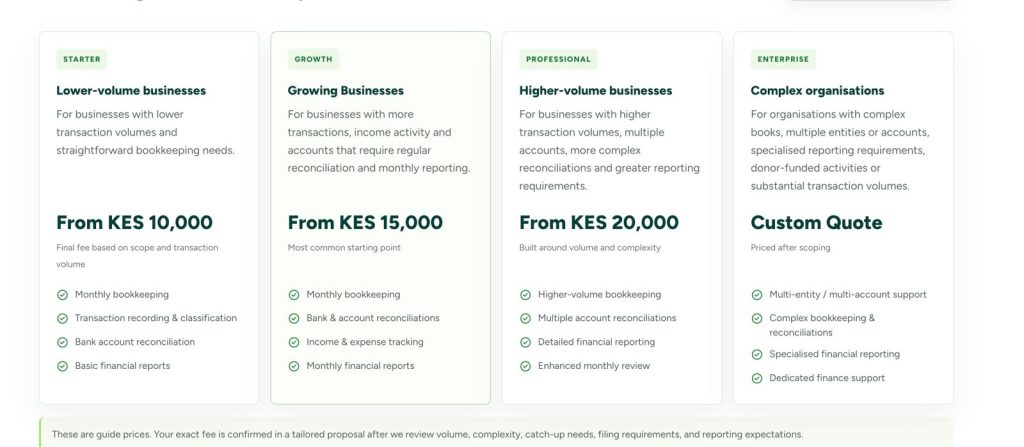
Pricing Bulletin
Source: FedhaTrac’s dedicated pricing page, reviewed October 2026. These are starting prices rather than guaranteed package fees. The homepage currently displays different monthly figures, so customers should obtain a current written quotation before making a purchasing decision.
The appropriate package depends on the work involved rather than simply the number of employees or the company’s annual revenue.
For example, a small retailer processing hundreds of daily transactions may require more reconciliation work than a consulting company issuing a relatively small number of monthly invoices.
Need an exact accounting quotation? Visit FedhaTrac Pricing and request an assessment based on your business requirements.
Accounting Services Cost in Kenya: 5 Factors That Affect Pricing
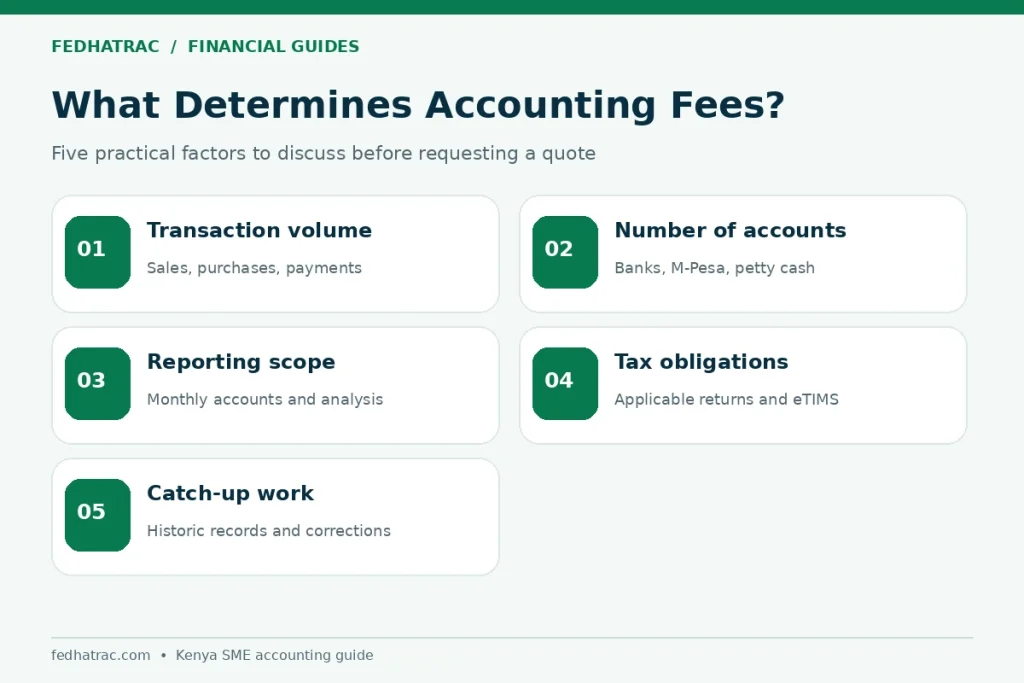
Understanding the factors affecting accounting fees makes it easier to compare providers and avoid unexpected charges.
- Transaction volume
The number of financial transactions your business processes is a major workload consideration.
Transactions may include customer payments, supplier purchases, bank transfers, cash expenses, M-Pesa receipts, refunds and adjustments.
Higher volumes generally require more recording, classification, checking and reconciliation.
A business processing 50 transactions per month may require substantially less routine processing than one handling 1,000 transactions.
However, transaction volume is not the only consideration: a smaller number of complex transactions can also require considerable professional work.
- Number of financial accounts
Businesses often maintain multiple bank accounts, M-Pesa tills, paybills, petty cash balances and other payment channels.
Each account may require reconciliation against accounting records.
For example, a Nairobi retailer receiving payments through a bank account, M-Pesa till, cash register and online payment provider must ensure that records from all four channels are accurately captured and reconciled.
A business with several accounts may therefore need a more comprehensive accounting arrangement.
- Tax compliance requirements
Kenyan businesses may have different obligations depending on their activities, registration status and applicable tax rules.
Relevant areas can include:
- Corporation or individual income tax.
- Value Added Tax (VAT).
- Pay As You Earn (PAYE).
- Withholding tax.
- Turnover Tax (TOT), where applicable.
- eTIMS invoicing requirements.
The applicable obligations should be confirmed for each business rather than assumed.
The Kenya Revenue Authority provides official guidance on tax registration, returns, electronic invoicing and compliance.
A provider’s accounting quotation should explain which tax-related services are included and which require separate fees.
- Financial reporting requirements
Basic bookkeeping is different from preparing and interpreting comprehensive financial reports.
A growing company may require monthly profit and loss statements, balance sheets, cash flow reports, budget comparisons and management commentary.
Businesses seeking financing or accountable management of donor funds may also need more detailed records and supporting schedules.
More frequent or specialized reporting can increase the amount of professional work required.
- Condition of existing financial records
Businesses with complete, organized records are generally easier to onboard than businesses with substantial missing documentation or unreconciled transactions.
Historical bookkeeping cleanup may involve correcting entries, investigating discrepancies, organizing missing records and reconstructing financial information.
FedhaTrac lists catch-up bookkeeping as a separately available service, with indicative pricing starting from KES 10,000.
Learn more about bookkeeping cleanup benefits and how organized records support more reliable financial reporting.
What Is Included in Professional Accounting Services?
Before hiring an accounting provider, business owners should understand exactly what they are purchasing.
Bookkeeping and transaction recording
Bookkeeping involves recording business transactions accurately and consistently.
Typical activities include categorizing income, recording expenses, maintaining transaction histories and organizing supporting documentation.
Accurate bookkeeping provides the foundation for meaningful accounting reports.
For further information, read our guide to bookkeeping versus accounting in Kenya.
Bank and M-Pesa reconciliation
Reconciliation compares accounting records with statements and other transaction evidence.

Its purpose is to identify missing transactions, duplicated entries, unexplained differences and potential recording errors.
For businesses relying heavily on mobile payments, proper M-Pesa reconciliation is particularly important.
FedhaTrac already provides resources on M-Pesa bookkeeping in Kenya and bank reconciliation.
Financial statement preparation
Financial reports help business owners understand financial performance and position.
Important statements include:
Profit and loss statement: Summarizes revenue and expenses over a period to show profitability.
Balance sheet: Shows assets, liabilities and equity at a particular date.
Cash flow statement: Explains cash movements during a reporting period.
A business may record accounting profits while experiencing cash shortages because customer payments are delayed or working capital is tied up elsewhere.
Our article on profit versus cash flow explains why these measures should be assessed separately.
Tax preparation and filing support
Tax preparation may involve reviewing accounting records, organizing supporting information, calculating relevant liabilities and preparing applicable returns.
The precise responsibilities depend on the client’s agreed service scope.
Outsourcing these activities can reduce the administrative burden on business owners, but it does not transfer all legal tax responsibilities away from the taxpayer.
An effective arrangement should clarify responsibilities, filing deadlines, supporting records and review procedures.
Management reporting and financial guidance
Management accounts convert bookkeeping records into information that business owners can act upon.
They may cover sales performance, expense trends, liquidity, outstanding customer balances and budget performance.
Learn more in our management accounts in Kenya guide.
FedhaTrac Accounting Packages: Which Is Suitable for Your Business?
FedhaTrac offers different service levels to accommodate businesses with varying financial requirements.
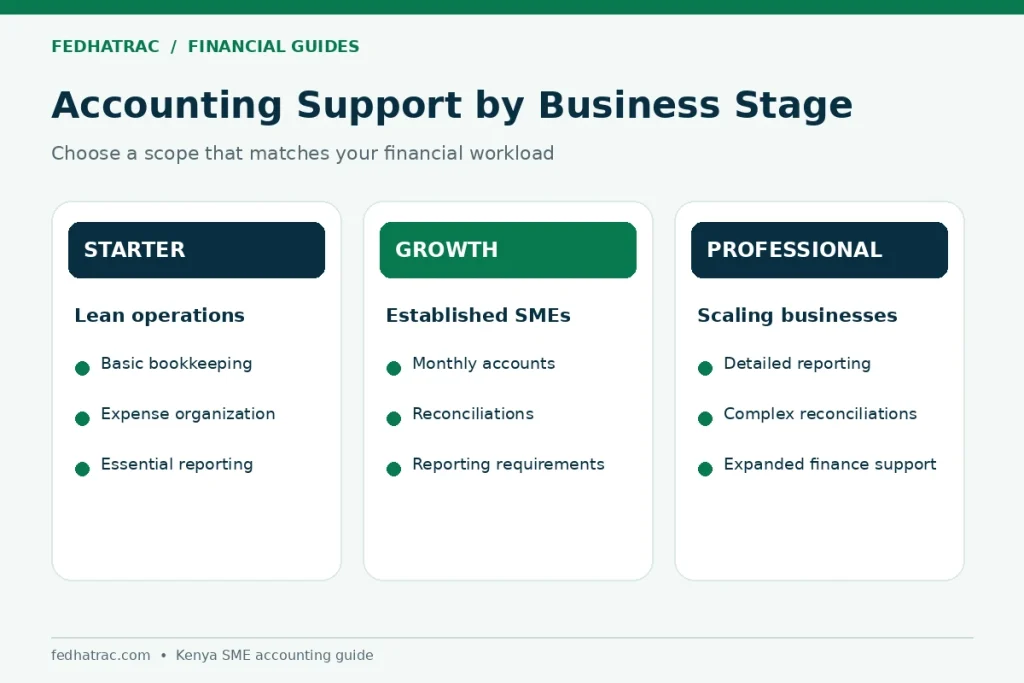
Starter: For lean operations
The Starter package is designed for solopreneurs, freelancers, small NGOs, CBOs and early-stage teams.
Its published starting price is KES 5,000 per month on the dedicated pricing page.
The package focuses on a basic bookkeeping routine, expense tracking and essential compliance support.
It may suit organizations that require structured financial records without the reporting demands of a more complex business.
Growth: For established SMEs
The Growth package has a published starting price of KES 10,000 per month.
It is intended for growing businesses requiring more consistent monthly bookkeeping, management reporting and tax deadline tracking.
A business expanding its customer base, payment channels or transaction volume may benefit from this additional financial visibility.
Professional: For scaling businesses
The Professional package has a published starting price of KES 15,000 per month.
It is intended for businesses with higher transaction volumes, more detailed reporting requirements and increased financial complexity.
The dedicated pricing page highlights advanced reporting, compliance oversight and priority finance support.
Enterprise: For complex organizations
Enterprise pricing is provided through a custom quotation.
This option is intended for organizations with complex reporting requirements, multiple entities, donor-funded activities or more demanding financial controls.
The scope may include multi-entity support, donor and audit reporting, and a dedicated operating process tailored to the organization.
Important: The exact deliverables, responsibilities, deadlines and fees should always be specified in the final service proposal.
Compare FedhaTrac’s accounting packages.
Additional Accounting and Tax Services: Published FedhaTrac Prices
Some organizations require individual services rather than a complete monthly package.
FedhaTrac’s dedicated pricing page also lists the following:
| Service | Published charge |
| Nil return filing | KES 1,000 |
| Tax Compliance Certificate support | KES 1,200 |
| Employee tax return — single P9 | KES 2,000 |
| Personal or business income tax return | KES 2,500 |
| eTIMS training | KES 3,500 |
| VAT return filing | KES 2,500 per month |
| Company registration | KES 10,000 |
| Catch-up bookkeeping | From KES 10,000 |
| Financial and tax consultancy | Custom quotation |
| Donor and grant reporting | Custom quotation |
| Annual audit preparation and support | Custom quotation |
These amounts are FedhaTrac’s published service charges, not official KRA or government fees. Applicable third-party costs and government disbursements may be separate.
Always confirm the current fee and exact scope before engaging a provider.
Outsourced Accounting vs Hiring an In-House Accountant in Kenya
Businesses commonly consider two approaches to managing accounting responsibilities: employing their own accountant or engaging an external service provider. When evaluating accounting services cost in Kenya, business owners should compare the overall expense of outsourcing with the cost of maintaining an internal accounting function.
Both approaches can work, depending on the company’s operational requirements.
| Consideration | In-house accounting | Outsourced accounting |
| Staffing | Employee or internal finance team | External professional service |
| Cost structure | Salary and relevant employment costs | Agreed service fee |
| Daily availability | Based on working arrangements | Based on agreed scope and response times |
| Supervision | Managed internally | Managed through a service agreement |
| Scalability | May require recruitment | Scope can potentially be adjusted |
| Software | Business manages tools and access | May use existing systems or provider platform |
| Reporting | Based on staff responsibilities | Based on contracted deliverables |
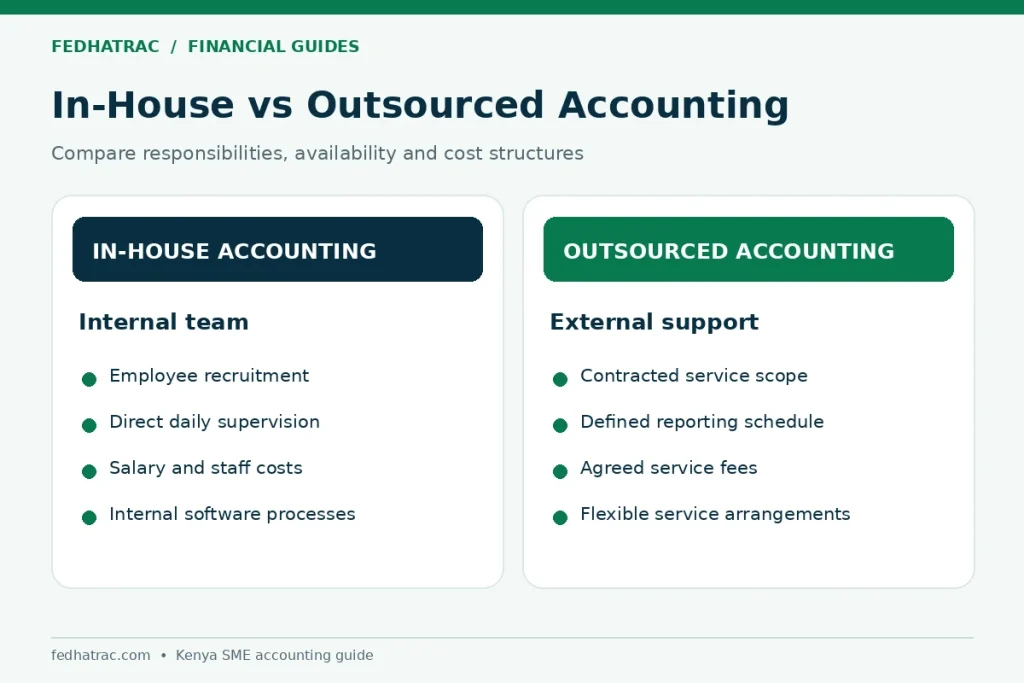
When an in-house accountant makes sense
Hiring internally may be appropriate for businesses requiring continuous on-site financial support, extensive daily interaction with operational departments or direct oversight of complex finance activities.
It may also suit organizations with sufficient workload to justify dedicated finance employees.
When outsourcing makes sense
Outsourcing may be attractive when a company needs reliable bookkeeping and reporting without establishing a full internal finance department.
Potential advantages include access to professional support, a defined service scope and flexibility as requirements change.
However, outsourcing is not automatically cheaper in every situation. The comparison should consider actual workload, employment costs, software requirements, service charges and operational needs.
For further reading, explore outsourced accounting services in Kenya.
The Hidden Costs of Poor Bookkeeping and Accounting affecting Accounting Services Cost in Kenya
Choosing a provider solely because it offers the lowest fee can be a costly mistake.
Incomplete financial records can contribute to business problems that are considerably more expensive than proper recordkeeping.
Unreconciled transactions
Differences between bank balances and accounting records can make it difficult to understand the company’s true cash position.
Unresolved discrepancies may also make financial reporting less reliable.
Poor expense visibility
Without consistent transaction classification, business owners may struggle to determine which activities generate profits and which costs are increasing.
This can affect pricing, budgeting and operational decisions.
Tax compliance problems
Late filings, inaccurate records and unsupported tax positions may expose businesses to compliance risks.
KRA’s compliance guidance emphasizes meeting applicable return-filing, payment and other statutory requirements.
Maintaining complete records makes it easier to prepare returns and respond to compliance questions.
Delayed financial decisions
Businesses that receive meaningful reports months after transactions occur may miss opportunities to control spending or respond to cash shortages.
Routine financial reporting provides earlier visibility into these problems.
Difficult audit preparation
Poorly organized receipts, invoices, bank statements and supporting schedules can increase the effort required to prepare records for an audit or independent review.
The value of professional accounting is not limited to preparing reports. It includes building financial records that support better decisions, stronger controls and operational continuity.
Why Choose FedhaTrac for Accounting Services in Kenya?
Selecting an accounting provider requires more than comparing monthly charges.
A reliable financial partner should understand your business, establish clear responsibilities, provide useful reports and help you maintain organized financial records. FedhaTrac helps businesses understand accounting services cost in Kenya by offering published starting prices and proposals tailored to each organization’s financial requirements.
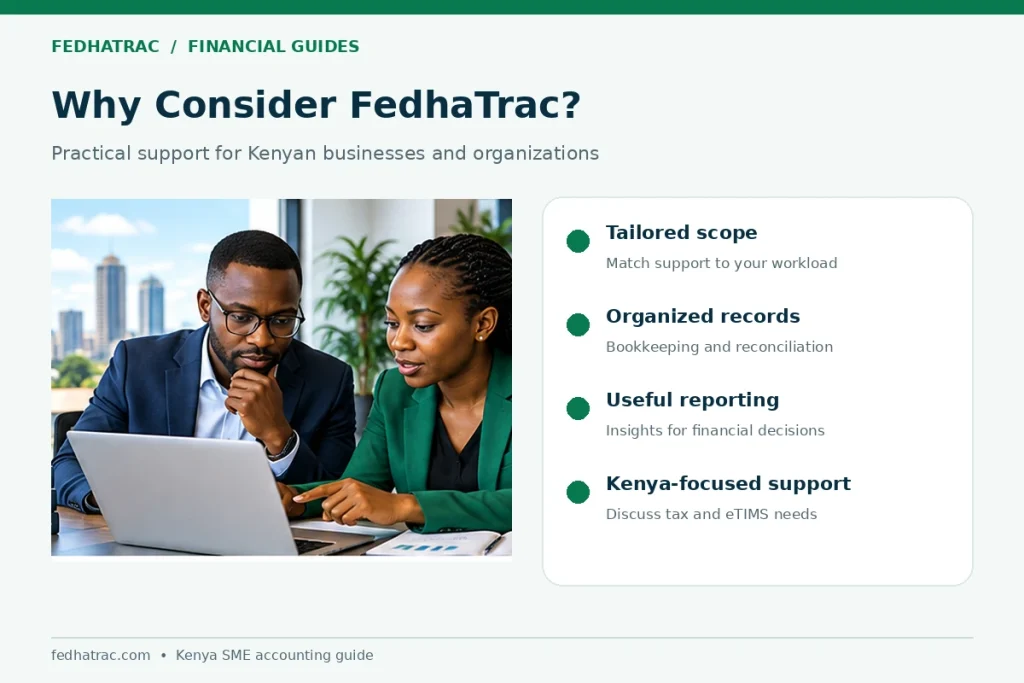
Here is why FedhaTrac deserves consideration.
- An integrated approach to financial management
FedhaTrac combines accounting support with a financial management platform.
Instead of treating recordkeeping, reporting and financial oversight as unrelated activities, the company offers a more coordinated approach.
Its published services encompass bookkeeping, accounting, financial reporting and tax-related support.
This can help businesses establish a clearer process for managing financial information.
- Services tailored to different business needs
Not every business requires the same accounting package.
A startup may need basic bookkeeping and straightforward reporting. A growing SME may need more detailed financial management, while an NGO may require donor reporting and additional accountability procedures.
FedhaTrac offers packages and tailored proposals designed around transaction volumes, reporting requirements and organizational complexity.
This allows businesses to discuss the services they actually require instead of assuming a standard package will fit every situation.
- Financial reporting that helps owners make decisions
Recording expenses and income is important, but business owners also need to understand what the numbers mean.
FedhaTrac’s service offering includes financial reporting and management insight.
Such information can help owners evaluate profitability, monitor cash flow, investigate expense trends and make better-informed operational decisions.
For example, a growing business might use monthly reports to identify rising supplier costs or delayed customer payments before they create more serious financial pressure.
- Kenya-focused tax and compliance support
Businesses in Kenya must understand applicable KRA requirements, maintain supporting documentation and meet relevant filing obligations.
FedhaTrac offers Kenya-focused tax preparation, compliance and eTIMS-related services.
Its services can help businesses organize relevant records, track filing responsibilities and obtain support with applicable tax procedures.
Customers should always confirm which tax obligations are included in their individual service agreement.
- Support for businesses using existing accounting systems
Some businesses already maintain their records using QuickBooks Online, Xero or spreadsheets.
FedhaTrac states that it can work within existing workflows and offers its own financial management platform for businesses needing a more structured system.
This can be useful for owners who want professional assistance without unnecessarily replacing established bookkeeping processes.
Compatibility, integrations and access arrangements should be agreed upon during onboarding.
- Clearer financial responsibilities through a tailored proposal
FedhaTrac’s published onboarding approach involves understanding the client’s records, reviewing the scope of work and issuing a specific proposal.
A properly scoped arrangement can clarify which services will be delivered, how frequently reports are prepared, the responsibilities of each party and the applicable fees.
This is especially important for businesses with payroll, tax filing, donor reporting or more complex accounting needs.
- A partner focused on freeing up business owners’ time
Business owners have many competing responsibilities, from customer service and staffing to inventory, operations and growth.
Handling every reconciliation, expense record and financial report personally can consume time that could otherwise be spent running the business.
By engaging suitable bookkeeping and accounting support, owners can delegate agreed financial tasks while retaining responsibility for major business decisions.
FedhaTrac aims to make financial management more organized, giving business owners access to records and reports that help them understand their position.
- Support across different organization types
FedhaTrac’s published service offering addresses startups, SMEs, professional firms, NGOs, project-based businesses and more complex organizations.
These customers often have different accounting needs.
A retailer may prioritize daily transaction recording and stock-related financial visibility, while an NGO may require donor-specific reporting.
Working with a provider that recognizes these differences can make it easier to develop an appropriate accounting arrangement.
Ready to organize your finances with professional support?
Visit FedhaTrac’s pricing page to request a free consultation and receive a tailored accounting proposal for your business.
How to Choose the Right Accounting Services Provider in Kenya
Before selecting a firm or professional, consider the following questions.
Does the provider understand your industry?
Financial workflows differ among retailers, professional services businesses, nonprofits and project-based organizations.
Choose a provider capable of understanding your operational environment.
Are the fees and deliverables documented?
A good proposal should explain recurring services, one-off work, reporting timelines, review procedures and separately chargeable activities.
Avoid comparing prices without comparing what is included.
Will you receive useful financial reports?
Ask which reports are provided, how frequently they are prepared and whether someone will explain important findings.
A report is more useful when decision-makers understand it.
How are records and data handled?
Discuss software access, user permissions, confidentiality, supporting documentation, backups and the process for retrieving your information.
Financial records are sensitive business information and deserve appropriate controls.
What happens when your business grows?
Your accounting needs may change significantly as transaction volumes increase, staff numbers grow or additional locations open.
Discuss whether the service arrangement can accommodate such changes and how pricing will be reviewed.
How to Get Started with FedhaTrac
Engaging FedhaTrac begins with understanding what your business requires.
Step 1: Request a consultation
Explain your business type, accounting challenges and desired outcomes.
Relevant information may include monthly transaction volume, number of accounts, existing bookkeeping system and reporting expectations.
Step 2: Review the accounting scope
FedhaTrac assesses your requirements to determine the support needed.
This is an opportunity to discuss reconciliations, reporting, applicable tax services, record cleanup and any specialized requirements.
Step 3: Receive your proposal
A tailored proposal should identify the services to be delivered, the quoted price and the proposed onboarding arrangements.
Review the terms carefully before proceeding.
Step 4: Begin the agreed accounting process
After engagement, provide the agreed financial records or appropriate access to existing systems.
A structured process for maintaining records and receiving reports can then be established.
Book a Free Consultation with FedhaTrac.
Frequently Asked Questions About Accounting Services Costs in Kenya
- How much does a small business accountant cost in Kenya?
Accounting costs vary by transaction volume, financial complexity and the services required. FedhaTrac’s dedicated pricing page lists packages starting from KES 5,000 per month, subject to a tailored quotation. This is FedhaTrac’s advertised starting price, not a verified national market average.
- Is bookkeeping cheaper than full accounting services?
Basic bookkeeping may cost less because its scope is generally narrower. However, the actual price depends on transaction volume, complexity and what the provider includes. Comprehensive accounting may involve additional reporting, analysis and specialist support.
- Can I outsource accounting services in Kenya?
Yes. Businesses can engage external professionals or firms to undertake agreed accounting activities. The arrangement should clearly define responsibilities, confidentiality, reporting expectations and fees.
- Does FedhaTrac provide tax filing services?
Yes. FedhaTrac advertises tax preparation and filing support, VAT-related services, eTIMS assistance and other compliance services. The precise obligations and deliverables included in a package should be confirmed in writing.
- Does FedhaTrac support businesses using QuickBooks or Xero?
FedhaTrac states that it can work with businesses using QuickBooks Online, Xero, Excel and other existing workflows. Specific compatibility and access arrangements should be confirmed during consultation.
- Are accounting fees tax-deductible in Kenya?
The treatment of accounting expenses depends on the taxpayer’s circumstances, the nature of the expense and applicable tax rules. Businesses should retain supporting documentation and obtain qualified advice on their specific tax treatment.
- How do I get an accurate accounting quotation?
Prepare information about your business activity, transaction volumes, accounts, employees, current records, tax obligations and reporting needs. FedhaTrac uses a discovery and scoping process to develop a tailored proposal.
Conclusion: Choose Accounting Services That Deliver Value
Understanding accounting services costs in Kenya helps business owners make better decisions about professional financial support. The right accounting arrangement should provide more than basic transaction recording: it should support accurate records, meaningful reporting and appropriate compliance processes.
Price is important, but businesses should also evaluate service scope, reporting quality, reliability, data handling and the provider’s understanding of their operations. A lower monthly fee is not necessarily better value if important accounting responsibilities are excluded.
Understanding accounting services cost in Kenya allows SMEs to select an accounting arrangement that balances affordability, accurate financial reporting, and practical business needs. At FedhaTrac, our aim is to help Kenyan businesses maintain cleaner records, improve financial visibility and spend less time struggling with routine financial administration.
Take the next step toward clearer business finances.
Explore FedhaTrac’s Accounting Packages and Request a Free Consultation
Contact FedhaTrac
- Website: https://fedhatrac.com/
- Email: support@fedhatrac.com
- Phone: +254 743 420 920
- Location: Nairobi, Kenya
Editorial note: Package starting prices and tax information should be reconfirmed before publication and whenever the article is updated. This article provides general information and does not replace business-specific professional advice.


