
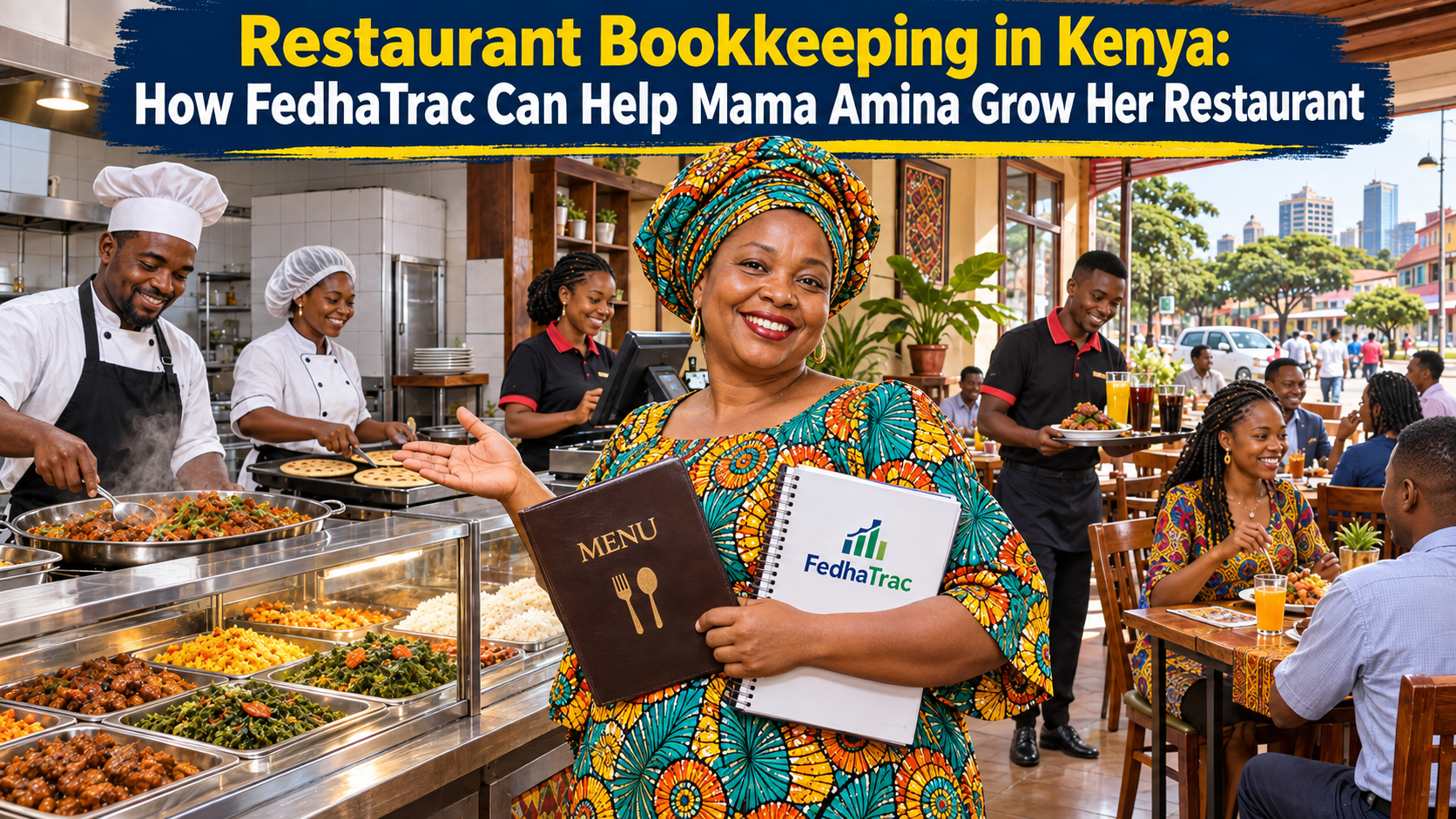
Mama Amina’s restaurant is busiest just before lunchtime. In the kitchen, one chef prepares pilau while another portions vegetables. A waiter carries plates to a family, the cashier accepts an M-Pesa payment, and a supplier arrives with tomatoes, cooking oil and flour. Amina sees a room full of customers. What she cannot always see is how much the restaurant truly earns after food, wastage, wages, utilities and supplier bills.
That is where Restaurant Bookkeeping in Kenya becomes a practical management tool rather than a pile of paperwork. Reliable numbers help Amina know which meals make money, whether the till balances, what she owes suppliers and how much cash is available for next week. FedhaTrac can support these records through its published bookkeeping, accounting, reconciliation, reporting and tax-compliance services. This is a fictional illustration of what those services could look like for a Kenyan restaurant, not a testimonial from a real customer.
The Real Challenge Behind a Busy Kenyan Restaurant
Amina runs a modest neighbourhood restaurant serving tea, chapati, ugali, nyama, rice and freshly prepared vegetables. Her customers include students, shopkeepers, office workers, boda boda riders and families. Business peaks at breakfast and lunch, but some evenings are quiet. She takes cash, M-Pesa and card payments, and occasionally receives catering deposits. Her staff must serve quickly while maintaining hygienic handling and accurate orders.
Restaurant Bookkeeping in Kenya is particularly demanding because money and stock move at different speeds. Flour arrives in bags, cooking oil in containers and vegetables in crates; they become meals sold individually. Discounts, complimentary meals, spoiled ingredients and customer refunds can change the numbers. Cash collected today may be needed tomorrow for wages, gas or vegetables. Even a successful-looking outlet can experience cash shortages.
Amina does not need someone to take over the kitchen. She needs reliable financial records, checks that identify discrepancies and timely reports she can use before making purchasing or expansion decisions. Her chefs and supervisors must still control portions, stock counts, service quality and the physical movement of goods.
Start With Clear Daily Sales Records
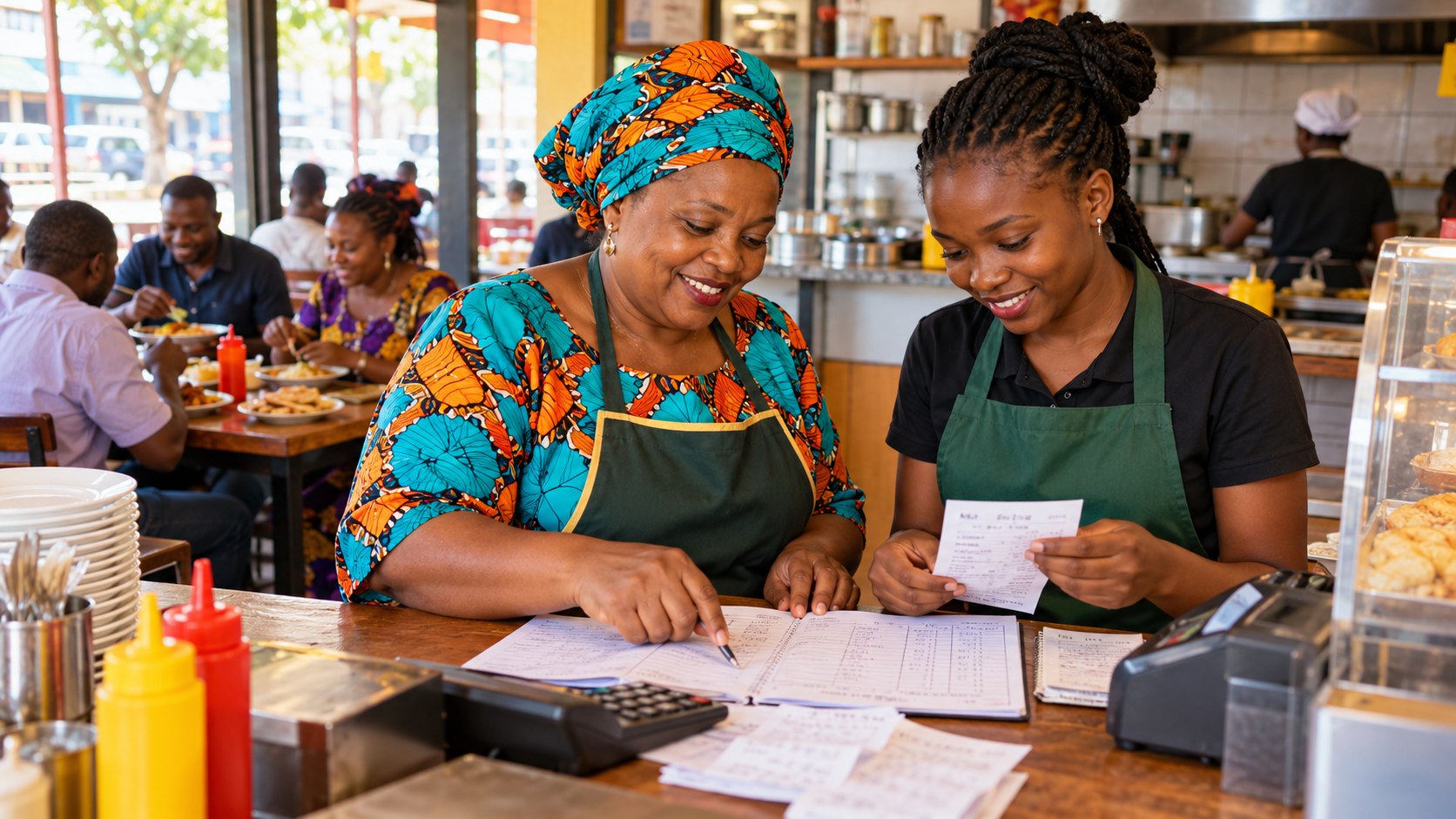
Restaurant Bookkeeping in Kenya with Mama Amina and cashier checking daily sales receipts and a cash register
The first improvement in Restaurant Bookkeeping in Kenya is a dependable daily sales summary. Amina should record every sale once, regardless of whether payment arrives through a POS terminal, till, business M-Pesa line, bank transfer or delivery platform. She should also record cash refunds, cancelled orders, discounts and genuine credit sales separately.
A sensible closing routine compares the POS sales report with the cash drawer, mobile-money statement, card settlement report and approved adjustments. For example, a KSh 42,000 sales report cannot be explained by a KSh 34,000 collection total without looking at unsettled card payments, unpaid customer bills, missing transactions or errors. A transfer of cash from the till into the bank is movement of money, not a second sale.
FedhaTrac’s reconciliation and bookkeeping services can help organise the daily source records, classify income and investigate unexplained differences with Amina. For a practical companion, see FedhaTrac’s M-Pesa Bookkeeping in Kenya guide. The restaurant itself remains responsible for operating its tills, approving refunds and providing complete records.
Separate sales from payment movements
Cash withdrawals, owner contributions, loans received and transfers between business accounts must not inflate revenue. When a customer pays a deposit for a future catering event, the timing of accounting revenue recognition also needs proper assessment. Restaurant Bookkeeping in Kenya should explain these distinctions rather than treat every deposit as turnover.
Know the Cost of Every Popular Meal

Mama Amina and a Kenyan chef checking ingredients, recipe quantities and a kitchen ledger
Amina sells a plate of beef stew and ugali for KSh 500. Suppose its illustrative ingredient cost is KSh 210 and takeaway packaging adds KSh 20. The KSh 270 left is not net profit: kitchen labour, rent, power, water, cleaning, equipment costs and taxes may still have to be paid. The example simply shows how understanding direct meal costs supports more informed pricing.
Good Restaurant Bookkeeping in Kenya connects purchases, stock usage and sales with meaningful product categories. Amina can compare the cost of cooking oil, flour, meat and vegetables against food sales over time. She may discover that a popular dish has a weak margin because its ingredients have become expensive, or that portion sizes vary between shifts.
FedhaTrac can support cost and profitability reporting from the purchase, inventory and sales records supplied by the restaurant. Kitchen supervisors should maintain standard recipes, count stock and record wastage; an accounting partner can interpret the resulting information but should not claim to physically weigh ingredients or manage the menu unless separately contracted to do so.
A simple costing habit
For each key dish, document the standard portion, ingredient quantities, current purchase costs and applicable packaging. Review the assumptions when supplier prices change. Compare expected usage with physical counts. This is far more useful than guessing that a full restaurant must be making a good profit.
Keep Supplier Purchases and Payables Under Control

Mama Amina checking fresh tomato crates with a supplier at the entrance of her Kenyan restaurant
In Restaurant Bookkeeping in Kenya, a morning delivery can involve rice from one wholesaler, meat from another and fresh produce from several market traders. In Restaurant Bookkeeping in Kenya, each purchase should be supported by an appropriate invoice, receipt or other record, together with proof of delivery and evidence of payment when made.
Amina’s receiving clerk can confirm the quantities and quality delivered. The bookkeeper can then record the cost, correct supplier and payment terms. An accounts-payable schedule shows which balances are due this week, next week or later. If an invoice is disputed because fewer cartons arrived than ordered, the discrepancy should be resolved before payment is authorised.
FedhaTrac’s business-operations and accounting support can help organise invoices, track expenses and report outstanding obligations. This complements the restaurant’s internal delivery checks. Useful background is available in FedhaTrac’s Expense Tracking and Invoicing article. The owner still approves purchases and supplier payments.
Reduce Waste, Shrinkage and Missing Stock
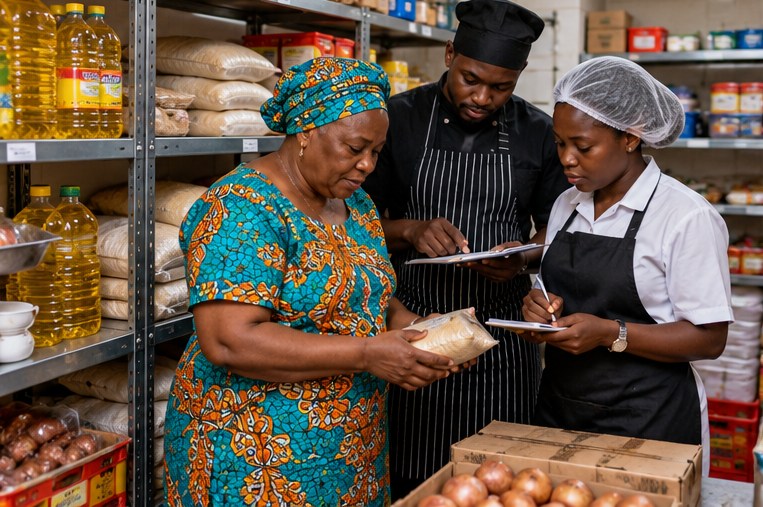
Mama Amina supervising a restaurant inventory count with kitchen staff in a storeroom
Food inventory is unusually sensitive to spoilage, over-portioning, breakage, theft and unexpected price changes. Amina cannot rely on an end-of-month guess. Her kitchen needs a practical daily or weekly count of high-value and perishable items, a goods-received record and a clear log for wastage, returns and transfers.
Restaurant Bookkeeping in Kenya should use those physical records to reconcile opening stock, purchases, usage and closing stock. A rough movement check is opening stock plus purchases minus closing stock, with adjustments for returns, transfers and other documented movements. That calculation is not a substitute for correct costing, but it highlights what needs further investigation.
KRA’s September 2026 stock-management guidance reinforces the importance of recording goods purchased, received, sold, transferred, returned, adjusted or otherwise disposed of. The notice addresses accurate stock records in relation to electronic invoicing; it should not be portrayed as proof that every restaurant must buy a particular stock software package.
FedhaTrac can assist with the accounting records and variances based on stock counts supplied by Amina’s team. An illustrated scenario might involve her kitchen manager checking a missing carton of cooking oil while an accountant reviews the purchase and usage entries. This separation of duties improves accountability.
Make Cash Flow Visible Before Bills Become Urgent
Restaurant Bookkeeping in Kenya must explain why profit and cash are not the same. Rent may be payable on the first of the month, suppliers may give seven days’ credit, and a large catering customer may settle an invoice only after delivery. Even an outlet that reports a profit may struggle to pay staff or purchase ingredients when these dates collide.
For Restaurant Bookkeeping in Kenya, Amina can use a rolling four-week forecast that starts with actual bank and mobile-money balances and adds expected receipts and payments. It should account for supplier bills, utilities, wages, taxes, equipment repairs, rent and scheduled loan instalments. Uncertain catering work belongs in a separate scenario instead of being treated as guaranteed money.
FedhaTrac can help turn regular bookkeeping records into a usable cash-flow report and management review. Amina can then decide whether to delay a nonessential renovation, negotiate sensible supplier terms or preserve funds for a peak weekend. Its Profit vs Cash Flow guide explains this distinction in more detail.
Organise Restaurant Expenses Without Hiding Important Costs
Amina pays for charcoal or cooking gas, cleaning materials, internet, rent, power, water, packaging, repairs, delivery charges and marketing. Restaurant Bookkeeping in Kenya should allocate these to clear categories so she can compare costs from month to month. Personal withdrawals and genuine business expenses should be distinguished, with owner transactions recorded appropriately for the entity’s legal structure.
When figures look unusual, an accountant can examine whether an expense has been duplicated, a large item should be treated as equipment rather than routine consumption, or a supplier credit has been missed. Proper classification supports meaningful financial statements; it does not automatically make every cost tax deductible. Tax treatment depends on the law, documentation and the business’s actual circumstances.
Amina should retain original source documents and use a business bank or payment account wherever practical. Restaurant Bookkeeping in Kenya becomes much easier when receipts are captured promptly rather than reconstructed from a shoebox near a filing deadline.
Maintain Strong Till, Kitchen and Staff Controls
Restaurant Bookkeeping in Kenya also depends on simple controls that employees can actually follow. One person should not be able to receive stock, change purchase records, authorise supplier payments and approve their own adjustments without review. Each cash shift should have a count, exception notes and a named person responsible for sign-off. Access to POS cancellations and refunds should be restricted and logged.
Restaurant Bookkeeping in Kenya benefits from these controls because transaction records become more reliable. Supervisors can document staff meals, wastage and promotional discounts, while Amina reviews unusual adjustments. If a variance appears, the response should be a fair investigation based on evidence, not an automatic accusation against an employee.
FedhaTrac can help analyse reconciliations and recommend improvements to financial record controls. Daily staffing decisions, work schedules, employment contracts and the practical handling of wages remain with the employer and its authorised advisers. Although PAYE and other statutory obligations may apply, this does not imply that FedhaTrac provides payroll processing as a standard service.
Prepare eTIMS and KRA Records the Professional Way
KRA’s eTIMS guidance says that persons engaged in business are generally expected to onboard and issue electronic tax invoices, subject to the framework and specific exceptions. A restaurant should verify the suitable solution and ensure its sales records can be reconciled with relevant invoicing data. POS and eTIMS are related compliance and recording tools, not automatically the same system.
For Restaurant Bookkeeping in Kenya, the VAT position must be assessed separately. KRA states that businesses supplying taxable goods or services worth KSh 5 million or more in a year generally must register for VAT, with conditional voluntary registration below the threshold. The treatment of individual supplies requires checking the applicable VAT law, including exemptions and zero ratings; an accountant should not assume every menu item has an identical treatment. See the official KRA VAT guidance.
Eligible resident businesses may fall under Turnover Tax instead of the ordinary income-tax system, depending on turnover and the statutory conditions. KRA’s Turnover Tax guidance identifies a turnover band above KSh 1 million up to KSh 25 million and a 1.5% rate on qualifying gross sales. TOT eligibility does not eliminate a separate VAT obligation where applicable. The correct tax treatment must follow Amina’s actual legal entity, turnover and supplies.
KRA began validating income and expenses for relevant annual returns from January 2026 against sources including TIMS/eTIMS and withholding-tax information. Accurate invoicing and purchase documentation therefore matter throughout the year, not only when filing. The official KRA notice explains this process and applicable exceptions.
FedhaTrac’s published tax-filing and accounting support can help Amina organise records, review obligations and prepare relevant returns within the agreed scope. Restaurant Bookkeeping in Kenya is not a guarantee of tax compliance by itself; accurate source documents, the correct registrations, timely submissions and lawful treatment are all essential.
Use Monthly Reports to Make Better Restaurant Decisions

Mama Amina reviewing restaurant financial reports with a professional Kenyan accounting adviser at a laptop
At the end of each month, Restaurant Bookkeeping in Kenya should provide answers, not merely a long spreadsheet. What were total sales? What proportion came through each payment method? How much was spent on food inputs? Did waste rise? Were supplier balances overdue? Is there enough cash for next month’s rent and equipment maintenance?
A practical Restaurant Bookkeeping in Kenya monthly pack can include a profit-and-loss statement, cash summary, bank and M-Pesa reconciliation status, supplier ageing, major expense comparisons and a food-cost or inventory movement summary. Not every micro-restaurant needs a complicated dashboard. The right level of reporting depends on transaction volume, records and the decisions the owner must make.
Amina can review these reports with FedhaTrac and her managers, then choose actions: renegotiate one supplier price, adjust a portion size, reduce an underperforming menu item or postpone a second branch until cash flow improves. Reports inform choices but cannot promise particular profits. FedhaTrac’s Cash Flow Statement for Kenyan Businesses guide provides additional context.
What FedhaTrac Could Do for Mama Amina
Restaurant Bookkeeping in Kenya works best when responsibilities are agreed in writing. Based on its published services, a sensible engagement for Mama Amina could include outsourced transaction recording, reconciliations, expense organisation, financial statements, cash-flow reporting, tax-filing support and periodic reviews. The exact work, frequency and responsibilities should be confirmed in a service proposal; physical inventory counts, POS operation and direct kitchen management remain with the restaurant.
To begin Restaurant Bookkeeping in Kenya for a new client, FedhaTrac would need to understand the restaurant’s ownership structure, existing records, payment channels, sales reports, supplier arrangements and tax registrations. If past records are incomplete, a catch-up bookkeeping phase may be appropriate before relying on monthly results. The team can then agree a records handover routine and reporting timetable, with clear arrangements for protecting customer and business financial information.
The objective of Restaurant Bookkeeping in Kenya is not to burden Amina with accounting language. It is to give her a dependable picture of sales, costs, obligations and cash so she can lead a restaurant that serves customers well and grows at a financially sustainable pace. Businesses seeking professional support can learn about FedhaTrac’s accounting services or contact the team through FedhaTrac.
Frequently Asked Questions About Restaurant Bookkeeping in Kenya
Does a small restaurant need daily bookkeeping?
A restaurant should record daily transactions and keep supporting documents, even if an external accountant completes full reconciliations on an agreed schedule. Restaurant Bookkeeping in Kenya is more accurate when cash counts, M-Pesa receipts, refunds and deliveries are captured while the information is fresh.
Can FedhaTrac manage the kitchen or install the POS?
FedhaTrac’s published services focus on bookkeeping, accounting, financial reporting and tax support. Its involvement in Restaurant Bookkeeping in Kenya should not be described as physical kitchen management, POS installation or a guaranteed inventory automation service unless separately verified and agreed.
How can Amina discover whether a meal is profitable?
She can compare menu prices with standard ingredient quantities, purchase costs, packaging and relevant overhead. Restaurant Bookkeeping in Kenya provides the source records and reporting, while chefs maintain accurate recipes and actual portion controls. A high-selling meal is not necessarily a high-margin meal.
Does every restaurant need VAT registration?
No. Registration depends on the value and nature of taxable supplies and other legal conditions. KRA generally sets the mandatory threshold at KSh 5 million in annual taxable supplies. Restaurant Bookkeeping in Kenya helps assemble the turnover records needed to assess obligations, but a specific determination should follow official KRA guidance and applicable law.
How often should Amina review financial results?
Daily sales checks and regular stock counts should feed a meaningful monthly financial review. Restaurant Bookkeeping in Kenya then helps her compare results, watch cash flow and plan for upcoming obligations. A larger or rapidly changing restaurant may need more frequent review.
Amina’s kitchen will always require teamwork, quality ingredients and warm hospitality. With disciplined records and professional support, she can add financial visibility to those strengths. That is the practical promise of Restaurant Bookkeeping in Kenya: not instant success, but clearer decisions, stronger controls and a business owner who knows what the numbers are saying.


