

The matatus are lined up beneath a shelter at Wendani SACCO’s Nairobi waiting area. At the front of the terminal, a booking office handles enquiries while vehicles prepare for the next trip. Behind the visible activity is another operation passengers rarely see: recording contributions, identifying payments, monitoring expenditure and reporting accurately to the SACCO’s members.
For a public transport cooperative, that financial work is as important as route coordination. PSV SACCO Accounting in Kenya helps managers distinguish what the SACCO earns from money handled on behalf of members, keep track of daily transactions and prepare reliable reports. A stage may look organised from outside while its accounts are full of unanswered questions.
Consider the fictional example of Wendani SACCO, whose management committee wants stronger systems as its matatu operations expand. FedhaTrac could provide the bookkeeping, reconciliation and financial-reporting support that helps the committee make confident decisions. The aim is not to replace drivers, stage marshals or transport regulators. It is to make the financial side of running a cooperative clearer, more consistent and easier to supervise.
Why Matatu SACCO Operations Need Reliable Bookkeeping

Wendani SACCO staff checking vehicle operations on a tablet at a busy Nairobi matatu stage
A typical day can produce contributions from vehicle owners, bank and M-Pesa receipts, cash held at the office, operating bills and payments for shared services. Depending on the SACCO’s approved arrangements, some money may belong to the cooperative, while other money is being held for members or third parties. PSV SACCO Accounting in Kenya becomes essential when one office handles several categories of money.
At Wendani SACCO, a manager might know that many vehicles were dispatched, yet struggle to answer which member paid, whether a receipt was reversed, or why a supplier balance remains unpaid. These are not merely filing problems. Incomplete records affect relationships among the committee, staff and vehicle owners.
In practice, PSV SACCO Accounting in Kenya depends on simple daily habits rather than one dramatic change. A practical bookkeeping framework starts with an approved chart of accounts, a documented payment process, a register of members and vehicles, and clear responsibility for reviewing transactions. FedhaTrac can support the accounting records and reconcile transactions while Wendani SACCO’s officials remain responsible for operational decisions and internal approvals.
Start With a Daily Vehicle and Member Collection Register
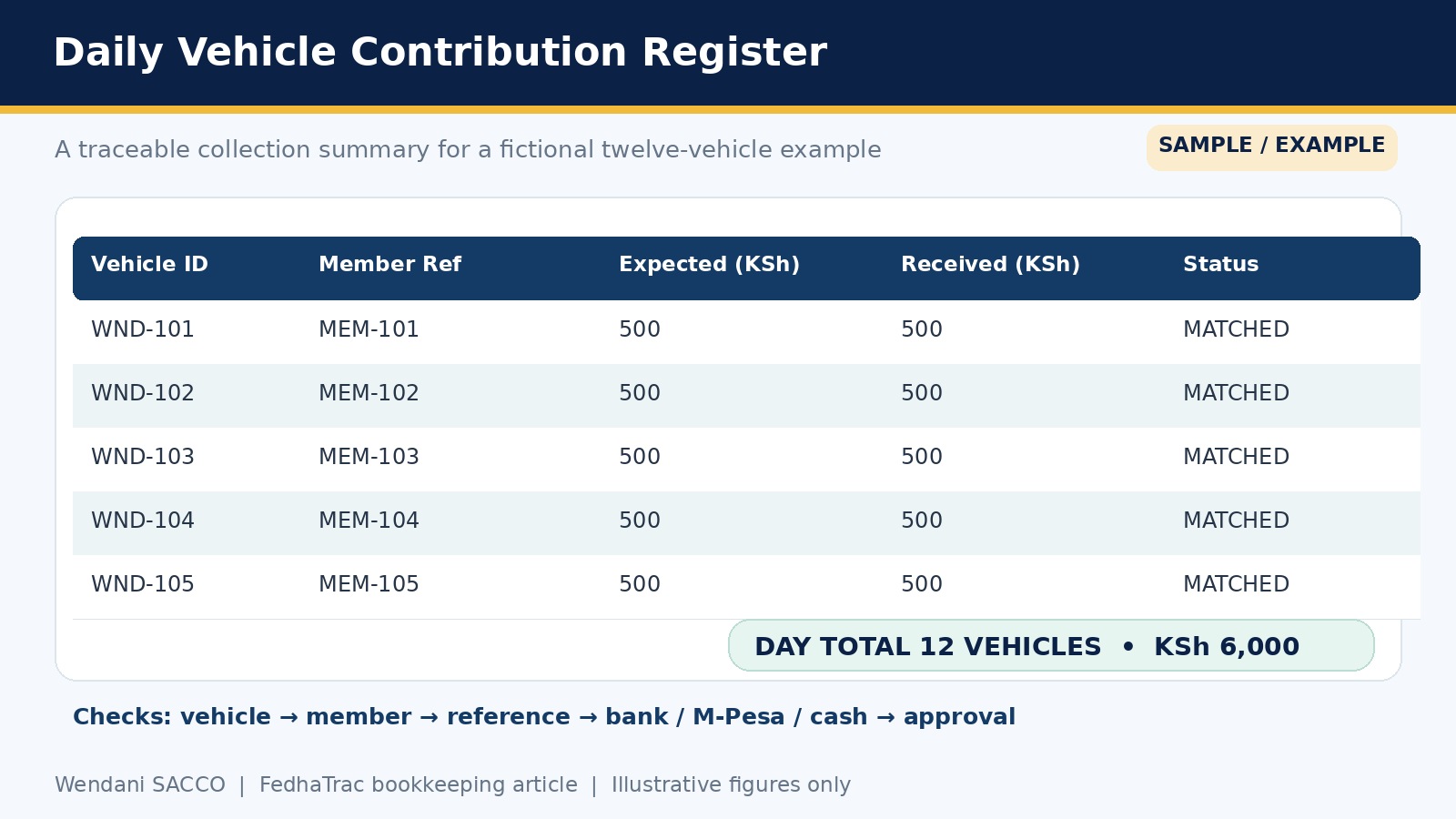
Example matatu SACCO daily collections register with vehicle references and KSh 6,000 teaching total
PSV SACCO Accounting in Kenya works best when every collection can be traced to a purpose and a payer. Rather than recording a single amount described as “matatu money,” Wendani SACCO should identify the vehicle, member, date, payment method, receipt reference and category of collection.
What a useful register should capture
A daily register can include a vehicle identification number, member account, route or stage, amount expected under an approved schedule, amount received, payment channel, receipt reference and any unresolved difference. If a contribution is waived or adjusted, the authorisation should also be recorded.
For illustration only, suppose twelve vehicles each owe a documented daily SACCO contribution of KSh 500. The expected amount is KSh 6,000. If recorded M-Pesa contributions are KSh 4,500 and verified cash contributions are KSh 1,500, the daily receipts total KSh 6,000. This is an invented teaching example, not a claim about Wendani SACCO’s actual charges or fleet.
As part of PSV SACCO Accounting in Kenya, the register should then be checked against payment statements and receipt records. PSV SACCO Accounting in Kenya is more reliable when each amount has an identifiable source, rather than being assumed correct because the total appears reasonable.
Separate SACCO Revenue From Owners’ Money
One of the most important questions in PSV SACCO Accounting in Kenya is simple: whose money is it? A cooperative may earn income from approved administrative or membership-related charges. It may also receive money temporarily on behalf of individual vehicle owners or other parties. Those transactions cannot all be treated identically.
The accounting treatment depends on the cooperative’s by-laws, agreements, actual control of funds and the substance of each transaction. A refundable member deposit is not automatically earned income. A transfer collected for an owner is not necessarily the SACCO’s turnover. A payment already recorded as a receivable should not be treated as a second sale when it arrives in the bank.
For PSV SACCO Accounting in Kenya, this distinction allows the committee to see the cooperative’s own operating performance rather than an inflated figure that combines revenue and funds awaiting settlement. FedhaTrac can help map transaction categories, maintain member balances and flag unclear items for management to resolve.
For further reading, FedhaTrac’s M-Pesa bookkeeping guide explains why the purpose of a transaction matters as much as the money received.
Reconcile M-Pesa, Cash and Bank Transactions
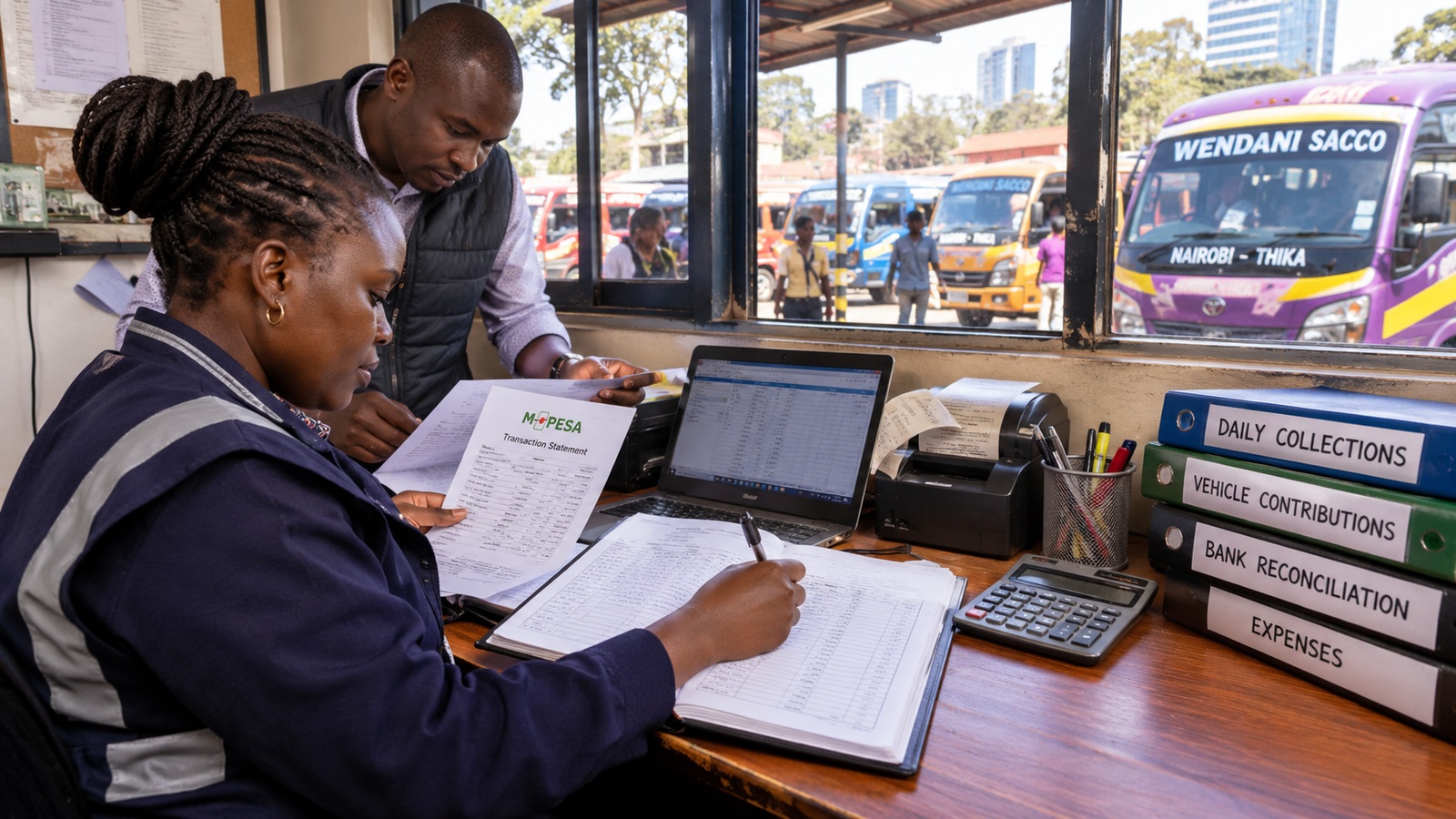
Wendani SACCO cashier checking M-Pesa transactions against a collection ledger and bank records
Many Kenyan operators use multiple payment channels. A till or Paybill confirmation, a bank deposit slip and an office receipt may relate to the same underlying payment. PSV SACCO Accounting in Kenya requires these records to be matched, not simply added together.
Wendani SACCO could establish a daily cashier summary and a weekly reconciliation. The summary should show opening cash, verified collections, approved cash payments, deposits and closing cash. Mobile-money transactions should be matched by reference and checked for charges, reversals and transfers. Bank statements should then be reconciled with the bookkeeping ledger.
Avoid counting the same money twice
Suppose KSh 4,500 is received through M-Pesa and later transferred to the SACCO’s bank account. The transfer changes where that money is held; it does not create another KSh 4,500 in income. This distinction is fundamental to PSV SACCO Accounting in Kenya and prevents management reports from overstating receipts.
Unexplained differences should be investigated promptly. The person receiving money should ideally not be the only person reviewing the reconciliation. FedhaTrac’s bank reconciliation guide provides a practical starting point for that control.
Give Members Clear, Traceable Statements
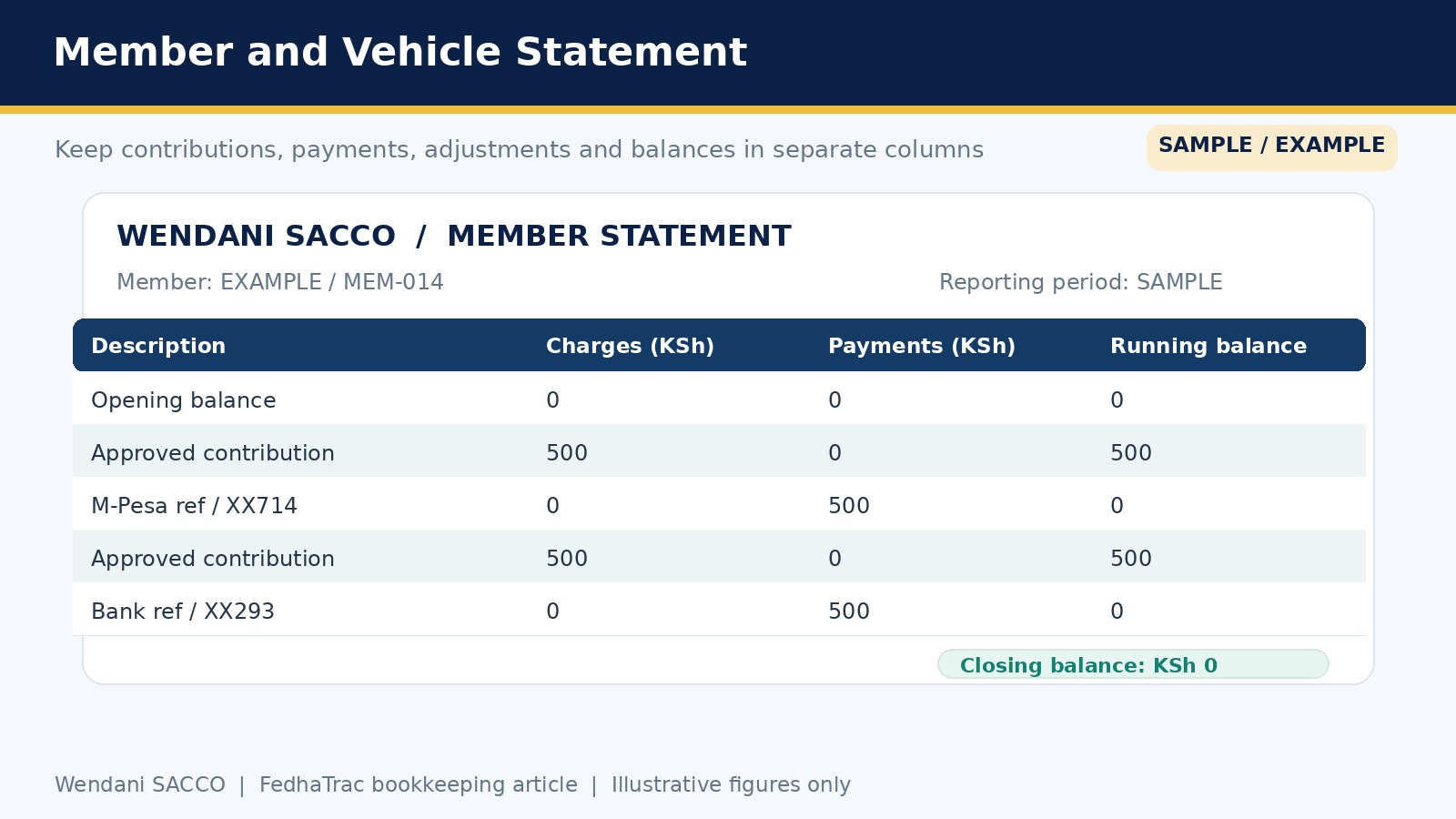
Sample PSV SACCO member statement showing contribution charges, payments and closing balance
PSV SACCO Accounting in Kenya should make it easy for a vehicle owner to understand transactions recorded against their account. A member statement can identify approved contributions due, payments received, adjustments, refundable deposits where applicable and the balance outstanding or held.
This is particularly useful when a member operates more than one vehicle. Wendani SACCO should be able to report by member and, where appropriate, by vehicle without mixing two owners’ accounts. Statements need clear dates, reference numbers and explanatory notes for disputed entries.
For PSV SACCO Accounting in Kenya, regular statements support transparency. They also reduce the need to rebuild a payment history from phone screenshots when disagreements arise. FedhaTrac can organise the underlying ledgers and statement preparation, while the cooperative’s officers confirm the approved charges and member arrangements.
Control Stage Expenses, Suppliers and Staff-Related Costs

Sample matatu SACCO office expense ledger with supplier evidence, approvals and expense categories
A SACCO’s monthly expenses might include rent for the booking office, internet, stationery, office utilities, cleaning, software, professional fees, security and authorised operating supplies. Depending on the arrangement, there may also be transport-related payments collected or settled on behalf of vehicle owners. PSV SACCO Accounting in Kenya requires these costs to be classified correctly.
Under a reliable PSV SACCO Accounting in Kenya routine, each expense should have a business purpose, supporting document, relevant supplier information and approval trail. Larger supplier bills need a clear record of what has been invoiced, paid or remains outstanding. Payments for insurance, inspection or licensing should identify which entity or vehicle is responsible rather than being assigned casually to general expenses.
Personnel compensation records, deductions and relevant statutory documents also need organisation. However, financial recordkeeping is not a substitute for proper employment, human-resources or payroll compliance advice. FedhaTrac can help maintain accounting records and support tax work within the agreed service scope.
Learn more about sound supporting documents in FedhaTrac’s expense tracking and invoicing guide.
Prepare a SACCO Budget and Protect Working Cash
PSV SACCO Accounting in Kenya should help management plan ahead, not merely look backward. The committee needs to estimate routine operating expenses, expected SACCO income, supplier obligations and planned improvements before committing available money.
A useful PSV SACCO Accounting in Kenya budget should distinguish ordinary operating expenditure from capital purchases, exceptional projects and payments due to members. It should also show whether receipts are sufficient to cover committed expenses, particularly when activity changes with school terms, holidays, roadworks or route disruptions.
At Wendani SACCO, a basic rolling cash forecast could compare expected collections with upcoming office bills, contractual commitments and approved projects. This makes it easier to see a shortage early and decide which discretionary expense can be postponed. A cash forecast cannot eliminate uncertainty, but it can prevent surprise obligations from catching the committee unprepared.
FedhaTrac’s cash-flow statement guide explains how reporting on cash movements complements a profit-and-loss report.
Strengthen Approvals and Reduce Financial Disputes
Weak approval practices can undermine even a busy, successful stage. PSV SACCO Accounting in Kenya benefits from a few simple controls: written collection schedules, consecutively identifiable receipts, approved payment requests, restricted access to financial records and periodic independent review.
Wendani SACCO could designate who confirms collections, who approves expenses, who initiates transfers and who reviews reconciliations. Not every cooperative has enough staff for complete separation of duties, but a committee member can provide a second review where practical. A documented exception register can record missing receipts, disputed balances and unusual adjustments.
The goal is accountability rather than bureaucracy. When a member asks why an entry appears on a statement, the office should be able to produce a sensible answer supported by records. FedhaTrac can help establish a consistent reporting routine; the committee remains responsible for authorising transactions and responding to member grievances.
Use Monthly Reports for Committee Decisions
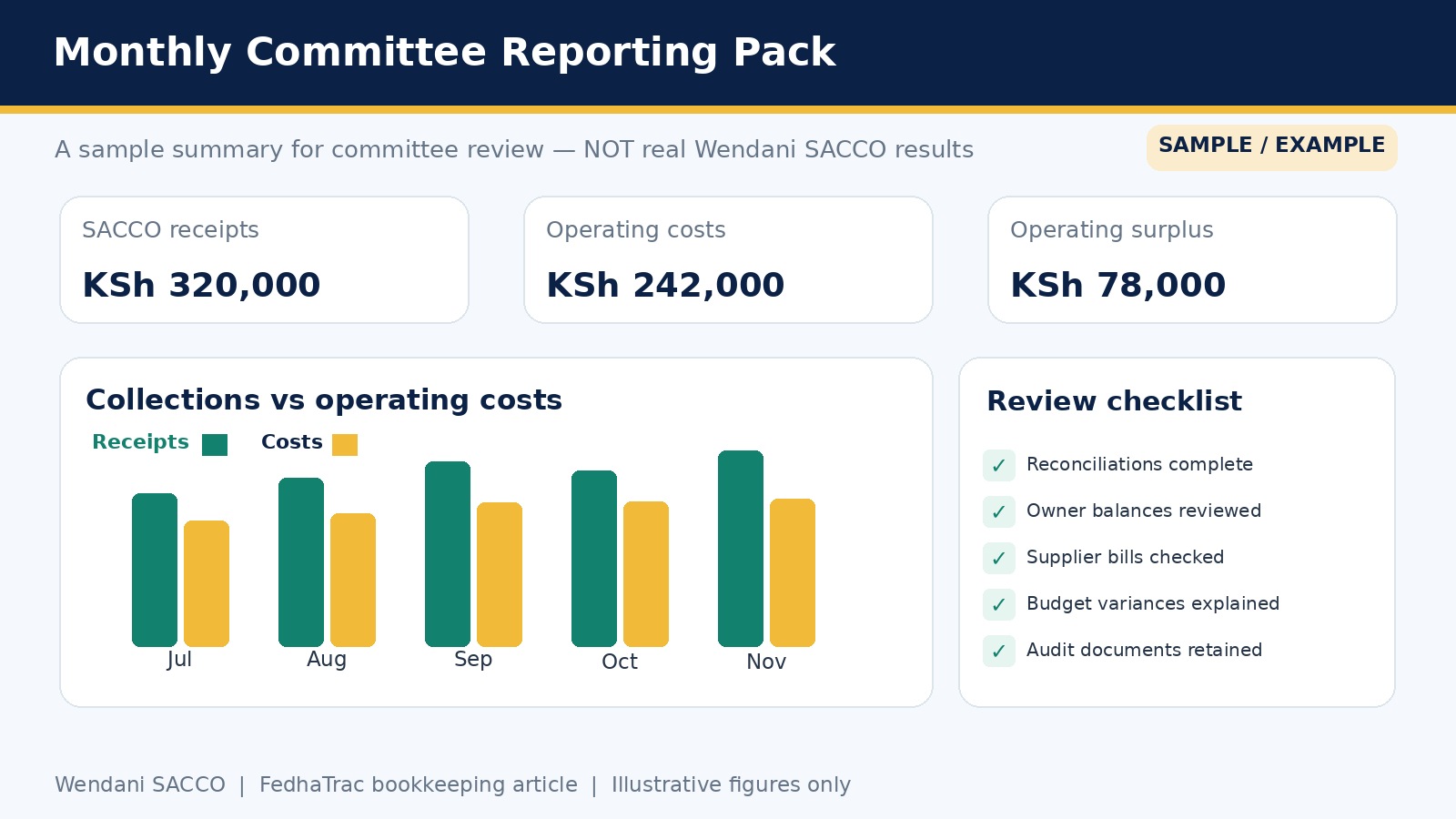
Example matatu SACCO monthly receipts, operating costs, surplus and committee review checklist
The value of PSV SACCO Accounting in Kenya becomes obvious during a committee meeting. Instead of a collection of unrelated notebooks, management can review a concise packet showing income, expenses, cash balances, member receivables, supplier liabilities and important unresolved items.
A monthly PSV SACCO Accounting in Kenya reporting pack might include an income-and-expenditure statement, a balance sheet, a cash reconciliation summary, an aged member-balance report and a comparison of actual expenditure against the approved budget. If the cooperative handles third-party funds, their balances should be reported distinctly and explained.
Questions a committee should be able to answer
How much income belongs to the SACCO itself? What amounts are still owed by members? Which suppliers must be paid soon? Did actual operating costs exceed budget? Are bank and mobile-money balances reconciled? Which exceptions need committee attention? PSV SACCO Accounting in Kenya is effective when the reports make these questions answerable without guesswork.
FedhaTrac’s profit-and-loss reporting guide can help committee members understand what a financial performance report shows—and what it cannot show about available cash.
Understand Kenyan Cooperative and PSV Obligations
A matatu SACCO must distinguish transport-operating oversight from cooperative financial regulation. The National Transport and Safety Authority administers public service transport services, licensing and related procedures. A properly registered cooperative also has obligations under Kenya’s cooperative framework, including maintaining accounting records and meeting applicable audit and reporting requirements.
The State Department for Co-operatives explains that registered cooperatives are expected to keep proper financial statements, undergo an annual audit by an approved auditor, and submit audited accounts and annual returns within the applicable statutory periods. Their by-laws and registration details determine additional governance requirements.
Importantly, transport cooperatives are not automatically supervised by the Sacco Societies Regulatory Authority merely because they use the word “SACCO.” SASRA specifically distinguishes transport cooperatives from the deposit-taking and specified non-deposit-taking SACCO businesses it regulates. A cooperative undertaking separately regulated financial activity should obtain advice on its particular status.
PSV SACCO Accounting in Kenya therefore requires careful compliance review rather than a generic assumption that every transport operator has the same obligations. FedhaTrac can help organise accounts and audit-ready records, but licensing decisions, transport enforcement and statutory audits remain with the relevant authorities and authorised professionals.
Keep KRA Documentation and eTIMS Records Organised
Good PSV SACCO Accounting in Kenya also supports tax compliance. The Kenya Revenue Authority’s eTIMS guidance states that persons carrying on business generally need to use electronic tax invoicing, subject to applicable rules and exceptions. It is important to identify the SACCO’s actual taxable supplies and not automatically assume passenger fares, member contributions and agency collections receive identical tax treatment.
KRA’s income-and-expense validation process, effective from January 2026 for the relevant returns, increases the value of reconciling ledger entries to electronic invoices and other supporting records, where required. The law contains exceptions and special cases, so the SACCO’s tax adviser should confirm how specific activities are treated.
Wendani SACCO can support that review by keeping invoices, statements, approved expense documents, member registers and clear records of money received on behalf of others. FedhaTrac’s eTIMS guide for Kenyan businesses explains the broader electronic-invoicing process.
How FedhaTrac Could Ease Wendani SACCO’s Operations
The strongest contribution FedhaTrac could make is consistency. PSV SACCO Accounting in Kenya does not improve merely because someone installs new software. It improves when collection records are complete, accounts are reconciled, exceptions are investigated, member statements are understandable and reports arrive in time for decisions.
For Wendani SACCO, a sensible starting engagement could involve reviewing existing records, mapping SACCO and member transaction types, setting up usable ledgers, agreeing on a collection-report format and establishing a month-end close. Where past records are incomplete, catch-up bookkeeping may be necessary before reliable reports can be produced.
The result is not a promise of higher profits or instant regulatory approval. It is a better basis for management. Vehicle owners can receive clearer statements, the committee can see the cooperative’s financial position, and day-to-day officials spend less time searching for missing documents. That is how PSV SACCO Accounting in Kenya can ease operations in practice.
Frequently Asked Questions About Matatu SACCO Accounting
Can FedhaTrac manage a SACCO’s daily matatu operations?
FedhaTrac focuses on financial support: bookkeeping, reconciliations, reports, accounting and related compliance assistance. It is not presented here as a substitute for vehicle dispatch teams, stage managers, safety officers or transport regulators. Good PSV SACCO Accounting in Kenya complements those functions by giving them more dependable financial information.
Should all daily matatu collections be recorded as SACCO income?
No. The accounting depends on the actual arrangement. Money received on behalf of a vehicle owner, a refundable deposit and a fee earned by the SACCO may need different treatment. PSV SACCO Accounting in Kenya should reflect the contracts, by-laws and economic substance rather than applying one label to every receipt.
Does SASRA regulate every matatu SACCO?
No. SASRA states that transport cooperatives are outside its ordinary regulatory scope. They may still have cooperative-law, transport and tax obligations, and any separate regulated deposit-taking activities require individual assessment.
What reports should a PSV SACCO review each month?
Useful reports include income and expenditure, cash and bank reconciliation, member balances, supplier liabilities, budget variances and material exceptions. The exact format depends on the cooperative’s size, structure and approved financial policies.
How can Wendani SACCO begin improving its accounts?
It can start with approved collection categories, reliable member and vehicle identifiers, complete payment statements, documented expense approvals and a regular reconciliation process. FedhaTrac can assess existing records and propose bookkeeping support suited to the volume and condition of the transactions.
Bring More Financial Order to Your Matatu SACCO
Running a busy Nairobi waiting area involves far more than arranging vehicles in a queue. Behind the activity, the committee must account for members’ money, operating expenses and statutory responsibilities. PSV SACCO Accounting in Kenya gives that work a structure that can be reviewed, explained and improved.
Wendani SACCO is a fictional illustration, but the need for accurate accounting is real. If your transport cooperative faces unclear member balances, inconsistent collection records or delayed financial reports, contact FedhaTrac to discuss practical bookkeeping, reconciliation and financial-reporting support. Making the accounts clearer is an important first step toward making the entire operation easier to manage.


