

eTIMS + FedhaTrac: Kenyan entrepreneur with a finance professional reviewing eTIMS invoices, M-Pesa transactions and organised financial records on a digital dashboard
Table of Contents
ToggleeTIMS Guide for Kenyan businesses and SMEs using FedhaTrac
This eTIMS Guide for Kenya businesses and SMEs explains how KRA eTIMS works, who needs to register, how to complete eTIMS registration, issue electronic tax invoices and keep your business records tax-ready.
For Kenyan businesses, invoicing is no longer simply about preparing a PDF, adding a company logo and sending it to a customer. The electronic Tax Invoice Management System better known as eTIMS has made electronic tax invoicing an important part of the country’s business and tax environment. Kenya Revenue Authority states that all persons engaged in business are required to onboard KRA eTIMS and issue electronic tax invoices. Importantly, this requirement is not restricted to VAT-registered companies. KRA expressly includes companies, partnerships, sole proprietorships, associations, trusts and persons carrying on business across different sectors.
That makes eTIMS Guide for Kenyan businesses need a much broader financial-management issue. A business may generate compliant sales invoices but still have poor bookkeeping, unreconciled M-Pesa transactions, missing supplier documentation or expenses that cannot easily be explained. Conversely, excellent bookkeeping cannot replace an electronic tax invoice where one is required. The strongest financial process therefore connects invoicing, expenses, payments, supporting documents, bookkeeping and tax preparation. This is where KRA eTIMS and professional bookkeeping intersect. FedhaTrac’s guide to the importance of financial management explains why maintaining these connected financial records matters beyond compliance.
For many SMEs, however, the difficulty is not understanding that compliance matters. It is finding the time to register, select the appropriate eTIMS solution, generate invoices correctly, maintain supporting records, reconcile payments and keep the underlying books organised. FedhaTrac can support businesses through eTIMS registration and, for clients whose financial administration we manage, assist with ongoing eTIMS invoicing alongside bookkeeping, accounting and tax support. You therefore do not necessarily have to navigate every stage alone. The objective is to establish a financial process that keeps the business organised throughout the year rather than scrambling to reconstruct records when a tax deadline approaches.
eTIMS Guide: What Is eTIMS in Kenya?
eTIMS stands for electronic Tax Invoice Management System.
KRA describes eTIMS as a software solution designed to provide taxpayers with a simple, convenient and flexible approach to electronic invoicing. It can be accessed through different devices and solutions depending on the nature and size of the business.
In practical terms, KRA eTIMS enables businesses to generate electronic tax invoices and transmit the relevant invoice information through KRA’s system.
That is an important distinction.
eTIMS is not your entire bookkeeping system.
A business still needs to maintain records of:
- Sales
- Expenses
- Customer balances
- Supplier transactions
- Bank activity
- M-Pesa activity
- Cash transactions
- Assets and liabilities
- Supporting documentation
- Other accounting information
eTIMS sits within this wider financial ecosystem.
Think of it this way:
eTIMS → Electronic tax invoicing
Bookkeeping → Complete financial transaction records
Accounting → Classification, reporting and interpretation
Tax → Calculation, preparation and filing of tax obligations
For a well-managed SME, these processes should communicate with each other.
Who Must Register for eTIMS in Kenya?
This is one of the most important questions businesses ask.
According to KRA’s current guidance, all persons engaged in business are required to onboard eTIMS and issue electronic tax invoices, subject to the specific rules and mechanisms applicable to different transactions and taxpayers.
KRA identifies persons in business as including:
- Companies
- Partnerships
- Sole proprietorships
- Associations
- Trusts
- Persons with applicable income-tax obligations
- Persons operating in the informal sector
- Other persons conducting business
This is why assuming that eTIMS applies only to large corporations is dangerous.
Do Non-VAT Businesses Need eTIMS?
Yes, being non-VAT registered does not by itself exempt a business from eTIMS.
This is another major source of confusion.
KRA specifically states that persons in business who are not required to register for VAT may still be required to onboard eTIMS. Its examples include businesses supplying VAT-exempt goods and services, such as certain medical and educational services, tours and travel businesses, and NGOs carrying on business.
KRA has therefore provided simplified eTIMS Lite options for small and micro non-VAT taxpayers.
The lesson for SMEs is simple:
Do not use “I’m not VAT registered” as your test for whether eTIMS applies to you.
Check the requirements based on your actual business and tax position.
Why eTIMS Matters for Tax Filing in Kenya
This is where eTIMS becomes particularly important.
KRA states that the requirement to onboard eTIMS and issue compliant invoices is anchored in law. It also explains that businesses claiming deductions for business expenses need valid electronic tax invoices to support those expenses, subject to the applicable tax rules.
This creates two sides of eTIMS Guide for businesses in Kenya
As a Seller
Your business needs to issue the appropriate electronic tax invoice for qualifying supplies.
As a Buyer
Your business needs appropriate supporting documentation for expenses it intends to claim.
KRA warns that failing to issue eTIMS-compliant invoices can affect customers’ ability to support business-expense deductions and, where the customer is VAT registered, their ability to claim input VAT.
That means poor invoicing can affect both you and your customers.
eTIMS vs iTax: What’s the Difference?
These systems are related to tax administration but perform different functions.
| System | Primary Purpose |
|---|---|
| eTIMS | Electronic tax invoicing |
| iTax | Wider tax administration and filing |
| Bookkeeping system | Maintaining business financial records |
| Accounting process | Producing and analysing financial information |
A common SME mistake is assuming that because tax returns are ultimately handled through KRA systems, the business does not need organised bookkeeping.
That is incorrect.
The tax return is an end result.
The business still needs reliable underlying records from which financial and tax information can be prepared.
Which eTIMS Solution Should Your Business Use?
There isn’t one eTIMS setup for every Kenyan business.
KRA currently provides several options.
| eTIMS Solution | Generally Designed For |
|---|---|
| eTIMS Lite Web | Smaller businesses with minimal transactions |
| eTIMS Lite USSD | Individuals and sole proprietors |
| eTIMS Lite Mobile App | Simplified mobile invoicing |
| Online Portal | Service-sector businesses |
| eTIMS Client | Businesses dealing in goods or goods and services |
| VSCU | System-to-system integration and higher transaction volumes |
| OSCU | Businesses using online invoicing systems |
| Reverse/Buyer-Initiated Invoicing | Specified situations where buyer generates invoice |
KRA has also made it possible for taxpayers to register on more than one eTIMS solution and access invoices generated through different solutions from the online taxpayer portal.
Why Choosing the Right Solution Matters
A consultant issuing a relatively small number of service invoices does not have the same operational needs as a retailer managing stock, branches and numerous daily transactions.
Choosing the appropriate solution can make compliance substantially easier.
eTIMS Guide to Registration in Kenya: Step-by-Step
 KRA has simplified the onboarding process and says taxpayers can now self-onboard without waiting for KRA intervention to approve the initial service request. Before installing or using an eTIMS solution, however, the taxpayer needs to register and provide information about the nature of the business.
Step 1: Make Sure Your KRA Details Are Up to Date
Before starting, confirm that your business information is correct.
Pay particular attention to the mobile number registered on iTax.
KRA says the OTP used during eTIMS signup is sent to the iTax-registered mobile number. If you cannot access that number, you may need to update your iTax profile first.
Step 2: Access the Official KRA eTIMS Platform
Do not rely on random links sent through messages or unofficial websites.
Start from KRA’s official eTIMS resources.
KRA eTIMS Information & Services
KRA also provides a dedicated onboarding page containing the current registration and solution guides:
Step 3: Start Your eTIMS Registration
The eTIMS taxpayer signup process asks for the taxpayer’s PIN and verifies taxpayer information.
The current signup interface includes taxpayer details such as the PIN, taxpayer name, mobile number, email and location information, followed by OTP verification.
Your details should correspond with your KRA/iTax records.
Step 4: Verify Your Identity Using OTP
Request the OTP.
KRA sends it to the mobile number associated with the taxpayer’s iTax information.
Enter the OTP to complete the required verification.
If the OTP does not arrive, KRA recommends confirming access to the iTax-registered mobile number and checking whether promotional messages are enabled on the phone.
Step 5: Provide Your Business Information
The registration process requires information about the taxpayer and nature of the business.
Accuracy matters because the business activity influences which eTIMS solution is appropriate.
A company selling physical products may have different requirements from a consultant providing only services.
Step 6: Choose the Appropriate eTIMS Solution
Your next step depends on the business.
A small non-VAT taxpayer may be able to use eTIMS Lite, while a service business may use the Online Portal. Businesses handling goods may require eTIMS Client, while businesses with established invoicing or ERP systems may investigate VSCU or OSCU integration.
Don’t simply choose the first option you see.
Choose based on how the business actually operates.
Step 7: Configure or Access Your Selected Solution
Some eTIMS solutions are web based while others involve software or system integration.
KRA provides installation links and user guides for Online Portal, Windows and Android PayPoint solutions, USSD, eCitizen Web and multi-pay point configurations.
KRA eTIMS Installation & User Guides
Step 8: Configure Your Business for Invoicing
Once onboarded, make sure the business information required for generating invoices is configured appropriately.
Depending on the solution and nature of the business, this may involve products/services and relevant invoicing information.
This stage deserves attention because the objective is not merely to say:
“We registered for eTIMS.”
The objective is:
“We can consistently generate the appropriate invoices for actual business transactions.”
Step 9: Test Your Invoicing Process
Generate invoices according to the applicable KRA process and verify that the workflow works before relying on it for day-to-day operations.
KRA provides current tutorials for registering, generating invoices and raising credit notes across several eTIMS solutions.
What Happens After eTIMS Registration?
Registration is not the end of eTIMS compliance.
This is one of the most important points for SMEs.
Registering simply gives the business the mechanism needed to operate within the electronic invoicing framework.
The ongoing work involves:
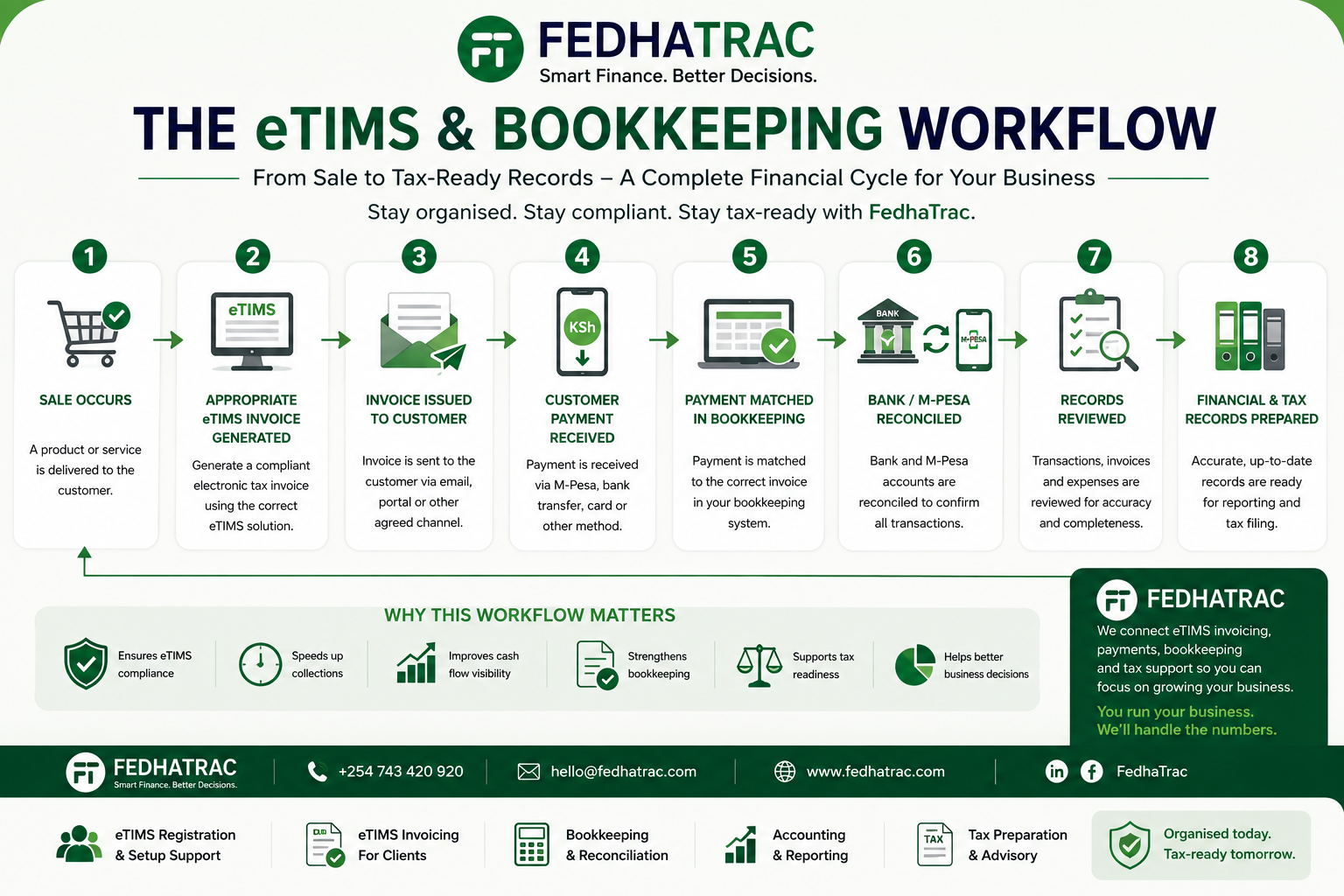
That is why eTIMS and bookkeeping should not operate in isolation.
How Does eTIMS Invoicing Work?
At its simplest, an eTIMS invoice documents a business supply through the applicable KRA electronic invoicing system.
The exact procedure varies depending on which eTIMS solution you use.
KRA currently provides tutorials covering invoice creation through eCitizen Web, the eTIMS Online Solution and eTIMS Client.
Businesses also need procedures for corrections.
For example, KRA notes that where multiple eTIMS solutions are used, a credit note can only be generated from the solution through which the original invoice was raised.
This illustrates why businesses need an organised invoicing process rather than simply allowing invoices to be generated inconsistently by different people.
How Can You Verify an eTIMS Invoice?
KRA provides two methods in its current guidance.
You can:
Scan the QR code appearing on the invoice, or
Use the invoice-number checker through KRA’s systems.
Verification can be useful when reviewing supplier documentation before relying on an invoice as part of the business’s financial records.
eTIMS and Business Expenses: The Other Side of Compliance
Most discussions about eTIMS focus on sales invoices.
But businesses should pay equal attention to purchases and expenses.
Imagine your business spends money on:
- Stock
- Equipment
- Professional services
- Marketing
- Repairs
- Business supplies
- Contractors
- Transport
- Other operating costs
Recording the expense in your bookkeeping software does not by itself establish that all tax requirements relating to the deduction have been satisfied.
Supporting documentation matters.
This is why good eTIMS bookkeeping Kenya businesses maintain should connect the expense transaction with the appropriate supplier documentation and payment information.
eTIMS, M-Pesa and Bookkeeping: How Everything Connects
This is particularly important for Kenyan SMEs.
Imagine you issue an eTIMS invoice for KSh 50,000.
The customer pays through M-Pesa.
You now potentially have three connected records:
| Record | What It Shows |
|---|---|
| eTIMS invoice | KSh 50,000 sale |
| Bookkeeping record | Revenue/customer receivable |
| M-Pesa record | KSh 50,000 payment |
These records should tell the same financial story.
If the customer payment is incorrectly entered as another sale, revenue can be duplicated.
If the M-Pesa receipt is never matched against the invoice, the books may continue showing the customer as owing KSh 50,000.
This is why eTIMS Guide for Business in Kenya SMEs need cannot be separated completely from bookkeeping.
9 Essential Steps to Keep Your Business eTIMS-Ready
1. Complete eTIMS Registration Correctly
Make sure the taxpayer is properly onboarded and using an appropriate solution.
2. Issue Electronic Tax Invoices Consistently
Do not allow some qualifying sales to go through formal invoicing while others remain buried in WhatsApp messages, handwritten notes or payment confirmations.
3. Keep Customer Records Organised
Invoices should be traceable to customers and transactions.
4. Match Customer Payments to Invoices
An invoice and a payment are not the same transaction.
Good bookkeeping connects them.
5. Reconcile M-Pesa
Where customers pay through M-Pesa, reconcile those receipts with invoices and bookkeeping records.
6. Reconcile Bank Accounts
Bank receipts and payments should similarly agree with the books.
7. Maintain Supplier Documentation
Do not focus entirely on sales while ignoring expense documentation.
8. Review Your Books Every Month
Monthly reviews help identify missing invoices, unexplained transactions and discrepancies while they are still recent.
9. Prepare for Tax Throughout the Year
The worst time to discover twelve months of missing records is immediately before a filing deadline.
Tax readiness should be a process, not an annual emergency.
Common eTIMS Mistakes Kenyan SMEs Should Avoid
Several problems appear repeatedly when businesses manage invoicing and bookkeeping separately.
- Assuming eTIMS applies only to VAT-registered businesses.
- Registering but failing to use the system consistently.
- Choosing an unsuitable eTIMS solution.
- Issuing invoices but failing to maintain proper bookkeeping.
- Recording customer payments as additional revenue.
- Ignoring supplier documentation.
- Failing to reconcile M-Pesa and bank transactions.
- Waiting until tax season to organise invoices.
- Allowing several employees to issue invoices without a controlled process.
- Treating an M-Pesa confirmation as if it were automatically the same thing as an eTIMS invoice.
- Failing to properly handle corrections and credit notes.
- Assuming software alone guarantees compliance.
That last point deserves emphasis.
Technology facilitates compliance. Processes maintain it.
eTIMS Readiness Checklist for Kenyan SMEs
Use this checklist as part of your monthly financial review:
Registration
☐ Business is appropriately onboarded on eTIMS
☐ Correct eTIMS solution is being used
☐ KRA/iTax contact information is current
Sales
☐ Required sales invoices have been generated
☐ Customer details are maintained where appropriate
☐ Corrections and credit notes are properly handled
Payments
☐ Customer payments are matched to invoices
☐ M-Pesa receipts are reconciled
☐ Bank receipts are reconciled
Expenses
☐ Supplier invoices are collected and organised
☐ Expense documentation is reviewed
☐ Payments are matched to expenses
☐ Unclear transactions are investigated
Bookkeeping
☐ Sales agree with bookkeeping records
☐ Expenses are properly categorised
☐ Accounts are reconciled
☐ Customer balances are reviewed
☐ Monthly financial records are complete
Tax Readiness
☐ Missing documents are followed up promptly
☐ Tax records are reviewed before deadlines
☐ Professional advice is sought where the treatment is unclear
Can Someone Handle eTIMS Registration and Invoicing for You?
This is where we should distinguish between KRA’s onboarding mechanism and ongoing business support.
KRA has automated self-onboarding so taxpayers can register without waiting for manual approval of the initial application.
That does not mean every business owner has to personally manage every administrative task surrounding eTIMS, bookkeeping and tax.
A business can still obtain professional assistance understanding the requirements, preparing for registration, selecting an appropriate solution, establishing invoicing processes and maintaining the financial records around those invoices.
And that is exactly where FedhaTrac comes in.
How FedhaTrac Helps Businesses Stay eTIMS-Ready
FedhaTrac does not simply tell clients:
“Here is eTIMS. Go figure it out.”
Our objective is to help businesses establish a workable financial process.
FedhaTrac Can Help You With eTIMS Registration
If you have not yet onboarded, FedhaTrac can assist you through the eTIMS registration and setup process, helping you understand the information required and the appropriate solution for your business.
That removes much of the uncertainty businesses experience when trying to determine where to begin.
FedhaTrac Can Help Manage eTIMS Invoicing for Clients
Registration is only the first step.
For clients whose financial administration we support, FedhaTrac can also assist with ongoing eTIMS invoicing rather than leaving you to manage the entire invoicing process yourself.
This is particularly useful for entrepreneurs who would rather concentrate on:
Selling. Serving customers. Running operations. Growing the business.
Instead of spending valuable time moving between invoicing systems, M-Pesa statements, spreadsheets and bookkeeping records.
We Connect eTIMS With Your Bookkeeping
This is where the service becomes substantially more valuable.
An eTIMS invoice is one part of a financial transaction. FedhaTrac can help connect Invoice, Customer, Payment, Mpesa or Bank, Bookkeeping, Accounting and Finally Tax preparation. This creates a much stronger financial trail.

We Help With the Expense Side Too
Tax readiness isn’t only about invoices you issue.
The documentation supporting money your business spends matters too.
Through ongoing bookkeeping, FedhaTrac can help organise and categorise business expenses and identify records that require attention.
For businesses wanting stronger expense controls, our guide to the best expense tracker in Kenya provides additional guidance.
We Keep Your Books Updated
One of the biggest advantages of professional bookkeeping is consistency.
Instead of waiting until tax deadlines, transactions can be maintained throughout the year.
This means fewer surprises when financial statements or tax information need to be prepared.
Our broader guides to maintaining strong financial health and developing strong financial-management skills explain why this ongoing financial discipline matters.
DIY eTIMS vs FedhaTrac-Supported Financial Management
| DIY Approach | FedhaTrac-Supported Approach |
|---|---|
| You research registration | We can guide the registration process |
| You choose the eTIMS solution | We can help assess the appropriate setup |
| You manage invoicing | We can assist with invoicing for supported clients |
| You track customer payments | Payments can form part of bookkeeping |
| You reconcile M-Pesa | Reconciliation can form part of bookkeeping |
| You organise expenses | Expense records can be maintained systematically |
| You prepare books | Bookkeeping can be professionally maintained |
| You coordinate tax records | Accounting/tax support can be connected |
| Multiple disconnected tasks | More integrated financial workflow |
The goal is not to take control away from the business owner.
It is to reduce the amount of financial administration the owner must personally perform while improving the quality of the resulting records.
eTIMS Guide Frequently Asked Questions for Kenyan Businesses
1. Is eTIMS mandatory in Kenya?
KRA states that all persons engaged in business are required to onboard eTIMS and issue electronic tax invoices, subject to the specific rules applicable to the taxpayer and transaction. This includes more than VAT-registered businesses. Companies, partnerships, sole proprietorships and other persons conducting business can fall within the requirement.
2. Do I need eTIMS if my business is not VAT registered?
Being non-VAT registered does not automatically remove the eTIMS requirement. KRA specifically states that persons carrying on business who are not required to register for VAT can still be required to onboard. KRA provides eTIMS Lite solutions aimed at smaller non-VAT taxpayers.
3. Is eTIMS registration free?
KRA says its eTIMS software—including the online portal and client software—is provided free of charge. Businesses choosing system integration through approved third-party integrators may incur costs associated with that integration.
4. Can I use eTIMS on my phone?
Yes. KRA provides several options, including eTIMS Lite Web, USSD through *222#, and a mobile application, subject to the suitability of each solution for the taxpayer. Other solutions include the Online Portal, eTIMS Client and system-to-system integration.
5. What happens if my customer pays through M-Pesa?
The payment method and tax invoice serve different purposes. An M-Pesa transaction confirms movement of money, while the eTIMS invoice documents the relevant sale through the electronic invoicing system. In the bookkeeping records, the payment should then be matched to the appropriate invoice rather than automatically treated as another sale.
6. Can FedhaTrac register my business for eTIMS?
FedhaTrac can assist clients with the eTIMS registration and setup process so they do not have to navigate the requirements completely on their own. Because KRA’s initial onboarding process is now automated for taxpayers, the support should be described as helping the client complete and manage the process rather than suggesting FedhaTrac replaces KRA’s registration system.
7. Can FedhaTrac issue and manage eTIMS invoices for me?
For clients whose financial administration FedhaTrac manages, eTIMS invoicing can form part of the support provided. This allows invoicing to connect more naturally with customer payment tracking, bookkeeping, reconciliation, accounting and tax support rather than leaving the business owner to maintain each process independently.
Final Thoughts: eTIMS Readiness Starts With Better Financial Records
eTIMS Guide for Kenyan business needs should not be viewed as a once-off registration exercise. Registering is important, but the real work happens afterwards. Businesses need to generate appropriate invoices consistently, maintain supplier documentation, match customer payments, reconcile M-Pesa and bank accounts and ensure their bookkeeping reflects what actually happened during the period. KRA’s current guidance makes clear that eTIMS applies broadly to persons carrying on business and is not simply a system for VAT-registered corporations.
The easiest way to manage these obligations is to build them into normal business operations. When a sale occurs, invoicing should follow. When payment arrives, it should be matched. When an expense occurs, the appropriate supporting documentation should be maintained. At month-end, M-Pesa, bank accounts, invoices and expenses should be reconciled. The result is tax-ready bookkeeping Kenya SMEs can rely on throughout the year, rather than a collection of documents assembled hurriedly when a deadline approaches. You can find KRA’s latest official guidance through the KRA eTIMS portal.
FedhaTrac can help make that process considerably easier. We can assist with eTIMS registration and setup, ongoing eTIMS invoicing for supported clients, bookkeeping, transaction reconciliation, accounting and tax support. Instead of leaving you with software and expecting you to manage every financial task yourself, the objective is to provide the practical support needed to keep your financial records organised. Your job is to run your business. Ours is to help ensure the financial records behind it remain organised, useful and ready when you need them.
Ready to Get Your Business eTIMS-Ready?
Need help registering for eTIMS—or already registered but don’t want to manage the invoicing and bookkeeping alone?
Talk to FedhaTrac. We can help you set up the process and provide ongoing financial support so that eTIMS invoicing, bookkeeping, accounting and tax preparation work together instead of becoming four separate headaches.


