
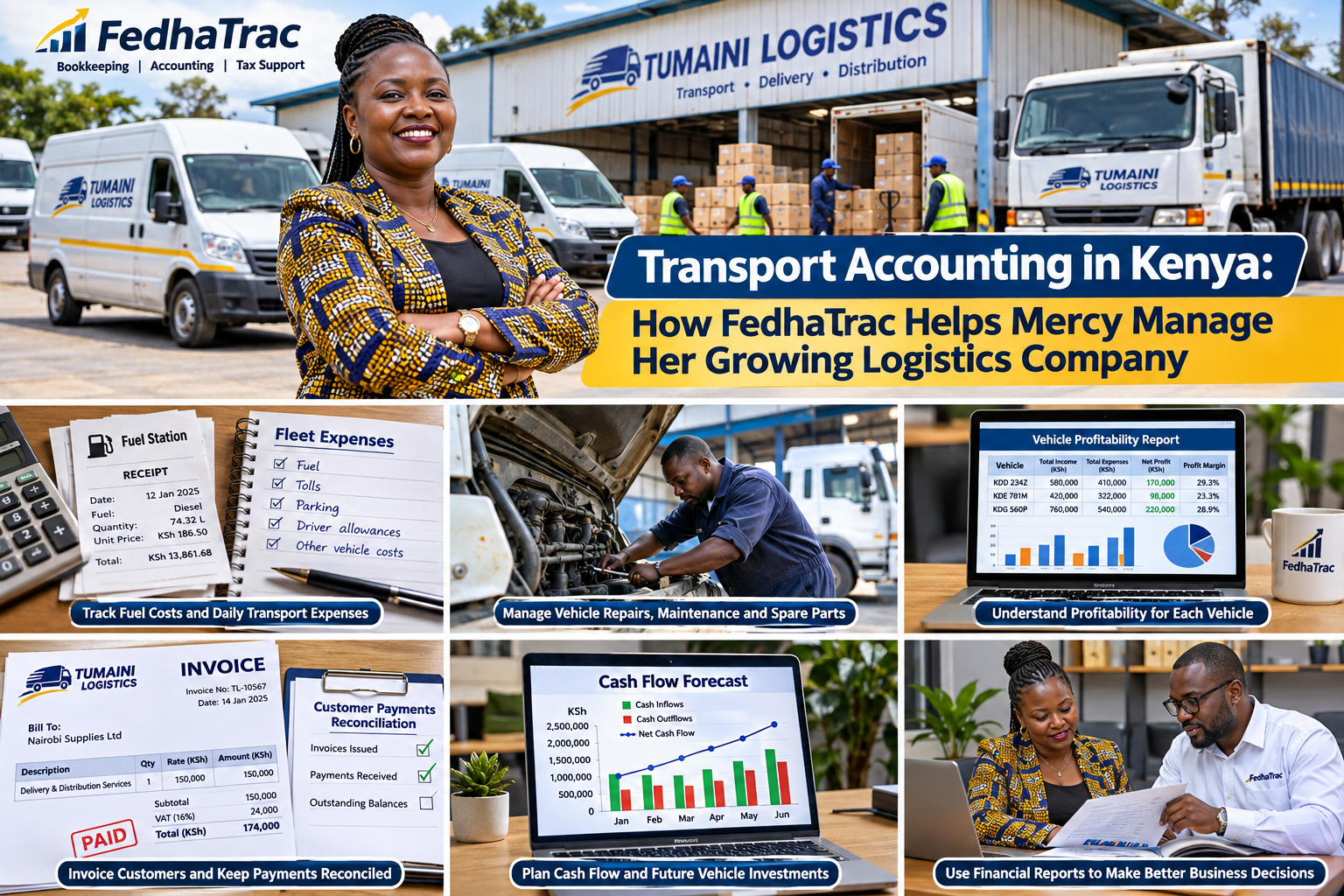
The first van at Tumaini Logistics used to be easy for Mercy to manage. She knew every customer, approved every fuel stop, and could remember most deliveries without opening a spreadsheet. Now her Kenyan transport business has several vans and a truck, a growing list of customers, and drivers moving between towns on different schedules. Parcels are leaving the depot every morning, yet she cannot confidently say which vehicle earned the most money last month. That is why Transport Accounting in Kenya matters as much as adding another vehicle to the fleet.
Mercy is a fictional business owner, but her challenges are familiar to growing transport operators. A vehicle can look busy while barely covering fuel and repairs. A customer can receive goods promptly but settle an invoice weeks later. A truck can have a profitable month on paper and still leave the business short of cash for insurance, tyres or loan instalments. With the right records, FedhaTrac can help Mercy turn everyday activity into understandable financial information.
Good Transport Accounting in Kenya does not replace dispatch planning, vehicle inspections or road-safety obligations. It connects delivery income, operating costs, customer balances, vehicle assets and cash movement so owners can make decisions based on evidence. Here is how a practical bookkeeping approach could help Tumaini Logistics move from managing transactions reactively to understanding the performance of its growing fleet.
IN THIS ARTICLE
Delivery records · Fuel costs · Vehicle repairs · Vehicle profitability · Customer payments · Trip advances · Cash flow · Fleet assets · eTIMS and tax · Monthly reports · Weekly routine · FAQs · Talk to FedhaTrac
1. Build a Financial Record for Every Delivery
When Tumaini Logistics receives an order, Mercy needs more than a destination and a driver’s name. Each job should have a reference number, customer, date, vehicle, agreed price, delivery status and invoice reference. If additional charges arise, such as authorised waiting time or a route change, they should be documented before the customer account is updated. This simple structure gives Transport Accounting in Kenya a reliable starting point.
Within Transport Accounting in Kenya, FedhaTrac can help organise sales records so an invoice is not lost between a WhatsApp instruction, a dispatch sheet and a bank alert. Where a customer is billed on credit, the sale and the outstanding amount need to be tracked separately from the eventual payment. Where payment is received immediately, the receipt still needs to be matched to the underlying delivery. Mercy then sees both completed work and what customers actually owe.
If one route regularly requires extra loading time or returns, Mercy can compare its revenue with its related expenses. The goal is not to make drivers complete complicated forms. It is to capture a small number of useful details consistently so the financial books and operational records can explain the same journey.
2. Track Fuel by Vehicle, Journey and Distance
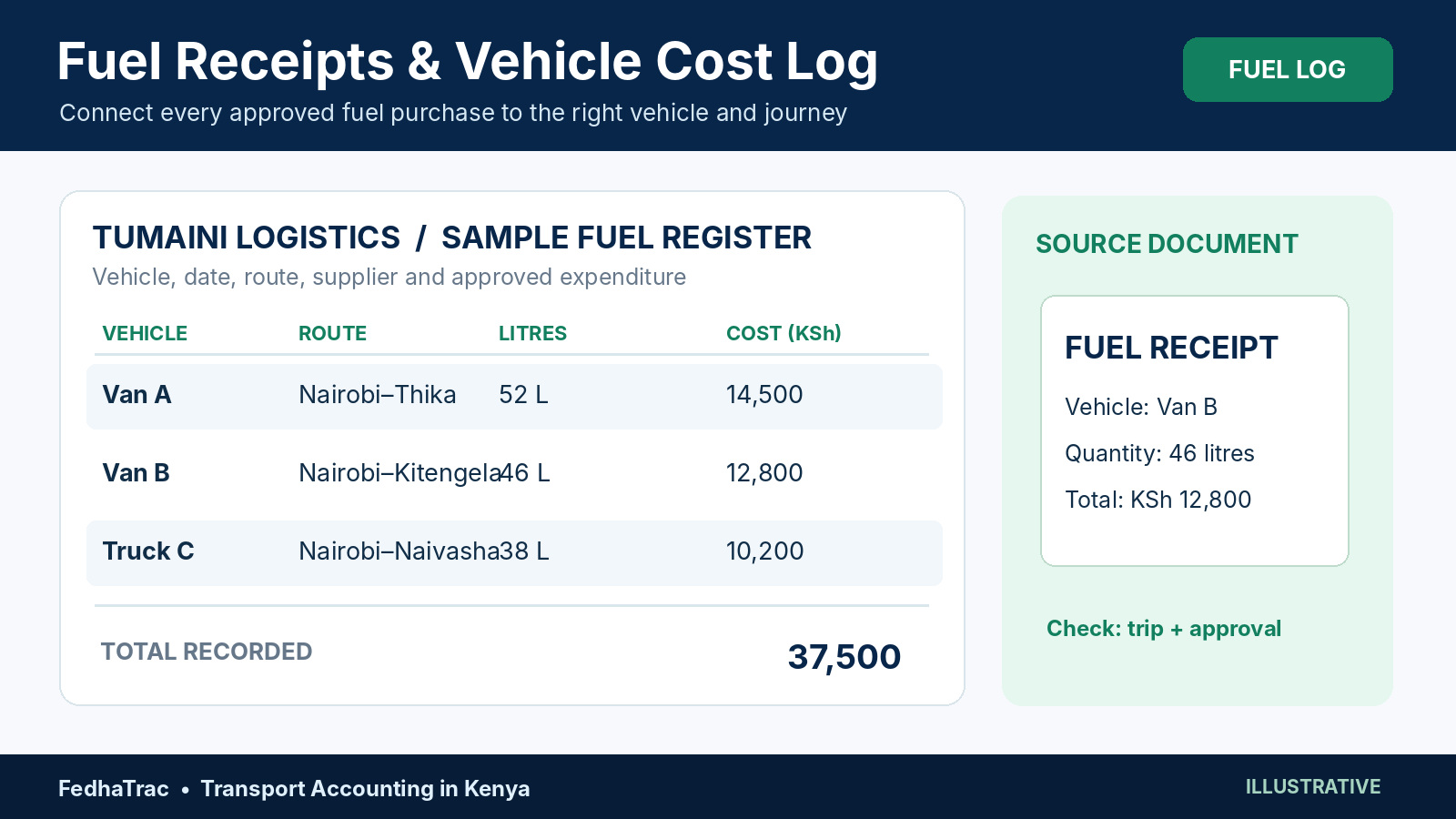
Sample fuel expense register matching fleet vehicles, journeys, receipts and recorded costs for transport accounting in Kenya.
Fuel is one of the most visible costs in Transport Accounting in Kenya, but a stack of petrol-station receipts is not a fuel-management system. Mercy needs the vehicle registration, date, litres, amount paid, supplier, odometer reading where available, and the journey or operating period. Fuel purchased for a company van should not disappear into a single monthly category that gives no insight into which vehicle consumed it.
For Transport Accounting in Kenya, a good process starts with authorised fuel purchases, receipts and a fuel log. Bookkeeping then records the cost in the correct period and, when practicable, links it to the vehicle or route. Comparing distance travelled with litres purchased may help Mercy investigate unusual patterns. Differences are signals for review, not proof that a driver did something wrong: traffic, load weight, detours, vehicle condition and driving conditions affect consumption.
FedhaTrac’s role is to help keep the expense records complete and reconcilable. Mercy and her fleet supervisor remain responsible for approving journeys, verifying odometer entries and investigating operating issues. In Transport Accounting in Kenya, the clearest results come when reliable operational evidence and accurate financial records work together.
3. Separate Routine Repairs From Major Vehicle Expenditure
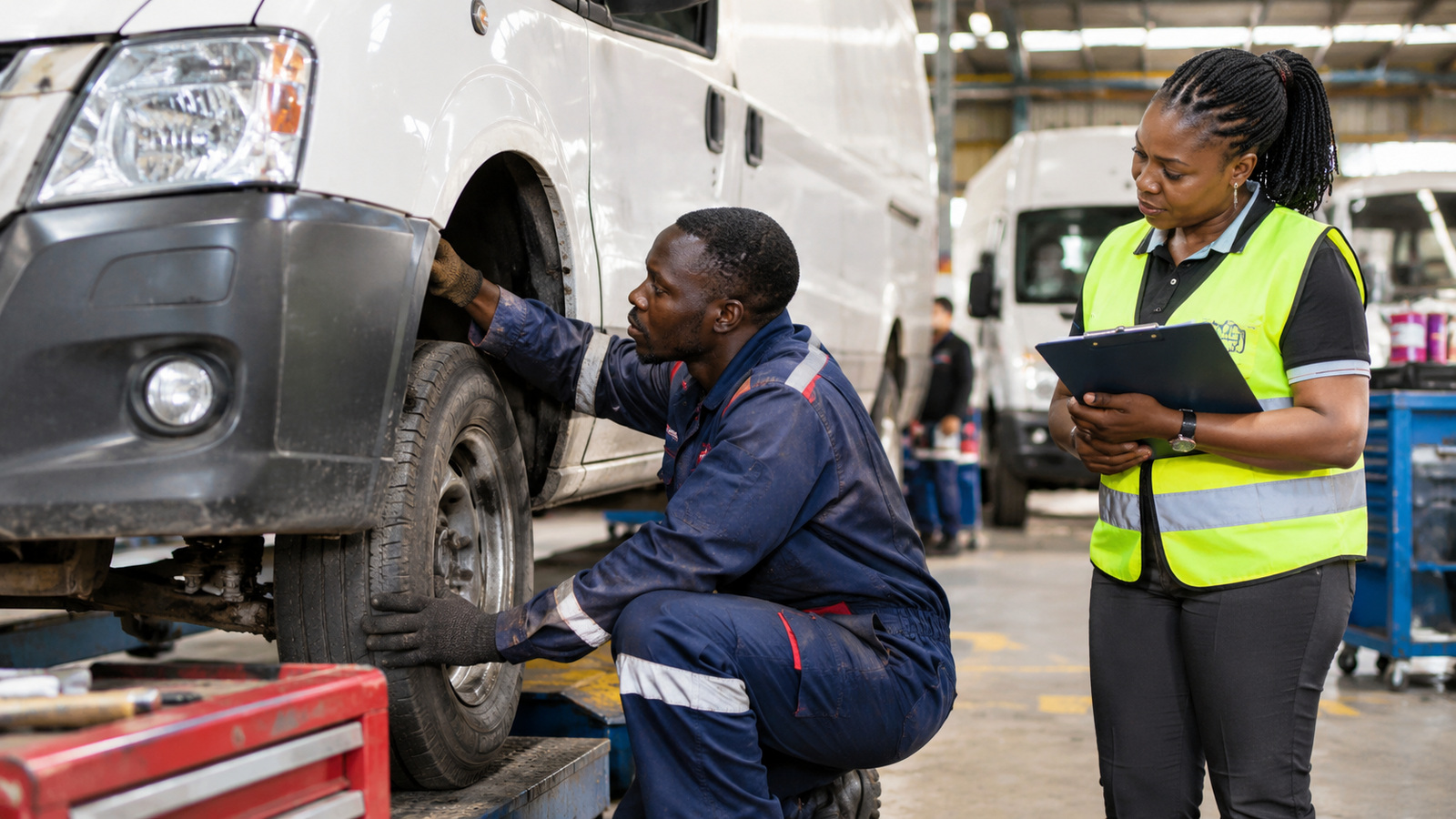
Kenyan mechanic inspecting a delivery van while a transport supervisor reviews maintenance documentation.
A transport business encounters punctures, oil changes, brake servicing, battery replacements, unexpected breakdowns and occasional major work. If Mercy labels all of them “miscellaneous expenses,” she loses a valuable view of fleet reliability. Transport Accounting in Kenya works better when repairs and servicing are recorded against each vehicle, with supplier details, invoice dates, work descriptions and payment status.
Not every large payment should be treated the same way in the accounts. Routine operating repairs may be expenses, while the purchase of a vehicle or an improvement that meets the relevant accounting criteria may need to be treated as an asset and accounted for over time. The correct approach depends on the transaction, accounting framework and tax rules; the amount alone does not determine the classification. A qualified accountant should review borderline cases.
For Tumaini Logistics, a simple maintenance-cost history can reveal whether a van is becoming unusually expensive to operate. For Transport Accounting in Kenya, FedhaTrac can help capture invoices, categorise expenditure and prepare cost reports. The mechanical judgment about whether a vehicle is roadworthy remains with the appropriate technical professionals.
4. Know Which Vehicles Actually Make Money
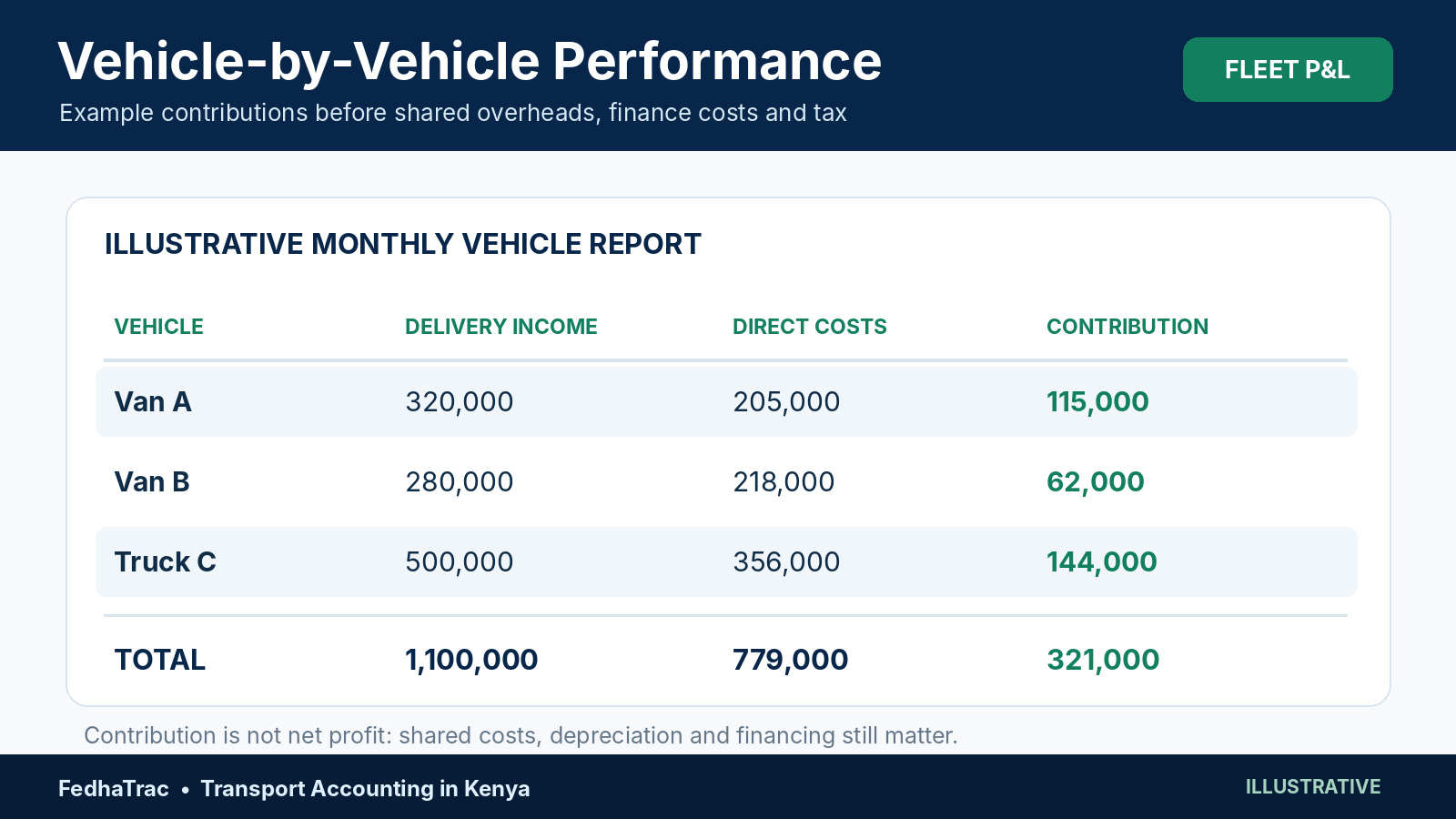
Illustrative vehicle profitability report comparing delivery income, direct costs and contributions for Tumaini Logistics.
The central question in Transport Accounting in Kenya is not merely “How much did our fleet earn?” Mercy also needs to ask: “What did each van or truck contribute after its direct costs?” A basic vehicle report should bring together attributable income, fuel, tolls, route-related charges, repairs, and other appropriate direct costs. Shared costs such as rent, office salaries or software should be allocated only using a sensible, consistent method where allocation helps management.
Consider a fictional monthly illustration, not Tumaini Logistics’ actual results:
| Vehicle | Delivery income | Direct operating costs | Contribution before shared overheads |
| Van A | KSh 320,000 | KSh 205,000 | KSh 115,000 |
| Van B | KSh 280,000 | KSh 218,000 | KSh 62,000 |
| Truck C | KSh 500,000 | KSh 356,000 | KSh 144,000 |
| Total | KSh 1,100,000 | KSh 779,000 | KSh 321,000 |
These contributions are not net profits. The company still needs to consider shared overheads, finance costs, depreciation where appropriate, taxes and other accounting items. Still, the example helps Mercy identify where to ask questions. Van B may need a route review, pricing adjustment or cost investigation; it should not automatically be withdrawn because its contribution is smaller.
With well-maintained Transport Accounting in Kenya records, FedhaTrac could help prepare this kind of report for management review. Transport Accounting in Kenya becomes useful when it supports decisions about pricing, capacity and fleet composition, rather than producing numbers that nobody acts on.
5. Match Customer Invoices to Receipts and Outstanding Balances
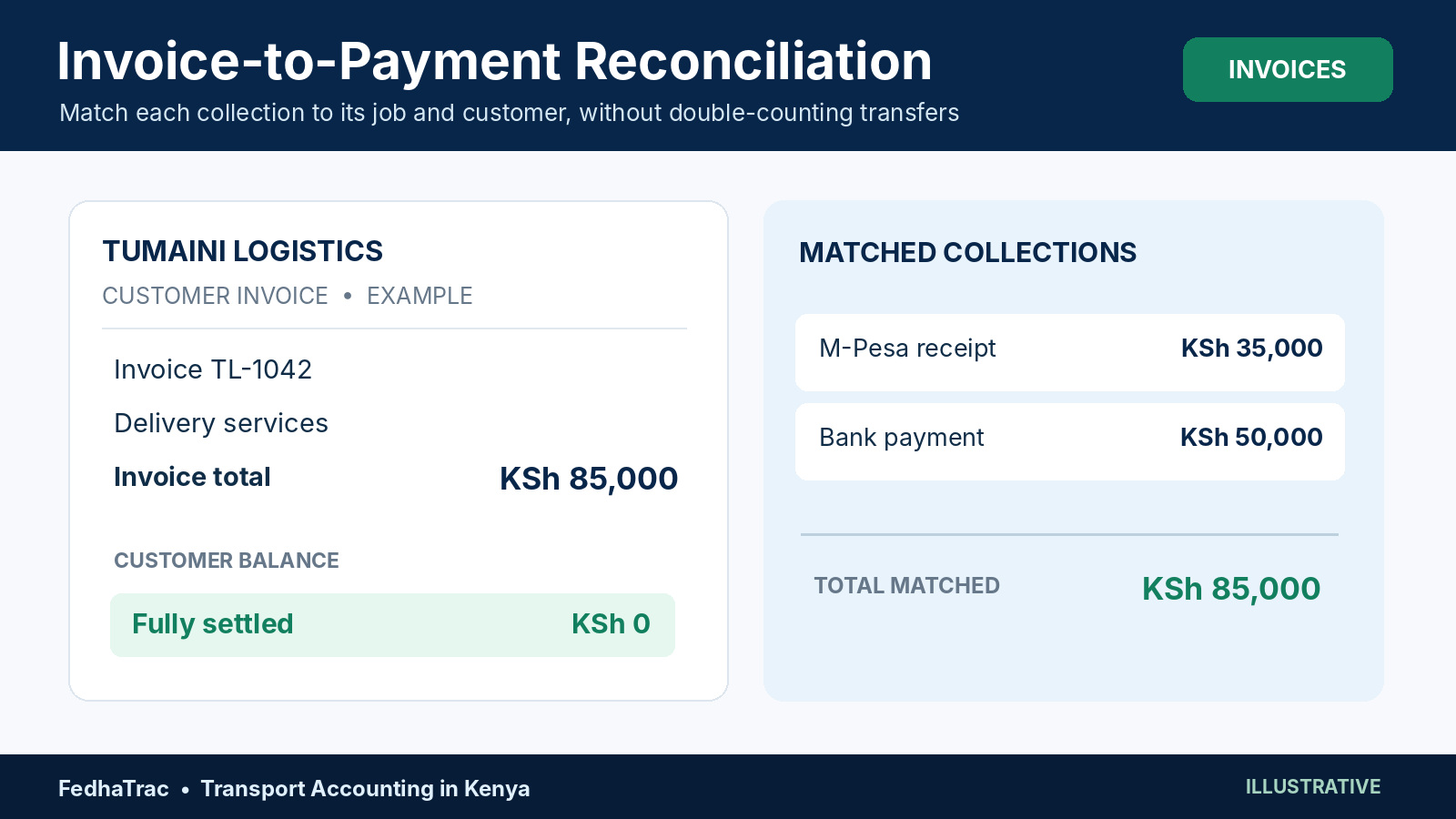
Illustrative customer invoice matched to bank and M-Pesa receipts, with an outstanding balance of zero.
Some customers pay deposits; others pay on delivery; corporate accounts may have agreed credit terms. Mercy needs to know which invoices have been issued, partly paid, fully settled or overdue. Clear expense tracking and invoicing helps connect the dispatch job to the customer account.
For Transport Accounting in Kenya, every receipt should be matched to the correct invoice. A transfer between Tumaini Logistics’ own M-Pesa and bank accounts is not new delivery revenue. Neither is a bank loan. This distinction is fundamental to Transport Accounting in Kenya because recording the same money twice can make fleet performance appear stronger than it is. FedhaTrac’s guides to M-Pesa bookkeeping and bank reconciliation explain how to connect payment channels without duplicating income.
Mercy can also review overdue invoices each week. An accounts-receivable ageing schedule shows how much is current, how much is past due and which customers require follow-up. Credit control remains a management decision, but accurate books give her a credible basis for those conversations and help protect cash needed for daily operations.
6. Control Driver Advances, Trip Claims and Supplier Payments
Trips can require cash advances for approved expenses, and employees may submit receipts after returning to the depot. Transport Accounting in Kenya should distinguish advances awaiting accountability from confirmed business expenses. For example, giving a driver KSh 8,000 for an authorised journey does not necessarily mean the full KSh 8,000 was spent. Receipts, unused funds and approved items should be reconciled when the trip ends.
An effective trip-claim process records the advance, relevant vehicle or job, approved categories, receipts, return of unused funds and any authorised reimbursement. This does not mean FedhaTrac is running Mercy’s dispatch department or payroll system. Rather, it can help organise the financial evidence and accounting treatment once the company has supplied and approved its records.
The same discipline applies to suppliers as part of Transport Accounting in Kenya. Tyre vendors, mechanics, fuel stations and warehouse service providers may offer credit. A supplier ledger shows invoices received, credit notes, payments made and balances still payable. If Mercy knows what is due next week, she can plan payments instead of discovering liabilities when a supplier calls. Such control is an essential part of Transport Accounting in Kenya.
7. Forecast Cash Before Adding Another Truck
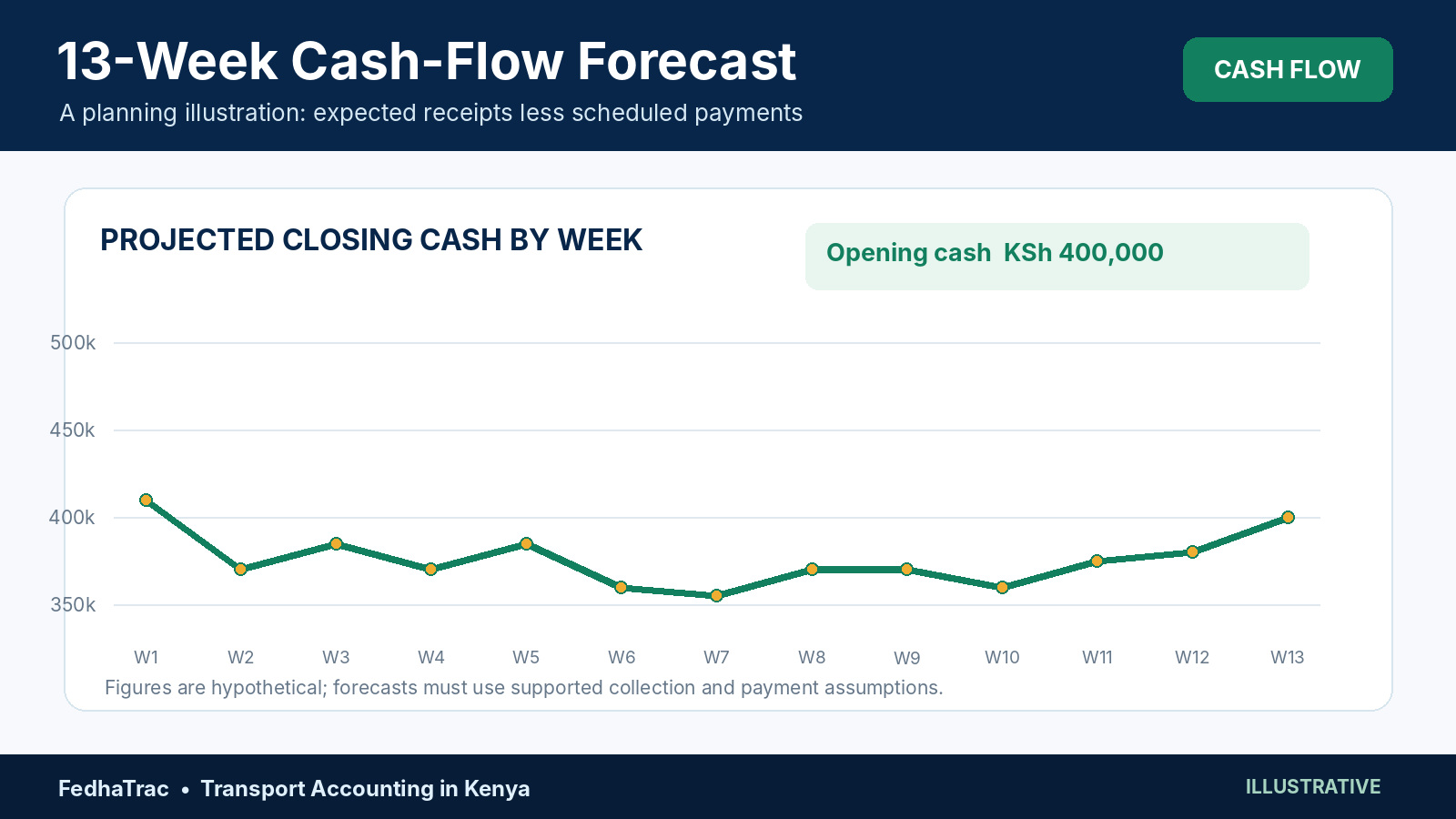
Illustrative 13-week logistics cash flow forecast showing projected closing cash by week.
Mercy is considering another delivery truck. Demand looks promising, but the purchase must be evaluated against the company’s cash requirements, not only its expected sales. Transport Accounting in Kenya should include a rolling cash forecast that places expected customer collections and upcoming payments on dates. Fuel, repairs, supplier balances, rent, statutory obligations and debt servicing can then be reviewed alongside the proposed investment.
For Transport Accounting in Kenya, a practical 13-week forecast can start with opening available cash, add realistic expected receipts, subtract anticipated cash payments and show the projected closing balance each week. It should distinguish committed customer receipts from hopeful sales forecasts. The forecast can also model a breakdown or a major customer’s late payment so Mercy understands her exposure before making a large commitment.
A cash-flow statement explains historical cash movement, while a forecast helps management prepare for what may happen next. Both differ from profit. A new vehicle loan may increase cash initially without creating sales, and a loan repayment can reduce cash without being fully classified as a current operating expense. Good Transport Accounting in Kenya keeps these effects clear.
8. Maintain Vehicle Asset and Finance Records
Each vehicle represents a significant investment. Mercy should maintain an asset register with identification details, purchase date, acquisition cost, finance arrangements, major improvements, disposals and relevant accounting information. The register should be supported by ownership and purchase documentation and reconciled to the financial statements as appropriate.
A vehicle financed through a loan or other arrangement needs careful classification. The business must distinguish loan principal, interest, applicable asset amounts and related cash movement. Tax deductions and accounting depreciation are not automatically identical. FedhaTrac can help maintain the underlying books and prepare schedules, while the proper treatment should be assessed under the applicable accounting and tax framework.
This side of Transport Accounting in Kenya matters when Mercy compares buying with hiring a vehicle, considers refinancing, or assesses whether to replace an ageing van. A realistic decision uses purchase price, financing, utilisation, future maintenance, residual value and cash capacity rather than assuming that more vehicles always produce more profit.
9. Keep eTIMS and Tax Records Ready Throughout the Year
Transport Accounting in Kenya must also support the applicable Kenyan tax obligations. KRA’s eTIMS guidance states that people engaged in business generally need to onboard and issue electronic tax invoices, including businesses that are not registered for VAT, subject to the relevant rules and exceptions. Businesses should keep valid supplier documentation and use the appropriate invoicing process for the transactions they undertake.
VAT registration is generally required where taxable supplies reach or are expected to reach KSh 5 million in a year; the actual VAT treatment of particular transport services and supplies should be checked rather than assumed. KRA has also explained that the 2026 year-of-income treatment of declared income and expenses involves electronic-invoice support, with relevant legal exceptions. Mercy should review her circumstances with an appropriately qualified tax adviser instead of applying one rule to every possible transaction.
FedhaTrac can help organise invoices, bank records, expense schedules and bookkeeping information for tax preparation and KRA returns. Separately, Tumaini Logistics remains responsible for the vehicle, driver, insurance, road-use and other operating requirements that apply to its activities. Transport Accounting in Kenya supports compliance through evidence; it is not a substitute for specialist transport licensing or legal advice.
10. Read Monthly Reports and Make Better Fleet Decisions

Kenyan logistics owner Mercy reviewing financial reports and fleet performance with an accountant at Tumaini Logistics.
At month-end, Mercy should be able to see a straightforward management pack: revenue by vehicle or route, direct operating costs, contribution, shared expenses, customer receivables, supplier payables, bank and M-Pesa reconciliations, and a forward cash view. This is more useful than collecting receipts in a box and waiting until year-end to reconstruct the accounts.
The monthly review should produce actions. Which routes carry attractive margins? Which invoices need follow-up? Are tyres or maintenance becoming more expensive? Does Van B need better scheduling? Is there enough cash to fund a deposit on the planned truck? Mercy can compare results with the previous month and with her own budget, allowing for seasonal changes and unusual one-off costs.
A sound profit and loss statement gives the overall result, while vehicle reports reveal operational patterns. For Tumaini Logistics, the value of Transport Accounting in Kenya is the ability to connect both perspectives and understand what is driving the business forward.
A Practical Weekly Routine for Tumaini Logistics
She needs a routine that her team can actually maintain. The following workflow can be adjusted to the number of vehicles and the complexity of the company.
Every working day
Record completed deliveries and billing references. Capture fuel purchases, approved trip expenses and supplier invoices promptly. Keep the supporting documents and identify the correct vehicle wherever practical. Separate company transactions from personal payments.
Every week
Review unpaid customer invoices, reconcile trip advances, investigate missing receipts, and check fuel and repair costs that look unusual. Confirm upcoming supplier payments and review the next few weeks of cash requirements. Transport Accounting in Kenya is easier when exceptions are investigated while the trip details are still fresh.
Every month
Reconcile all significant bank and M-Pesa accounts, review vehicle-level cost reports, examine aged customer and supplier balances, update cash forecasts and discuss the management accounts. FedhaTrac can support this process through bookkeeping and reporting services agreed with the business. Regular reviews help Mercy respond while decisions can still change the result.
Frequently Asked Questions About Transport Accounting in Kenya
Can a busy vehicle still lose money?
Yes. Frequent deliveries do not guarantee a good margin. Fuel, repairs, tolls, driver-related costs, depreciation and shared overheads can consume revenue. Vehicle-level reporting helps identify the reasons, although an accurate calculation requires a consistent approach to costs and sensible interpretation.
Should every fuel receipt carry a vehicle number?
Linking fuel purchases to the relevant vehicle is helpful where practical. Registration details, litres, purchase amount, supplier, trip information and available odometer readings can make consumption patterns easier to investigate. The aim is a reliable record, not unnecessary administrative work.
Is a transfer from M-Pesa to the company bank account new income?
Usually not when both accounts belong to the same business. It is typically a transfer of existing money. Recording the original customer payment and the subsequent transfer as two sales would overstate revenue. The accounts should be reconciled together.
Does FedhaTrac manage trucks, drivers or transport permits?
This article concerns financial records and reporting, not fleet operations or professional transport compliance. FedhaTrac’s potential role includes agreed bookkeeping, reconciliation, financial reporting and tax-record support. Vehicle operation, driver supervision and applicable permits remain with the business and relevant specialists.
Let FedhaTrac Help You See the Numbers Behind Every Delivery
Mercy started Tumaini Logistics because she saw an opportunity to serve customers reliably. As her fleet grows, she needs financial records that are just as dependable as her delivery service. Transport Accounting in Kenya gives her a clearer view of cash, customer debts, fuel costs, maintenance trends and the contribution made by each vehicle.
If your transport, courier or delivery business is growing, explore FedhaTrac’s bookkeeping support and discuss the records your operation needs. Organised books will not remove every breakdown, delay or difficult customer, but they can help you make decisions with greater clarity and confidence.


