

Warehouse Bookkeeping in Kenya is rarely as straightforward as counting boxes and issuing storage invoices. At Go Downing Warehousing INC, a busy fictional logistics business in Kenya, forklifts move through packed aisles, receiving teams check incoming pallets, and dispatch workers prepare goods for collection. Behind that activity are financial questions that deserve just as much attention: Which customer should be billed? What goods are held on someone else’s behalf? Which service charges remain unpaid? And how much does the warehouse actually earn after operating costs?
FedhaTrac can help businesses like Go Downing Warehousing INC answer those questions through organised bookkeeping, reconciliations, expense tracking and management reporting. Warehouse Bookkeeping in Kenya works best when the physical movement of goods is connected to supporting records, while the business’s own accounting distinguishes customer property, earned service revenue, business expenses and money collected in advance. That separation is essential for both sound decisions and accountable customer relationships.
Consider the experience of Daniel, a fictional operations manager at Go Downing Warehousing INC. His warehouse has received more enquiries from retailers, wholesalers and distributors, but increased activity has not automatically produced greater profits. Staff can tell him which truck arrived, yet invoices are sometimes delayed. Customers query storage days, and the finance team struggles to match some receipts to specific accounts. FedhaTrac’s value is to bring financial structure to the operation without pretending bookkeeping replaces warehouse safety, stock-handling expertise or the company’s operational controls.
A Busy Warehouse Needs More Than a Busy Yard

Staff supervise dispatch and loading of cartons into a truck at a Kenyan warehouse dock
Warehouse Bookkeeping in Kenya begins with one practical insight: activity and revenue are not the same thing. One client may fill fifty pallet spaces but pay late. Another may use only ten spaces and request frequent handling services. A busy loading bay can create transport, overtime and equipment costs that exceed the extra handling income generated.
For Go Downing Warehousing INC, Daniel needs consistent definitions for receiving, storage, picking, dispatch and any agreed additional services. He also needs a reliable record of when a service was performed and the contractual rate that applies. FedhaTrac can help translate those operational events into traceable invoices, customer balances and management reports. This helps the company see where income comes from rather than judging success by how many vehicles enter its gates.
Good Warehouse Bookkeeping in Kenya also makes the day easier for customers. Warehouse Bookkeeping in Kenya should create evidence that the customer can inspect, not just a total on a bill. A client can ask about a disputed charge and receive a clear explanation supported by a goods-received note, movement log and invoice. Fewer unexplained charges can mean fewer payment disputes and more confidence in the service relationship.
Begin With Goods Received Notes and Reliable Stock Movements
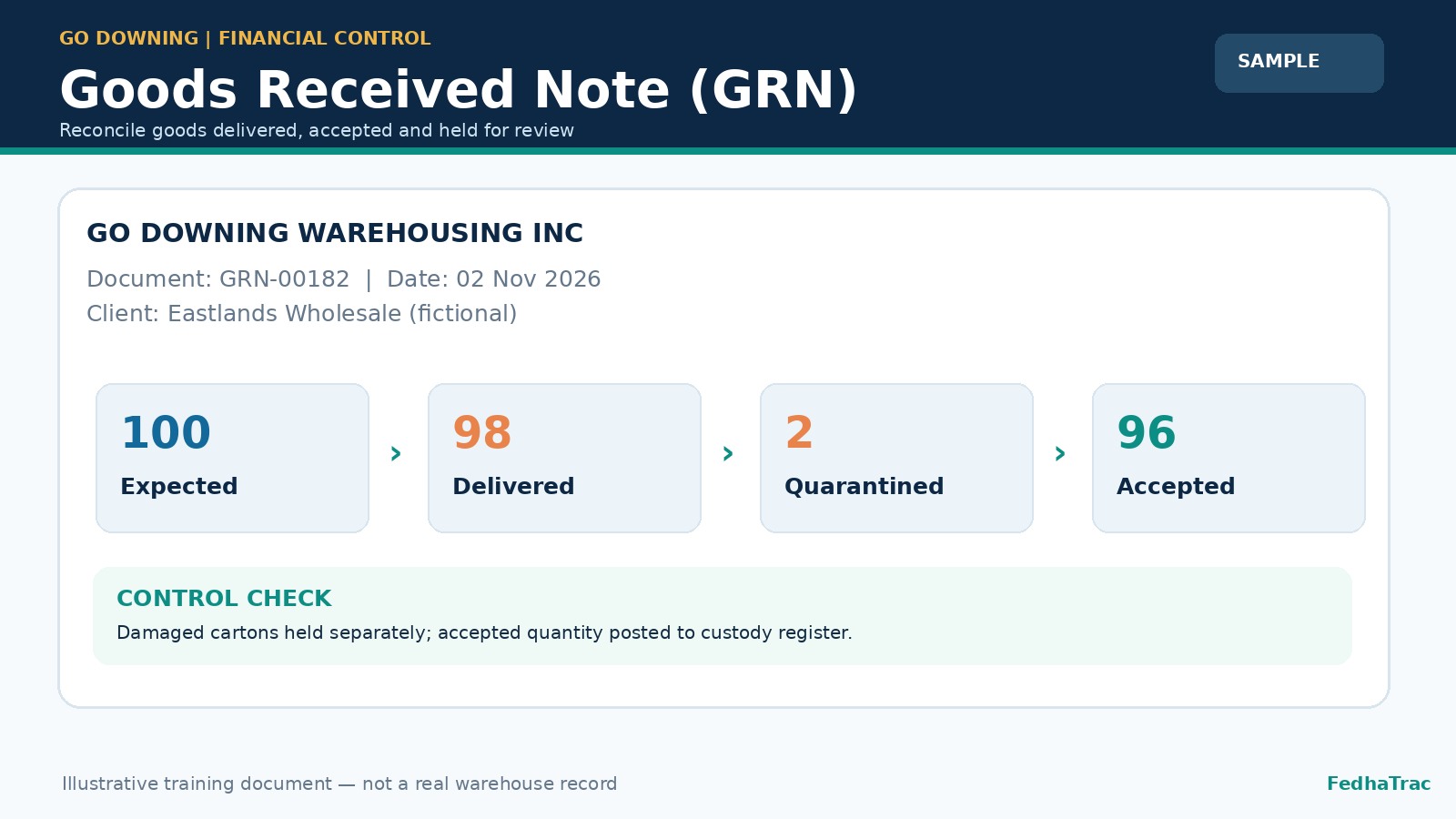
Illustrative goods received note showing expected, delivered, quarantined and accepted cartons
When a delivery reaches the warehouse, the receiving team should record the date, customer, delivery reference, item description, units or pallets, condition and storage location. Differences between expected and actual quantities should be escalated promptly. A goods-received note, often called a GRN, supports the warehouse’s operational inventory record and later forms part of the evidence for charges where the contract allows receiving fees.
Warehouse Bookkeeping in Kenya is stronger when each GRN has a unique reference that can be connected to the customer’s account. Daniel can trace one pallet from arrival to storage and eventual dispatch without asking staff to reconstruct events from memory. When picking or despatch occurs, a dispatch note and stock movement record should complete the trail. Barcode scans and warehouse management systems can make that process easier, but a spreadsheet or paper register can still work when it is consistently controlled and reviewed.
A key distinction matters: goods received for a storage customer usually remain the customer’s property, not the warehouse operator’s trading inventory. The warehouse must keep an accurate custody or quantity record without automatically recording the customer’s merchandise as its own asset. The accounting depends on contracts and ownership. For goods the operator owns, the IFRS Foundation’s IAS 2 Inventories guidance is relevant where that standard applies; it does not turn customer-owned goods held in custody into the warehouse’s assets. Mixing third-party goods with company stock can distort the balance sheet. FedhaTrac can support the bookkeeping classification while warehouse staff remain responsible for the physical count and condition of goods.
Invoice Storage and Handling Services Without Guesswork
Storage agreements can charge per pallet, bin, square metre, day, week or month. Handling fees, loading, unloading, picking, packing, returns processing and other services may be priced separately. Warehouse Bookkeeping in Kenya should therefore start with a clear rate card or customer-specific contract, not a general assumption about what every client owes.
Imagine a simplified, illustrative customer account that records 180 pallet-days at KSh 35 each, plus two separately chargeable handling movements at KSh 250 each. Storage fees would be KSh 6,300 and handling charges KSh 500, producing a KSh 6,800 service subtotal before any applicable tax. If the customer pays KSh 4,000 against that invoice, the unpaid balance is KSh 2,800. These are invented teaching figures, not Go Downing Warehousing INC’s actual prices or results.
The financial record should connect those charges to dated warehouse activity and to the issued invoice. Warehouse Bookkeeping in Kenya therefore relies on both the rate agreement and an auditable service record. That is where a practical expense tracking and invoicing process becomes useful. FedhaTrac can help ensure invoices are raised consistently, corrections are recorded properly, and overdue amounts are visible before cash shortages become serious.
Keep Customer Stock, Deposits and Warehouse Revenue Separate
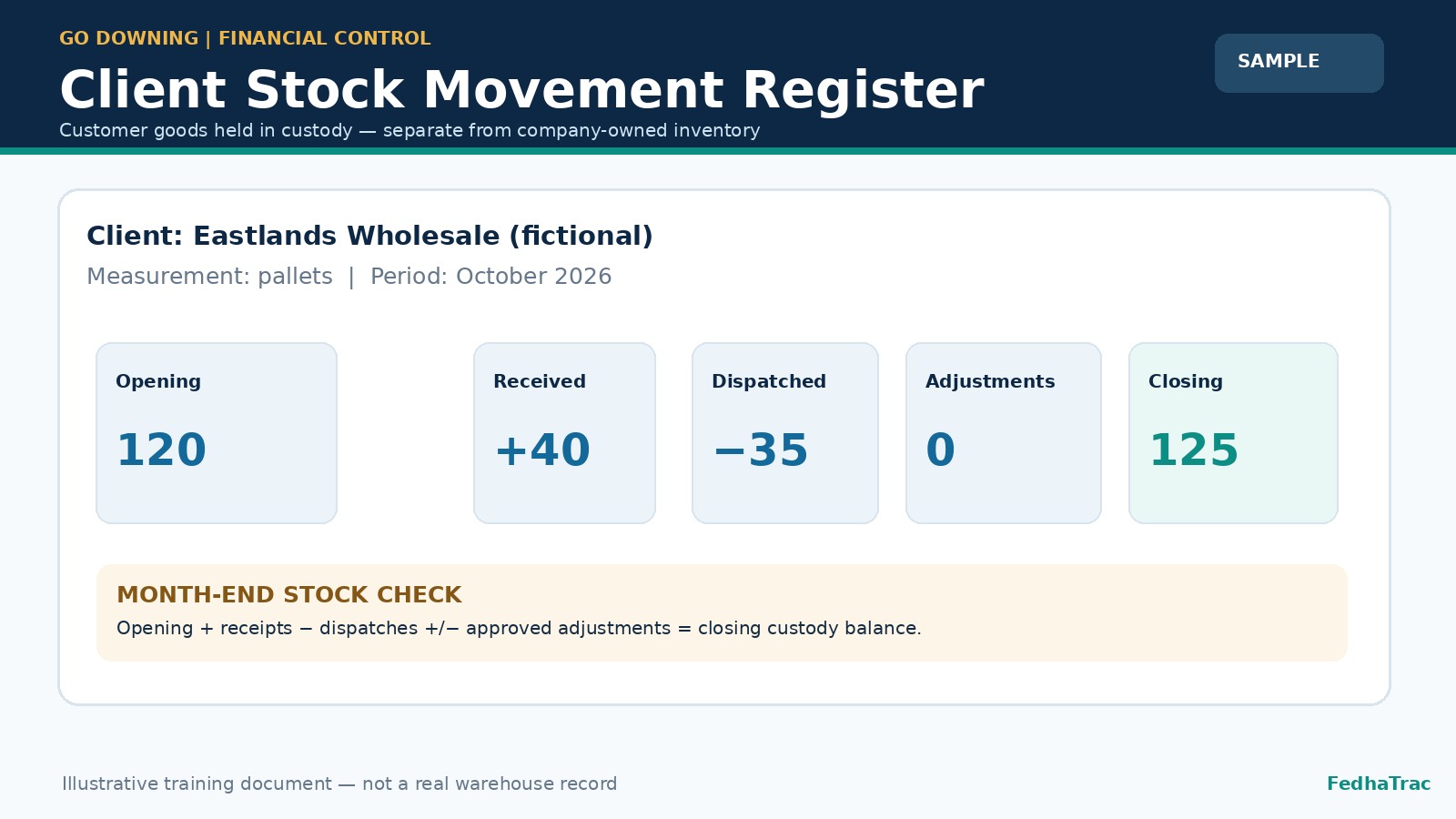
Sample client stock register: 120 opening pallets, 40 received, 35 dispatched and 125 closing pallets
Warehouse Bookkeeping in Kenya can become misleading when every cash receipt is treated as earned income. A customer might pay in advance for future storage, leave a refundable security deposit or settle an older invoice. Those events have different accounting effects. A deposit that must be refunded is generally a liability rather than immediate sales revenue; advance payments may need to be recognised as income over the period in which services are performed, depending on the applicable accounting framework and contract.
For Daniel, this distinction protects the warehouse against false confidence. A large bank deposit does not necessarily mean the current month was profitable. Equally, an issued invoice may recognise revenue before cash has arrived. FedhaTrac helps Go Downing Warehousing INC maintain customer ledgers that distinguish billed services, payments received, credit notes, deposits and outstanding balances.
Warehouse Bookkeeping in Kenya also requires discipline around third-party stock. A pallet owned by a client should not become part of company purchases merely because it sits on the warehouse floor. Likewise, if the company purchases its own packaging materials, uniforms or spare parts, those need separate records. Clean classification makes financial statements more meaningful and reduces confusion during reviews. Warehouse Bookkeeping in Kenya depends on distinguishing the goods being safeguarded from the services being sold.
Reconcile M-Pesa, Bank Transfers and Customer Accounts
Clients may settle invoices through M-Pesa, bank transfers or other accepted channels. Some send one payment covering several invoices; others use incomplete references. The finance team should identify the payer, date, transaction reference, amount and invoice allocation. Any unidentified receipt belongs in an investigation process rather than being allocated at random.
Warehouse Bookkeeping in Kenya improves when balances are reconciled regularly. A payment received through M-Pesa and then transferred to the company’s bank account should not be counted as sales twice. The transfer is movement between the company’s own payment channels, while the underlying customer receipt is recognised once. FedhaTrac can support these controls through M-Pesa bookkeeping and regular bank reconciliation.
Go Downing Warehousing INC can also review its receivables by age. Warehouse Bookkeeping in Kenya should highlight overdue accounts early enough for a practical response. Warehouse Bookkeeping in Kenya also makes it easier to record the action taken and the result. A balance outstanding for seven days may need a reminder; one that is several months old may require a documented follow-up and a review of the customer’s credit terms. The point is not to pressure customers indiscriminately, but to show Daniel when cash collection is falling behind the warehouse’s operational commitments.
Know the True Cost of Operating the Facility
A warehouse can generate healthy invoices while losing money through unmanaged operating costs. Rent, electricity, security, cleaning, equipment servicing, repairs, insurance, internet, staff-related costs and materials all affect the cost of providing storage and handling services. Warehouse Bookkeeping in Kenya should categorise expenses in a way that management can use.
At Go Downing Warehousing INC, Daniel may discover that a particular customer frequently requests labour-intensive handling, while another occupies space that could be offered more profitably under a different agreement. He needs accurate costs before making that judgment. FedhaTrac can help classify expenditure by cost centre or activity where the underlying records are sufficiently detailed, and then prepare monthly comparisons against the business’s budget.
Equipment purchases also deserve attention. Warehouse Bookkeeping in Kenya needs to show why a long-term equipment investment differs from routine operating expenditure. Buying a forklift or substantial racking system is not necessarily the same accounting event as paying for routine repairs. Capital expenditure, depreciation, repairs and financing payments should be assessed separately under the appropriate accounting policies. Warehouse Bookkeeping in Kenya gives management a clearer view when those decisions are documented instead of buried in one undifferentiated expense total.
Protect the Business Against Shrinkage, Damage and Disputes

Warehouse workers verify pallet locations and stock records along organised warehouse aisles
Missing cartons, breakages, water exposure and inaccurate picking can create customer claims, operational delays and potentially significant costs. A bookkeeper cannot inspect goods remotely, but clear financial records can support an effective claims process. Every incident should have a reference, date, affected customer, item details, photographs where appropriate, investigation notes, contract terms and documented resolution.
Warehouse Bookkeeping in Kenya works with stock-control procedures rather than replacing them. The warehouse’s operational team should reconcile physical counts against custody records, report discrepancies and approve write-offs or adjustments according to policy. The accounts team should separately consider whether any compensation is owed, whether a recoverable insurance claim exists and when an accounting provision or expense is appropriate. Those treatments should not be invented simply because a damage report has been opened.
For Go Downing Warehousing INC, the benefit is accountability. Daniel can identify recurring patterns, such as damage associated with a particular handling point, and discuss corrective action. FedhaTrac can help the business keep the financial consequences traceable, while management and advisers determine contractual or legal liability where a dispute arises.
Budget for Equipment, Space and Seasonal Demand
Warehouse Bookkeeping in Kenya becomes more valuable when it informs the future, not just the previous month. A busy season may require extra shifts, consumables, vehicle movements or short-term equipment hire. A quieter season can leave storage capacity underused while fixed rent and security bills continue. Daniel needs forecasts based on realistic expected activity and payment timing.
A monthly budget can compare projected storage revenue, handling income, direct labour, utilities, rent and planned maintenance. A short-term cash forecast should then show when customers are likely to pay and when the warehouse must settle suppliers. The two reports answer different questions: one assesses expected operating performance; the other assesses whether sufficient cash will be available on the required dates.
FedhaTrac can support both through orderly records and financial reporting. Its cash-flow guidance for Kenyan businesses explains why a profitable month does not guarantee a comfortable bank balance. Warehouse Bookkeeping in Kenya turns that principle into a practical question for Daniel: Can the company pay its obligations while waiting for large customers to settle their invoices?
Build a Reporting Dashboard That Management Can Trust
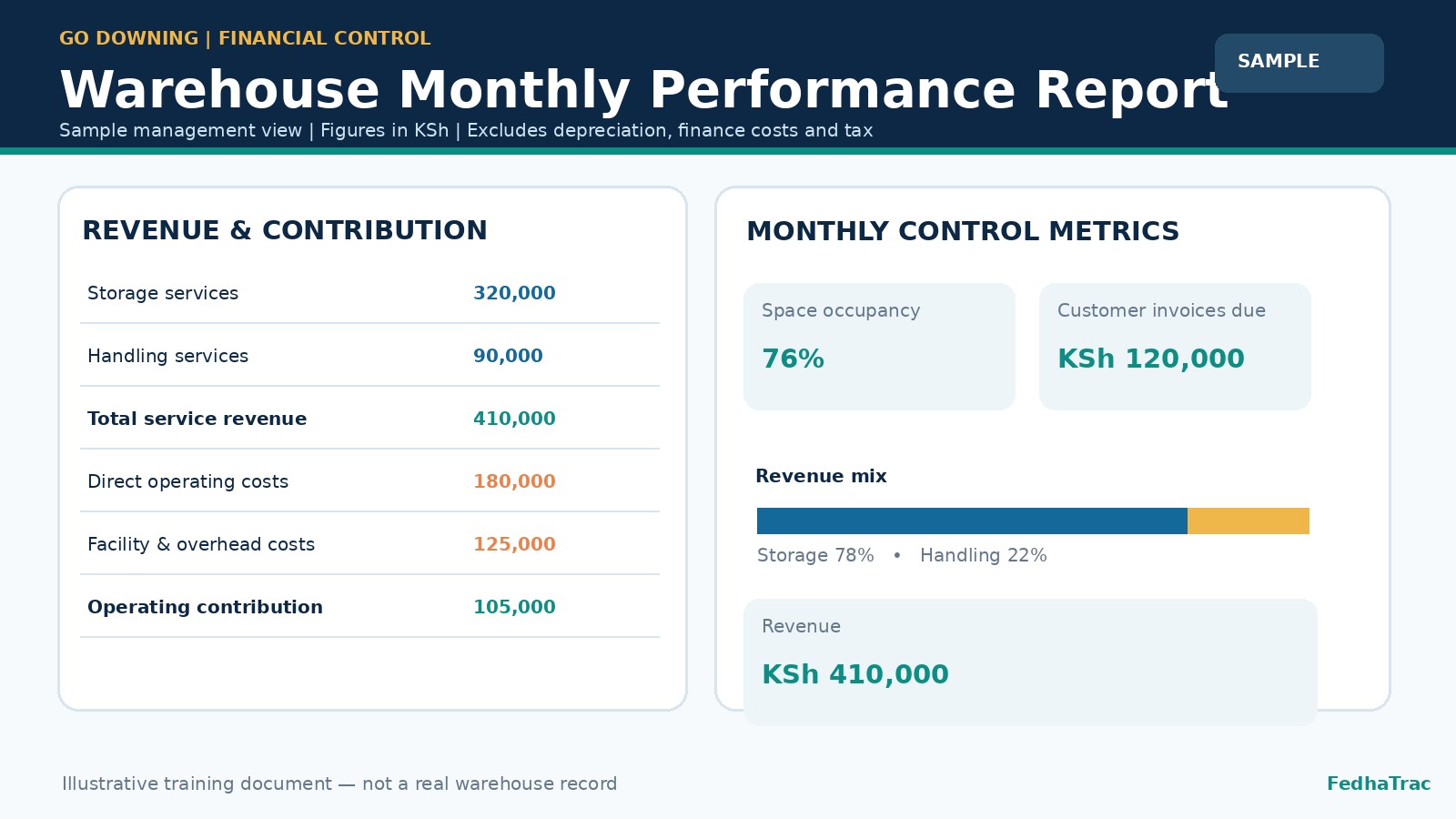
Illustrative warehouse management dashboard showing service revenue, operating costs and receivables
The best reports are not necessarily the most complicated. Go Downing Warehousing INC can begin with a monthly view of invoiced storage income, handling income, customer debtors, operating costs, cash received and cash available. Operational indicators may include pallet occupancy, goods received, goods dispatched, stock discrepancies and incident counts, provided those figures come from verified warehouse records.
Warehouse Bookkeeping in Kenya improves decision-making when operational statistics and financial reports tell a consistent story. If occupancy rises but storage income does not, Daniel can investigate free storage periods, unbilled days or incorrect customer rates. If dispatch activity increases but handling margin falls, he may need to review labour requirements and contract pricing. FedhaTrac can prepare financial reports and help management ask useful questions of the figures.
Management should also review unusual changes rather than concentrating on headline profit. Warehouse Bookkeeping in Kenya is more useful when every variance leads to a specific question and an accountable follow-up. Has a debtor balance grown faster than sales? Are electricity costs rising despite stable occupancy? Have repairs increased since a piece of equipment began failing? An orderly profit-and-loss statement and cash report make these questions easier to answer.
Keep eTIMS and Tax Records Ready for Review
Warehouse Bookkeeping in Kenya should support Kenyan tax requirements without confusing bookkeeping with legal or tax rulings. The Kenya Revenue Authority’s eTIMS guidance explains that persons engaged in business are generally required to onboard the system and issue electronic tax invoices, subject to applicable rules and exceptions. A warehouse operator should establish the correct treatment of each taxable service and ensure its invoices match the actual services supplied.
KRA’s VAT registration guidance explains that registration is generally required when taxable supplies reach or are expected to reach KSh 5 million in a year, subject to applicable law and eligibility rules. This is a registration threshold, not a statement that every type of receipt or every storage agreement attracts the same VAT treatment. Go Downing Warehousing INC should have its actual services and registration position reviewed rather than relying on a blanket assumption.
In its income-tax return filing notice, KRA confirms that 2025 returns had transitional allowances for some expenses lacking eTIMS/TIMS invoices, while the 2026 year of income faces stricter electronic-invoice support requirements, subject to statutory exceptions. For Warehouse Bookkeeping in Kenya, that makes supplier documentation, invoice references and complete reconciliations especially important. FedhaTrac’s eTIMS guide can help readers understand the process, while the warehouse should seek professional guidance for its specific obligations, particularly if it offers customs-related or bonded warehousing services subject to additional rules.
Put Clear Financial Responsibilities Around Every Warehouse Activity
A useful control structure makes roles visible. Warehouse staff should confirm actual goods received and released; customer service staff should verify agreed rates and exceptions; authorised managers should approve credits or unusual payments; and the bookkeeping process should reconcile invoices, receipts and expenses. When a small team cannot fully separate every duty, independent review becomes particularly important.
Warehouse Bookkeeping in Kenya is stronger when Daniel has a clear route for resolving discrepancies. An unapproved rate reduction, unmatched receipt or missing dispatch reference should be investigated before month-end. The company should protect confidential customer records and limit access to financial and inventory information according to job requirements. FedhaTrac can help provide the bookkeeping discipline and reporting rhythm, while Go Downing Warehousing INC retains control over its own staff, authorisations and warehouse operations.
How FedhaTrac Helps Go Downing Warehousing INC Grow With Confidence
Daniel’s story is fictional, but the pressures are familiar to warehouse operators across Kenya. Space is costly, customers demand traceability, and high activity can disguise weak margins or overdue debts. Warehouse Bookkeeping in Kenya provides the financial visibility required to grow without losing control of the basics.
FedhaTrac offers outsourced bookkeeping, reconciliation, accounting support, reporting and Kenya-focused tax-compliance services. For a warehouse business, those services can help bring together customer invoices, expenses, supplier balances and payment records into a dependable monthly picture. The company can then make more informed choices about rates, staffing, equipment investment, payment terms and future capacity.
Warehouse Bookkeeping in Kenya will not prevent every damaged carton, delivery delay or customer dispute. It will, however, make it easier to see what happened financially, what remains unresolved and what management needs to address. If your warehouse is growing faster than its records, explore FedhaTrac’s bookkeeping support and discuss the scope of help your operation actually needs. Better records can turn a crowded warehouse into a more accountable, better-managed business.


