

On a busy morning at a Baraka Builders Limited project, the tower crane is lifting steel, a concrete mixer is waiting beside the entrance, and dozens of workers are moving between floors. Juma, the company’s founder, can see the building taking shape. What he cannot see quite as easily is whether the project is still making money. He has supplier bills arriving, subcontractors awaiting certification, equipment-hire charges accumulating, and a customer payment that may not arrive for several weeks. Construction Bookkeeping in Kenya is the financial discipline that connects all those moving parts.
Juma’s company is a fictional example, but his challenges are familiar to contractors managing apartments, commercial premises, renovations, and specialist works. A busy site is not proof of a healthy margin. One unpaid variation, duplicated delivery, or misplaced fuel receipt can distort the picture. FedhaTrac can support a company like Baraka Builders Limited by organizing transaction records, reconciling payments, and preparing useful financial information for management. Construction Bookkeeping in Kenya becomes much more valuable when it helps a contractor decide what to do before a budget is exhausted.
Why a Busy Construction Site Can Still Lose Money
Construction Bookkeeping in Kenya is different from recording a single shop’s daily sales. Projects extend over weeks or months, costs are incurred in stages, and payments depend on contract terms, approvals, and actual progress. Juma may operate three sites at once: an apartment block in Nairobi, a retail fit-out in Kiambu, and renovation work in Nakuru. If every fuel receipt, building-material purchase, and supplier payment goes into one general expense account, he cannot know which project is profitable.
A better approach gives every project a clear reference and records each cost against it. It also separates directly attributable project costs from company-wide overhead, such as the head office’s internet, accounting support, or general administration. Juma then sees where funds are being used rather than relying on memory. Contractors need records that support operational decisions as well as tax reporting; the strongest system connects estimates, purchase orders, deliveries, invoices, and bank transactions without pretending that bookkeeping replaces engineering supervision.
Give Every Project Its Own Cost Code
For Baraka Builders Limited, Construction Bookkeeping in Kenya can start with simple, consistent codes: BB-NBI-01 for the apartment project, BB-KBU-02 for the retail fit-out, and BB-NKR-03 for renovation work. Within each project, material purchases, subcontractor charges, site wages, machinery hire, transport, and permits can be grouped into meaningful categories. Each document then carries the project code and the relevant cost category.
This structure helps Juma answer questions that matter: How much cement and steel has the Nairobi project consumed? Which subcontractor balance remains unpaid? How much equipment hire is still committed? Are site-level costs rising faster than approved progress? Accurate Construction Bookkeeping in Kenya also makes it easier to separate expenses that have been incurred from purchase orders that have merely been approved. A commitment is important for forecasting, but it should not automatically be confused with a paid invoice or an accounting expense.
FedhaTrac’s expense tracking and invoicing guide explains how consistent documentation supports stronger business control. Juma can apply the same basic discipline to each construction site without turning the financial records into an unnecessarily complicated system.
Control Materials From Purchase Order to Delivery

Kenyan construction team scanning cement bags and recording rebar deliveries against purchase orders at Baraka Builders.
Materials can consume a large share of a construction budget. Construction Bookkeeping in Kenya needs to connect the supplier quotation, approved purchase order, delivery note, receiving confirmation, and invoice. If Juma orders 500 bags of cement but the site confirms only 470, the discrepancy should be investigated before the invoice is approved. Likewise, if a supplier delivers steel in two batches, staff should check quantities and specifications instead of assuming the invoice tells the whole story.
The site team remains responsible for physically inspecting and accepting deliveries; the bookkeeper needs reliable evidence of what happened. A receiving register should identify the project, supplier, delivery date, item, unit, quantity ordered, quantity received, exceptions, and authorized recipient. Construction Bookkeeping in Kenya becomes especially useful when financial records can be traced back to site documents rather than unverified messages. This creates a stronger basis for handling supplier credit notes and avoiding duplicate claims.
Overstocking also deserves attention. Purchasing materials early can protect a schedule, but it can tie up cash and increase exposure to damage, loss, or theft. A periodic stock reconciliation and a record of materials transferred between sites help management see what is available and where it belongs.
Track Labor, Subcontractors, and Equipment Separately

Construction site supervisor reviewing daily labor and equipment use beside concrete mixing operations in Kenya.
Juma’s next challenge is that not every person or machine on site has the same financial treatment. Direct employee labor, subcontracted work, rented excavators, owned machinery, and third-party transport should not disappear into a category labeled “miscellaneous.” Construction Bookkeeping in Kenya works better when the company records the cost and basis of each arrangement. Supporting documents may include attendance records, subcontractor agreements, approved work certificates, equipment timesheets, hire invoices, and delivery tickets.
For labor-related records, the site supervisor should confirm the work performed while the appropriate employer or service provider remains responsible for employment, payroll, and statutory obligations. A bookkeeping provider can organize associated records without taking over site management or promising payroll services that have not been agreed. In Construction Bookkeeping in Kenya, this separation of responsibilities matters because it reduces the risk of paying the wrong person, allocating labor to the wrong project, or treating an advance as a completed service.
When a subcontractor submits a payment application, Juma needs to compare it with the contract, certified progress, prior payments, and any agreed retention or deductions. The amount invoiced, amount approved, amount paid, and balance outstanding may all be different—and the records should show each one.
A Practical Project-Cost Example for Juma
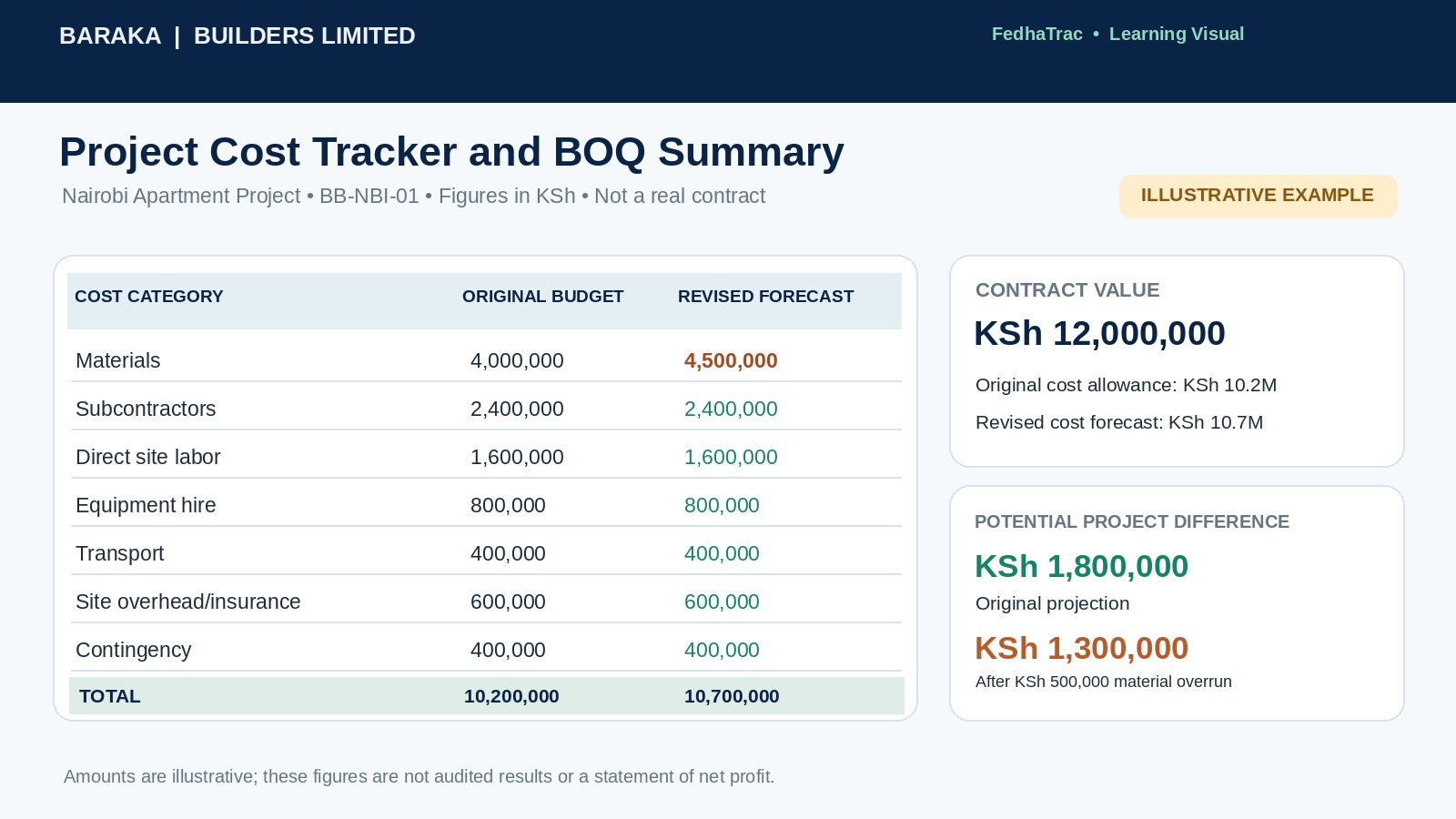
Sample construction BOQ and cost tracker comparing project budget with revised materials costs and expected margins.
Consider a hypothetical apartment-building contract worth KSh 12,000,000, excluding any tax adjustments that may apply. The following is an illustrative management budget, not a quotation, real client result, or accounting valuation. Construction Bookkeeping in Kenya can turn this cost plan into a live comparison between budgeted costs, actual costs, and committed expenditure.
| Budget category | Illustrative planned amount |
| Materials | KSh 4,000,000 |
| Subcontractors | KSh 2,400,000 |
| Direct site labor | KSh 1,600,000 |
| Equipment hire | KSh 800,000 |
| Transport and logistics | KSh 400,000 |
| Site overhead and insurance | KSh 600,000 |
| Contingency | KSh 400,000 |
| Total planned project costs | KSh 10,200,000 |
The planned difference between contract value and these project costs is KSh 1,800,000. It is not automatically net profit: company overhead, finance charges, tax, other contract adjustments, and the applicable accounting policy still matter. Suppose materials rise from KSh 4,000,000 to KSh 4,500,000 with no approved price adjustment. Planned project costs become KSh 10,700,000, reducing the expected difference to KSh 1,300,000.
That KSh 500,000 change is not just an accounting footnote. It may influence how Juma negotiates future purchases, approves variations, or allocates contingency. By reviewing cost-to-complete estimates alongside the ledger, Construction Bookkeeping in Kenya helps management recognize margin pressure early instead of discovering it when the final invoice is prepared.
Keep Client Billing, Certifications, and Retention Clear
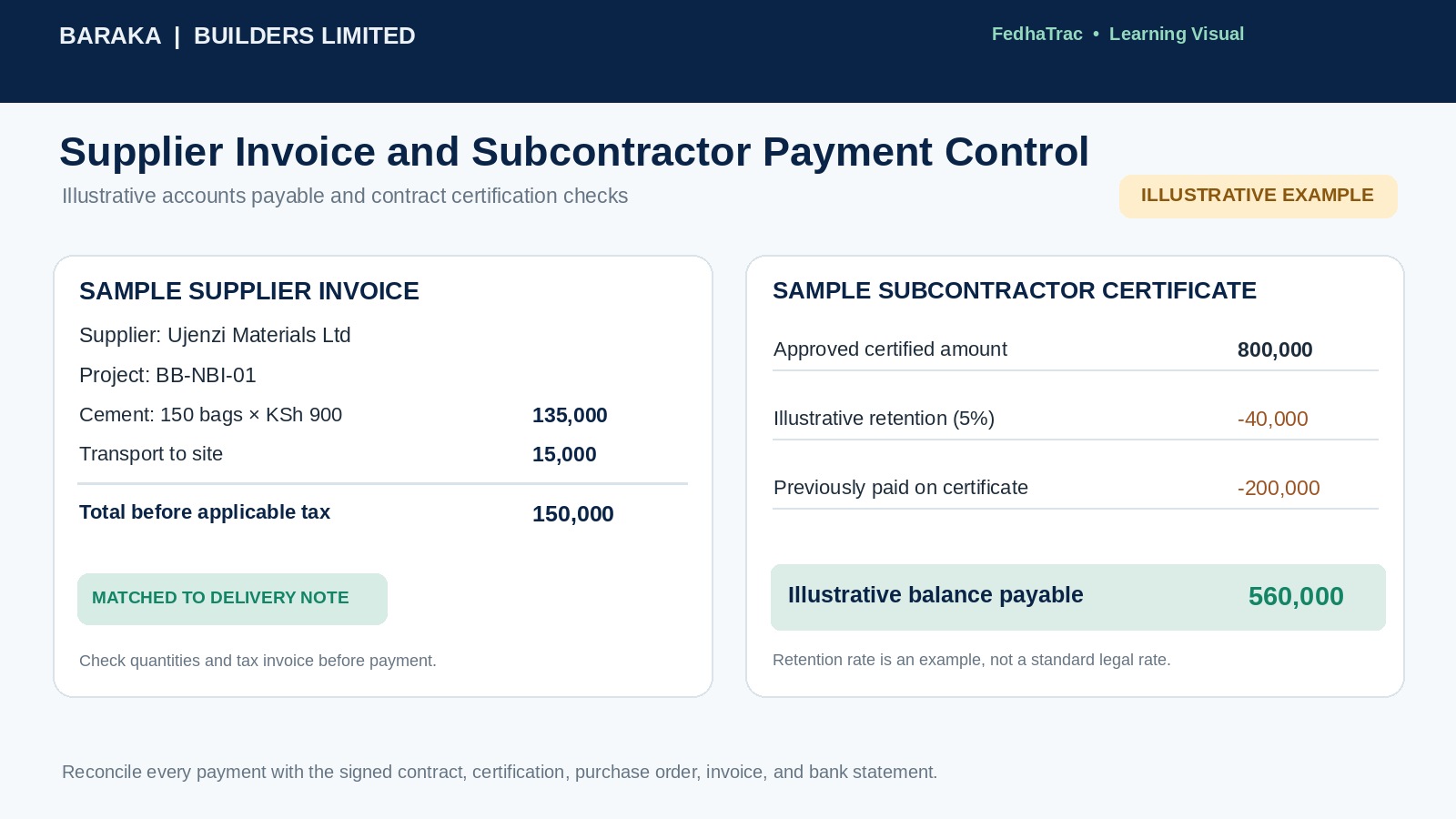
Illustrated construction supplier invoice and subcontractor payment certificate with hypothetical approval and retention figures.
A construction contract may involve an advance, progress applications, interim certificates, approved variations, and final settlement. Construction Bookkeeping in Kenya should record those stages separately. Juma needs a schedule showing the contract price, approved changes, amounts billed, payments received, amounts outstanding, and any retention under the specific agreement. There is no universal retention percentage that should be inserted into every project; the signed contract controls.
Suppose Baraka Builders receives a deposit before mobilization. That receipt improves available cash, but it does not automatically mean all of it has been earned as revenue. Likewise, certification and cash collection do not necessarily occur on the same date. The appropriate recognition of contract revenue and related balances depends on the applicable accounting framework and contract terms. The IFRS Foundation’s IFRS 15 resources explain why the timing of revenue recognition requires assessment rather than assumption.
Construction Bookkeeping in Kenya therefore needs more than a list of bank deposits. It needs a clear trail from certified work to invoices, customer balances, credit notes, and receipts. Regularly reviewing aged receivables helps Juma follow up on outstanding amounts before cash pressure affects site progress.
Understand Why Profit and Cash Flow Differ
A project can be on track to earn a positive margin and still lack enough money to pay for tomorrow’s cement delivery. Construction Bookkeeping in Kenya should distinguish income earned, invoices issued, cash collected, expenses incurred, and actual payments. If a client owes Baraka Builders KSh 2 million but the company must pay KSh 1.4 million to suppliers this week, the receivable will not settle those bills until the client pays.
Juma needs a rolling cash forecast organized by expected collection dates and payment dates. It should include labor and subcontractor obligations, supplier credit terms, equipment hire, debt payments, and tax obligations where relevant. The forecast must also allow for delays, because payment dates in a construction contract are not always the same as dates cash reaches the bank. Construction Bookkeeping in Kenya helps when these assumptions are updated weekly rather than copied unchanged from an old budget.
FedhaTrac’s profit-versus-cash-flow explanation explores why profitable businesses can still face liquidity problems.
Reconcile Bank, M-Pesa, and Supplier Payments
Contractors often move money through bank accounts, mobile money, and approved petty-cash arrangements. Construction Bookkeeping in Kenya needs a routine for matching each payment to the proper invoice, supplier, project, and authorization. A transfer from the company bank account into M-Pesa is not automatically a new expense; it may simply move the same funds between two company-controlled accounts. The actual expense arises when the funds are spent for a valid business purpose.
A strong reconciliation process identifies unmatched payments, bank charges, duplicated entries, reversed transactions, and customer receipts that have not been allocated correctly. Construction Bookkeeping in Kenya benefits from basic separation of duties even in a small contracting firm. FedhaTrac’s bank reconciliation guide offers useful background for this review.
Documenting payment approval is equally important. The accounts team should not release an unverified duplicate supplier invoice merely because it is marked urgent. Clear approvals protect working relationships, preserve records, and reduce disputes at project closeout.
Prepare for NCA and KRA Compliance With Better Records
In Kenya, contractor licensing and project registration involve obligations that go beyond bookkeeping. The National Construction Authority’s local contractor guidance describes registration, practicing-license requirements, and supporting documentation, including a valid KRA Tax Compliance Certificate. The NCA project-registration guidance also explains the developer’s project-registration responsibility and the roles of contractors and consultants. Construction Bookkeeping in Kenya supports these processes by keeping invoices, payments, asset records, and financial information organized; it does not substitute for permits, engineering approvals, or an NCA license.
KRA’s eTIMS guidance says persons carrying on business generally need to issue electronic tax invoices. Its income-and-expense validation notice explains the cross-checking of returns against electronic invoicing, withholding-tax, and import data, subject to statutory exceptions. Construction Bookkeeping in Kenya therefore requires organized supporting documents instead of assuming every supplier receipt is adequate for every tax purpose.
VAT registration is generally required when taxable supplies meet or are expected to meet KSh 5 million within 12 months, subject to the relevant rules; see KRA’s VAT guidance. Particular projects, withholding obligations, deductions, and contract structures can have different treatment. Juma should seek qualified advice rather than applying one percentage or one invoicing method to every situation.
Reports That Help Juma Make Better Project Decisions
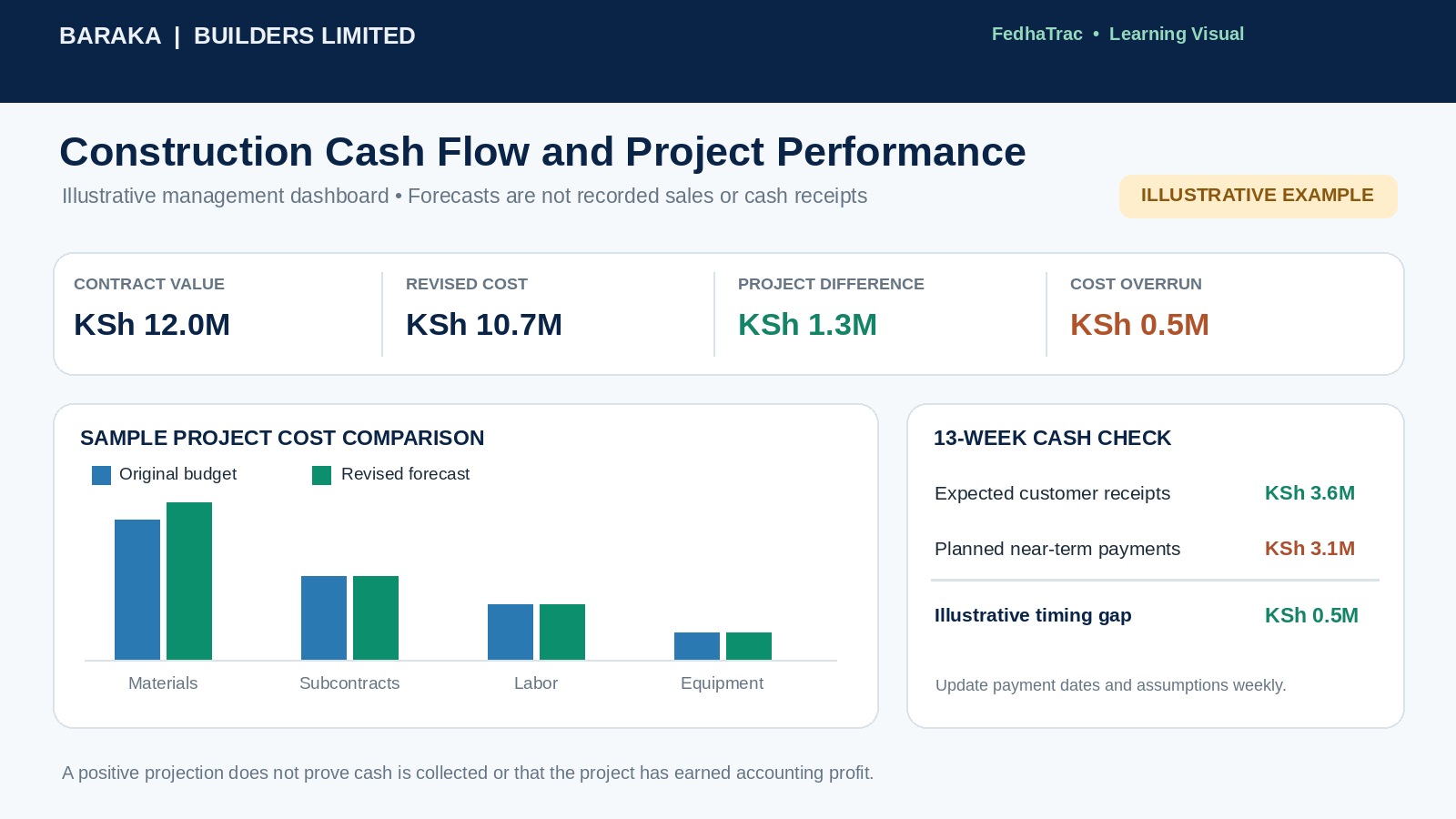
Sample project profitability dashboard with Baraka Builders construction costs and projected cash receipts and payments.
Management reporting should answer questions, not just produce spreadsheets. In Construction Bookkeeping in Kenya, Juma benefits from a monthly project cost report, payables and receivables schedule, commitments register, cash forecast, and explanation of major budget variances. A report should identify the project and date, explain the source of the data, and distinguish actual costs from forecasts so that decision-makers do not mix unlike figures.
For example, the apartment project may show a materials overrun while the renovation project has money tied up in unpaid invoices. One company-wide profit figure can hide both problems. Construction Bookkeeping in Kenya makes it possible to compare project performance without implying that a good outcome on one contract will automatically fund a shortfall on another. The management team can then decide whether to renegotiate purchases, improve collection follow-up, or delay an equipment commitment.
Good reports also improve communication between Juma, engineers, quantity surveyors, procurement staff, and the finance team. They do not replace technical certifications, but they make the financial consequences of site decisions easier to understand.
Simple Internal Controls Every Contractor Can Adopt
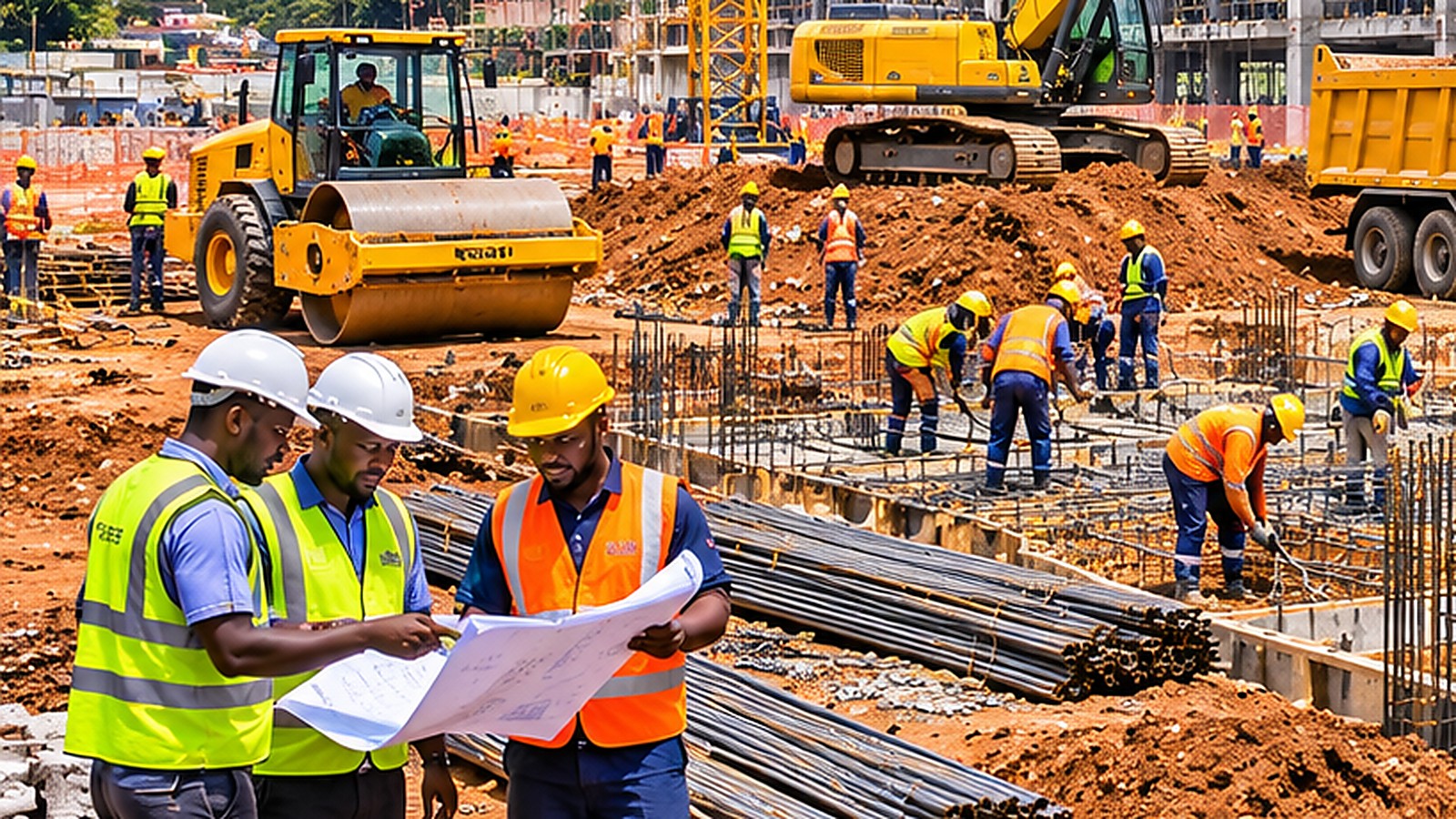
Construction engineers coordinating procurement and reviewing site plans for accountable project spending in Kenya.
Construction Bookkeeping in Kenya improves when Baraka Builders Limited has repeatable controls rather than relying on Juma’s personal oversight of every transaction. A basic purchase process can begin with a site requisition, continue through approval and supplier selection, and end with confirmation of receipt and invoice matching. High-value changes should be documented and reviewed before a contract commitment is made.
Site teams should record material transfers, equipment use, and damage or loss promptly. Procurement staff should maintain supplier records. Finance staff should reconcile accounts and report unusual items. Management should investigate exceptions rather than editing records until they appear to agree. Construction Bookkeeping in Kenya does not have to be expensive to be disciplined; clear responsibility and consistent documentation often matter more than adding another software subscription.
When Should a Construction Company Seek Bookkeeping Support?
A contractor may need assistance when the same supplier bill appears on multiple sites, when project margins cannot be explained, or when customer payment schedules are unclear. Other warning signs include weeks of unrecorded receipts, unresolved bank differences, missing delivery documentation, and repeated cash shortages despite substantial contract values. Construction Bookkeeping in Kenya is easier to improve before these problems become entrenched.
FedhaTrac can discuss suitable bookkeeping, financial-record organization, expense categorization, reconciliation, and reporting support with a firm such as Baraka Builders Limited. The exact work should be agreed according to the company’s systems, staff responsibilities, and reporting needs. FedhaTrac is not represented here as the project’s contractor, quantity surveyor, auditor, or site supervisor. Construction Bookkeeping in Kenya works best when financial support complements those professionals instead of blurring accountability.
Frequently Asked Questions
Is a construction deposit the same as earned profit?
No. A deposit is a receipt of cash, while profit depends on revenue and costs recognized under the appropriate accounting policies. Construction Bookkeeping in Kenya should identify advances, billings, work progress, and cash receipts separately, with professional review where needed.
Can one bookkeeping system cover several sites?
Yes, provided records can be tagged to individual jobs, suppliers, and cost categories. Construction Bookkeeping in Kenya becomes much less useful when multi-site transactions are pooled into one untraceable total.
Should contractors keep bills of quantities alongside invoices?
Yes. A bill of quantities can be an important planning and comparison document, but it is not proof that a supplier delivered goods or that a payment occurred. Construction Bookkeeping in Kenya should connect plans with evidence of transactions and actual site activity.
Build Financial Confidence as Your Construction Company Grows
Juma cannot stop every material-price increase or guarantee that each progress payment arrives on time. He can, however, improve how Baraka Builders Limited measures the impact. With organized purchase records, separate job costs, reconciled payments, careful cash forecasts, and readable project reports, decisions become less reactive. Construction Bookkeeping in Kenya gives growing contractors a clearer view of what projects are costing, what customers still owe, and which obligations are coming due.
FedhaTrac can help construction companies develop that financial visibility through appropriate bookkeeping and reporting support. If your business is managing several jobs, balancing suppliers against certifications, or preparing to grow, contact FedhaTrac to discuss a practical recordkeeping approach. Better Construction Bookkeeping in Kenya will not build the structure for you—but it can help protect the business finances behind every successful build.


