

Bookkeeping vs Accounting in Kenya is a practical management subject, not terminology reserved for accountants. It helps an owner answer a precise question: Does the business need transaction processing, higher-level reporting and judgement, or an integrated service covering both? Kenyan SMEs make sales through bank accounts, M-Pesa, cash, card channels and credit invoices, while costs may be paid immediately or recognised later. Without disciplined records, those timing differences make otherwise familiar numbers difficult to trust.
This guide explains bookkeeping vs accounting in Kenya in plain professional language and then moves into implementation. You will see the accounting logic, a worked KES example, the review questions management should ask, common errors and the monthly workflow required to produce reliable information. The aim is not to turn an owner into a technical accountant. It is to make the report useful enough that management can challenge unusual figures, assign action and recognise when specialist judgement is needed.
The guide forms part of FedhaTrac’s Accounting for Kenyan SMEs cluster. It builds on bookkeeping fundamentals and the wider accounting and financial-reporting overview. Where formal reporting is required, the applicable framework and entity circumstances matter. The IFRS Foundation’s IFRS for SMEs resources explain the purpose and scope of the standard, while ICPAK’s illustrative Kenyan SME statements provide a useful local presentation reference.
Bookkeeping vs Accounting in Kenya: The Clear Difference
Bookkeeping vs Accounting in Kenya is best understood as a connected sequence rather than a contest between two services. Bookkeeping captures and organises the financial activity of the business. Accounting interprets, adjusts and reports that information so owners, lenders, tax professionals and other users can make decisions. Bookkeeping creates the reliable record; accounting turns that record into meaning.
A bookkeeper may record sales and expenses, process bank and M-Pesa transactions, match customer receipts, maintain supplier balances and complete reconciliations. An accountant uses those records to assess cut-off and classification, post accruals or depreciation, evaluate provisions, prepare financial statements and explain profitability, liquidity and financial position. The boundary can vary by organisation, but the direction of work remains the same: transactions become ledgers, ledgers become reviewed accounts, and reviewed accounts become decisions.
Bookkeeping and Accounting Compared
| Area | Bookkeeping | Accounting |
|---|---|---|
| Primary purpose | Create complete, organised transaction records | Interpret and report financial performance and position |
| Typical work | Capture, categorise, match and reconcile | Adjust, analyse, report and advise |
| Typical outputs | Ledgers, reconciliations, receivable and payable schedules | P&L, balance sheet, cash flow and management analysis |
| Main time focus | Daily, weekly and monthly processing | Period-end review and forward-looking decisions |
| Core question | What transactions occurred, and are they recorded correctly? | What do the results mean, and what should management do? |
Why One Cannot Work Properly Without the Other
Accounting built on weak bookkeeping produces unreliable answers. If M-Pesa expenses are missing, transfers are recorded as revenue or customer payments are duplicated, the accountant’s reports inherit those errors. Sophisticated ratios cannot repair an incomplete ledger. The accountant must first reconstruct the records, which increases cost and delays reporting.
Bookkeeping without accounting also has limits. A perfectly reconciled bank account does not by itself explain gross margin, recognise depreciation, evaluate a doubtful receivable or show whether profit can support debt. Transactions may be accurately captured yet still need period-end adjustments and interpretation. Bookkeeping tells the story line by line; accounting explains the story as a whole.
A simple transaction journey
Imagine an SME buys equipment for KES 600,000. Bookkeeping records the supplier document and bank payment and reconciles the transaction. Accounting determines whether the item should be treated as an asset, estimates its useful life, records depreciation and considers the effect on profit, cash flow and the balance sheet. Both stages are necessary. Missing the first loses evidence; missing the second misstates performance.
How the Two Functions Work Together Each Month
- Collect invoices, receipts, bank statements, M-Pesa statements and supporting records.
- Record and categorise transactions consistently.
- Match customer and supplier payments and reconcile cash accounts.
- Review ledgers for unusual, missing or duplicated activity.
- Post accounting adjustments such as accruals, prepayments and depreciation.
- Prepare financial statements and management commentary.
- Use the reports to decide on pricing, collections, spending, tax and growth.
A small business may outsource both functions to one provider, divide them between team members or keep bookkeeping internally while using an external accountant for review. The arrangement matters less than clear responsibilities, documented cut-off dates and a review trail. Someone must own record completeness, someone must own accounting judgement, and management must own the resulting decisions.

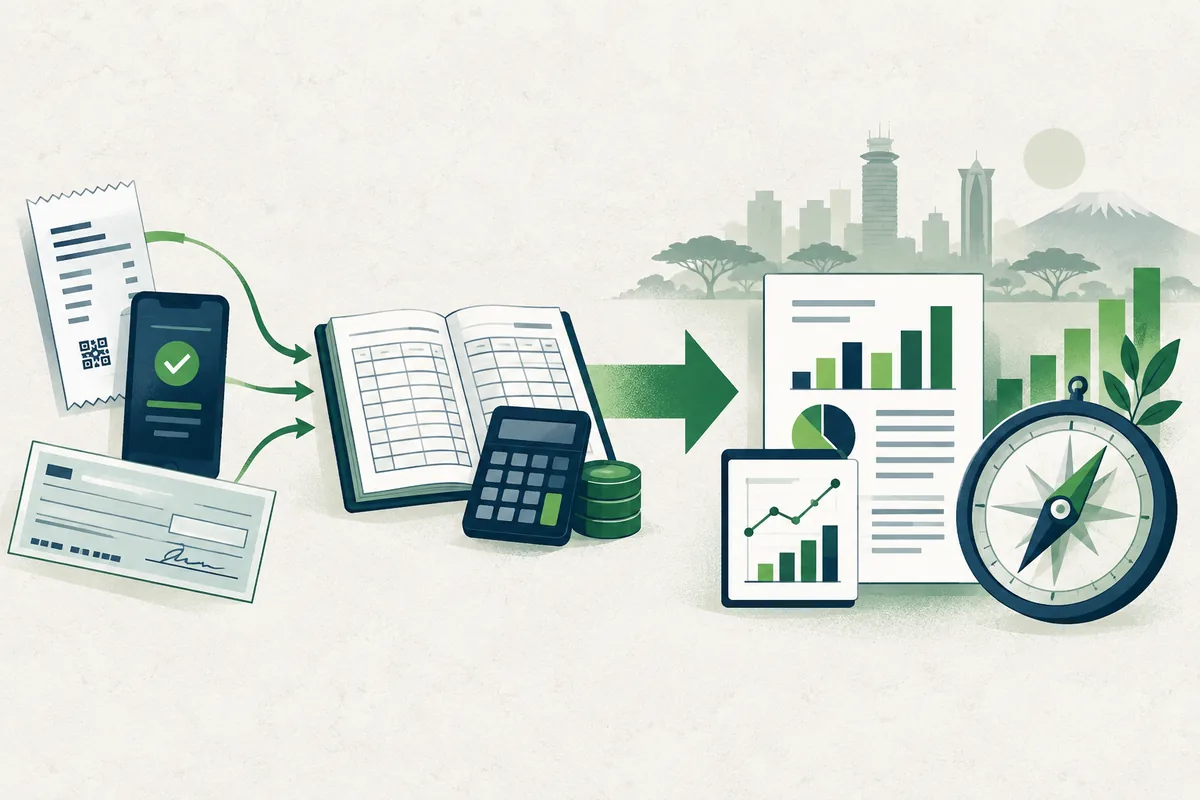
Bookkeeping vs accounting: professionals reviewing financial records to turn accurate bookkeeping data into useful financial insights.
Where Bookkeeping Ends and Accounting Judgement Begins
The dividing line is not always a job title. Categorising a routine internet bill may be straightforward bookkeeping. Deciding whether major software development creates an asset can require accounting judgement. Matching a payment to a known invoice is bookkeeping; assessing whether an old unpaid invoice is recoverable is accounting. The more unusual, material or policy-dependent the issue, the stronger the need for qualified review.
A Month in the Financial Information Chain
During the month: preserve the evidence
Invoices are raised, supplier bills arrive and money moves through bank, M-Pesa and cash. Bookkeeping captures those events promptly, uses consistent account codes and keeps source documents connected to entries. Regular processing prevents month-end from becoming a reconstruction exercise.
At month-end: prove completeness
Reconciliations compare the ledger with bank and M-Pesa statements. Customer receipts are matched to invoices, supplier balances are reviewed and missing documents are requested. Exception reports identify duplicates, unusual balances and transactions sitting in temporary accounts.
During accounting review: apply the reporting rules
The accountant reviews cut-off, accruals, prepayments, depreciation, inventory, taxes, loans and provisions. The objective is to ensure the ledger represents economic activity in the correct period and categories. Material estimates and policy choices are documented.
During management review: turn reports into decisions
The P&L, balance sheet, cash flow and supporting schedules are compared with budget and previous periods. Management asks why margins, liquidity and working capital changed and agrees actions. The information chain is complete only when the report influences what the business does next.
What Goes Wrong When Bookkeeping Is Missing
- The accountant spends expensive time locating basic records and rebuilding transactions.
- Reports arrive too late to influence collections, spending or pricing.
- Missing M-Pesa or cash activity understates income or expenses.
- Transfers, loans and owner funding may be confused with revenue.
- Customer and supplier balances cannot be trusted.
- Tax and audit support becomes harder because evidence is disconnected.
Year-end cleanup can produce a set of accounts, but it does not give the owner reliable information throughout the year. Timely bookkeeping is therefore not clerical overhead; it is the infrastructure on which accounting and management reporting depend.
What Goes Wrong When Accounting Review Is Missing
A reconciled ledger can still treat equipment as an ordinary expense, ignore depreciation, omit accrued liabilities or carry doubtful receivables at full value. The records may be internally tidy but economically misleading. Accounting review ensures that unusual transactions and period-end estimates are handled appropriately and that the statements are interpreted in context.
Who Should Do What?
| Responsibility | Typical owner | Required evidence |
|---|---|---|
| Supply complete documents and explanations | Business owner and operational team | Invoices, receipts, contracts and approvals |
| Record, match and reconcile transactions | Bookkeeping function | Ledgers and reconciliation schedules |
| Review policies, estimates and adjustments | Accounting function | Journal support and accounting schedules |
| Approve decisions and actions | Management | Review minutes and action log |
Choosing a Combined Service Without Losing Accountability
One provider can perform both bookkeeping and accounting, but the engagement should still distinguish preparation from review. Agree document deadlines, reporting dates, approval limits, access controls and how unresolved items will be escalated. The client remains responsible for supplying complete information and making business decisions. Clear boundaries make the combined process stronger, not more bureaucratic.
The practical conclusion is simple: bookkeeping and accounting are different, but neither should be isolated. Bookkeeping supplies dependable financial evidence. Accounting converts that evidence into properly adjusted statements and insight. Management then uses the insight to act. A break anywhere in that chain reduces the value of everything that follows.
Skills and Controls Required at Each Stage
Bookkeeping requires accuracy, consistency, document discipline and an understanding of how transactions flow through customer, supplier and cash records. Accounting requires those foundations plus knowledge of recognition, measurement, presentation, tax interaction and financial analysis. Strong communication matters in both functions because unexplained transactions cannot be resolved by software alone.
Controls should reflect the risks. The person collecting cash should not be the only person reconciling it. Supplier changes and unusual payments should be approved. Manual journals need support. Access to accounting systems should follow responsibilities, and backups or export procedures should protect the records. Outsourcing a function does not remove the need for client-side approval and oversight.
When the Business Is Ready for a Stronger Process
Complexity, not only revenue, drives the need. Several bank or M-Pesa accounts, stock, credit customers, multiple branches, grants, loans or external investors all increase reporting risk. Late closes, recurring suspense balances and tax-season cleanups are practical signs that the current process is no longer sufficient. Strengthening bookkeeping first creates a dependable base; adding regular accounting review ensures that the base produces meaningful reports.
Choosing the Right Support for a Kenyan SME
An early-stage business with few transactions may begin with monthly bookkeeping and periodic accounting review. A growing business with stock, credit customers, several payment channels or external funding usually needs a stronger close process and monthly management accounts. Warning signs include unreconciled M-Pesa, unexplained balances, late reports, tax-season reconstruction and decisions based only on the bank balance. FedhaTrac can combine routine record maintenance with accounting review and reporting so the handoff between the two functions does not break down.
Frequently Asked Questions
Is bookkeeping the same as data entry?
No. Good bookkeeping includes consistent classification, document control, payment matching and reconciliation. Data entry without these controls can create a ledger that looks complete but is unreliable.
Can an accountant work without a bookkeeper?
An accountant can reconstruct records, but someone must still perform the bookkeeping work. When records are incomplete, accounting becomes slower, more expensive and less timely.
Can a bookkeeper prepare financial statements?
Roles vary with skill and scope, but formal adjustments, reporting judgements and interpretation require appropriate accounting competence and review. Clear responsibility is more important than job title alone.
Which service does a small business need first?
Begin with complete, reconciled books, then add accounting review and reporting appropriate to the business. In practice, a dependable monthly process needs both functions.
How does software affect bookkeeping and accounting?
Software automates capture and reporting, but it cannot reliably determine the purpose of every transaction or make every accounting judgement. People still need to review evidence, exceptions and policies.
When should the functions be outsourced?
Outsourcing can help when internal time, skill, controls or continuity are insufficient. The agreement should define records required, deadlines, responsibilities, outputs and review boundaries.
 Final Thoughts
bookkeeping vs accounting in Kenya becomes valuable when management understands the logic, trusts the data and acts on the result. The strongest report is not necessarily the longest. It is the one that reconciles to evidence, uses consistent classifications, explains material movements and leads to a clear decision.
Build the process from dependable records. Reconcile cash, review control accounts, maintain supporting schedules and close the month on a defined timetable. Then compare performance, investigate exceptions and assign actions. This discipline turns accounting from a year-end compliance exercise into an operating system for the business.
For Kenyan SMEs, the practical goal is financial visibility without unnecessary complexity. Start with the decisions that matter, agree the minimum reliable reporting pack and improve it as the organisation grows. When a transaction or accounting judgement is material, seek qualified advice rather than forcing an uncertain answer into the report.
Bookkeeping vs accounting in Kenya: management summary
- Bookkeeping vs accounting in Kenya compares record creation with financial interpretation.
- The bookkeeping side of bookkeeping vs accounting in Kenya captures and reconciles transactions.
- The accounting side of bookkeeping vs accounting in Kenya applies judgement and explains results.
- Bookkeeping vs accounting in Kenya is a workflow, not a choice between competing services.
- Without accurate records, bookkeeping vs accounting in Kenya breaks at the reporting stage.
- Without analysis, bookkeeping vs accounting in Kenya stops before numbers inform decisions.
- A clear handoff makes bookkeeping vs accounting in Kenya efficient each month.
- Growing SMEs should define responsibilities for bookkeeping vs accounting in Kenya in writing.
- Software supports bookkeeping vs accounting in Kenya but does not replace review or judgement.
- Together, bookkeeping vs accounting in Kenya creates evidence, insight and accountability.
- Reviewing bookkeeping vs accounting in Kenya regularly strengthens the monthly reporting workflow.
- bookkeeping vs accounting in Kenya should be reviewed with evidence and clear responsibility.
- A consistent bookkeeping vs accounting in Kenya process supports confident SME decisions.
- Use bookkeeping vs accounting in Kenya to turn financial evidence into a specific management action.
Turn the Report into a Monthly Decision
Gather the last three months of bank, M-Pesa and accounting records, identify the balances you do not trust, and list the five decisions management needs the numbers to support. Then speak with FedhaTrac about a proportionate bookkeeping, accounting and reporting workflow for your SME.


