

A growing business can make healthy sales and still struggle to buy stock, pay suppliers, or meet its next payroll. The problem may not be weak demand. It may be that customers have received goods or services while their payments remain outstanding. Accounts receivable management in Kenya gives owners a disciplined way to know who owes what, when payment is due, and which action will turn an unpaid balance into cash.
Consider a hypothetical Nairobi wholesaler that offers 30-day payment terms to retain valuable buyers. Late settlements and unmatched receipts can prevent it from restocking on schedule even when sales are growing.
The following nine steps explain credit control, debtor aging, respectful follow-ups, Kenyan recordkeeping, and practical performance measures. The emphasis is on decisions after an invoice has been issued. For the broader process of issuing invoices and recording expenses, see FedhaTrac’s expense tracking and invoicing guide.
What Accounts Receivable Management Means
Accounts receivable are amounts customers owe a business for goods or services supplied on credit. A customer who pays immediately generally leaves no outstanding trade receivable from that sale. A customer who is given an agreed payment period creates an amount that must be tracked until it is collected, adjusted legitimately, or otherwise resolved.
Accounts receivable management in Kenya connects five tasks: deciding when to offer credit, recording each customer’s balance, monitoring due dates, collecting payments, and keeping accounting records consistent with evidence. It is not simply making repeated phone calls. A good process distinguishes a genuinely overdue customer from a disputed invoice, an unapplied payment, or an account whose payment terms were entered incorrectly.
Allocate responsibilities clearly: sales confirms terms, operations confirms delivery, finance records balances, an assigned employee follows up, and management approves escalation. Staff should not reconstruct receivables from scattered WhatsApp chats.
Why Credit Sales Can Create a Cash Shortage
In accounts receivable management in Kenya, a credit sale may be recognized as revenue before payment arrives, depending on the applicable accounting policies and facts. The business may meanwhile pay transport, salaries, rent, inventory suppliers, and other costs in cash. Consequently, profitability and available cash are different questions.
For more on cash receipts and payments, see FedhaTrac’s cash flow statements guide.
Step 1: Set a Clear Credit Policy Before Extending Credit
Accounts receivable management in Kenya starts before the first overdue invoice. A short written credit policy should identify customers eligible for credit, required approval, payment terms, credit limits, and documents needed to support the transaction. Use periods appropriate to your business; seven, fourteen, and thirty days are examples of commercial terms, not a statutory rule for every Kenyan supplier.

Accounts receivable management in Kenya: Kenyan wholesale clerk providing paperwork to a customer at the counter.
Check customer identification and reliable contact details, confirm the correct billing entity, and document who can approve orders. Where the risk is material, obtain appropriate trade references or other lawful credit information. Keep the approval proportionate: a small repeat customer buying low-value stock does not require the same assessment as a large new corporate buyer.
Clarify Payment Terms in Writing
A quotation, accepted order, contract, or invoice should make the due date and payment instructions understandable. Specify whether payment is due on delivery, a calendar date, or a defined number of days after an agreed event. Ensure any interest or late-payment charges have a proper contractual and legal basis; do not add arbitrary penalties after a dispute begins.
Accounts receivable management in Kenya improves when every department uses the same approved terms. Promising a customer sixty days verbally while the finance system records fourteen days causes unnecessary conflict and unreliable aging reports.
Step 2: Build a Reliable Customer Debtors Register
The core working document in accounts receivable management in Kenya is a receivables register, sometimes called a debtor ledger. Each entry should identify the customer, invoice reference, date, original amount, due date, receipts allocated, approved credit notes, and remaining balance. A short exception field should explain disputes, commitments, and next actions.
Maintain one authoritative ledger. Match bank and M-Pesa receipts to the right invoices, including payments covering several invoices. Investigate unidentified deposits rather than inventing customers or recording the same receipt as new revenue.
A strong register also retains supporting documents: accepted order, delivery note, service completion confirmation, invoice, correspondence, and payment evidence. A customer who says goods never arrived requires an operational investigation, not just another reminder. FedhaTrac’s bank reconciliation article explains how receipts can be matched to independent banking evidence.
Worked Example: A KSh 550,000 Receivables Portfolio
To demonstrate accounts receivable management in Kenya, the following figures are illustrative only. They do not describe FedhaTrac clients or actual Kenyan businesses. Assume the report is prepared on November 13, 2026, and that each balance is unpaid in full. Days overdue are measured from the stated due date.
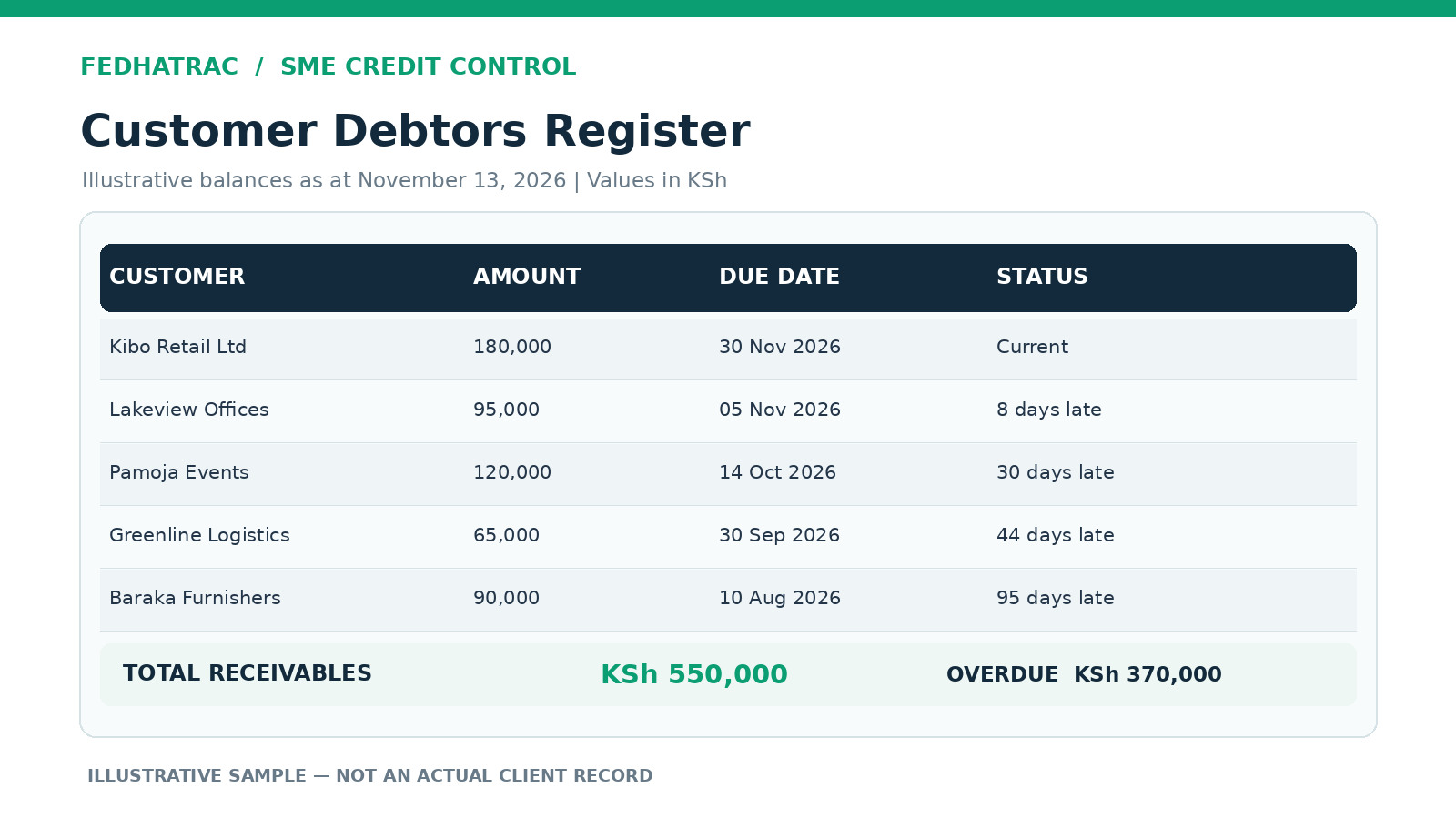
Illustrative customer debtors register with KSh 550,000 outstanding and KSh 370,000 overdue.
The total is KSh 550,000, comprising KSh 180,000 not yet due and KSh 370,000 overdue. The overdue share is approximately 67.3%: KSh 370,000 divided by KSh 550,000. This percentage signals collection pressure, but it does not prove all late amounts are uncollectible. Accounts receivable management in Kenya requires investigation at invoice level before any conclusion about loss.
Accounts receivable management in Kenya calls for differentiated action. Check Lakeview’s payment reference, confirm whether Pamoja has accepted the invoice, obtain a documented settlement plan from Greenline if appropriate, and escalate Baraka for management review. Kibo’s current balance should still receive a courteous reminder before its due date.
Step 3: Use a Debtors Aging Report Every Week
Aging is central to accounts receivable management in Kenya because it groups unpaid balances according to how far they have passed their due dates. Define buckets consistently. In this worked example, “current” means not yet due, and the overdue categories are 1–30, 31–60, 61–90, and more than 90 days. The illustration yields these amounts:
| Aging bucket | Amount (KSh) | Management response |
| Current | 180,000 | Confirm invoice receipt and terms |
| 1–30 days overdue | 215,000 | Prompt reminder and resolve queries |
| 31–60 days overdue | 65,000 | Agreed action and management follow-up |
| 61–90 days overdue | 0 | Continue monitoring |
| Over 90 days overdue | 90,000 | Formal risk and recovery review |
| Total | 550,000 | Review weekly |
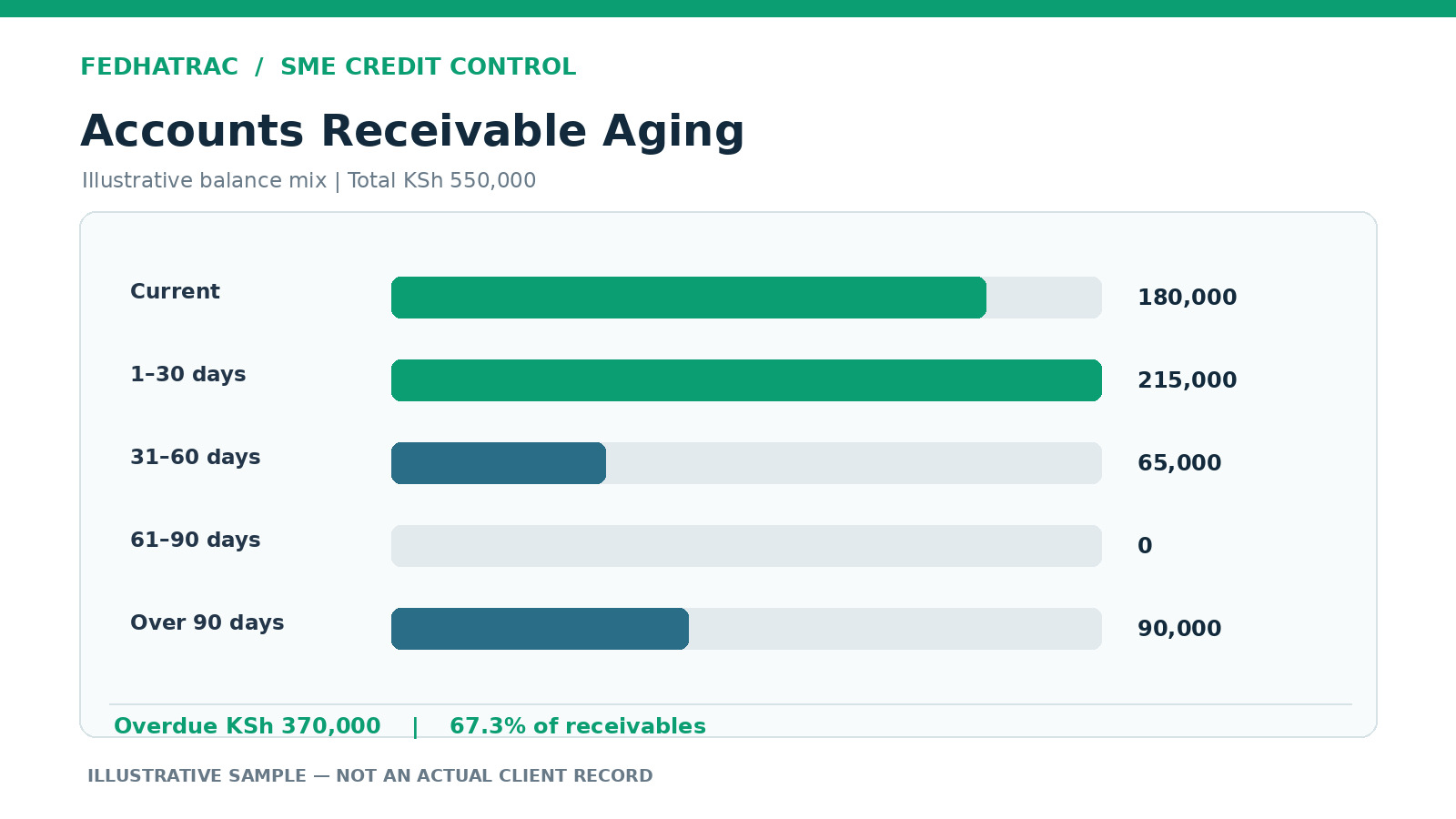
Illustrative accounts receivable aging chart of KSh 550,000 outstanding, including KSh 370,000 overdue.
Accounts receivable management in Kenya benefits from both an aging summary and a customer-level exception list. Older balances may need urgent attention, but current invoices can also be risky. Aging measures time, not recoverability.
Do not silently change an original due date to make a balance appear current. If the parties agree revised terms, preserve the original terms and record the new commitment separately. This maintains an honest history and makes collection performance measurable.
Step 4: Design a Respectful Payment Collection Workflow
Accounts receivable management in Kenya is most effective when follow-up occurs predictably and courteously. Rather than sending aggressive messages, create an escalation schedule. For example, confirm the customer received an invoice shortly after issuance; send a friendly reminder several days before the due date; contact the correct billing person when overdue; and escalate unresolved balances to an authorized manager.
Every follow-up should state the invoice reference, amount outstanding, due date, payment instructions, and a clear request for either confirmation of payment or a specific payment date. Capture the response in the register. The aim is a verifiable next step, not an argument. If the customer reports a missing purchase order, delivery dispute, or incorrect amount, assign an internal owner and a resolution deadline.

Kenyan finance officer reviewing an invoice while calling a customer about an outstanding payment.
Example of a Professional Reminder
“Hello, our records show invoice INV-205 for KSh 95,000 was due on November 5, 2026. Please let us know whether payment has been made or when we should expect settlement. If there is a query about the invoice, we will be glad to review it.”
This is a sample communication for the hypothetical register, not a report of an actual collection. Accounts receivable management in Kenya should maintain a professional tone and avoid disclosing customer financial information to unrelated third parties.
Step 5: Match Payments, Credit Notes, and Disputes Correctly
In accounts receivable management in Kenya, collections fail when payment information and accounting records disagree. Reconcile bank and M-Pesa receipts to the receivables register, distinguish deposits from final settlement, and document how partial payments are allocated. A customer with three invoices may pay one amount covering two of them; the ledger must show precisely which balances remain open.
If goods are legitimately returned or an invoiced amount is reduced, assess whether an appropriate credit note is required. The Kenya Revenue Authority’s eTIMS guidance explains that credit notes are created through the eTIMS solution on which the original invoice was issued. A customer merely being late does not, by itself, justify canceling the sale or issuing a credit note.
Accounts receivable management in Kenya therefore depends on a documented distinction between nonpayment, genuine corrections, commercial disputes, and debts that may be impaired. Never manipulate an invoice or customer balance simply to make a collection report look better.
Step 6: Understand the Kenyan Tax and Recordkeeping Context
Delayed payment does not automatically postpone tax obligations. For VAT-registered businesses, KRA’s VAT guidance explains that the tax point can arise on the earliest applicable event, including supply, invoicing, or payment, subject to the law and transaction circumstances. Businesses should obtain advice on their own tax treatment rather than assuming VAT is due only when a customer settles.
KRA also explains electronic invoicing and corrections through eTIMS. Keep invoices, notes, contracts, delivery records, and collection evidence readily traceable. Accounts receivable management in Kenya must make operational figures agree with bookkeeping and tax documentation rather than create parallel versions of the truth.
Financial reporting treatment of doubtful debts depends on the entity, applicable reporting framework, and evidence about recoverability. A manager should not automatically write off an old receivable or assume a tax deduction is available. Ask a qualified accountant to assess material impairment, adjustments, and applicable tax rules.
Step 7: Protect Customer Privacy During Debt Collection
Accounts receivable management in Kenya involves names, contact details, outstanding balances, and payment histories. Where these relate to identifiable individuals, they may be personal data. Kenya’s Data Protection Act, 2019 requires lawful processing and appropriate safeguards, among other duties.
Use customer contact information only for legitimate, defined purposes. Limit access to employees who need it; store records securely; and avoid publicly naming alleged debtors or contacting unrelated relatives and colleagues to apply pressure. The business should also correct inaccurate records promptly and retain information according to a justified retention policy and legal obligations.
Respectful, lawful collection practices help preserve customer relationships and reduce complaints. Privacy is not a reason to stop legitimate debt administration; it is a reason to do the work carefully.
Step 8: Know When to Escalate a Serious Dispute
Effective accounts receivable management in Kenya does not turn every late balance into a legal case. First confirm the amount, debtor identity, contract, delivery evidence, due date, and communications. A credible dispute over quality or quantity may require commercial resolution. Where an amicable settlement is possible, record any payment plan in writing and monitor performance against it.
For eligible claims involving sale or supply of goods and services, the Kenyan Judiciary describes the Small Claims Court’s monetary jurisdiction as up to KSh 1 million. Eligibility, location, procedural requirements, defenses, and other legal circumstances still matter; a court process is not a guaranteed recovery method.
Contract claims also involve limitation periods. Section 4 of Kenya’s Limitation of Actions Act generally specifies six years for actions founded on contract, subject to the Act’s exceptions and how the cause of action accrues. For older or disputed accounts, seek timely legal advice. Accounts receivable management in Kenya should identify potential legal issues early rather than assume invoices remain enforceable indefinitely.
Step 9: Monitor Collection Measures and Assign Ownership
A useful accounts receivable management in Kenya dashboard does not need dozens of figures. Begin with the total customer balance, total past due, amount over sixty or ninety days, value of unallocated receipts, and actual collections against a documented target. Compare trends over time rather than judging a single snapshot.
In the illustrative portfolio, opening receivables of KSh 420,000 plus KSh 300,000 in new credit invoices less KSh 170,000 in receipts gives closing receivables of KSh 550,000, assuming no other adjustments. This reconciliation is an important control: a dashboard total should agree to the underlying customer ledger and general ledger.
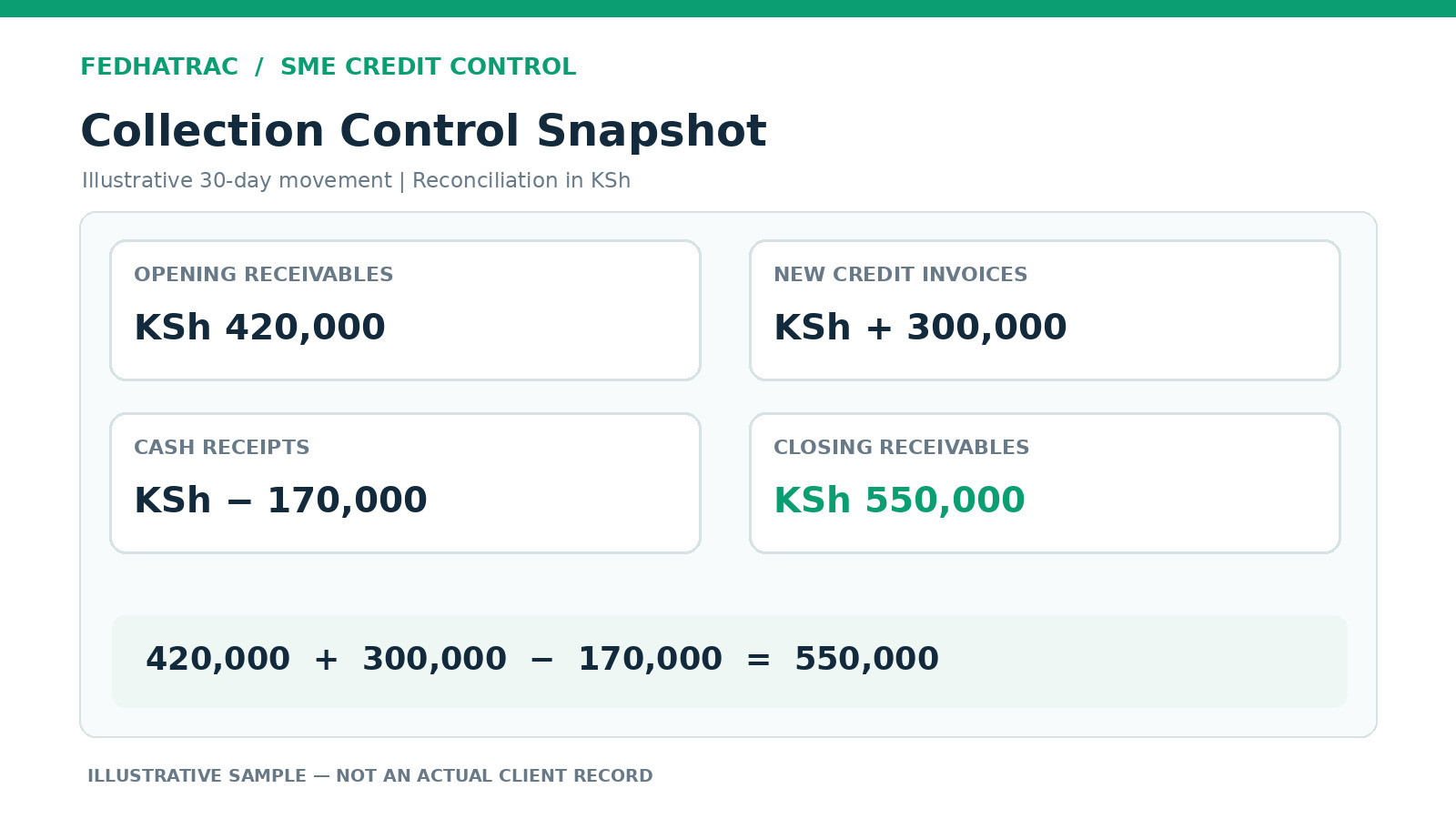
Illustrative collection dashboard showing KSh 420,000 opening plus KSh 300,000 invoices less KSh 170,000 receipts.
A common additional measure is days sales outstanding (DSO), typically calculated using average receivables, credit sales, and the number of days in the period. It is only useful when the inputs are defined consistently; changes in sales mix, seasonality, and partial-period records can distort comparisons. Accounts receivable management in Kenya should use measures to trigger investigation, not to declare that one number represents every business’s ideal performance.
Daily, Weekly, and Monthly Responsibilities
Daily accounts receivable management in Kenya includes recording new credit sales, allocating receipts, and flagging customer queries. A weekly credit-control meeting should review overdue balances by customer, expected receipt dates, broken promises, unresolved disputes, and who owns the next action. Keep it short enough that employees can sustain it during a busy trading week.

Kenyan SME workshop owner and accountant checking records and customer balances in a business office.
Monthly work includes agreeing the customer subsidiary ledger to the general ledger, reviewing old credit balances and unidentified receipts, assessing collection risk, and reporting changes to management. FedhaTrac’s balance sheet and management accounts guides explain how receivables connect to wider financial decisions.
Accounts receivable management in Kenya works best when the owner sees a one-page exception report: the five largest overdue accounts, upcoming receipts, disputed items, and decisions required. The objective is not more paperwork; it is fewer avoidable surprises.
How FedhaTrac Can Support SME Credit Control
An SME may not need a full-time credit controller, but it does need dependable customer records and an owner who reviews overdue balances. Accounts receivable management in Kenya can be supported through structured bookkeeping, customer-ledger maintenance, bank and M-Pesa reconciliation, aging schedules, and regular reporting, subject to the scope agreed with the service provider.
A business should distinguish accounting support from legal debt recovery and from authority to negotiate or receive customer funds. Clarify responsibilities, approvals, data access, and reporting frequency before any engagement. FedhaTrac’s accounting services article helps owners frame those expectations.
The immediate next step is practical: list every unpaid customer invoice, verify the totals, identify the ten most important accounts, assign follow-ups, and schedule a weekly review. If your books are fragmented, contact FedhaTrac to discuss a suitable accounting and reporting workflow. Effective accounts receivable management in Kenya begins with reliable numbers and ends with accountable action.
Frequently Asked Questions
Is an unpaid invoice the same as a bad debt?
No. An overdue invoice is a payment that has passed its agreed due date. A bad or impaired debt involves a separate assessment of whether the amount is likely to be recovered. Accounts receivable management in Kenya should preserve this distinction and document the evidence used for any accounting adjustment.
Can a business charge interest on a late invoice?
Do not assume it can. Review the agreed contract, applicable law, and the circumstances before adding late-payment charges. Where the position is unclear or disputed, obtain qualified legal advice rather than inventing a fee.
What is the most useful first step for a small business?
Create a verified invoice-by-invoice list, match recent bank and M-Pesa receipts, and identify which balances are genuinely past due. The first benefit of accounts receivable management in Kenya is knowing the real outstanding amount before chasing customers or making cash commitments.


