
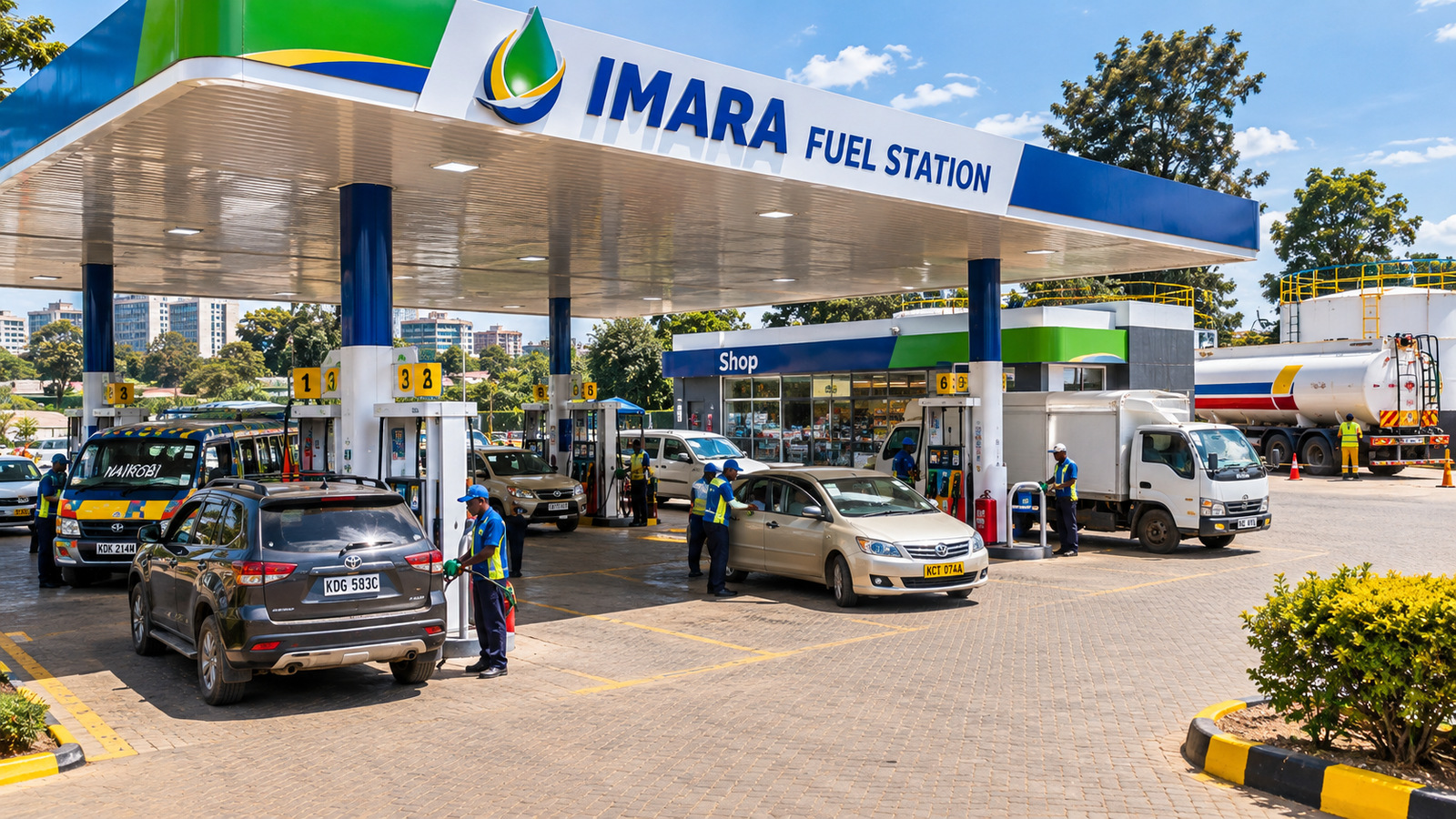
Petrol Station Accounting in Kenya begins long before Mr. Otieno checks the balance in his business account. At Imara Fuel Station, vehicles line up beneath the canopy, attendants move between pumps, customers pay using different methods, and a delivery tanker occasionally replenishes underground storage.
For Mr. Otieno, a fictional independent station owner in Nairobi, strong sales have not always produced clear answers. Pump readings, cashier summaries, mobile-money receipts, bank deposits, fuel deliveries, and inventory measurements are kept by different people. FedhaTrac can help establish a more disciplined bookkeeping and reporting process so the owner understands what happened, what needs investigation, and what action should follow.
The purpose of Petrol Station Accounting in Kenya is not to replace safe fuel-handling procedures or the station’s technical systems. It is to connect credible operational evidence with accurate accounting records.
Why a Busy Fuel Station Still Needs Strong Bookkeeping
Petrol Station Accounting in Kenya presents an unusual combination of high transaction volumes and tight operational controls. Sales happen quickly, but fuel must also be purchased, stored, measured, and dispensed correctly. A cash receipt has to be linked to a sale, a mobile-money settlement must not be counted twice, and inventory differences should be investigated rather than hidden with an unexplained adjustment.
At Imara Fuel Station, the accounting questions start with each shift. How many liters did each pump dispense? What was the approved selling price for the period? Which sales were paid immediately, and which belonged to authorized fleet customers on credit? Were any sales reversed or corrected, and were those changes approved?
Petrol Station Accounting in Kenya turns this information into a repeatable management routine rather than a stressful month-end reconstruction.
Start With Pump Meter Readings at Every Shift Handover

Two Kenyan petrol station attendants checking shift handover records beside fuel pumps
A supervisor should identify the pump, nozzle, fuel product, reading time, responsible attendants, and any approved meter corrections. The difference between valid readings provides a starting point for the volume dispensed during that shift, subject to documented technical adjustments and exceptional events.
Petrol Station Accounting in Kenya becomes much easier when the day and night teams sign off the same readings. If one shift leaves a gap, the next team inherits a disagreement that may be difficult to reconstruct. A consistent handover form helps staff record the numbers while the evidence is fresh; the person reviewing the shift can then compare the meter report with the sales system and documented price changes.
This is an accounting control, not a substitute for metrology or equipment maintenance. Suspected faulty meters, leaks, or unsafe dispensing conditions must be handled by qualified technical personnel under applicable requirements. FedhaTrac can support recordkeeping and reconciliations, while the station remains responsible for its pumps and safety systems.
Reconcile Fuel Sales With Cash, M-Pesa, Cards, and Fleet Credit

Kenyan fuel station cashier matching M-Pesa and card payments with daily sales receipts
In Petrol Station Accounting in Kenya, a station can dispense fuel worth a substantial amount without receiving all of that money in the till. Some drivers pay cash, others use M-Pesa or cards, and approved commercial customers may receive invoices under credit terms. Petrol Station Accounting in Kenya must distinguish the value of sales from the timing and method of collection.
Mr. Otieno can require a daily sales reconciliation with a line for each payment channel, plus authorized credit sales, refunds, approved reversals, and unsettled card transactions. Differences should have named owners and written explanations rather than a vague entry labeled “other.”
FedhaTrac’s guidance on M-Pesa bookkeeping in Kenya explains a key principle: transferring money between the station’s own accounts is not another sale. Petrol Station Accounting in Kenya requires that same discipline. If KSh 260,000 arrives in the business till and later moves to the bank, the transfer changes where the money sits; it does not create a second KSh 260,000 of revenue.
A Worked Example of One Pump’s Daily Sales
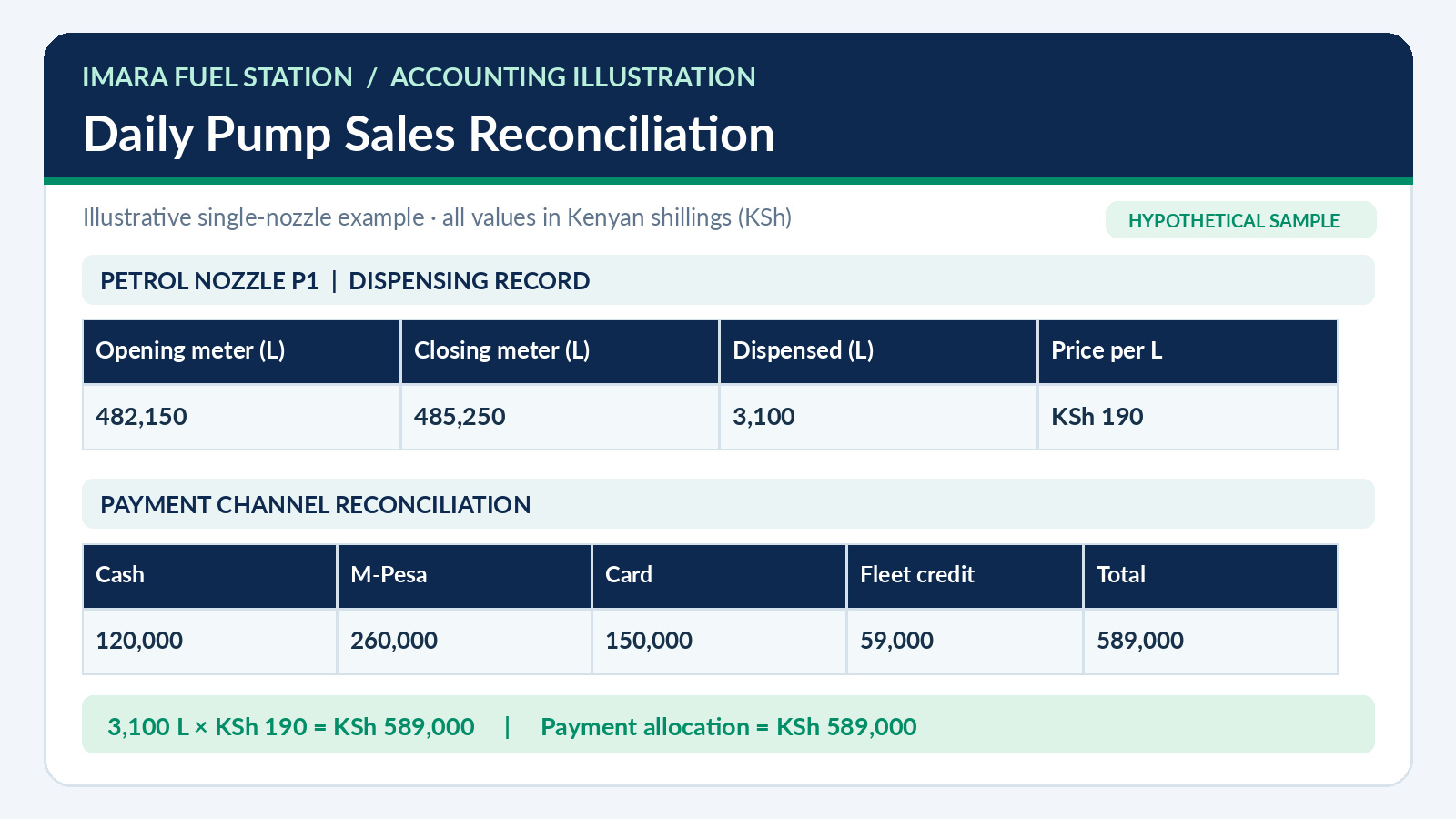
Illustrative petrol station pump sales reconciliation showing liters sold and KSh 589000 split by payment method
Consider an entirely hypothetical day at Imara Fuel Station. A petrol nozzle opens at 482,150 liters and closes at 485,250 liters, giving 3,100 liters dispensed. Assume solely for illustration that the applicable selling price is KSh 190 per liter throughout the period. The implied value of sales is KSh 589,000, before considering any approved corrections or technical exceptions.
The station’s corresponding payment record shows KSh 120,000 cash, KSh 260,000 M-Pesa, KSh 150,000 card receipts, and KSh 59,000 in properly authorized fleet credit. Together, those amounts equal KSh 589,000. This numerical match is reassuring, but it does not prove every transaction is valid. Source evidence, merchant settlements, invoicing, and subsequent collections still require review.
Petrol Station Accounting in Kenya becomes useful when the numbers make discrepancies visible. If cash counted is only KSh 118,000, the KSh 2,000 difference should be traced to a receipt, approved expense, deposit, error, or documented incident. A supervisor should not insert a balancing figure and close the shift without understanding the cause.
Track Fuel Inventory Separately From Pump Sales

Illustrative petrol station gross margin showing KSh 589000 in sales and KSh 35650 gross profit
Fuel inventory has a physical side that cannot be replaced by bookkeeping. For each product and tank, Mr. Otieno needs opening quantities, verified deliveries, recorded dispensing, authorized adjustments, and closing measurements. The expected closing quantity can then be compared with the observed quantity, recognizing that measurement method, temperature, calibration, timing, and equipment condition can affect the reconciliation.
For example, suppose a petrol tank held 12,000 liters at the start of the period, received 8,000 liters, and recorded 3,100 liters dispensed. The expected balance is 16,900 liters. If the physical measurement indicates 16,870 liters, there is a 30-liter difference to investigate. Petrol Station Accounting in Kenya should record that variance clearly, not assume it is theft or automatically write it off.
Potential causes require different responses: delayed meter postings are an administrative problem; a delivery discrepancy may require supplier evidence; inaccurate tank calibration or suspected leakage calls for technical investigation. Bookkeepers can track the financial effect only after the underlying physical event is understood and supported.
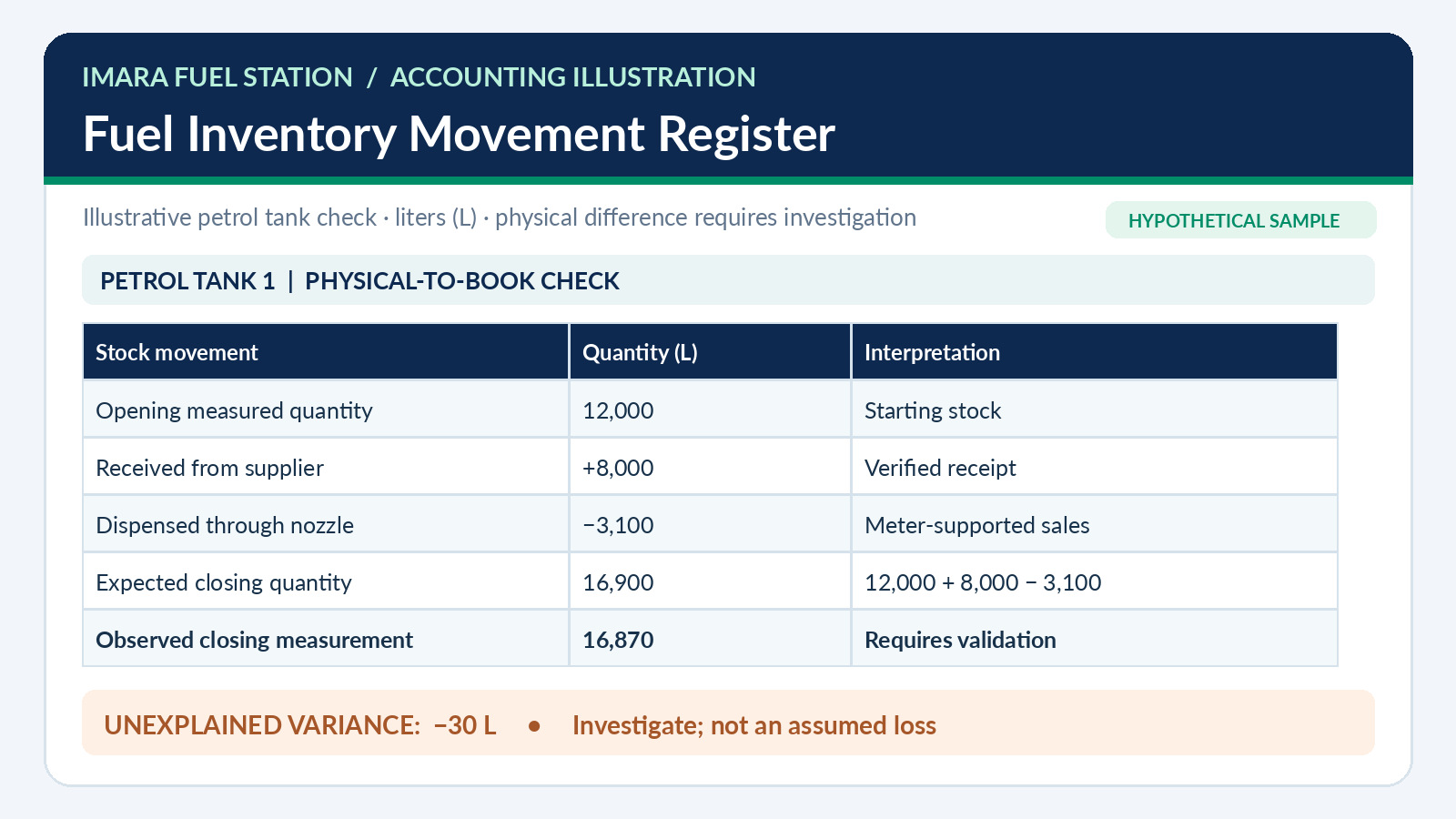
Illustrative fuel inventory register showing expected closing 16900 liters and an unexplained 30-liter variance
Control Deliveries, Supplier Invoices, and Fuel Purchase Costs
A delivery creates two connected records: the physical product received and the amount owed to the supplier. A fuel purchase file should contain the purchase order or supply agreement, delivery documentation, receiving measurements, supplier invoice, relevant tax documentation, and proof of payment. Petrol Station Accounting in Kenya relies on these records to support both stock entries and supplier balances.
Any discrepancy should remain open for investigation rather than being silently changed to match the invoice.
FedhaTrac can help Mr. Otieno maintain supplier ledgers and a list of outstanding invoices. The broader principles described in expense tracking and invoicing in Kenya help ensure that purchase documents are consistently classified and reconciled before management relies on the figures.
Understand Fuel Gross Margin Without Confusing It With Cash
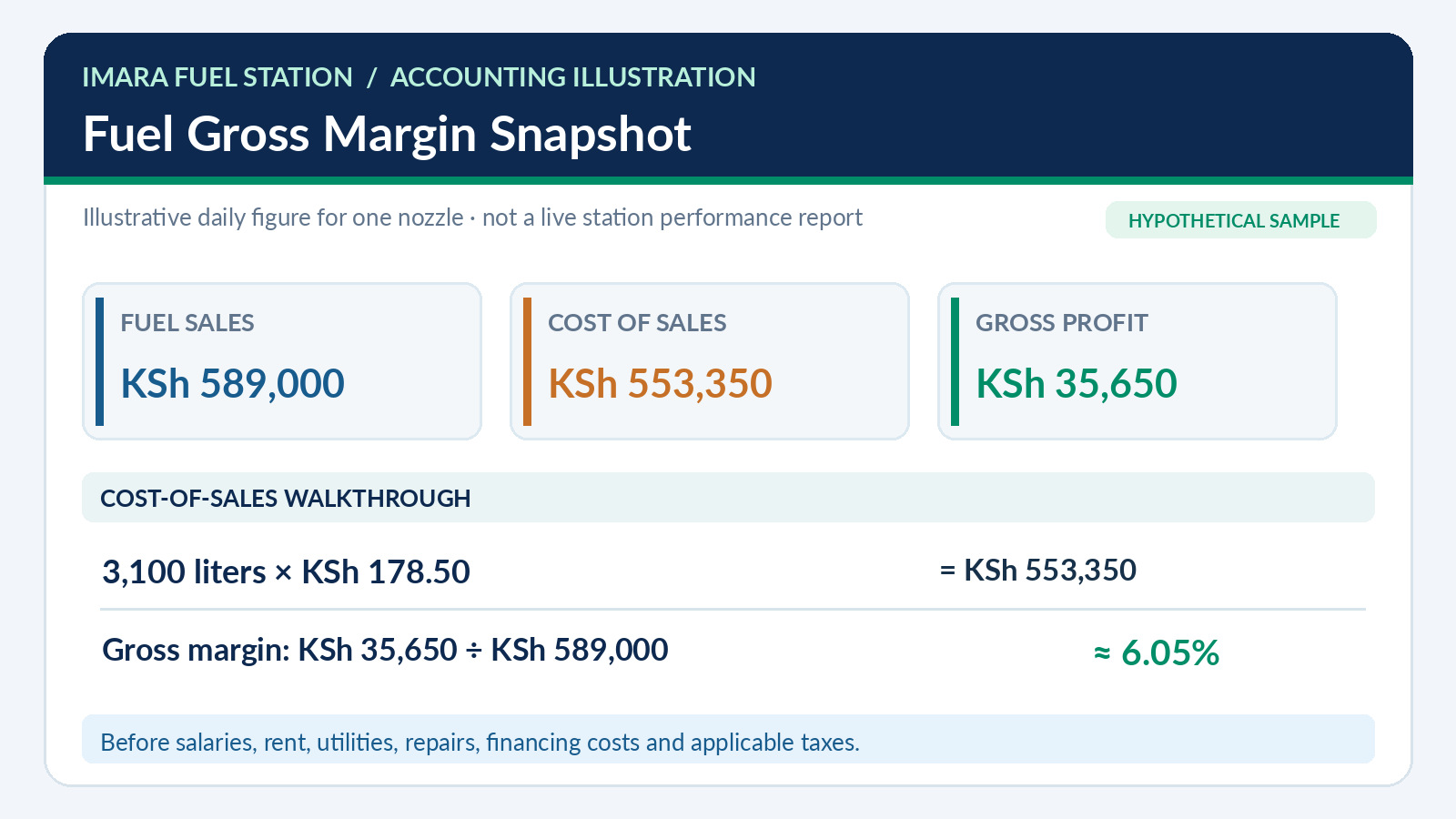 A fuel business can report high sales while earning a much smaller gross margin. Revenue is not profit, and the cost of product sold must be considered before the owner evaluates operating performance. Petrol Station Accounting in Kenya therefore needs a cost-of-sales calculation grounded in actual purchases, the station’s accounting policy, and reliable inventory information.
Take the hypothetical 3,100 liters from the earlier example. If the illustrative inventory cost assigned to those liters is KSh 178.50 per liter, fuel cost of sales is KSh 553,350. Compared with sales of KSh 589,000, the illustrative gross profit is KSh 35,650. These example prices are not current Kenyan pump prices or an industry margin benchmark.
Petrol Station Accounting in Kenya should connect the income statement with the balance sheet and cash-flow forecast. FedhaTrac’s article about profit versus cash flow offers further context on why a business may appear profitable yet struggle to meet supplier payments.
Keep Shop, Lubricant, and Other Income Streams Separate
Many stations also operate a mini-mart, sell lubricants, rent space to a car-wash operator, or provide other authorized services. These activities should not disappear into a single total labeled “fuel sales.” Each category may have different margins, expenses, contracts, inventory processes, and tax treatment. Separating them helps Mr. Otieno understand which operations strengthen the business and which may be consuming resources.
Petrol Station Accounting in Kenya benefits from a practical chart of accounts with distinct income and expense lines. Shop sales can be reconciled to the shop register, stock movements, and payment channels. Lubricant purchases and sales can be monitored separately from petrol and diesel. Where the station receives rental or service income, the underlying agreement and correct accounting treatment should support each entry.
Avoid allocating every shared expense using an arbitrary percentage. Where useful, management can establish a documented, reasonable basis for apportioning utilities, staff time, space, or other shared costs.
Make Shift Reviews and Cash Handling Harder to Manipulate
A reliable system needs separation of duties. The person dispensing fuel should not be the only person authorizing corrections, confirming collections, and approving an unexplained shortfall. Where staffing is limited, the owner can introduce documented reviews, sequential records, restricted access, and supervisor sign-off without creating unnecessary bureaucracy.
For Imara Fuel Station, a practical shift packet might include meter readings, the POS summary, merchant settlement totals, cash counts, fleet-credit approvals, refunds, exception notes, and the handover signatures. Petrol Station Accounting in Kenya works best when the packet is completed promptly and unusual transactions are escalated before they accumulate.
FedhaTrac can support record organization, transaction classification, and reconciliation. It should not be presented as the party physically controlling fuel pumps, handling emergency incidents, or approving every cash movement. Management remains responsible for assigning operational authority, reviewing significant exceptions, and safeguarding the station’s assets.
Manage Fleet Accounts and Customer Receivables
Commercial customers can help a station grow, but unpaid fuel invoices can create serious pressure on cash. Mr. Otieno should know the approved credit limit, billing terms, authorized vehicles, supporting delivery evidence, amounts invoiced, payments received, and overdue balances for every fleet customer. Petrol Station Accounting in Kenya must not classify an unpaid invoice as cash already collected.
A fleet account schedule can show current balances and aging categories so the manager knows which customers require follow-up. Invoiced fuel should be traceable to an authorized transaction or agreed record, and adjustments should carry approval.
When payments arrive, they need to be matched against the correct invoices and recorded once. The bank-reconciliation principles in FedhaTrac’s bank reconciliation in Kenya guide are especially helpful here: unidentified deposits, timing differences, reversals, and bank charges all deserve investigation.
Watch Recurring Expenses and Maintenance Commitments
Fuel stock is often the largest purchasing category, but operating expenses determine how much of the gross margin remains. Electricity, security, cleaning, rent, wages, insurance, POS services, generator costs, equipment maintenance, and bank charges should be recorded consistently. Petrol Station Accounting in Kenya gives Mr. Otieno the ability to compare those costs month over month and explain unexpected changes.
Repairs and capital improvements should not automatically be treated alike. Fixing a faulty fitting and installing a new dispensing system may have different accounting consequences. Documentation and professional judgment matter more than simply coding everything to “repairs.”
Another useful control is a commitments register for bills not yet paid. Petrol Station Accounting in Kenya is stronger when the owner can see both actual payments and upcoming obligations. Otherwise, a large bank balance may create false comfort when a fuel supplier, tax payment, or scheduled maintenance invoice is already due.
Use a Short Cash-Flow Forecast to Plan Fuel Replenishment
Imara Fuel Station needs cash to buy its next delivery before all customers may have paid for earlier fuel. A forecast should therefore track expected daily receipts, fleet collections, planned supplier settlements, operating costs, and a prudent reserve for essential commitments. Petrol Station Accounting in Kenya turns these dates into a practical liquidity picture.
Mr. Otieno can begin with a rolling four-week schedule and update it as actual amounts become known. The forecast should identify restricted or committed funds separately from cash genuinely available for new purchases. It should also distinguish a bank loan from sales: borrowing increases cash and liabilities, not operating revenue.
FedhaTrac can help organize those records and prepare regular management information. The principles behind monthly bookkeeping for Kenyan small businesses are useful for closing each reporting period and building a dependable cash forecast from reconciled information.
Meet EPRA Licensing and Safety Documentation Requirements
Petrol Station Accounting in Kenya operates within a regulated industry, but bookkeeping is only one part of compliance. The Energy and Petroleum Regulatory Authority’s petroleum licence guidance describes requirements for retail petroleum operations and related applications. Depending on the licence or renewal, records may include valid permits, tax compliance evidence, environmental and fire documents, tank and dispensing-meter calibration certificates, and other prescribed information.
Mr. Otieno should keep a controlled compliance calendar and ensure the responsible technical and regulatory advisers confirm which documents apply to the station. Financial bookkeeping can help organize payments, renewal costs, and supporting records, but it does not certify tank safety, perform meter calibration, or substitute for a valid EPRA licence. These obligations belong to the station and appropriately qualified professionals.
Petrol Station Accounting in Kenya supports better documentation, while regulatory compliance requires the correct operational action as well.
Comply With KRA’s Fuel-Station eTIMS System
Fuel retailers have industry-specific electronic invoicing obligations. KRA’s official eTIMS Fuel Station System guidance explains integration with forecourt controllers, sales systems, and related equipment for electronic invoicing. KRA states that fuel stations were required to integrate by June 30, 2025, and its subsequent public notice reiterated compliance and enforcement expectations.
For Imara Fuel Station, Petrol Station Accounting in Kenya should incorporate reconciliation between invoicing records, recorded sales, and relevant settlement information. Bookkeeping support does not itself install or certify the invoicing system. Mr. Otieno should work with the appropriate systems provider and KRA channels to address technical integration, rejected transactions, or compliance questions.
Fuel, lubricants, shop goods, and other supplies can have different VAT classifications. The current KRA VAT guidance should be consulted together with applicable law and professional advice; this article deliberately does not assume one uniform rate for every product. Petrol Station Accounting in Kenya must keep adequate product-level documentation so returns and input-tax positions can be reviewed correctly.
Prepare Monthly Reports That Answer Owner Questions
A useful Petrol Station Accounting in Kenya report does more than show one total for monthly turnover. Mr. Otieno should see liters sold by product, sales by payment channel, stock reconciliation exceptions, gross margin by product where reliable, operating expenses, unpaid supplier invoices, fleet receivables, and cash available against upcoming obligations.
Petrol Station Accounting in Kenya works best when the reporting pack highlights both the result and its explanation. For example, an increase in sales volume may still produce weaker cash flow if fleet debt rises. A favorable margin may be outweighed by repair costs. A physical inventory variance should remain visible until investigated and resolved with evidence.
FedhaTrac can support the bookkeeping and reporting processes behind these decisions, based on an agreed scope of services. The aim is not to promise that every difference will disappear.
How FedhaTrac Can Support Mr. Otieno’s Next Stage of Growth
Mr. Otieno does not need another disconnected spreadsheet or an end-of-month surprise. He needs a clear routine: record accurate pump and sales information, reconcile collection channels, document inventory movements, organize supplier invoices, classify expenses, and review a trustworthy financial report. Petrol Station Accounting in Kenya becomes manageable when those steps happen on schedule and each unexplained figure has an accountable reviewer.
FedhaTrac’s bookkeeping services can help a business establish organized transaction records, reconciliations, and financial reporting, subject to the agreed engagement. Specialist fuel-system integration, engineering inspections, licensing, and safety functions must remain with the competent providers and station management responsible for them.
The fictional Imara Fuel Station story illustrates a real business lesson: more vehicles at the pumps do not automatically mean more money available to the owner. With reliable Petrol Station Accounting in Kenya, Mr. Otieno can distinguish high activity from sustainable performance, protect the integrity of his records, and make more deliberate decisions about stock, credit, costs, and growth. Businesses seeking that financial clarity can contact FedhaTrac to discuss appropriate bookkeeping and reporting support.


