
Running a laundry business requires more than clean clothes and satisfied customers. You also need to know whether each wash load, pressed shirt, delivered duvet, and corporate linen contract is earning enough to cover water, electricity, chemicals, staff, and machine repairs. Laundry business accounting in Kenya connects these daily activities to the financial decisions that keep a shop sustainable.
At FedhaTrac, we give laundry owners practical bookkeeping, payment reconciliation, financial reporting, and tax-support services. We organize your records, explain your numbers, and help you make decisions with evidence instead of guesswork. Whether you operate a neighborhood washing shop, a dry-cleaning counter, or a growing commercial laundry, our approach to laundry business accounting in Kenya is built around your actual workflow.
Consider Safi Spin Laundry & Dry Cleaners, an illustrative Nairobi business handling wash-and-fold orders, ironing, duvet cleaning, collections, deliveries, and corporate linen contracts. Safi Spin is an example for this article, not a claim that it is an existing FedhaTrac customer. Its hypothetical figures show how our services could help a laundry owner see the financial picture behind the work.
Why Laundry Business Accounting in Kenya Needs More Than a Sales Total
A busy shop can still run short of money. A machine may process dozens of loads while electricity costs climb; a hotel contract may keep staff occupied but settle invoices 30 days later. Without proper laundry business accounting in Kenya, the owner might celebrate a high sales figure while overlooking service costs and unpaid bills.
We start by understanding how your business earns money. Walk-in customers may pay for a bundle of clothing, while another customer pays per garment, per kilogram, or for express service. Corporate clients may send monthly linen orders under agreed rates. Delivery charges and discounts should be identified separately so you do not confuse turnover with profit.

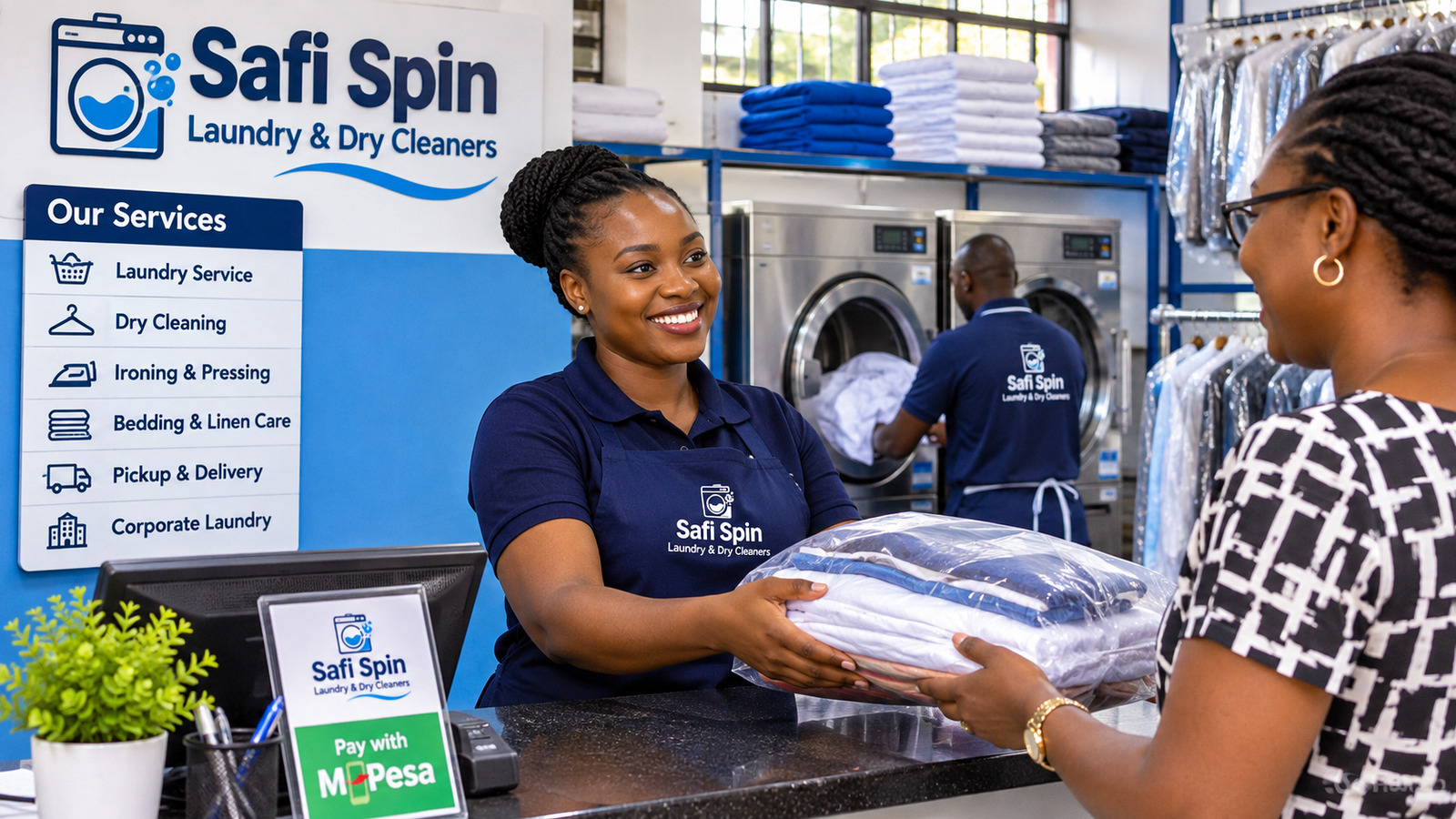
Laundry business accounting in Kenya illustrated by a Safi Spin customer receiving garments
We then organize the supporting evidence: service orders, invoices, receipts, supplier documents, M-Pesa statements, bank records, and recorded expenses. Our bookkeeping service is designed to handle that work rather than simply hand you software and expect you to figure it out. This makes laundry business accounting in Kenya useful even when you already use a till, spreadsheets, or a booking app.
Start with the six financial questions every owner should ask
How much did we earn from completed jobs? How much cash was actually collected? What did it cost to perform each service? Which customers still owe us money? What must we pay our suppliers next? And how much profit remains after all expenses? We use laundry business accounting in Kenya to make each question answerable from reliable records, not memory.
1. Match Laundry Orders to Cash, M-Pesa, and Bank Collections
Laundry shops receive payments in several ways. One customer pays in cash on pickup; another sends M-Pesa before delivery; a corporate client settles an invoice by bank transfer. If payments are not matched to their orders, apparent daily revenue can be misleading. Strong laundry business accounting in Kenya begins by separating work performed from money received.
At FedhaTrac, we organize the order and sales summaries you provide, review the related receipts, and reconcile recorded collections to available M-Pesa and bank statements. We flag differences for investigation: unrecorded cash, duplicate entries, deposits posted against the wrong order, and transfers received after the reporting period. We do not claim that every transaction synchronizes automatically with every outside system; our accountants work from the agreed source records and reports.
For example, an illustrative month at Safi Spin records KSh 1,050,000 in revenue from completed services. Of that, KSh 650,000 was received by M-Pesa, KSh 145,000 in cash, and KSh 145,000 by bank transfer. Total collections are KSh 940,000, leaving KSh 110,000 outstanding. Our laundry business accounting in Kenya would distinguish those two totals immediately rather than report KSh 1,050,000 as money already in the account.
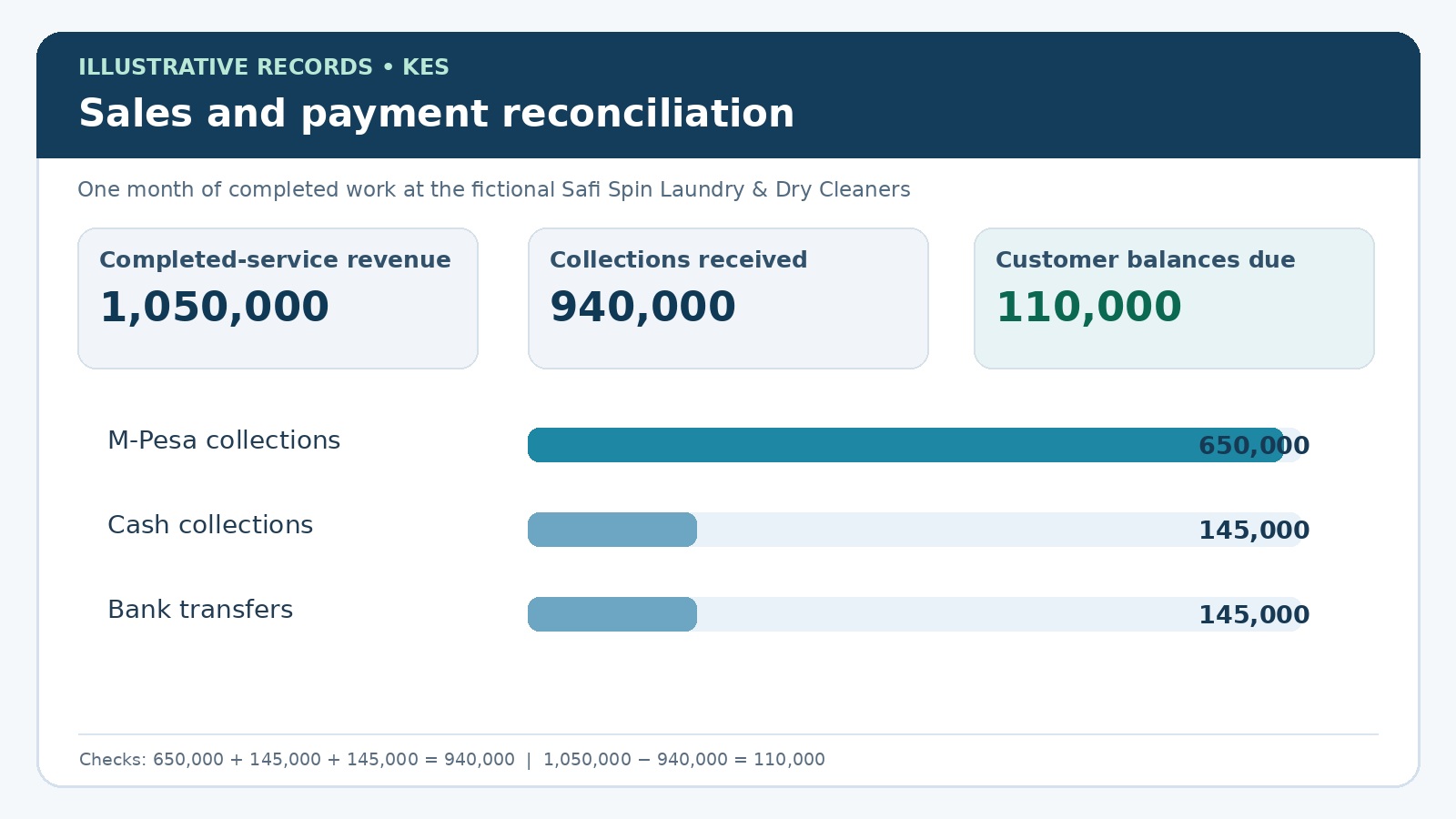
Sample laundry business accounting in Kenya reconciliation of M-Pesa, cash, bank and unpaid bills
If a customer prepays for work not yet performed, the accounting treatment depends on the arrangement and applicable accounting basis. We review that distinction so advance collections do not automatically get mistaken for completed-service revenue. We also help the shop document refunds, cancellations, and corrected invoices. Accurate laundry business accounting in Kenya means fewer unanswered questions at month-end.
2. Control the Real Costs of Washing, Pressing, and Dry Cleaning
A quoted price is not the same as a profitable price. Laundry owners pay for detergents, softeners, stain treatments, water, power, packaging, and labor. Commercial equipment also requires preventive maintenance and occasional repairs. We support laundry business accounting in Kenya by recording these costs consistently and explaining how they affect service margins.
Our team helps categorize direct processing costs separately from broader operating expenses. Detergent used on customer work belongs in a different analysis from office stationery; a machine technician’s repair invoice should not disappear inside an undifferentiated “miscellaneous” total. Water and electricity bills can be reviewed alongside load counts or service volumes where those records exist. We do not pretend the accounting system itself measures each wash cycle or each machine’s consumption.

Safi Spin laundry staff handling linen and garment processing in a Kenyan laundry shop
Suppose Safi Spin spends KSh 90,000 on chemicals and treatment products, KSh 55,000 on water, KSh 130,000 on electricity, KSh 25,000 on packaging, and KSh 90,000 on labor directly assigned to processing customer orders. The illustrative direct-cost total is KSh 390,000. With KSh 1,050,000 in completed-service revenue, that leaves KSh 660,000 before indirect operating expenses. This is how laundry business accounting in Kenya can turn a long list of bills into a useful gross-margin discussion.
We also help owners compare service types. A pressed shirt, a washed duvet, and a hotel linen bundle require different labor, machine time, and materials. Where the business maintains usable job information, our accounting service can support cost comparisons that reveal which prices need review. Laundry business accounting in Kenya should inform decisions, not promise that every service can be made profitable by a software setting.
3. Keep Rent, Wages, Deliveries, and Machine Repairs Visible
Variable service costs are only part of the picture. Rent, front-desk salaries, delivery fuel, internet, marketing, and routine administration can reduce a healthy gross margin. We make laundry business accounting in Kenya more actionable by tracking these items in categories that a business owner can understand and review.
For Safi Spin, assume monthly rent of KSh 120,000, administrative and front-desk wages of KSh 180,000, delivery expenses of KSh 50,000, equipment maintenance of KSh 35,000, and marketing and administrative costs of KSh 35,000. Those operating expenses total KSh 420,000. Subtracting them from the KSh 660,000 gross profit gives an illustrative operating result of KSh 240,000 before interest, depreciation, income tax, and other adjustments. This is a model, not a promise of earnings.
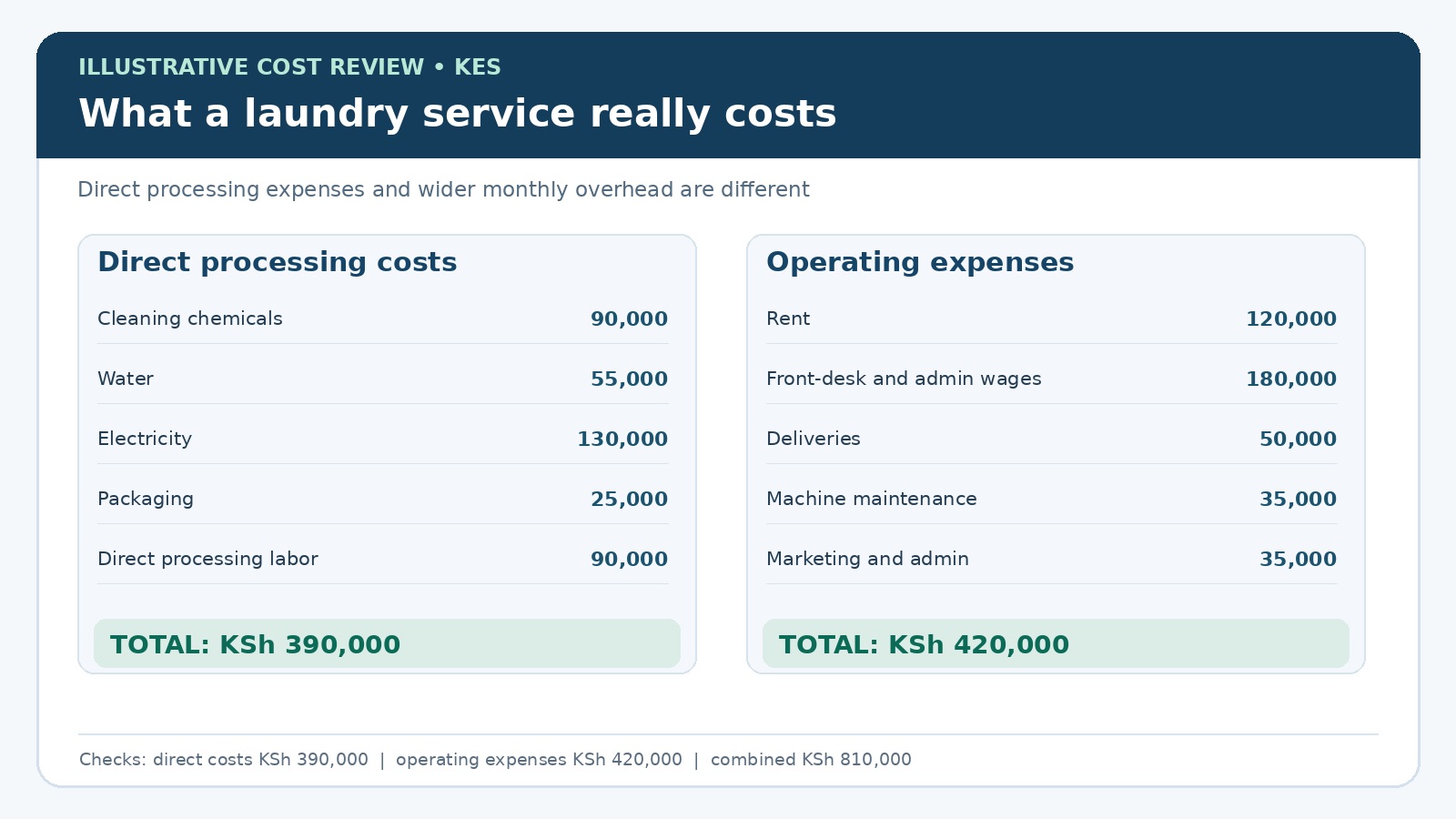
Illustrative laundry cost breakdown for detergents, electricity, water, wages and overhead
A clear expense history also helps you spot changes. If electricity rises while revenue stays flat, we can show the trend. If delivery costs increase faster than delivery income, we can help you review pricing or route economics. If machine repairs become frequent, documented costs may support an informed replacement-versus-repair decision. This is the everyday value of laundry business accounting in Kenya: seeing the pressure points before they consume your margin.
We can organize supplier invoices and supporting documents, track amounts due, and help the owner plan cash requirements. Our business operations support includes payment tracking, expense workflows, supplier records, and document organization. Good laundry business accounting in Kenya supports timely decisions without suggesting we physically maintain machines or manage the laundry floor.
4. Manage Corporate Laundry Accounts Without Losing Cash Flow
Serving hotels, restaurants, guesthouses, or serviced apartments can bring recurring revenue. It can also create an uncomfortable gap between service delivery and payment. A contract that looks impressive on a sales report may be stressful if wages and utility bills fall due before the client pays. We use laundry business accounting in Kenya to keep customer balances, invoice dates, and actual receipts visible.
We help maintain customer records, organize approved invoices, follow up on outstanding balances as agreed, and review aging reports. A business owner can see which customer is overdue and what documentation supports the amount. Where a credit note, disputed charge, or partial payment is involved, we help keep the history traceable. Good laundry business accounting in Kenya supports professional relationships without making promises that a customer will pay on a particular day.
At Safi Spin, the illustrative KSh 110,000 outstanding from completed jobs may include a KSh 75,000 hotel linen invoice and KSh 35,000 from other approved credit accounts. The owner needs to understand both amounts before committing to new chemicals or a larger delivery contract. FedhaTrac can prepare a cash forecast using expected collections and planned payments, while clearly distinguishing forecasts from money already available.
Our financial services include cash-flow analysis and preparation of financial information for business decisions. Whether your laundry works with just walk-in customers or a network of institutional clients, laundry business accounting in Kenya should make unpaid work and future obligations visible in the same conversation.
5. Turn Monthly Numbers into Decisions, Not Just Reports
Business owners do not need a folder of unexplained spreadsheets. They need to know whether the shop is improving, which services earn their keep, whether cash is sufficient for wages, and which expenses need attention. At FedhaTrac, laundry business accounting in Kenya means preparing reports and talking through what they say.
Our team can prepare a profit-and-loss statement, cash-flow analysis, balances owed by customers, balances payable to suppliers, and management summaries. We review trends against earlier periods or agreed budgets when records are available. Through our reporting and advisory services, we help you understand the numbers rather than handing over a dashboard without context.
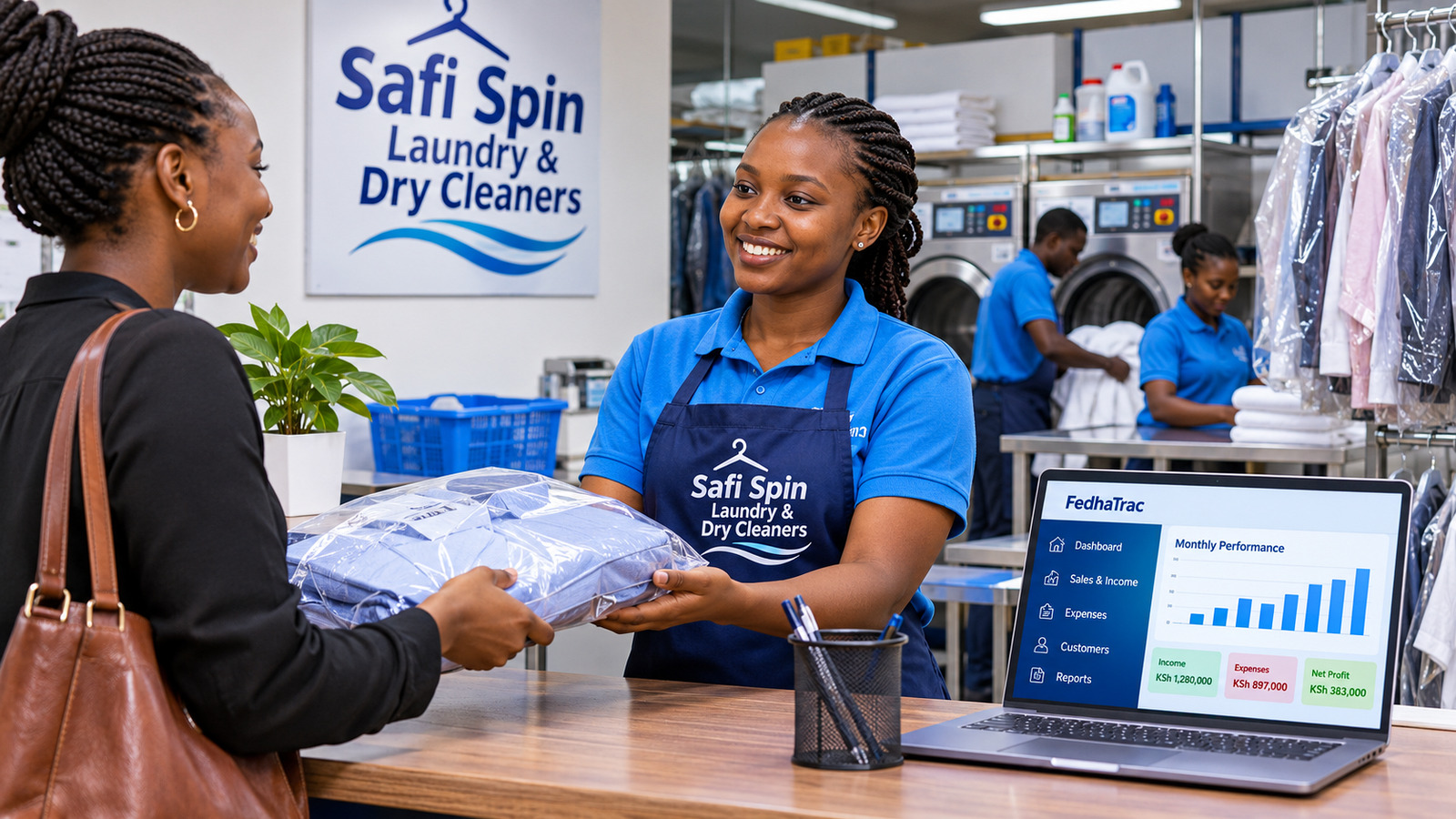
Kenyan laundry owner reviewing sales information and financial records with FedhaTrac support
An illustrative monthly financial snapshot
| Safi Spin income and costs | Amount (KES) |
| Wash-and-fold services | 320,000 |
| Ironing and pressing | 155,000 |
| Duvet and specialist garment care | 180,000 |
| Pickup and delivery service revenue | 95,000 |
| Corporate linen services | 300,000 |
| Total completed-service revenue | 1,050,000 |
| Direct processing costs | (390,000) |
| Gross profit | 660,000 |
| Operating expenses | (420,000) |
| Operating result before further adjustments | 240,000 |
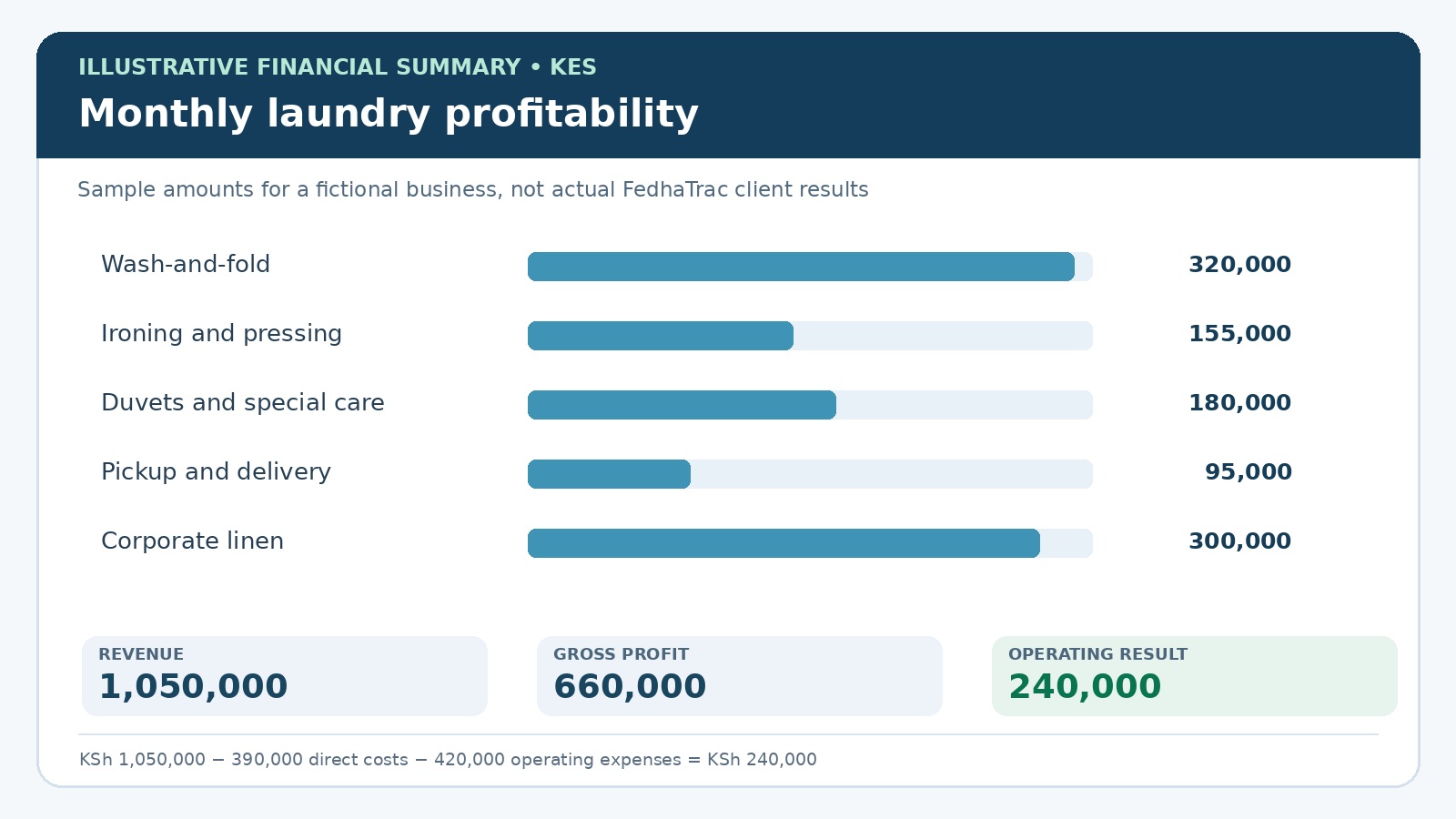
Sample Safi Spin laundry financial dashboard with revenue, gross profit and operating result
These figures are hypothetical and deliberately simplified. They are not a client testimonial, a VAT computation, or a guarantee of financial performance. They show why laundry business accounting in Kenya should separate revenue, collections, direct costs, overhead, and profit rather than treat them as the same measure.
Our analysis would also consider whether the owner has mixed personal withdrawals with business expenses, whether machine purchases belong in assets rather than immediate routine expenses, and whether reports are based on complete supporting documents. Professional laundry business accounting in Kenya gives management a more credible basis for pricing, staffing, equipment planning, and expansion.
6. Prepare Organized Records for KRA and Business Growth
Tax compliance is easier to manage when transactions and supporting documents are organized throughout the year. The Kenya Revenue Authority states that persons engaged in business generally need to onboard eTIMS and issue electronic tax invoices, with relevant solutions for different taxpayer types. VAT registration and return obligations depend on the business’s circumstances; KRA identifies an annual KSh 5 million threshold for mandatory VAT registration on taxable supplies, subject to applicable rules and exceptions.
At FedhaTrac, we help clients prepare clean bookkeeping records, reconcile sales and expenses, organize eTIMS documentation, and review applicable tax obligations. We support KRA filing where it is part of the agreed service. We do not assume that every small laundry is VAT registered or subject to the same income-tax regime. For that reason, laundry business accounting in Kenya should be tailored to the business’s actual registration, turnover, and activities.
We can also prepare reports to support a financing discussion or planned investment in better washers, water storage, or an additional collection point. A lender or investor may ask for sales history, evidence of expenses, and cash-flow information. FedhaTrac tax filing and compliance support helps clients organize tax-related financial records, while our accounting team supports the broader reporting that owners need for decisions. Laundry business accounting in Kenya becomes an ongoing discipline, not a last-minute exercise when a deadline approaches.
Good tax compliance begins with accurate financial records. According to the Kenya Revenue Authority’s eTIMS guidance, businesses are generally required to issue electronic tax invoices. Additionally, KRA’s VAT guidelines explain that businesses making taxable supplies of KSh 5 million or more within a 12-month period must register for VAT, subject to applicable requirements. At FedhaTrac, we help laundry and dry-cleaning businesses organize invoices, reconcile transactions, maintain reliable financial records, and prepare for applicable tax obligations. Our professional support helps you manage compliance requirements while concentrating on growing your business.
How We Begin Working With Your Laundry or Dry-Cleaning Business
We start with a conversation about your shop, services, payment methods, major costs, and existing records. You may already use a POS, a booking system, Excel, paper service tickets, or a combination. We can work with usable reports from an existing system, or discuss the FedhaTrac tools available for your business. We confirm the information and access needed before committing to a process.
Next, we agree on a practical bookkeeping and reporting scope. That might include recording sales, classifying costs, reconciling M-Pesa and bank movements, reviewing customer balances, and preparing monthly management reports. We identify missing data and explain what the owner or team must continue recording operationally, such as garment counts and completed jobs. This is how we put laundry business accounting in Kenya to work without disrupting the shop unnecessarily.
As the records become more consistent, we help the owner use the results. Perhaps prices need review, a corporate account needs collection follow-up, or a recurring expense needs investigation. We explain the available evidence and discuss sensible next steps. Our promise is professional financial support and clearer records—not guaranteed savings or automatic business growth.
Questions Laundry and Dry-Cleaning Owners Ask Us
Can FedhaTrac manage our bookkeeping if we already use a POS or laundry order app?
Yes. We can work with the sales and transaction reports available from your existing system and connect that information to bookkeeping, reconciliation, expenses, and financial reporting. We also offer our own POS solution where it is suitable. We confirm file formats and the agreed workflow first; we do not claim automatic integration with every third-party app. Laundry business accounting in Kenya can be effective without forcing you to abandon the tools that already serve your customers.
Will you help us understand why our laundry is busy but cash is tight?
That is exactly the kind of financial question we help investigate. We review recorded completed-service revenue, payment collections, unpaid customer invoices, supplier obligations, and expenses. We then explain the differences in practical language. Laundry business accounting in Kenya can reveal whether pressure is coming from slow collections, rising operating costs, owner withdrawals, or another documented factor.
Can you help with hotel and corporate laundry invoices?
Yes. Our team helps organize customer invoices, track balances, reconcile payments, and prepare supporting records. For ongoing contracts, we can help you review the financial performance of the work using the records you provide. We do not promise debt recovery, but we help you know what is outstanding and what deserves follow-up.
Does FedhaTrac only prepare tax returns?
No. Tax support is one part of what we offer. Our services include outsourced bookkeeping, reconciliations, expense and supplier records, management reporting, and financial analysis. That means laundry business accounting in Kenya with FedhaTrac is about understanding the business throughout the month, not simply sending a return at the deadline.
How do we get started with FedhaTrac?
Contact our team and describe your laundry services, current records, and biggest financial concern. We will discuss the appropriate bookkeeping, accounting, reporting, and tax-support scope. You can keep concentrating on garment care and customer service while we help bring more structure and clarity to the financial side of the operation.
Give Your Laundry Business the Financial Attention It Deserves
You already work hard to return garments clean, pressed, and on time. Your business finances deserve the same care. At FedhaTrac, we turn daily records into understandable financial information, help you reconcile what was earned with what was collected, and keep expenses, customers, and supplier obligations from disappearing into paperwork.
If you want more confidence in your prices, costs, cash flow, and financial decisions, professional laundry business accounting in Kenya is a practical place to start. Speak with FedhaTrac about the service package that fits your shop. We are ready to help you understand the numbers behind every load and build a better-informed business.


