

Running a cereals shop can be a good business in Kenya, but strong sales do not automatically mean healthy profits. Each delivery of maize, beans, rice, green grams, or millet brings questions about purchase costs, weighing, transport, customer payments, and how much stock is actually left. At FedhaTrac, we provide cereals shop accounting in Kenya that helps owners turn these everyday transactions into reliable financial information. We help you see what you have sold, what you have spent, what customers owe, and what your business has truly earned.
Consider Mama Njeri’s Cereals Palace, an illustrative grain retailer in Nakuru. The shop buys some cereals in bulk and sells by the kilogram, by the bag, and to selected institutions on agreed credit terms. It is a fictional business used to explain our services, not a claimed FedhaTrac customer or a record of actual results. Our approach to cereals shop accounting in Kenya is designed for precisely this combination of sales activity and financial complexity.
Why Cereals Shop Accounting in Kenya Matters Beyond Daily Sales
A shop owner may remember the selling price of a 90-kilogram bag but forget the transport, unloading, packaging, and payment charges attached to it. Without a consistent record of these movements, buying decisions can easily be based on guesswork.
Our bookkeeping services bring sales records, bank statements, mobile-money reports, invoices, stock summaries, and expenses together. We reconcile the figures, investigate differences, and explain them in ordinary business language. This is how cereals shop accounting in Kenya becomes a practical management tool rather than a collection of receipts in a drawer.
1. Match Every Sale to the Money Collected
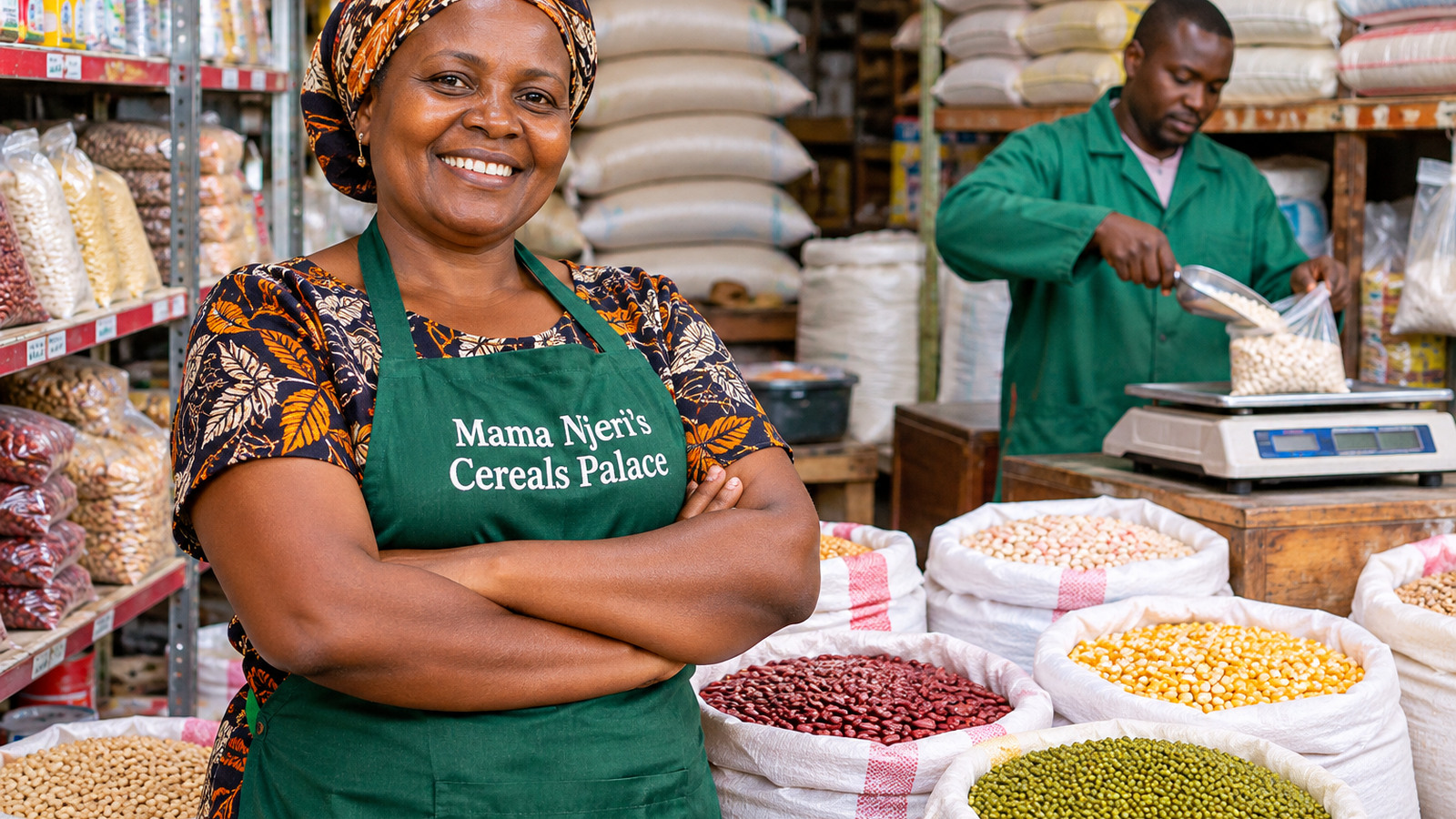
Cereals shop accounting in Kenya as a shop assistant weighs grain for a customer
A cereals shop typically receives cash at the counter, M-Pesa payments, bank transfers, and sometimes payments made days after an invoice. We help reconcile those records against the shop’s actual sales so that a payment is not counted twice and a credit sale is not mistaken for cash already received.
For example, imagine Mama Njeri’s Cereals Palace records KSh 1,260,000 of completed sales in one illustrative month. Of that amount, KSh 640,000 is collected through M-Pesa, KSh 390,000 in cash, and KSh 170,000 through the bank. The remaining KSh 60,000 represents unpaid customer invoices. The total agrees with sales, but only KSh 1,200,000 has been collected.
With our cereals shop accounting in Kenya, we can help identify unmatched payments, investigate reversals, review deposit records, and prepare a simple collections summary for management. If you use our POS system, we can work with its sales records. If you already use another POS or manual sales register, we can use the reports and source documents available.
2. Work Out the Real Cost of Buying Grain
Purchasing maize from a supplier is only part of the cost of getting saleable stock into the shop. Freight, unloading, and other directly attributable acquisition costs may form part of inventory cost under the applicable accounting treatment. The exact treatment should reflect the nature of each expense and the business’s accounting policy.
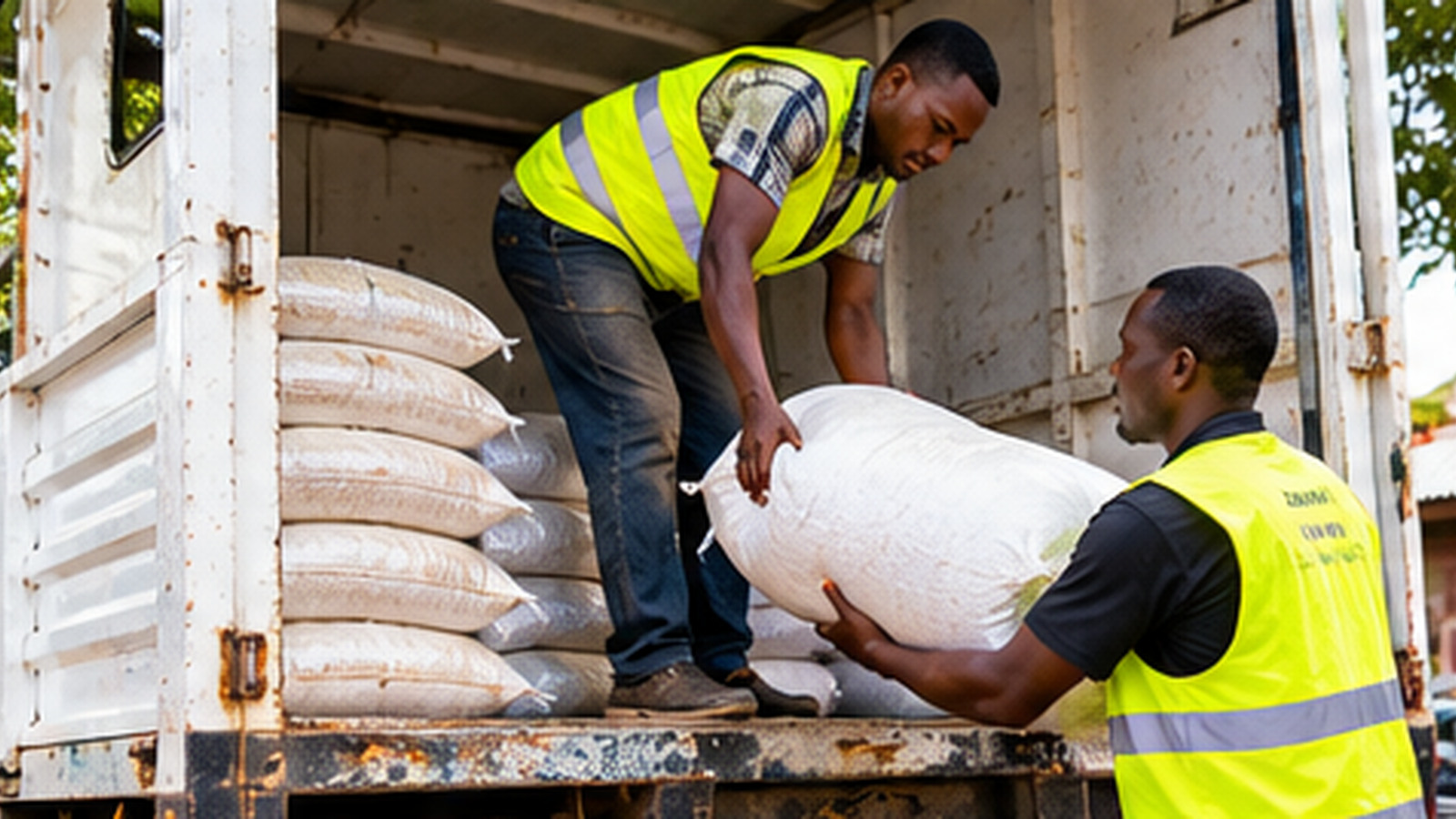
Delivery workers receiving bulk bags for stock costing at a Kenyan cereals retail shop
Take a separate, hypothetical purchase of 1,000 kilograms of maize for KSh 91,000. Add KSh 4,000 of inbound transport and KSh 1,000 of unloading. The total landed cost becomes KSh 96,000, or KSh 96 per kilogram. Selling 100 kilograms from that batch at KSh 128 per kilogram would bring KSh 12,800 in sales and a KSh 9,600 cost of goods sold, leaving KSh 3,200 in gross profit before operating expenses and any stock adjustments.
Our team organizes these purchase documents and makes the cost assumptions visible. Through cereals shop accounting in Kenya, we help the owner compare suppliers using more than the headline price of a sack. Through cereals shop accounting in Kenya, we distinguish inbound delivery costs from outward customer-delivery expenses, reducing double counting.
3. Reconcile Grain Bought, Weighed, Sold, and Remaining
Cereals are frequently repacked and sold in quantities smaller than the original bag. That creates opportunities for recording errors, torn packaging, weighing differences, spillage, moisture changes, or losses that need investigation. The physical count must be completed by the shop team; our role is to turn those counts into a financial reconciliation and highlight unexplained differences.
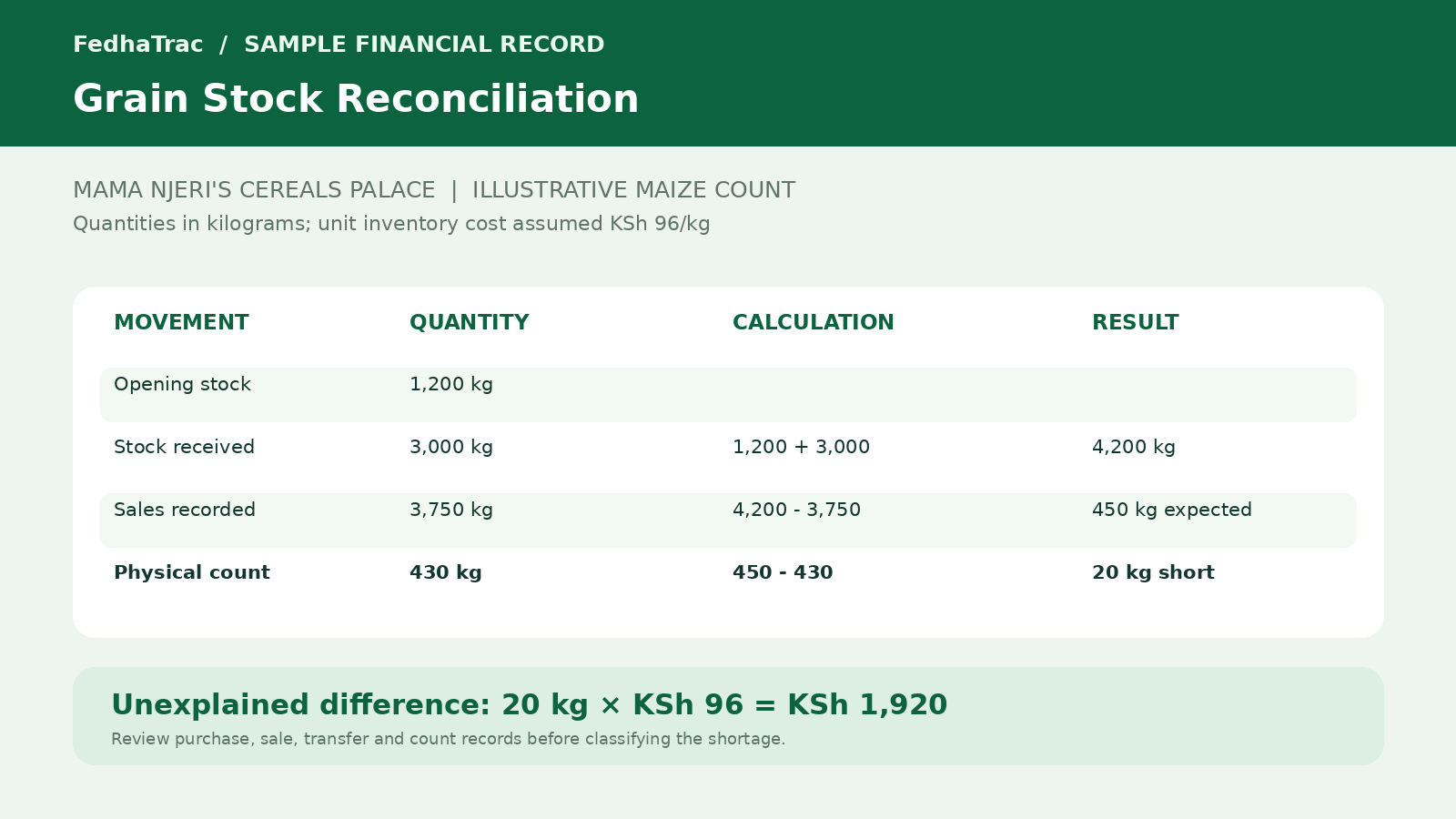
Sample cereals shop accounting in Kenya stock reconciliation showing a 20 kilogram maize shortage
Suppose a maize stock record starts with 1,200 kilograms, receives 3,000 kilograms, and records sales of 3,750 kilograms. The expected closing quantity is 450 kilograms. If the shop’s verified physical count is 430 kilograms, the unexplained difference is 20 kilograms. At an illustrative unit cost of KSh 96, that represents KSh 1,920 requiring review, not automatic proof of theft or waste.
We help compare the stock movement schedule with supplier invoices, sales records, returns, authorized write-offs, and count sheets. If a loss is confirmed, it can be classified and recognized under an appropriate accounting treatment. Cereals shop accounting in Kenya should make exceptions visible without blaming staff before the facts are checked. We also help the owner distinguish financial stock valuation from physical storage, food-safety checks, and weighing controls, which remain operational responsibilities.
Our cereals shop accounting in Kenya makes each category easier to review.
4. See Which Cereals Actually Generate Gross Profit
Different products carry different purchase costs, packaging needs, and price movements. We use recorded sales and costs to prepare product-category results so that you can distinguish revenue from gross profit.
For Mama Njeri’s Cereals Palace, imagine the month includes KSh 480,000 in maize sales, KSh 330,000 in beans, KSh 270,000 in rice, and KSh 180,000 in other pulses. The matching illustrative cost of goods sold is KSh 360,000, KSh 249,000, KSh 201,000, and KSh 132,000 respectively. That makes total sales KSh 1,260,000, cost of goods sold KSh 942,000, and gross profit KSh 318,000.
Our accounting services help interpret the figures. A category may earn a higher margin percentage but tie up stock longer, while another may produce steady cash sales. Cereals shop accounting in Kenya gives you the information needed to ask better questions about reorder sizes, promotional pricing, and purchasing priorities.
5. Control Supplier Bills and Customer Credit
A retailer buying from farmers, millers, distributors, or wholesalers may receive different payment terms from each supplier. Some invoices are due on delivery; others allow a short credit period. Meanwhile, institutional buyers may request 14- or 30-day settlement terms.
As part of cereals shop accounting in Kenya, we prepare supplier ledgers, record due dates, allocate payments, and maintain customer-balance schedules. Under cereals shop accounting in Kenya, the owner can see which supplier bills are approaching, which customer accounts are overdue, and what documents support each balance.
For Mama Njeri’s Cereals Palace, the illustrative KSh 60,000 in outstanding customer invoices is revenue not yet collected, not an additional sale. We can help produce an aging summary and a professional collection routine while the business remains responsible for commercial credit decisions and customer relationships.
6. Keep Operating Costs Separate From Inventory Costs
Rent, wages, utilities, shop security, payment fees, stationery, and customer deliveries can gradually reduce the amount left after gross profit. Some purchasing expenses belong in the cost of inventory; other costs belong in the period’s operating expenses. Keeping those categories separate makes it easier to compare months and prevents misleading margins.
Imagine monthly expenses of KSh 43,000 for rent, KSh 70,000 for staff, KSh 28,000 for customer delivery and local distribution, KSh 12,000 for utilities, KSh 10,000 for retail packaging, KSh 7,000 for payment and banking fees, and KSh 10,000 for other running costs. The combined operating expenses are KSh 180,000. Against KSh 318,000 gross profit, this gives KSh 138,000 of illustrative operating profit before stock-variance adjustments, finance costs, depreciation, and tax.
Through cereals shop accounting in Kenya, we organize receipts, classify expenses, and prepare comparisons of changing costs. Cereals shop accounting in Kenya helps an owner notice rising delivery spending or bank charges without confusing these with the price paid for grain.
7. Plan Cash for the Next Stock Purchase
A busy shop needs working capital long before the month-end report is complete. Suppliers may expect payment while customers still owe money, and grain prices can move between buying cycles. The relevant question is not only whether last month was profitable; it is whether available funds will cover purchases, payroll, rent, and other commitments as they become due.
Our specialized reporting and advisory support can help turn expected receipts and scheduled payments into a short-term cash-flow forecast. With cereals shop accounting in Kenya, we separate cash already in the bank from credit sales that might be collected later. We can review supplier-payment dates, anticipated stock orders, and a sensible operating reserve without presenting a forecast as a guarantee.
For Mama Njeri’s Cereals Palace, the difference between KSh 1,260,000 in sales and KSh 1,200,000 collected is a reminder to plan around actual cash. An owner who understands this difference can discuss payment terms earlier and decide whether a large restock order is affordable.
8. Receive Understandable Reports and Tax-Ready Financial Records
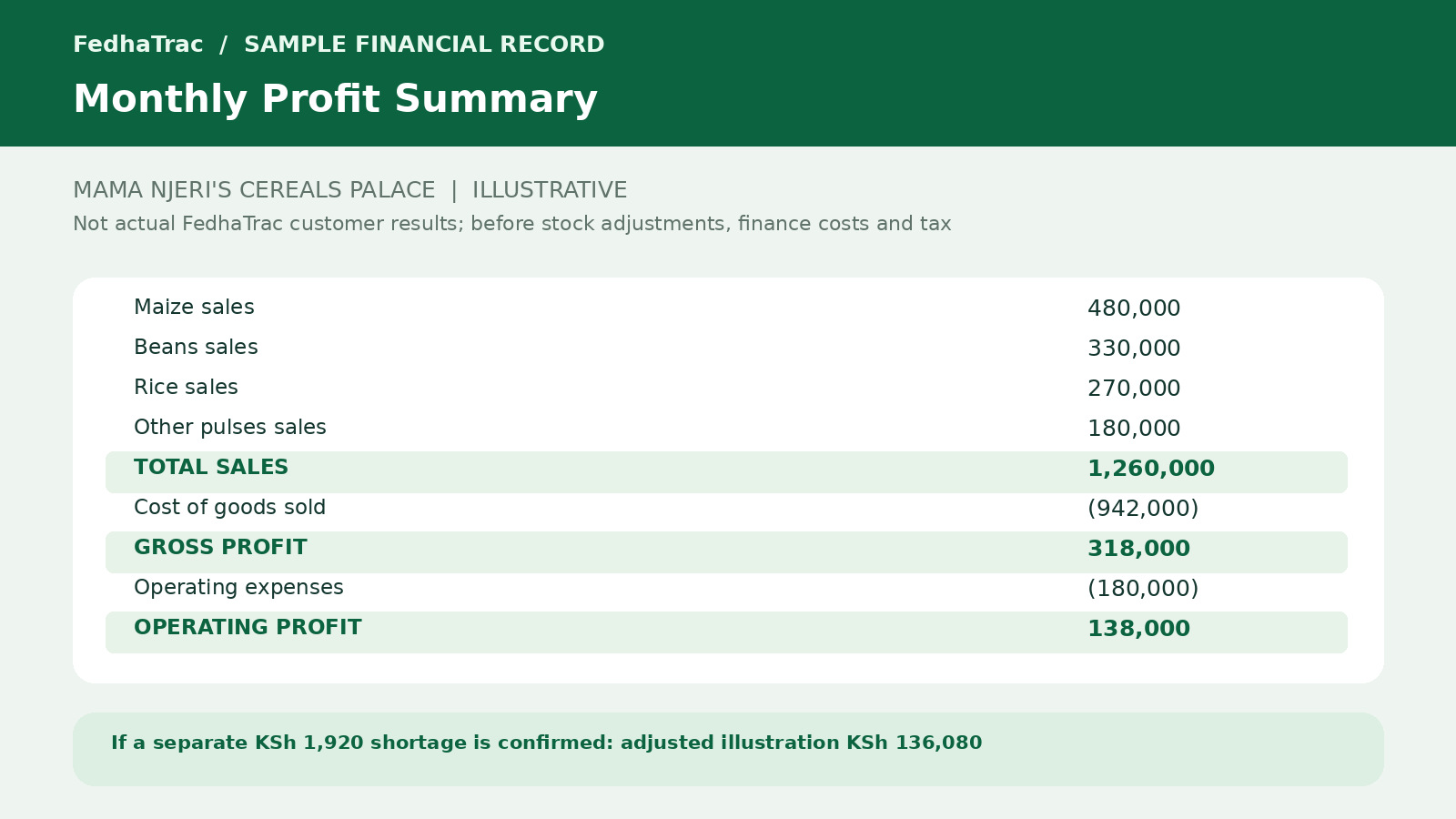
Sample cereals shop accounting in Kenya monthly gross profit and operating profit report
At month-end, we want the owner to receive more than a spreadsheet full of figures. Our cereals shop accounting in Kenya can support a practical reporting pack showing sales, cash collections, credit customers, supplier balances, inventory movement, operating costs, and profit. We review what changed and explain where a follow-up decision is needed. That is the value of professional financial support: facts you can use, not reports you must struggle to interpret.
We also help businesses organize records for their applicable Kenya Revenue Authority obligations. The Kenya Revenue Authority’s explanation of eTIMS confirms that electronic invoicing requirements can apply to businesses that are not VAT-registered. The exact VAT treatment of a particular grain or other product depends on its legal classification, and the shop’s tax registration and filing obligations must be assessed individually. We will not assume that every cereal attracts the same VAT treatment.
KRA has also announced income-and-expense validation in returns from 2026, using data that includes TIMS/eTIMS records, with stated exceptions. Properly maintained invoices, purchase documents, and reconciliations therefore matter. Through our cereals shop accounting in Kenya and tax-support services, we help organize the supporting records and assess which filing assistance the business needs, without promising that bookkeeping alone replaces a registered taxpayer’s legal responsibilities.
What the Monthly Figures Could Show at Mama Njeri’s Cereals Palace
The following table is an illustrative model, not a report produced for a real FedhaTrac customer. All values are in Kenya shillings, and the figures intentionally exclude any unverified tax treatment or claim about actual grain prices.
| Financial item | Amount (KSh) |
| Maize sales | 480,000 |
| Bean sales | 330,000 |
| Rice sales | 270,000 |
| Other pulses sales | 180,000 |
| Total completed sales | 1,260,000 |
| Cost of goods sold | (942,000) |
| Gross profit | 318,000 |
| Operating expenses | (180,000) |
| Illustrative operating profit | 138,000 |
The KSh 138,000 figure is before any confirmed stock adjustment, financing costs, depreciation, and tax. If the separate KSh 1,920 maize shortage described earlier were confirmed and had not already been recognized in expenses, the illustrative result would fall to KSh 136,080, all else being equal. We explain these distinctions because cereals shop accounting in Kenya must be credible enough for owners to rely on, rather than simply display an impressive number.
The same records show KSh 640,000 received through M-Pesa, KSh 390,000 cash, KSh 170,000 bank receipts, and KSh 60,000 uncollected customer invoices. This reconciles to the KSh 1,260,000 sales total, but cash received is KSh 1,200,000. When we bring together profitability and collections, Mama Njeri can see why a profitable month can still feel financially tight.
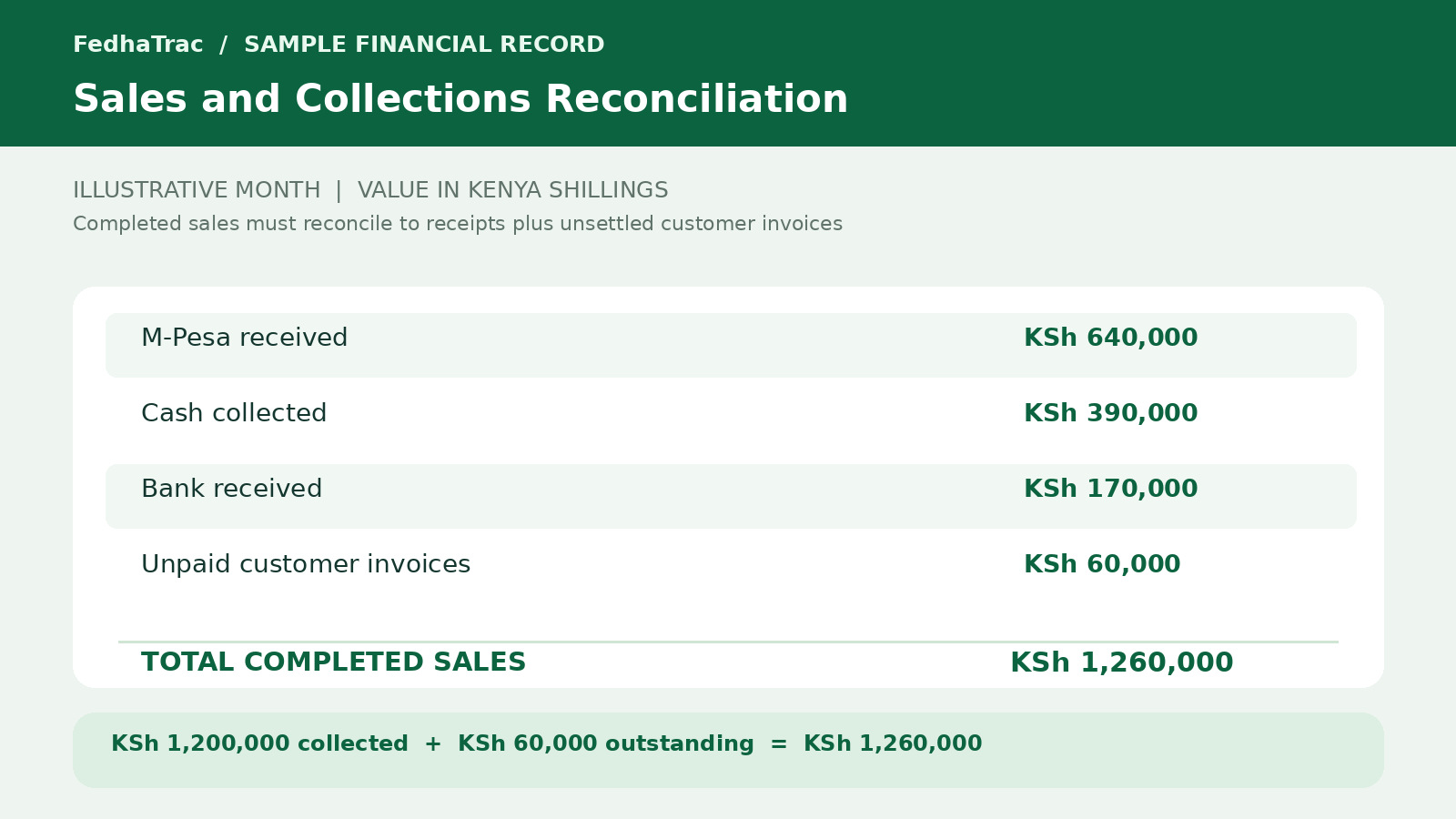
Sample payment reconciliation comparing M-Pesa cash bank and customer credit for cereals shop
How We Work With a Cereals Retailer
We begin by understanding your sales process, available records, supplier terms, payment channels, and monthly reporting needs. Then we agree on what you will provide, how often we will reconcile it, and what financial reports will be useful. Our business operations support can help organize invoice and payment tracking alongside the bookkeeping work.
For cereals shop accounting in Kenya, we can start with POS exports, manual sales records, bank and M-Pesa statements, supplier invoices, and verified stock counts. Cereals shop accounting in Kenya should fit the business’s reality while improving discipline over time. Our cereals shop accounting in Kenya helps make the numbers clearer while giving owners access to professional support.
Frequently Asked Questions About FedhaTrac and Cereals Shops
Do I need a POS system before FedhaTrac can help my cereals shop?
No. We offer our own POS solution, and we can also work with sales reports from an existing POS or with suitable manual records. Our cereals shop accounting in Kenya focuses on reconciling the figures and explaining what they mean. We will assess the records you have and recommend a practical way to improve them, rather than insisting that you replace a system that already meets your needs.
Can you help me know whether I am making a profit on maize and beans?
Yes. We help organize sales and relevant purchase costs by product category so you can see gross profit and understand how operating costs affect the overall result. Cereals shop accounting in Kenya is especially useful when suppliers change prices or some products sell much faster than others.
Will FedhaTrac help me identify missing stock?
We help reconcile the financial stock records against the counts your team performs. If an unexplained difference appears, we review purchases, sales, transfers, and authorized adjustments with you. Our cereals shop accounting in Kenya highlights discrepancies and their estimated financial effect, but it does not replace physical counting, calibrated weighing, secure storage, or a proper investigation of possible loss.
Can you manage supplier bills and unpaid customer accounts?
We can help organize supplier invoices, payment histories, due dates, customer balances, and follow-up schedules. This makes it easier to understand what is owed and what is expected to come in. Our cereals shop accounting in Kenya helps you manage the information while you remain in charge of approving payments, extending credit, and maintaining relationships with customers and suppliers.
How do I know whether my cereals shop needs VAT or eTIMS?
The answer depends on the business and the goods it supplies. We review your registration position and help organize invoices and records for the requirements that apply. KRA’s VAT guidance explains registration rules, while its eTIMS guidance covers electronic invoicing. With cereals shop accounting in Kenya, we support reliable records and appropriate tax preparation rather than making blanket claims about the tax rate on all grains.
Why choose FedhaTrac instead of doing all the bookkeeping myself?
Because your time is better spent purchasing wisely, serving customers, and building supplier relationships while we help you maintain a dependable view of the finances. We bring professional reconciliation, expense organization, reporting, and practical explanations into one working relationship. Our cereals shop accounting in Kenya is designed to help you ask the right questions earlier and make decisions with greater confidence.
Run Your Cereals Business With Better Financial Clarity
A cereals retailer needs to understand more than how many bags left the shop today. The important picture includes what those bags cost, which payments have cleared, what remains on the shelves, what suppliers are owed, and how much profit is available after expenses. At FedhaTrac, we make that picture easier to see through practical bookkeeping, reconciliations, accounting reports, and relevant tax support.
If the challenges described at Mama Njeri’s Cereals Palace resemble those in your shop, our team can help you bring order to the numbers without overstating what software alone can accomplish. Contact FedhaTrac to discuss your sales records, stock-cost challenges, and reporting needs. Our cereals shop accounting in Kenya starts with understanding your existing records.


