

School audit preparation in Kenya should not begin with a frantic search for last year’s receipts. School owners and administrators deserve a clearer process: records that reconcile, decisions supported by documents, and financial reports that can be explained when an independent auditor asks questions. At FedhaTrac, we help schools build that foundation. We organize the accounting evidence, identify gaps, prepare supporting schedules, and make the audit process easier to manage.
Consider Naya Totos Preparatory School as an illustrative example. Its office handles tuition payments, termly budgets, teachers’ compensation, food purchases, transport expenses, learning materials, and supplier bills. Even when staff work diligently, documents can end up scattered across bank portals, M-Pesa statements, spreadsheets, notebooks, and email attachments. This example describes how our service would support such a school; it does not claim Naya Totos is an existing FedhaTrac client or that an audit has already occurred.
The purpose of school audit preparation in Kenya is straightforward: every material balance should be traceable to dependable records. We help the school’s leaders approach an audit with evidence rather than assumptions, while the independent auditor remains responsible for the audit procedures and opinion.
Why School Audit Preparation in Kenya Deserves Its Own Plan
An audit is not simply another monthly bookkeeping exercise. A bookkeeper may record a bank payment correctly; an auditor may additionally ask who approved it, what was purchased, whether the delivery occurred, and why the expense belongs in that reporting period. That is where school audit preparation in Kenya becomes valuable. The focus moves from having totals to explaining the evidence behind them.
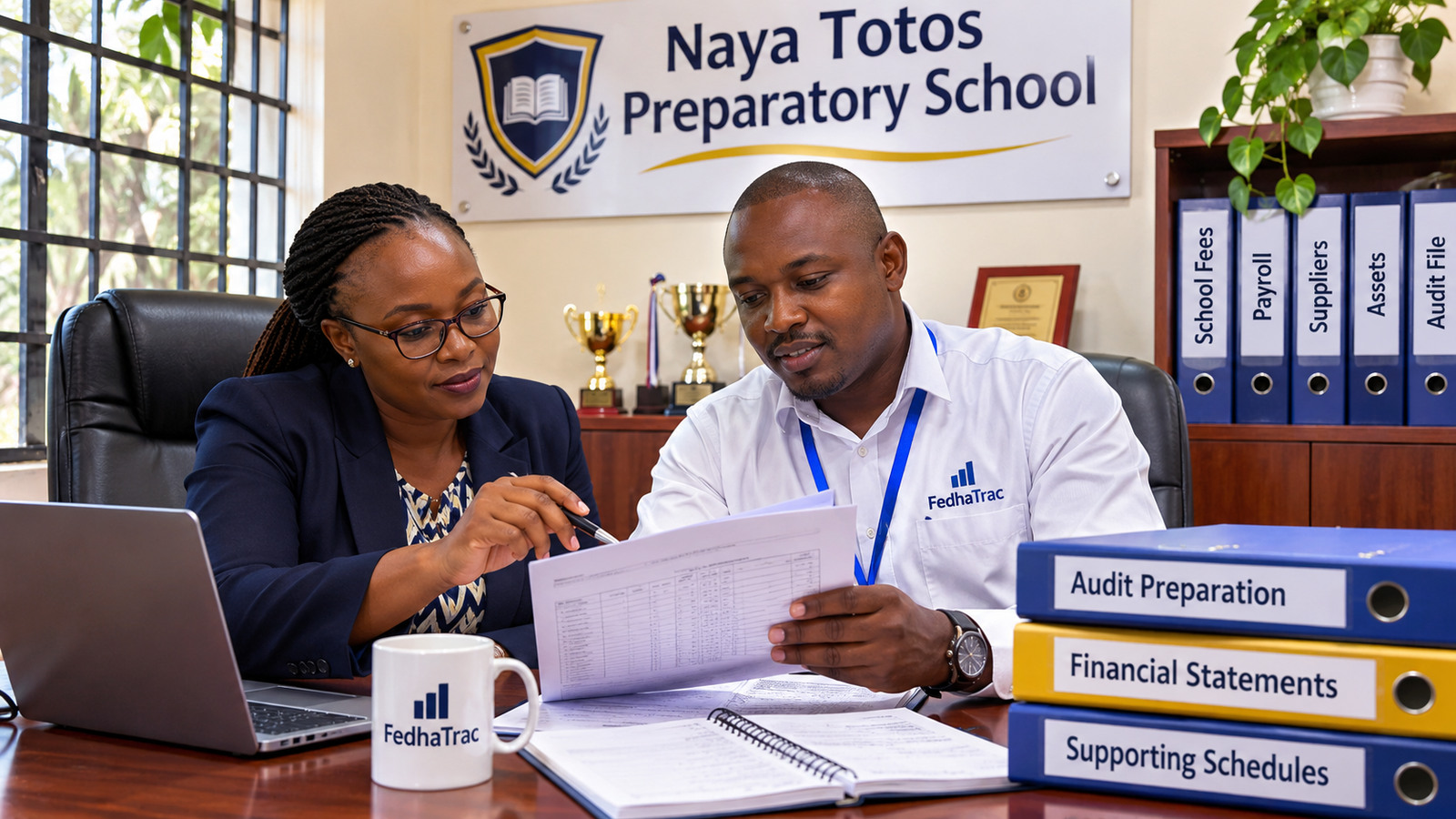
Naya Totos Preparatory School finance team reviewing audit preparation records
Our audit preparation and support service includes document organization, reconciliations, supporting schedules, gap reviews, audit-file preparation, and coordination support with auditors. Those are practical services we can deliver without claiming to replace an independent audit. For a private preparatory school, the applicable financial-reporting and audit obligations depend on its legal structure, governance arrangements, contracts, and the scope of the review. Public-school funding manuals are useful references for sound recordkeeping, but their requirements must not automatically be presented as binding on every private school.
At Naya Totos Preparatory School, the key objective would be to give management one dependable audit file covering the following seven records.
1. School Audit Preparation in Kenya: Fee Ledgers and Outstanding-Balance Schedules
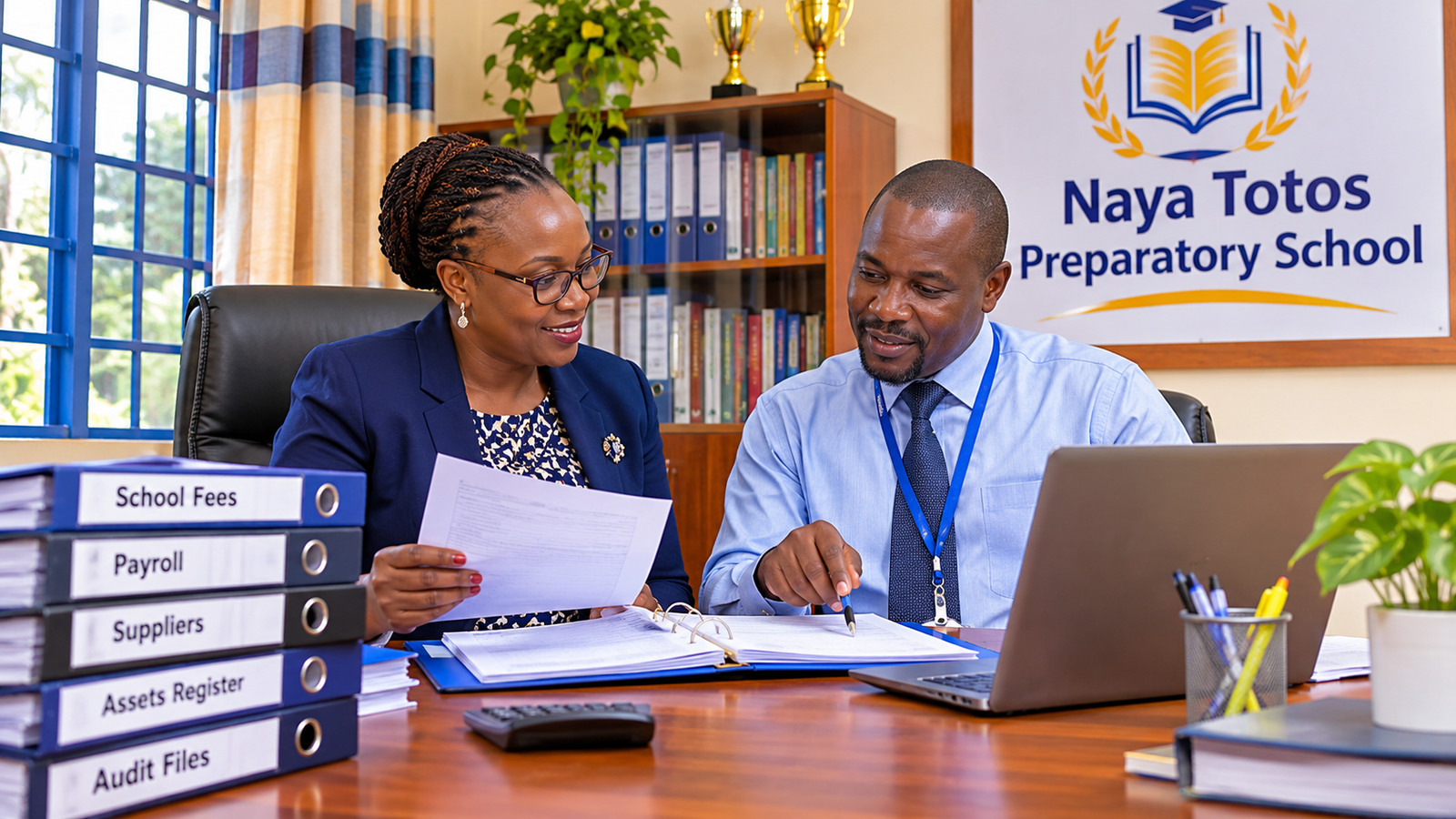
School administrators reviewing parent fee schedules and accounting records
Parents may pay fees before a term begins, in several installments, or after an agreed date. A school can have a healthy bank balance while still carrying unresolved parent accounts. In school audit preparation in Kenya, the auditor needs to understand how reported fee income and receivables were determined, not merely see that money reached the bank.
We help organize fee schedules that connect opening balances, approved charges, receipts, waivers, reversals, refunds, and closing balances. If a payment reference does not identify a learner, we flag it for investigation rather than assigning it to the wrong account. The school remains responsible for confirming parent and learner details, approving adjustments, and handling conversations with families.
For Naya Totos Preparatory School, the audit file could include a summary of total billed fees, a reconciliation to the school fee ledger, a list of balances by age, and supporting authorization for discounts or write-offs. That is a more credible outcome than presenting a single spreadsheet total without explanations.
An essential part of school audit preparation in Kenya is separating fee amounts billed from actual cash collected. We can help management make that distinction clearly and avoid treating a transfer between school-controlled accounts as a second receipt of income. You receive a schedule that is easier to review, discuss, and defend.
2. Bank and M-Pesa Reconciliations
A bank statement proves what the bank recorded. It does not explain every entry in the school’s accounting records. Similarly, a Paybill report may show many parent payments, but settlement into the bank can appear as a batch deposit. An effective school audit preparation in Kenya workflow connects all those movements without double-counting them.
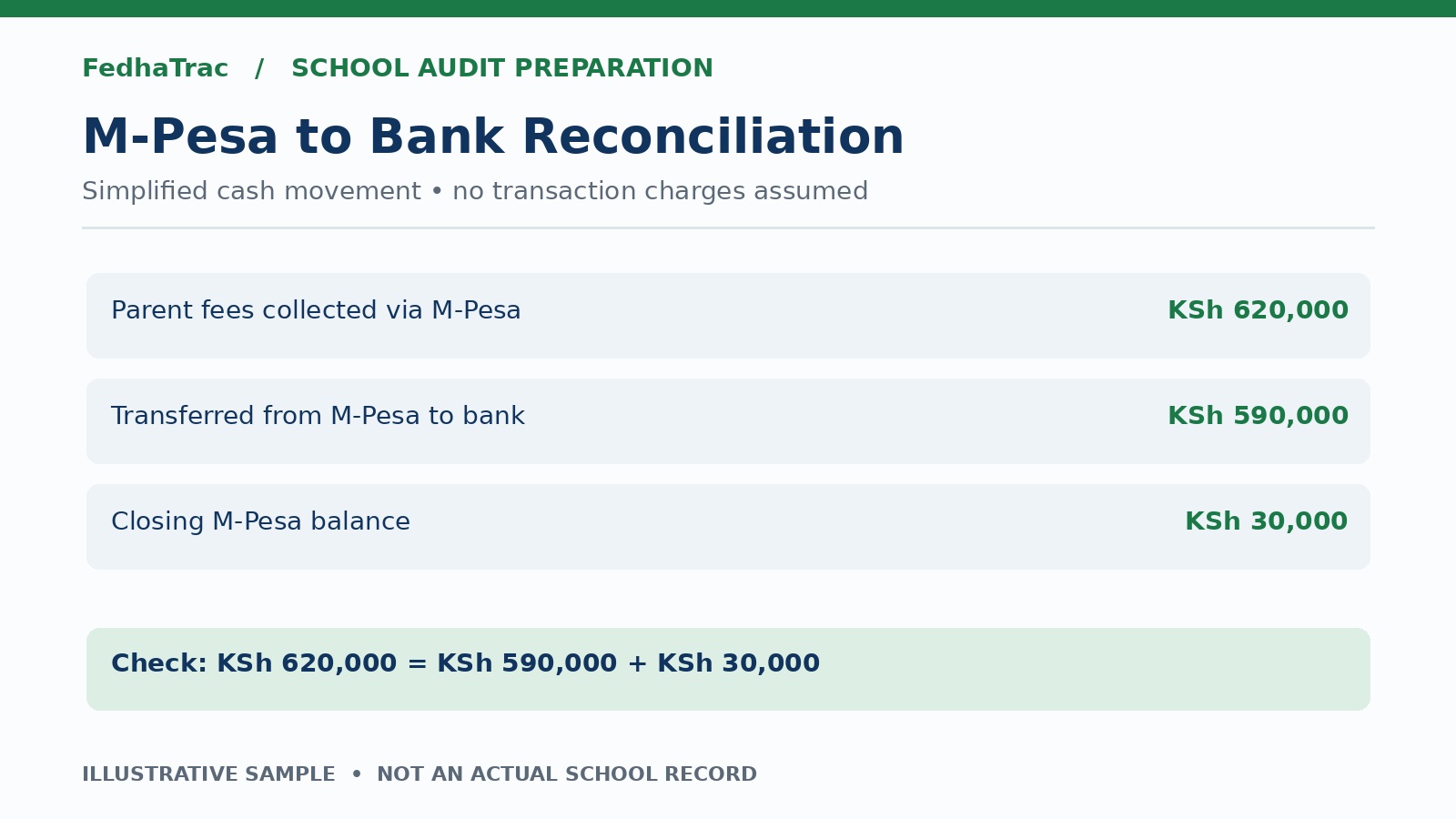
Illustrative M-Pesa and bank reconciliation showing KSh 620,000 collected
Our team compares the school’s cashbook or ledger with bank statements, mobile-money transaction reports, and supporting receipts. We document outstanding deposits, bank charges, reversals, duplicate references, and unexplained entries. We help prepare a reconciliation for each relevant account at the audit date, with a log of differences needing school approval or clarification.
At Naya Totos Preparatory School, a Paybill collection of KSh 45,000 later transferred to the bank remains one collection, not KSh 90,000 in revenue. A payment received but not identified to a learner goes onto an investigation list. This is an illustrative transaction, not an assertion about the school’s real records.
For school audit preparation in Kenya, timely reconciliations also reduce the risk that old differences accumulate across terms. We can establish a regular close routine, so audit readiness grows month by month rather than depending on a last-minute rescue. Our bookkeeping service complements this work by keeping the underlying records organized throughout the year.
3. Supplier Invoices, Procurement Evidence, and Payment Vouchers
A school purchases food, textbooks, stationery, cleaning products, software, uniforms, furniture, and maintenance services. For the auditor, an expense line is more persuasive when it is supported by the supplier invoice, evidence of delivery, authorization, and payment. School audit preparation in Kenya therefore needs a complete purchase trail, not just a list of amounts spent.
We help create schedules of supplier bills and outstanding creditors and match recorded payments to the appropriate invoices. Where documents are missing, we identify the gap early and give the school’s staff a focused request list. We can also organize purchase orders, delivery notes, approval records, credit notes, and supplier statements that the school already holds.
Imagine a term’s stationery supplier sends two invoices with similar descriptions. Our reconciliation highlights a potential duplicate for review before it becomes part of the final expenditure summary. The bursar and management confirm what was ordered and delivered; we organize the financial evidence and record the authorized conclusion.
This is a central benefit of school audit preparation in Kenya: it brings together who requested a purchase, who approved it, what the school received, and what the school paid. For Naya Totos Preparatory School, cleaner supplier records would support both the audit discussion and ordinary financial decisions.
4. Payroll, Staff-Cost Schedules, and Statutory Support
Salaries and related payments are often significant school expenses. Teaching staff, support workers, drivers, kitchen workers, and administrators may have different pay arrangements. Audit-ready payroll information should match the financial ledger and the bank or other payment evidence, with adjustments and deductions properly supported.
We help arrange payroll summaries, staff-cost reconciliations, approved reimbursement records, and relevant statutory support for school audit preparation in Kenya. The school retains responsibility for employment contracts, HR decisions, attendance, correct employee data, and authorization of payments. We do not invent payroll records or certify employment matters that management has not verified.
Where PAYE applies, the Kenya Revenue Authority’s PAYE guidance explains the employer’s filing and remittance obligations. Other payroll contributions and applicable rules must be checked for the period under review. Our tax filing and compliance service can help organize the supporting accounting information and agreed filing work.
At Naya Totos Preparatory School, an audit support schedule might show gross payroll expense, authorized deductions, net payments, and any outstanding liabilities at period-end. During school audit preparation in Kenya, we would investigate any differences rather than make them disappear through unsupported journal entries.
5. Assets, Stock, and Equipment Registers
A preparatory school owns or uses items that outlast a single lesson: desks, classroom furniture, computers, library equipment, kitchen assets, school buses, and sometimes buildings. It also consumes materials such as exercise books and cleaning supplies. School audit preparation in Kenya should distinguish long-term assets from consumable supplies and connect the accounting balances to a physical record.
We help compile or reconcile an asset register with available purchase invoices, acquisition dates, costs, disposals, and relevant accounting adjustments. The school carries out physical verification, confirms whether items are still in use, and approves corrections. Where the accounting framework requires depreciation or impairment assessment, the treatment should follow that framework and the facts—not a made-up percentage.
For Naya Totos Preparatory School, suppose the general ledger shows twelve computers but the school confirms that only eleven are in service. We would document the variance, request evidence of transfer, repair, or disposal, and support the authorized accounting correction. That is an illustrative control example, not an actual loss discovered at the school.
Good school audit preparation in Kenya also makes it easier to link planned purchases to the budget and to explain why a classroom improvement was treated as an asset or an expense.
6. Financial Statements, Trial Balance, and Supporting Schedules
For school audit preparation in Kenya, an audit file should connect detailed transactions to the final financial statements. The trial balance, income-and-expenditure report or profit-and-loss statement, statement of financial position, cash balances, receivables, payables, and supporting schedules must agree according to the relevant reporting basis. School audit preparation in Kenya brings those pieces into one coherent reporting package.
At FedhaTrac, we prepare or organize financial reports within our agreed scope and trace material balances back to ledgers and documentary support. We investigate unreconciled accounts and help management approve valid adjustments. Illustrative financial reports are not audited statements.
Here is a hypothetical Naya Totos Preparatory School fee-receivables schedule, shown only to explain the arithmetic.
| Illustrative fee-receivables schedule | Amount (KSh) |
| Opening unpaid balances | 420,000 |
| New fees billed during period | 1,650,000 |
| Less: fee payments allocated | (1,420,000) |
| Less: approved adjustments | (50,000) |
| Closing unpaid balances | 600,000 |
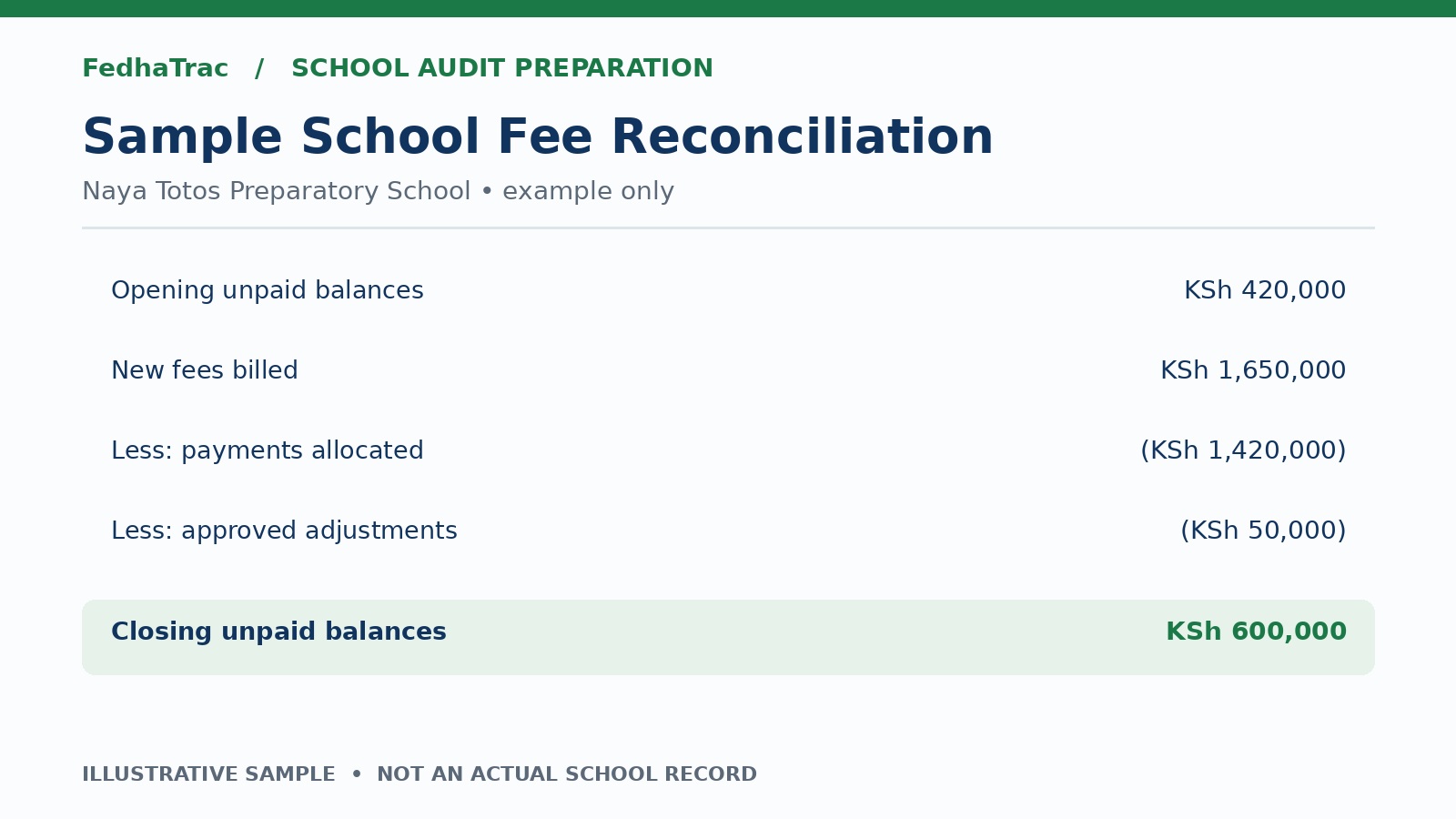
School audit preparation in Kenya sample fee receivables reconciliation totaling KSh 600,000
The calculation is KSh 420,000 + KSh 1,650,000 − KSh 1,420,000 − KSh 50,000 = KSh 600,000. The closing balance should match the ledger and be supported by identifiable learner-level records kept confidential. The auditor may test individual components and assess the accounting basis; we help the school provide a clear schedule and underlying evidence.
For school audit preparation in Kenya, we can also compile budget-versus-actual reports and explain material variances in a management schedule. Our specialized reporting and advisory services support decision-making beyond audit day.
7. Governance Records, Approvals, and the Audit Request File
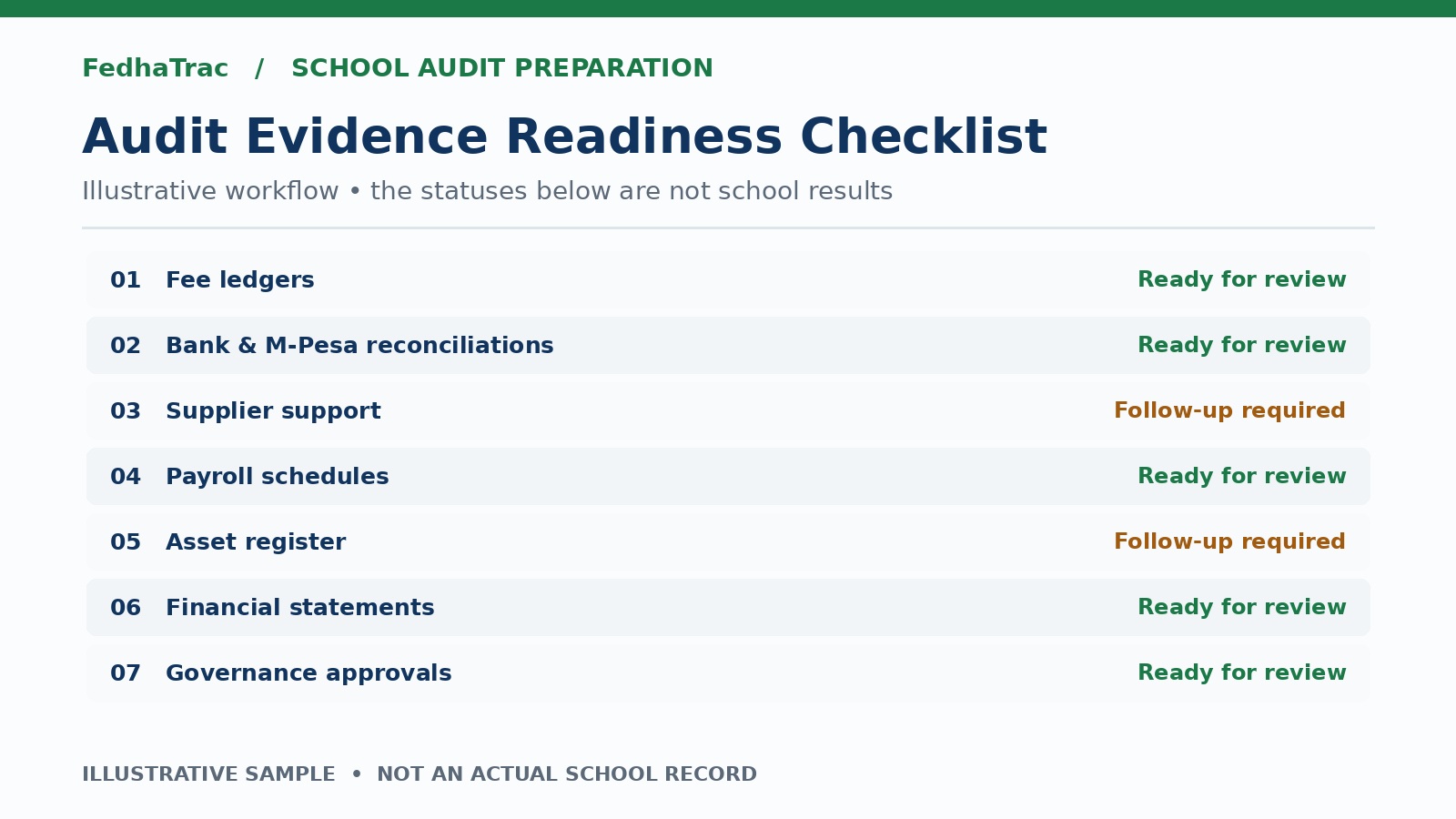
Illustrative audit evidence checklist for seven school financial record groups
School audit preparation in Kenya also depends on the approval trail behind each transaction. An auditor may request budgets, management decisions, committee minutes, contract approvals, authorization policies, or explanations for exceptional spending. For school audit preparation in Kenya, these records show how financial decisions were controlled and who was responsible for them.
We help the school assemble an audit-request index showing the document requested, its source, the responsible person, the current status, and any questions requiring follow-up. We can organize signed minutes and approval documents supplied by management, but we do not draft fictional minutes, backdate approvals, or represent that an unsigned document was approved.
The Ministry of Education’s public-primary-school financial management manual illustrates the importance of cashbooks, bank records, debtors, creditors, vouchers, budgets, and supporting files for audit. That manual addresses public-school funding arrangements; a private school’s precise mandatory requirements must be determined separately. The recordkeeping principles are nevertheless useful when building a disciplined private-school file.
For Naya Totos Preparatory School, school audit preparation in Kenya would result in a structured index rather than a collection of unnamed folders. Our coordination support helps the school respond consistently while management remains responsible for the truth and completeness of what it submits.
How We Prepare Naya Totos Preparatory School for an Audit
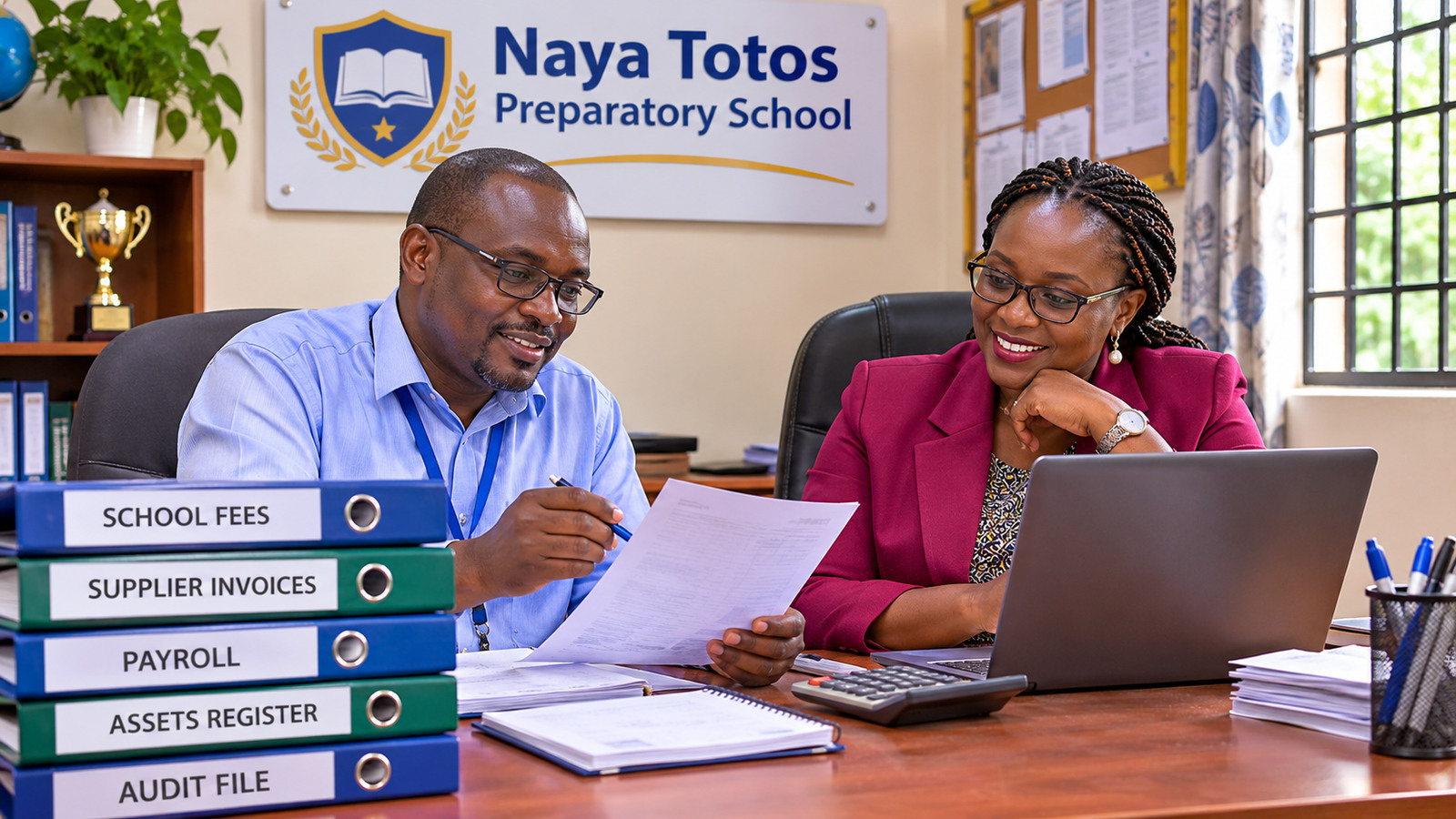
School leaders discussing financial statements and audit documentation
Our approach to school audit preparation in Kenya begins with a focused discussion of the audit period, the school’s existing systems, the applicable reporting basis, and the records available. We then review the trial balance and key account lists, request missing documents, reconcile priority balances, and prepare schedules that explain the financial statements. Finally, we assemble a controlled audit file and an action register for issues management must resolve.
We do not insist that the school abandon its current software. We can work with accounting exports, spreadsheets, bank records, M-Pesa statements, and documentary evidence provided through an agreed process. We help the school see which information is complete, which amount needs a better explanation, and which approval is still outstanding.
The difference between bookkeeping and school audit preparation in Kenya is the level of supporting evidence required. Bookkeeping records transactions; audit preparation builds traceability between transactions, account balances, decisions, and documents. You can engage our team to establish the process in advance or discuss catch-up support when records need attention. We will agree the scope before work begins.
School Audit Preparation in Kenya Must Protect Confidential Records
Student records require particular care. A fee ledger may contain learners’ names and guardians’ payment information, and a payroll file contains employee data. School audit preparation in Kenya must therefore include controlled access, appropriate redaction, secure transfer, and retention practices. The Office of the Data Protection Commissioner’s education-sector guidance emphasizes security and limiting access to authorized personnel.
We help organize the financial evidence without suggesting that sensitive learner details should be placed in a public report or shared indiscriminately. Naya Totos Preparatory School should approve who receives particular records and how the audit file is stored and shared.
Frequently Asked Questions About School Audit Preparation in Kenya
Can FedhaTrac prepare our school even if our records are incomplete?
Yes. We offer audit-preparation and clean-up support and can start by identifying missing invoices, unreconciled accounts, and unclear balances. We’ll explain what needs the school’s confirmation, organize the available evidence, and agree a realistic plan for addressing gaps. We will never invent documents to make a file appear complete. Contact us to discuss the state of your records and the appropriate scope.
Does FedhaTrac conduct the independent school audit?
Our article concerns school audit preparation in Kenya, not an assurance opinion. We organize records, prepare schedules, review reconciliations, and support coordination with the appointed auditor. An appropriately independent auditor carries out the audit and issues any required opinion. You get better-prepared records without confusing our support role with the auditor’s responsibilities.
Can you work with our school bursar and existing accounting system?
Absolutely. We can work with records produced by your current accounting process and collaborate with the bursar under an agreed workflow. We help turn the figures into reconciled reports and clearly indexed supporting documents. Your team keeps authority over admissions, fee policies, approvals, and the accuracy of school-specific information.
When should our school start preparing?
The best time is before the financial year closes. School audit preparation in Kenya is more manageable when bank reconciliations, fee schedules, supplier records, and asset updates are maintained during the year. If the audit date is already approaching, we can still review your available records, prioritize essential schedules, and identify unresolved items that need management attention.
Why choose FedhaTrac rather than handling every audit request ourselves?
Because school leaders should not spend days hunting for receipts and rebuilding spreadsheets when those documents could already be organized. We provide dedicated bookkeeping, reconciliation, reporting, and audit-file support. We explain the outstanding issues, work alongside your administrators, and help you respond to auditors using traceable evidence. Our role is to make your school finance process clearer, more consistent, and easier to manage.
Let FedhaTrac Help Your School Become Audit-Ready
Naya Totos Preparatory School illustrates a challenge many schools recognize: there are plenty of documents, but not always one reliable explanation of the financial position. School audit preparation in Kenya changes that by connecting fees, payments, purchases, payroll, assets, reports, and approvals into an orderly evidence trail.
At FedhaTrac, we help you prepare with reconciled books, organized supporting schedules, clearer reports, and practical coordination support. Whether your school is growing, preparing for an annual review, or trying to bring historic records up to date, we can help you identify the right next step. Contact FedhaTrac to discuss audit preparation for your school and request a service proposal suited to your records and reporting needs.


