

Clinic Bookkeeping in Kenya Starts With Trustworthy Numbers
Clinic Bookkeeping in Kenya is about more than recording consultation fees. It connects services delivered, amounts billed, money collected, insurance claims, supplier expenses, and the information a clinic owner needs to make sound decisions. A waiting room can be full while the clinic’s cash position remains tight, particularly when third-party reimbursements arrive weeks after treatment. Without accurate records, management may confuse busy operations with healthy finances.
Consider Amani Grove Medical Centre, a fictional outpatient clinic in Nairobi managed by Dr. Njeri. Her staff handle consultations, laboratory requests, approved minor procedures, and routine administrative activity. Patients pay through cash, M-Pesa, cards, or approved insurance arrangements. As patient numbers grow, so do questions about collections, pending claims, consumables, and the costs of keeping the doors open. FedhaTrac can support the financial side without taking over clinical care or professional medical responsibilities.
A reliable approach to Clinic Bookkeeping in Kenya gives Dr. Njeri a practical view of what has been earned, what has been collected, what remains outstanding, and which costs are rising. The following framework shows how a clinic can build that visibility step by step.
Why Clinic Bookkeeping in Kenya Is Different From Ordinary Retail Accounting
A clinic’s financial cycle rarely ends when a patient leaves reception. A consultation might be paid for immediately, while a laboratory service is billed to an insurer and only settled after review. Some amounts are refundable deposits or payments for future appointments. Others relate to a previously issued invoice. Clinic Bookkeeping in Kenya must preserve those distinctions instead of treating every receipt as a new sale.

Medical professional consults an outpatient in a Kenyan private clinic examination room.
There is another difference: financial records coexist with confidential health information. A bookkeeper needs a transaction reference, service category, amount, payment status, and supporting evidence, but generally does not need the patient’s diagnosis or clinical notes. This separation protects patients and keeps financial responsibilities appropriately defined. The Office of the Data Protection Commissioner’s guidance on health data explains the safeguards and lawful processing considerations relevant to healthcare information.
For Amani Grove, Clinic Bookkeeping in Kenya therefore starts with clear boundaries: clinicians provide care; authorized reception and billing staff document charges; and financial personnel reconcile amounts, review costs, and prepare management reports using appropriately limited access.
Record Each Service Before Matching the Payment
Amani Grove can structure its daily billing register around a service date, anonymized billing reference, department, service description, gross amount, payment category, and outstanding balance. Consultation, laboratory, procedure, and any separately supplied goods should be identified rather than placed under one broad heading called “sales.” This approach makes errors easier to find and allows management to review service-line performance.
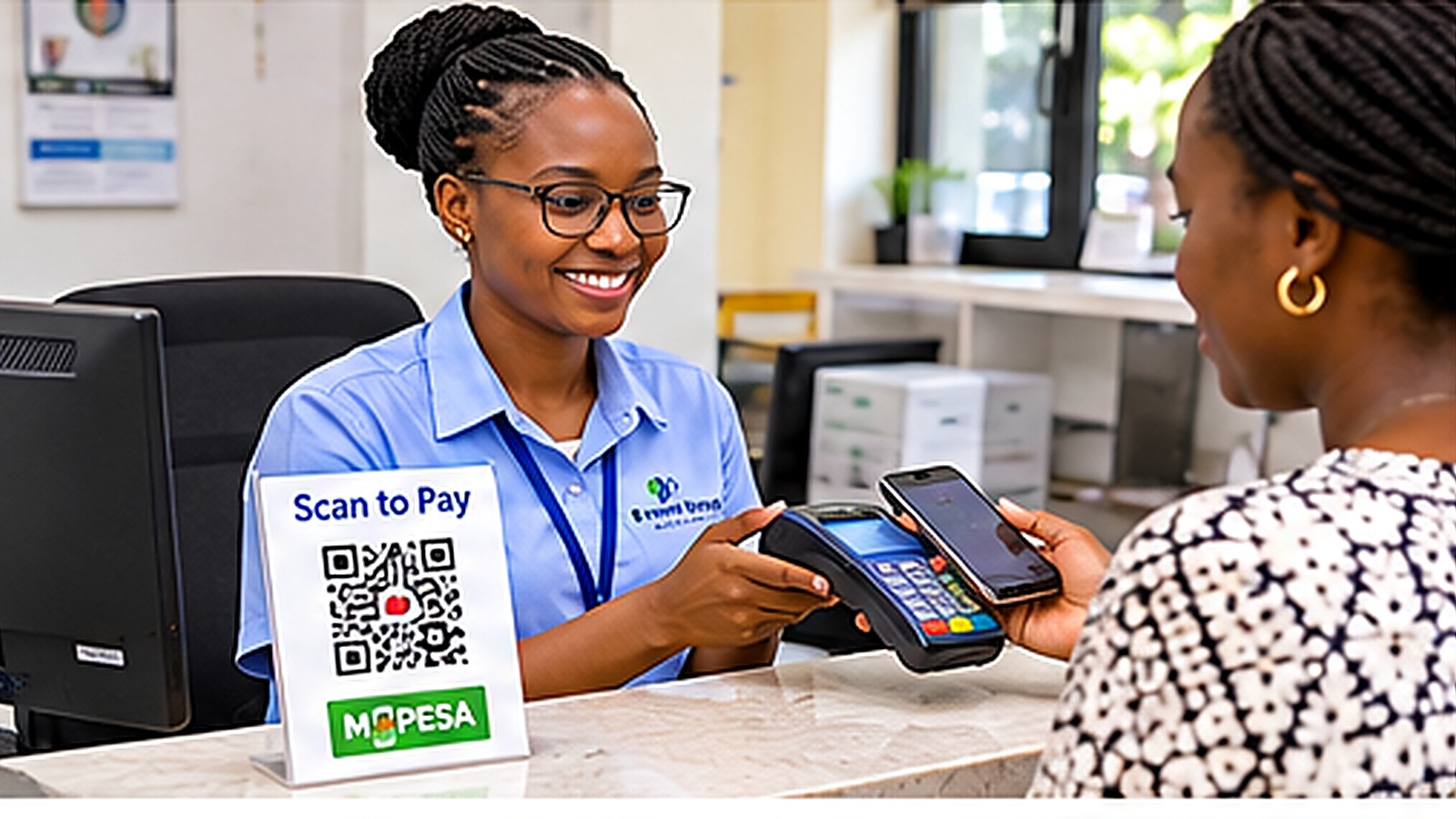
Clinic receptionist accepts an electronic patient payment at Amani Grove Medical Centre.
Clinic Bookkeeping in Kenya should also account for discounts, authorized reversals, cancellations, and refunds. A refund of an earlier payment is not simply an unrelated operating expense. A corrected bill should retain a traceable history so that the clinic can explain how the final amount was reached.
Create a daily billing control
At closing, compare the appointment or service log with the billing register, then compare billed amounts with payment records and approved claims. Investigate missing references rather than assuming every booked appointment was completed or that every service resulted in an immediately collectible bill. This basic review is one of the most effective Clinic Bookkeeping in Kenya controls for preventing unrecorded charges and overstated revenue.
Reconcile Cash, M-Pesa, Cards, and Bank Transfers
Many Kenyan clinics receive money through several channels on the same day. The cashier’s closing report should match receipts to the relevant billing references and payment confirmations. Cash must be counted, card settlements checked, and M-Pesa transactions matched with the actual statement rather than with screenshots alone. A bank transfer should be identified by its source and the bill it settles.
For Clinic Bookkeeping in Kenya, a payment received against an existing bill normally reduces the customer balance; it does not automatically create new revenue. Similarly, moving money from the clinic’s business M-Pesa account into its bank account changes where the money is held. It does not create another consultation fee. A useful related resource is FedhaTrac’s guide to M-Pesa bookkeeping in Kenya.
Track Insurance Claims Without Assuming Every Claim Will Be Paid
Insurance billing is a major reason Clinic Bookkeeping in Kenya requires careful receivables management. A submitted claim is not the same as cash collected, and submission is not proof that the claim will be approved in full. Claims can be returned for missing information, reduced, disputed, or paid later than expected. The clinic’s financial records must reflect the terms of each arrangement and the actual status of its claims.
Dr. Njeri should be able to see claims submitted, claims accepted where that status is available, amounts paid, rejected items, disputed balances, and the age of unsettled balances. A weekly review can prioritize older items and identify recurring reasons for delayed reimbursement. For responsible financial reporting, receivables must also be assessed for recoverability rather than presented indefinitely at their original value.
Use an insurance aging schedule
An aging report can group eligible unpaid balances by how long they have remained outstanding: current, 1–30 days, 31–60 days, 61–90 days, and older. Each grouping should have an owner responsible for follow-up. Clinic Bookkeeping in Kenya becomes more useful when the schedule is reconciled with the ledger and actual remittance information instead of being maintained as a disconnected spreadsheet.
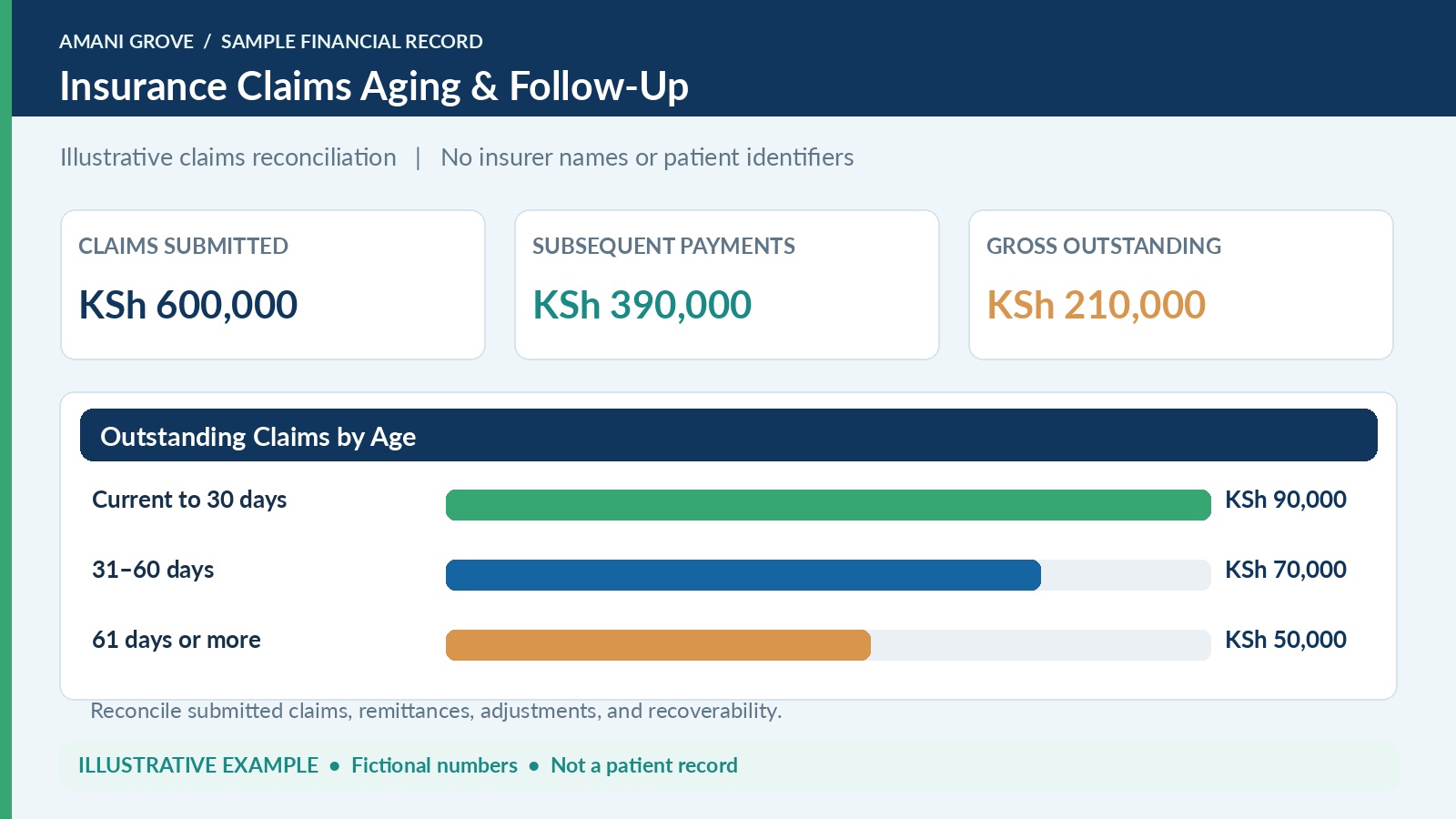
Illustrative insurance claims aging report showing KSh 600,000 submitted, KSh 390,000 subsequently paid and KSh 210,000 outstanding.
A Practical Clinic Bookkeeping in Kenya Billing Example
The following amounts are hypothetical, provided solely to illustrate the accounting logic for Amani Grove Medical Centre. They do not represent real patient information, clinic activity, insurance contracts, or FedhaTrac client results.
| Illustrative November billing category | Amount (KSh) |
| Consultations | 710,000 |
| Laboratory services | 490,000 |
| Approved outpatient procedures | 310,000 |
| Separately billed medicines and supplies | 340,000 |
| Total amounts billed | 1,850,000 |
The financial team matches KSh 270,000 in cash, KSh 540,000 through M-Pesa, KSh 260,000 through cards, and KSh 180,000 through direct bank transfers to the relevant bills. Those channels total KSh 1,250,000. A further KSh 600,000 relates to claims submitted to third-party payers, giving a total of KSh 1,850,000 accounted for by payment or claim status. That reconciliation does not prove all claims are recoverable or that all billed amounts meet revenue-recognition requirements.
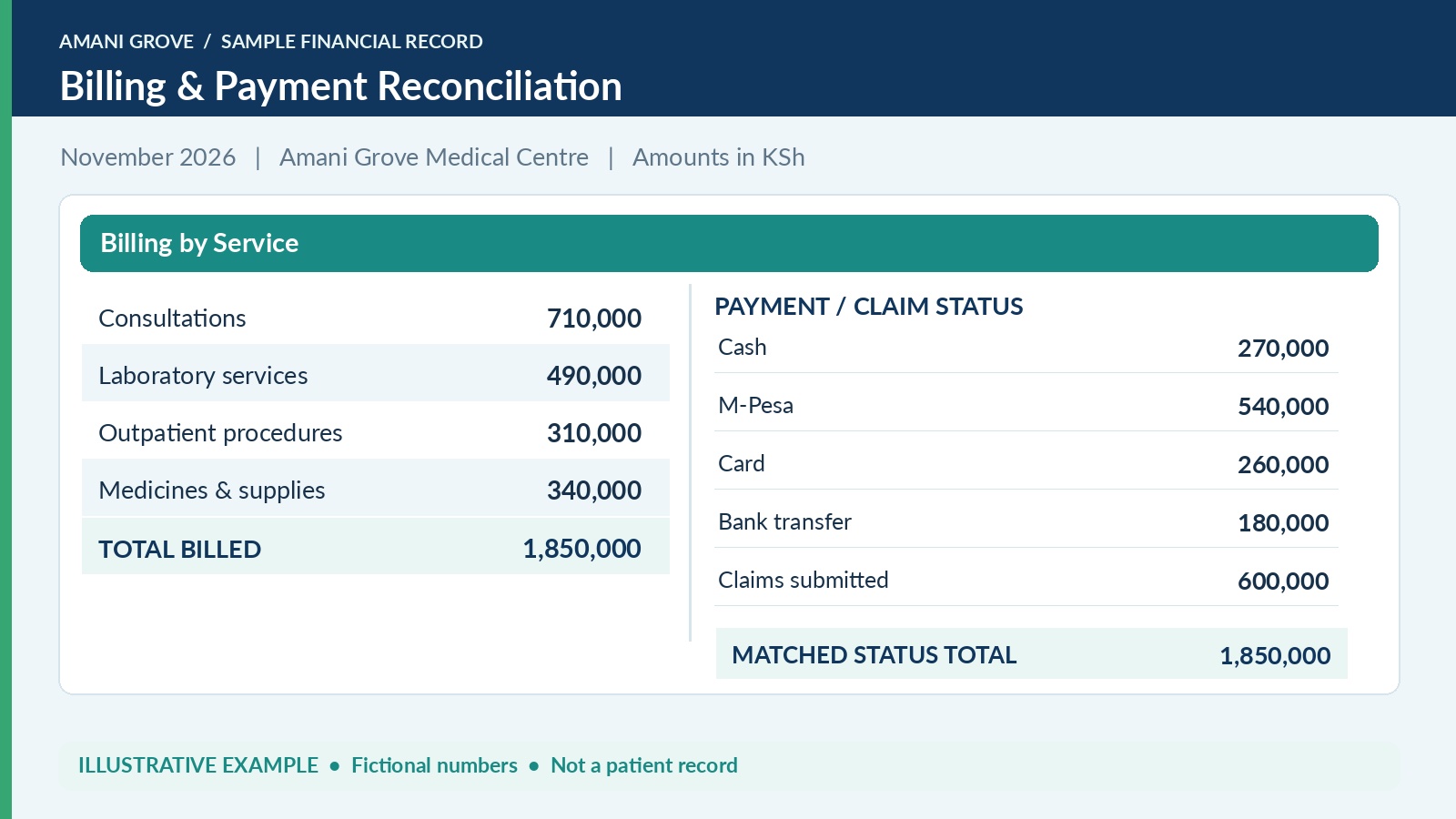
Illustrative clinic billing reconciliation showing KSh 1,850,000 billed across services and payment or claim categories.
Suppose subsequent claim settlements total KSh 390,000. The remaining gross claims balance is KSh 210,000 before any contractual adjustments or credit-loss assessment. It would be wrong to describe KSh 1,850,000 as cash received, or to record the KSh 390,000 as an additional sale if the relevant service revenue had already been recognized. Clinic Bookkeeping in Kenya must keep billings, earned revenue, cash, and receivables distinct.
Control Consumables, Medicines, and Supplier Invoices
A clinic uses gloves, syringes, dressings, diagnostic kits, disinfectants, and other supplies. Some items are used immediately, while others stay in stock. For Clinic Bookkeeping in Kenya, purchasing a box of consumables does not always mean its entire cost belongs in the current period’s clinical consumption. The records should distinguish inventory held, stock issued, damaged or expired items, and supplies actually used, applying the accounting policy appropriate to the clinic.

Clinic staff member checks medical consumables and supplier stock on organized shelves.
Supplier invoices should be matched to purchase orders and confirmed deliveries where those controls are used. Separating medical consumables, laboratory supplies, repairs, office supplies, and equipment purchases makes the monthly reports more meaningful. FedhaTrac’s expense tracking and invoicing guide explains the wider recordkeeping principles that support this work.
Make Clinic Expenses Visible by Department
Clinic Bookkeeping in Kenya should allow Dr. Njeri to see recurring costs without searching across hundreds of payment messages. Typical categories include premises rent, utilities, clinic cleaning, approved supplies, equipment servicing, laboratory outsourcing, internet, insurance, professional services, and employee-related expenses. Actual categories depend on the services offered and the clinic’s legal and operating structure.
The clinic should also separate ordinary operating expenses from purchases of long-lived equipment. A diagnostic machine may be an asset whose cost is allocated through depreciation under the applicable accounting framework, whereas routine maintenance may be an operating expense. A loan repayment also needs to be split appropriately between principal and interest rather than automatically recorded as a single operating cost.
Understand Whether the Clinic Is Profitable and Liquid
High service volumes do not guarantee that a clinic has enough cash to pay its obligations. Amani Grove may recognize eligible service revenue today but receive an insurer’s reimbursement later. Meanwhile, rent, utilities, suppliers, and wages may fall due on fixed dates. That timing difference is why Clinic Bookkeeping in Kenya should connect the income statement to receivables, payables, and a rolling cash forecast.
For example, consider an illustrative KSh 1,850,000 of correctly recognized revenue and KSh 1,250,000 of relevant operating expenses. The resulting KSh 600,000 is an example operating surplus before financing, tax, depreciation adjustments not already included, and other applicable items. It is not equivalent to cash available for withdrawal. The clinic might still be waiting for KSh 210,000 in gross claims while facing supplier payments next week.
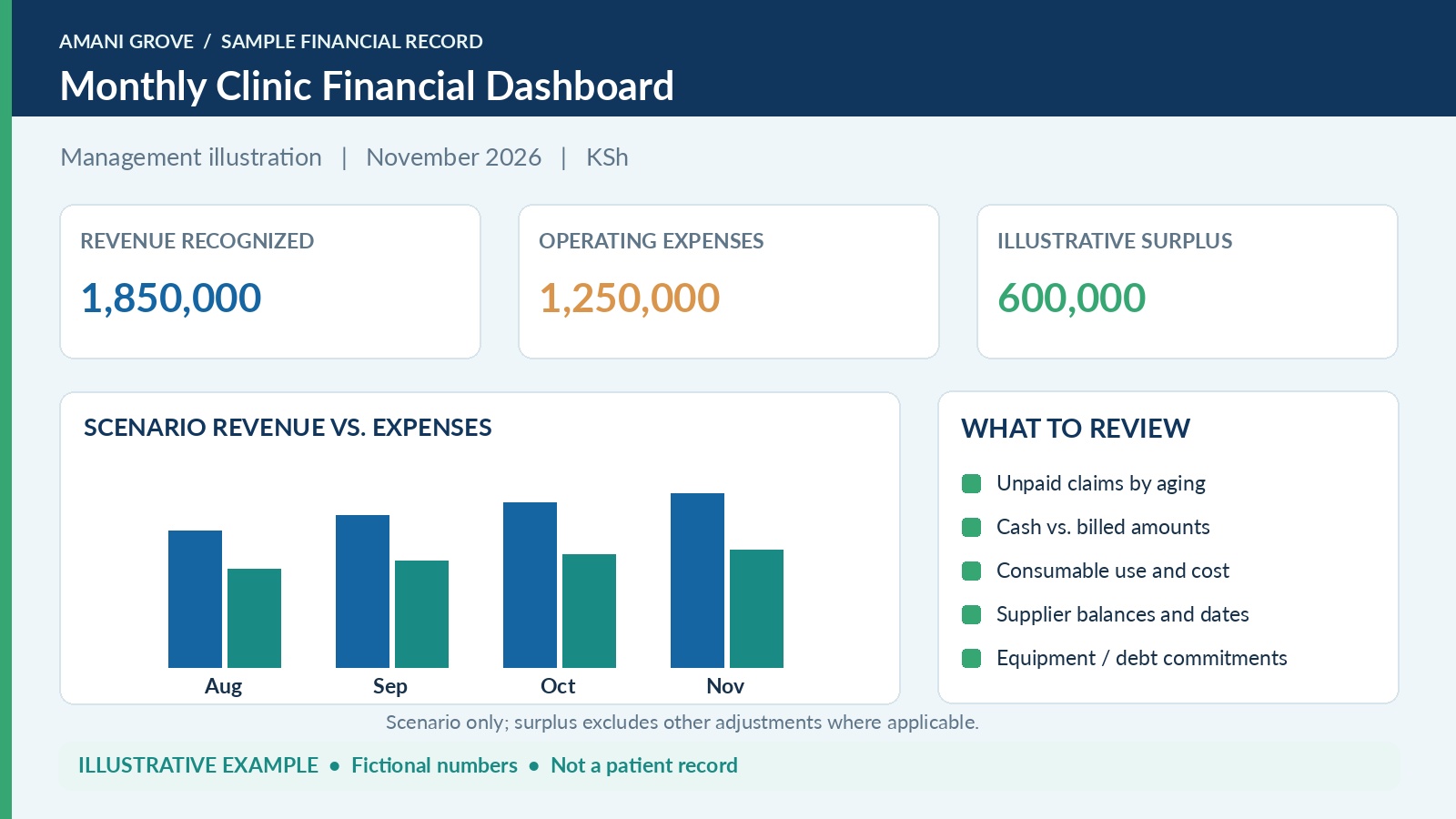
Illustrative clinic financial dashboard showing KSh 1,850,000 revenue, KSh 1,250,000 operating expenses and KSh 600,000 surplus.
FedhaTrac’s explanation of profit versus cash flow gives owners a useful starting point. Clinic Bookkeeping in Kenya adds a healthcare-specific focus: the clinic’s revenue cycle and insurance reimbursement timing may be as important as patient volume when planning cash.
Protect Confidential Patient Information During Financial Reviews
Medical confidentiality should not disappear because someone needs to reconcile a payment. A billing reference, service category, amount, and status will often be sufficient for ordinary finance reporting. Clinical details, diagnoses, test results, and treatment notes should remain within appropriately authorized health systems and workflows. Access must be based on legitimate duties, and records should be secured, retained, and shared according to applicable requirements.
The ODPC guidance on processing health data emphasizes lawful bases, safeguards, transparency, and appropriate handling of sensitive information. Clinic Bookkeeping in Kenya must account for those constraints when financial records are exported, shared with an external service provider, or used for reporting. Confidential information should not be included in ordinary marketing case studies or sample financial graphics.
Keep Licensing and Tax Records Organized
Clinic Bookkeeping in Kenya operates alongside obligations that belong to the licensed health facility and its qualified healthcare professionals. The Kenya Medical Practitioners and Dentists Council’s facility registration guidance explains the registration and licensing framework for relevant institutions. The Council also clarifies that health facilities may have nonmedical owners, while patient management must remain with appropriately qualified personnel. Financial support from FedhaTrac does not replace those responsibilities.
The tax side needs equally careful classification. The Kenya Revenue Authority’s VAT guidance distinguishes exempt supplies from taxable supplies. Qualifying medical services may be exempt, but a clinic should not assume that every item it sells or every associated activity receives identical VAT treatment. VAT registration and input-tax implications depend on the actual supplies and applicable law.
KRA’s eTIMS guidance states that businesses supplying VAT-exempt services, including hospitals providing medical services, are also within its electronic invoicing framework. Therefore, being exempt from charging VAT on qualifying medical services does not by itself mean a clinic can ignore eTIMS. Clinic Bookkeeping in Kenya should align invoices, receipts, expense documents, and tax records to the clinic’s actual circumstances.
Prepare Monthly Reports That Support Real Decisions
A practical monthly clinic reporting pack does not have to be complicated. It can include service revenue by department, daily payment reconciliations, outstanding claims, supplier balances, stock movement summaries, cash-flow forecasts, and an income-and-expense report. The point is not to produce more pages; it is to help management identify actions.
Clinic Bookkeeping in Kenya should help Dr. Njeri answer questions such as: Are collections falling behind billings? Which claim balances have aged? Which consumables cost more per visit? Have supplier invoices been matched to deliveries? How much unrestricted cash is available after upcoming commitments? Are cash and M-Pesa balances fully reconciled?
How FedhaTrac Can Support Clinic Bookkeeping in Kenya
FedhaTrac offers bookkeeping, accounting, tax support, and financial-management services for Kenyan businesses. For a clinic, the scope of an engagement can be designed around financial tasks that the clinic has authority to delegate. These may include organizing billing records, reconciling payment channels, reviewing supplier costs, preparing receivables schedules, and producing management information from permitted financial data.
The clinic remains responsible for its healthcare operations, patient data protection arrangements, professional licensing, and approvals. FedhaTrac should not be described as a clinical provider, medical insurer, or decision-maker about claims eligibility. Its value is in giving authorized managers clearer numbers so they can investigate gaps and plan responsibly.
Clinic Bookkeeping in Kenya works best when the clinic and the financial support team agree on the chart of accounts, supporting documents, reporting deadlines, access permissions, approval limits, and who resolves discrepancies. A monthly reconciliation timetable is generally more useful than trying to reconstruct the previous year after records become disorganized.
Common Clinic Bookkeeping in Kenya Mistakes to Avoid
One mistake is recording every payment as income, even when it settles an already recognized invoice or moves between two clinic-owned accounts. Another is assuming that every insurance claim will be paid as submitted. Both errors can overstate financial performance and distort expectations about cash.
Clinics can also confuse inventory purchases with actual consumable usage, classify equipment acquisitions as everyday expenses, overlook small payment charges, or leave supplier invoices unrecorded until they are paid. These problems make period-to-period comparison difficult. Incomplete supporting documents can also complicate tax preparation and dispute resolution.
Perhaps the most serious administrative mistake is sharing more patient information than an accounting task requires. Clinic Bookkeeping in Kenya must improve financial controls without weakening confidentiality. Data-minimization and authorized access should be part of the process from the beginning, not added after a security incident.
Frequently Asked Questions About Clinic Bookkeeping in Kenya
Do small clinics need separate M-Pesa and bank reconciliation?
Yes. Clinic Bookkeeping in Kenya should trace transactions across all material payment channels. An M-Pesa-to-bank transfer is generally an internal movement of funds, not another patient sale, so both accounts should be reconciled together where relevant.
Is an insurance claim the same as cash in the bank?
No. An insurance claim is a request for payment under applicable arrangements. Collection depends on validation, terms, adjustments, and settlement. The clinic should record and assess the balance appropriately rather than treating all submitted claims as guaranteed cash.
Are all services and goods sold by a clinic exempt from VAT?
Not necessarily. The tax status depends on what is actually supplied. Qualifying medical services can be exempt, but separately supplied products or other activities require specific review against current KRA guidance and the VAT Act.
Should an external bookkeeper receive patient medical histories?
Not as a routine requirement. Financial tasks should use only the permitted information necessary for the purpose, with appropriate safeguards and access controls. Sensitive health data requires particularly careful lawful handling.
How frequently should a clinic prepare financial reports?
Monthly reports are a practical baseline, supported by daily billing checks and regular reconciliation. Clinics with high transaction volumes or slow claim settlements may need more frequent reviews of cash, collections, and unpaid claims.
Build a Stronger Clinic With Reliable Financial Information
Clinic Bookkeeping in Kenya gives a growing healthcare business a clearer understanding of the money behind its operations. It connects services delivered with bills, payments, insurance claims, supplier costs, and the cash needed to continue serving patients. The objective is not to replace professional judgment. It is to make financial information dependable enough for management to use.
For Amani Grove Medical Centre, the fictional story illustrates how the right records can help Dr. Njeri look beyond a busy waiting room and identify overdue claims, unreconciled payments, rising costs, and upcoming commitments. Better financial visibility can support better planning while qualified clinicians remain in charge of care.
If your clinic’s books are behind, M-Pesa payments are difficult to trace, or monthly results do not match the money actually collected, FedhaTrac can discuss appropriate bookkeeping, accounting, reporting, and tax-support services. Contact the team through FedhaTrac to explore a financial process suited to your clinic’s operations, approvals, and confidentiality requirements.


