

A Busy Hotel Needs a Clear Financial Picture
At Karibu Gardens Hotel in Nakuru, guests arrive with suitcases, the reception desk manages late check-ins, and the housekeeping team prepares rooms before the next visitors arrive. The restaurant serves breakfast while the conference hall gets ready for a corporate meeting. Madam Wambui, the fictional hotel’s manager, can see how busy everyone is. What she cannot always see is whether each department is earning enough to cover its costs.
That is where Hotel Bookkeeping in Kenya becomes a practical management tool. A full reception lobby does not tell an owner whether booking commissions have been deducted correctly, whether a corporate client has paid, or whether the money in the bank belongs to future guests whose stays have not yet occurred. Strong records connect those details to a dependable picture of performance.
For this illustrative story, Karibu Gardens has 45 rooms, a restaurant, and conference facilities. It accepts direct reservations, bookings through online travel platforms, and accounts from corporate customers. None of the characters, results, or figures presented here represents an actual FedhaTrac client. The scenario shows how structured bookkeeping can work for an accommodation business of this type.
FedhaTrac can support hotel operators with transaction records, reconciliations, expense tracking, and financial reporting. The objective of Hotel Bookkeeping in Kenya is not to interrupt hospitality work with paperwork; it is to give management timely, trustworthy information while hotel teams focus on the guest experience.
From Reservation to Check-Out: Record Each Stay
A reservation is the beginning of a financial process, not proof that revenue has already been earned. A guest may reserve a room today, pay a deposit next week, and check in next month. Another guest may pay after departure through a corporate account. Cancellations, no-shows, refunds, and room upgrades add further differences between a booking report and actual income.
Good Hotel Bookkeeping in Kenya starts by connecting the reservation reference, room type, stay dates, nightly rate, taxes or levies where applicable, payment channel, and any balance outstanding. Front-desk staff should close each day’s arrivals, departures, modifications, and cancellations against the property-management system or a controlled booking register.

Hotel receptionist checking in guests at a Kenyan hotel reception desk; Hotel Bookkeeping in Kenya.
Reconcile M-Pesa, Cards, Cash, and Bank Transfers
A guest may pay part of a bill through M-Pesa and the remainder by card. A conference organizer may send a bank transfer, while a walk-in guest settles with cash. Payment processors may deduct fees or settle transactions a day or two later. Without a daily reconciliation, differences accumulate quickly.
For reliable Hotel Bookkeeping in Kenya, the cashier’s daily collection summary should match individual folios, receipts, M-Pesa statements, card-terminal settlements, cash counts, and relevant bank credits. Each variance needs an explanation and an owner responsible for resolving it. Card fees should not disappear into an unexplained shortfall.
An M-Pesa transfer into the hotel’s bank account is normally a movement between its own accounts, not additional room revenue. FedhaTrac’s practical guidance on M-Pesa bookkeeping in Kenya explains why reconciling the original receipt and subsequent transfer is essential.
Understand Online Booking Commissions and Corporate Accounts
Hotels often receive different amounts depending on whether a guest books directly, through an online travel agency, or through a corporate agreement. Online booking platforms can charge commissions, and their payment arrangements vary: some collect from guests and remit a net amount, while others expect the hotel to collect directly and pay the platform separately.
In Hotel Bookkeeping in Kenya, an online platform payout should be reconciled against the gross booking value, contract terms, commission invoice, refunds, and taxes or levies where applicable. Booking commission is not simply missing cash. Where the hotel is the principal for the accommodation service, accounting may show the gross sale and a separate commission expense; the exact treatment depends on contractual facts and the applicable reporting framework.
Corporate customers require a different control. The hotel needs a credit agreement, approved billing information, invoice date, payment due date, and an aging report that distinguishes current balances from overdue ones. A guest checking out does not mean the corporate invoice has been paid.
A Worked Example of Hotel Room Revenue
Consider a completely hypothetical 30-day month. Karibu Gardens has 45 available rooms, providing 1,350 available room-nights. If 810 room-nights are sold, occupancy is 60%. At an assumed average room rate of KSh 7,500, the hotel’s illustrative gross room revenue is KSh 6,075,000, before considering the appropriate taxes, levies, or guest-specific adjustments.
The room-nights come from 370 direct bookings, 260 online-platform bookings, and 180 corporate bookings. Multiplying each category by KSh 7,500 gives KSh 2,775,000, KSh 1,950,000, and KSh 1,350,000 respectively. These three figures reconcile to the KSh 6,075,000 gross room total.
Suppose the platform’s agreed commission is 15% of its KSh 1,950,000 booking value. The sample commission is KSh 292,500, leaving a hypothetical KSh 1,657,500 platform settlement. If direct bookings have been fully collected and corporate guests have paid KSh 900,000, collections from these channels total KSh 5,332,500; KSh 450,000 of corporate invoices remains outstanding. The platform commission is accounted for separately, not disguised as a reduction in total room activity.
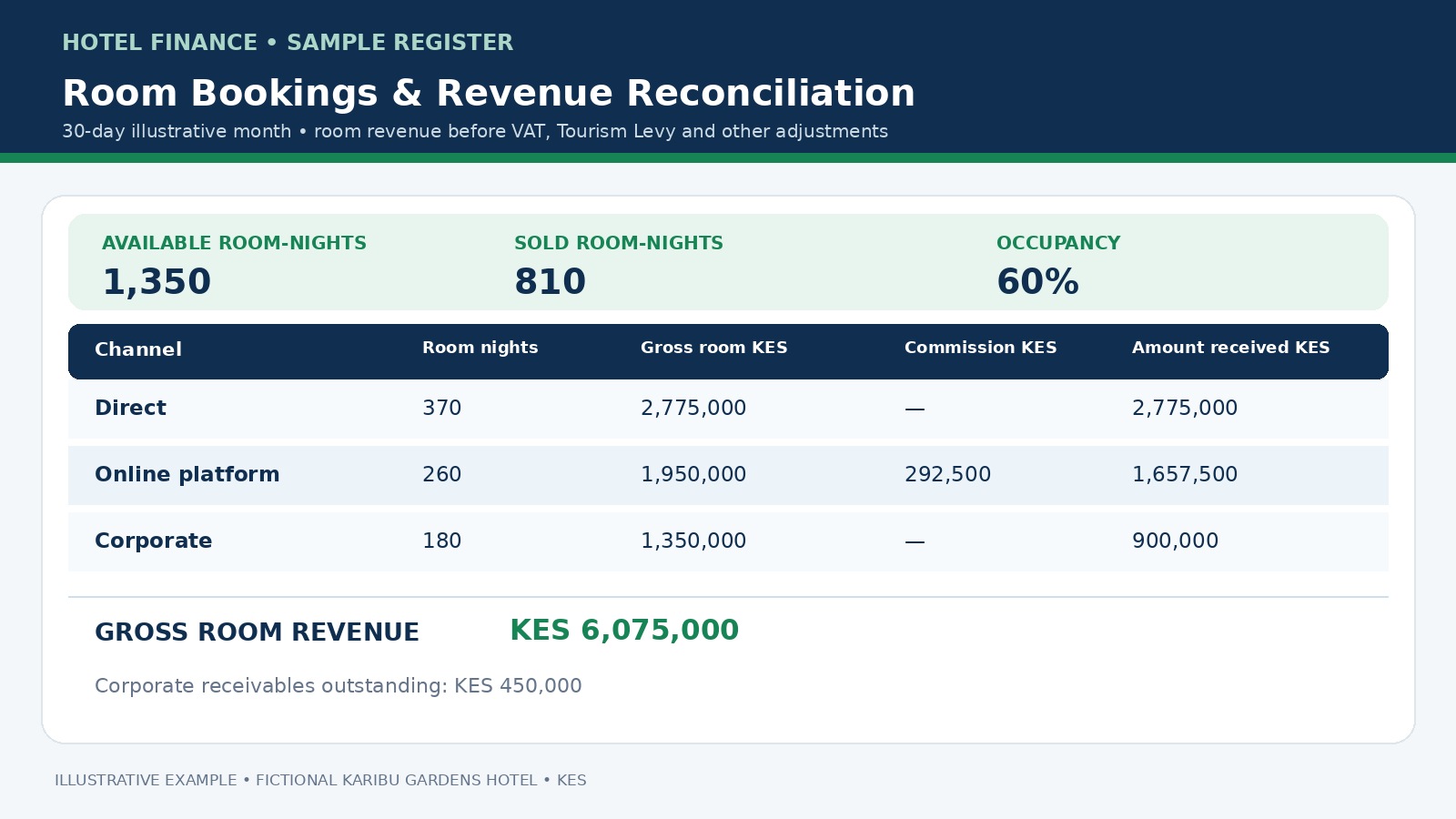
Illustrative hotel room booking revenue reconciliation with 810 occupied room-nights and KSh 6,075,000 gross room revenue.
For Hotel Bookkeeping in Kenya, this calculation is deliberately simplified and excludes VAT, Tourism Levy, service charges, timing differences, and booking-specific adjustments. Its purpose is to show how Hotel Bookkeeping in Kenya reconciles room-nights, gross revenue, commission costs, actual receipts, and amounts still owed. The figures are examples, not claims about Karibu Gardens or any real hotel.
Track Conferences, Meals, and Other Departments Separately
A hotel with more than one service line needs to know which activities generate revenue and which consume resources. Room charges, restaurant sales, conference packages, laundry services, and other approved offerings should not all be buried in a single undifferentiated sales account.
Effective Hotel Bookkeeping in Kenya uses clear departmental categories. For instance, a conference booking might include venue rental, catered lunch, projector hire, and room accommodation for delegates. The invoice can show the relevant components without losing the overall customer reference. Each department should have a consistent method of recording direct expenses so management can compare like with like.
At Karibu Gardens, the banquet team prepares an event order showing the expected guest count, meal choices, venue arrangements, and agreed price. After the event, actual guest numbers, approved extras, supplier costs, and payments are checked against that order. This allows Madam Wambui to compare the event’s contribution with its original estimate.
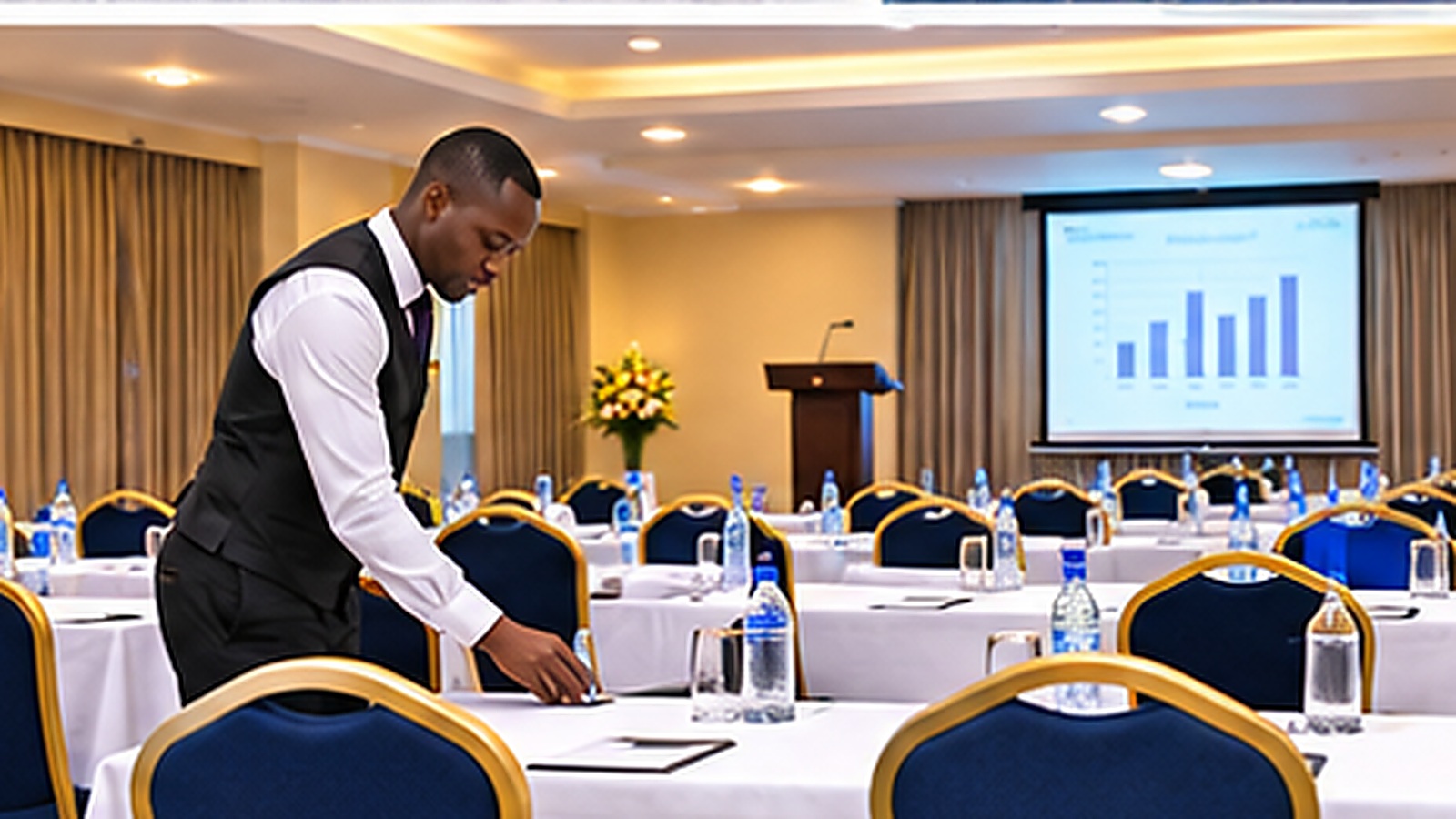
Hotel event staff arranging conference tables and chairs for corporate guests in Kenya.
Control Housekeeping and Room-Turnover Spending
Clean rooms are the foundation of the guest experience, but they bring repeated costs: laundry, toiletries, cleaning products, outsourced services, linen replacements, and occasional repairs. A crowded storeroom can conceal wastage just as easily as it conceals shortages.

Housekeeping employee preparing guest bedroom and linens at a Kenyan hotel.
For Hotel Bookkeeping in Kenya, managers should link purchasing records to supplier invoices, delivery confirmations, stock issues, and room-turnover activity. Housekeeping supervisors can report damaged linen and unusual usage without having to make accounting decisions themselves. The bookkeeping team can then classify the costs consistently and investigate exceptions.
A simple operational indicator is housekeeping supply cost per occupied room-night. If the hotel spends KSh 162,000 on an eligible set of room supplies for 810 occupied room-nights, that narrow measure is KSh 200 per occupied room-night. It is not the full cost of delivering a room, since wages, utilities, maintenance, laundry, and other overhead may be tracked separately.
Make Each Expense Visible Before Month End
Hotel managers face payments that arrive at different times: fresh produce delivered daily, monthly utility bills, routine maintenance, contractor invoices, booking-platform commissions, and periodic software subscriptions. If these are recorded only when the bank payment clears, monthly results can be distorted.
A sound Hotel Bookkeeping in Kenya process captures approved bills with the correct supplier, date, business purpose, department, amount, due date, and supporting tax invoice where required. A review of unpaid bills then informs both the expense report and the upcoming cash plan. Purchase requests, authorization, receiving, and payment approval should be separated when practical for the hotel’s staffing level.
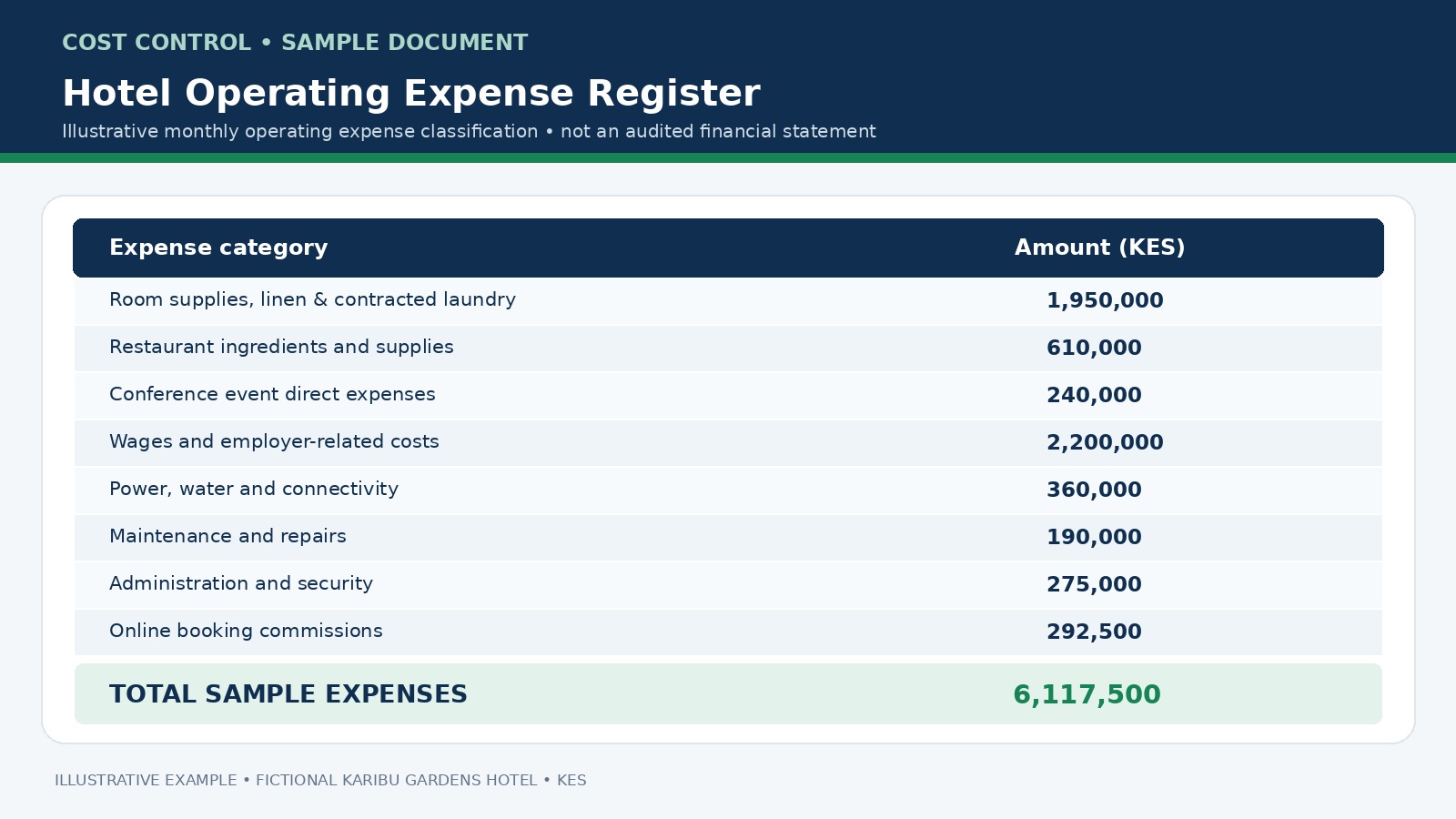
Sample Kenyan hotel monthly expense register totaling KSh 6,117,500 across operating categories.
In Hotel Bookkeeping in Kenya, Madam Wambui may approve a replacement water heater after engineering confirms that it is needed. The finance team should evaluate whether the cost is an immediate repair expense or a longer-lived asset under the hotel’s accounting policy. The purchase must not be coded automatically as ordinary cleaning supplies simply because it was paid from the same bank account.
FedhaTrac’s article on expense tracking and invoicing in Kenya explains the importance of keeping the supporting paperwork connected to transactions. Consistent Hotel Bookkeeping in Kenya makes that evidence usable during monthly reviews and tax preparation.
Report Occupancy, Profitability, and Cash Flow Together
A hotel needs more than one financial indicator. Occupancy measures the share of available room-nights sold, average daily rate measures room revenue per room-night sold, and revenue per available room (RevPAR) combines pricing and occupancy. Profit reporting answers a different question: what remains after properly classified costs and expenses?
In Hotel Bookkeeping in Kenya, the month-end report should connect the room activity summary with revenue by department, booking commissions, payroll-related costs, supplies, utilities, maintenance, accounts receivable, accounts payable, and available cash. Comparisons against the budget and previous periods are often more informative than a single headline figure.
Continuing the hypothetical example, add KSh 1,650,000 from the restaurant and KSh 950,000 from conferences to the KSh 6,075,000 room revenue. Total illustrative revenue becomes KSh 8,675,000. If combined departmental and operating expenses are KSh 6,117,500, the illustrative operating surplus is KSh 2,557,500 before any excluded financing, depreciation, tax, or other adjusting items. It is not a reported net profit or a guarantee of cash on hand.
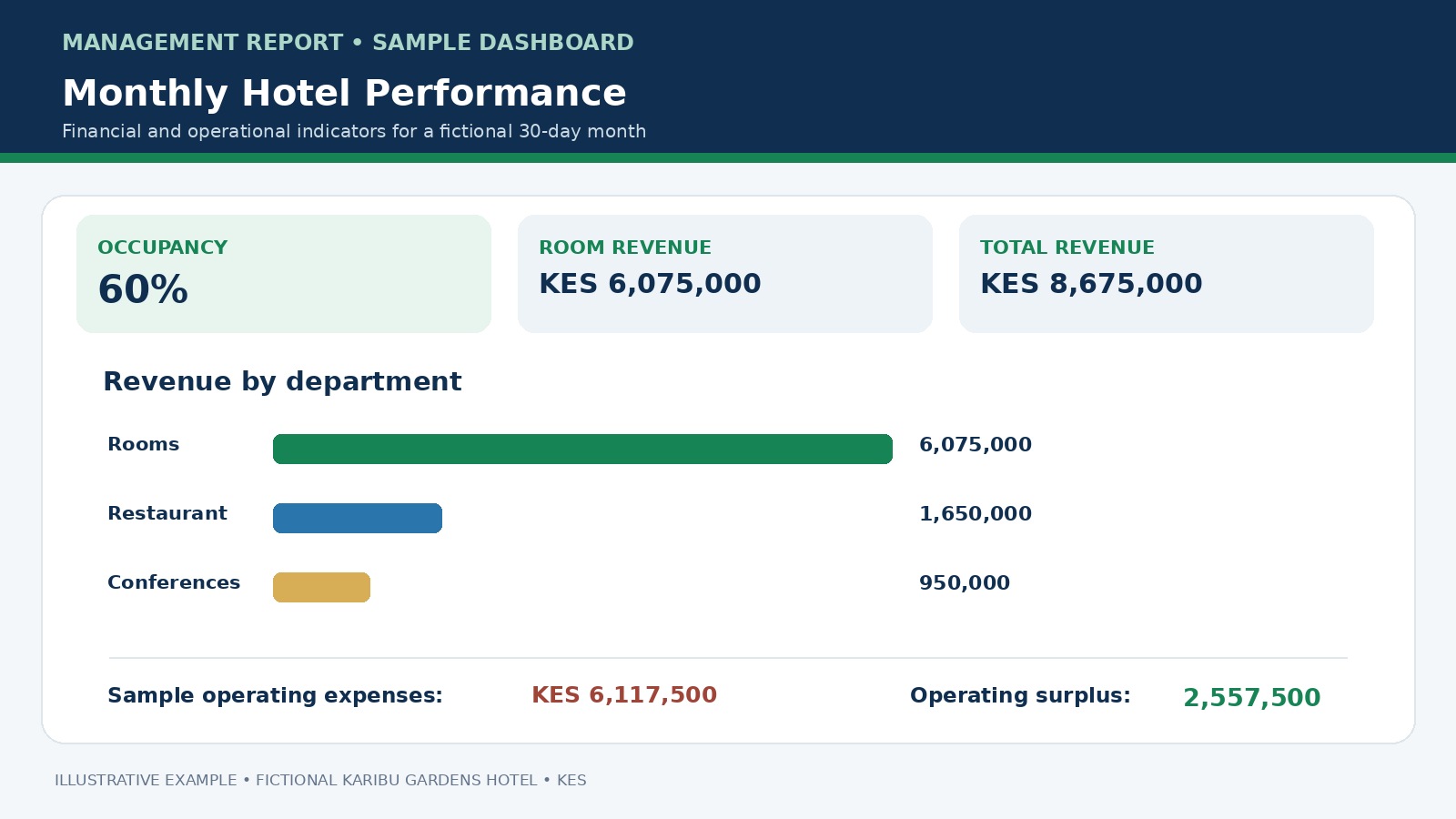
Illustrative Karibu Gardens Hotel financial dashboard showing 60 percent occupancy, revenue, and operating surplus.
For the same sample month, RevPAR would be KSh 6,075,000 divided by 1,350 available room-nights, or KSh 4,500. The illustrative average daily rate is KSh 7,500. These figures must be compared with the hotel’s actual pricing strategy and cost structure rather than treated as universal targets.
Detailed profit-and-loss reporting and a separate cash flow statement serve complementary roles. Hotel Bookkeeping in Kenya brings them together so Madam Wambui can see why a good trading month may still coincide with overdue supplier bills.
Forecast Cash Before the High and Low Seasons
Hotel Bookkeeping in Kenya must account for advance deposits for future stays, pay suppliers before a conference, and wait weeks for a corporate customer to settle. These differences create cash pressure even when expected revenue looks healthy. A practical rolling forecast places likely customer receipts and committed payments against actual dates.
With Hotel Bookkeeping in Kenya, Madam Wambui can review a 13-week cash forecast that separates expected M-Pesa receipts, platform settlements, corporate collections, supplier bills, wages, financing payments, and statutory obligations. Deposits associated with future services should be visible so that money needed to fulfill those stays is not mistaken for surplus cash.
Keep Kenyan Hotel Taxes and Tourism Requirements in View
Hospitality businesses have several compliance questions, and the correct treatment depends on the legal entity, taxable supplies, operating activities, and current rules. The Tourism Regulatory Authority oversees licensing and classification within its mandate. Kenya’s hotel licensing process is described through the government’s KenInvest eProcedures resource.
The Tourism Fund states that a 2% Tourism Levy applies to qualifying regulated hotel, restaurant, and other tourism activities. Its levy calculation guidance addresses the appropriate base when VAT or service charges are included in a bill. A hotel should verify the services within scope, the correct calculation, registration, filing procedure, and deadlines rather than applying 2% indiscriminately to every amount passing through its bank account.
KRA’s VAT guidance explains the KSh 5 million annual taxable-supplies registration threshold and related obligations. KRA also describes eTIMS electronic invoicing for persons in business, subject to relevant rules and exceptions. Tourism Levy, VAT, accommodation revenue, and service charges are distinct concepts; one cannot simply assume that a tourism levy replaces VAT.
Hotel Bookkeeping in Kenya should preserve documentation for lodging, meals, events, eligible business expenses, taxes, and levy calculations. It should also flag unresolved issues for a qualified tax professional. FedhaTrac can support recordkeeping and applicable tax-compliance preparation, but professional legal and licensing decisions remain with the hotel and the relevant authorities.
Protect Guest Information and Strengthen Internal Controls
Hotel records may contain guest names, identity information, booking details, contact information, and payment references. Financial controls should not require distributing unneeded personal data to everyone who handles reports. Access to reservations, refunds, customer balances, and bank information should be limited to appropriate roles.
For Hotel Bookkeeping in Kenya, practical controls include unique staff logins, approval of refunds and rate overrides, independent review of cash counts, regular reconciliation, a clear record of voided invoices, and secure retention of supporting documents. The same person should not have unrestricted authority to create a supplier, approve a bill, and release payment without review.
How FedhaTrac Can Support Karibu Gardens Hotel
At Karibu Gardens, Madam Wambui does not need a second reception team. She needs financial records that explain what the first team has already done. FedhaTrac’s bookkeeping, reconciliation, expense organization, and reporting services can support that goal when the agreed scope matches the hotel’s systems and transaction volume.
A sensible starting point for Hotel Bookkeeping in Kenya is a records review: inspect the reservation and billing systems, cash and M-Pesa channels, booking-platform statements, bank accounts, supplier records, and current reporting deadlines. Then set a routine for capturing transactions, resolving exceptions, reviewing accounts, and delivering understandable monthly reports.
The next step is to discuss the size and complexity of the hotel with FedhaTrac. For a property with multiple revenue departments, Hotel Bookkeeping in Kenya is most useful when it is tailored to the business rather than imposed as a generic retail template.
Frequently Asked Questions About Hotel Bookkeeping in Kenya
Can a hotel show strong occupancy but weak cash flow?
Yes. Hotel Bookkeeping in Kenya distinguishes occupied rooms and invoiced revenue from settled payments, deposits, commissions, supplier bills, and upcoming expenses. High occupancy does not guarantee that corporate customers or booking platforms have already paid.
Is an advance room deposit always revenue immediately?
Not necessarily. Hotel Bookkeeping in Kenya should track deposits against the hotel’s relevant revenue-recognition and tax rules. Money may be received before the related accommodation service is provided, and the accounting and tax timing can differ.
Should restaurant and conference sales be separate from rooms?
Usually, separate categories improve management visibility. Hotel Bookkeeping in Kenya can show revenue and relevant costs for each department while allowing shared expenses to be allocated by a reasonable, consistent method.
Does the Tourism Levy replace VAT for hotels?
No. Tourism Levy and VAT are separate obligations with different rules. Hotel Bookkeeping in Kenya needs the proper records to determine applicable liability, supported by current Tourism Fund and KRA guidance.
How often should a hotel reconcile its accounts?
Busy hotels generally benefit from daily cashier and guest-folio checks, frequent M-Pesa and card reconciliation, and a formal month-end closing process. Hotel Bookkeeping in Kenya works best when important exceptions are investigated promptly instead of being left until annual reporting.
What records should an owner prepare before contacting FedhaTrac?
Useful starting materials include recent booking and guest-folio exports, M-Pesa and bank statements, supplier invoices, booking-platform settlement reports, corporate receivables, and prior financial summaries. With those records, Hotel Bookkeeping in Kenya can begin from a more reliable baseline and identify the clean-up or ongoing support needed.
Make Every Occupied Room Count Financially
Karibu Gardens Hotel’s success will be judged by the experience guests remember, but management also needs to understand how the business earns, spends, collects, and plans. With a clear link between bookings, departments, payments, and financial reports, Madam Wambui can spot problems earlier and decide where to focus attention.
That is the practical promise of Hotel Bookkeeping in Kenya: fewer unexplained balances, better visibility into room and departmental performance, and decisions based on evidence rather than a busy lobby alone. Hotels and guesthouses that want a more dependable accounting routine can explore the bookkeeping and reporting support offered by FedhaTrac.


