
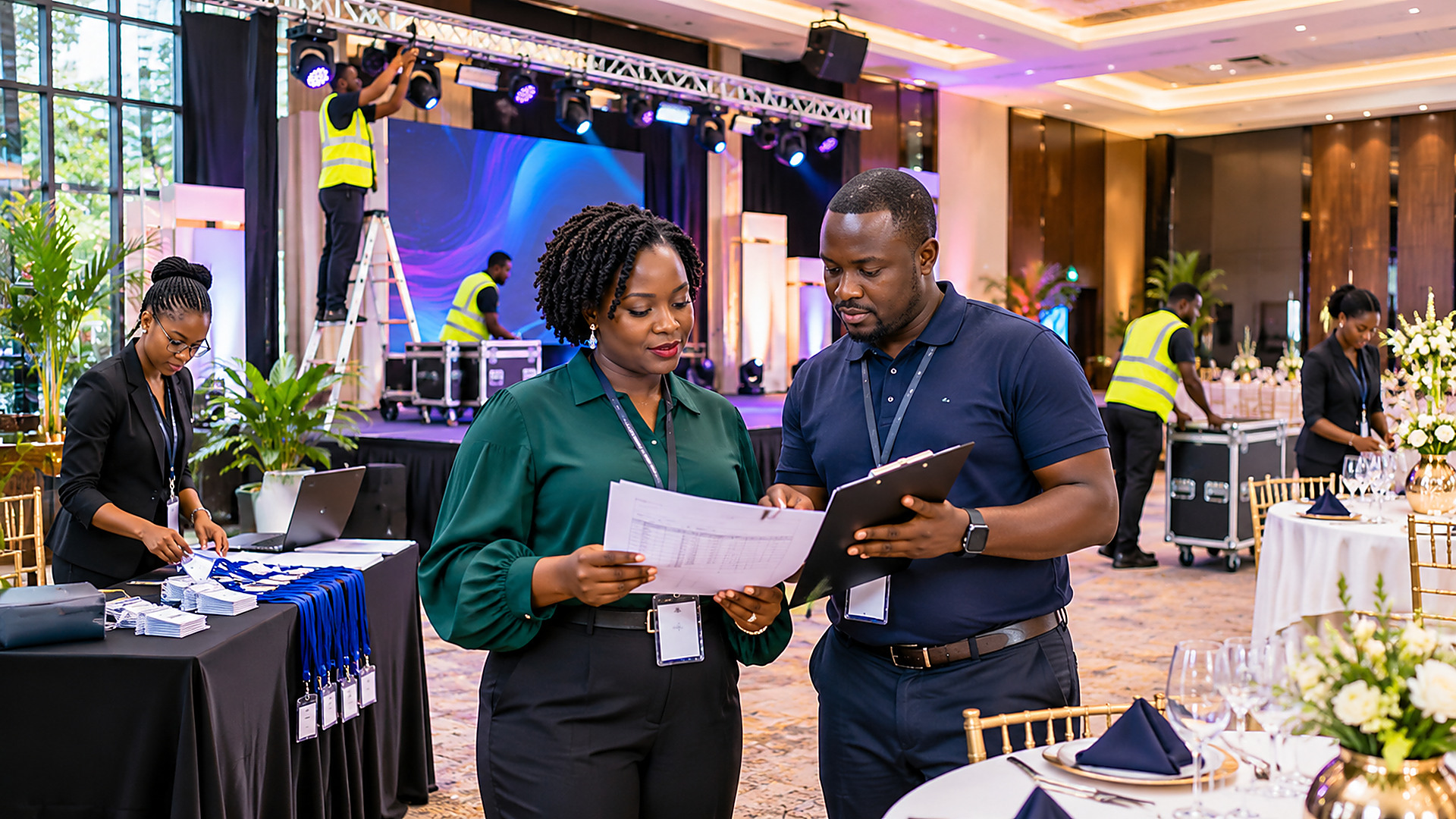
An event can look spectacular on the day and still leave its organizer struggling to pay the final supplier invoices. A corporate conference may sell out, a wedding may delight its guests, and a product launch may generate impressive photographs. Yet none of those outcomes proves that the organizer made a sustainable profit. Event management accounting in Kenya helps event businesses understand what they earned, what they committed to spend, what customers still owe, and how much cash remains available for the next assignment.
At FedhaTrac, we help businesses maintain clear financial records, reconcile transactions, organize invoices and supplier information, and prepare practical financial reports. For event organizers, that means treating every booking as a financial commitment rather than waiting until the music stops to count the money. Strong event management accounting in Kenya makes a difference long before the doors open.
Consider TukioNest Events Ltd., a fictional Nairobi company that plans weddings, conferences, exhibitions, product launches, and private celebrations. Its staff can coordinate a complicated function, but the same team also needs to follow deposits, hire charges, caterer payments, temporary staffing, client changes, and refunds. TukioNest is an illustrative example, not a FedhaTrac client or a claim about an actual business’s results.
Why event management accounting in Kenya requires its own approach
Event businesses carry expenses before an event is complete. A venue may demand a reservation payment, a lighting supplier may require an advance, and a caterer may price against a minimum guest count. Meanwhile, the client may pay in stages and request extra services after approving the original quotation. Without a record for each event, it becomes easy to mix a customer’s advance with the company’s available earnings.
Event management accounting in Kenya also needs a distinction between a planner’s own service fees and funds managed on behalf of a client. If a planner contracts directly with suppliers as the principal provider, the relevant revenue and costs may be recorded differently from a situation in which the planner merely arranges third-party services as an agent. The agreement, the actual obligations, and the applicable accounting policy determine the treatment; a large event budget is not automatically the planner’s revenue.
1. Record client deposits without confusing cash with earned revenue
A customer booking a wedding for August may pay a deposit in May. The bank balance increases immediately, but work and supplier obligations may continue for months. Under an appropriate accrual policy, advance amounts can initially represent an obligation to deliver services rather than completed revenue. The timing of recognition depends on the contract and the service being provided. Event management accounting in Kenya starts with identifying that distinction instead of treating every deposit as immediate profit.
For TukioNest, every client file should connect the signed quotation, contract, booking date, event date, invoice, deposit receipt, revised scope, and final balance. A simple customer ledger can show a KSh 900,000 deposit against a KSh 1,500,000 contracted event, leaving KSh 600,000 still contractually due before later receipts or adjustments. The record should also distinguish a refundable security deposit from an ordinary advance for services where the terms require different treatment.
When a customer adds extra lighting or another 50 meals, the organizer should obtain written approval and document the revised price. Otherwise, a seemingly minor change becomes an unrecovered cost. Our business operations support helps maintain invoices, payment records, supplier details, and related documentation, so managers can follow what was approved rather than relying on messages buried in a WhatsApp thread.
2. Build a live event budget before placing supplier orders
The budget is more than an attractive total in a proposal. It is a working cost plan that should change only through recorded approvals. For each event, TukioNest can organize cost lines for venue and catering, sound and staging, flowers and décor, printing and branding, transport, temporary staff, permissions where applicable, and contingency. A separate line for the company’s planning or coordination fee helps clients understand what they are buying.

Kenyan event planning team reviewing supplier budgets and financial reports for TukioNest Events Ltd.
In event management accounting in Kenya, the approved budget must be compared with a committed-cost register and actual supplier bills. An item is committed when the business agrees to an expense, even if the invoice or payment arrives later. Suppose a KSh 260,000 audiovisual allowance becomes a signed KSh 285,000 contract: the expected overspend is KSh 25,000 before a single shilling leaves the bank. Management can negotiate, revise the client scope, or find savings elsewhere while options remain.
It also matters whose budget is being managed. In some arrangements, the client contracts directly with the venue and TukioNest earns only a coordination fee. In others, TukioNest buys and resells a full event package. Good event management accounting in Kenya records those contracts faithfully, rather than treating both arrangements as identical.
3. Track venue, catering, décor, and production supplier payments
A single conference can involve a hotel, catering team, stage contractor, decorators, photographers, printers, security provider, and transport operator. Some request deposits and others invoice after delivery. A supplier register should identify the business name, agreed work, contract value, deposit paid, balance owed, payment due date, and supporting documents. Event management accounting in Kenya turns those details into a payment schedule that the finance team can review each week.

TukioNest event operations staff checking invoices and supplier commitments beside a decorated venue
TukioNest should avoid paying the same advance twice simply because a supplier resends an invoice. The controls are straightforward: use a unique reference for each purchase, match the payment to a contract or approved order, mark advances separately, and obtain a final invoice or receipt when services are delivered. Where a supplier changes banking details, a second-person confirmation can reduce payment-diversion risk.
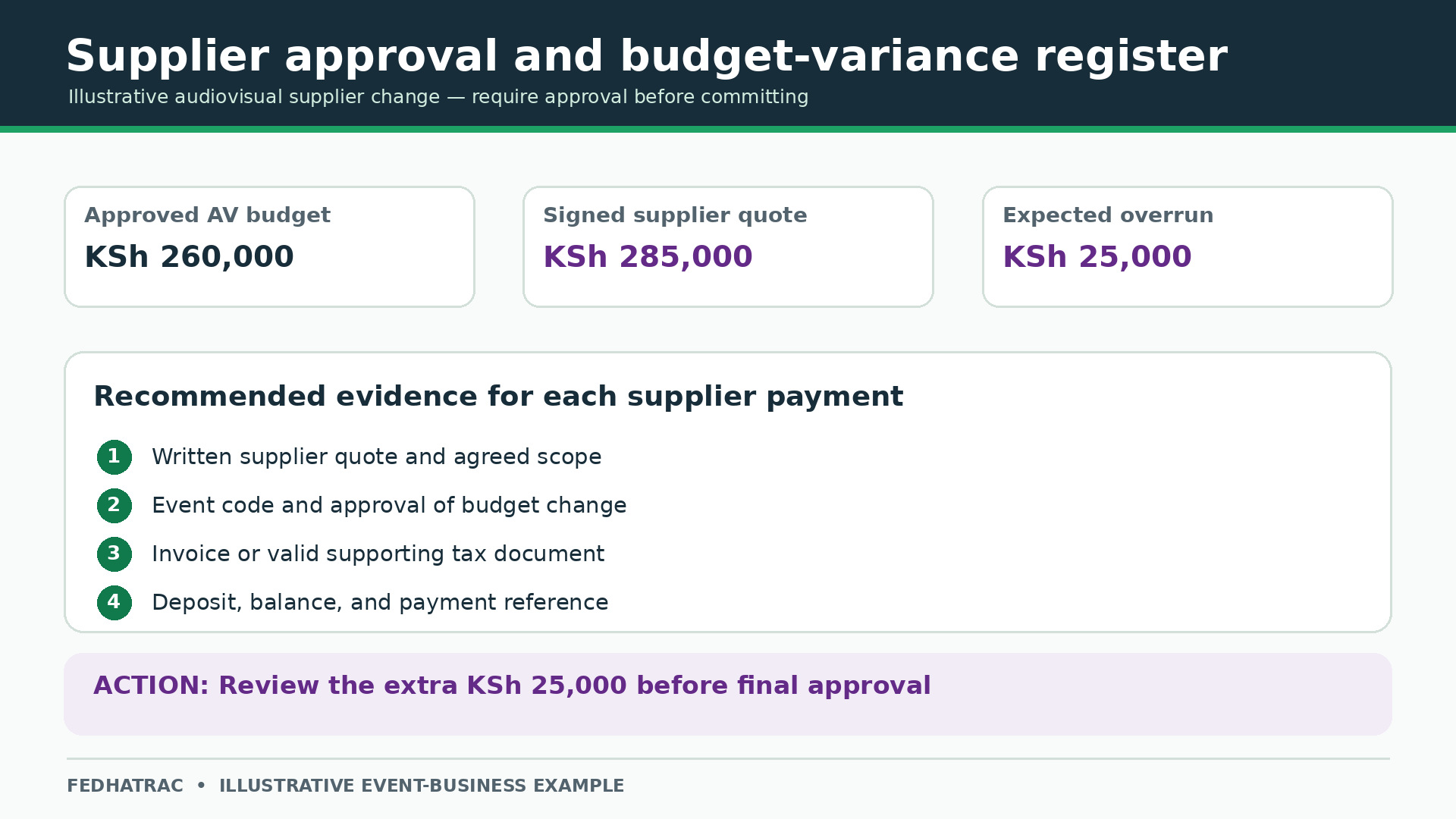
Supplier approval register showing KSh 25000 event audiovisual budget variance and required documentation
Supplier payments are especially relevant to cash-flow planning because vendor due dates may precede client installments. A KSh 200,000 deposit from a client is not adequate cover for KSh 350,000 in venue and sound advances falling due that week. Event management accounting in Kenya helps highlight that mismatch early enough to renegotiate a milestone or protect a reserve.
4. Capture temporary staff, freelance fees, and event-day costs
Corporate functions often rely on short-term ushers, registration clerks, technicians, loaders, MCs, photographers, and interpreters. TukioNest needs a record of the role, agreed rate, approved hours or assignment, attendance evidence supplied by the operations team, payment date, and applicable statutory or contractual treatment. A verbal promise to pay a freelancer can create a real liability even when no formal supplier invoice has yet arrived.

Kenyan event staff documenting crew costs and contractor hours at an outdoor event setup
Event management accounting in Kenya should also separate employees from genuine independent contractors based on the facts of the engagement; the label on a spreadsheet does not decide the legal classification. The applicable payroll obligations, withholding treatment, and reporting requirements depend on the payment and the relationship. FedhaTrac can help organize records and support relevant Kenyan tax compliance, while the event company remains responsible for accurate operational inputs.
5. Measure the actual profit of each event, not just total sales
An events company can be busy without being profitable. TukioNest therefore needs a separate profitability view for each conference, wedding, or launch. For a hypothetical corporate event for which TukioNest is the principal service provider, consider this illustrative fully earned and invoiced package. The figures exclude VAT to focus on operating performance; actual invoice and tax treatment must be assessed separately.
| Event profitability item | Amount (KSh) |
| Event package revenue | 1,500,000 |
| Venue and catering | (620,000) |
| Audiovisual and staging | (260,000) |
| Décor and branding | (145,000) |
| Event staff and contractors | (105,000) |
| Transport and logistics | (60,000) |
| Total direct costs | (1,190,000) |
| Event contribution | 310,000 |
| Allocated business overhead | (125,000) |
| Illustrative operating profit | 185,000 |
The operating margin is 12.33% (KSh 185,000 divided by KSh 1,500,000). The contribution before overhead is KSh 310,000, or approximately 20.67%. These are two different performance measures. Event management accounting in Kenya prevents an owner from quoting the KSh 310,000 contribution as the final profit while ignoring office rent, supervision, insurance, and other shared expenses.
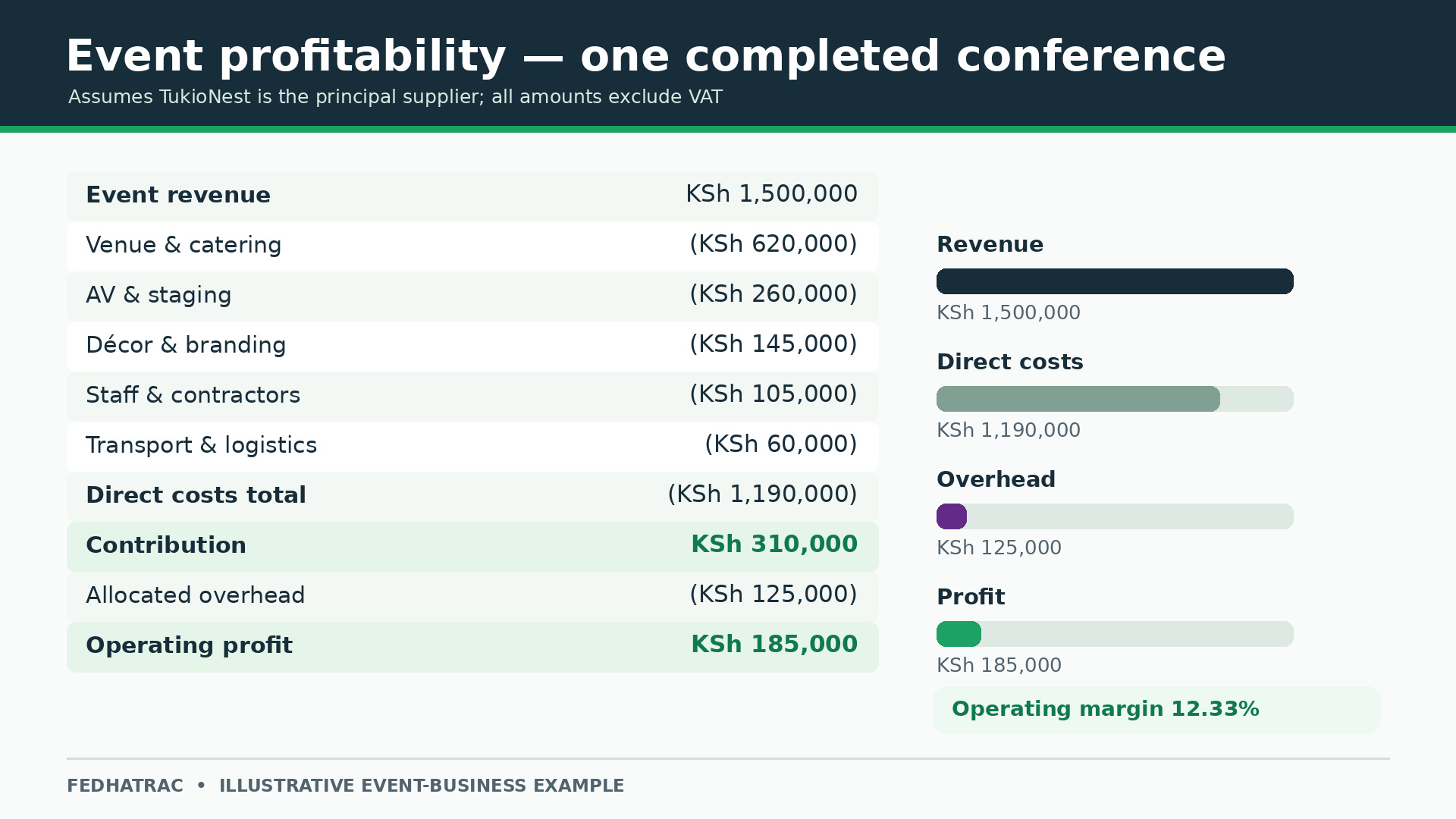
Event management accounting in Kenya example showing KSh 1.5 million revenue and KSh 185000 operating profit
The allocated KSh 125,000 should be based on a reasonable and consistent method, such as project management hours or a documented overhead allocation policy. TukioNest can then compare margins across a 300-person conference, a small wedding, and a multi-day exhibition without unfairly loading every expense onto one job. With event management accounting in Kenya, pricing decisions are grounded in records instead of intuition.
6. Reconcile M-Pesa, banks, refunds, and available cash
Profit is not the same as cash. A client can owe TukioNest money after an otherwise successful event, while the organizer has already paid its caterers, crew, and venue. Clear event management accounting in Kenya therefore needs both an event profit statement and a cash schedule by expected payment date.
Using the same fictional event, assume KSh 900,000 was received as deposits and KSh 350,000 as a later payment by month-end. The remaining KSh 250,000 is still a customer receivable. Assume all KSh 1,190,000 of direct costs and KSh 125,000 of allocated overhead were paid in cash during the same period, with no other balance-sheet changes. Then the simplified cash bridge is:
| Simplified month-end cash bridge | Amount (KSh) |
| Opening cash available | 180,000 |
| Customer deposits received | 900,000 |
| Later customer payments received | 350,000 |
| Direct event costs paid | (1,190,000) |
| Overhead paid | (125,000) |
| Closing cash available | 115,000 |
| Customer receivable still outstanding | 250,000 |
The cash decreased by KSh 65,000 even though the event produced KSh 185,000 in operating profit. Under these simplified assumptions, the difference is the KSh 250,000 still owed by the customer: KSh 185,000 profit less KSh 250,000 increase in receivables equals negative KSh 65,000 operating cash movement. This is an example of why event management accounting in Kenya must show both profitability and collection status.
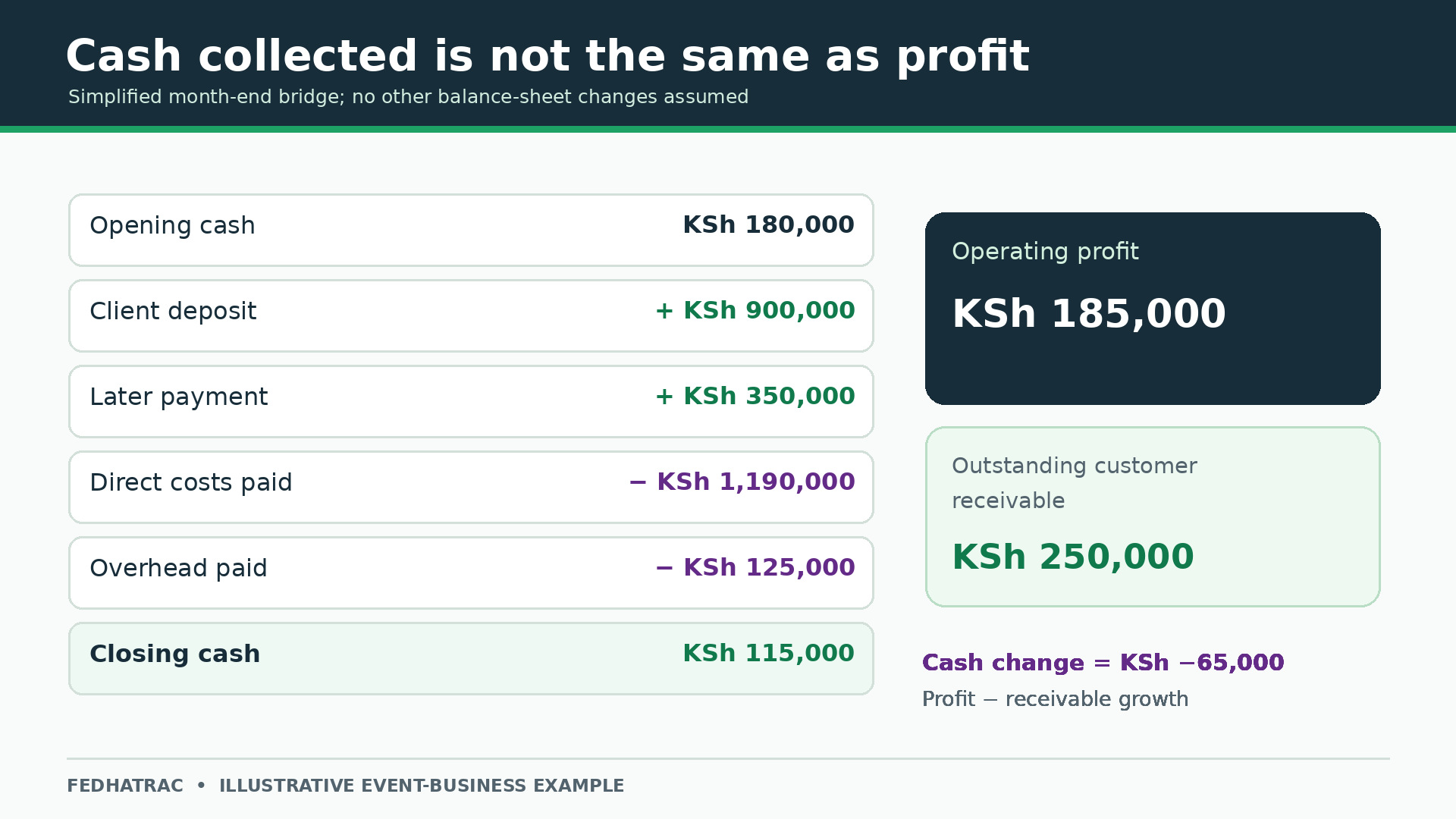
Illustrative TukioNest event cash-flow bridge from KSh 180000 opening to KSh 115000 closing cash
When a date changes or a client cancels, the bookkeeper should link the original invoice, credit note where appropriate, supplier terms, refund decision, and actual payment. Not every deposit is refundable, and the financial treatment depends on the written contract and applicable law. Event management accounting in Kenya provides a clear paper trail for these decisions without promising that every dispute can be resolved by accounting software.
7. Keep event invoices and tax documentation ready for KRA
A well-managed event business should understand that accounting records and tax invoices serve related but distinct purposes. The Kenya Revenue Authority’s eTIMS guidance states that persons conducting business generally need to onboard and issue electronic tax invoices, including businesses that are not VAT-registered, subject to applicable provisions and exceptions. Event management accounting in Kenya should connect eTIMS records with customer invoices, credits, payments, and the underlying event contract.
VAT registration and the correct tax treatment cannot be inferred from the words “event planning” alone. Whether TukioNest supplies its own service, resells a package, or handles payments on a client’s behalf can affect invoicing and accounting. The event company should have the arrangement reviewed before applying a tax treatment to high-value pass-through supplier costs. Our tax filing and compliance support helps businesses maintain a defensible documentary trail and prepare applicable returns.
There can also be withholding-tax questions when paying certain professionals or when clients withhold tax from qualifying fees. The KRA withholding-tax guidance explains that applicability and rates depend on the payment category and recipient’s status. It would be misleading to apply a single withholding percentage to all caterers, decorators, DJs, or other suppliers. Event management accounting in Kenya instead keeps the contract, recipient classification, tax evidence, and payment confirmation together for review.
How FedhaTrac would support a company like TukioNest
TukioNest is a fictional illustration of the kind of work our team can support—not a claimed customer success story. FedhaTrac’s published services include bookkeeping, business operations support, specialized reporting and advisory, and audit preparation. These services provide a practical foundation for event management accounting in Kenya without implying that we automatically run ticketing, guest registration, venue calendars, or supplier dispatch.
For an events firm, we can agree on an event reference structure, organize receipts and supplier documents, support bank reconciliations, review receivables and payables, and compile management reports from the records supplied. A useful monthly report can compare each event’s budget with actual costs, unpaid customer balances, supplier commitments, and contribution to overhead. With event management accounting in Kenya, owners can discuss one clear financial picture rather than several contradictory summaries.
A practical monthly closing checklist for event organizers
TukioNest could make the final five working days of every month a structured financial review. First, confirm that each active event has a signed scope and updated budget. Second, match all customer receipts to invoices and event identifiers. Third, reconcile supplier deposits, bills, and outstanding balances. Fourth, collect event-day float reconciliations and staff payment documentation. Fifth, investigate unmatched bank transactions, credit notes, and refunds before closing the period.
Next, compare actual event costs with approved budgets and flag overruns. Finally, prepare a summary of cash, customer receivables, supplier liabilities, completed-event margins, and upcoming deposits or milestones. Event management accounting in Kenya works best when this review is repeated consistently, with named approvers and clear deadlines rather than an emergency scramble at year-end.
Frequently asked questions about event management accounting in Kenya
Can an event planner count a customer deposit as profit?
No. A deposit is cash received, not a profit calculation. Its revenue treatment depends on what the business has promised and delivered, while profit also requires the related costs and appropriate overhead. Good event management accounting in Kenya tracks these items separately.
How do we account for suppliers paid before an event?
Record the approved commitment, payment reference, and supporting contract, then classify an advance appropriately until the goods or services are provided. When the final invoice arrives, reconcile the advance and balance to avoid duplicate recording. This is a core control in event management accounting in Kenya.
Can FedhaTrac prepare an event-by-event profitability report?
Our accounting and reporting support can help prepare useful financial analysis from the records and project references agreed with the client. The company must provide complete budgets, invoices, supplier records, and payment evidence. Event management accounting in Kenya depends on reliable source information.
Do event businesses in Kenya need eTIMS if they are not VAT-registered?
KRA guidance generally includes persons carrying on business, even where they are not VAT-registered, subject to applicable invoicing provisions and exceptions. An event business should check its circumstances and current KRA rules. Event management accounting in Kenya should keep the accounting and electronic-invoicing records aligned.
What if a customer cancels a wedding or conference?
Review the signed cancellation terms and supplier commitments, document any credit or refund approved, and reconcile the balances. Refundability is contractual and sometimes legal, not something the accountant should assume. Event management accounting in Kenya provides evidence to support a fair and accurate settlement.
Is event management accounting the same as guest-booking software?
No. Event software may handle seating charts, RSVPs, run sheets, or ticket sales. FedhaTrac focuses on its published bookkeeping, accounting, financial support, and reporting services. Event management accounting in Kenya can use information from operations, but it does not require FedhaTrac to provide unverified event-management integrations.
Build better event margins with FedhaTrac
An unforgettable event should also be a financially controlled event. TukioNest’s hypothetical example shows how deposits, supplier commitments, temporary labor, final invoices, profitability, and cash can tell different stories if they are not reconciled. With event management accounting in Kenya, owners gain the clarity to quote responsibly, follow up on collections, and discuss results with confidence.
At FedhaTrac, we can help your events company keep organized books, reconcile customer and supplier transactions, prepare clear financial reports, and review the numbers behind your next event. Explore our services and contact FedhaTrac to discuss a practical bookkeeping and financial reporting arrangement for your business.


