

A recruitment firm can celebrate ten successful placements and still wonder why its bank balance has barely moved. Employer invoices may remain unpaid, advertising campaigns cost more than expected, and a replacement guarantee can turn yesterday’s profitable assignment into tomorrow’s unpaid work. Recruitment agency accounting in Kenya helps agency owners connect each hiring assignment to its actual income, costs, outstanding balances, and financial responsibilities.
At FedhaTrac, we support Kenyan professional-service businesses with bookkeeping, reconciliations, invoicing records, tax-compliance assistance, and management reporting. In this guide, we use AjiraNest Recruitment Services Ltd., a clearly fictional Nairobi recruitment business, to demonstrate how disciplined recruitment agency accounting in Kenya can strengthen decision-making. AjiraNest is an illustrative example, not a FedhaTrac customer or a claim about an actual agency’s financial results.
Recruitment businesses have several income models: permanent-placement fees, retained searches, executive assignments, recruitment-project fees, and HR advisory work. Some also arrange contract staffing, but their payroll obligations depend on the contracts and who is the actual employer. This distinction matters because a recruitment commission is not the same as wages paid to workers employed by a client.
Why recruitment agency accounting in Kenya requires specialized records
Unlike a shop that knows the cost of an item when it sells, a recruiter spends money and staff time before it knows whether a candidate will be hired. A search may stretch across several weeks, an employer may postpone an appointment, or a candidate may leave during a contractual guarantee period. The agency must see costs by assignment without confusing cash receipts with profit.
For AjiraNest, recruitment agency accounting in Kenya begins with four linked records: an employer contract, an assignment or vacancy reference, a documented fee milestone, and a ledger of attributable costs. That foundation makes it easier to understand placement margins, prepare invoices, monitor collections, and give managers meaningful monthly reports. It also supports a clear distinction between the recruiting company’s operations and an employer client’s payroll obligations.

AjiraNest recruitment firm organizing employer contracts and financial records in Nairobi office
Nine smart financial checks for a recruitment business
1. Define when a placement fee is earned
A permanent-placement contract might charge a percentage of agreed candidate compensation, a fixed fee, or staged search fees. The signed agreement should say when invoicing is permitted, whether a deposit is refundable, which services are delivered at each milestone, and what happens if the hire does not proceed. Recruitment agency accounting in Kenya should follow the actual contract and the company’s applicable accounting policy—not simply count every incoming deposit as earned income.
AjiraNest can assign a unique reference to each employer engagement. Its finance records should link the engagement letter, invoice, candidate placement confirmation, and payment receipt. A retained search may have several milestones; a success-only assignment may not generate an invoice until the agreed hiring event happens. If a guarantee could require a free replacement, management should consider the possible financial exposure with its accountant when applying an appropriate reporting policy.
We help firms organize these transactions through our bookkeeping services, so that revenue explanations are backed by documents rather than guesses.
2. Separate employer revenue from candidate-related spending
Recruitment businesses often buy job advertisements, candidate assessments, background screening, travel, and communication services. These expenditures are not automatic deductions from the client’s fee. Each invoice from a screening provider or advertising platform belongs in the appropriate expense category and, where useful, under a particular vacancy or employer contract.
For recruitment agency accounting in Kenya, this separation protects both gross margin analysis and audit trails. AjiraNest should record a KSh 260,000 placement invoice as revenue under the relevant policy, while recording its KSh 32,000 direct advertising and screening spend separately. Netting the two into one KSh 228,000 transaction would hide useful information about pricing and supplier costs.
3. Track recruiter time and assignment profitability
Recruiters may handle several vacancies simultaneously. A busy desk is not necessarily a profitable desk. Timesheets or reasonable internal effort allocations help a finance team understand whether a difficult executive search is absorbing too many hours compared with its contracted fee. That is a management-costing practice, not a promise that FedhaTrac automatically monitors recruiter productivity.
AjiraNest can compare each assignment’s contracted fee with attributable candidate-sourcing costs, staff effort, interview logistics, and a consistent share of overhead. Recruitment agency accounting in Kenya becomes especially valuable when a seemingly successful fee cannot cover repeated advertising and extended searches. Management should revisit its price, scope, or candidate sourcing plan before accepting an identical contract.
4. Control receivables before a new search begins
An employer may approve a placement and then settle its invoice several weeks later. Meanwhile, rent, salaries, and marketing subscriptions remain due. That makes accounts receivable one of the most important areas of recruitment agency accounting in Kenya. Every invoice should show the client name, reference, invoice date, amount, payment terms, and whether a credit note or collection adjustment is required.
AjiraNest can review receivables in current, 1–30-day overdue, 31–60-day overdue, and older categories. Staff should resolve disputes about placement dates and invoicing milestones early, rather than sending repetitive reminders without supporting evidence. FedhaTrac’s business operations support includes invoice and payment-tracking workflows that can assist with this recordkeeping.
5. Distinguish recruitment from outsourced staffing payroll
A placement agent normally invoices an employer for recruitment services; the employer then pays its own employee according to the employment relationship. A contract-staffing company may instead employ some workers directly and invoice customers for their services. Those arrangements create different payroll and tax obligations, so no agency should assume that every worker placed with a client belongs on its payroll.

Kenyan recruitment agency conducting candidate interview and reviewing employment documents
In recruitment agency accounting in Kenya, AjiraNest should first determine who signs the employment contract, who pays salaries, and which party has statutory obligations. For its actual employees, it should maintain payroll records, benefits and deduction schedules, and proof of applicable remittances. For workers legally employed by clients, AjiraNest should not duplicate their wages as its own payroll expense. Any staffing arrangement needs its contracts reviewed before books or payroll procedures are set up.
6. Reconcile M-Pesa, bank payments, and credit notes
An employer might pay from a corporate bank account, settle an approved invoice in installments, or use another agreed payment channel. Recruitment agency accounting in Kenya requires each receipt to be matched to the right invoice, not merely added to an undifferentiated income total. Refunds, deposit transfers, and reversed transactions deserve their own supporting documents.
A proper monthly reconciliation compares the cash book with bank and payment statements, investigates unmatched transactions, and documents corrections. If a customer prepays an assignment that has not yet reached its agreed revenue milestone, the financial statements may need to treat the amount as a liability until the relevant performance requirement is met. We support accounting and reconciliation work under the scope agreed with each client.
7. Set a budget for recruitment campaigns and technology
Professional recruitment uses paid job boards, CRM subscriptions, candidate databases, background checks, internet connections, office facilities, and communications tools. These costs can quietly expand when recruiters open new search campaigns without coordinating budgets. AjiraNest should approve campaign expenditure before purchasing advertising and compare committed costs against its client fee and projected margin.
A useful recruitment agency accounting in Kenya budget distinguishes direct vacancy costs from shared software and office overhead. The management team can then decide whether a premium platform is earning its cost or simply supporting activity that has not converted into placements. This is a financial question; activity reports alone do not prove that a subscription improves profitability.
8. Prepare compliant invoices and retain evidence
Kenya’s Revenue Authority explains that persons carrying on business, including those not registered for VAT, are generally within the electronic invoicing framework, subject to applicable rules and exceptions. Recruitment firms must check their own VAT status, invoice requirements, and tax treatment instead of copying another agency’s settings. Official guidance is available on the KRA eTIMS information page.
For recruitment agency accounting in Kenya, retained evidence should connect invoices, service contracts, supplier bills, payment records, and expense explanations. KRA has also announced income-and-expense validation against electronic invoicing and other records for returns submitted from January 2026. The supporting-document process matters just as much as the bookkeeping entry. FedhaTrac offers tax filing and compliance support; the firm’s final tax responsibilities remain determined by law and its facts.
9. Review profit, cash flow, and capacity every month
A monthly report should answer more than whether revenue increased. Which employers pay promptly? Which recruitment services deliver healthy margins? How much cash will be needed before the next major invoice is collected? How many assignments are sitting in an unresolved guarantee period? These are management questions that accurate recruitment agency accounting in Kenya can support.

Recruitment agency consultants reviewing client assignment and finances in office
At FedhaTrac, our specialised reporting and advisory services help businesses examine revenue, expenditure, cash flow, budgets, and performance. AjiraNest could use a monthly management report and quarterly review to decide whether to hire another recruiter, change pricing, or build a stronger cash reserve.
Recruitment agency accounting in Kenya: illustrative monthly results
The following example is hypothetical. It shows how recruitment agency accounting in Kenya distinguishes profitability from collections. All figures are in Kenyan shillings, before applicable taxes and without claiming real customer outcomes.
| Illustrative monthly income and cost | Amount (KES) |
| Retained executive search fees | 520,000 |
| Permanent placement fees | 280,000 |
| HR consultancy fees | 180,000 |
| Total service revenue | 980,000 |
| Candidate sourcing and screening | (135,000) |
| Assignment-related delivery costs | (95,000) |
| Contribution after direct costs | 750,000 |
| Employee and office overhead, including depreciation | (510,000) |
| Illustrative operating profit | 240,000 |
That is an operating margin of approximately 24.5%. It does not mean AjiraNest has KSh 240,000 of additional cash available. Suppose clients paid KSh 740,000, leaving KSh 240,000 in month-end receivables. Also assume the KSh 510,000 overhead includes KSh 50,000 of noncash depreciation and there were no other working-capital changes. Cash expenses would then equal KSh 690,000: KSh 230,000 direct costs plus KSh 460,000 cash overhead.
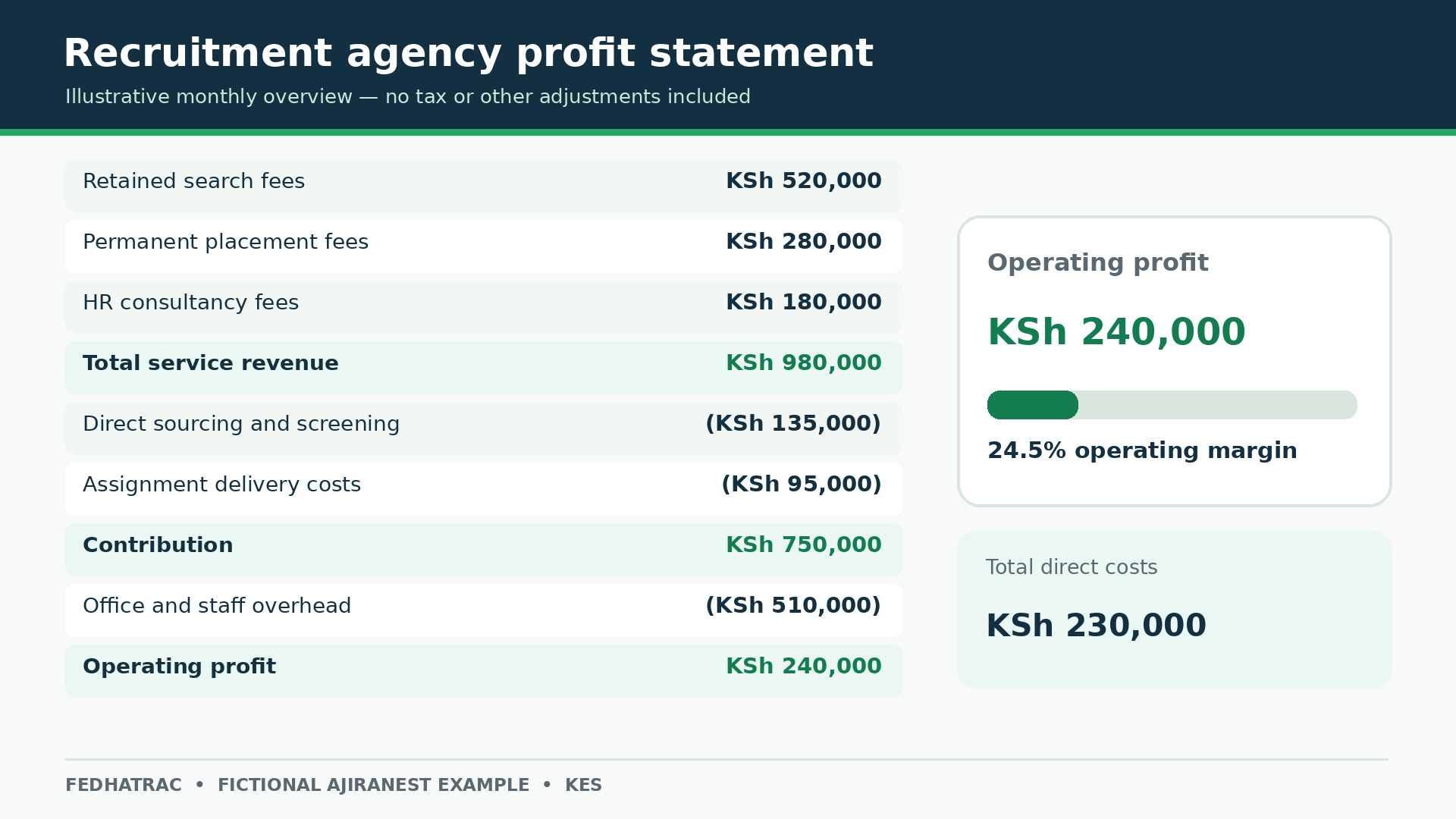
Illustrative recruitment agency financial statement KSh 980000 revenue and KSh 240000 profit
If opening cash was KSh 190,000, cash would close at KSh 240,000 after KSh 740,000 receipts and KSh 690,000 cash payments. The KSh 50,000 rise in cash reconciles to KSh 240,000 operating profit, less the KSh 240,000 increase in receivables, plus KSh 50,000 noncash depreciation. Good recruitment agency accounting in Kenya explains this difference without suggesting that profit and available cash are identical.
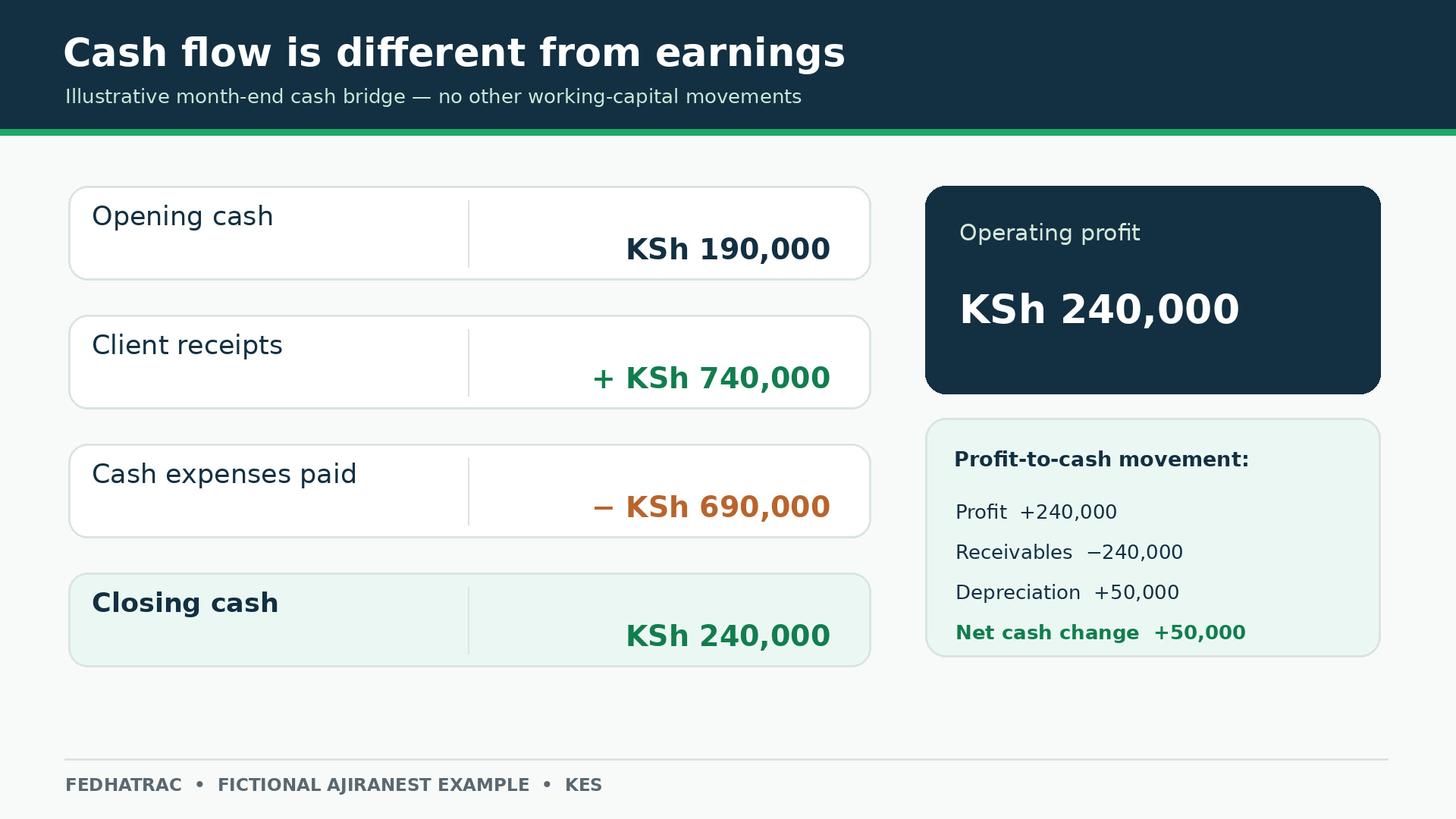
Recruitment agency cash-flow example from KSh 190000 opening to KSh 240000 closing cash
Recruitment agency accounting in Kenya: one assignment example
AjiraNest signs an illustrative placement contract worth KSh 260,000. It spends KSh 32,000 on job advertising and screening, attributes KSh 45,000 of recruiter effort, and allocates KSh 62,000 of office overhead to that assignment. Total attributable costs are KSh 139,000 and the assignment’s illustrative operating profit is KSh 121,000, or approximately 46.5% of the fee.
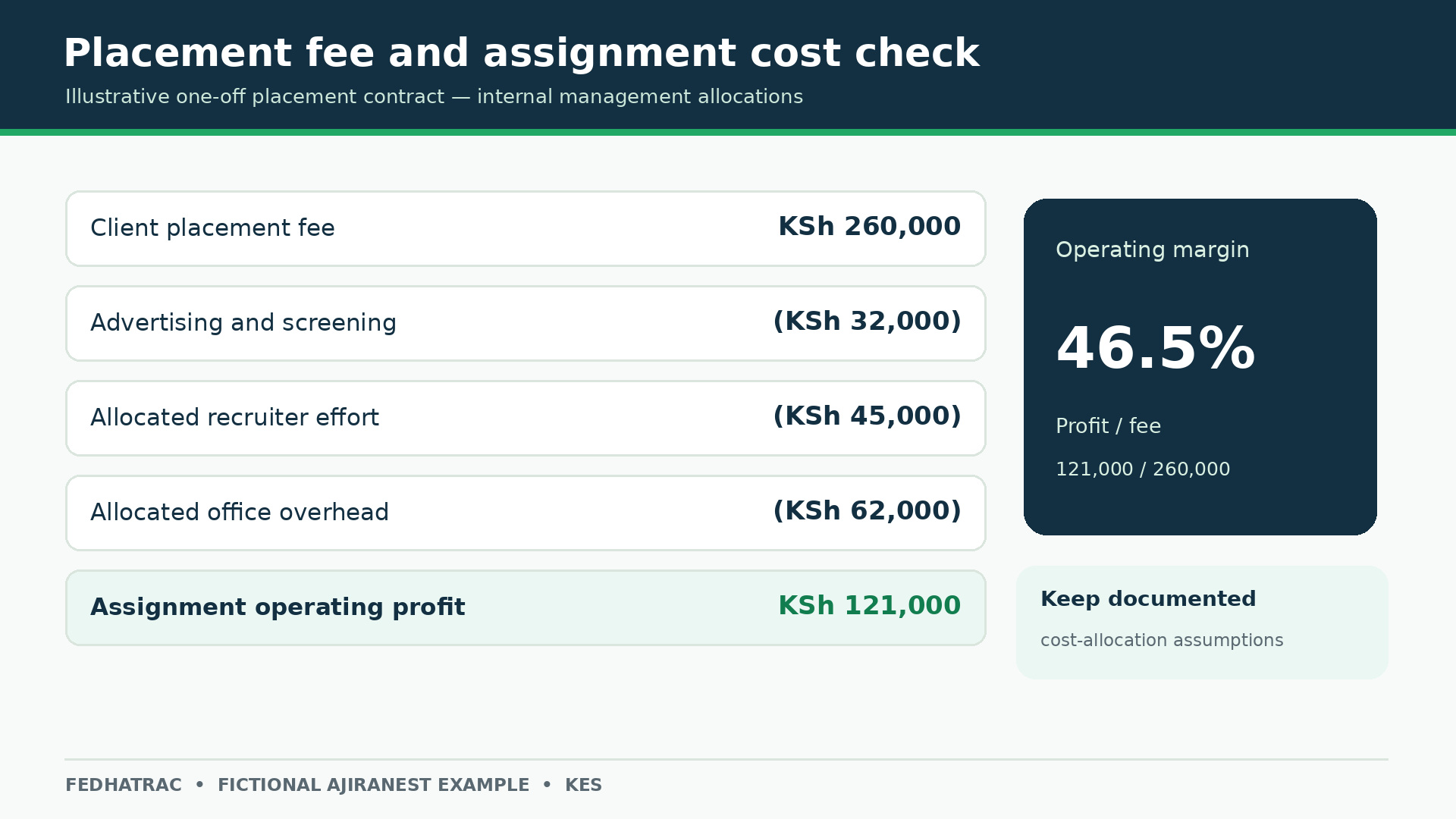
Recruitment placement KSh 260000 fee and KSh 121000 illustrative assignment profit
These internal allocations are management estimates, not necessarily separate payroll transactions or the amounts presented under statutory accounting rules. The example is useful because recruitment agency accounting in Kenya can reveal which assignments consume disproportionate resources. Managers can compare like-for-like contracts using consistent costing methods and documented assumptions.
Compliance and recruitment-sector responsibilities in Kenya
Recruitment is a regulated activity, not simply an invoicing category. The National Employment Authority publishes accreditation requirements for private employment agencies, and it distinguishes arrangements involving foreign recruitment. Agencies should confirm the current applicable conditions directly with NEA before operating or renewing accreditation; the existence of a financial ledger does not substitute for sector registration.
Recruitment agency accounting in Kenya is one part of good governance, alongside proper candidate data handling, lawful contractual arrangements, accurate employer records, and employment-law compliance. FedhaTrac’s role is financial records, bookkeeping, support with applicable KRA matters, and financial reporting—not legal approval, employment agency licensing, or candidate placement. We do not claim our software verifies employment agencies or automates recruitment regulation.
Businesses should obtain professional advice for unusual arrangements, including cross-border placement, staff outsourcing, disputes over recruitment charges, and employer-of-record structures. A candidate fee or a worker deduction must not be assumed permissible simply because an agency can record it. Financial procedures should follow the legal and contractual analysis, not replace it.
How FedhaTrac supports recruitment agency accounting in Kenya
We begin by understanding the agency’s service models, transaction volume, employer contracts, banking arrangements, current books, and reporting deadlines. We agree the scope before setting up the work. That may include organizing transaction records, reconciling accounts, reviewing invoice schedules, preparing management accounts, and supporting tax documentation. We do not promise that every feature or integration is automatically included in every engagement.
Next, we help create a useful structure for employer clients, search assignments, direct costs, shared overhead, and unpaid fees. The agency’s own staff retain responsibility for confirming hiring milestones, issuing business instructions, and supplying relevant supporting records. With that division of work, recruitment agency accounting in Kenya becomes a predictable financial process rather than a late-month scramble to reconstruct invoices.
Finally, we can discuss results in a regular financial review: receivable aging, gross margin, cost trends, cash needs, and questions the management team should investigate. FedhaTrac combines a business-facing financial platform with agreed professional support, but we do not represent it as a recruitment applicant-tracking system. Our job is to help the agency understand its finances, make decisions, and keep evidence organized.
Recruitment agency accounting in Kenya: a practical month-end routine
A reliable month-end process begins with signed contracts and service milestones. Confirm which placement or advisory fees were earned, collect invoices and supplier documents, reconcile incoming payments, classify expense transactions, and review open balances. Separate deposits and credits requiring follow-up, and verify who employs workers in any staffing arrangement before posting payroll-related amounts.
Then review campaign costs against budgets, allocate reasonable direct costs to jobs, inspect unusual balances, and prepare an income statement together with a cash-flow view. Recruitment agency accounting in Kenya is most valuable when the monthly report is understandable enough for business managers to act on it. A concise explanation of the biggest cost changes can be more useful than a large report nobody reads.
Frequently asked questions
Does a recruitment agency need bookkeeping if employers pay only after placement?
Yes. The agency still pays for recruiting work before a fee is received. Recruitment agency accounting in Kenya helps document those costs, follow agreed fee milestones, and monitor the financial effect of unsuccessful or delayed assignments.
Does FedhaTrac run the agency’s recruitment or candidate-selection system?
No such function is claimed here. FedhaTrac provides financial services and platform features related to accounting, invoices, reconciliations, reporting, and operations support. Candidate screening, applicant tracking, and recruitment regulatory approvals are separate functions.
Are placed candidates automatically on the recruitment firm’s payroll?
No. Payroll responsibility depends on the actual employment contracts and applicable legal arrangements. A direct-placement fee ordinarily differs from a situation where the agency is itself the employer under a contract-staffing model.
Can FedhaTrac help with late recruitment invoices and reporting?
Yes, under an agreed scope. Our business operations and accounting services cover financial records, invoice and payment tracking, reconciliations, and reporting. Recruitment agency accounting in Kenya benefits when each overdue invoice is traceable to an employer, assignment, and supporting agreement.
What should an agency prepare before contacting FedhaTrac?
Start with current invoices, recent bank statements, service contracts, expense records, payroll information for actual employees, and the management reports you already use. We can then discuss a practical bookkeeping and advisory scope based on your processes and deadlines.
Give AjiraNest-style financial discipline to your real recruitment business
AjiraNest is a fictional example, but the underlying challenges are familiar to real professional-service firms: uncertain placement dates, supplier costs incurred early, slow employer payments, and reports that arrive too late to guide pricing. Recruitment agency accounting in Kenya helps connect those moving parts into one reliable financial picture.
At FedhaTrac, we can help you organize the books, track invoicing and payments, reconcile accounts, prepare reports, and discuss your next financial decisions. Visit our contact page to discuss recruitment agency accounting in Kenya and the support that fits your business.


