
Why Cleaning Company Accounting in Kenya Must Start With Each Contract
A busy cleaning business can have dozens of occupied sites, a full team of cleaners, and a steady queue of customer requests while still struggling to pay staff on time. The problem is often not a shortage of activity. It is a shortage of reliable information about which contracts earn money, which invoices remain unpaid, and what supplies and labor actually cost. At FedhaTrac, cleaning company accounting in Kenya means connecting those everyday operations to records that support better decisions.
Consider NuruBreeze Cleaning Services Ltd., a fictional Nairobi company used only for illustration. In our example, NuruBreeze provides routine office cleaning, residential-estate janitorial services, retail-center cleaning, and occasional post-construction deep cleaning. It is not presented as a real customer, a registered company we have verified, or evidence of FedhaTrac client results. Its hypothetical figures will show what useful financial discipline could look like.
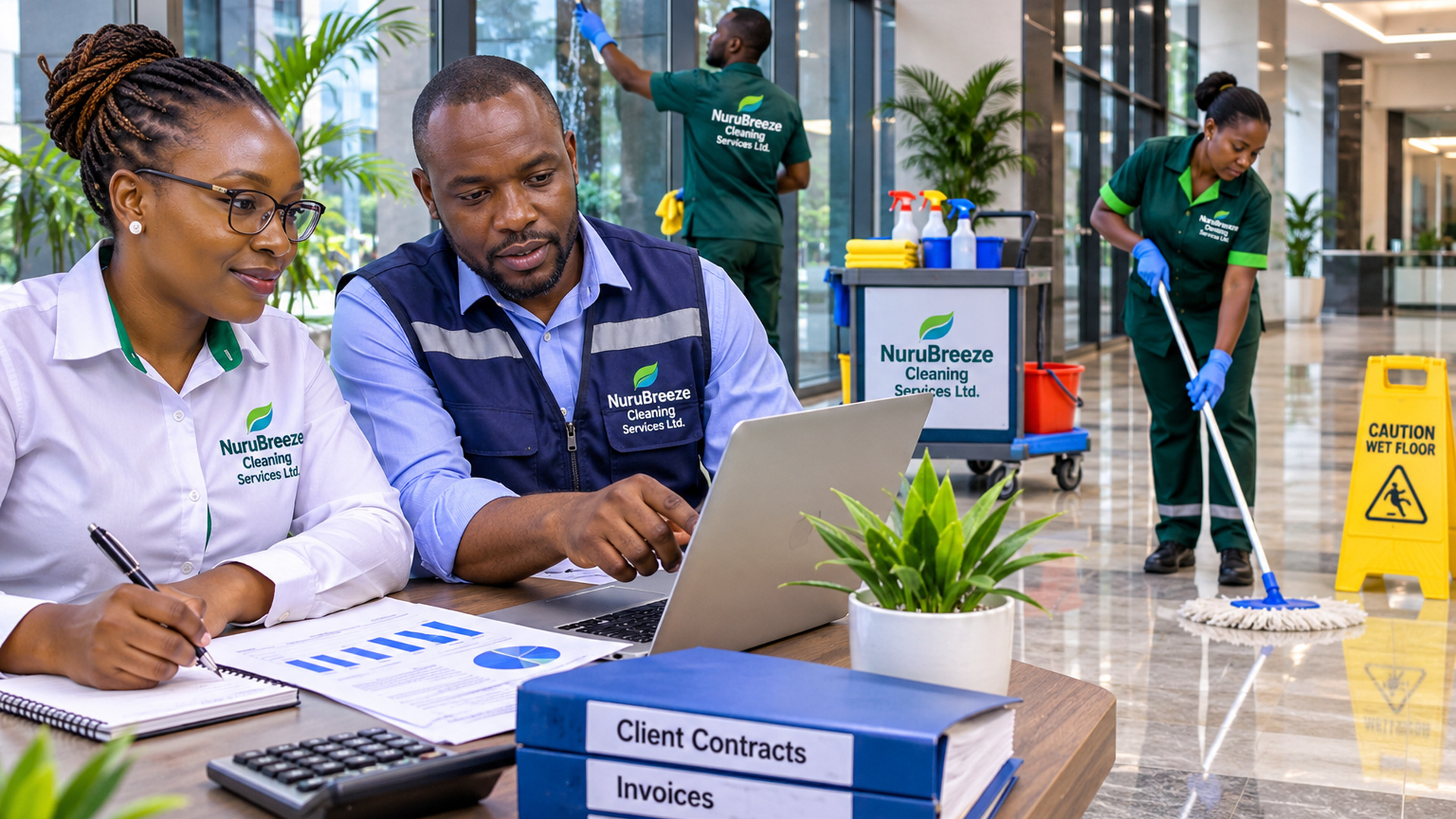
NuruBreeze Cleaning Services Ltd. fictional office cleaning team reviewing cost records
We provide bookkeeping support, accounting services, invoicing and payment-record assistance, and specialized reporting and advisory. We work from agreed source documents and explain what the results mean. We do not pretend our platform automatically schedules cleaners, monitors attendance, or counts chemical usage without the client’s operational records. That distinction makes cleaning company accounting in Kenya useful and credible.
1. Turn Cleaning Contracts Into Clear Financial Records
A corporate site may pay a fixed monthly fee for daily cleaning, while a homeowner requests a single sofa-cleaning visit. Another customer may order a special floor treatment outside the standing contract. Combining all payments in one undifferentiated sales total makes it difficult to judge performance. With cleaning company accounting in Kenya, we help distinguish recurring contract income, additional services, credits, deposits, and outstanding customer balances.
For cleaning company accounting in Kenya, our team reviews available agreements, signed quotations, service dates, client details, invoices, and receipts. A useful contract record identifies the customer, location, services included, billing cycle, agreed fee, payment terms, and any separately chargeable work. We help organize supporting documentation so a manager can connect the invoice to the underlying service agreement rather than reconstruct the facts months later.
NuruBreeze’s hypothetical monthly revenue is KSh 420,000 from one office complex, KSh 280,000 from a retail center, KSh 240,000 from an apartment estate, and KSh 160,000 from completed deep-cleaning jobs. The total is KSh 1,100,000 in service revenue. This is a simplified illustration, excluding VAT treatment and other possible adjustments. The cleaning company accounting in Kenya process begins by recognizing the services recorded for the period—not assuming all KSh 1,100,000 has arrived in the bank.
A customer might also pay in advance for future work. Such receipts require the appropriate treatment under the business’s accounting policies and contract terms; receiving cash does not always mean the service has already been earned. We help bring that distinction into the records and highlight missing evidence before monthly reports are finalized.
2. Use Cleaning Company Accounting in Kenya to Reconcile Collections
Corporate cleaning buyers may settle invoices on 30-day or longer terms even though the contractor pays cleaners every month. A business therefore needs two views: revenue from services performed and cash actually received. Our business operations support helps organize invoices, receipts, customer accounts, and payment follow-up records. Cleaning company accounting in Kenya should make overdue balances visible without confusing a promised payment with cash already collected.
For the illustrative NuruBreeze month, assume it collects KSh 790,000 against KSh 1,100,000 of current service revenue. With no opening receivables, write-offs, or advance payments in this simplified scenario, KSh 310,000 remains owed by customers. A manager who sees only KSh 1,100,000 in revenue could mistakenly plan payroll as if every shilling were available. We reconcile the recorded collections to bank and M-Pesa evidence and flag unmatched transactions for investigation.
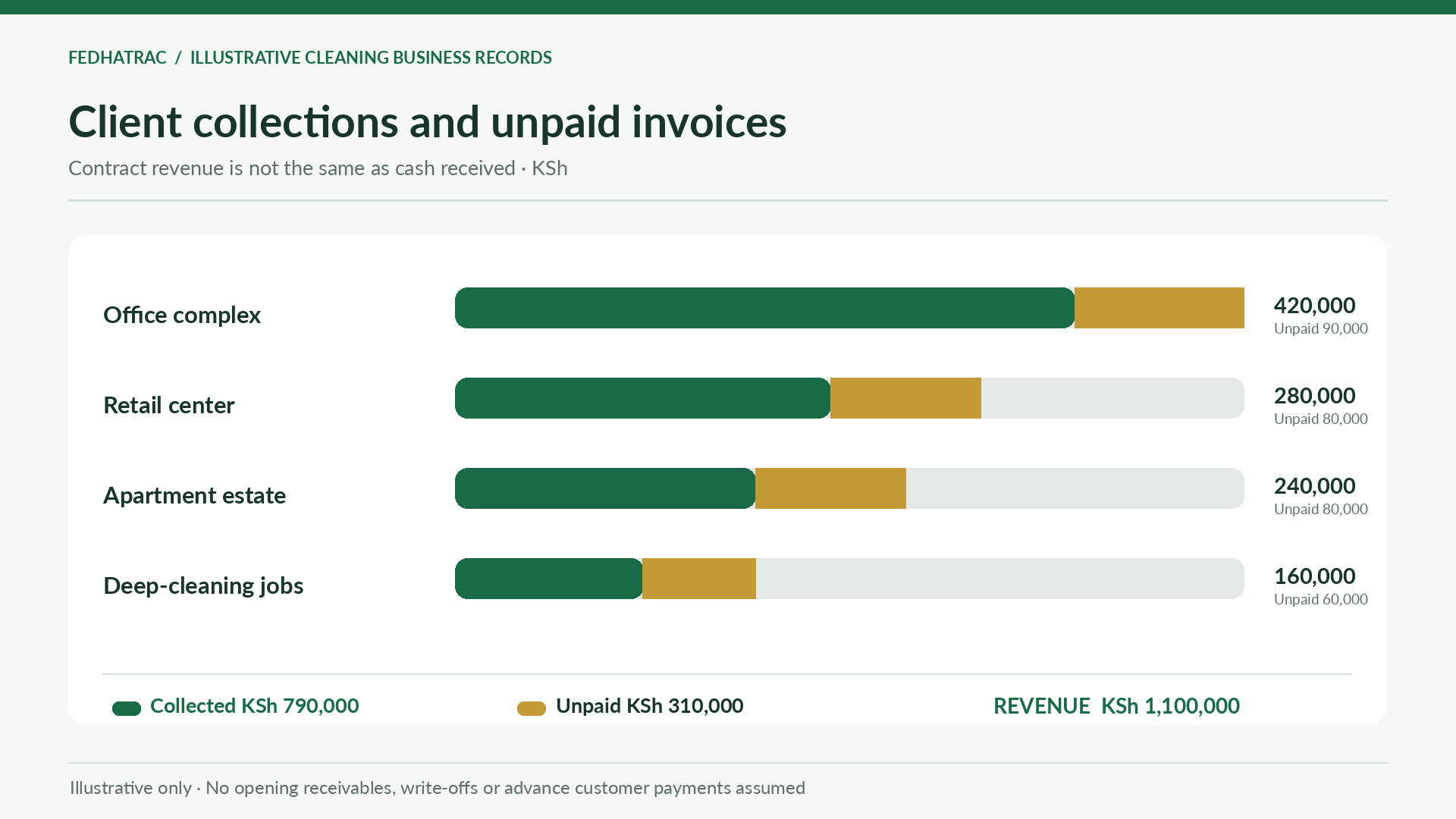
Illustrative cleaning company invoices reconciled: KSh 1,100,000 revenue, KSh 790,000 paid and KSh 310,000 unpaid
This is where cleaning company accounting in Kenya moves beyond filing receipts. Our reports can identify an ageing corporate account, repeated short payments, or a seasonal collection pattern that deserves management attention. We do not promise automatic debt recovery or guarantee that every client will pay on time.
3. Price Each Cleaning Site After Wages, Supplies, and Transport
A contract may look impressive because its monthly fee is large, yet need costly labor, daily transport, equipment, and chemicals. To understand its economics, we separate costs directly related to a site from general office overhead. Cleaning company accounting in Kenya becomes more useful when the owner can compare like-for-like contracts instead of relying solely on the bank balance or total turnover.
In a realistic contract review, direct costs can include wages of cleaners assigned to that location, relief shifts, site supervision, detergent consumption, protective items, travel, and an agreed equipment-use allocation. The client or supervisor supplies shift records, materials-issued logs, and other operational evidence. We help classify and analyze those records. We do not claim FedhaTrac automatically records attendance or measures chemical quantities; cleaning company accounting in Kenya relies on usable supporting records.
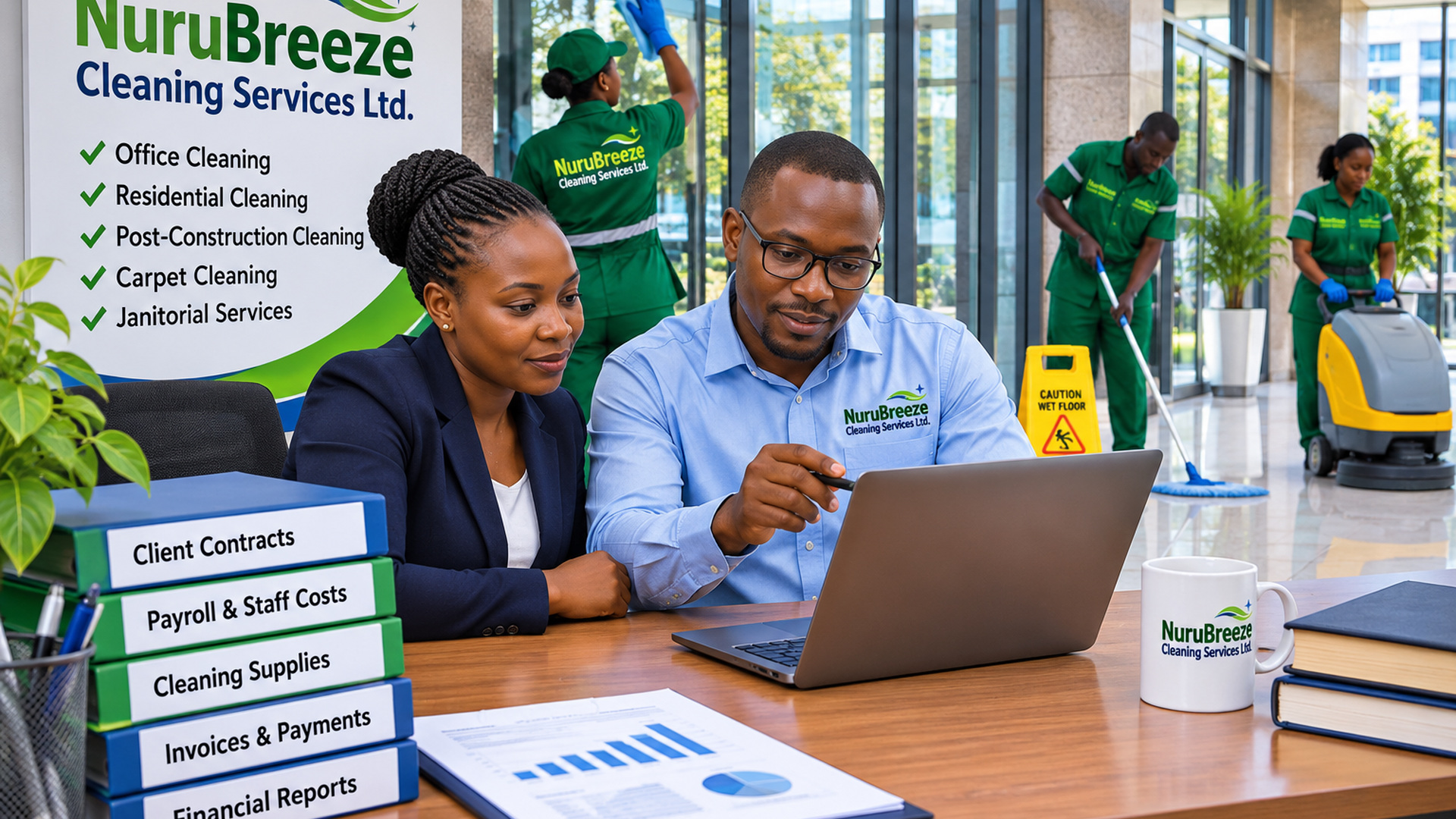
Kenyan cleaning staff and site managers reviewing cleaning contract cost records
For NuruBreeze’s fictional office-complex contract, assume a KSh 420,000 monthly fee. The direct costs are KSh 170,000 in assigned wages, KSh 35,000 in consumables, KSh 25,000 in transport, KSh 30,000 for relief and supervision, and KSh 20,000 as a management equipment-use charge. Total direct costs are KSh 280,000, leaving KSh 140,000 contribution, a 33.3% contribution margin. Allocating KSh 85,000 of shared overhead would leave an illustrative KSh 55,000 contract result before other adjustments.
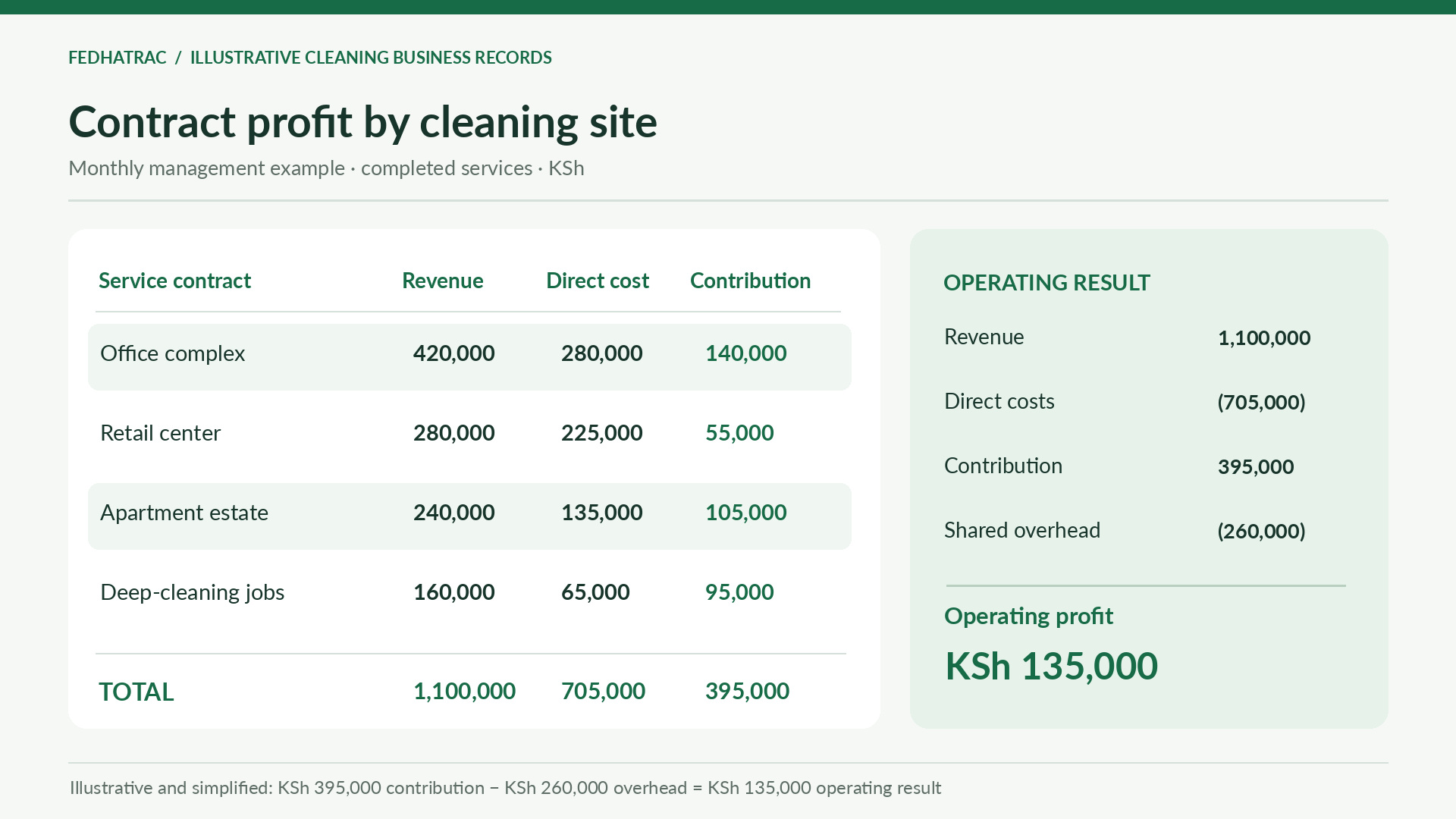
Cleaning contract profitability example with KSh 135,000 operating profit from KSh 1,100,000 revenue
These are invented figures for explanation, not FedhaTrac customer outcomes. Equipment-use allocations and overhead distribution must be chosen consistently and reconciled to the formal accounting treatment. We can help management review assumptions and explain why a contract with a large invoice may nevertheless deliver a modest return. Accurate cleaning company accounting in Kenya supports pricing discussions before a loss-making contract is renewed.
4. Keep Payroll Records and Staff Costs Organized
Labor is central to commercial cleaning. Owners need records for regular employees, relief cleaners, supervisors, overtime, allowances, and payments associated with specific sites. A weekly roster or attendance sheet may show who worked; the finance record must then show the authorized cost and payment evidence. Our service organizes bookkeeping and reporting around the records supplied by the business, rather than selling an unverified automated staff-tracking feature.
For employers, Kenyan PAYE obligations depend on applicable law and the employee’s circumstances. The Kenya Revenue Authority’s PAYE guidance explains employer deduction and filing responsibilities. Other statutory employment contributions may apply separately and should be confirmed using current official guidance. FedhaTrac can help prepare relevant accounting records and provide agreed tax-support services, but we do not claim an employer is compliant merely because wages appear in a dashboard.
5. Control Consumables, Equipment, and Supplier Bills
Cleaning companies buy detergents, disinfectants, gloves, cloths, bin liners, brushes, mop heads, and protective gear. They may also own vacuums, floor polishers, water extraction machines, and specialist equipment. Purchasing a machine is not the same event as using chemicals on a job. Cleaning company accounting in Kenya must distinguish supplier invoices, amounts unpaid, materials used, stock remaining, and equipment-related accounting charges.
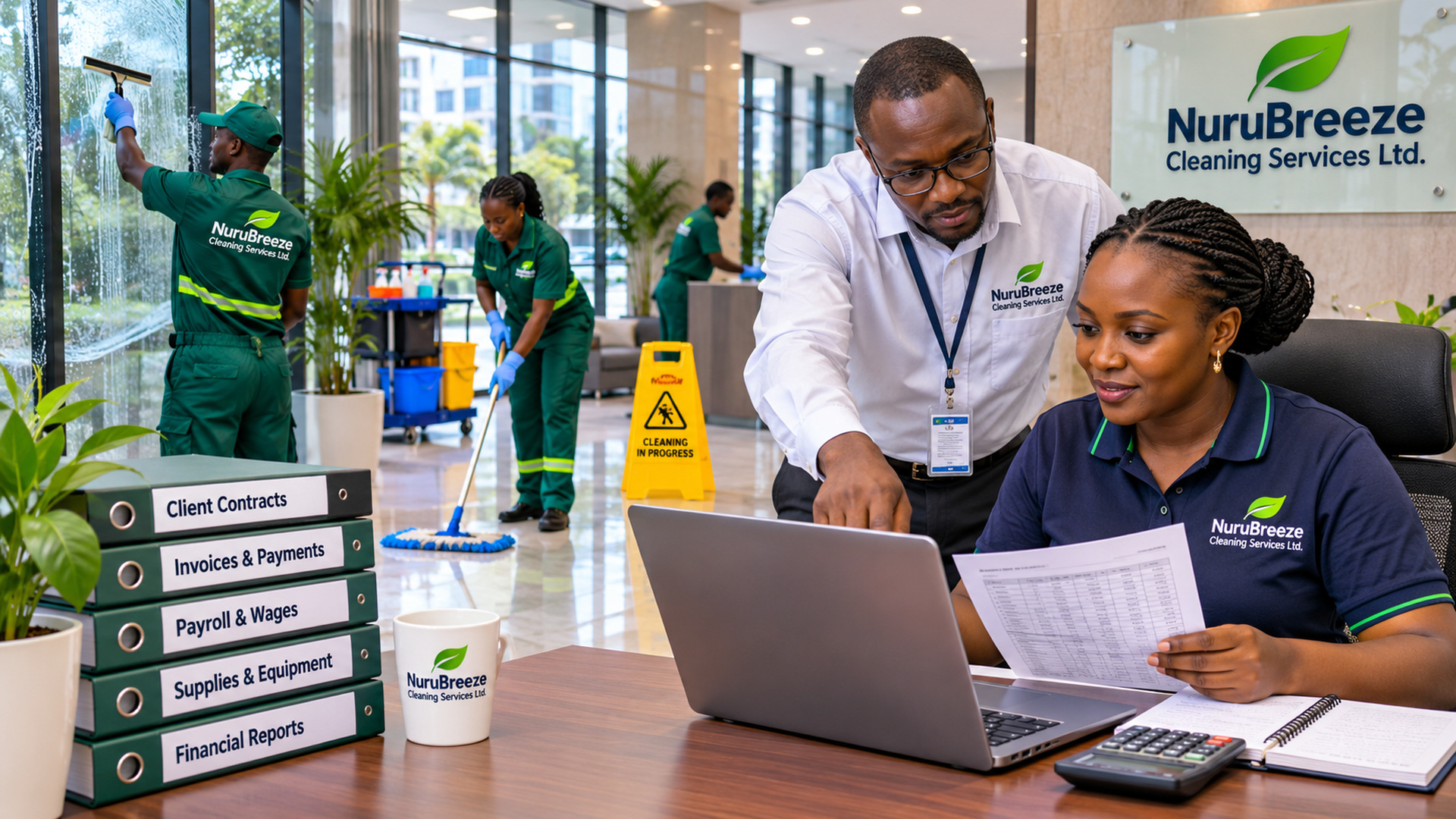
Cleaning operations alongside supplier invoices and cleaning equipment records
Our team can organize supplier records and payment evidence and work with stock or purchase reports that the company maintains. Where FedhaTrac’s inventory and purchase-order tools fit the client’s workflow, we can discuss them; otherwise we can work from usable exports and documents. We do not guarantee automated stocktaking, purchasing approvals, or equipment telemetry based solely on the existence of an inventory interface.
For example, buying KSh 150,000 in cleaning chemicals does not automatically mean KSh 150,000 was consumed on jobs that month. The company may have unused stock for future contracts. Likewise, a new floor scrubber should not simply be mixed into routine detergent expenditure without reviewing the appropriate accounting treatment. Cleaning company accounting in Kenya helps the owner see both cash outlays and the cost of delivering services.
A simple stock-and-supplier routine strengthens cleaning company accounting in Kenya: retain purchase invoices, record materials issued to sites, reconcile supplier statements, and review unusual usage or price changes. We can then discuss which information is missing and what operational controls management should strengthen. The goal is not a perfect-looking spreadsheet; it is a traceable record that supports practical spending decisions.
6. Why Cleaning Company Accounting in Kenya Separates Profit From Cash
A profitable cleaning business can still face a payroll crisis when customers pay late. To make cleaning company accounting in Kenya decision-ready, FedhaTrac can prepare management reports that distinguish earned revenue, direct service costs, overhead, receivables, and the movement of money through bank accounts and other recorded payment channels. These measures answer different questions and should not be combined casually.
Here is NuruBreeze’s illustrative monthly operating summary, using the same KSh 1,100,000 service revenue noted earlier. Direct wages total KSh 430,000, consumables KSh 95,000, transport KSh 65,000, relief and site supervision KSh 80,000, and equipment-use charges KSh 35,000. Direct costs total KSh 705,000, so contribution is KSh 395,000. Shared overhead totals KSh 260,000, leaving an illustrative operating result of KSh 135,000, or roughly 12.3% of revenue.
| Illustrative management result | KSh |
| Revenue from completed services | 1,100,000 |
| Direct cleaning and site costs | (705,000) |
| Contribution after direct costs | 395,000 |
| Shared operating overhead | (260,000) |
| Operating result before further adjustments | 135,000 |
This result is not the same as bank cash. Assume NuruBreeze begins with KSh 180,000, collects KSh 790,000 from customers, and pays KSh 430,000 in direct wages, KSh 95,000 for consumed supplies, KSh 65,000 in transport, KSh 80,000 for relief and supervision, and KSh 200,000 of cash overhead. Its closing bank balance is KSh 100,000. The KSh 35,000 equipment-use charge and KSh 60,000 of overhead depreciation in this example are noncash management/accounting charges, explaining part of the difference.
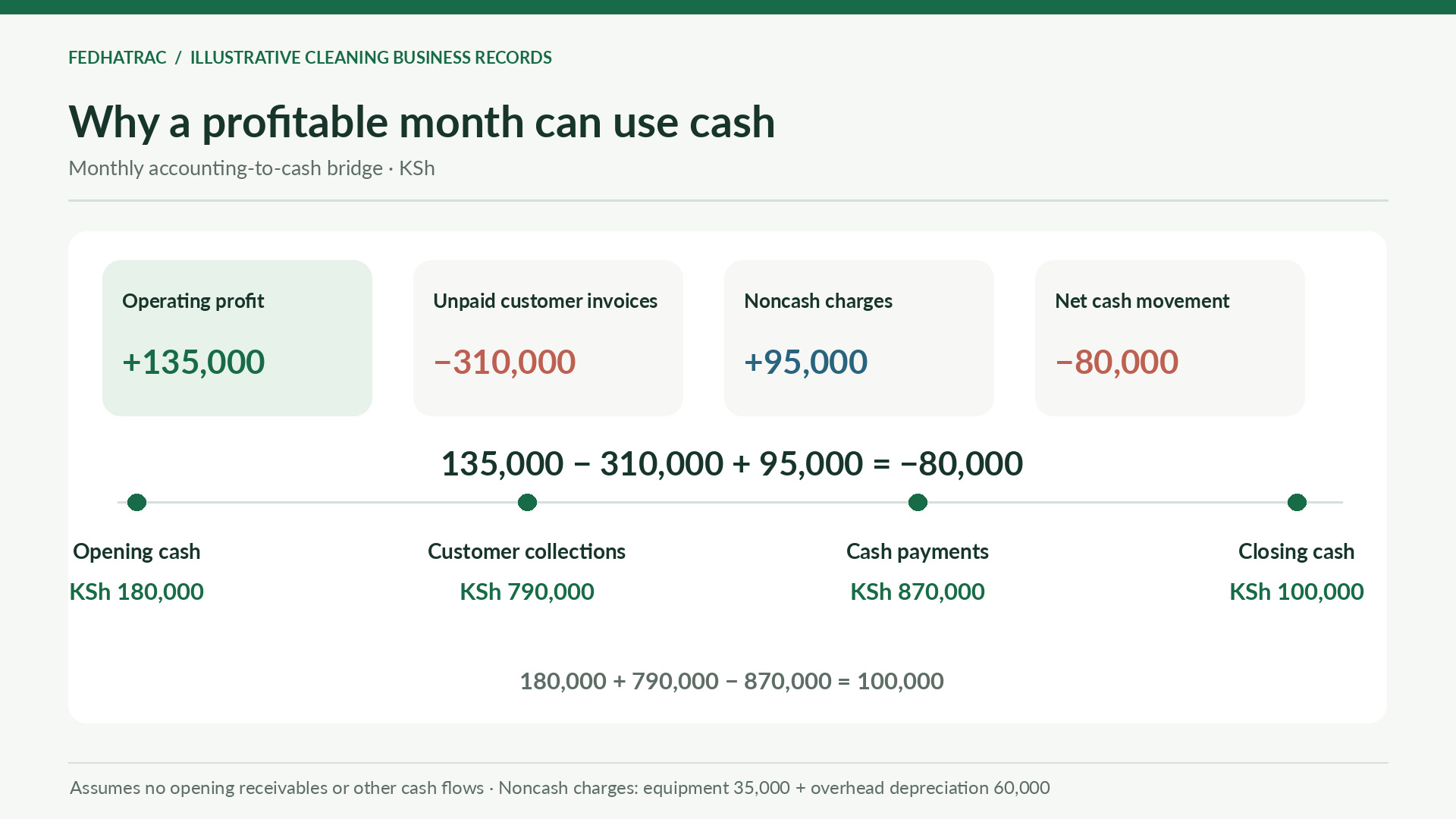
Financial reconciliation from KSh 135,000 operating profit to KSh 100,000 closing cash for a fictional cleaning business
The reconciliation is explicit: KSh 135,000 operating result minus KSh 310,000 unpaid customer invoices plus KSh 95,000 in noncash charges equals a KSh 80,000 cash decrease. Starting KSh 180,000 less that decrease leaves KSh 100,000. These hypothetical figures assume no other working-capital changes, taxes, financing movements, or investment payments. We use examples like this to explain why cleaning company accounting in Kenya must report profit and liquidity separately.
7. Turn Cleaning Company Accounting in Kenya Into Better Reviews
The best monthly report should lead to a sensible management conversation. At FedhaTrac, our reporting and advisory support includes management accounts, budgets, cash-flow analysis, and performance discussions. We also provide agreed quarterly and annual reviews. Cleaning company accounting in Kenya can therefore support decisions on contract renewals, staffing budgets, purchasing, and whether the business has the financial capacity to take on another site.
Suppose NuruBreeze is invited to quote for an additional office building. Before it offers an attractive price, management should estimate required cleaning hours, transport distances, consumables, supervision, equipment, and expected payment timing. Our financial analysis can compare those estimates with existing contract results. The business makes commercial decisions; our cleaning company accounting in Kenya reports help it work from better financial evidence.
Tax and Recordkeeping Obligations Cleaning Businesses Should Review
For cleaning companies, reliable tax documentation starts with accurate invoices, payroll information, supplier records, and reconciled ledgers. KRA explains that businesses are generally required to use eTIMS for electronic tax invoicing, including many businesses that are not VAT-registered. Tax treatment, reliefs, and exceptions depend on the facts. FedhaTrac supports applicable tax filing and compliance work without promising one-click statutory submissions.
KRA has also announced income-and-expense validation from January 2026, subject to relevant statutory exceptions. Cleaning company accounting in Kenya should therefore preserve invoice evidence, correct supplier details where required, and records that explain transactions. We help organize these materials and flag discrepancies for review, while the business remains responsible for providing true information and meeting its obligations.
A contractor should not assume all revenue is VAT-exempt or that every employment-related contribution has a single universal rate. We check the rules relevant to the actual business and period rather than repeating outdated online tax figures. For payroll and equipment-related questions, specialist review may be appropriate before a filing or management decision is finalized.
How FedhaTrac Starts Working With a Cleaning Company
We begin with the cleaning company’s current contracts, payment methods, expense records, major suppliers, and desired reports. The owner might have Excel sheets, a POS, a simple invoicing tool, paper job cards, or several disconnected systems. Our cleaning company accounting in Kenya engagement can be tailored to the usable records and agreed workload, including catch-up bookkeeping where transactions need to be reconstructed from reliable evidence.
Next, we agree on what the client will supply and what our team will handle: recording transactions, reconciling accounts, preparing financial statements, organizing invoices and supplier balances, supporting applicable tax records, or preparing management reports. We clarify how operational data such as cleaner attendance or consumable quantities will reach finance. Clear responsibilities matter more than claiming every business process has been automated.
For cleaning company accounting in Kenya, we establish a repeatable close and review routine. Unexplained differences are investigated, missing invoices are requested, customer balances are checked, and the resulting reports are discussed in understandable language. Cleaning company accounting in Kenya should give the owner a more dependable view of contract margins and payroll commitments without requiring the business to become an accounting expert.
Frequently Asked Questions
Can FedhaTrac help a cleaning company with monthly client contracts?
Yes. We help maintain customer invoices, record and reconcile receipts, track outstanding balances, and analyze contract income and costs from the supporting records. We can also provide management reporting to show which accounts deserve attention. We cannot promise that every customer will pay by the due date, but we can help you see what is due and what has been received.
Do you provide payroll and tax support for cleaning staff?
We support the underlying wage records, bookkeeping, and agreed Kenyan tax-compliance work. Employment classifications, statutory contributions, and PAYE calculations must follow current law and the company’s actual circumstances. We do not advertise automated attendance or payroll integrations unless those features have been verified for the specific client setup.
Can you work with our existing POS, spreadsheets, or accounting software?
Yes, we can discuss an appropriate process using usable exports, bank statements, invoices, and existing records. We also provide FedhaTrac tools and QuickBooks-related assistance where suitable. Any software access, integration, and exact workflow should be confirmed during onboarding rather than assumed from a marketing description.
Is cleaning company accounting in Kenya only useful to large contractors?
No. A small residential-cleaning team may need basic sales, wages, and expense tracking, while a multi-site contractor needs stronger contract-level reporting and receivables analysis. We can discuss a scope proportionate to your size, transaction volume, and reporting needs without inventing a universal price or promised savings.
How can we begin working with FedhaTrac?
Contact FedhaTrac and tell us what services you sell, how many cleaning sites you serve, and which financial records you already keep. We will discuss the appropriate bookkeeping, accounting, reporting, and tax-support requirements and agree on next steps. With better records, cleaning company accounting in Kenya can help management make clearer decisions about contracts, cash, and growth.
Put Cleaner Financial Records Behind Every Cleaning Contract
NuruBreeze Cleaning Services Ltd. is fictional, but the management questions are real: What did each contract earn? Which clients still owe money? Can the business pay staff before the next receipts arrive? Is the price of a new site high enough to cover the work? At FedhaTrac, we help businesses answer those questions with organized bookkeeping, reconciliations, financial reporting, and practical advice. Cleaning company accounting in Kenya should support the people delivering the cleaning service—not distract them from it. Talk to our team about a financial-management approach that fits your business.


