

For a business serving customers across borders, clean records are not optional. Different bank accounts, currencies, accountants, time zones, and reporting deadlines can turn routine transactions into a confusing month-end exercise. International bookkeeping services in Kenya offer an organized way to handle that workload without surrendering control of your books. At FedhaTrac, we support overseas businesses and accounting firms from Nairobi, working within agreed procedures and the systems they already use.
Our approach to international bookkeeping services in Kenya starts with understanding your finance workflow: what should be recorded, what must be reconciled, who approves adjustments, and which reports your managers or accountants expect. We can help with transaction classification, bank and credit-card reconciliations, general-ledger maintenance, bookkeeping cleanup, and monthly reporting. Your finance lead, accountant, or CPA can then review clearer records.
What Are International Bookkeeping Services in Kenya?
International bookkeeping services in Kenya are remote bookkeeping services provided from Kenya to organizations based elsewhere, or to businesses with financial activity in more than one market. The work involves maintaining accurate records under a client’s agreed chart of accounts, software setup, currency conventions, and review process. Rules still vary by jurisdiction.
For example, an overseas design firm might receive payments into two bank accounts, pay online software subscriptions through a credit card, and engage contractors in several countries. Its bookkeeping team must record these activities consistently, reconcile statements, and flag missing evidence. FedhaTrac can perform the agreed processing while the client retains ownership of its records and decisions.
Our international bookkeeping service supports businesses and professional firms locally, regionally, and internationally. The service is especially useful where the owner needs dependable monthly records but does not want to build a larger in-house processing team. Unlike a general outsourced accounting article, this guide focuses on the mechanics of cross-border handoffs, currencies, controls, and CPA oversight.
1. Keep Your Existing Accounting Software and Review Process
A software migration is not a prerequisite for international bookkeeping services in Kenya. At FedhaTrac, we can work with established client processes using QuickBooks Online, Xero, Sage, Odoo, Tally, Maconomy, Excel-based records, and other systems assessed during onboarding. Our work depends on the access you authorize and the specific functionality available in your chosen setup, not on an unverified software integration.

FedhaTrac bookkeeper reviewing financial records for an international client
We begin by checking the chart of accounts, transaction types, accounting periods, and the way your team receives supporting documents. If an account uses a particular coding rule or requires approval before adjustments, we document that procedure. This reduces avoidable reclassification.
For accounting firms, international bookkeeping services in Kenya should strengthen an existing workflow rather than compete with it. The firm can retain its client contact, final technical review, advisory decisions, and statutory work while FedhaTrac completes agreed transaction and reconciliation tasks behind the scenes. Explore our bookkeeping support for accounting and CPA firms to understand that division of responsibilities.
2. Reconcile Bank and Credit-Card Activity Across Borders
A transaction appearing in a bank feed does not automatically explain what it represents. Subscription charges, customer deposits, transfers between owned accounts, supplier payments, refunds, and fees may require different treatment. Strong international bookkeeping services in Kenya identify and classify those items using supporting records rather than guessing from a merchant description.
Our team can record deposits and withdrawals, match them with invoices or receipts, reconcile bank and card accounts, and identify uncleared items. If a charge lacks documentation, we raise a query. If a transfer appears on two accounts, we check that it is not counted twice as revenue or expenditure. These checks support trustworthy month-end balances.
Illustrative reconciliation — not a FedhaTrac client case: an overseas consulting firm records gross customer receipts of USD 9,500. Its payment provider deducts USD 65 in fees and deposits USD 9,435. The books should be able to explain the USD 9,500 receipt, the USD 65 fee, and the USD 9,435 cash settlement instead of treating the deposit as all the revenue earned. Actual revenue recognition still depends on the underlying services and accounting policy.
| Illustrative settlement item | Amount (USD) |
| Gross customer receipts collected | 9,500 |
| Less: payment processing fees | (65) |
| Net cash deposited | 9,435 |
For international bookkeeping services in Kenya, reconciliation provides evidence for the reviewer.
3. Record Foreign-Currency Transactions Without Losing the Audit Trail
When customers and suppliers use different currencies, it is easy to confuse transaction value, cash settlement, and exchange movements. We work with the client’s existing software and approved accounting instructions to record source currencies, reference dates, exchange rates, and any required review adjustments. We do not assume that one standard rate or tax treatment applies to every jurisdiction.

Business team processing cross-border commerce records and orders
A straightforward foreign-currency cash example helps. Suppose an account begins the month with EUR 5,000, receives EUR 2,400, and pays EUR 1,650. Its closing euro-denominated bank balance should be EUR 5,750, before investigating timing differences or unreconciled entries. Converting that figure into another reporting currency requires the client’s prescribed accounting policy and applicable rates; it is a separate step from the euro cash reconciliation.
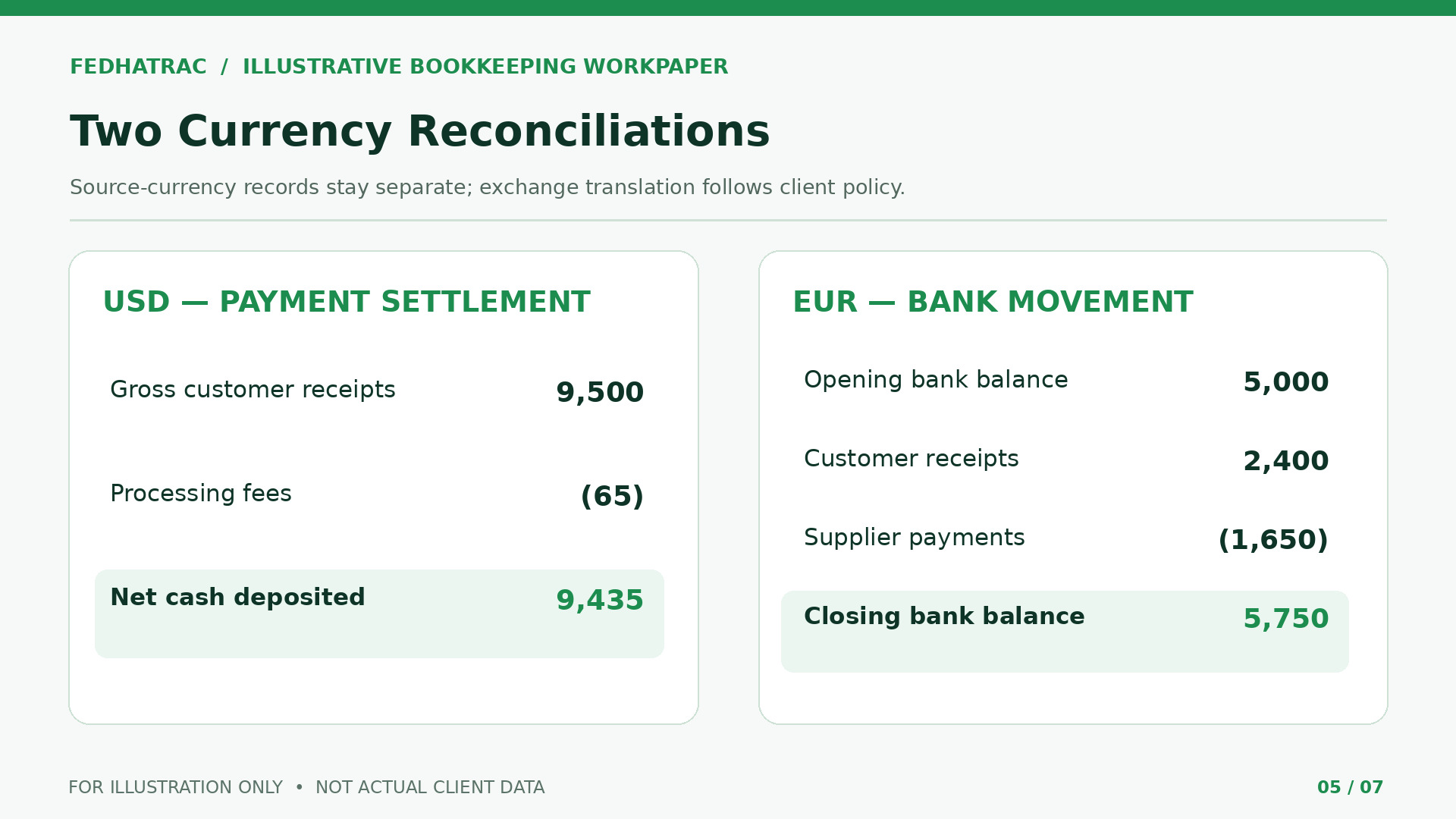
Illustrative USD payment and EUR bank reconciliation examples for international bookkeeping
For international bookkeeping services in Kenya, we encourage an exception record for unfamiliar currencies, missing conversion evidence, unexpected bank fees, and unusual rounding differences. The reviewer then gets a clear question list. Where accounting-standard decisions are necessary, the appointed accountant should approve the treatment.
4. Produce Month-End Files Your Overseas Accountant Can Review
A business owner may want a profit-and-loss statement; an accounting firm may need reconciliations, general-ledger extracts, and a list of open queries before signing off. Effective international bookkeeping services in Kenya adapt the deliverables to those different audiences. At FedhaTrac, we can prepare monthly Profit & Loss reports, Balance Sheets, agreed schedules, and reports appropriate to the engagement.
Our proposed month-end routine groups the work into a predictable handoff: records received, transactions posted, accounts reconciled, exceptions explained, reviewer comments addressed, and reporting prepared. It is a human-assisted process agreed with the client, not a claim that a software button automatically closes the books.
What a useful month-end handoff contains
- A list of bank and credit-card accounts reconciled through the agreed date.
- Outstanding transactions or missing documents requiring attention.
- Supporting schedules for balances selected by the client or reviewing accountant.
- A record of approved journal adjustments and unresolved review comments.
- Draft reports with the relevant period, currency, and reporting basis labeled.
With international bookkeeping services in Kenya, reporting discipline matters just as much as speed. Unexplained balances can delay decisions; clear query lists support timely review.
5. Support CPA and Accounting Firms Without Taking Over Their Clients
Professional firms often face peaks in bookkeeping demand across several client files. They might need help with monthly transaction processing, a cleanup project, or reconciliations that must be ready for a senior accountant to review. Our international bookkeeping services in Kenya can be organized around each firm’s chart of accounts, document standards, close calendar, and approval responsibilities.

Kenyan finance professionals collaborating on overseas accounting firm bookkeeping
We can maintain general ledgers, review unusual postings, build Excel summaries, prepare receivables and payables schedules, and assemble month-end working papers. We then return the agreed output for the firm’s review. The firm remains responsible for its own client relationship, tax work, professional judgments, and the assurance services it provides.
For international bookkeeping services in Kenya to work well across multiple clients, the file names, due dates, access rights, and escalation contacts must be clear. We prefer a documented procedure per client. That makes it easier to find which records have been processed, which queries are outstanding, and which adjustments still require approval.
Our separate accounting and CPA firms solution explains how we can provide additional processing capacity while preserving the firm’s own review and client oversight.
6. Build Sensible Data-Access and Confidentiality Controls
Cross-border records may contain customer details, employee information, bank statements, and commercially sensitive transactions. Before sharing access, the parties should agree what documents are needed, which team members may see them, and where questions or supporting evidence will be exchanged. Access should match the tasks assigned rather than giving every user unrestricted permissions.
FedhaTrac discusses appropriate system access, document-sharing procedures, and communication arrangements as part of the engagement. Confidentiality agreements or NDAs can also be agreed where required. We do not describe an NDA or a login screen as a substitute for understanding applicable privacy law and contractual responsibilities.
Where a transaction involves transferring personal data across borders, organizations may need specific legal safeguards. Kenya’s Office of the Data Protection Commissioner publishes guidance on cross-border transfers; overseas clients must also evaluate the rules applicable to their own data and location. We do not claim that buying international bookkeeping services in Kenya automatically satisfies the GDPR, UK data rules, or any other jurisdiction’s privacy requirements.
International bookkeeping services in Kenya depend on agreed access, responsibilities, and query escalation. These measures should be reviewed with the client’s legal and compliance advisers where necessary.
7. Choose a Flexible Scope Instead of an Unclear All-In Package
Not every overseas business needs the same level of support. A company with 80 monthly transactions and one bank account has a different workload from an accounting firm managing ten client ledgers, complex card feeds, and legacy cleanup work. Our international bookkeeping services in Kenya can be scoped around the actual volume, complexity, deadlines, software, and reporting needs.
FedhaTrac’s service page explains that engagements may use an agreed hourly arrangement or a fixed monthly fee when the recurring scope is predictable. We do not advertise a universal price or promise a particular cost saving before assessing the work. An initial discussion helps identify whether the right fit is continuous monthly bookkeeping, support for specific accounts, cleanup, or a multi-client arrangement.
For international bookkeeping services in Kenya, the key pricing questions are practical: How many statements and accounts need reconciliation? How many transactions need classification? How reliable are the source documents? Who handles corrections and final approval? What happens when the volume changes? These answers are more useful than an attractive package name with missing details.
How Our International Bookkeeping Process Works
We treat international bookkeeping services in Kenya as a repeatable collaboration, with clear ownership at each step.
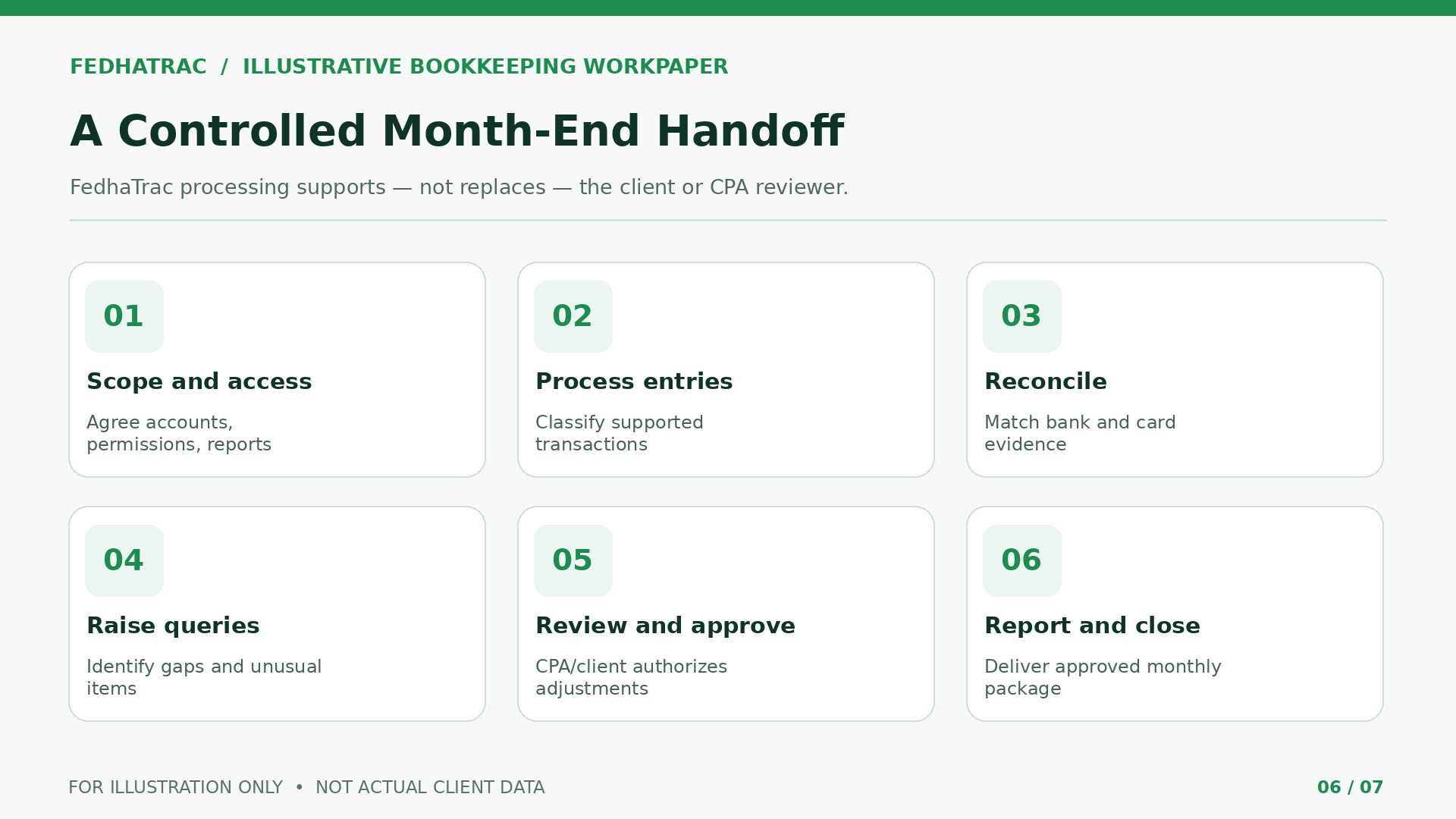
FedhaTrac international month-end bookkeeping workflow from setup to accountant approval
Step 1: Agree the scope and responsibilities
We discuss your bookkeeping backlog, software, expected reports, currency requirements, and review structure. Where an accountant or CPA will approve journals, we identify that reviewer before processing begins.
Step 2: Arrange records and access
We agree how bank statements, invoices, card transactions, and other supporting evidence will be supplied. System permissions and document-sharing practices are matched to the agreed responsibilities.
Step 3: Process transactions and reconcile
Our team classifies entries, maintains the ledger, reconciles agreed accounts, and records outstanding issues. We may prepare Excel schedules or other supporting workpapers based on the client’s agreed process.
Step 4: Raise exceptions and obtain approvals
Unusual items, missing documents, and uncertain classifications go to the designated contact. Material adjustments follow the client’s review and authorization process rather than being made on unsupported assumptions.
Step 5: Provide reports and close the cycle
We prepare the agreed reconciliation files and monthly reporting for review, address feedback within scope, and establish the next period’s deadlines. This makes international bookkeeping services in Kenya practical for owners and finance teams.
A Sample International Month-End Review
Consider a hypothetical overseas software agency that uses one USD bank account and a separate EUR account. The accounting team wants monthly reconciliation files, a profit-and-loss report, and an exception list for its external accountant. No real FedhaTrac customer data is used in this example.
The USD account has receipts of USD 9,500, provider charges of USD 65, and a net settlement of USD 9,435. The EUR account begins at EUR 5,000, adds EUR 2,400 in receipts, and subtracts EUR 1,650 in payments, leaving EUR 5,750. Both accounts are reconciled in their source currencies before any conversion required for reporting. An unexplained card charge of USD 120 is left in an exception list pending evidence, not silently posted to a guessed expense category.
| Month-end workpaper | Illustrative finding | Reviewer action |
| USD payment settlement | USD 9,435 net of USD 65 fees | Check gross receipt and fee documents |
| EUR bank reconciliation | EUR 5,750 closing balance | Confirm bank statement agrees |
| Unexplained card charge | USD 120 awaiting receipt | Request supporting evidence |
| Management reporting | Draft P&L and Balance Sheet | Approve adjustments and reporting basis |
In this example, international bookkeeping services in Kenya create an orderly trail from underlying activity to the figures the accountant reviews. The example does not show profit, because expenses, earned revenue, and exchange adjustments would need additional evidence before a reliable profit figure could be calculated.
What International Bookkeeping Does—and Does Not—Replace
There is an important distinction between preparing the ledger and taking legal responsibility for a company’s accounts. Our international bookkeeping services in Kenya can support transaction recording, classification, reconciliations, agreed adjustments, schedules, and management reports. They do not automatically make FedhaTrac the client’s statutory auditor, local tax agent, legal adviser, or licensed professional in another country.
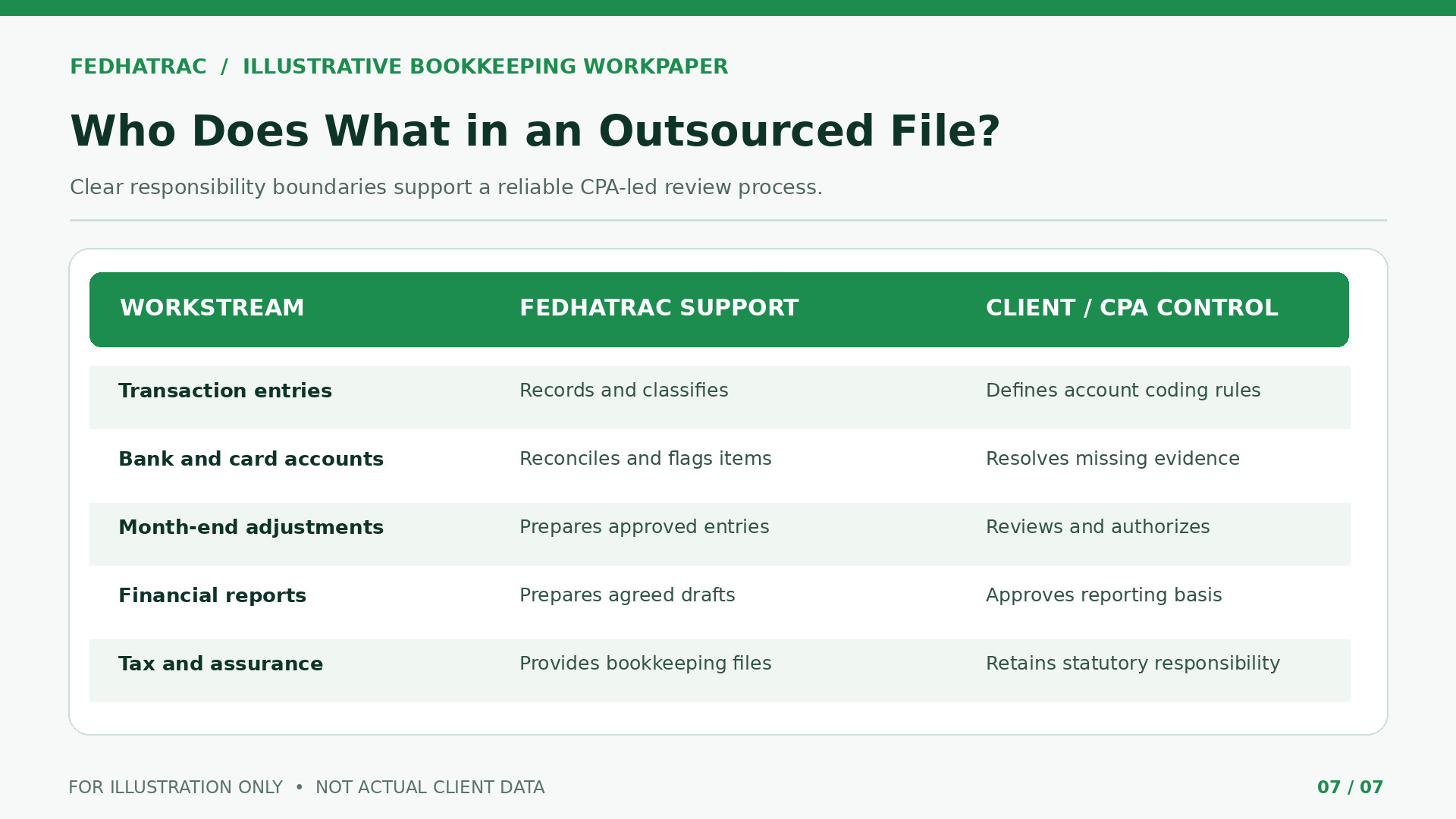
Bookkeeping responsibilities divided between FedhaTrac and the client accountant or CPA
Reporting frameworks also differ by jurisdiction and entity type. The IFRS Foundation’s jurisdiction profiles explain that use of IFRS Accounting Standards is not identical everywhere. We therefore work from the client’s stated reporting basis and escalate technical accounting judgments to the appropriately responsible professional.
Some clients also need specialized reporting and advisory beyond ordinary transaction work. We can discuss those services separately. This clear separation is why international bookkeeping services in Kenya can fit alongside an existing accounting firm rather than displacing one.
Frequently Asked Questions
Can FedhaTrac work with a business registered outside Kenya?
Yes. Our international bookkeeping services in Kenya are intended for businesses and accounting firms operating internationally, subject to an agreed scope, suitable system access, and applicable legal requirements. We start by understanding where the business operates and what its internal or external accountant needs.
Must we move from Xero or QuickBooks to a FedhaTrac system?
No. We can work with QuickBooks Online, Xero, Sage, Odoo, Tally, Maconomy, Excel-based workflows, and other software assessed during onboarding. Our international bookkeeping services in Kenya are designed to fit your existing environment where practical, without claiming an automatic integration.
Who approves year-end adjustments and tax filings?
The designated accountant, CPA, or other authorized professional retains the review and statutory responsibilities appropriate to the engagement. We can prepare agreed bookkeeping schedules and process approved adjustments. Our international bookkeeping services in Kenya do not replace jurisdiction-specific professional advice or legal filings unless separately agreed and appropriately qualified.
Can you help if our accounts are months behind?
Yes. Cleanup and catch-up bookkeeping can be included after assessing the condition of the records and available documents. For international bookkeeping services in Kenya, we would agree which periods, accounts, and reports are included before estimating effort or delivery arrangements.
How do you protect our confidential financial information?
We agree access permissions, document sharing, communication channels, and escalation responsibilities for the engagement. Appropriate confidentiality terms can be discussed. Clients must also assess the privacy and data-transfer requirements applicable to their organizations. We present international bookkeeping services in Kenya as a controlled business process, not as a blanket legal-compliance guarantee.
Partner With FedhaTrac for International Bookkeeping
If your staff spend each month chasing statements, explaining card charges, or rebuilding reports for a reviewer, the underlying workflow may need more structure. FedhaTrac helps businesses and professional firms bring discipline to those tasks through practical bookkeeping support, reconciliations, exception handling, and reporting that follows agreed procedures.
Our international bookkeeping services in Kenya give overseas organizations a workable way to maintain records without imposing a new software stack or removing their own accountant from the process. Whether you need monthly support, cleanup, or additional capacity for a CPA team, we can discuss a scope matched to your records and responsibilities.
Contact FedhaTrac or explore our international bookkeeping services to tell us which accounting system you use, the number of accounts you reconcile, and the reports you need. We will discuss a practical engagement structure for your business or firm.


