

Security companies in Kenya often win contracts before they have enough working capital to run them comfortably. Guards must be paid, replacements arranged, uniforms maintained, and supervisors transported to client sites even when customers take weeks to settle invoices. Security company accounting in Kenya gives owners a clearer way to manage those commitments without mistaking a growing contract list for available cash.
At FedhaTrac, we help security businesses organize their books, reconcile payments, monitor customer balances, and understand the actual cost of delivering guarding services. Our accounting services turn daily transactions into financial reports that managers can use. We also support invoicing, record organization, tax preparation, and practical discussions about business performance.
This guide explains seven financial practices that can make security company accounting in Kenya more useful to owners, operations managers, and finance teams. Whether you serve residential estates, offices, warehouses, or commercial facilities, the goal is the same: know what each contract earns, what it costs, who owes you, and when your next major payment is due.
Why Security Company Accounting in Kenya Requires Special Attention
A guarding contract is not just a monthly invoice. Its costs can include wages, employer-related obligations, relief coverage, transport, equipment, supervision, insurance, and administrative support. Some costs are shared across clients; others belong to a particular site. If everything is recorded under one general expense account, an unprofitable contract can remain hidden inside an apparently successful business.
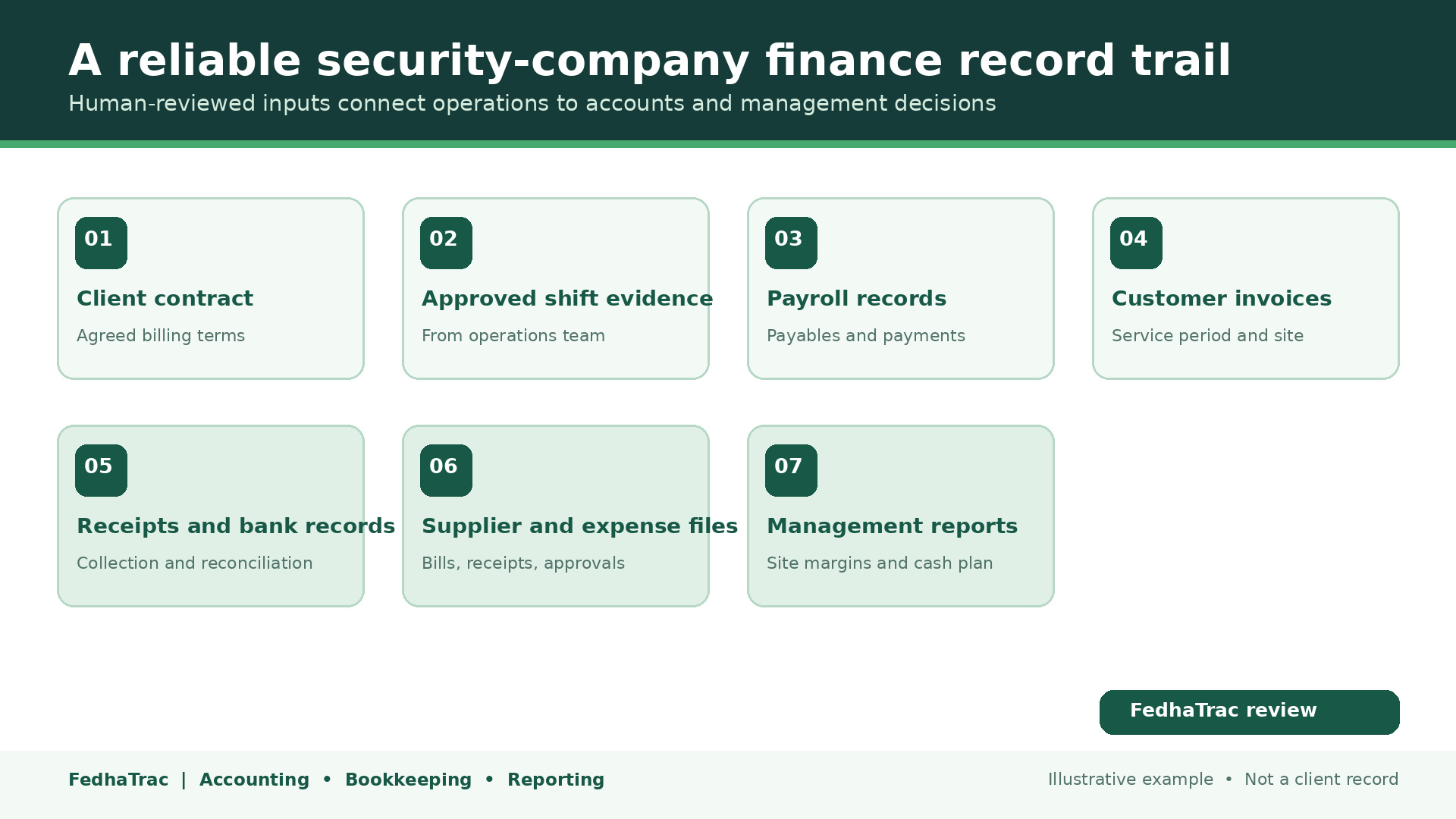
With security company accounting in Kenya, we connect the company’s operational evidence—contracts, approved shift summaries, payroll registers, supplier bills, and customer receipts—to its financial records. FedhaTrac does not claim to replace guard deployment or attendance software. We can work with the records and reports your operations team already maintains, then help organize their financial consequences.
1. Build Reliable Guard Payroll Records Before Payday
Payroll is usually a major recurring commitment for a guarding company. Each payroll period can involve contracted employees, relief personnel, different sites, approved overtime, allowances, leave adjustments, and deductions. Incomplete information becomes an accounting problem when the finance team cannot establish what was earned, what was paid, and what remains payable.
Our approach to security company accounting in Kenya starts with a practical payroll-support file. We help reconcile the company’s authorized employee records and pay schedules against bank or other payment evidence, with separate records for wages, employer obligations, advances, and outstanding balances. We distinguish gross payroll cost from employees’ net payments because the two are not interchangeable.

Security company accounts team reviewing guard payroll evidence and approved schedules
For example, the approved roster may identify relief hours for an estate after a regular guard takes leave. The finance file should identify which client assignment bears that cost, how the amount was approved, and whether it was paid. That supports cleaner contract costing, even when workforce scheduling happens outside FedhaTrac.
Kenyan employers should also check their payroll treatment against current legal requirements. The KRA PAYE guidance describes employers’ withholding and remittance responsibilities. We help prepare and reconcile records for applicable filings; we do not substitute a generic example for a current wage order, an employment contract, or individualized payroll advice.
2. Invoice Every Client Clearly and Follow Up on Unpaid Balances
A business may protect ten sites and still experience a cash crisis if three large customers delay payment. Reliable security company accounting in Kenya therefore needs a contract-linked invoicing process, not simply a folder of PDFs. Each customer record should show the agreed billing period, service description, approved adjustments, invoice date, due date, payments, and outstanding balance.
Through our business operations support, we help prepare and administer invoices, organize supporting documents, track receipts, and follow up on agreed payment records. A finance assistant can use an aging schedule to separate current invoices from those that are 30, 60, or more days overdue, then prioritize appropriate client conversations.
For security firms, a useful invoice reference may identify the guarded location and the period covered. If a client questions an extra night shift or a relief-guard charge, the related approval and deployment evidence should be retrievable. We can help match that evidence to the invoice without claiming that FedhaTrac automatically produces bills from live attendance feeds.

Security company supervisor reviewing client contracts and invoice records
One practical benefit of security company accounting in Kenya is that recognized service revenue, cash received, and money still owed remain visible as different figures. Sending an invoice is not the same event as collecting the money. When managers understand that difference, they can plan wages and supplier commitments more realistically.
3. Calculate the True Margin of Each Security Contract
Winning a new site at a low fee can increase turnover while weakening the business. In security company accounting in Kenya, we recommend reviewing profitability by customer, site, or service contract. Direct expenses belong to the service that created them; shared office overhead should be considered separately and allocated only where a sound method is useful for management decisions.
We can organize direct costs such as guard payroll, relief coverage, site transport, and equipment consumption against the related client revenue. Our specialised reporting and advisory supports profitability analysis by service, project, or client, helping managers see where a contract may require tighter cost control or a commercial review.
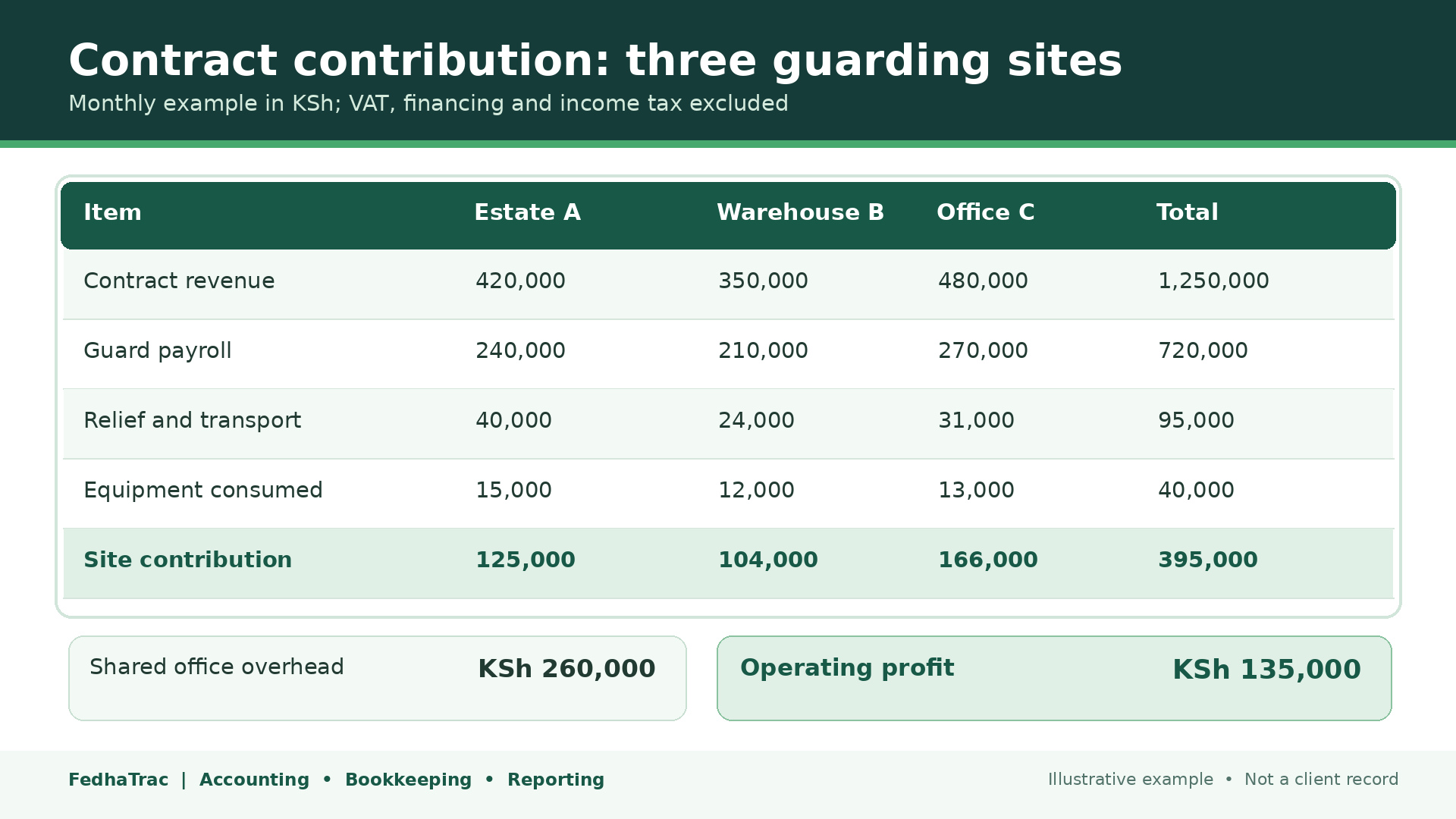
Consider the following illustrative monthly example, which describes a hypothetical security provider—not a FedhaTrac customer or actual payroll benchmark. Figures exclude VAT, financing, and income tax. The equipment line is an accounting expense for items consumed or allocated during the month, not necessarily cash paid that month.
| Item | Estate A (KSh) | Warehouse B (KSh) | Office C (KSh) | Total (KSh) |
| Contract revenue | 420,000 | 350,000 | 480,000 | 1,250,000 |
| Direct guard payroll | 240,000 | 210,000 | 270,000 | 720,000 |
| Relief and site transport | 40,000 | 24,000 | 31,000 | 95,000 |
| Equipment consumed | 15,000 | 12,000 | 13,000 | 40,000 |
| Site contribution | 125,000 | 104,000 | 166,000 | 395,000 |
Shared office overhead in the same illustration is KSh 260,000, leaving KSh 135,000 in operating profit (KSh 395,000 minus KSh 260,000). The site contributions are not final contract profits because they exclude shared overhead. This distinction is essential to accurate security company accounting in Kenya and prevents overly optimistic pricing decisions.
Security company accounting in Kenya illustrative contract contribution table for three guarded sites
4. Forecast Cash Before Payroll and Statutory Payment Dates
Profit does not automatically pay salaries. Security company accounting in Kenya needs a rolling cash forecast showing money already in the bank, payments expected from clients, and obligations falling due. This matters particularly when invoices are settled after the pay period in which guarding services were provided.
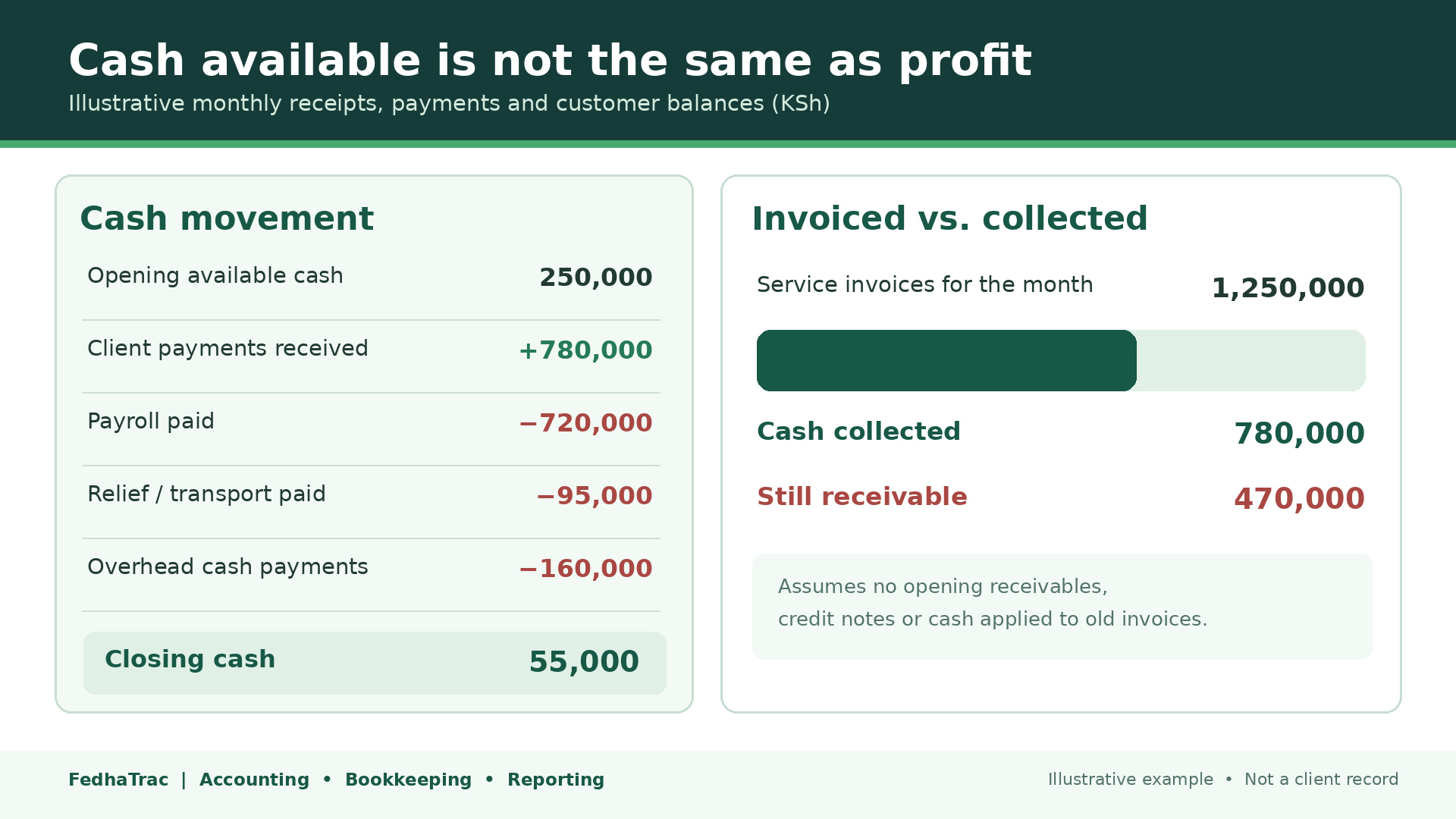
Using the same hypothetical provider, suppose opening available cash is KSh 250,000, customers pay KSh 780,000 during the month, and cash payments comprise KSh 720,000 for payroll, KSh 95,000 for site transport and relief, and KSh 160,000 for other overhead. The closing cash figure is KSh 55,000: KSh 250,000 + KSh 780,000 − KSh 720,000 − KSh 95,000 − KSh 160,000. This is a simplified cash illustration, not a cash-flow statement prepared under accounting standards.
The KSh 1,250,000 invoiced for the period includes KSh 470,000 not yet collected if all customer receipts relate to those new invoices and there are no opening receivables or adjustments. The month’s profit and closing cash differ because receipts, outstanding invoices, unpaid expenses, and noncash expense allocations occur at different times.
Security business cash movement and KSh 470000 uncollected client invoices explained
With security company accounting in Kenya, we help monitor these timing gaps through reconciled records, cash-flow reporting, and management reviews. We can discuss which client balances need attention, which approved payments are imminent, and how a proposed new contract would affect working-capital requirements before management commits to additional deployment costs.
5. Control Uniforms, Equipment, Vehicles, and Site Expenses
Uniform replacements, radios, torches, batteries, office supplies, transport fuel, and vehicle maintenance can be individually modest but collectively significant. Effective security company accounting in Kenya records purchases with the correct business purpose and supporting documentation, rather than burying all spending under miscellaneous expenses.
FedhaTrac helps maintain supplier records, purchase documentation, receipt files, and expense classifications. A company can connect its existing equipment issue register to accounting records so managers understand what was purchased, which site uses it, and whether an item is still in stock, has been consumed, or should be considered a longer-lived asset.

Kenyan security business reviewing supplier costs and finance documentation
An item purchased for use over several periods may require different accounting treatment from consumable stationery. We review that distinction in the context of applicable accounting policies; financial depreciation and tax deductions are not automatically identical. The objective is more dependable reporting, not an unsupported promise of real-time radio, uniform, vehicle, or guard-location tracking.
As part of security company accounting in Kenya, we also encourage clear approval and receipt evidence for supplier charges. When company cards, M-Pesa, or bank transfers are used, our bookkeeping and reconciliation support can help match the payment to an invoice or other acceptable document and reduce duplicate or unexplained postings.
6. Keep PSRA, KRA, and Employment-Related Records Organized
A registered guarding provider must manage industry requirements as well as ordinary business taxes and employment records. The Private Security Regulatory Authority identifies guarding services as regulated and confirms that private security providers operating in Kenya must meet registration and licensing requirements. PSRA compliance is a separate legal responsibility; FedhaTrac is not the licensing authority.
Our role in security company accounting in Kenya is to organize financial evidence that may support responsible compliance: reconciled ledgers, payroll and supplier records, customer invoices, financial statements, and documentation requested during reviews or audits. We help management prepare records for discussions with advisers, regulators, and independent auditors; we do not issue regulatory licenses or independent audit opinions.
KRA’s eTIMS guidance describes electronic invoicing obligations, and its November 2025 public notice explains validation of income and expenses beginning in 2026, subject to legal exceptions. Our tax filing and compliance support helps clients prepare applicable returns and related evidence; it does not mean ordinary invoicing automatically becomes an eTIMS-integrated or KRA-approved solution.
For security company accounting in Kenya, the practical lesson is to keep dates, documents, payroll schedules, tax classifications, and payment reconciliations current. Exact wage rates, contribution calculations, and filing rules should be checked against the requirements applying to that employer and period, rather than copied from an outdated industry estimate.
Security finance month-end record trail from contracts and payroll through financial reporting
7. Review Financial Performance With Management Every Quarter
An accounting report becomes more valuable when someone explains what it says. With security company accounting in Kenya, we help owners ask practical questions: Which client accounts pay late? Which sites make a positive contribution? Have transport expenses increased? Is the company collecting sufficient cash to support a new guarding contract?
Our management accounts can compare revenue, costs, outstanding customer balances, supplier obligations, and operating performance. FedhaTrac can also support quarterly and annual financial review meetings, management presentations, and board-style discussions, as agreed with the client. Those sessions connect financial numbers to decisions about pricing, staffing budgets, purchasing, and investment.
Suppose a manager sees that the largest client has a strong contribution margin but consistently pays outside the agreed credit period. A report should show both facts: the contract may be profitable on paper while exposing the company to payroll pressure. This kind of balanced interpretation is where security company accounting in Kenya becomes an operational management tool rather than merely an exercise in filing receipts.
How FedhaTrac Supports Your Security Business
We combine bookkeeping, accounting, invoice administration, payment reconciliation, cash-flow reporting, tax-support records, and financial reviews around the information your company already uses. Our team can help clean up historical books, structure customer and supplier accounts, and prepare understandable financial statements. We can also work with existing accounting systems and agreed data exports where appropriate.
Our dashboard provides financial views of money in, money out, net movement, and bookkeeping status. For security company accounting in Kenya, those views can support visibility when the underlying records are maintained correctly. They should not be confused with a guaranteed bank feed, automated payroll engine, guard scheduling application, or PSRA reporting portal.
We can agree practical administrative support, including authorized calls and consultations, where the work falls within the service engagement. Our first priority is to establish what information your company has, what is missing, which obligations are time-sensitive, and which reports will genuinely help management operate more confidently.
Starting Security Company Accounting in Kenya With Reliable Records
For an efficient first review, share the latest client contract list, recent invoices, payment statements, approved payroll summaries, bank and M-Pesa records, supplier balances, and any current management accounts. We will agree which records can be relied on, which require clarification, and which corrections need your authorization before they enter the books. This makes the starting position transparent rather than assuming historical figures are already complete.
A useful security company accounting in Kenya engagement also identifies the people responsible for approving a payment, confirming a site adjustment, and answering questions about a customer invoice. We can document those responsibilities without claiming to manage guard deployment. Once opening balances are reconciled, security company accounting in Kenya becomes easier to maintain month after month, with fewer surprises when management requests an urgent report.
Frequently Asked Questions About Security Company Accounting in Kenya
Can FedhaTrac help if we already have payroll and attendance software?
Yes. We can work with suitable exports, approved reports, payment evidence, and finance records from your existing processes. Our service focuses on security company accounting in Kenya, reconciliation, financial reporting, and agreed payroll-support records. We would confirm the data format and responsibilities before starting; we do not claim a ready-made integration with every attendance platform.
How can we tell whether a guarding contract is profitable?
Start by comparing contract revenue with the direct costs of servicing that location, then account sensibly for shared overhead. FedhaTrac helps organize those figures and prepare management reports so pricing decisions are informed by documented costs, not only the invoice amount. This is a core benefit of security company accounting in Kenya for growing firms.
Can you help us recover overdue customer payments?
We help maintain customer statements, invoice records, aging schedules, reconciliations, and agreed payment follow-up information. Where authorized, administrative follow-up can be part of the engagement. We cannot guarantee collection of a disputed or unpaid debt, but clearer records give you a stronger basis for timely communication.
Does FedhaTrac handle PSRA licensing or automatically file all taxes?
No. PSRA determines industry registration and licensing requirements, while KRA administers applicable taxes. Our team supports the relevant financial records, documentation, and preparation or filing work agreed with you. Security company accounting in Kenya should support compliance without suggesting that financial software replaces the responsible authority or professional review.
Is FedhaTrac suitable for smaller security firms?
Yes. A security provider with a few sites still needs reliable invoicing, payroll-support records, payment reconciliation, and visibility into its cash position. We can discuss an appropriate scope for security company accounting in Kenya based on your client count, current records, systems, and reporting priorities rather than assuming every company needs the same service package.
Get Better Visibility Into Your Security Company Finances
Security businesses protect people, property, and facilities. Their financial records need comparable discipline. If you are struggling with late-paying clients, uncertain contract margins, scattered receipts, or an uncomfortable gap between payroll dates and customer collections, our team can help you build a more understandable financial picture.
Talk to us about security company accounting in Kenya through FedhaTrac’s contact page. We can review your current recordkeeping process, identify priority reconciliations, and discuss bookkeeping, reporting, tax-support, and business-operations services suited to the way your company works. Clearer records make it easier to decide what to improve next.


