
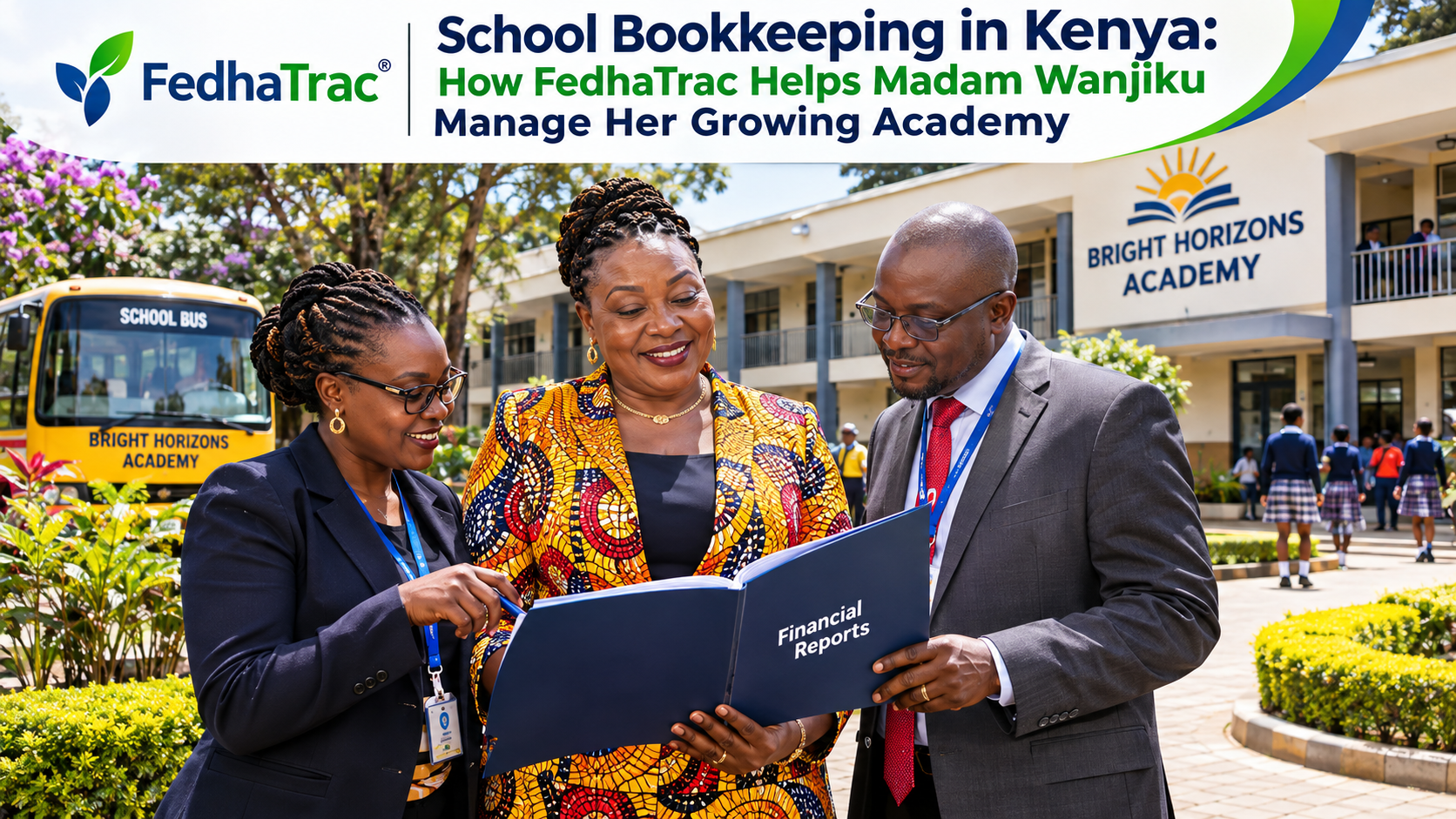
At Bright Horizons Academy, the morning bell is followed by a familiar rush: teachers welcome learners, a school bus returns from its route, the kitchen prepares lunch, and parents send fee payments through M-Pesa. Madam Wanjiku, the fictional school proprietor, is proud of the academy she has built. But as enrolment grows, financial questions follow her from the bursar’s office to the classroom corridor. Which families have paid? How much cash is available for supplies? Are the school’s figures reliable enough for the next management meeting? School Bookkeeping in Kenya is what turns those scattered questions into organised answers.
The academy, its staff and the situations described here are illustrative, not a testimonial from an actual FedhaTrac customer. The practical challenges, however, are recognisable to owners and administrators of private schools. FedhaTrac’s bookkeeping services can support orderly records, reconciliations and reporting so that the leadership team spends less time looking for missing numbers and more time making responsible decisions. School Bookkeeping in Kenya is not a replacement for a school bursar or manager. It is the discipline that helps their work stand up to review.
A Growing Academy Needs More Than a Fees Notebook
Madam Wanjiku once managed a small school using a bank balance and basic fees notebook. Now the academy has more classes, staff, suppliers and payments with unclear references. The bank balance cannot explain what remains due. School Bookkeeping in Kenya provides a dependable framework for recording what happened and what remains outstanding.
School Fees: Match Each Payment to the Right Learner

Madam Wanjiku and a Kenyan school bursar reviewing financial records in the academy courtyard.
Every term begins with a list of expected fees. Yet cash does not arrive in a perfect sequence. Some families pay the whole balance; others pay in instalments; some make advances or settle old amounts. If the academy treats all incoming money as a single undifferentiated total, Madam Wanjiku cannot tell whether a particular learner’s account is current. School Bookkeeping in Kenya starts by maintaining fee ledgers that show opening balances, charges, receipts, adjustments and closing amounts for each learner.
The bursar should use clear references and support each payment with a transaction record. When an amount cannot immediately be identified, it belongs on an investigation list until staff confirm its owner, not on an arbitrary learner account. Fee waivers, approved discounts and refunds should be documented and authorised. FedhaTrac can support the underlying bookkeeping and reconciliation process while school staff retain responsibility for communicating with parents and protecting learner information. A good ledger gives management a reliable view of collections without exposing personal financial details.
Make M-Pesa and Bank Reconciliation Part of the Weekly Routine

Kenyan academy managers consulting financial documents and accounting records on a sunny school campus.
M-Pesa is convenient for parents, but its transaction messages are not a complete accounting system. A payment can have a wrong reference, a reversal or a settlement into the bank. The bank statement might show one bulk deposit representing multiple M-Pesa receipts. School Bookkeeping in Kenya requires each channel to be checked against the school’s fee records so amounts are not missed or counted twice.
For example, when parents pay through a school Paybill and the collections are later transferred to the academy’s bank account, the transfer generally moves existing funds rather than creating another fee receipt. Recording it twice would exaggerate income. The team should match collections to learner accounts, record relevant transaction charges and investigate differences promptly. FedhaTrac’s guide to M-Pesa bookkeeping explains why classification matters as much as matching totals. Its bank reconciliation guide covers related bank checks. School Bookkeeping in Kenya becomes less stressful when these reviews happen weekly, with a full month-end reconciliation.
Know the Difference Between Fees Due and Cash Available
A term’s fee demand is not the same as cash in hand. Suppose Bright Horizons Academy invoices fees at the beginning of term, but several families arrange staggered payments. Salaries, transport fuel, food and utilities still fall due on fixed dates. School Bookkeeping in Kenya helps Madam Wanjiku see both the receivables position and the actual amount available to meet obligations. An academy can appear successful on paper while facing a temporary cash shortage.
A practical report separates billed fees, payments received and unpaid balances. The bursar can flag overdue amounts according to the school’s approved policies, while administrators discuss repayment arrangements respectfully with parents. Management should also avoid treating money earmarked for a restricted purpose as unrestricted operating cash. FedhaTrac’s bookkeeping and management-reporting support can make these categories easier to review; it does not decide which parents should be contacted or how learners are treated.
An Illustrative Term-Opening Cash Forecast
Madam Wanjiku asks for a simple forecast before ordering more teaching materials. The following figures are illustrative only, not Bright Horizons Academy’s actual income, pricing or results. They show why a busy school needs forward-looking information in addition to its historical accounts.
| Illustrative item | Amount (KSh) |
| Opening available cash | 450,000 |
| Expected fee collections during the first month | 1,850,000 |
| Expected total cash available | 2,300,000 |
| Teaching staff and related payments | 1,050,000 |
| Food, fuel, utilities and other operating costs | 650,000 |
| Books, equipment and planned purchases | 390,000 |
| Projected closing cash | 210,000 |
On these assumptions, the projected closing cash is KSh 210,000. That is not automatically a comfortable buffer: an unexpected bus repair or delayed parent payment could absorb it. School Bookkeeping in Kenya helps the academy update the forecast with actual collections and approved expenses rather than treating the first estimate as guaranteed. For more on cash movement and forward planning, the FedhaTrac cash-flow statement guide explains the wider principle.
Track Teaching Materials, Uniforms and School Supplies Separately
Not every purchase has the same financial meaning. Exercise books consumed during teaching, equipment expected to last for years and uniforms bought for resale may require different treatment. If the academy runs a shop, the owner needs to know the cost and quantity of stock on hand, what has been sold and which items are moving slowly. School Bookkeeping in Kenya can connect purchasing records, stock information and the relevant financial accounts so management is not guessing from empty shelves.
School staff can keep signed delivery notes and periodic stock counts. A purchase order should describe what was approved, while the supplier invoice and delivery record show what was billed and received. FedhaTrac can help record the financial transactions and categorise the expenditure correctly; staff on site still inspect deliveries and safeguard materials. School Bookkeeping in Kenya supports better budgeting when routine teaching supplies, resale stock and longer-term assets are not all bundled into one vague expenses heading.
Control Meals, School Transport and Maintenance Costs

Bright Horizons Academy staff on school grounds with the school bus and campus in the background.
The school bus looks smart outside the gate, but its real running cost includes fuel, tyres, servicing, insurance and occasional repairs. The kitchen has its own food supplies, gas, staffing and waste. Maintenance costs appear when a door breaks or water systems need attention. School Bookkeeping in Kenya makes these activities visible as separate cost centres rather than hidden inside one large ‘general expenses’ total.
Madam Wanjiku can then compare actual spending with the budget, ask why costs changed and decide which service needs closer attention. She may discover that higher fuel spending reflects a longer route, not careless purchasing. Or a rising lunch cost may call for better supplier comparison and portion planning. Those are management decisions informed by records, not judgments made by FedhaTrac. Consistent expense tracking and invoicing makes School Bookkeeping in Kenya more useful because each amount has a documented purpose.
Keep Supplier Bills and Payment Approvals Under Control
Busy school offices receive invoices from printers, food wholesalers, uniform providers, cleaners and repair contractors. A supplier might deliver at the beginning of the term and send a reminder at the end. Without a reliable payables list, the bursar may pay the same invoice twice or overlook an agreed payment date. School Bookkeeping in Kenya means recording each valid supplier bill, payment, credit note and outstanding balance with appropriate supporting evidence.
Bright Horizons Academy should have a practical separation between requesting goods, approving spending, confirming delivery and releasing payment. The exact controls depend on the school’s size, but one person should not be left to approve every stage without review. FedhaTrac can support supplier ledgers and reconciliation, giving Madam Wanjiku a clearer picture of commitments before she authorises additional purchases. Good records also help the school address disputes professionally, using documents instead of conflicting memories.
Support Staff-Cost Records Without Losing Management Control
Teachers and support staff make the school operate, and compensation is often a major recurring commitment. Staff-related financial records can include agreed pay, allowances, reimbursements, advances and amounts due. School Bookkeeping in Kenya requires these entries to be correctly categorised and supported, so the income statement and cash forecast reflect the school’s actual obligations.
FedhaTrac’s role in this story is bookkeeping, reconciliations and tax-related record support—not a claim that it runs the school’s payroll. Bright Horizons Academy remains the employer and manages employment decisions, contracts and statutory responsibilities. Where PAYE applies, the Kenya Revenue Authority states that employers must file and remit it on or before the ninth day of the following month. Management should check all current employment and contribution obligations with appropriately qualified advisers. School Bookkeeping in Kenya helps the accounting records support that work rather than replace it.
Build Term Budgets That Reflect Real School Priorities
Madam Wanjiku and academy staff discussing school budgets and paperwork together.
A school budget should be a working plan, not a spreadsheet filed away at the beginning of January. For each term, Madam Wanjiku can consider likely enrolment, expected collections, staffing needs, utilities, supplies, transport, upkeep and planned improvements. School Bookkeeping in Kenya gives her prior-period costs that can be used to build realistic estimates instead of relying on intuition alone.
A monthly or termly budget-versus-actual report should show what was planned, what happened, the difference and the reason. A higher electricity bill may reflect a new computer laboratory; a lower collection rate may point to delayed fee payments rather than falling enrolment. FedhaTrac can prepare relevant financial summaries while leadership evaluates the operational explanations. The result is more disciplined resource allocation: money for teaching quality, safety and essential services is discussed before discretionary purchases are approved.
Produce Clear Reports for the School Board and Proprietor
Madam Wanjiku needs reports she can understand without sorting through hundreds of transaction lines. At minimum, School Bookkeeping in Kenya should support a useful view of fee collections and arrears, spending by category, bank and M-Pesa balances, outstanding supplier bills, and actual results against the term budget. Where appropriate, financial statements should follow the reporting framework relevant to the school’s legal structure.
FedhaTrac can help turn orderly bookkeeping into management information. For example, a monthly income-and-expenditure or profit-and-loss summary can show how fees and other properly recognised income relate to teaching, administration and operating costs. A cash-flow report complements it by showing when money moved. The profit-and-loss statement guide explains why profitability and cash availability must not be confused. School Bookkeeping in Kenya is most valuable when reports lead to specific questions and recorded management decisions.
Tax, eTIMS and Recordkeeping: Apply the Rules Carefully
Schools operate within Kenyan tax rules, but not every school transaction has the same treatment. Under the Value Added Tax Act, qualifying education services provided by pre-primary, primary and secondary schools are listed among exempt supplies. Ancillary activities, such as some separate commercial sales or services, may need their own VAT assessment; a school should not assume every receipt is automatically treated like tuition. School Bookkeeping in Kenya helps keep those income streams identifiable so a qualified tax adviser can apply the correct rules.
The KRA eTIMS guidance expressly discusses schools providing VAT-exempt education services within the broader electronic invoicing framework. KRA’s current income-and-expense validation guidance also places greater importance on valid supporting records, subject to applicable exceptions. Bright Horizons Academy should keep invoices, receipts, fee records, bank statements and relevant employment records systematically and confirm its precise obligations rather than treating a general article as personalised tax advice. School Bookkeeping in Kenya makes that compliance review substantially easier.
Protect Parent and Learner Information
School financial records contain sensitive details: learner names, guardians’ contacts, balances and payment arrangements. Good bookkeeping does not justify sharing this data widely. Access to learner ledgers should be limited according to staff roles, reports should avoid unnecessary personal identifiers, and backups should be controlled. School Bookkeeping in Kenya works best alongside a sensible privacy and data-retention policy and the school’s legal responsibilities.
A Practical Monthly Close for Bright Horizons Academy
School Bookkeeping in Kenya becomes more reliable through repetition. Before the monthly management meeting, the bursar and bookkeeping support team can follow a simple close routine: confirm fee charges and approved adjustments, match receipts to learner accounts, reconcile M-Pesa and bank movements, review supplier bills, categorise expenses, check asset and stock records, and prepare the budget comparison. Unidentified transactions should appear on an action list with an owner and deadline.
How FedhaTrac Can Make Madam Wanjiku’s Work Easier
FedhaTrac cannot teach lessons, drive the school bus or decide how much a family should pay. What it can do is help give the leadership team organised books, reconciled accounts and meaningful financial reports. For Madam Wanjiku, that means fewer meetings spent chasing missing receipts and more time discussing priorities supported by evidence. School Bookkeeping in Kenya converts daily activity into a financial picture that staff can review and improve.
The appropriate service depends on transaction volumes, the state of existing records and what the school already handles internally. A new academy may need a simple monthly structure; a larger one may need catch-up bookkeeping, more detailed reporting or specialist tax support. Schools can explore FedhaTrac’s bookkeeping service and tax-filing and compliance support to discuss a suitable scope. School Bookkeeping in Kenya is not a promise of higher enrolment or instant savings; it is a practical foundation for more accountable management.
Frequently Asked Questions About School Bookkeeping in Kenya
What records should a private school keep?
A private school should maintain appropriate fee ledgers, receipts, invoices, bank and M-Pesa statements, expense records, supplier balances, financial reports and relevant employment documents. The precise records depend on its legal structure, transactions and statutory obligations. School Bookkeeping in Kenya works when each major figure can be traced to supporting evidence.
How often should a school reconcile M-Pesa and bank accounts?
A monthly reconciliation is a useful minimum control for many small institutions. A school collecting numerous fees every day may benefit from weekly reviews or more frequent matching during the start of term. School Bookkeeping in Kenya becomes much harder when unmatched receipts are left unresolved for months.
Are all school fees subject to VAT in Kenya?
No. Qualifying education services are generally listed as exempt under the VAT Act, but the classification of separate activities should be assessed individually. Schools should seek current professional advice on their precise supplies and electronic invoicing obligations rather than applying one assumption to every income stream.
Can FedhaTrac replace a school bursar?
Not necessarily. The bursar usually remains central to parent communication, approvals and day-to-day school administration. FedhaTrac’s bookkeeping, reconciliation and reporting support can complement that role, depending on the scope agreed with the academy.
Give Your Academy a Financial Foundation That Can Grow
Bright Horizons Academy’s next challenge is not simply finding more classrooms. It is maintaining financial clarity while more learners, suppliers and activities place demands on the school. Madam Wanjiku needs to know what has been collected, what remains due, what cash is available and whether planned spending is affordable. School Bookkeeping in Kenya gives those questions a repeatable, evidence-based answer.
If your school is dealing with unmatched M-Pesa payments, overdue fee ledgers, unclear supplier costs or reports that arrive too late to guide decisions, contact FedhaTrac to discuss bookkeeping and financial-reporting support. A well-organised school finance function will not eliminate every challenge, but it can give the people running the school a much stronger basis for responding to them.


