

KRA tax filing for furniture shops in Kenya works best when every sofa, dining set, office desk, customer deposit, delivery, and supplier purchase has a clear financial trail. Some customers reserve a bed with a deposit, institutional buyers request credit, and deliveries happen after the order. Returns and custom-made items add complexity.
For owners, that makes tax preparation a year-round task rather than a last-minute login to iTax. FedhaTrac provides tax filing and compliance support, outsourced bookkeeping, reconciliations, and financial reporting for Kenyan businesses. Its team organizes records and supports applicable returns without replacing KRA or guaranteeing outcomes.
This guide uses Imara Furniture & Home Décor, an illustrative Nairobi showroom selling beds, wardrobes, sofas, dining sets, and office furniture, to explain nine practical services. Imara is not presented as a real FedhaTrac customer, and the financial examples are hypothetical. The aim is accurate KRA tax filing for furniture shops in Kenya.
Why Furniture Shops Need a Different Tax-Filing Routine
A furniture retailer can make a sale, receive a deposit, arrange transport, pay a carpenter, buy replacement fittings, and deliver the finished item on different dates. The paperwork for each stage must still describe one coherent transaction. If a KSh 60,000 deposit is entered as a new sale and the full invoice is recorded again upon delivery, sales figures may be overstated. If a returned sofa disappears from the sales register but remains in the stock records, another mismatch develops.
The records behind KRA tax filing for furniture shops in Kenya must connect orders, invoices, payments, stock, supplier documents, and reports. VAT and income tax are distinct obligations. FedhaTrac helps maintain the accounting foundation and provides support for the applicable tax work, rather than relying on screenshots and guesswork at the end of a reporting period.
9 Smart Ways FedhaTrac Supports KRA Tax Filing for Furniture Shops in Kenya
1. Recording showroom sales in one consistent ledger
A dining table sold for cash, a mattress paid through M-Pesa, and desks sold on credit need linked invoices, payment references, and correct classification.
For KRA tax filing for furniture shops in Kenya, dependable customer records are the starting point. FedhaTrac’s bookkeeping service records and organizes income, customer records, and supporting documents. For a furniture retailer, the process begins with an agreed sales register identifying the date, invoice reference, customer, description, amount, payment method, and outstanding balance. Sales in cash, by bank transfer, and through M-Pesa can then be reconciled against their respective statements.

Sales and M-Pesa/payment-record activity. Insert as supporting photo.
Accurate sales books support KRA tax filing for furniture shops in Kenya because the reported turnover can be traced back to individual transactions. The shop must still issue electronic invoices through a compliant eTIMS solution.
2. Linking custom orders, deposits, and installment payments
Consider a made-to-order sofa priced at KSh 174,000, including VAT at 16% in this hypothetical VAT-registered example. Its net selling price is KSh 150,000 and VAT is KSh 24,000. The customer pays KSh 58,000 upfront, leaving KSh 116,000 to be settled later. The deposit is a payment against the order, not an additional KSh 58,000 sale on top of the full KSh 174,000 price.
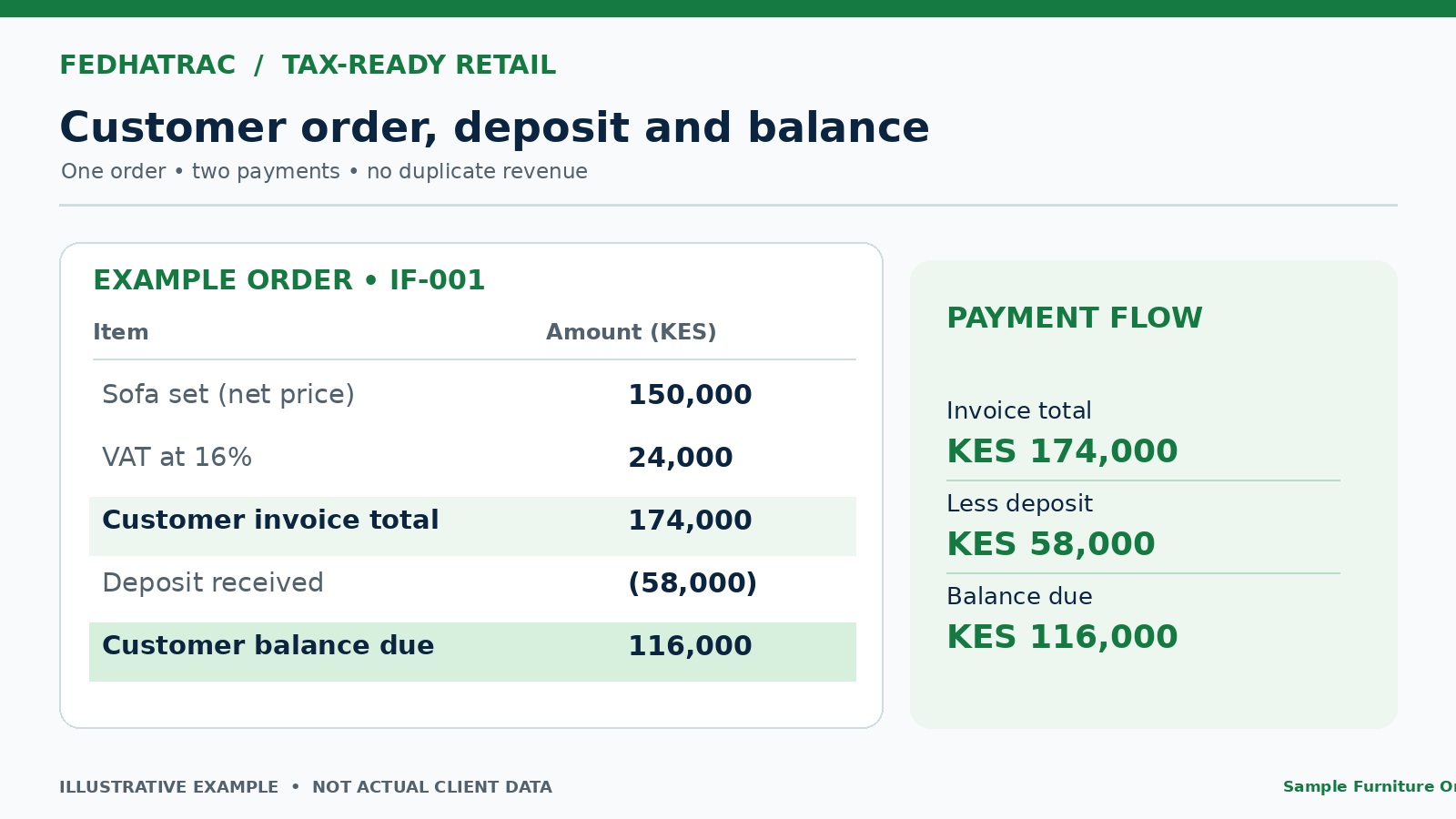
Accurate sample documentation; values are hypothetical.
KRA tax filing for furniture shops in Kenya becomes more precise when installment and deposit records follow the order. FedhaTrac can organize the quotation or order, payment receipt, related invoice, delivery information, and balance due. This keeps accounts understandable. Importantly, KRA’s VAT guidance explains that the VAT tax point generally arises at the earliest of relevant events, including receiving part or full payment, issuing an invoice, or delivering the goods. The specific invoice treatment must be reviewed for the transaction.
For KRA tax filing for furniture shops in Kenya, this prevents a common mistake: waiting until final delivery to consider the tax consequences of a deposit, or issuing documents that double-count the order.
3. Reconciling M-Pesa, cash, bank transfers, and card payments
Furniture sales often involve relatively large payments. A customer may pay a deposit by M-Pesa, settle the balance by bank transfer, and then pay a separate delivery charge in cash. A bank balance alone cannot show whether revenue is correct or all receivables are settled.
The payment trail also matters to KRA tax filing for furniture shops in Kenya. FedhaTrac’s team captures payment records, matches receipts to invoices, investigates unmatched deposits, and updates customer balances. A useful monthly review checks the cash register, M-Pesa statement, bank statement, card settlements, and customer ledger. Bank fees, settlement delays, duplicate entries, and unidentified deposits are investigated before preparing returns.
Reconciled collections help distinguish receipts from revenue for KRA tax filing for furniture shops in Kenya. FedhaTrac’s dashboard makes the updated records and supporting documents visible to the business owner.
4. Organizing eTIMS invoices, corrections, and returns
According to KRA’s eTIMS guidance, persons engaged in business generally need to use the electronic invoicing framework, even if they are not VAT-registered; applicable mechanisms and exceptions should be checked. A furniture shop must therefore treat electronic invoicing as part of daily sales operations rather than merely a requirement when submitting returns.
KRA tax filing for furniture shops in Kenya relies on consistent electronic invoice records. FedhaTrac provides eTIMS guidance and invoicing support, helping organize records generated by the shop’s chosen compliant solution. The team can compare eTIMS data with the sales ledger and flag missing documents or inconsistent corrections. If a customer returns a cabinet after an invoice was issued, the shop should review whether a compliant credit note is required instead of simply deleting the transaction.
For further background, see FedhaTrac’s eTIMS guide for Kenyan businesses. KRA tax filing for furniture shops in Kenya is easier when sales and eTIMS agree; FedhaTrac should not be described as an automatic POS or inventory system without verifying the integration.
5. Tracking supplier invoices and furniture stock movements
Stock records matter because a showroom can hold expensive items for weeks or months. A wardrobe may be on display, a dining set may be awaiting delivery, and damaged stock may need repair or a supplier return. A purchase invoice is not proof that stock has been sold.

Operations staff reviewing purchase records; distinct from customer sales and accounting consultation.
A strong approach to KRA tax filing for furniture shops in Kenya includes inventory evidence. FedhaTrac organizes supplier invoices, payments, and accounting entries, while the shop supplies reliable counts and movement documents. These records support opening and closing inventory and cost of goods sold. KRA’s stock-management guidance emphasizes accurate records of stock received, purchased, sold, transferred, returned, adjusted, or otherwise disposed of, aligned with electronic invoices.
For KRA tax filing for furniture shops in Kenya, a controlled stock-to-accounting reconciliation helps explain gross profit and supporting deductions. FedhaTrac does not replace a furniture-specific stock system.
6. Preparing VAT returns using supported purchase and sales records
A furniture retailer that is required to register for VAT must pay particular attention to invoice timing, tax rates, and deductible input VAT. KRA generally requires VAT registration at KSh 5 million in annual taxable supplies, subject to the law. The general VAT rate is 16%, while a business below the threshold may be eligible for voluntary registration under conditions.
VAT preparation is a key part of KRA tax filing for furniture shops in Kenya. FedhaTrac’s advertised tax service includes VAT return support. For a VAT-registered shop, the team can prepare schedules of taxable sales, output VAT, eligible input VAT, credit notes, and adjustments for review before filing. In a simple hypothetical month with KSh 1,250,000 in net standard-rated sales, output VAT is KSh 200,000. If qualifying net purchases carry KSh 112,000 of deductible input VAT, the difference is KSh 88,000 before other permitted adjustments or credits.
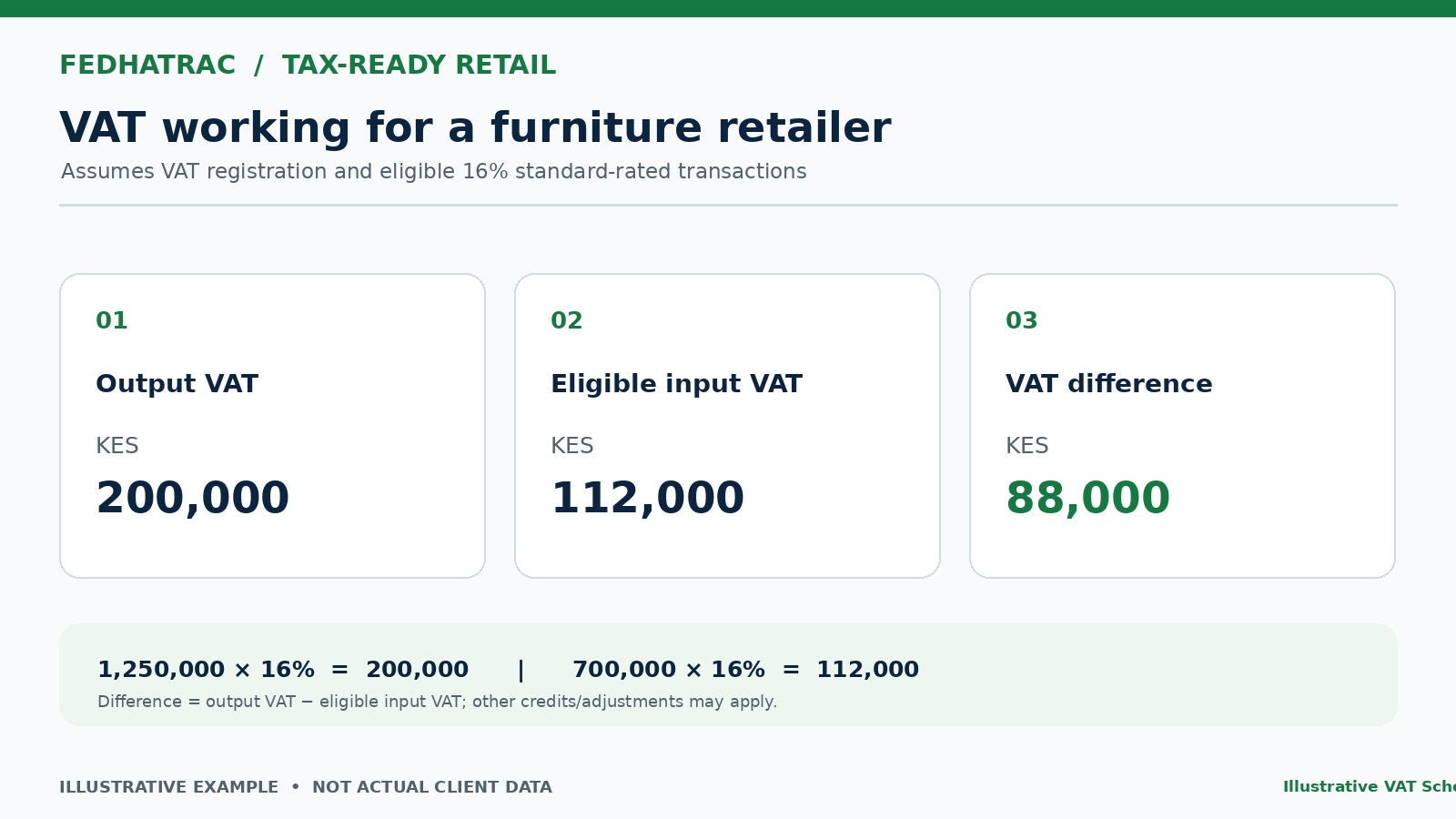
Assumes 16% rate and qualifying input VAT; it is not a filed VAT return.
KRA tax filing for furniture shops in Kenya must use the actual invoices and applicable tax treatment, not assume that every expense carries deductible VAT. KRA states that VAT returns and any amount due are generally filed and paid by the 20th of the following month.
7. Identifying the correct income-tax regime for the business
VAT registration and income-tax treatment are separate questions. For example, KRA’s current principal Turnover Tax page describes an eligible resident business with annual turnover above KSh 1 million and not exceeding KSh 25 million, subject to exclusions and elections, and gives a rate of 1.5% of gross sales. An eligible business making taxable supplies can also have VAT obligations when it meets the relevant VAT threshold.
A furniture shop is not automatically a Turnover Tax taxpayer: its structure, turnover, elections, and obligations matter. A company operating under the ordinary corporation-tax regime needs a tax computation based on the applicable rules, which may differ from its accounting profit. FedhaTrac can help review the records, determine the likely filing pathway with the client, and prepare the necessary schedules and returns.
Choosing the right income-tax regime is central to KRA tax filing for furniture shops in Kenya. Applying one percentage to every furniture retailer, or subtracting operating expenses from gross turnover when computing Turnover Tax, can produce the wrong result.
8. Building a tax-ready financial report and document archive
For KRA tax filing for furniture shops in Kenya, a sales report alone is insufficient: the return needs supporting evidence. FedhaTrac prepares and maintains financial records covering income, expenses, customer and supplier balances, bank reconciliations, profit and loss, cash flow, and the document trail behind them. Catch-up bookkeeping is available when records are incomplete.

Owner and adviser examining financial records.
In a sample month, KSh 1,250,000 net sales less KSh 710,000 cost of goods sold and KSh 295,000 operating expenses yields KSh 245,000 profit before tax. Output VAT and input VAT are reported separately in the VAT schedule; VAT payable is not simply an operating expense deducted again from those profit figures.
KRA tax filing for furniture shops in Kenya benefits from an auditable trail connecting the figures to real business activity. The Tax Procedures Act’s record-keeping requirements and related KRA guidance make it prudent to retain invoices, statements, tax returns, stock reports, and payment records in an organized archive rather than a collection of personal phones.
9. Tracking deadlines and preparing returns before the last day
The relevant calendar may include VAT, Turnover Tax, annual income tax, and PAYE, depending on the business. FedhaTrac’s tax filing service includes deadline tracking, preparation, and filing support so the team can identify missing schedules early and provide the client with a clear view of the work required.
An annual calendar is vital to KRA tax filing for furniture shops in Kenya. A particularly important update is the Finance Act 2026 guidance: from January 2027, individual taxpayers, including relevant self-employed taxpayers, move to an income-tax filing deadline of 30 April after the year of income. Companies and other non-individual taxpayers generally retain the sixth-month filing rule. VAT remains generally due by the 20th of the following month, while PAYE is generally due by the 9th.
These are key facts for KRA tax filing for furniture shops in Kenya. FedhaTrac tailors the calendar to the retailer’s obligations and current KRA guidance.
A Practical Furniture Shop Tax-Filing Example
Imagine Imara Furniture & Home Décor finishing a busy showroom-sales and delivery month. The staff provide an export of sales, issued eTIMS invoices, deposit records, M-Pesa and bank statements, supplier bills, and a stock-count summary. FedhaTrac uses these inputs to update the books, reconcile collections, and prepare financial and tax schedules for review.
The following amounts are hypothetical, not client results. VAT examples assume 16% standard-rated supplies and qualifying input tax, which must be verified in practice.
| Illustrative measure | Amount (KES) |
| Net sales, excluding VAT | 1,250,000 |
| Cost of goods sold | 710,000 |
| Gross profit | 540,000 |
| Operating expenses | 295,000 |
| Profit before tax | 245,000 |
| Output VAT on KSh 1,250,000 | 200,000 |
| Eligible input VAT on qualifying purchases | 112,000 |
| Illustrative VAT difference before adjustments | 88,000 |
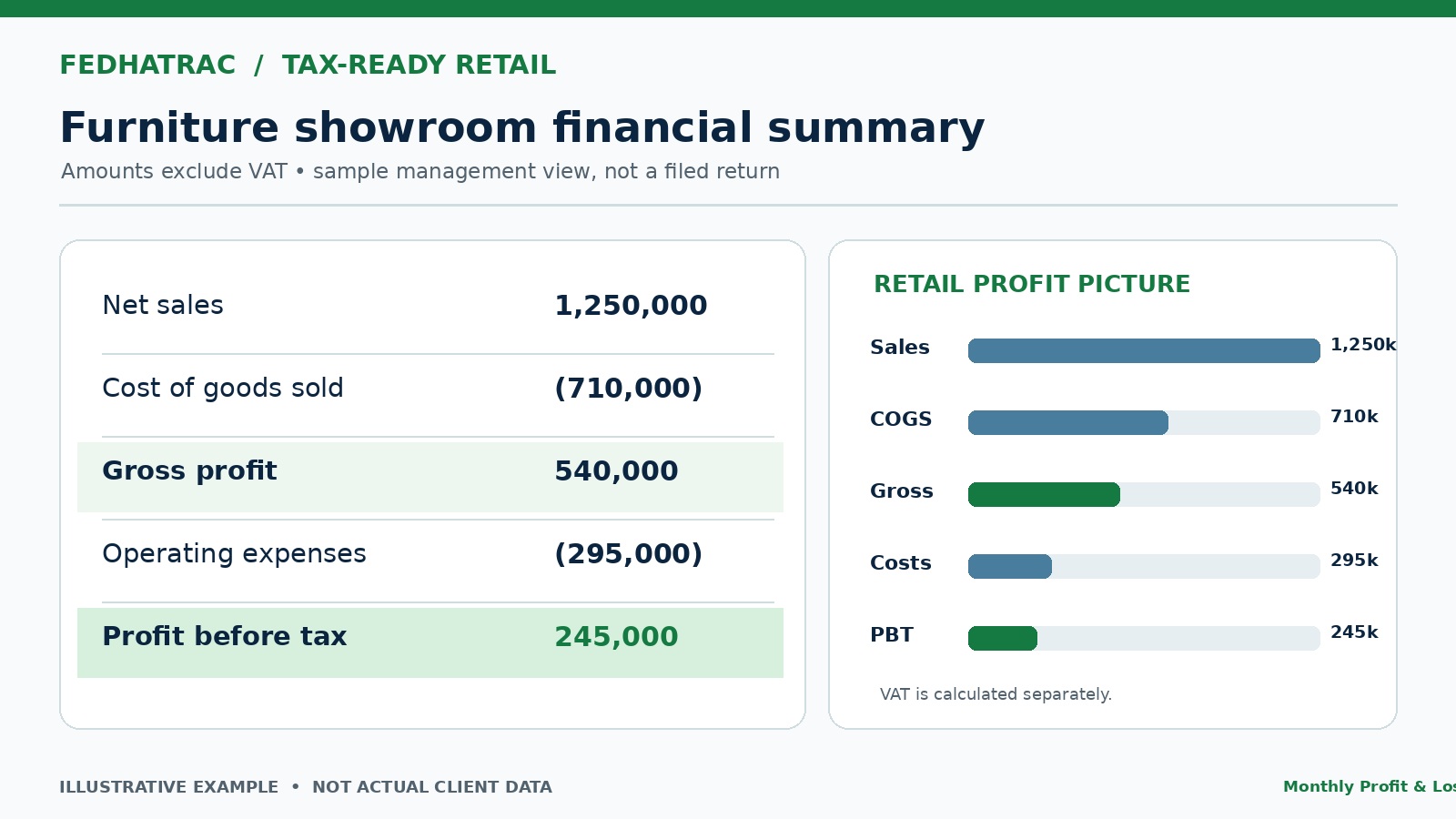
Financial summary that reconciles to article figures; not actual client results.
The cost of goods sold need not equal purchases in that month, because opening stock and closing stock affect the expense recognized. Similarly, VAT should not be confused with the shop’s income tax. KRA tax filing for furniture shops in Kenya requires the relevant VAT workings, income-tax computation, and other obligations to be handled separately and accurately.
What a Furniture Retailer Should Prepare Each Month
For KRA tax filing for furniture shops in Kenya, prepare these records: sales and eTIMS invoices; credit notes; customer deposits and balances; cash, M-Pesa, bank, and card statements; purchase invoices; transport and installation expense records; payroll information where relevant; inventory movement and physical-count reports; and earlier tax acknowledgements. A monthly checklist is much more effective than asking staff to recover missing paperwork a year later. FedhaTrac also offers a wider KRA returns guide for SMEs.
A manager should review deposits, damaged or returned sofas, delivery fees, supplier credit notes, and institutional invoices. These questions connect the storefront to the return and are what distinguish furniture-shop accounting from generic retail bookkeeping.
FedhaTrac can help the finance side stay organized, while the retailer remains responsible for providing complete, truthful records and operating the required invoicing process. This shared responsibility is at the center of KRA tax filing for furniture shops in Kenya.
Frequently Asked Questions
Must a small furniture shop use eTIMS if it is not VAT-registered?
KRA’s published position is that persons engaged in business generally fall within the eTIMS framework, including many non-VAT businesses. Certain small-supplier transactions use buyer-initiated invoicing arrangements. FedhaTrac can help review the applicable method and organize the invoice trail. KRA tax filing for furniture shops in Kenya should not assume that a lack of VAT registration removes every electronic invoicing duty.
Does a customer deposit count as a second sale?
No. A deposit is part-payment against an underlying order, not an extra sale in addition to the full order value. However, for VAT-registered suppliers, receiving part-payment can establish the VAT tax point under KRA’s rules. The documents must reflect the transaction correctly and avoid double counting. FedhaTrac can reconcile the receipt and customer balance.
Can FedhaTrac file VAT, income tax, and other KRA returns for a furniture retailer?
FedhaTrac advertises VAT, individual and corporation tax, PAYE, withholding-tax, and eTIMS support. The actual scope depends on the client’s registered obligations, quality of records, and agreed service arrangement. KRA tax filing for furniture shops in Kenya is a tailored compliance service, not a promise that every shop requires every listed return.
How is a furniture shop’s stock reflected in its financial reports?
Stock purchased for resale is normally tracked through inventory accounting and recognized in cost of goods sold when appropriate under the applicable accounting framework. Physical counts, returned stock, damaged pieces, and transfers matter. FedhaTrac helps with the accounting records and reconciliations, while the shop provides accurate stock information from its operations.
What happens if the shop has not maintained books for several months?
FedhaTrac offers catch-up bookkeeping. The team can help organize the available invoices and statements, reconstruct records, and identify gaps that still need supporting evidence. Returns must not rely on invented sales or unsupported input tax.
Make Furniture Shop Tax Filing a Monthly Process
KRA tax filing for furniture shops in Kenya is not only about completing a form. It is the result of correctly recording furniture orders, handling deposits, issuing electronic invoices, reconciling payments, tracking supplier purchases and stock movements, preparing suitable financial reports, and keeping an accurate calendar of tax obligations.
FedhaTrac provides the bookkeeping expertise, accounting support, financial visibility, and tax preparation and filing assistance that furniture retailers can use to make those tasks manageable. Regular reviews can reduce avoidable errors, although outcomes depend on the actual records and circumstances.
If you operate a furniture showroom, office-furniture store, or home décor business, contact FedhaTrac to discuss a tailored bookkeeping and tax-support arrangement. The objective is practical: keep your financial information dependable, stay aware of the obligations that actually apply, and be ready when the next KRA filing date arrives.


