

A car that stays parked still costs money. Insurance continues, finance installments may fall due, depreciation does not stop, and a missed vehicle inspection can postpone the next customer handover. For a Kenyan leasing operator, the decisive question is not just how many cars are owned. It is whether each vehicle generates enough collected income to cover its own costs while remaining legally and mechanically ready for the next assignment.
At FedhaTrac, we approach car leasing financial management in Kenya as a fleet decision problem supported by sound records. This guide focuses on the financial evidence behind customer contracts, lease installments, refundable deposits, maintenance, capital investment and management reporting. The business in our examples, NuruDrive Fleet Leasing Ltd., is entirely fictional; its figures are teaching examples rather than actual customer results.
Begin with a fleet register that tells the truth
In car leasing financial management in Kenya, One spreadsheet or register should identify the vehicle, registration, acquisition date, capital cost, ownership or financing status, insurance renewal, service interval and whether it is available, on contract or under repair. A serial list of registration numbers without a financial connection misses why some vehicles create returns and others absorb cash. The practical challenge is visible in day-to-day operations. The business should be able to show how this decision affects its invoices, cash commitments and eventual financial result.

Owner discussing lease terms for car leasing business in Kenya
The operational routine is straightforward: Match each registration to the approved fixed-asset record and the operator’s own movement log. Restrict changes in ownership, depreciation estimates and disposal values to authorized staff; reconcile the book register with physical vehicles.
At FedhaTrac, Our accounting and reporting support can organize the value, depreciation and other financial attributes of a vehicle register, while the owner remains responsible for vehicle tracking and safe fleet operations. In car leasing financial management in Kenya, we prefer information that can be checked back to an agreed contract, a numbered register, a genuine invoice or a banked payment, as appropriate.
Make every lease contract a measurable obligation
In car leasing financial management in Kenya, A contract needs the agreed vehicle, period, monthly rate, mileage or usage limits, responsibilities for fuel and repairs, late-return charges, deposit terms and the precise event that creates an invoice. Informal promises may look harmless until a customer disputes additional kilometers or the condition of the returned car. The owner needs evidence before a small problem becomes a monthly dispute. The business should be able to show how this decision affects its invoices, cash commitments and eventual financial result.

Vehicle key handover with client for car leasing business in Kenya
The operational routine is straightforward: File signed or otherwise properly authorized terms with the vehicle and customer reference. Where terms change, preserve the amendment rather than silently editing the original invoice. Separate long-term vehicle leasing from an occasional short hire in the contract index.
At FedhaTrac, Our business operations support can help with invoice administration, customer accounts and supporting documentation; FedhaTrac does not claim to issue motor-vehicle licenses or operate a telematics platform. In car leasing financial management in Kenya, we prefer information that can be checked back to an agreed contract, a numbered register, a genuine invoice or a banked payment, as appropriate.
Keep refundable security deposits out of operating income
In car leasing financial management in Kenya, A security deposit can improve cash held in the bank without being earned revenue. A business that spends deposits as if they were profit risks a cash shortage when vehicles return and customers are entitled to refunds after permitted deductions. Deposits can also be offset only according to the actual contract and applicable law. The most useful report starts with a source document, not with an attractive chart. The business should be able to show how this decision affects its invoices, cash commitments and eventual financial result.
The operational routine is straightforward: Open a customer deposit ledger showing amount received, the associated contract, valid deductions, return approval and refund date. Review the aggregate refundable balance alongside bank liquidity rather than burying it in the sales total.
At FedhaTrac, We can help reconcile receipt records, customer balances and liability schedules so management sees money held on behalf of customers separately from cash available for routine expenses. In car leasing financial management in Kenya, we prefer information that can be checked back to an agreed contract, a numbered register, a genuine invoice or a banked payment, as appropriate.
Distinguish a lease invoice from money already collected
In car leasing financial management in Kenya, A vehicle may earn an installment this month but the customer may pay next month. The difference becomes a receivable that still needs collecting; it is not additional bank cash. The opposite happens with a deposit received before a future service period, which should not automatically be presented as current service income. A manager should be able to follow the movement without asking staff to reconstruct it from memory. The business should be able to show how this decision affects its invoices, cash commitments and eventual financial result.

Fleet performance review meeting for car leasing business in Kenya
The operational routine is straightforward: Prepare monthly customer statements, age invoices into current and overdue groups, and match payments by reference before sending reminders. Flag unusually large deductions, duplicate invoices and customers who repeatedly renegotiate dates.
At FedhaTrac, FedhaTrac’s bookkeeping, invoicing, reconciliation and advisory work helps management assess cash collections without mistaking a growing receivables balance for strong liquidity. In car leasing financial management in Kenya, we prefer information that can be checked back to an agreed contract, a numbered register, a genuine invoice or a banked payment, as appropriate.
Watch service, fuel, tire and insurance costs by vehicle
In car leasing financial management in Kenya, Average fleet expenditure hides an expensive vehicle that is losing money. A high-mileage unit may require frequent maintenance and replacement tires; another may attract insurance costs while remaining idle. A sensible allocation method should separate vehicle-specific costs from head-office expenses. The practical challenge is visible in day-to-day operations. The business should be able to show how this decision affects its invoices, cash commitments and eventual financial result.
The operational routine is straightforward: Capture invoice number, approved work, odometer reading, supplier, vehicle reference and payment evidence. Compare planned service intervals with actual expenses, and investigate unusually high recurring repairs before extending that vehicle’s contract.
At FedhaTrac, Our financial reporting can present cost-per-vehicle schedules from the records the operator supplies; roadworthiness checks and mechanical repair remain the responsibilities of licensed or qualified operational providers. In car leasing financial management in Kenya, we prefer information that can be checked back to an agreed contract, a numbered register, a genuine invoice or a banked payment, as appropriate.
Price downtime and utilization honestly
In car leasing financial management in Kenya, A fully booked fleet can still make poor returns if vehicles stay out of service for damage inspection or repairs between customers. Conversely, a spare vehicle protects service continuity but carries financing, insurance and storage costs. Utilization should measure available billable days, not simply whether a key is with a driver. The owner needs evidence before a small problem becomes a monthly dispute. The business should be able to show how this decision affects its invoices, cash commitments and eventual financial result.
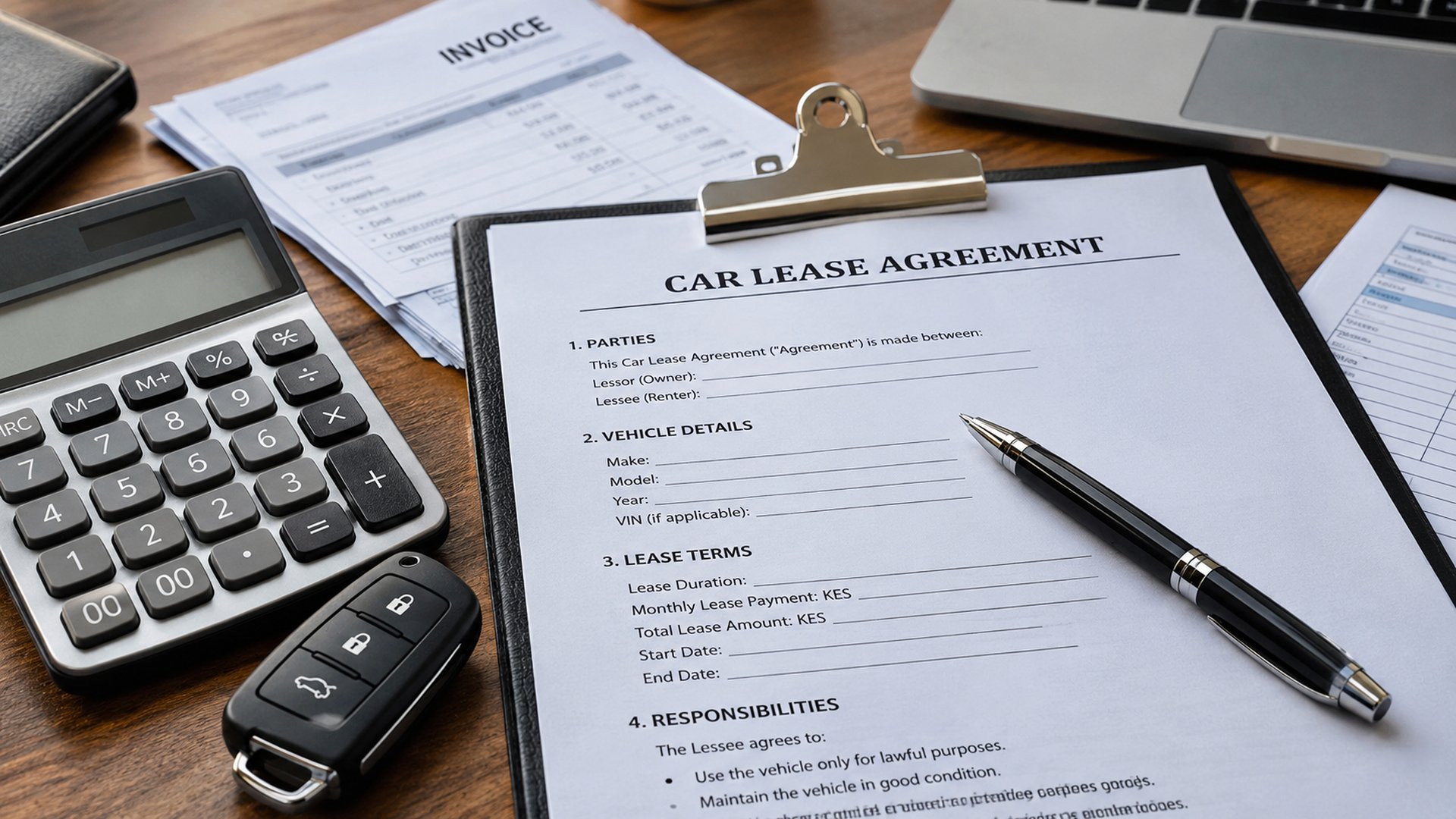
Car leasing financial management in Kenya — lease contract and vehicle keys
The operational routine is straightforward: Record expected and actual handover dates, days awaiting cleaning or repairs, and invoices issued for valid extensions. Review billed days as a percentage of available days by vehicle class rather than promoting gross bookings alone.
At FedhaTrac, Specialised reporting and advisory can translate this operational log into utilization, earned revenue and operating-margin measures to support renewal or disposal decisions. In car leasing financial management in Kenya, we prefer information that can be checked back to an agreed contract, a numbered register, a genuine invoice or a banked payment, as appropriate.
Handle vehicle value, finance and depreciation carefully
In car leasing financial management in Kenya, Buying a vehicle is not the same accounting event as paying the monthly insurance premium. Capital expenditure creates an asset that is generally expensed through an appropriate depreciation policy, while loan principal repayments reduce debt rather than automatically being treated as operating expense. Financial lease classifications depend on contracts and applicable standards. The most useful report starts with a source document, not with an attractive chart. The business should be able to show how this decision affects its invoices, cash commitments and eventual financial result.
The operational routine is straightforward: Maintain acquisition invoices, finance agreements, interest schedules, estimated useful lives and disposal authorizations. Review tax treatment separately from accounting depreciation and confirm the correct treatment of any right-of-use assets with a qualified accountant.
At FedhaTrac, FedhaTrac can help prepare relevant ledgers and financial reports but does not automatically determine legal ownership, insurance scope or statutory tax deductions from a vehicle photograph. In car leasing financial management in Kenya, we prefer information that can be checked back to an agreed contract, a numbered register, a genuine invoice or a banked payment, as appropriate.
Use monthly fleet reviews to decide what comes next
In car leasing financial management in Kenya, The practical outcome of reports should be a decision: keep, repair, reprice, refinance or sell a vehicle. Compare revenue, direct expenses, allocated overhead, arrears and downtime by vehicle class. One attractive contract may conceal poor working capital if its customer never pays on time. A manager should be able to follow the movement without asking staff to reconstruct it from memory. The business should be able to show how this decision affects its invoices, cash commitments and eventual financial result.
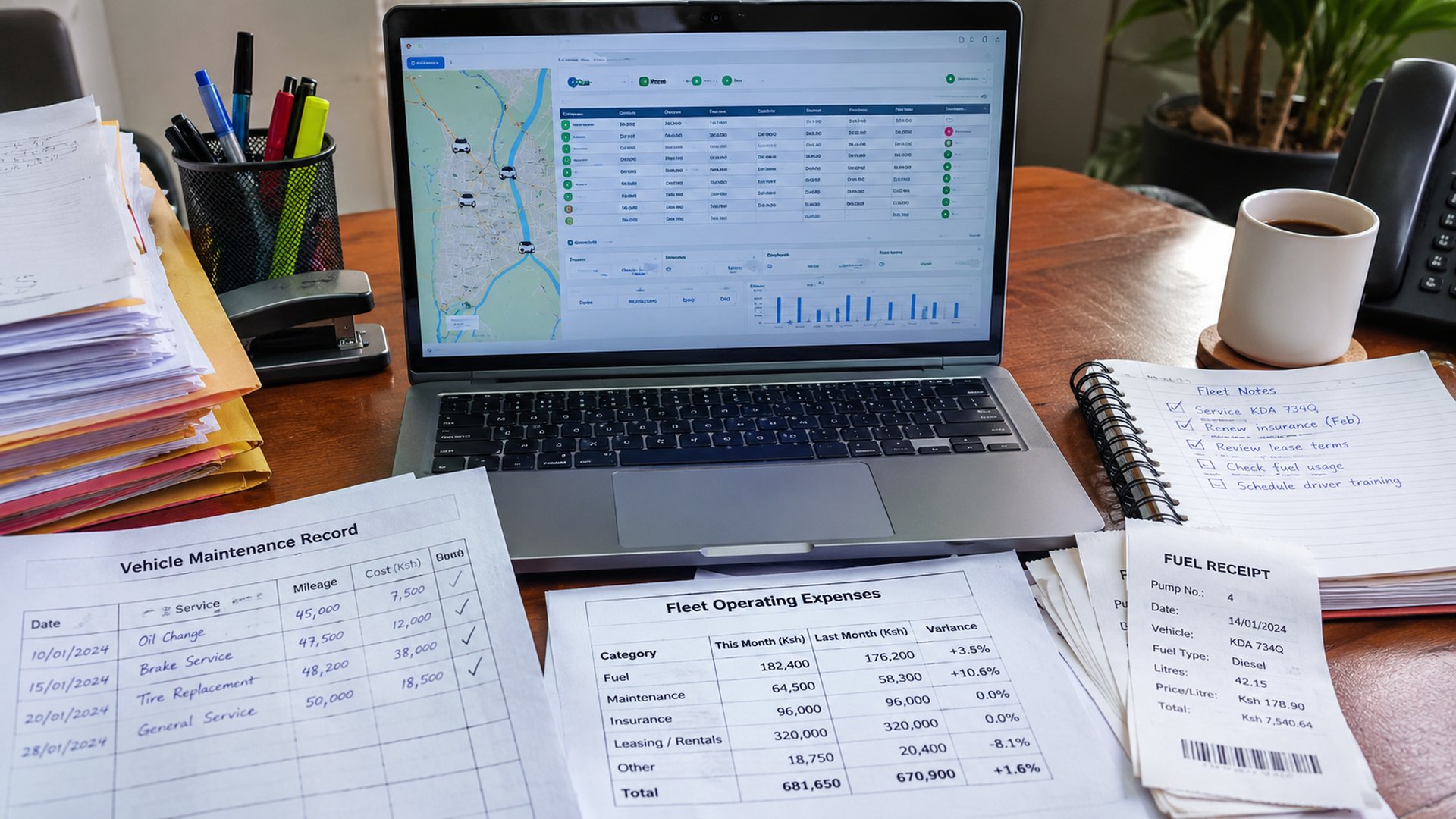
Fleet cost and maintenance papers for car leasing business in Kenya
The operational routine is straightforward: In a monthly review, ask which contracts renew, which cars enter service soon, what cash is needed for insurance and what deposits might become refundable. Assign owners and dates to the actions, not just colorful dashboard indicators.
At FedhaTrac, Our team offers management reporting, cash-flow analysis, consultations and quarterly or annual review meetings. This is decision support, not a guarantee that a fleet investment will make a profit. In car leasing financial management in Kenya, we prefer information that can be checked back to an agreed contract, a numbered register, a genuine invoice or a banked payment, as appropriate.
A worked example: NuruDrive Fleet Leasing Ltd. (fictional)
The following is an illustrative financial model for NuruDrive Fleet Leasing Ltd., a fictional car leasing business used only to explain car leasing financial management in Kenya. It is not a report about a real FedhaTrac customer, and none of the figures should be used as industry benchmarks or quoted supplier prices.
NuruDrive has eight active vehicles generating KSh 640,000 in agreed monthly lease fees and KSh 40,000 in separately documented eligible service charges. Direct fleet running costs are KSh 270,000, and allocated overhead is KSh 180,000, including KSh 90,000 of noncash depreciation. That produces KSh 230,000 of operating profit before interest and tax. Collections total KSh 630,000, leaving KSh 50,000 outstanding against earned invoices. Opening cash of KSh 185,000 plus collections less KSh 270,000 of direct cash costs and KSh 90,000 of cash overhead leaves KSh 455,000 closing cash before financing, capital expenditure and other changes. A separate KSh 200,000 refundable-deposit liability remains a customer obligation and is not counted as earned revenue.
The lesson for car leasing financial management in Kenya is that a single headline amount rarely captures all the obligations. Owners should inspect the underlying document trail, whether money has actually been received or paid, and any commitments that fall due after the reporting date. We help connect the evidence to sensible financial reporting and management conversations, but the operator must certify its physical activities and the professional accountant must apply the correct reporting policy.
A five-minute weekly fleet cash check
At the start of each week, list lease invoices falling due, customers awaiting reminders, repair orders requiring a payment, insurance or inspection renewals, and deposits possibly becoming refundable. Confirm the cash available after these obligations rather than treating booked revenue as banked cash. Compare this plan with last week’s actual receipts and the vehicle handover diary. If a repair is postponed, write down the expected downtime and replacement transport cost. This simple habit gives management early warning when a fleet looks busy but is about to face a liquidity shortfall.
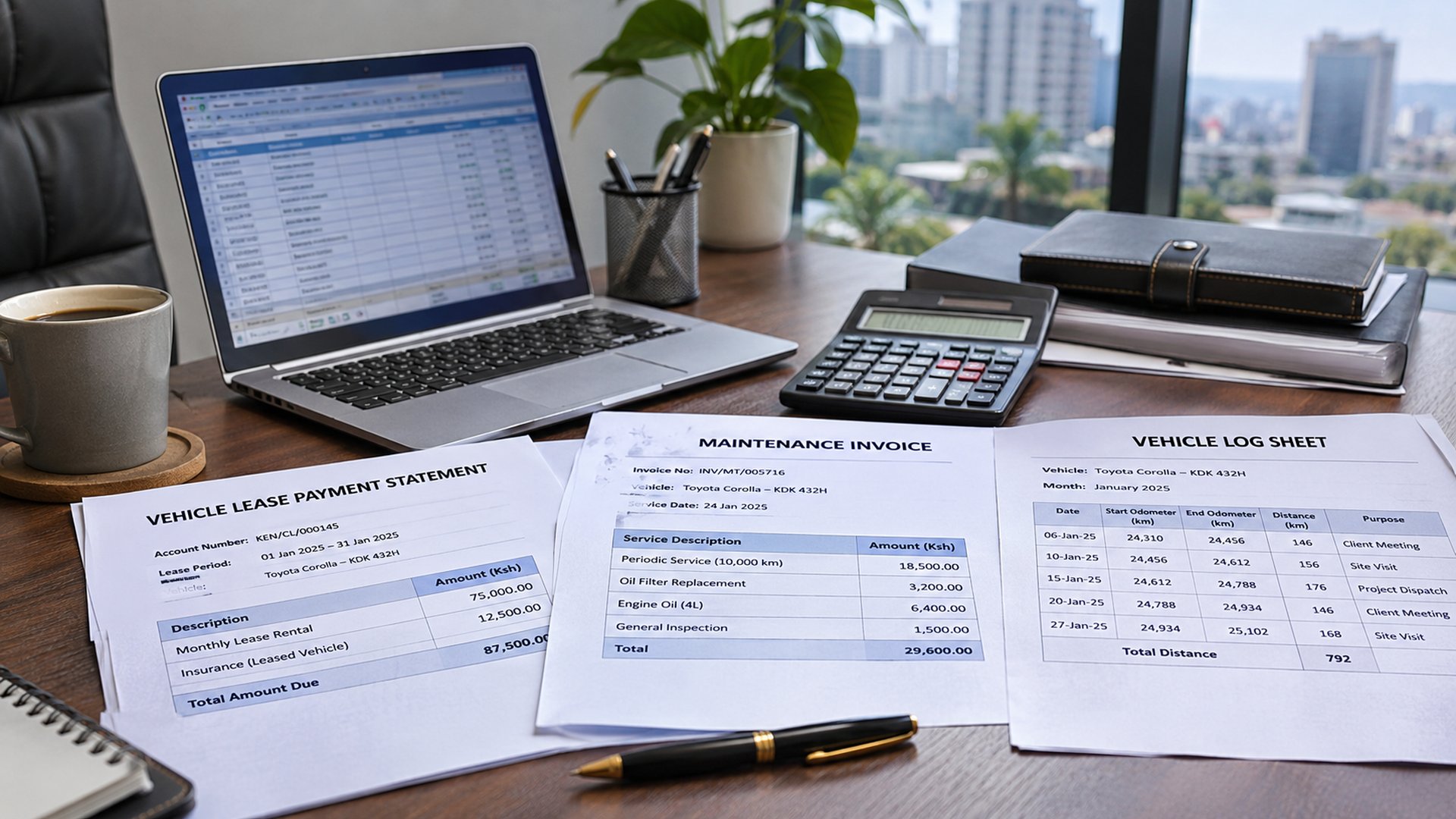
Invoices and vehicle operating statement for car leasing business in Kenya
A useful report for prospective lenders
When discussing financing, owners should present the vehicle asset schedule, financing obligations, verified collected revenue, expenditure by vehicle and documented customer contracts. Lenders may request different information; a glossy utilization chart without reconciliation cannot establish creditworthiness. A responsible management report explains reasonable assumptions and risk, including depreciation and downtime, while preserving the underlying source invoices and agreements.
How we help turn records into decisions
Our services include specialised reporting and advisory, financial services and fixed-asset supporting records, alongside practical reconciliation, accounting, tax-document preparation and scheduled reviews when relevant. In car leasing financial management in Kenya, our starting point is a discussion about which documents already exist and where the main commercial disagreements or delays arise. We agree a reporting period, identify missing evidence and produce a workable record flow rather than claiming that one button solves an entire business operation.
For our published capabilities and available service options, see FedhaTrac services, business management services, and audit preparation. Internal links should lead to related help, not replace the need for clear explanations here. Car leasing financial management in kenya is stronger when each monthly review ends with named follow-ups for unresolved balances and costs.
Kenyan compliance and supporting evidence
Kenyan business owners should maintain appropriate transaction records and check tax obligations for their actual circumstances. KRA’s eTIMS guidance explains electronic business invoicing, while other licenses and operational requirements vary by the activities performed. For this car leasing business, an invoice or financial spreadsheet is not a substitute for permits, clinical or food-safety decisions, vehicle compliance, or lawful stock provenance where applicable.
Relevant sector references include Kenya National Transport and Safety Authority and KRA eTIMS invoicing guidance. In car leasing financial management in Kenya, we advise checking changes with the competent authority and keeping the dated source documents alongside related financial records. FedhaTrac can support record organization and tax preparation within its confirmed scope; regulatory approval must come from the appropriate authority.
Frequently asked questions
Can FedhaTrac manage vehicles and GPS tracking?
We help organize the accounting, customer, payment and financial reporting evidence. Live GPS, mechanical inspections, roadworthiness certification and dispatch are distinct operational services, not capabilities we claim without confirmation. With car leasing financial management in Kenya, the right first step is to define the evidence and the decision the business needs to make, then select the appropriate support rather than assume unverified automation.
Why does a profitable leasing business still run short of cash?
Receivables, refundable deposits, insurance renewals, loan payments and vehicle purchases move cash at different times from earned income. We help you see those movements separately. With car leasing financial management in Kenya, the right first step is to define the evidence and the decision the business needs to make, then select the appropriate support rather than assume unverified automation.
Do deposits count as income?
Not merely because they were received. Treat refundable deposits according to the contract and appropriate accounting; any permitted application or forfeiture needs documented authorization. With car leasing financial management in Kenya, the right first step is to define the evidence and the decision the business needs to make, then select the appropriate support rather than assume unverified automation.
What should I bring to a FedhaTrac consultation?
Bring your fleet list, lease agreements, invoices, receipts, bank and M-Pesa statements, finance schedules and repair records. We can identify the financial gaps before building reports. With car leasing financial management in Kenya, the right first step is to define the evidence and the decision the business needs to make, then select the appropriate support rather than assume unverified automation.
Build the next month on clearer evidence
Good car leasing financial management in Kenya is not about producing a thicker bundle of papers at month-end. It is about knowing which income is earned, which amounts remain owed, what costs belong to each activity, and which decisions the owner should take now. At FedhaTrac, we bring bookkeeping discipline, financial reporting and practical advisory support to that process without pretending to replace the specialists who operate the business itself.
Contact FedhaTrac to discuss your current records and the services suited to your operation. We can help identify the financial evidence to organize first, create a realistic reporting plan, and make the next review more useful than a glance at the bank balance.


