
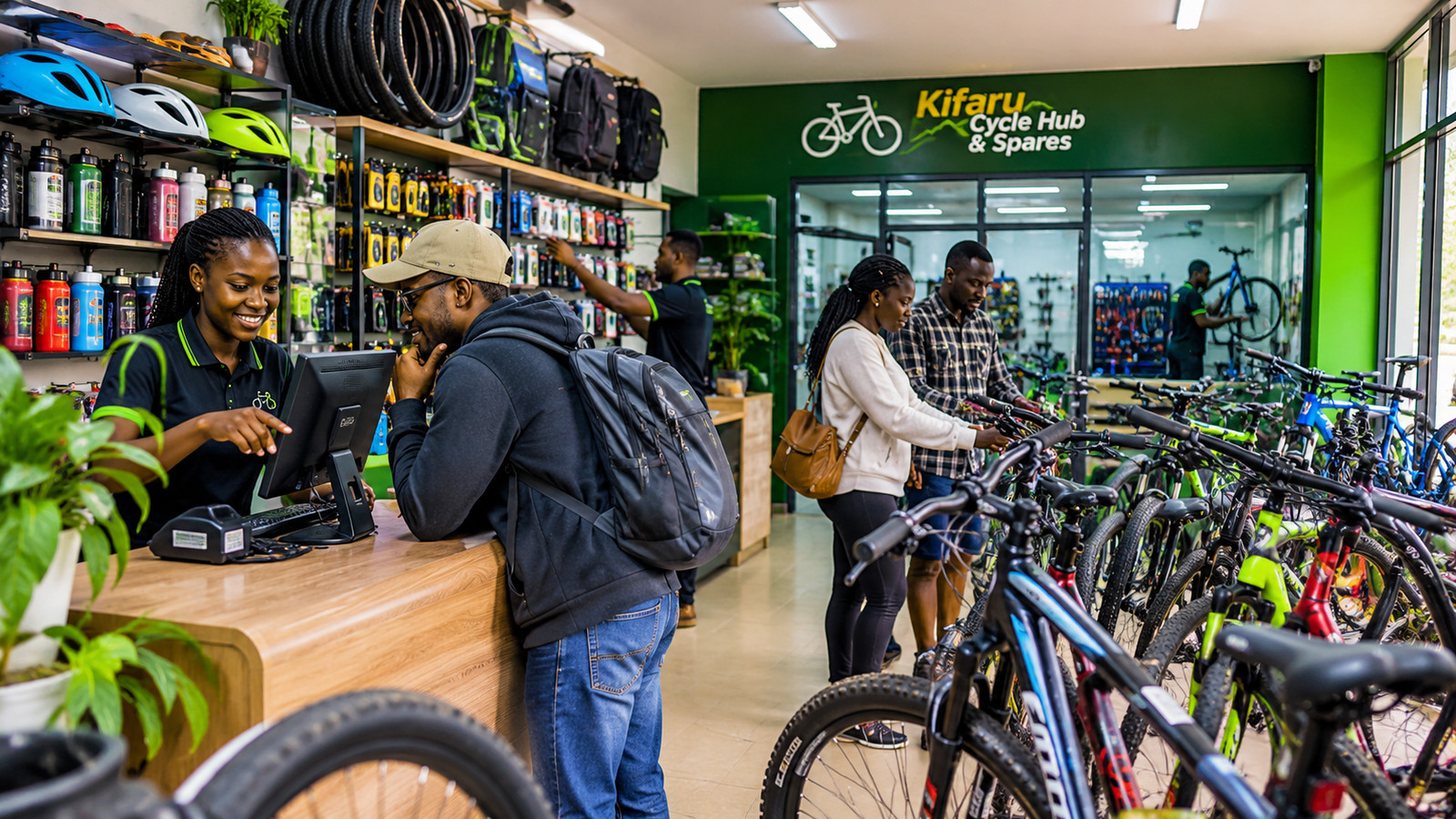
A bicycle shop can sell a mountain bike in the morning, replace a punctured tube at lunchtime, and collect an M-Pesa payment for helmets before closing. All three transactions matter, but they do not tell the owner the same story. A complete bike ties up significant stock capital; a repair combines labor and parts; an accessory may have a completely different margin. A bicycle shop POS system gives the counter an organized starting point. At FedhaTrac, we go further by connecting that activity to bookkeeping, payment reconciliation, expenses, supplier balances, and financial reports you can act on.
Meet Kifaru Cycle Hub & Spares, a fictional Nairobi retailer selling adult and children’s bicycles, helmets, locks, tires, chains, and basic repair services. Kifaru is an example, not a real FedhaTrac client or a claim about results we have achieved for a named business. The owner wants answers: Which products actually earn money? Which payments reached the bank? Can next month’s stock be financed without squeezing rent and wages? That is where our finance support helps.
Choose a Bicycle Shop POS System: Ours or Yours
FedhaTrac offers its own point-of-sale solution, so a shop looking for a new system can discuss its sales workflow with our team. If you already use another bicycle shop POS system, we can work with its available sales reports, invoices, payment summaries, and other agreed records. We then organize those figures within your financial records and help you understand them.
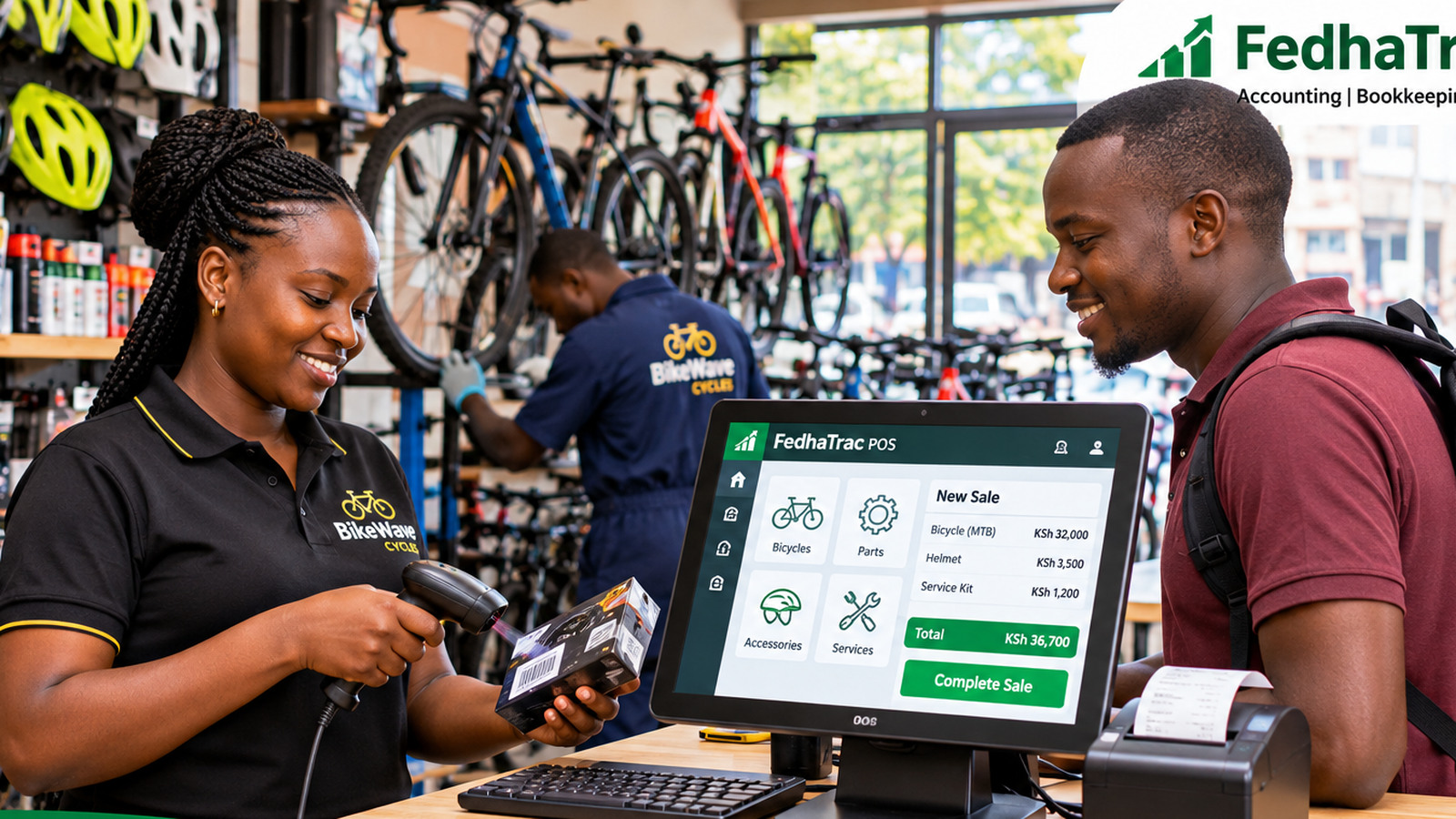
Shop assistant demonstrating a point-of-sale checkout to a bicycle customer in a Kenyan cycling shop
A software vendor may show today’s turnover; our bookkeeping and accounting support helps you see whether that turnover becomes collected cash, whether costs are correctly recorded, and what profit is left after expenses. We do not assume that every third-party POS has a direct automatic connection to our platform. Reliable exported reports, source documents, and a consistent review process can still create meaningful financial visibility.
For Kifaru, a bicycle shop POS system would be the reliable point of capture for sales of bikes and accessories. Our team would use those records together with workshop sheets, stock-count evidence, supplier invoices, and payment statements to prepare a financial picture the owner can trust. Here are seven practical controls we can put around that workflow.
1. Use a Bicycle Shop POS System to Trace Each Sale
A single bike sale may include the bicycle, helmet, lock, bottle cage, assembly service, delivery charge, and a customer discount. Without a structured sale record, staff might issue one broad receipt while the owner loses sight of what was sold and what each item cost. We organize categories and records so each sale can be explained.
With our bicycle shop POS system option, we can discuss a checkout structure appropriate for the shop. With an existing bicycle shop POS system, we can use its itemized exports where available. If a bicycle shop POS system cannot export every detail, we agree on a practical supporting register rather than pretending the missing information exists.
Imagine a customer buys a bicycle for KSh 38,000, a helmet for KSh 3,500, and a lock for KSh 1,500. The complete sale is KSh 43,000 before any documented discount. Our process helps the owner distinguish bike revenue from accessory revenue, match the payment, and preserve records that explain the transaction. That discipline also makes refund investigations and staff handovers less stressful.
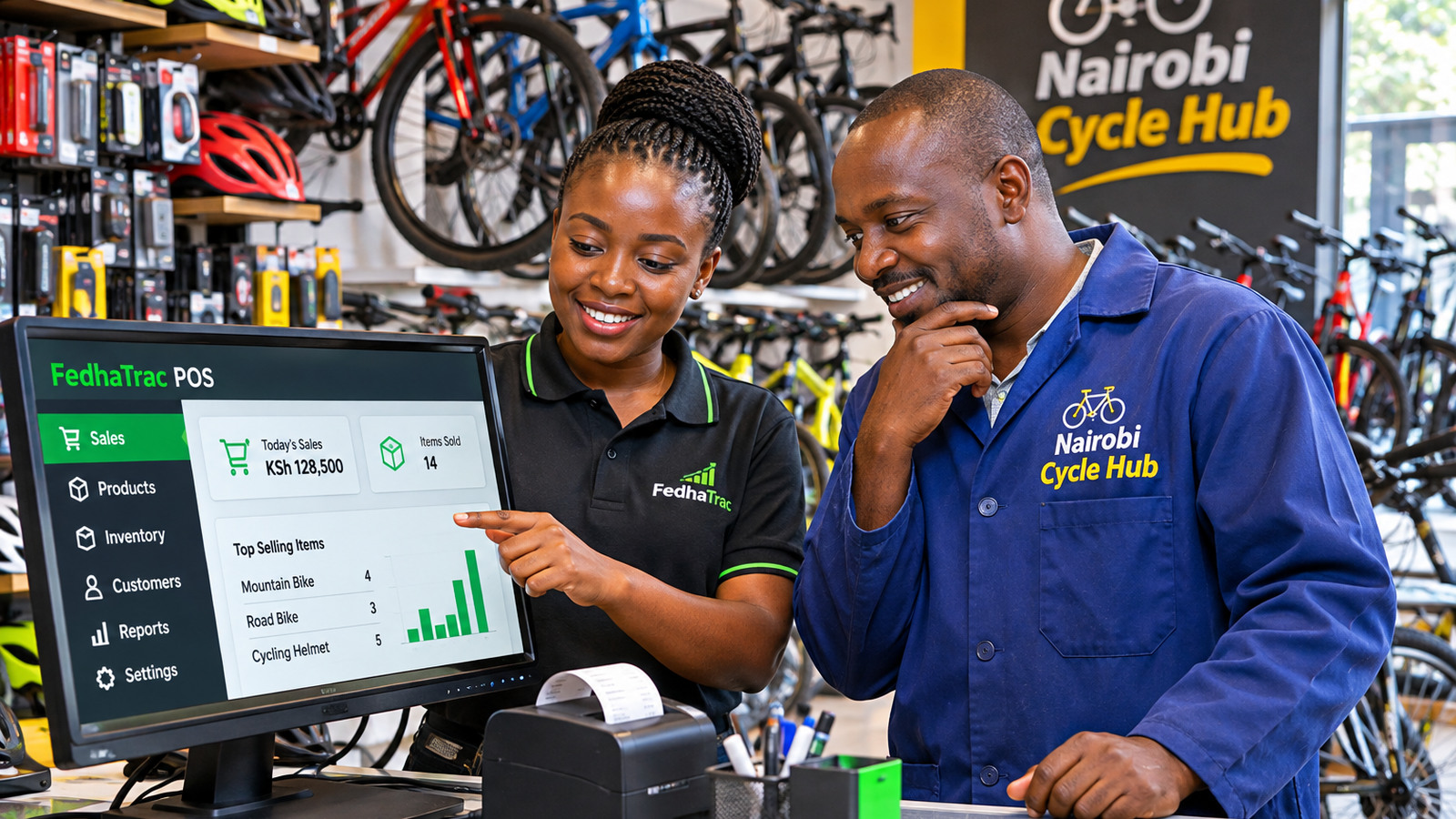
FedhaTrac retail representative explaining bicycle sales records on a POS screen
The benefit: you can ask which categories are driving sales instead of relying on memory, and our team can prepare more useful reports from the same activity already passing through the counter.
2. Reconcile Cash, M-Pesa, Bank and Customer Credit
A customer may pay partly through M-Pesa, another may use cash, and a corporate buyer may collect several bikes on approved credit. The cashier may see a successful transaction even though some money has not yet arrived or a refund needs to be matched.
We use bicycle shop POS system reports alongside cash counts, M-Pesa statements, bank deposits, card settlement records where applicable, and customer account schedules. Our team matches the amounts to supporting evidence, investigates differences, and keeps exceptions visible until they are resolved. For example, if the bicycle shop POS system says KSh 60,000 was received through M-Pesa but the reference list supports only KSh 57,000, we flag the KSh 3,000 difference for review instead of silently treating it as collected.
For an illustrative month at Kifaru, net sales amount to KSh 700,000. Of that total, KSh 470,000 is settled through M-Pesa, KSh 110,000 in cash, KSh 75,000 through bank or card channels, and KSh 45,000 remains on customer credit. Those four categories reconcile to KSh 700,000, but only KSh 655,000 represents receipts from those sales so far, before settlement costs or bank transfers.

Illustrative payment reconciliation for bicycle retail sales, showing KSh 655,000 collected and KSh 45,000 on credit
This is where our service adds value beyond a checkout screen. We make the difference between sales earned, cash received, and money still owed understandable. Your business owner can make spending decisions based on evidence rather than overestimating available cash.
3. Connect Spare Parts and Repair Labor to Each Workshop Job
A bike repair might require a tube, brake pads, cable, lubricant, and technician time. If the shop records only a single repair price, it becomes difficult to understand the cost of providing the service. If parts leave the shelf without being recorded anywhere, the stock count and the financial results can drift apart.
Our approach starts with a simple workshop job record showing the customer, bicycle, work requested, materials used, labor charged, agreed price, completion date, and payment reference. Where the chosen bicycle shop POS system supports service categories or relevant line items, that information can feed the sales report. Where it does not, we can work from a consistent job sheet and reconcile the workshop totals to the register.
Suppose Kifaru charges KSh 2,500 for a repair, using parts and consumables that cost KSh 650. That leaves KSh 1,850 before the share of technician wages, rent, utilities, and other operating costs. We help management understand this difference between a job’s direct margin and the actual profit of the business. We are not promising an automated repair-ticket feature unless it is confirmed for the chosen setup.
By separating parts sales from workshop services, our reports can show whether a busy repair bench is supporting the shop financially or consuming time without adequate returns. That is a valuable question for bicycle owners, mechanics, and retailers alike.
4. Keep Supplier Purchases and Bicycle Stock Costs Under Control
A bicycle retailer may purchase complete bikes from one wholesaler, accessories from another, and workshop consumables from several suppliers. Some purchases are paid immediately; others come with due dates. A shop can look healthy at the till while struggling to pay for its next delivery.
We organize supplier invoices, purchase records, due dates, and payment histories so the owner has a clearer view of what the business owes. A bicycle shop POS system may provide item quantities and sales movement; we compare that information with purchase invoices and physical stock-count records supplied by the team. We can then help prepare stock-cost schedules, highlight unexplained differences, and identify categories that deserve attention.
For example, a bicycle shop POS system report might show eight bicycle chains sold in a period while the physical count suggests ten pieces left the shelf. We would not automatically label the difference as theft. Returns, workshop usage, damage, miscounts, or missed transactions could explain it. Our role is to make the variance visible and help the business document a supported correction.
See our retail bookkeeping guide for related accounting principles. This is especially relevant when a shop carries multiple bike sizes, children’s models, tires, and small spare parts. With better records, the owner can compare ordering decisions against actual demand and available cash instead of restocking purely on instinct.
5. Identify What the Business Earns After Costs
High sales are encouraging, but revenue is not profit. A bicycle shop POS system may show KSh 700,000 of sales without deducting the cost of bikes, repair parts, payroll, rent, delivery, and the other expenses that keep the shop running. At FedhaTrac, we combine those records to help the owner see a fuller picture of performance.
Here is a fully illustrative monthly summary for Kifaru. The amounts are not a real client’s data or a forecast of what FedhaTrac will earn for any business.
| Illustrative monthly measure | KSh |
| Complete bicycle sales | 420,000 |
| Accessories sales | 130,000 |
| Spare-parts sales | 90,000 |
| Repair labor and services | 60,000 |
| Total net sales | 700,000 |
| Cost of bicycles sold | (315,000) |
| Cost of accessories sold | (75,000) |
| Cost of spare parts sold | (52,000) |
| Direct repair consumables | (11,000) |
| Gross profit | 247,000 |
| Operating expenses | (159,000) |
| Illustrative operating result | 88,000 |
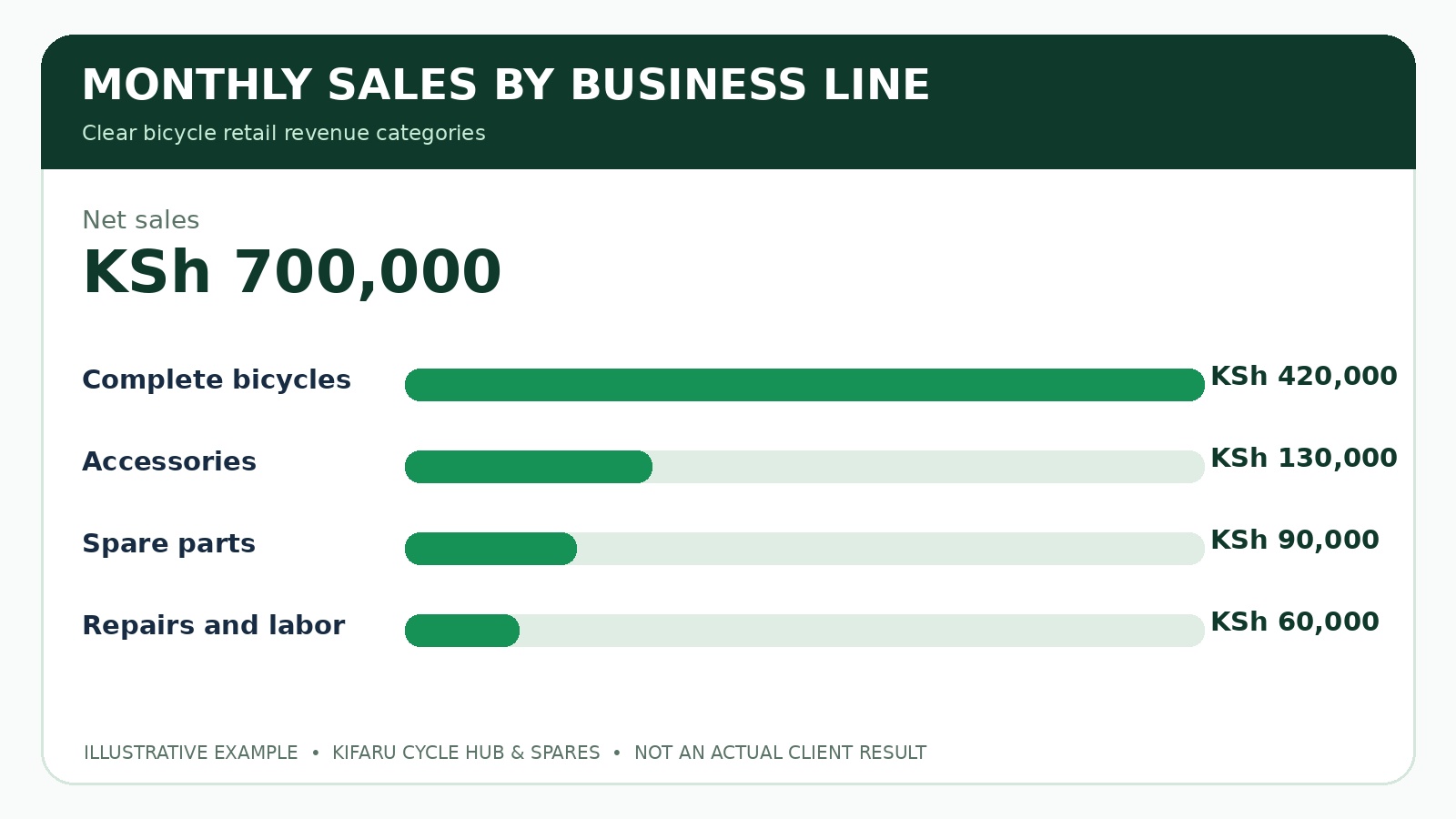
Sample bicycle shop POS system monthly sales report showing KSh 700,000 across bicycle, accessory, spare part and repair sales
The KSh 88,000 figure is before tax, financing costs, and depreciation. It also includes KSh 45,000 of customer credit sales not yet collected. It must not be mistaken for cash available to withdraw. This distinction helps the owner weigh supplier orders and upcoming bills responsibly.
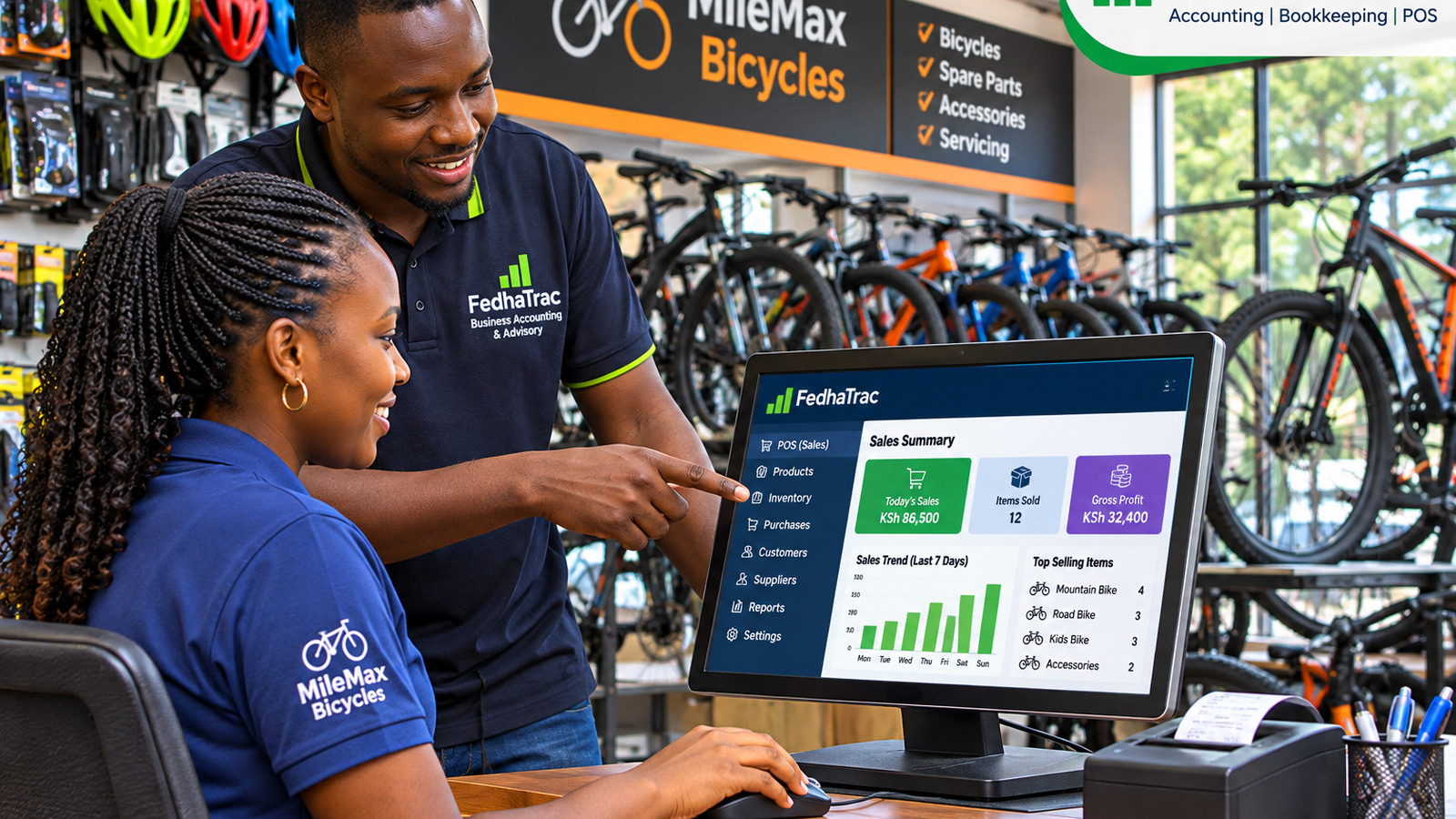
Kenyan bicycle store team reviewing POS sales and financial reports
Our financial reporting support turns bicycle shop POS system sales into management information. We can help you compare monthly margins, expense trends, cash collection, supplier obligations, and the contribution of bikes versus accessories or services. The owner sees what needs action, not just a total printed at closing time.
6. Make Pricing, Discounts and Stock Decisions More Informed
Cycling retailers face different buying patterns across school holidays, rainy periods, weekend recreation, and club events. Promotions can bring shoppers into the showroom, but discounts also reduce the amount left to cover business costs. We help management examine the figures before assuming every promotion is good for profit.
A bicycle shop POS system can provide sales by item or product category where configured. We use available reports, supplier costs, and expense information to compare categories and estimate margins. Consider two items selling for KSh 4,000 each: one costs KSh 2,100 to purchase while the other costs KSh 3,200. They generate KSh 1,900 and KSh 800 in gross margin respectively, even though the price on the shelf is identical.
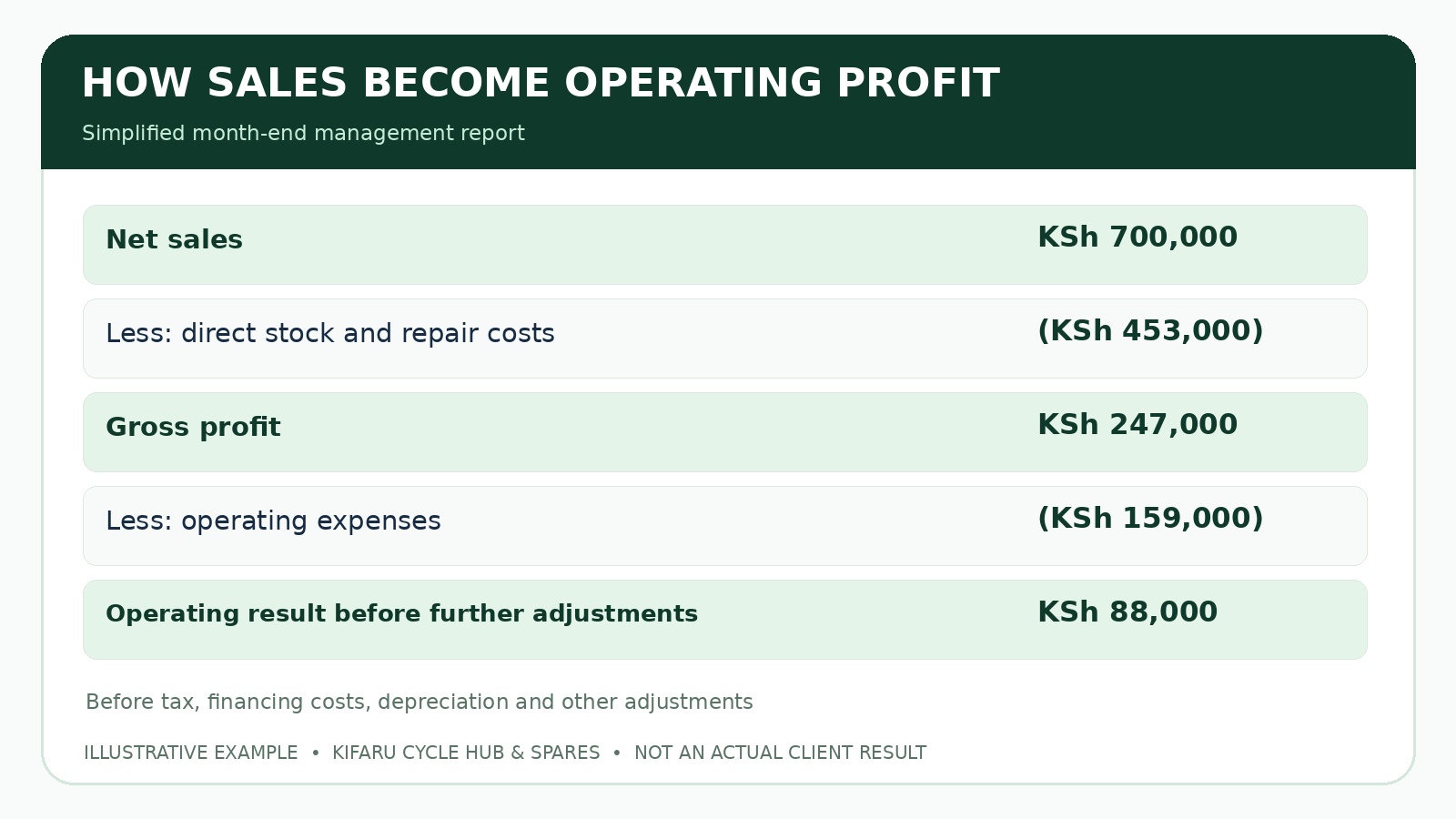
Sample bicycle retailer operating profit report from KSh 700,000 sales, KSh 453,000 direct costs, and KSh 159,000 expenses
We can also help the owner measure the financial impact of markdowns, bundles, refunds, and slow-moving items. If helmets sell more regularly than premium bikes, the business may need to allocate working capital differently. If repairs attract regular customers but use considerable labor, pricing deserves a separate review. Our guidance is grounded in the financial evidence available, not a promise that software alone makes every decision.
Kifaru can compare sales, margins, stock, and bills before funding its next order.
7. Turn Checkout Activity into Reports and Tax-Ready Records
We organize agreed sales and purchase evidence, reconcile transaction sources, record expenses, and prepare financial reports that support clearer discussions with owners and managers. The FedhaTrac services team can also help with relevant KRA filing and compliance tasks within the agreed engagement.
For Kenyan sellers, eTIMS electronic tax invoicing is a separate compliance obligation from simply issuing a standard bicycle shop POS system receipt. The Kenya Revenue Authority provides several eTIMS solutions. Direct system-to-system invoicing integration requires an appropriate supported setup and, where applicable, the relevant integration process; we do not claim every bicycle shop POS system automatically has that connection. Our role is to help organize the underlying records, identify the appropriate compliance workflow, and support the business with its tax obligations. Business owners can review the official KRA eTIMS guidance.
Month-end can then become a repeatable routine: obtain bicycle shop POS system summaries, verify receipts, reconcile supplier and payment balances, review stock-cost changes, resolve exceptions, and prepare the agreed reports. The bicycle shop POS system remains a valuable source; our accountants make the information more useful for decisions and compliance.
What It Looks Like to Work With FedhaTrac
We begin by learning how your bicycle store operates: which products it sells, whether it has a repair bench, how staff collect payments, which suppliers extend credit, and what system is already at the counter. If you want our POS solution, we discuss a suitable implementation and the data your team needs to capture. If you want to keep an existing bicycle shop POS system, we review its available exports and agree on a secure way to share the necessary reports.
Next, we agree on the records, responsibilities, and reporting scope. Our team handles the agreed bookkeeping, reconciliation, expense organization, queries, and reporting work. We identify unclear items rather than inventing explanations for them.
Finally, we review the numbers with you in language you can use: how much was sold, what was collected, which suppliers must be paid, how much stock cost, and which parts of the business deserve management attention. For a business owner, that means less guesswork and more confidence during purchasing, pricing, and expansion discussions.
This is why we believe bicycle shop POS system support should include both practical software and people who understand the accounts. We offer that combination without requiring you to change a checkout setup that already works.
Frequently Asked Questions About POS and Bicycle Shop Finances
Can FedhaTrac provide a bicycle shop POS system?
Yes. We offer our own POS solution and can discuss how it would fit the products and sales workflow at your bicycle shop. Our value does not end when a customer receives a receipt: we also provide bookkeeping, reconciliation, and reporting support to help you understand what the shop earns and spends. Tell us how your team sells bicycles and accessories, and we will help you choose a practical approach.
What if I already have a bicycle shop POS system?
You can keep it. We work with the sales reports and supporting records your existing system can provide, alongside M-Pesa, bank, supplier, and expense information. We agree on the reporting process during onboarding rather than promising an automatic integration that has not been confirmed. You gain the benefit of our financial expertise without replacing working software simply for the sake of change.
Can you help me understand the profit on bikes, accessories and repairs?
Absolutely. We help organize product and service revenue, direct costs, operating expenses, and reconciled payment records so you can assess where money is being made and used. The quality of the analysis depends on complete sales and cost evidence, and we will explain what additional information your team should collect. Our goal is clear, practical reporting you can use to manage the business.
Can you help with M-Pesa differences, stock costs and customer balances?
Yes. These are exactly the kinds of financial records our bookkeeping and reconciliation team can help organize. We compare bicycle shop POS system totals with relevant payment statements and supporting documents, review supplier and customer schedules, and flag stock-cost variances that need attention. We also help you understand what has been paid, what remains outstanding, and what questions must be resolved before the books are closed.
Will FedhaTrac also help my bicycle shop with KRA requirements?
We offer tax-filing and compliance support as part of our wider services. We help clients maintain organized records and discuss relevant eTIMS and return-filing requirements for their circumstances. A bicycle shop POS system receipt is not automatically an eTIMS tax invoice, so we will explain the distinction and agree on a suitable compliance process. Contact us to discuss the scope your business needs.
Put Your Bicycle Shop’s Numbers to Work
Whether you operate one compact bike shop, a busy showroom with a repair counter, or a growing cycling retail business, your accounts should tell a useful story. At FedhaTrac, we bring together our bicycle shop POS system option, support for the reports from your current system, experienced bookkeeping, payment reconciliation, expense tracking, and practical financial reporting.
You do not need to choose between a familiar bicycle shop POS system and professional financial guidance. Talk to FedhaTrac about your sales process, and we will help you plan the records and support that give your business clearer financial direction. Keep serving cyclists; let us help make the numbers make sense.


