

A large catering booking can fill a kitchen and still leave an owner wondering where the money went. Food prices may change after the quotation, an extra guest table adds equipment rental, and a customer’s deposit may be needed to buy ingredients before the event. The difference between a busy catering schedule and a healthy business is the evidence connecting each event promise to every purchase and payment.
At FedhaTrac, our approach to catering business management in Kenya emphasizes business operations, supplier accountability and event-specific financial visibility. We can help organize invoices, approved purchase records, payment reconciliations and reports; chefs and event managers still decide food safety, menus and hospitality standards. Sufuria Events Catering Ltd. is a fictional demonstration business, not a customer claim.
Quote the actual guest count and service scope
In catering business management in Kenya, A quotation should record confirmed guests, menu, dietary requirements, service duration, venue access, equipment, delivery, staffing and the rules for extra plates or late changes. Quoting only a price per guest can leave costly equipment or transport outside the estimate. The practical challenge is visible in day-to-day operations. The business should be able to show how this decision affects its invoices, cash commitments and eventual financial result.

Chefs preparing event food for catering company in Kenya
The operational routine is straightforward: Record what is included and excluded, who approved the proposal and the last date for a guest-count change. A revised quotation must preserve the old version and clarify which version governs the event.
At FedhaTrac, FedhaTrac’s operations support helps retain the commercial trail, while the caterer determines menus, staffing ratios and safe food preparation. In catering business management in Kenya, we prefer information that can be checked back to an agreed contract, a numbered register, a genuine invoice or a banked payment, as appropriate.
Treat a client deposit as a contract commitment
In catering business management in Kenya, Deposits support ingredient purchases, but the accounting treatment depends on when the service is earned and the contract terms. A large bank balance before an event can be misleading if most of the cash must pay suppliers or could become refundable. The owner needs evidence before a small problem becomes a monthly dispute. The business should be able to show how this decision affects its invoices, cash commitments and eventual financial result.
The operational routine is straightforward: Link each receipt to the relevant booking and customer, track remaining invoice balances, and record deposit refunds or applications with approval.
At FedhaTrac, Our invoicing and reconciliation services can help distinguish receipts, customer prepayments, earned revenue and outstanding balances. In catering business management in Kenya, we prefer information that can be checked back to an agreed contract, a numbered register, a genuine invoice or a banked payment, as appropriate.
Use controlled purchase orders for ingredients
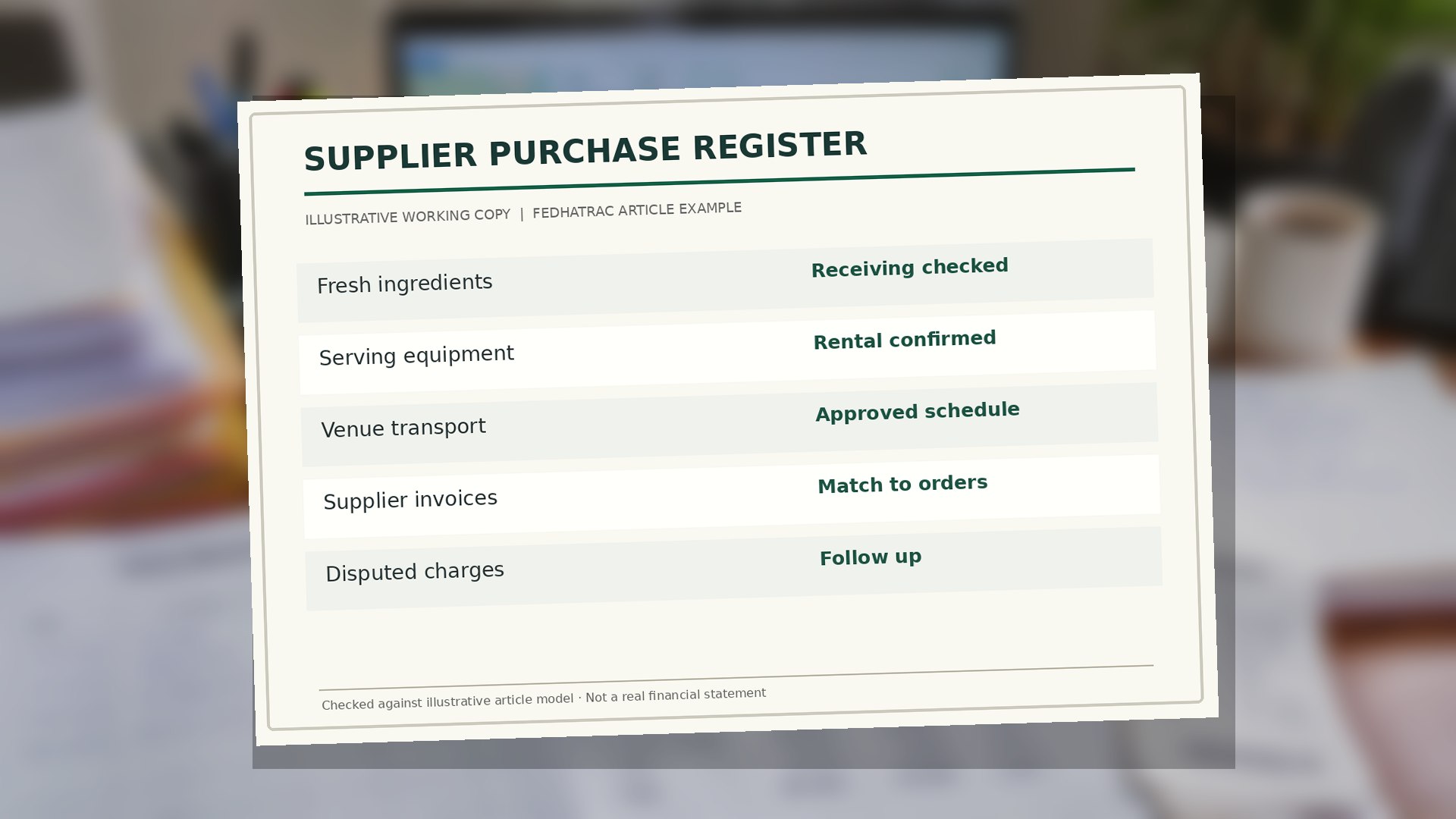
In catering business management in Kenya, Catering costs begin at the supplier. Rice, meat, vegetables, oil, water and disposable serving items may be ordered from several vendors over a short period. Without a controlled shopping and receiving trail, overbuying and duplicate payments are difficult to detect. The most useful report starts with a source document, not with an attractive chart. The business should be able to show how this decision affects its invoices, cash commitments and eventual financial result.

Event manager meeting with client for catering company in Kenya
The operational routine is straightforward: Compare the approved quantities and prices with receiving notes, supplier invoices and actual bank payments. Identify substituted items, rejected deliveries and emergency purchases separately.
At FedhaTrac, FedhaTrac’s business operations and purchasing support helps prepare supplier schedules and exception reports from the evidence provided. In catering business management in Kenya, we prefer information that can be checked back to an agreed contract, a numbered register, a genuine invoice or a banked payment, as appropriate.
Budget temporary staff and outsourced rentals
In catering business management in Kenya, Part-time servers, setup crews, tents, sound systems, crockery and transport can become the largest event-specific expenses after food. Payment terms differ: a supplier may require an advance while staff may receive approved payments after work. A manager should be able to follow the movement without asking staff to reconstruct it from memory. The business should be able to show how this decision affects its invoices, cash commitments and eventual financial result.
The operational routine is straightforward: Maintain authorized rosters or service confirmations, contractual rates, advances and proof of payment. Keep approved employment or contractor classifications rather than assuming all workers are interchangeable.
At FedhaTrac, We can record approved workforce expense figures and supplier bills; FedhaTrac does not advertise payroll processing or labor-law certification as an automatic software feature. In catering business management in Kenya, we prefer information that can be checked back to an agreed contract, a numbered register, a genuine invoice or a banked payment, as appropriate.
Log food waste and returned equipment
In catering business management in Kenya, After an event, unserved food, damaged dishes, missing chairs and extra transport trips should be documented as distinct events. Some losses are ordinary; others indicate quoting, packing or supervision problems. A cashier cannot recover margin merely by increasing next month’s sales. The practical challenge is visible in day-to-day operations. The business should be able to show how this decision affects its invoices, cash commitments and eventual financial result.

Catering team setting up service for catering company in Kenya
The operational routine is straightforward: Use a simple event closeout sheet with cooked quantity, served quantity, authorized disposal, outstanding rental returns and supplier claims. Respect food safety requirements when handling leftovers. A record becomes useful only when the person who prepared it, the date and the approving manager can be identified. This avoids turning every exception into an untraceable verbal explanation.
At FedhaTrac, Our management reports can identify patterns in costs and approved write-offs without taking over the kitchen’s operational safety decisions. In catering business management in Kenya, we prefer information that can be checked back to an agreed contract, a numbered register, a genuine invoice or a banked payment, as appropriate.
Reconcile multiple event payment channels
In catering business management in Kenya, Clients pay deposits, balances and final extras using cash, bank transfer or mobile money. A booking reference should connect these payments to invoices rather than relying on a screenshot in a group chat. The owner needs evidence before a small problem becomes a monthly dispute. The business should be able to show how this decision affects its invoices, cash commitments and eventual financial result.
The operational routine is straightforward: Match payment dates and references to customer accounts, resolve unmatched receipts, and issue agreed credit notes for genuine adjustments. Avoid treating a customer’s advance as an additional sale after the event is invoiced. A record becomes useful only when the person who prepared it, the date and the approving manager can be identified. This avoids turning every exception into an untraceable verbal explanation.
At FedhaTrac, FedhaTrac supports reconciliations, customer statements and clear bookkeeping status so owners can pursue the right balances. In catering business management in Kenya, we prefer information that can be checked back to an agreed contract, a numbered register, a genuine invoice or a banked payment, as appropriate.
Compare profit by event rather than the whole month
In catering business management in Kenya, Six events in one month can hide one loss-making weekend. Separate ingredients, event labor, transport, rentals and overhead allocation for each booking so the owner knows which menu or customer type is viable. The most useful report starts with a source document, not with an attractive chart. The business should be able to show how this decision affects its invoices, cash commitments and eventual financial result.
Catering business management in kenya — ingredient purchase orders and supplier invoices
The operational routine is straightforward: Use the same allocation logic consistently, flag exceptional changes and compare a final cost sheet with the approved quotation. Never infer a margin from food cost alone. A record becomes useful only when the person who prepared it, the date and the approving manager can be identified. This avoids turning every exception into an untraceable verbal explanation.
At FedhaTrac, Our specialised reporting and advisory offers useful event-level analysis from the operator’s approved records. In catering business management in Kenya, we prefer information that can be checked back to an agreed contract, a numbered register, a genuine invoice or a banked payment, as appropriate.
Keep eTIMS and county food documentation organized
In catering business management in Kenya, KRA describes eTIMS as a business electronic-invoicing system and county rules can require relevant public-health permits for food operators. The exact permit mix depends on the premises and local authority; finance staff should not improvise health certifications. A manager should be able to follow the movement without asking staff to reconstruct it from memory. The business should be able to show how this decision affects its invoices, cash commitments and eventual financial result.
The operational routine is straightforward: Maintain current tax-invoice records, supplier support, local permit copies and renewal reminders. Confirm VAT and tax status individually rather than claiming every catering firm charges the same tax rate. A record becomes useful only when the person who prepared it, the date and the approving manager can be identified. This avoids turning every exception into an untraceable verbal explanation.
At FedhaTrac, FedhaTrac can assist with tax-compliance records and documentation, while the business and authorized officers maintain actual food-safety approvals. In catering business management in Kenya, we prefer information that can be checked back to an agreed contract, a numbered register, a genuine invoice or a banked payment, as appropriate.
Turn the next event into a better process
In catering business management in Kenya, At closeout, ask whether the final guest count matched the quote, which suppliers varied prices, whether deposits covered commitments, and when remaining balances will be collected. The result should be a revised quote template and an actionable supplier list. The practical challenge is visible in day-to-day operations. The business should be able to show how this decision affects its invoices, cash commitments and eventual financial result.
Event cost sheet on desk for catering company in Kenya
The operational routine is straightforward: Schedule weekly booking reviews and a monthly management report that tests receipts, payables, cash needs and event margins. A record becomes useful only when the person who prepared it, the date and the approving manager can be identified. This avoids turning every exception into an untraceable verbal explanation.
At FedhaTrac, Our business consultations, financial reporting and quarterly reviews help owners turn past-event evidence into repeatable improvements. In catering business management in Kenya, we prefer information that can be checked back to an agreed contract, a numbered register, a genuine invoice or a banked payment, as appropriate.
A worked example: Sufuria Events Catering Ltd. (fictional)
The following is an illustrative financial model for Sufuria Events Catering Ltd., a fictional catering company used only to explain catering business management in Kenya. It is not a report about a real FedhaTrac customer, and none of the figures should be used as industry benchmarks or quoted supplier prices.
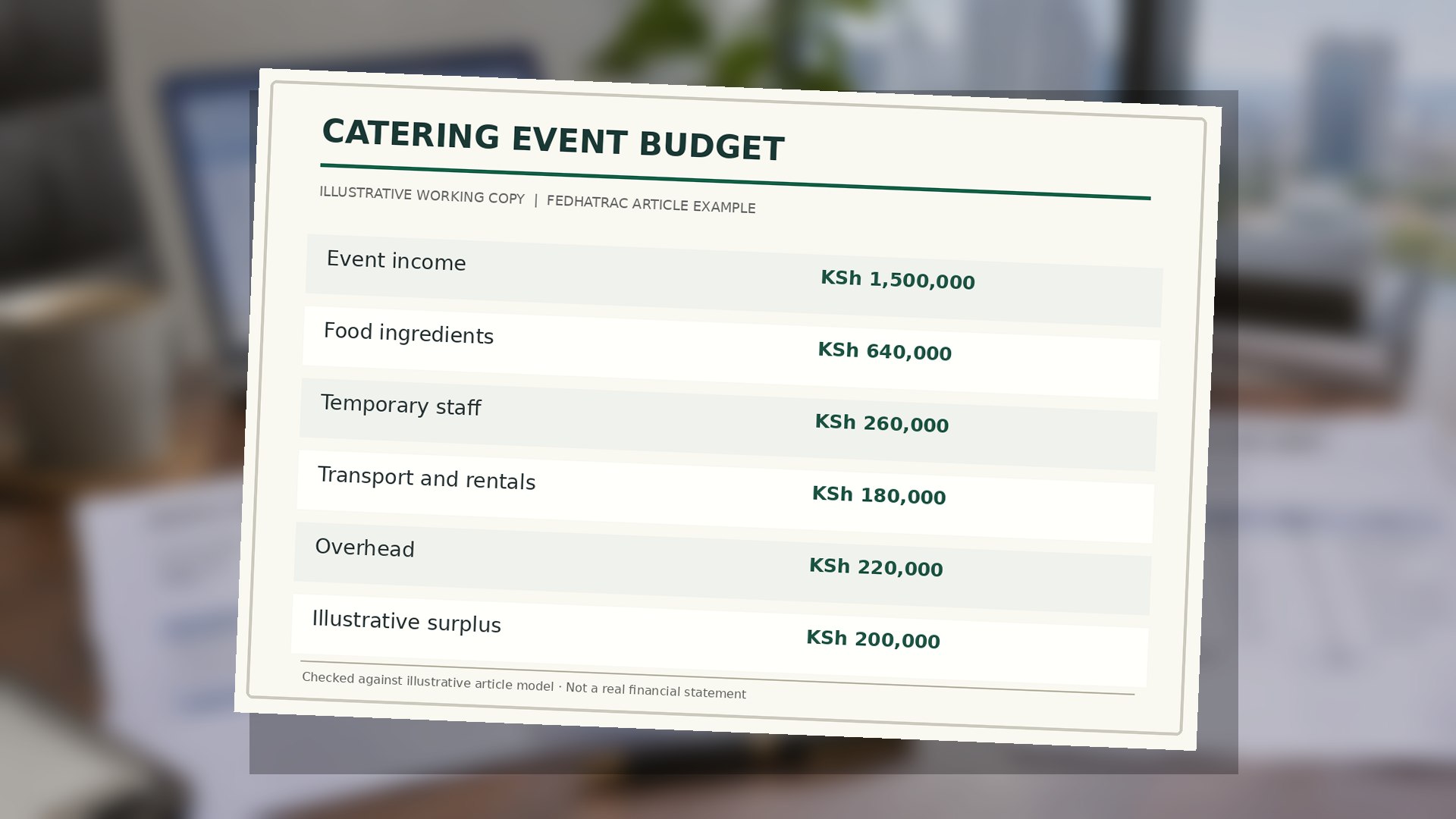
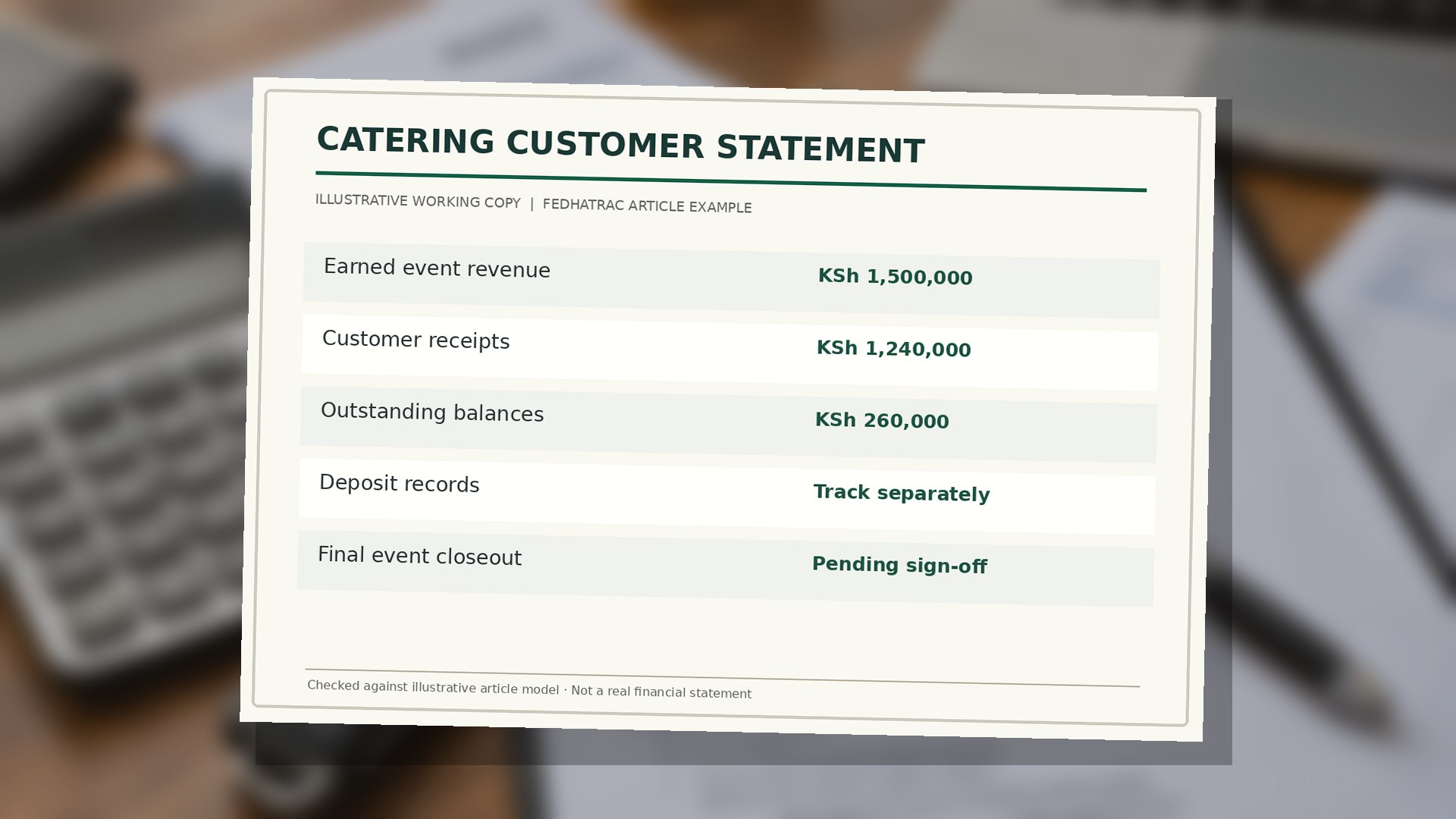
Sufuria Events Catering Ltd. runs six fictional events in a month and earns KSh 1,500,000. Food purchases used in those events cost KSh 640,000, approved temporary labor KSh 260,000, equipment and transport KSh 180,000, and allocated operating overhead KSh 220,000. Its illustrative operating surplus is KSh 200,000. Cash collected is KSh 1,240,000; therefore KSh 260,000 of earned invoices remain outstanding, assuming no opening receivables or credit notes. If a client has paid an advance for a future event, the caterer must separately evaluate whether the related service has been earned; the illustration does not classify future deposits as current revenue. A per-event analysis—not simply the aggregate profit—is needed to identify loss-making bookings.
The lesson for catering business management in Kenya is that a single headline amount rarely captures all the obligations. Owners should inspect the underlying document trail, whether money has actually been received or paid, and any commitments that fall due after the reporting date. We help connect the evidence to sensible financial reporting and management conversations, but the operator must certify its physical activities and the professional accountant must apply the correct reporting policy.
A practical event closeout meeting
Within a reasonable period after service, collect the approved final guest number, staff attendance confirmation, unused equipment returns, supplier bills and receipts for extras. Discuss what went well and what changed without blaming staff for every surprise. If one supplier exceeded the agreed purchase order, clarify whether the variation was approved. Close the customer account only after valid credits, balances and outstanding disputes are reviewed.
Customer deposits and event sales reconciliation for catering company in Kenya
Price future bookings from real costs
Avoid using the last contract price as the only starting point for a new proposal. Check ingredient quantities, event-labor rates, transport distance, equipment availability and any known seasonal price pressure. If management wants to discount for a repeat customer, calculate what happens to contribution after the discount and record the approval. Good catering business management in Kenya makes pricing decisions visible before the kitchen commits to purchases.
How we help turn records into decisions
Our services include business operations support, purchase order administration, invoices and reporting, alongside practical reconciliation, accounting, tax-document preparation and scheduled reviews when relevant. In catering business management in Kenya, our starting point is a discussion about which documents already exist and where the main commercial disagreements or delays arise. We agree a reporting period, identify missing evidence and produce a workable record flow rather than claiming that one button solves an entire business operation.
For our published capabilities and available service options, see FedhaTrac services, business management services, and audit preparation. Internal links should lead to related help, not replace the need for clear explanations here. Catering business management in kenya is stronger when each monthly review ends with named follow-ups for unresolved balances and costs.
Kenyan compliance and supporting evidence
Kenyan business owners should maintain appropriate transaction records and check tax obligations for their actual circumstances. KRA’s eTIMS guidance explains electronic business invoicing, while other licenses and operational requirements vary by the activities performed. For this catering company, an invoice or financial spreadsheet is not a substitute for permits, clinical or food-safety decisions, vehicle compliance, or lawful stock provenance where applicable.
Relevant sector references include Kenya business permits and food-handling overview and KRA electronic tax invoicing. In catering business management in Kenya, we advise checking changes with the competent authority and keeping the dated source documents alongside related financial records. FedhaTrac can support record organization and tax preparation within its confirmed scope; regulatory approval must come from the appropriate authority.
Frequently asked questions
Does FedhaTrac run catering orders and menus?
Our confirmed role is commercial and financial administration: invoices, supplier records, reconciliations, purchasing evidence and reporting. Menu design, kitchen execution and food safety remain with the caterer. With catering business management in Kenya, the right first step is to define the evidence and the decision the business needs to make, then select the appropriate support rather than assume unverified automation.
Can we handle events paid partly in advance?
Yes. Proper customer account records can distinguish deposits, earned revenue, balances due and authorized refunds. With catering business management in Kenya, the right first step is to define the evidence and the decision the business needs to make, then select the appropriate support rather than assume unverified automation.
What if suppliers change prices close to the event?
Keep the revised quotation, approved purchase order, receiving document and invoice, then review the variance in the event closeout. With catering business management in Kenya, the right first step is to define the evidence and the decision the business needs to make, then select the appropriate support rather than assume unverified automation.
Which records should I bring?
A sample quote, booking ledger, purchase invoices, staff and rental cost confirmations, customer receipts and recent bank or mobile-money statements. With catering business management in Kenya, the right first step is to define the evidence and the decision the business needs to make, then select the appropriate support rather than assume unverified automation.
Build the next month on clearer evidence
Good catering business management in Kenya is not about producing a thicker bundle of papers at month-end. It is about knowing which income is earned, which amounts remain owed, what costs belong to each activity, and which decisions the owner should take now. At FedhaTrac, we bring bookkeeping discipline, financial reporting and practical advisory support to that process without pretending to replace the specialists who operate the business itself.
Contact FedhaTrac to discuss your current records and the services suited to your operation. We can help identify the financial evidence to organize first, create a realistic reporting plan, and make the next review more useful than a glance at the bank balance.


