

A project can be busy, well staffed, and visibly progressing while its finances are heading in the wrong direction. Materials arrive, teams travel, suppliers request payment, and clients ask when the next milestone will be delivered. Yet the project manager may still struggle to explain how much has been committed, how much has actually been spent, or whether enough cash remains to finish. Project financial management in Kenya brings these questions into a disciplined process. At FedhaTrac, we combine project-level bookkeeping, useful financial tools, and professional reviews so you can move from collecting receipts to controlling decisions.
Whether you coordinate training programs, research assignments, technology rollouts, construction-related services, or community initiatives, a single business bank balance does not reveal the condition of each project. We help you organize the records behind your work, match spending to its purpose, review budgets against actual costs, and understand upcoming obligations. Our approach to project financial management in Kenya is practical: give your team clear information before a financial problem becomes a project delay.
Why Project Financial Management in Kenya Needs More Than an Expense Spreadsheet
A normal expense report tells you what the business paid. A project report should also tell you which assignment benefited, whether the purchase was approved, whether the goods or services were received, what still needs to be paid, and whether the expenditure remains within the relevant budget. These are different questions. Without project codes or consistent categories, one supplier invoice can be charged to the wrong job, a shared transport bill can be overlooked, or a customer advance can be mistaken for profit.

Project financial management in Kenya team reviewing project documents and budgets
FedhaTrac helps project teams build a workable record structure. Our project-based business accounting services include allocating transactions by job or contract, reconciling accounts, tracking supplier records, and preparing budget-versus-actual reports. The objective of project financial management in Kenya is not more paperwork. It is information that management can use to decide whether to approve a new expense, request a milestone payment, investigate a variance, or revise a delivery plan.
What FedhaTrac’s Project Finance Support Actually Covers
Our support brings together project budgets, funds-awarded records where relevant, requisitions, suppliers, invoices, payment histories, expense classification, and financial reports. The FedhaTrac interface you’ve seen includes a Project Management area with Funds Awarded, Budgets, Requisitions, and Donors/Funders. These features complement our professional bookkeeping and business operations support services.
We don’t claim every purchase is automatically approved, every banking transaction automatically synchronized, or every contract automatically converted into a report. The client’s approval arrangements, source documents, and system connections determine the workflow. What we provide is a way to keep financial evidence organized and a team that can interpret it. That distinction matters when choosing project financial management in Kenya for an actual organization rather than reading a generic software advertisement.
Build a Budget That Follows the Work
A project budget should reflect the activities that will consume money. Rather than placing everything under ‘miscellaneous,’ we help map reasonable cost groups such as personnel, travel, venue hire, materials, communication, specialist contractors, and equipment. Each line should have an owner and a clear basis. If staff are shared between projects, the allocation method should be documented rather than guessed after the work is completed.
Before a major commitment, management should ask whether the available budget covers both the proposed cost and obligations already incurred. A remaining budget is not the same as money in the bank. Our approach to project financial management in Kenya makes that distinction visible and helps teams compare estimates, recorded expenditure, and future work without declaring every unspent amount to be freely available cash.
Track Funding, Client Milestones, and Restrictions Separately
A corporate client may release payment when a deliverable is accepted; a grant-funded program may be restricted to specified activities; an internal project may be financed from the organization’s own reserves. Those arrangements cannot be treated as identical. At FedhaTrac, we help identify the source and conditions of funds, link receipts to the relevant project, and report their use in context.
A signed agreement or approved budget does not automatically mean money has been received or earned. For restricted funding, the correct accounting treatment also depends on the agreement and the applicable reporting framework. This is why sound project financial management in Kenya starts with a review of contracts and supporting records, not assumptions about what a dashboard number means.
Requisitions and Supplier Spending Without the Confusion
Many projects lose financial visibility between the request to spend and the actual payment. A field officer may request transport, an administrator may procure supplies, and accounts may receive an invoice days later. Unless the stages are connected, it is difficult to tell who requested the purchase, who approved it, whether it arrived, and whether the supplier is still owed money.

roject financial management in Kenya with site team reviewing procurement and project documents
We help organize requisitions with descriptive purposes, project references, expected costs, approval evidence, and supporting supplier documents. This document discipline underpins project financial management in Kenya. FedhaTrac’s requisition workspace shows financial records with dates, parties, values, balances, and statuses. Where a client requires additional approvals or delivery checks, those steps should be applied by the authorized team and documented. This practical discipline is central to project financial management in Kenya.
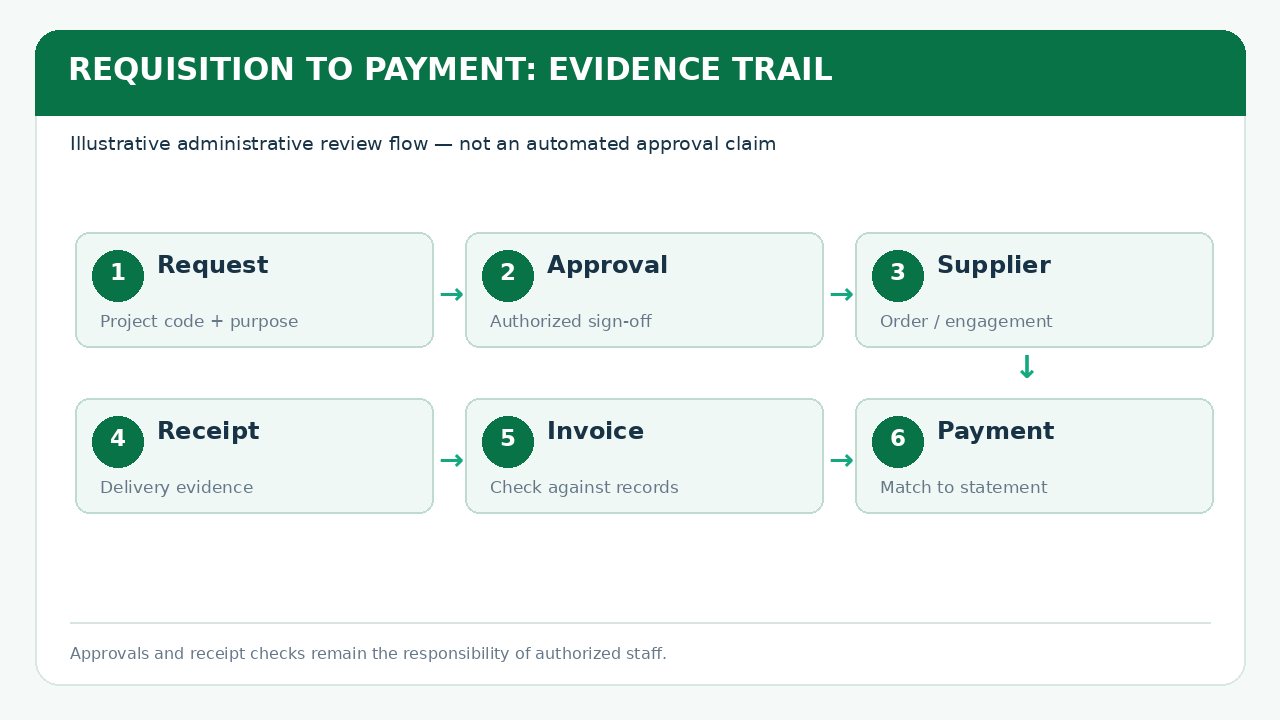
Illustrative requisition documentation process for project financial management in Kenya
A Practical Example: Three Projects, Three Different Financial Questions
Consider Tulia Project Services Ltd., a fictional Kenyan business running a skills-training rollout, a countywide field-survey assignment, and an office-systems implementation. These are illustrative figures created to show how our project reporting process works; Tulia is not being presented as an existing FedhaTrac customer.
| Project | Approved budget (KSh) | Recorded project costs (KSh) | Budget remaining (KSh) |
| Skills-training rollout | 1,200,000 | 760,000 | 440,000 |
| Field-survey assignment | 800,000 | 620,000 | 180,000 |
| Office-systems implementation | 1,000,000 | 540,000 | 460,000 |
| Total | 3,000,000 | 1,920,000 | 1,080,000 |
The figures show how much of the planned expenditure has been recorded, not how much cash is available or how much profit has been made. The field survey has consumed KSh 620,000 of its KSh 800,000 allocation, or 77.5%, while the other projects have different spending profiles. Management should next compare that utilization with work completed and obligations still pending. This is the kind of question project financial management in Kenya should put in front of decision-makers.
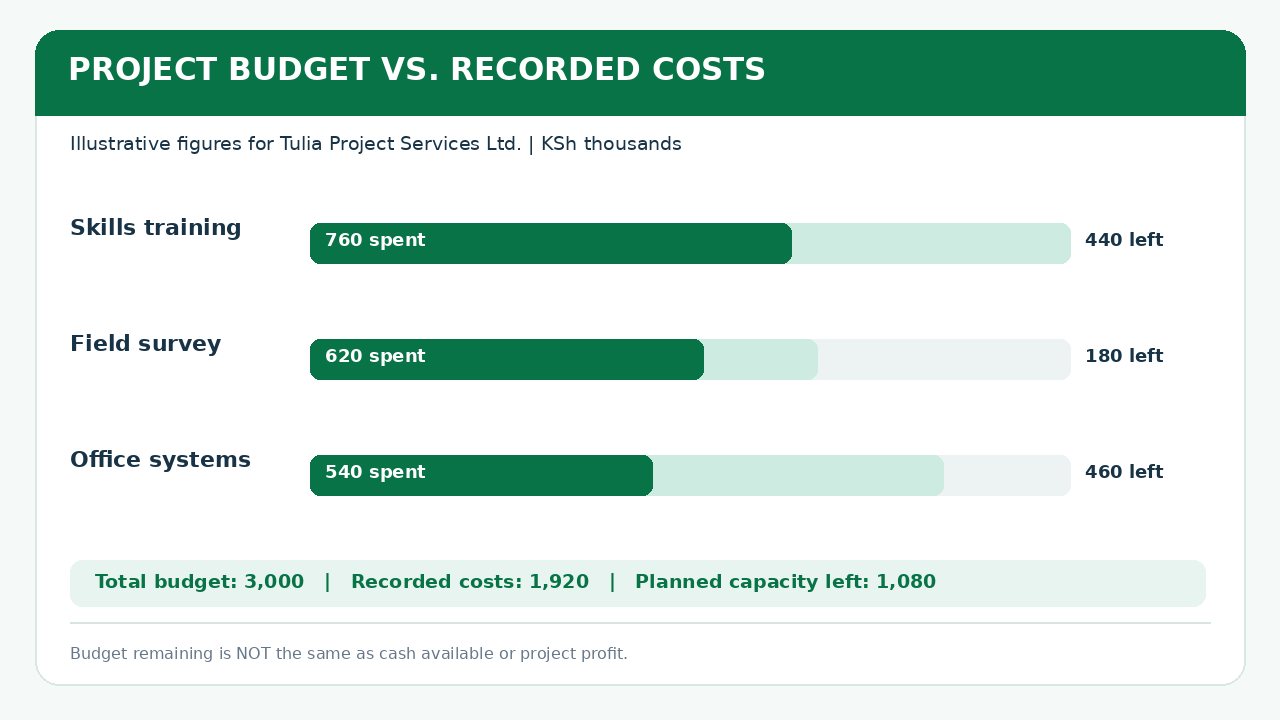
Illustrative project financial management in Kenya budget versus recorded costs across three assignments
Suppose Tulia has paid KSh 1,440,000 toward the KSh 1,920,000 recorded project costs, leaving KSh 480,000 of valid unpaid obligations under the simplified assumption that there are no opening project payables or other adjustments. The full cost belongs in the project view even though not every invoice has been settled. Without this separation, the team might understate costs merely because payments are delayed. Reliable project financial management in Kenya tracks both what has been incurred and what has been paid.
Bank Cash Is a Different Report
For the same illustrative period, opening business cash is KSh 350,000. Customer and funding receipts total KSh 1,750,000, while cash payments total KSh 1,440,000. The closing cash balance is therefore KSh 660,000, assuming no other cash movements. Those receipts are not automatically revenue, and the closing cash balance is not a measure of project surplus. Customer advances, restricted funds, receivables, and outstanding bills can all affect the position.
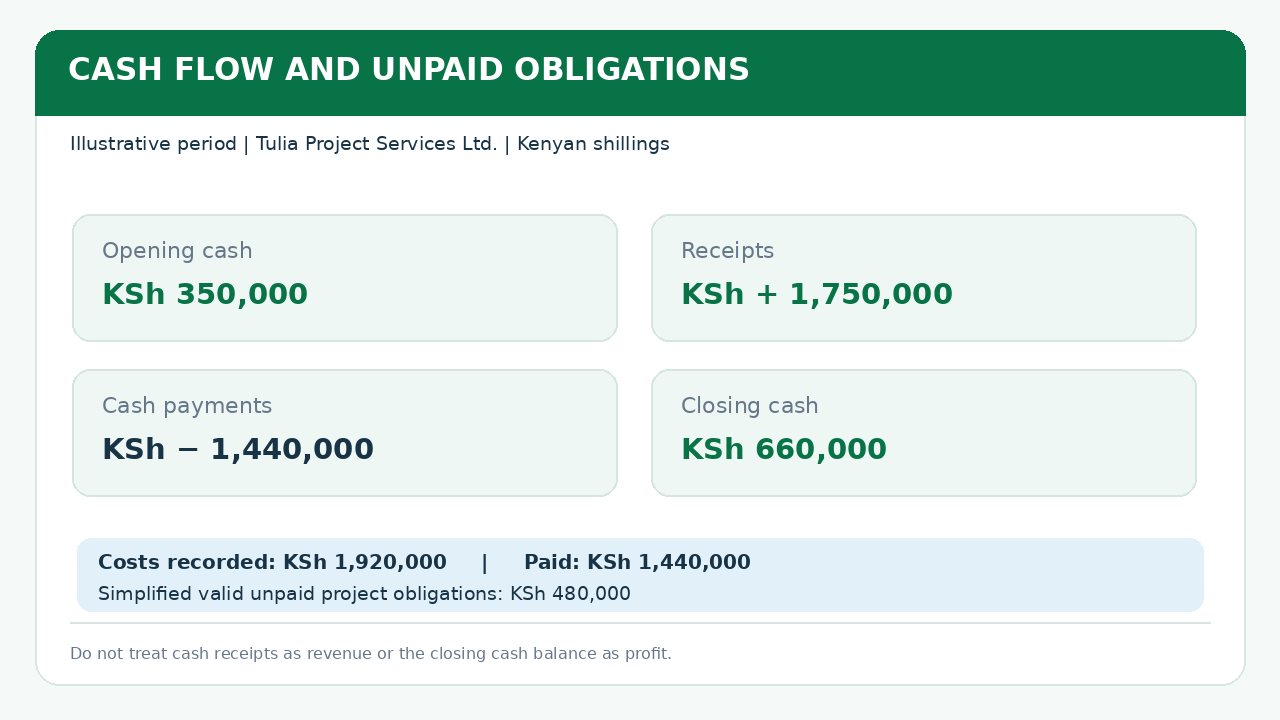
Illustrative cash balance and outstanding obligations in project financial management in Kenya
With FedhaTrac’s accounting and reconciliation support, the team can reconcile cash, bank, and M-Pesa movements to recorded transactions and explain material differences. A payment between two accounts owned by the same business should not be counted as fresh income. This is an essential safeguard in project financial management in Kenya, especially when multiple field teams use different payment channels.
Reports That Tell Managers What To Do Next
A useful project report is more than a list of receipts. In project financial management in Kenya, it must also guide decisions. It should answer whether spending is within plan, which cost categories changed, which suppliers need payment, which customer invoices remain uncollected, and what the next period will require. The best reports show the relationship between delivery progress and financial progress while explaining exceptions rather than hiding them in a total.
At FedhaTrac, our specialised reporting and advisory services help turn organized records into readable management accounts, budget comparisons, cash-flow discussions, and targeted financial reviews. We can discuss findings during the consultations, quarterly reviews, and annual meetings that are part of our wider service offering, subject to an agreed engagement. Project financial management in Kenya is most useful when the report leads to a documented next action.
Keep Project Costs, Shared Overheads, and Profit Separate
Accurate project financial management in Kenya begins by distinguishing shared costs from direct costs. Some expenses clearly belong to one assignment: field per diems, equipment hired for a site, or specialist fees tied to a deliverable. Other costs support several projects, such as office rent, finance staff, shared internet, and management transport. If the business charges all shared costs to the most active project, the results will mislead managers. If it charges none of them, projects may look more profitable than they really are.
We help clients define reasonable, consistent allocation methods and disclose how shared costs are treated. The method may reflect staff time, usage, a contractual rule, or another supportable basis. It should be reviewed when circumstances change. Project financial management in Kenya depends on the quality of such decisions because a visually attractive report cannot repair an unsupported allocation.
Project revenue also deserves care. For commercial projects, agreed milestones, delivered services, invoices, and cash receipts can occur on different dates. Revenue recognition depends on what has actually been earned under applicable accounting policies, rather than simply on cash deposits or the amount of a signed contract. We help clients keep those records intelligible and raise issues that need professional judgment.
Cash-Flow Forecasting Before the Next Payment Is Due
A profitable contract can still create a cash shortage when a supplier must be paid before a client settles an invoice. This timing risk is central to project financial management in Kenya. Project teams need a forward-looking view of payroll, travel, materials, supplier due dates, and expected customer receipts. Waiting until the bank account approaches zero makes it harder to negotiate payment terms or reschedule optional purchases responsibly.
A practical short-term forecast begins with verified cash, adds credible expected receipts, subtracts known obligations, and highlights uncertain amounts separately. We can help prepare and discuss these forecasts using your current records. Project financial management in Kenya should highlight timing risk; it should not disguise uncertain client payments as guaranteed money.
Prepare Better Evidence for Reviews, Audits, and KRA
Good project records show not only how much was spent, but why. Effective project financial management in Kenya depends on a clear evidence trail. Depending on the transaction, appropriate evidence may include the contract, approved requisition, purchase order, delivery note, invoice, payment confirmation, and a brief explanation of the project purpose. These records should be organized for retrieval and reconciled rather than merely stored in a folder.
For businesses subject to Kenya’s electronic invoicing rules, the Kenya Revenue Authority’s eTIMS guidance explains electronic tax invoice requirements. KRA’s notice on validation of income and expenses also outlines checks using eTIMS, withholding tax, and customs records, with statutory exceptions. The specific tax treatment depends on the organization’s status, the transaction, and current law. FedhaTrac helps clients organize supporting records and review applicable obligations; we do not claim that a project dashboard automatically files taxes or transmits invoices.
For audits or funding reviews, our audit preparation and support can help assemble reconciled figures and supporting schedules, coordinate requests, and identify missing evidence. The independent auditor remains responsible for any audit opinion. Dependable project financial management in Kenya makes the review process more orderly without promising a particular outcome.
How We Work With Your Project Team
Our starting point for project financial management in Kenya is a conversation about the projects you run, their funding arrangements, the records you already hold, and the decisions you struggle to make. We then agree on practical ways to classify costs, capture source documents, identify project owners, reconcile payments, and prepare reports. The objective is not to force every organization into the same workflow, but to provide a level of support matched to its operations.

FedhaTrac project financial management in Kenya administrative records coordination
The finance lead can keep oversight of the accounting records while project coordinators supply delivery evidence and budget explanations. Directors can receive concise reviews that explain variances, forecast cash requirements, and identify the decisions requiring approval. We can also support authorized administrative follow-ups and financial review meetings under the agreed service scope. This is where project financial management in Kenya becomes an ongoing partnership rather than a spreadsheet that nobody updates.
FedhaTrac offers its own financial-management dashboard together with professional bookkeeping, accounting, and reporting assistance. Clients retain responsibility for authorizing their spending and providing truthful source records. Our role is to help keep the financial information consistent, accessible, and meaningful so the people responsible for delivery can act with confidence.
Which Organizations Benefit Most?
Different industries need different forms of project financial management in Kenya. Project-based professional firms may need cost allocations and accurate client billing. Training businesses may need event-level budgets, facilitator costs, and venue payments. Service contractors may need supplier records and milestone cash-flow schedules. Nonprofits may require separate tracking of awarded funds and reporting conditions. Businesses running several internal initiatives may need clearer approval and budget comparisons before committing resources.
Common Questions About Project Financial Management in Kenya
Can FedhaTrac manage several projects for one organization? Yes, our project-oriented bookkeeping and reporting services can organize costs and financial records by job, assignment, or agreed project reference. We review the client’s reporting requirements and source records before setting up the approach, so managers can compare projects without confusing their transactions.
Do you only offer software, or do you provide real accounting support? We provide professional bookkeeping, accounting, reconciliation, reporting, and consultation support alongside FedhaTrac’s financial tools. You can discuss who will perform data entry, approval follow-up, report preparation, and management reviews as part of your service arrangement. This human support is a key reason to choose FedhaTrac for project financial management in Kenya.
Can you help us understand which project is overspending? Yes. Once appropriate budgets, project codes, and costs are recorded, we can help prepare budget-versus-actual reviews and explain notable differences. A variance should be discussed with the project manager; the figures alone may not reveal a timing difference, approved scope change, or incomplete delivery.
Can you track donor grants and private client contracts together? We can help organize different project records, but funding conditions and accounting treatments must remain distinct. Restricted donations are not interchangeable with ordinary sales revenue, and reporting deadlines should come from the actual agreement. We review the scope before deciding what schedules and reconciliations are needed.
Will FedhaTrac automatically approve spending or complete our eTIMS filings? We will not promise those functions without confirming the exact setup and service arrangement. Your appointed staff retain approval responsibilities, and tax submissions require the appropriate information and authorized procedures. We can support records, controls, and compliance work within the agreed scope.
What if our records are already months behind? Our catch-up bookkeeping and reconciliation services can help organize historical transactions, identify missing documents, and rebuild clearer reports, subject to the quality of the records available. You do not have to wait for another project cycle to start improving project financial management in Kenya.
Make Project Financial Management in Kenya a Competitive Strength
If your team is delivering several assignments but struggles to explain project costs, unpaid bills, cash needs, or budget variances, we can help. At FedhaTrac, we combine financial-management tools with people who organize the records, prepare understandable reports, and discuss what the numbers mean. We want you to spend less time reconstructing transactions and more time making informed choices about delivery, funding, and future work.
Take control of project financial management in Kenya with a partner who understands both daily transactions and the wider picture. Talk to FedhaTrac about your active projects, existing records, reporting expectations, and the financial support that would best fit your team.


