

Fixed Asset Register in Kenya: Know What Your Business Owns
A fixed asset register in Kenya should do more than list computers, vehicles, furniture, or machinery. It should help a business explain what it owns, what it paid, who is responsible for each item, where it is used, and how the relevant accounting values are calculated. When those records are scattered across purchase invoices, spreadsheets, and staff memories, management can miss equipment losses, duplicate purchases, or errors in financial statements.
At FedhaTrac, we help businesses turn these scattered records into organized accounting schedules and practical financial information. Our accounting services combine reconciliations, financial reporting, and professional support so owners can understand their assets without trying to solve every accounting question alone. We also help prepare the evidence that management and independent auditors need to review significant equipment balances.
Consider Pulse Events & Production Ltd., a fictional Nairobi company that hires out sound equipment, cameras, LED screens, lighting rigs, and generators. Its equipment travels to hotels, conference halls, and outdoor events. A fixed asset register in Kenya would help a business like Pulse keep the accounting records connected to its physical operations. All example figures are hypothetical, not customer results.
Why Equipment-Heavy Businesses Need Better Asset Records
At an event, a lighting unit may be on a truss, a camera may be with a field crew, and an amplifier may be back at the warehouse awaiting maintenance. The accounts might still show every item as present and operational. Without a dependable register and movement records, nobody has a complete view of what is available, damaged, missing, or due for replacement.
A useful fixed asset register in Kenya solves an accounting problem and supports an operational conversation. Management can compare the list with actual equipment, follow up missing documentation, and know which assets underpin its services. A fixed asset register in Kenya is not, by itself, a security system: it cannot prevent theft, track GPS positions, or tell a team where a flight case has moved unless people maintain accurate source records.
For Pulse Events, the most useful approach is to assign a responsible person, capture each asset’s identifiable details, and establish a periodic physical-verification routine. FedhaTrac can assist with the accounting register, schedules, reconciliations, and reports, while designated company staff confirm equipment location and condition on the ground.

Technicians checking camera equipment for a fixed asset register in Kenya
What FedhaTrac Helps You Record in a Fixed Asset Register in Kenya
A fixed asset register in Kenya is strongest when each material item can be traced to documentation. We begin by reviewing purchase records and the existing accounting ledger, then agree on sensible asset classes and a clear record format with management. Our role is to improve the reliability of the financial records, not to claim an unverified automatic asset-tagging feature.
For a fixed asset register in Kenya, useful fields include an internal asset reference, description, model or serial number, purchase date, supplier, acquisition cost, date available for use, location, responsible custodian, estimated useful life, depreciation method, accumulated depreciation, and carrying amount. Where relevant, the register can also note disposals, transfers, damage reports, and related invoices. Physical labeling requires a separate agreed process.
At FedhaTrac, our bookkeeping team can organize supporting invoices, payments, and entries, while the accounting review checks whether amounts belong in fixed assets, inventory, ordinary repairs, or another category. This distinction matters: a camera held for hire over several periods may be a fixed asset, whereas a camera purchased specifically for resale could be inventory.
The IFRS Foundation’s IAS 16 guidance explains the recognition and measurement principles for property, plant, and equipment under full IFRS. The precise accounting treatment depends on the entity’s applicable reporting framework and policies. We help clients document their selected policies rather than assume one treatment fits every Kenyan organization.
Building Pulse Events’ Illustrative Equipment Schedule
To show how a fixed asset register in Kenya supports real decisions, imagine Pulse’s accounts contain five asset groups that were all ready for use at the beginning of an illustrative financial year. We assume a straight-line method, five-year useful lives, no residual values, no impairment, and a full year of depreciation only for this example. These assumptions are not universal accounting or Kenyan tax rates.
| Asset group | Original cost (KES) | Illustrative annual depreciation (KES) | Carrying value after year one (KES) |
| Sound systems | 1,200,000 | 240,000 | 960,000 |
| LED screens | 900,000 | 180,000 | 720,000 |
| Cameras | 600,000 | 120,000 | 480,000 |
| Lighting rigs | 450,000 | 90,000 | 360,000 |
| Generators | 750,000 | 150,000 | 600,000 |
| Total | 3,900,000 | 780,000 | 3,120,000 |
In this fixed asset register in Kenya, the KSh 3,900,000 purchase-cost total does not mean the equipment’s market price is KSh 3,900,000 today. The KSh 3,120,000 carrying value is an illustrative accounting amount after one assumed year of depreciation; it is not a professional valuation or guaranteed resale figure. This is why a fixed asset register in Kenya needs clear labels, dates, and explanations, rather than a single impressive total.
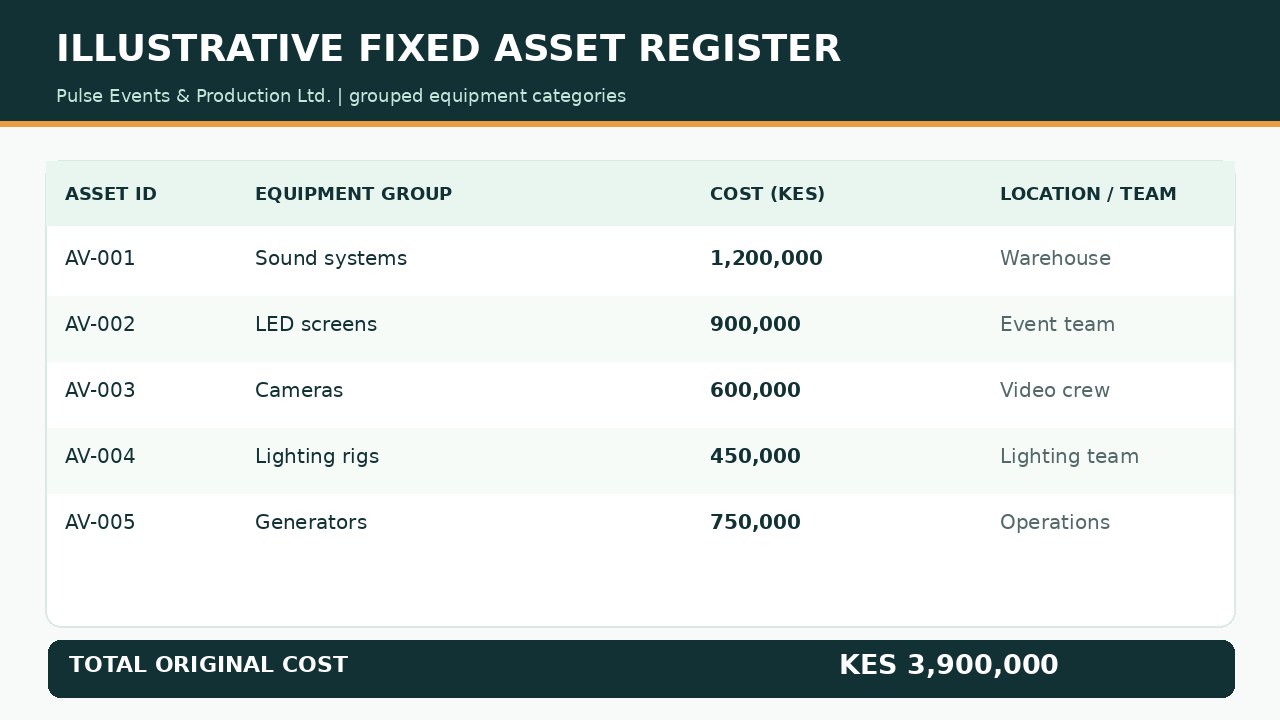
Illustrative fixed asset register in Kenya with equipment classes and KSh 3.9 million purchase costs
Pulse could also maintain an operational sheet for its 32 individual pieces of equipment. Suppose 29 units are counted at the warehouse or project sites, two are confirmed at an event using signed movement slips, and one has an unresolved location. The verification result is 29 + 2 + 1 = 32 items accounted for in the review process, but one still requires follow-up. Recording that exception is more honest than marking all 32 as fully verified.
Depreciation That Makes Financial Statements More Useful
Buying a KSh 900,000 LED screen creates a large cash outflow, but that payment is not automatically the same as the year’s accounting expense. The way its cost is recognized over time depends on when it becomes available for use, its estimated useful life, residual value, and the entity’s accounting policy. An accurate fixed asset register in Kenya supports those calculations and explains them to management.
In Pulse’s simplified example, KSh 900,000 divided by five years produces KSh 180,000 of annual straight-line depreciation, assuming nil residual value and a full year in service. A second year’s calculation could differ if circumstances change, the asset is impaired, a useful-life estimate is revised, or a disposal occurs. We review the schedule and document the assumptions instead of applying a generic percentage without considering the underlying equipment.
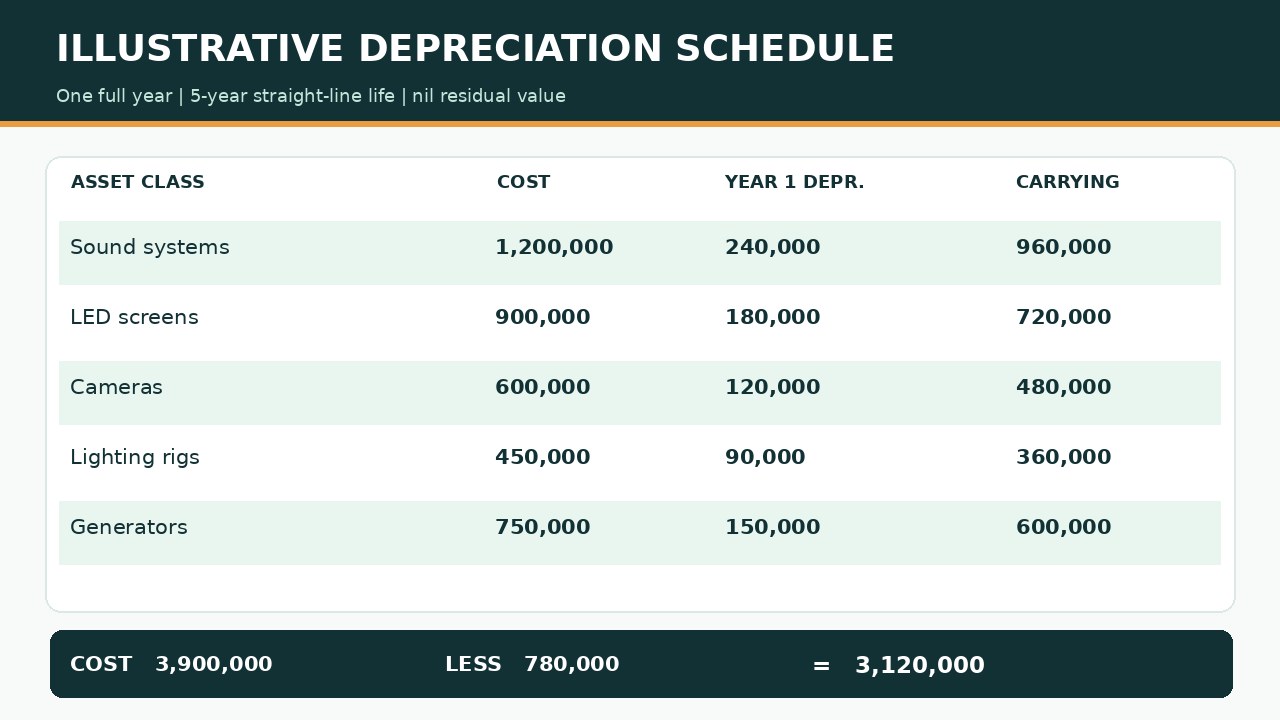
Illustrative fixed asset depreciation schedule showing KSh 780000 annual depreciation in Kenya
When a fixed asset register in Kenya is current, our team can explain asset costs more clearly. Through our specialized reporting and advisory, we help owners understand how depreciation affects operating results and the balance sheet. A good report explains the relationship between equipment cost, depreciation, maintenance expenditure, actual cash payments, and replacement decisions. A seemingly profitable year may still require cash for new sound mixers or ageing generators.
A fixed asset register in Kenya also helps separate routine service costs from qualifying improvements. For example, replacing a small cable may ordinarily be a repair expense, while a major upgrade can require different accounting assessment. The decision depends on facts and the applicable reporting framework, not merely the words used on an invoice.
Physical Checks, Movement Logs, and Responsible Custodians
Equipment in a mobile production business rarely remains in one room. That is why an accounting fixed asset register in Kenya should work alongside sign-out records, equipment-return reports, condition checks, and a clear responsibility structure. A register that is updated only at year-end may be too late to investigate a missing camera or a damaged light.
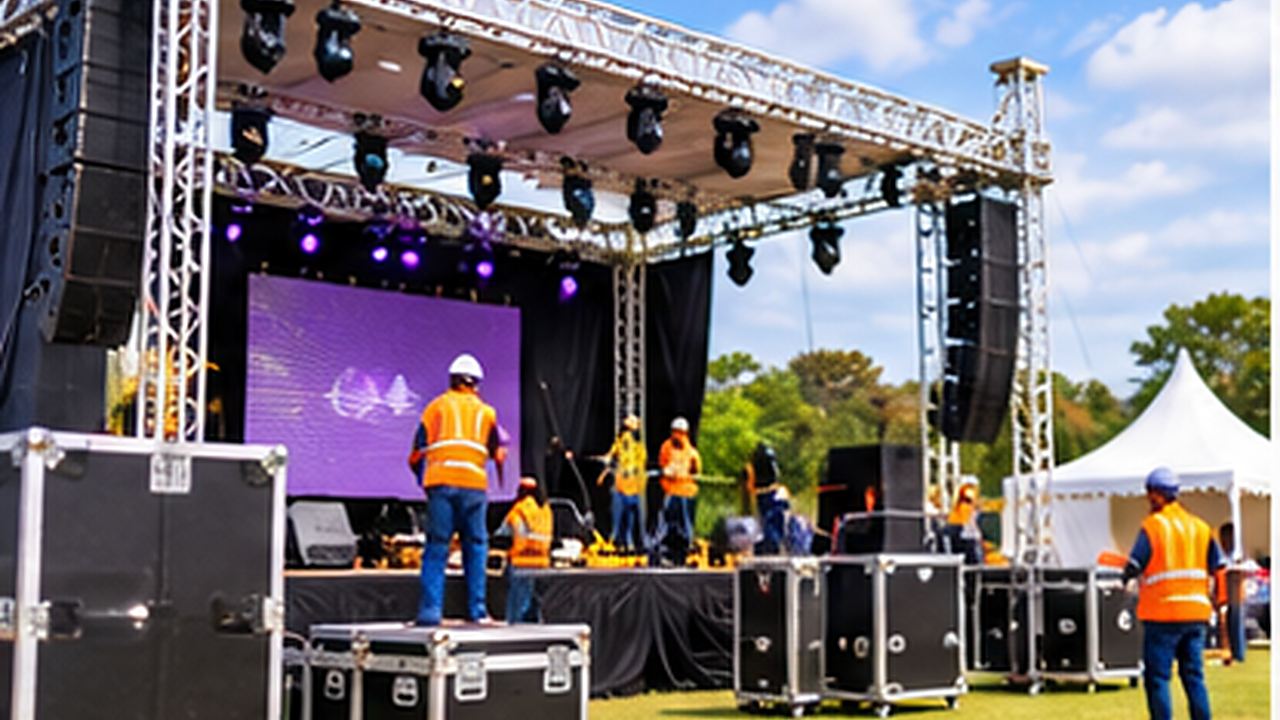
Kenyan event crew setting up production equipment tracked through asset movement records
Pulse’s warehouse coordinator could record an asset reference when a lighting rig leaves for a concert, assign it to the event crew, and confirm its return. A technician could document condition and repairs, while a finance officer checks whether any addition, impairment indicator, or disposal requires accounting attention. FedhaTrac can help reconcile the financial side and identify gaps for management to resolve, but the business remains responsible for conducting and approving physical inspections.
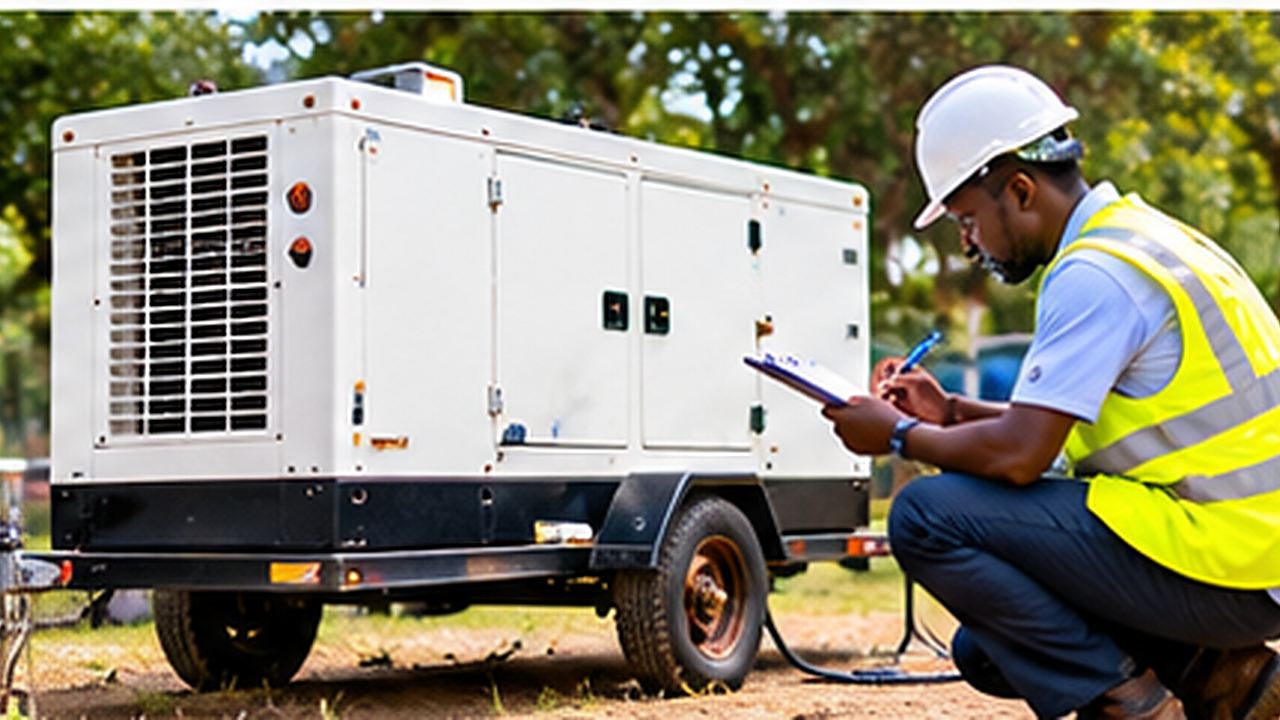
Physical generator inspection supporting equipment verification and asset accounting in Kenya
When a fixed asset register in Kenya flags a missing item, the correct next step is investigation, not automatically writing it off or pretending it exists. If an item is damaged, a technical condition report helps determine whether repair, replacement, or an accounting review is appropriate. A properly maintained fixed asset register in Kenya lets those decisions rest on evidence rather than assumptions.
Reconciling the Register With Accounting Records
Consider a second fictional situation: Pulse’s general ledger reports KSh 4,020,000 of equipment cost, but its verified fixed asset register in Kenya totals KSh 3,900,000. The unexplained difference is KSh 120,000. That discrepancy should be investigated before the accounts are finalized. It might relate to an incorrectly classified payment, an omitted asset, duplicated entry, or another cause; none should be selected without documents.
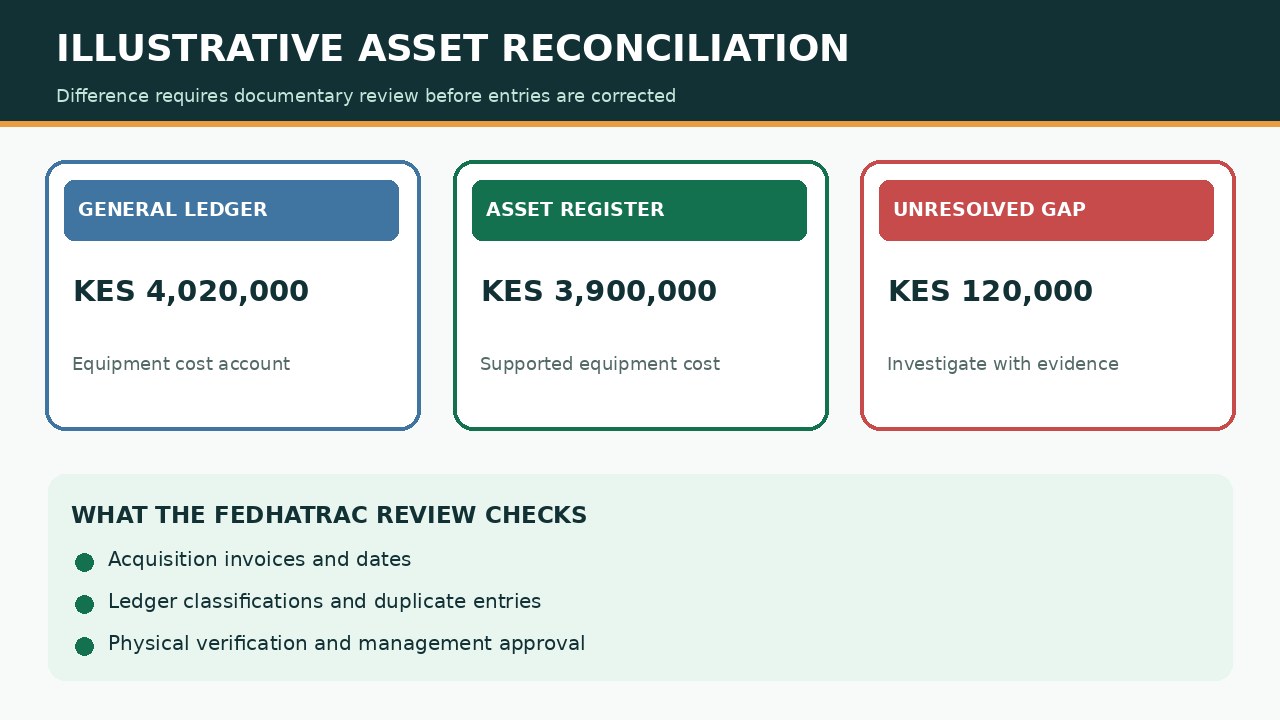
Illustrative fixed asset reconciliation comparing KSh 4.02 million ledger and KSh 3.9 million register
At FedhaTrac, we connect the ledger, invoices, supplier statements, bank and M-Pesa records, and supporting schedules through our accounting and reconciliation services. We identify exceptions, discuss proposed corrections with authorized client personnel, and document the agreed treatment. The objective is not to make two totals appear equal at any cost; it is to make them agree for the right reasons.
A fixed asset register in Kenya is also useful when disposing of equipment. For that reason, a fixed asset register in Kenya should be reconciled before a disposal is closed. If Pulse sells an old generator, finance should review its original cost, accumulated depreciation, sales proceeds, and any applicable gain or loss, along with the supporting documents. Removing an asset from the spreadsheet without recording its accounting disposal can leave the financial statements inaccurate.
Tax Capital Allowances Are Different From Book Depreciation
A reliable fixed asset register in Kenya should support tax work, but book depreciation should not simply be copied into the corporation-tax computation. The income-tax treatment of capital expenditure involves eligibility rules, applicable capital allowances, and evidence of the asset’s business use. Some categories receive different statutory treatment from others, and those rules may change over time.
The Kenya Revenue Authority’s capital deduction notice and its eTIMS guidance are useful authoritative starting points. For capital purchases, businesses should retain appropriate supplier invoices, payment evidence, asset descriptions, and other documents relevant to tax treatment. Electronic invoicing obligations have exceptions and particular rules, so a tax review must examine the transaction rather than assume that every receipt is sufficient or insufficient.
FedhaTrac’s tax filing and compliance support can help organize financial records and support the preparation of applicable tax schedules. We distinguish accounting depreciation, capital deductions, and supporting invoice requirements. We do not promise that a software register automatically files returns, guarantees tax relief, or overrides the KRA’s decisions.
For event-production businesses, equipment classes may be complicated. A lighting rig, a generator, and a delivery vehicle may not fall into the same tax category, even when all are used to deliver the same event. That is another reason to have professionals review classification and documentation before tax figures are submitted.
How FedhaTrac Supports Audit Preparation and Financial Reviews
With an up-to-date fixed asset register in Kenya, requests for evidence can be handled systematically. When auditors or lenders ask about long-term assets, a fixed asset register in Kenya becomes a practical evidence index. It connects ledger balances to individual records, acquisition invoices, depreciation schedules, transfers, and disposal documents. Missing evidence is easier to identify and resolve when the information is maintained during the year rather than assembled under deadline pressure.
Our audit preparation and support includes organizing schedules, reviewing reconciliations, identifying inconsistencies, and coordinating the requested files with independent auditors. FedhaTrac’s preparation work does not replace an independent audit opinion, a qualified valuer, an equipment technician, or the organization’s responsibility for safeguarding its property.
For Pulse, the management review could ask which sound systems are frequently repaired, which cameras are nearing replacement, whether a disputed KSh 120,000 ledger difference is resolved, and whether funds are available for new equipment. The FedhaTrac dashboard supports broader visibility of financial records and reporting, while our team interprets results in client consultations and periodic reviews.
A fixed asset register in Kenya is therefore not just an accounting compliance exercise. It is a foundation for decisions about capital spending, insurance documentation, borrowing discussions, and future service capacity. The register supports those conversations; it does not itself determine insurance coverage, asset market values, or the best investment decision.
A Practical Asset-Accounting Workflow With FedhaTrac
We approach fixed asset register in Kenya work as an organized financial service that can fit an existing accounting system. First, we discuss the equipment categories, current records, and management’s information needs. Next, we request available acquisition documents and identify gaps in asset references, ownership evidence, purchase dates, costs, and useful-life assumptions.
After agreeing the accounting approach, we prepare or tidy the register and reconcile totals to the general ledger. We can also outline an exception list for management’s physical-verification team, supporting documents to obtain, and items requiring technical or valuation input. The business confirms locations and condition; we address the accounting schedules.
We then use the fixed asset register in Kenya when preparing management accounts, depreciation schedules, and supporting audit files. During quarterly or annual consultations, we help decision-makers interpret the movements: additions, disposals, depreciation charges, and unresolved exceptions. Our scope can be agreed for a cleanup project or an ongoing financial-management engagement, depending on the condition of the fixed asset register in Kenya.
Because FedhaTrac supports bookkeeping, financial reporting, tax records, and advisory, clients do not have to treat asset accounting as an isolated spreadsheet exercise. Our business operations support helps keep supplier and payment evidence organized, while accounting professionals connect those records to the financial statements.
Questions Business Owners Ask About Asset Registers
Can FedhaTrac create a fixed asset register if our records are incomplete?
Yes, we can help review available invoices, ledger entries, asset lists, and payment records, then organize a workable schedule and identify missing information. Where purchase costs, ownership documents, or physical asset details cannot be verified, we flag the gaps for your team rather than invent values. We can discuss the best starting scope during a consultation.
Does FedhaTrac automatically tag or track equipment?
Our confirmed services include accounting records, reconciliations, financial reporting, and audit preparation. We can help structure asset references and work with information collected during physical verification, but we do not claim an automatic barcode-tagging, GPS-tracking, or equipment-location module without a separate confirmed arrangement. You still get the financial clarity and professional support that matter.
Can we keep using our existing accounting software?
Yes. We can discuss your current system and agree how our bookkeeping and accounting support will work with its exports, source documents, and reporting processes. The purpose of a fixed asset register in Kenya is reliable asset records, not forcing every company onto one software package or promising an integration that has not been tested.
Will a fixed asset register reduce our tax bill automatically?
No. An asset schedule provides supporting information, while eligible capital allowances depend on Kenyan law and the actual facts. We help organize records and prepare appropriate accounting and tax schedules, with careful distinction between book depreciation and tax deductions. A specific tax benefit cannot be promised without examining the case.
How often should the register be reviewed?
Businesses with frequent equipment movement may need operational updates after each issue, return, transfer, or disposal. Accounting schedules should also be reviewed at reporting dates, and physical checks can be scheduled based on risk and management policy. FedhaTrac can support the accounting review and explain exceptions during your periodic financial meetings.
Build Financial Confidence Around What Your Business Owns
If your company relies on cameras, generators, vehicles, machines, computers, or specialized equipment, a fixed asset register in Kenya can help you explain their cost, accounting value, documentation, and condition. A fixed asset register in Kenya supports decisions only when the records are checked, reconciled, and clearly understood.
At FedhaTrac, we combine professional bookkeeping, asset accounting support, financial reporting, audit preparation, and practical consultations. You gain a team that helps investigate discrepancies and explain the figures, not just another file to maintain. Contact FedhaTrac to discuss building or improving your company’s asset records and a financial-management plan suited to your operations.


