

SACCO financial reporting in Kenya should help a board answer a simple question: can we explain members’ money clearly, make informed decisions, and support every material figure with reliable records? A long spreadsheet is not enough. At FedhaTrac, we help cooperatives turn their day-to-day financial information into reconciled accounts, understandable management reports, and useful discussions with the people responsible for oversight.
A savings and credit cooperative handles several types of money at once. Member deposits, share capital, loan repayments, loan disbursements, interest, and operating expenses do not all belong in the same income column. When the distinctions disappear, even a busy cooperative can misunderstand its liquidity, operating performance, and obligations to members. Our role is to help organize those distinctions and make the results easier to act on.
This guide uses Miale Future Savings Cooperative, a fictional Nakuru-based cooperative, as an illustration. It is not a real FedhaTrac customer, and the figures below are examples rather than audited accounts. The purpose is to show what useful SACCO financial reporting in Kenya looks like when dependable bookkeeping meets hands-on financial support.
Why Your Board Needs More Than a Bank Balance
A treasurer might report that the cooperative has KSh 4 million in the bank. That number can be true without showing whether the cooperative has made a profit, owes members withdrawals, has issued new loans, or is approaching a cash shortfall. SACCO financial reporting in Kenya must connect cash and bank balances to the underlying transactions that produced them.
Member savings generally create obligations that need accurate classification. A new share contribution may increase equity rather than operating income. Recovering loan principal normally reduces a receivable; it is not the same as earning interest. Paying out a loan does not automatically create an operating expense. These distinctions are fundamental when preparing meaningful financial statements.
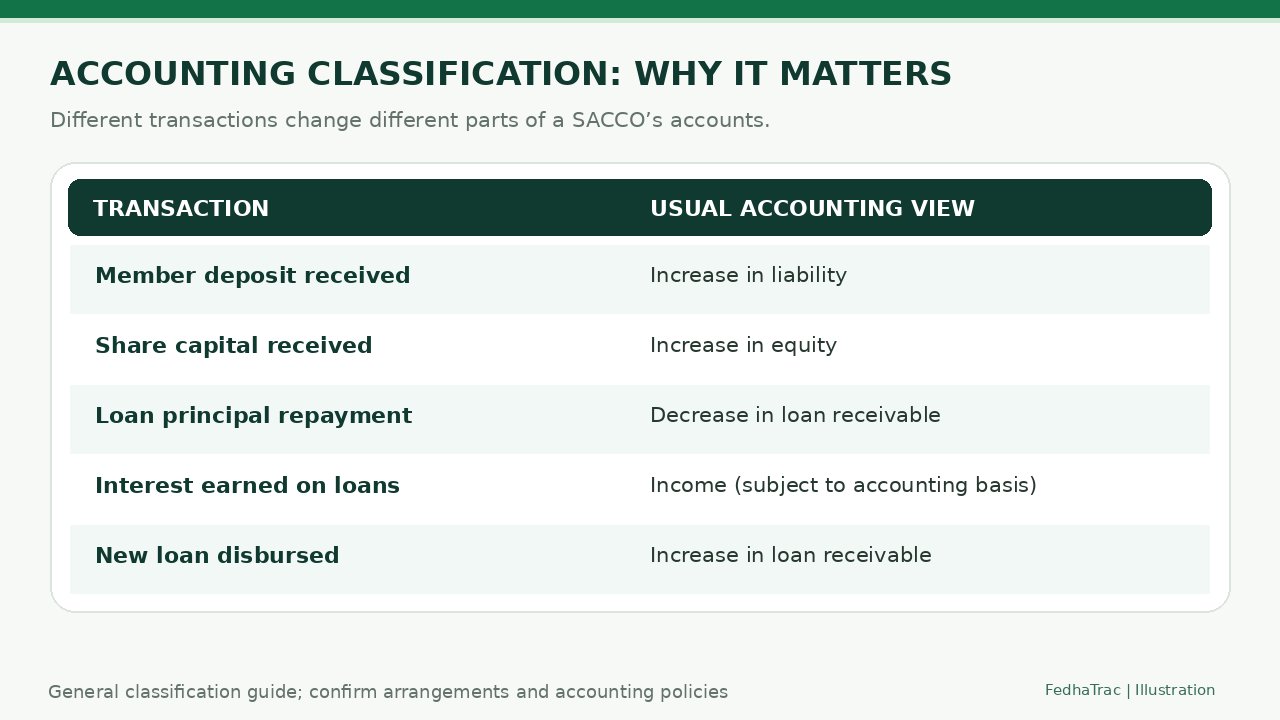
SACCO transaction classification guide distinguishing deposits shares principal and interest
At FedhaTrac, we help your finance team maintain supporting records and review transaction classifications. SACCO financial reporting in Kenya gives boards a reliable starting point for questions about spending, collections, member balances, and available cash. We combine accounting services with explanations in language that committee members can follow.
SACCO Financial Reporting in Kenya Starts with Organized Member Records
Reliable SACCO financial reporting in Kenya starts before the month ends. The cashier’s records, bank statements, payment confirmations, member contribution schedules, and loan-system exports need to describe the same period and use consistent references. Missing names, unexplained adjustments, or undated transactions create avoidable work when the board requests answers.

SACCO member receiving assistance at a cooperative service counter in Kenya
We help structure the records used in SACCO financial reporting in Kenya so that member receipts can be reviewed against bank and cash activity. Where a SACCO already uses a specialized member-management or core-banking system, we can work from its authorized exports and related documents. We do not assume that the FedhaTrac dashboard replaces that system or automatically posts member deposits and loan balances.
Our bookkeeping team helps organize source documents, clean transaction descriptions, identify outstanding items, and maintain a consistent monthly review process. The SACCO remains responsible for the accuracy of its member register, operational approvals, and loan records. Clear division of responsibility is one of the foundations of strong governance.
The Reports That Help Leaders See the Whole Cooperative
Good SACCO financial reporting in Kenya is a practical reporting pack, not an intimidating stack of pages. Different reports answer different questions. We help prepare or organize the financial schedules appropriate to the cooperative’s operations, accounting framework, and existing data.
Income, Expenses, and the Operating Result
An income-and-expenditure statement explains what the cooperative earned and incurred during a reporting period under the accounting policies applied. Interest income, permitted service charges, staff costs, administration, financing costs, and other applicable items should be classified consistently. A cash summary does not replace an accrual-based statement. For this reason, SACCO financial reporting in Kenya must distinguish cash movements from income.
Statement of Financial Position
A balance-sheet-style report shows assets, liabilities, and equity at a particular date. A SACCO may have loans receivable as assets, member deposits as liabilities, and share capital within equity. Correct presentation depends on its accounting framework and specific arrangements. We support SACCO financial reporting in Kenya by preparing reconciled supporting schedules that help explain the statement rather than presenting a single number without context.
Cash Movement and Reconciliation
Cash-flow reporting connects incoming and outgoing funds to actual balances. We review cashbooks, bank statements, approved disbursements, and recorded payments to help identify items that have not cleared or were posted incorrectly. Where M-Pesa is used, transaction references and settlement records also need review. Our financial reporting and advisory support turns these reviews into understandable management information.
Member and Loan Schedules
Member contribution summaries, loan balances, overdue instalments, and related interest calculations can provide essential context. We can reconcile summary totals and review reports from the SACCO’s source systems, but regulated lending operations require appropriate specialist controls. We do not claim an unverified automatic credit-risk engine, real-time loan-book integration, or regulator-ready prudential return generator.
A Practical Example: Miale Future Savings Cooperative
To show how SACCO financial reporting in Kenya should separate unlike transactions, imagine that Miale begins a quarter with KSh 3,200,000 in cash and bank balances. During the quarter, it collects member deposits, receives share contributions and loan repayments, grants new loans, and pays operating bills.
| Illustrative cash movement for the quarter | KSh |
| Opening cash and bank balances | 3,200,000 |
| Member deposits received | +1,800,000 |
| Share capital contributions received | +400,000 |
| Loan principal recovered | +1,100,000 |
| Interest collected on loans | +480,000 |
| Other operating income collected | +40,000 |
| Loans disbursed | −2,000,000 |
| Member withdrawals paid | −350,000 |
| Operating expenses paid | −260,000 |
| Interest paid on member deposits | −90,000 |
| Equipment purchased | −120,000 |
| Closing cash and bank balances | 4,200,000 |
These figures are hypothetical and assume every item cleared during the same period. Opening funds plus KSh 3,820,000 of receipts, less KSh 2,820,000 of payments, produces closing cash of KSh 4,200,000. The report is a cash-movement illustration, not a statement of profit or a prudential liquidity ratio.
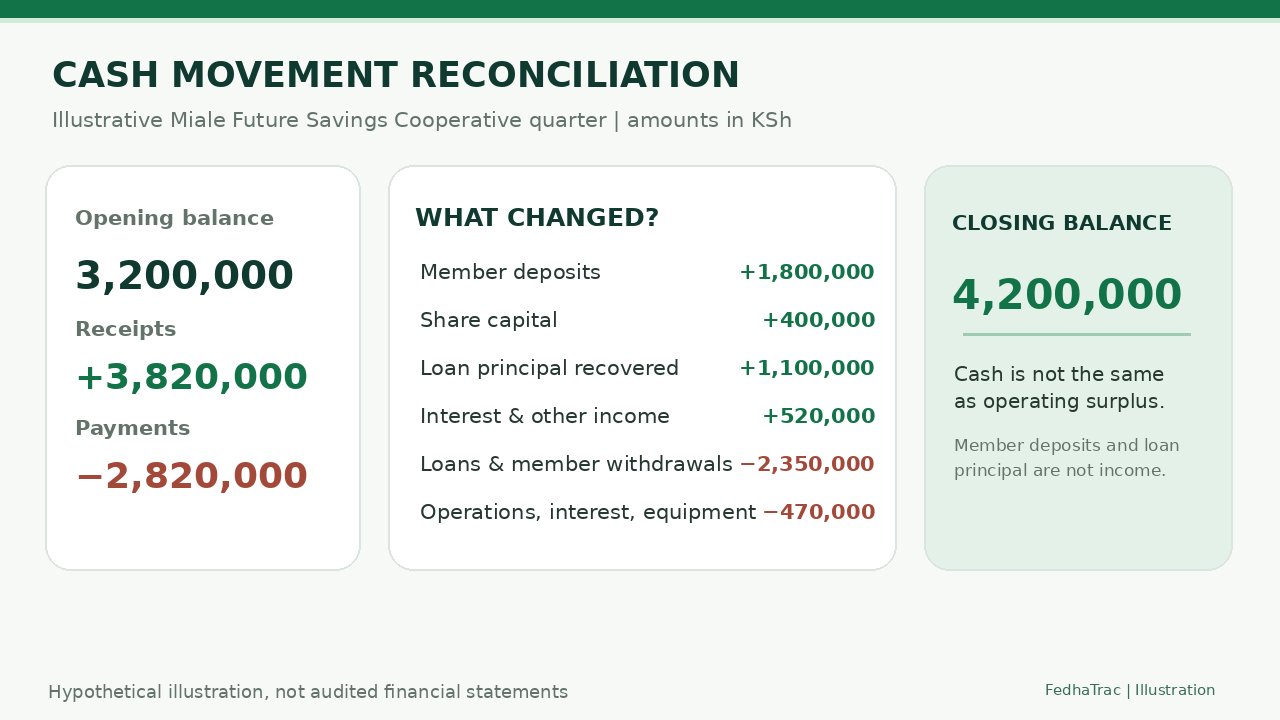
SACCO cash movement reconciliation example showing a KSh 4.2 million closing balance
Only KSh 520,000 of the listed cash inflows represents collected interest and other operating income. The KSh 1,800,000 in member deposits, KSh 400,000 of share capital, and KSh 1,100,000 in principal recoveries are not simply sales. After KSh 260,000 of operating costs and KSh 90,000 of interest paid, the cash-based operating difference in this narrow example is KSh 170,000.
Even that KSh 170,000 is not a finalized accounting surplus. Accrued income or costs, expected credit losses, depreciation, taxes, and other adjustments might change the reported result. We help management investigate and document such differences before a figure is presented as a final financial statement. This is how SACCO financial reporting in Kenya moves beyond a cash tally.
Member Savings and Loan Balances Deserve Their Own View
Savings mobilization is often described as growth, but a rising deposit balance can create future repayment obligations. Members also expect their contributions, savings, shares, loans, and payments to be recorded accurately. SACCO financial reporting in Kenya should therefore present member-balance information alongside the cooperative’s wider financial results.

Community cooperative members discussing savings and financial records in Kenya
We help reconcile member schedules with summary ledgers and flag differences for authorized staff to resolve. If a bank repayment is missing from the member loan record, the finance team should trace it and correct the source record using its established procedure.
Aged arrears and loan-portfolio summaries inform credit-quality discussions only when the records and accounting judgments are sound. SACCO financial reporting in Kenya benefits from independent review of these supporting schedules. Our role is financial interpretation, not loan approval or certifying a SACCO’s portfolio quality.
Reconcile Cash, Bank, and M-Pesa Before the Board Meeting
Reconciliations are the quiet work behind trustworthy SACCO financial reporting in Kenya. A bank transfer may be recorded in the wrong member account. A cash deposit may be listed twice. A payment captured in one month may reach the bank in the next. Without a disciplined review, those errors can flow into board papers and member statements.
At FedhaTrac, we compare the available transaction logs, bank statements, M-Pesa records, cashbooks, and approved vouchers. We flag amounts that do not agree and support the finance team in documenting corrective entries. This does not mean every bank or payment provider connects automatically to our platform; import methods and integrations must be confirmed for each setup.
Turn Quarterly Reports Into Decisions, Not Formalities
Reports can be technically complete yet leave directors unsure what to ask next. Through structured consultations and quarterly or annual meetings, we help leaders interpret their figures rather than simply receive them.

SACCO financial reporting in Kenya board members reviewing management accounts
A useful review can compare actual operating expenses with the approved budget; show how cash movements differ from income; discuss material reconciliation items; and note member-balance or loan-record exceptions that management must investigate. The meeting can assign responsible officers and target dates for follow-up. The cooperative’s board retains all decisions, approvals, and statutory responsibilities.
Consider Miale’s hypothetical KSh 4.2 million closing bank position. A responsible board discussion would also ask how much is required for member withdrawal obligations, upcoming operating costs, authorized loan disbursements, and other commitments. That wider view is why SACCO financial reporting in Kenya needs both well-prepared schedules and financial interpretation.
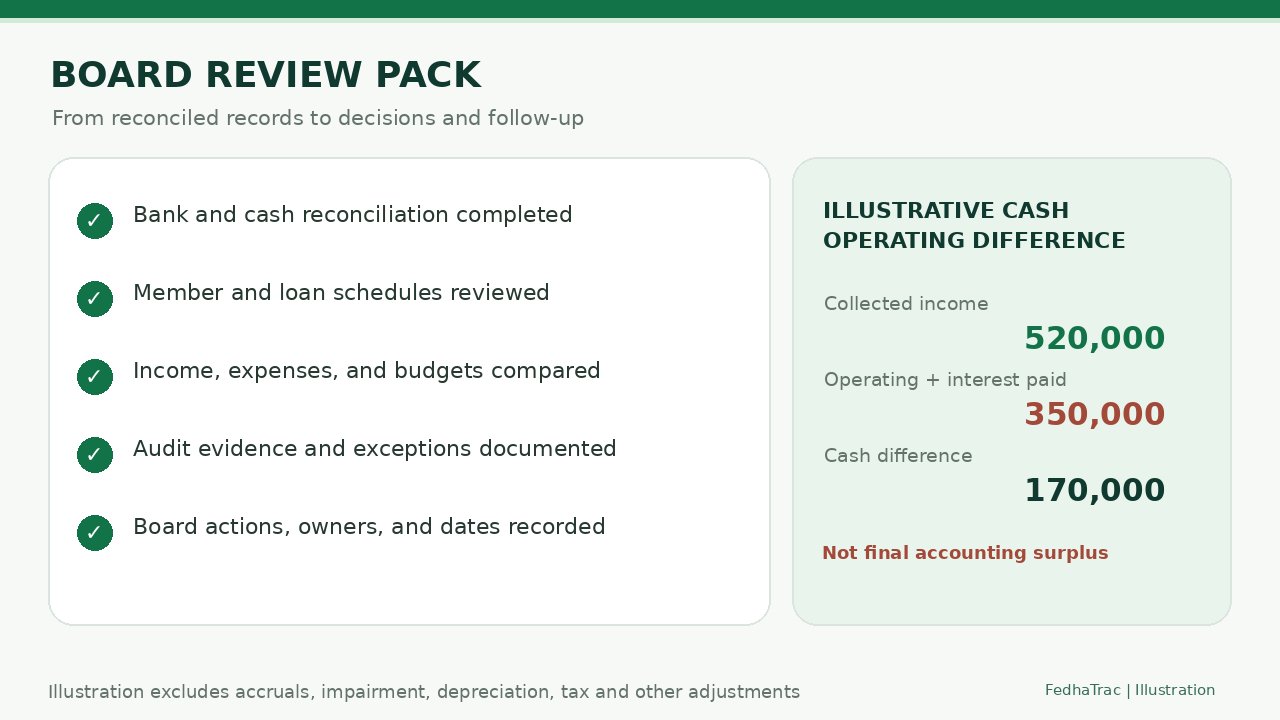
SACCO financial reporting board review checklist and illustrative cash difference
Our specialized advisory service can help turn financial reports into manageable agendas for committees, management meetings, and annual reviews. The aim is not to claim that one dashboard replaces judgment. It is to ensure that decisions start with reconciled, understandable information.
Audit Preparation: Better Records, Clearer Evidence
An annual audit is much easier to support when reconciliations, schedules, and explanations have been maintained through the year. SACCO financial reporting in Kenya should make it possible to trace material balances back to bank records, member schedules, vouchers, and authorized decisions.
Our audit preparation and support includes organizing accounting files, reconciling balances, preparing supporting schedules, and helping the organization respond to document requests. We do not present that service as an independent statutory audit or issue an audit opinion. Any required audit must be carried out by a suitably authorized, independent auditor.
Kenya’s Ministry of Cooperatives Cooperative Audit Directorate states that registered cooperative societies must keep proper accounts, undergo an annual audit, and present audited accounts and returns within its published timetable. Actual deadlines, presentation requirements, and the applicable framework should be confirmed for the entity and financial year.
SACCO financial reporting in Kenya is stronger when corrections are identified each month, not just before the annual general meeting. Routine bookkeeping creates an evidence trail while documents and transaction details are still available.
Understand Which Regulator and Reporting Rules Apply
Not every institution calling itself a SACCO has the same licensing status or reporting obligations. The SACCO Societies Regulatory Authority explains that it regulates deposit-taking SACCOs and SACCOs carrying on specified non-deposit-taking business. Other cooperative societies may be subject to different regulatory arrangements under the cooperative framework.
Regulated SACCOs may have additional prudential, governance, and return requirements beyond ordinary financial statements. A nonregulated cooperative should not assume that a template intended for a licensed deposit-taking SACCO is automatically appropriate. In SACCO financial reporting in Kenya, classification and compliance must follow the institution’s actual status, bylaws, financial products, and current official requirements.
FedhaTrac helps organize relevant accounting information and supporting records; we do not promise automatic SASRA filing, statutory certification, or compliance merely because our software is used. Where specialist regulatory preparation is needed, the exact scope should be agreed with qualified professionals and the SACCO’s management.
You Can Keep Your Existing SACCO Software
A cooperative may already use a system for its member register, loan processing, interest calculations, and teller transactions. That investment should not be discarded merely to obtain professional financial reporting. Our approach to SACCO financial reporting in Kenya begins with the existing workflow and available reports.
The FedhaTrac platform offers general transaction views, expense records, accounting tools, reports, receipts, and financial dashboard information. We complement those tools with bookkeeping, reconciliations, administrative assistance, and human reviews. For member-facing core banking, loan-origination workflows, specialized risk analysis, and automated regulatory returns, a SACCO must confirm what its existing system provides and what integrations, if any, are actually supported.
Why Partner with FedhaTrac?
At FedhaTrac, we do not want your cooperative to spend every quarter assembling conflicting spreadsheets and then struggle to explain them at an AGM. We combine disciplined financial recordkeeping with reporting expertise and conversations that make the numbers useful. Whether you need monthly reconciliations, management statements, accounting cleanup, financial review meetings, or audit-file preparation, we can discuss a support arrangement that fits the organization’s needs.
We can help your team understand what the reports show, what remains uncertain, and which accounting or operational matters deserve attention. We also offer authorized administrative follow-up and scheduled consultations where agreed. That is a fuller service than simply emailing a profit-and-loss statement.
SACCO financial reporting in Kenya works best when information is clear before a problem becomes urgent. Our approach to SACCO financial reporting in Kenya helps create that discipline, while your leaders remain responsible for member decisions, approvals, statutory filings, and governance. Talk to our team about FedhaTrac’s services and contact us to discuss your cooperative’s reporting requirements.
Frequently Asked Questions About SACCO Financial Reporting in Kenya
Can FedhaTrac prepare reports if our SACCO already uses another system?
Yes, we can review an agreed set of exported financial reports, bank statements, and supporting documents from your existing system. We then establish the scope of bookkeeping, reconciliation, and reporting support. We will confirm the format and access arrangements rather than promise an unverified direct integration. SACCO financial reporting in Kenya should work with reliable source records, not require unnecessary software replacement.
Will FedhaTrac maintain our members’ deposits and loan accounts automatically?
We can help reconcile and report on member-related financial records supplied through an agreed process. We do not assume that our general accounting platform acts as a licensed SACCO core-banking system or automatically updates every member loan. Your SACCO remains in charge of its operational source records and authorization controls. Our job is to make the accounting evidence and management reports more dependable.
Can you help the board understand financial statements before an AGM?
Yes. Our reporting and advisory support can include explanations and scheduled review meetings in which we walk through the statements, budget differences, cash position, and outstanding questions. This makes SACCO financial reporting in Kenya more useful for directors who need to ask informed questions but do not work in accounting every day.
Does using FedhaTrac mean we are automatically compliant with SASRA?
No. SASRA status and any reporting obligations depend on the cooperative’s activities and regulatory classification. We help with reconciled accounting records and report preparation within an agreed scope, but we do not automatically file prudential returns or certify compliance. The institution must verify applicable requirements and use authorized professionals where necessary.
Does FedhaTrac perform the independent annual SACCO audit?
Our role is audit preparation and support: organizing books, reconciling balances, and supplying schedules and supporting records. Independent audit opinions must come from appropriately authorized auditors. With better monthly SACCO financial reporting in Kenya, your organization can respond to audit requests more efficiently and approach the reporting season with greater clarity.
Give Your Members Better Financial Answers with FedhaTrac
Members entrust their savings, shares, and financial relationships to their cooperative. They deserve records that can be explained, and directors deserve reports that make risks and decisions visible. SACCO financial reporting in Kenya should show the difference between money received, money earned, obligations owed, and funds available for planned activities.
At FedhaTrac, we help you build that financial clarity through bookkeeping, reconciliations, reporting, consultations, and audit preparation. Let us discuss the records you have, the questions your board faces, and a practical reporting routine for your cooperative. Contact FedhaTrac today and turn your accounting information into financial decisions your members can understand.


