

Your POS Should Tell You More Than What You Sold
A point-of-sale (POS) system can tell you how many items passed through the till today. But can you explain how much money actually reached your bank or M-Pesa account, what you still owe suppliers, and whether the business earned a profit after expenses? POS accounting in Kenya should answer those bigger questions—not leave a shop owner staring at reports that never seem to match.
At FedhaTrac, we offer a practical choice. You can use our own POS system, or keep the POS system your business already uses. In either case, our team can work with your sales records and supporting financial information to make your numbers understandable. We help organize records, reconcile transactions, monitor expenses, and prepare financial reports so you can run your business with more confidence.
You don’t need to start from scratch to get professional accounting support. That is the central promise behind our approach to POS accounting in Kenya: keep serving your customers while we help you make sense of the figures.
Two POS Options, One Clearer Financial Picture
Option 1: Run Your Shop Using the FedhaTrac POS System
If you are opening a shop, replacing a manual cash register, or reviewing your current setup, ask us about the FedhaTrac POS system. We offer our own point-of-sale solution for businesses that want a sales tool alongside professional financial support. A POS captures sales activity; it does not replace the judgment involved in handling expenses, supplier balances, bank deposits, reconciliations, or financial statements. That is where our bookkeeping and accounting support adds value. With FedhaTrac, you can discuss the checkout operation and the financial records with a team focused on the full picture.
Option 2: Keep Your Existing POS and Let Us Work With Its Reports
Already happy with your cashier software? You do not have to change it to work with us. We can obtain or receive reports from the POS your team currently operates, then work with those reports and your bank, M-Pesa, purchase, and expense records. We help you interpret daily sales, explain differences, and see what the reports mean for your business.
This is an important part of POS accounting in Kenya because changing a working till can disrupt a busy store. Instead, we can agree on a practical routine for sharing exports, end-of-day summaries, refunds, stock reports, or other available records. Working with your POS reports is not the same as promising an automatic live integration with every POS brand. Any direct technical connection is assessed separately. The financial support does not depend on making that promise: reliable exports, appropriate access, and properly matched source documents provide a workable starting point.
9 Powerful Ways FedhaTrac Turns POS Records Into Better Business Decisions
1. We Turn Daily Sales Into Accurate, Useful Records
Your cashier may finish a shift with a POS summary, but the owner needs to know whether that summary is complete. In POS accounting in Kenya, we organize sales by date, location, payment method, and categories supported by available reports. We review voids, refunds, discounts, and genuine credit transactions rather than assuming every entry represents money already received.

Kenyan shop cashier issuing a receipt beside a point-of-sale terminal during customer checkout.
With POS accounting in Kenya, a sales report becomes an accounting record you can explain. By distinguishing new sales from account transfers and older invoices, we help you prevent double counting.
Our goal is straightforward: when you ask how much you sold yesterday, the number should have a clear source and a clear meaning.
2. We Reconcile M-Pesa, Cash, Bank, and Card Payments
A POS may report a successful sale before cash is banked or a card settlement appears. A customer may pay through M-Pesa, and an employee may later transfer part of the business float. If those movements are not distinguished, sales and cash figures can become confusing.
For POS accounting in Kenya, our team compares relevant POS totals with supporting payment statements, cash-count sheets, banking records, and approved adjustments. We investigate differences rather than automatically treating every unexplained amount as theft or a business loss. POS accounting in Kenya becomes especially valuable when you accept several payment methods. We help you understand what customers paid, what has settled, and which discrepancies still need attention.
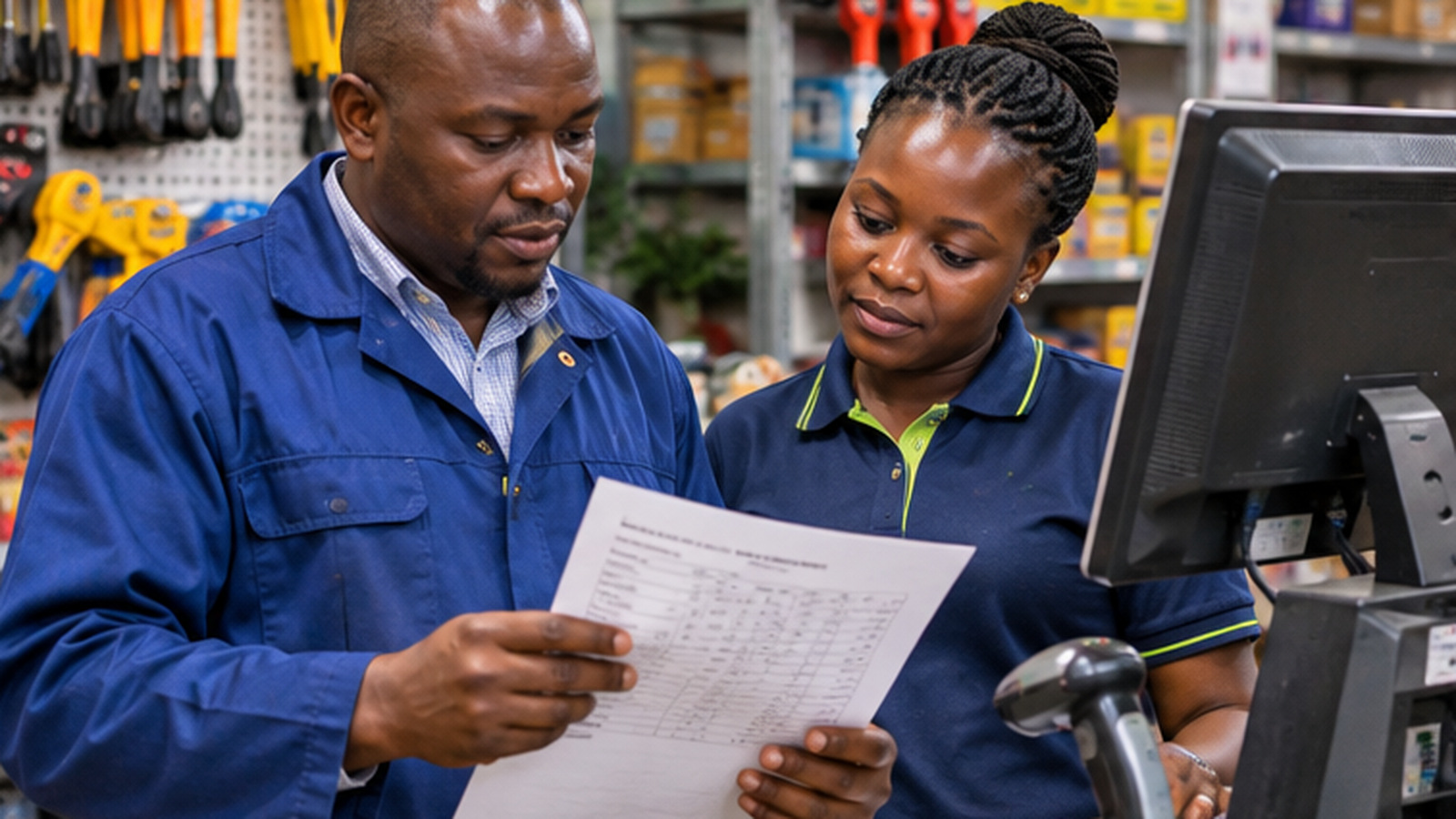
Hardware-shop staff reviewing printed sales reports from their existing POS system in Kenya.
3. We Explain What Your POS Reports Are Actually Saying
Some POS systems produce detailed daily summaries; others offer basic exports. Either way, a report full of figures is not the same as a business decision. With POS accounting in Kenya, we translate available data into practical answers: which sales channels bring in money, when refunds rise, whether discounts are eroding revenue, and what needs further investigation.
Our approach to POS accounting in Kenya considers both the numbers and the activity behind them. We avoid drawing conclusions from one report without context.
You should not need to become a qualified accountant to understand your store. We explain reports in clear language, highlight useful trends, and identify questions for the sales or operations team.
4. We Connect Sales to Expenses and Real Profitability
Revenue is exciting, but it is not profit. Stock costs, salaries, rent, utilities, delivery charges, mobile-money fees, and other operating expenses all affect how much a business retains. Our POS accounting in Kenya support organizes those costs and matches them with the relevant period using sound bookkeeping practices.
For POS accounting in Kenya, this distinction is critical. A shop that sells KSh 1 million in a month has not necessarily earned KSh 1 million. Our bookkeeping and accounting services help you understand gross profit, operating expenses, and profit before tax from supported records. When inventory or cost information is incomplete, we identify the limitation rather than invent an attractive margin.
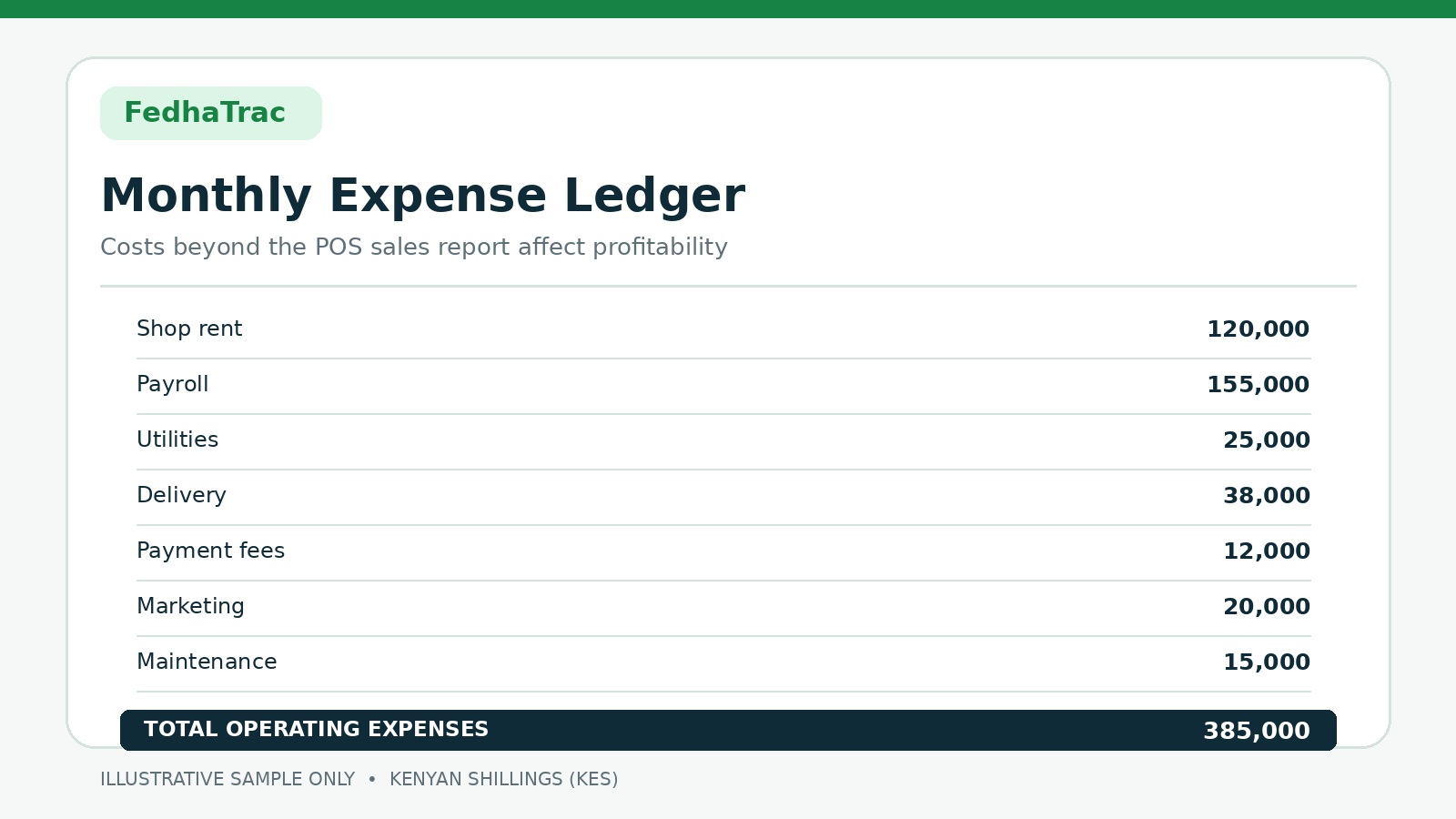
Sample monthly expense ledger for a Kenyan retailer, totaling KSh 385,000 in operating costs.
With us, you get help understanding the outcome of your trading activity—not just the headline sales number.
5. We Compare Stock Records With Purchases and Sales
A POS report may show that ten items were sold, while a physical count says the shelves are short by twelve. That difference needs investigation. Through POS accounting in Kenya, our team can use stock reports, supplier invoices, purchase records, stock-count sheets, and adjustment approvals you provide to support financial inventory reconciliation.
We help flag unusual differences, record agreed corrections, and reflect supported stock values in the accounts. We do not claim that reading a POS report automatically verifies physical quantities, expiry dates, or product authenticity. POS accounting in Kenya works best when the shop’s operational controls and financial records support one another. We help bring that evidence together so that pricing, purchase costs, shrinkage concerns, and stock valuation can be discussed using records instead of guesses.
6. We Account Properly for Discounts, Returns, and Refunds
Promotions are useful, but they complicate reconciliation when staff treat a refund as a new expense or fail to reverse the original sale correctly. Through POS accounting in Kenya, we organize return records, approved discounts, cancelled transactions, and refunds according to the facts and available documents.
In POS accounting in Kenya, the distinction between a genuine return, a price reduction, and a cash movement matters. When relevant tax invoices must be amended, we check the appropriate electronic-invoicing process rather than assuming a POS refund automatically fixes an eTIMS invoice. That extra care helps your reports remain understandable and supports a more reliable paper trail.
7. We Organize Customer Balances and Supplier Payments
Not every sale is settled on the day of purchase. Trade customers may buy on credit, while suppliers may allow the shop to pay for goods later. A POS alone may not give you a complete picture of those obligations, especially if payment and purchasing records sit in different places.
Through our bookkeeping services, we make POS accounting in Kenya more useful: we maintain customer and supplier records, organize invoices, and track balances against the evidence available. That is another benefit of POS accounting in Kenya: the owner can discuss cash commitments alongside sales performance. We help you see the difference between money already collected, amounts customers still owe, and obligations the shop must pay.
8. We Prepare Financial Reports That You Can Act On
At month-end, you need more than a folder of daily POS summaries. With POS accounting in Kenya, we turn reconciled income, costs, and other financial information into reports that explain what happened over the period. Depending on the agreed scope and completeness of records, those reports can include profit and loss, cash flow information, customer balances, and management summaries.
The FedhaTrac dashboard gives clients a way to view the financial work our team maintains for them. We organize supporting documents, keep the bookkeeping current under the agreed schedule, and explain the results. This combination of professional support and visibility is what makes POS accounting in Kenya genuinely useful.
Want to know whether a branch is ready to expand, or whether expenses are rising faster than sales? We help you interpret the available evidence before you commit money.
9. We Support KRA-Ready Records and Better Growth Planning
Good records from POS accounting in Kenya can support tax work, but a normal till receipt is not automatically the same thing as a valid electronic tax invoice. The Kenya Revenue Authority provides several eTIMS solutions and a separate process for qualifying system-to-system integration. We help review your records and support the appropriate tax-compliance workflow for your business.
Our tax filing and compliance services can help organize sales, purchases, eligible expenses, and supporting documents for applicable filings. We do not claim that the FedhaTrac POS or every third-party POS is automatically KRA-certified or integrated with eTIMS. We assess the relevant invoicing arrangement and help you understand the next steps.
With POS accounting in Kenya, financial clarity supports more than tax preparation. It helps owners set realistic budgets, consider expansion, negotiate with suppliers, and ask better questions about the future. Our team connects the accounting work to the decisions that matter to you.
See How a POS Report Becomes a Useful Reconciliation
Imagine a Kenyan retailer whose POS shows KSh 220,000 in net sales for one day. The breakdown below is illustrative, not an actual FedhaTrac customer result. It shows why a correct sales total and a complete collection record are different questions.
| Sales channel | POS sales (KSh) | Matched collections (KSh) |
| Cash | 42,000 | 42,000 |
| M-Pesa | 96,000 | 95,000 |
| Bank transfer | 28,000 | 28,000 |
| Card | 34,000 | 34,000 |
| Customer credit | 20,000 | 0 |
| Total | 220,000 | 199,000 |
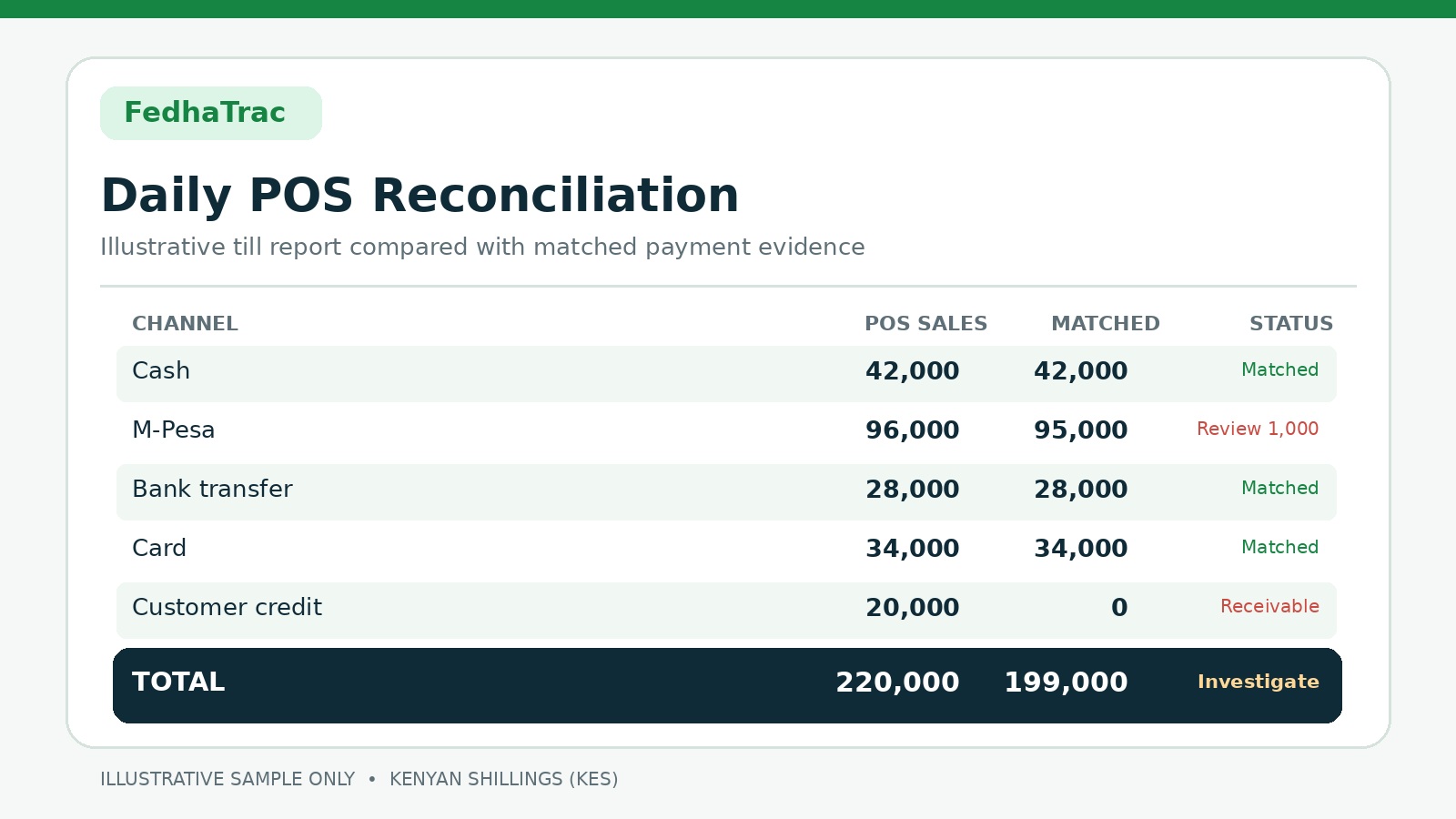
Illustrative POS sales reconciliation in Kenya: KSh 220,000 sales, KSh 199,000 matched collections, KSh 20,000 credit, and KSh 1,000 variance.
The KSh 20,000 credit balance is not a missing payment: it is a receivable to follow up. The remaining KSh 1,000 M-Pesa difference needs investigation. The example does not tell us whether that KSh 1,000 is a timing issue, a record error, a fee, or another explanation. We would compare transaction references and source records before classifying it.
This is what we mean by POS accounting in Kenya with real financial support. Rather than declaring a shortage from a single screen, we help you separate genuine receivables from unexplained differences and document the next action.
From Daily Transactions to a Month-End Profit Picture
Consider a second illustrative example: a shop records KSh 1,500,000 of net monthly revenue, KSh 960,000 in supported cost of goods sold, and KSh 385,000 in operating expenses. Its simplified profit before tax is KSh 155,000. These figures are for explanation only, not promises or results attributed to a client.
| Monthly measure | Amount (KSh) |
| Net sales revenue | 1,500,000 |
| Cost of goods sold | (960,000) |
| Gross profit | 540,000 |
| Operating expenses | (385,000) |
| Profit before tax | 155,000 |
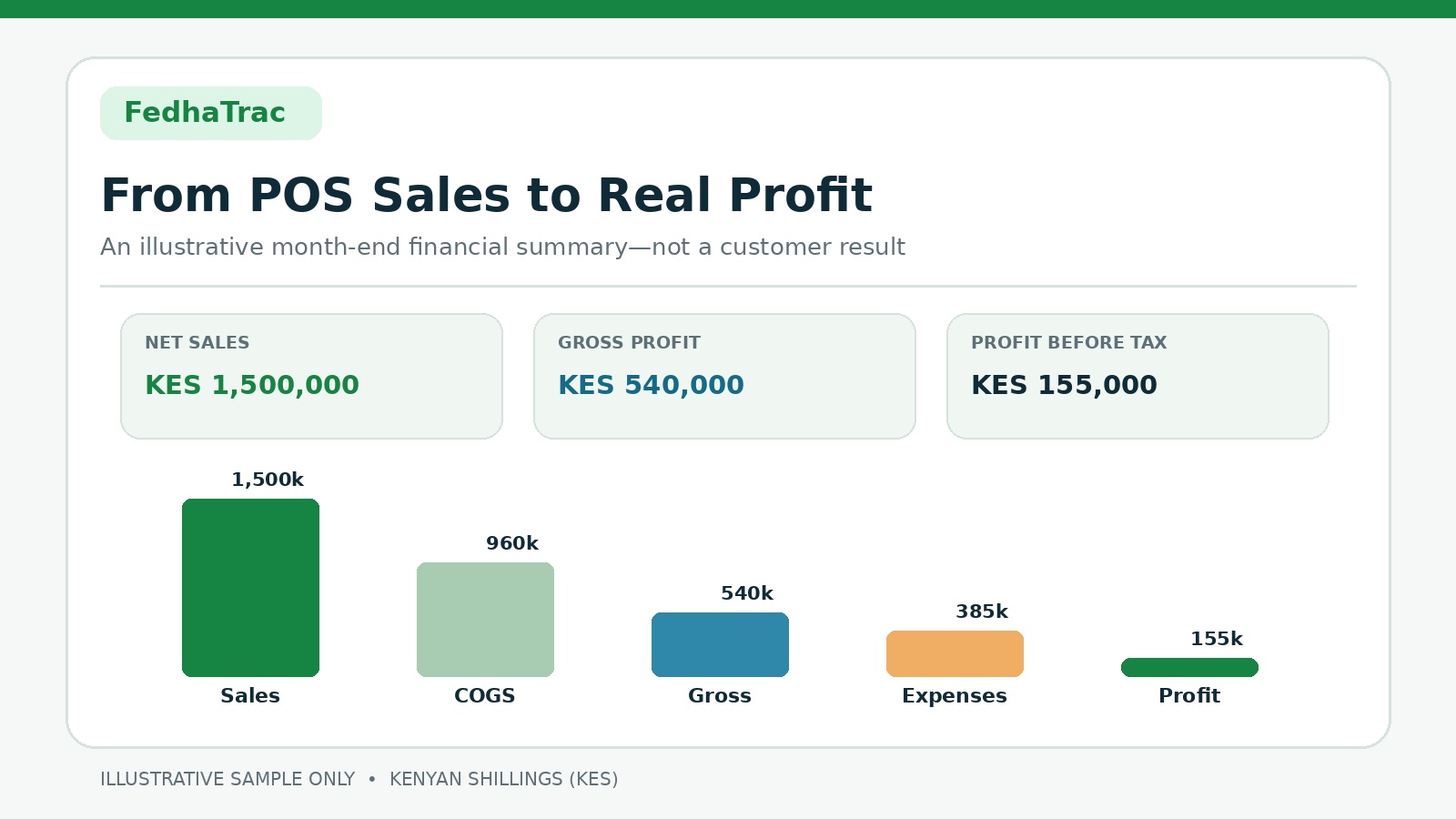
Illustrative Kenyan retail profit report showing KSh 1,500,000 sales and KSh 155,000 profit before tax.
The gross margin is 36%, while profit before tax is approximately 10.3% of net sales. A POS can contribute the sales evidence, but reliable profit analysis also depends on purchase costs, stock adjustments, expense records, and sound accounting. Our accounting support brings those pieces together for review.
This is the difference between counting transactions and understanding a business. POS accounting in Kenya should help an owner see both what the checkout processed and what the business actually earned under the accounting records.
A Simple Onboarding Process That Respects Your Business
We start with a conversation about your store, your existing POS, your payment methods, and what you most want to understand. If you want our POS, we discuss the suitable setup and available features. If you already have one, we examine the reports it can provide and agree how those records will be shared. Neither path requires a fabricated promise about automatic integration.

Kenyan business owner and financial advisor reviewing point-of-sale reports, expenses, and performance.
Next, we agree on the bookkeeping and reporting scope: which sales summaries, M-Pesa or bank statements, invoices, stock schedules, and expense records are needed, who supplies them, and how often we review the figures. POS accounting in Kenya can work for boutiques, hardware stores, agrovets, auto-spares retailers, supermarkets, restaurants, and other businesses that rely on daily transactions.
Questions Business Owners Ask Us About POS Accounting in Kenya
Does FedhaTrac have its own POS system?
Yes. We offer our own POS system for businesses that want a point-of-sale solution. Tell us about your business and we will discuss the system’s suitable setup and our support options.
Must I replace my current POS to use FedhaTrac?
No—and that flexibility is one of our strengths. If your existing POS serves your customers well, keep using it. We can work with its reports, reconcile the available sales and payment records, and explain your expenses and performance. If you would rather explore our POS, we can discuss that option too. POS accounting in Kenya should fit the way your business operates, not force an unnecessary disruption.
Can you work with reports from my particular POS brand?
Yes, we can work with reports from the POS you already use. During onboarding, we review which reports and exports are available and agree on the practical way to obtain the necessary information. Contact us with your POS details and we will help define the best reporting workflow for your shop.
Can FedhaTrac show whether my shop is actually profitable?
That is exactly the kind of clarity we help you build. We combine supported sales information with purchases, stock costs, operating expenses, and other records to prepare and explain financial reports. With professional POS accounting in Kenya, you can move from guessing your margins to understanding the figures behind them.
Will you help us make sense of M-Pesa and KRA records?
Absolutely. We help reconcile M-Pesa and bank movements with documented sales, and our tax-support team can assist with organizing records for applicable KRA obligations. eTIMS invoicing requirements depend on the business and the chosen compliant solution; we do not assume every POS receipt is automatically an eTIMS invoice.
Why choose FedhaTrac instead of handling the reports myself?
Because your time should go into customers, staff, products, and growth—not trying to explain five spreadsheets after closing time. We give you choices, qualified financial support, and reports you can understand. Use our POS or keep the system you trust. We organize the bookkeeping, investigate exceptions, track expenses, and help you see what your sales really mean. Contact FedhaTrac and tell us how your current checkout works; we will show you a practical path to clearer finances.
Keep Your POS. Or Choose Ours. Either Way, Choose Financial Clarity.
A shop owner should never have to choose between a working checkout and better accounting. At FedhaTrac, we offer our own POS system and also support businesses that want to continue using their existing POS. Then we help turn the available reports into organized records, reconciled payments, meaningful financial statements, and useful business discussions.
If you have been searching for POS accounting in Kenya that offers more than software, this is your next step. Talk to our team today. We will listen to how your business sells, explain how we can support it, and help you choose a setup that makes your figures work harder for you.


