

Running a fashion boutique is about more than choosing beautiful dresses and creating attractive displays. Every sale also creates a financial record. Every new collection ties up cash. Every discount, supplier invoice, customer deposit, delivery charge, and unsold item affects the business. That is why boutique accounting in Kenya matters even to a small clothing shop with one counter and a single employee.
A busy boutique can still struggle to pay rent if owners cannot separate collections, customer balances, stock purchases, and the actual cost of goods sold. Boutique accounting in Kenya provides reliable answers.
**FedhaTrac** offers outsourced bookkeeping, accounting, reconciliations, financial reporting, and Kenya-focused tax support. Its team can organize records supplied by boutique owners and work with agreed accounting processes, including existing software or structured spreadsheets. This article explains nine practical ways those services support fashion retailers, from a single shop to a growing operation that also sells through WhatsApp and Instagram.
Why Fashion Retailers Need More Than a Sales Notebook
Clothing differs by style, color, size, cost, and selling speed. Different sizes require different stock records, and promotions change margins. Boutique accounting in Kenya links those details to financial statements.
Consider Zuri Fashion House, a fictional Nairobi boutique used only to explain the workflow. It sells dresses, shoes, handbags, and accessories through walk-in visits and customer messages. We are not presenting Zuri as a real FedhaTrac client, and none of the example figures below represents an actual customer’s performance.
FedhaTrac does not need to replace the shop’s existing point-of-sale or stock-counting process to add value. It can use properly collected sales, purchase, payment, and stock records to prepare accurate accounts and useful management reports. Financial recordkeeping and inventory scanning are different services.
1. Record Boutique Sales by Channel, Not from Memory
A fashion shop may accept cash over the counter, M-Pesa till payments, bank transfers for bulk orders, and payment links for online orders. Without a daily sales summary, it becomes difficult to distinguish money received today from orders that have merely been promised. Boutique accounting in Kenya starts with a consistent sales record supported by receipts and transaction references.
FedhaTrac’s bookkeeping service covers the organization of income records, receipts, invoices, and customer information. A boutique can provide its daily POS export, receipt book, order log, and payment statements. The records can then be categorized by date, sales channel, and relevant product grouping under the agreed bookkeeping process.
For Zuri Fashion House, a practical daily summary would show walk-in dress sales separately from Instagram handbag orders and wholesale accessory transactions. Staff should mark unpaid reservations and customer deposits clearly instead of recording them automatically as completed sales. The exact accounting treatment of deposits depends on whether the shop has fulfilled its obligations and its applicable reporting basis.
This makes boutique accounting in Kenya useful for comparing sales channels and identifying incomplete orders.
2. Reconcile M-Pesa, Cash, Bank Transfers, and Card Collections
When a customer pays KSh 4,500 through M-Pesa, the payment notification is useful evidence, but it is not the entire accounting record. The business still needs the related sale, any charges, and the correct account to be matched. Cash may be counted at closing, while bank or card settlements may arrive later. Boutique accounting in Kenya needs these timing differences explained rather than hidden.

A fashion customer and shop attendant complete payment at the retail counter
FedhaTrac explicitly advertises M-Pesa, mobile-money, bank, and account reconciliation. Its finance team can compare boutique transaction listings against bank statements, mobile-money statements, receipt totals, and deposit records. Unmatched amounts should be investigated with staff instead of inserted as unexplained adjustments.
A workable closing routine is simple: record total sales, total payment types, refunds, outstanding balances, and cash counted; then check those numbers against the relevant statements. Differences may arise from duplicate entries, canceled orders, fees, transfers, or genuine omissions. Boutique accounting in Kenya provides a trail for resolving them.
This routine helps managers investigate discrepancies promptly, without promising automatic resolution.
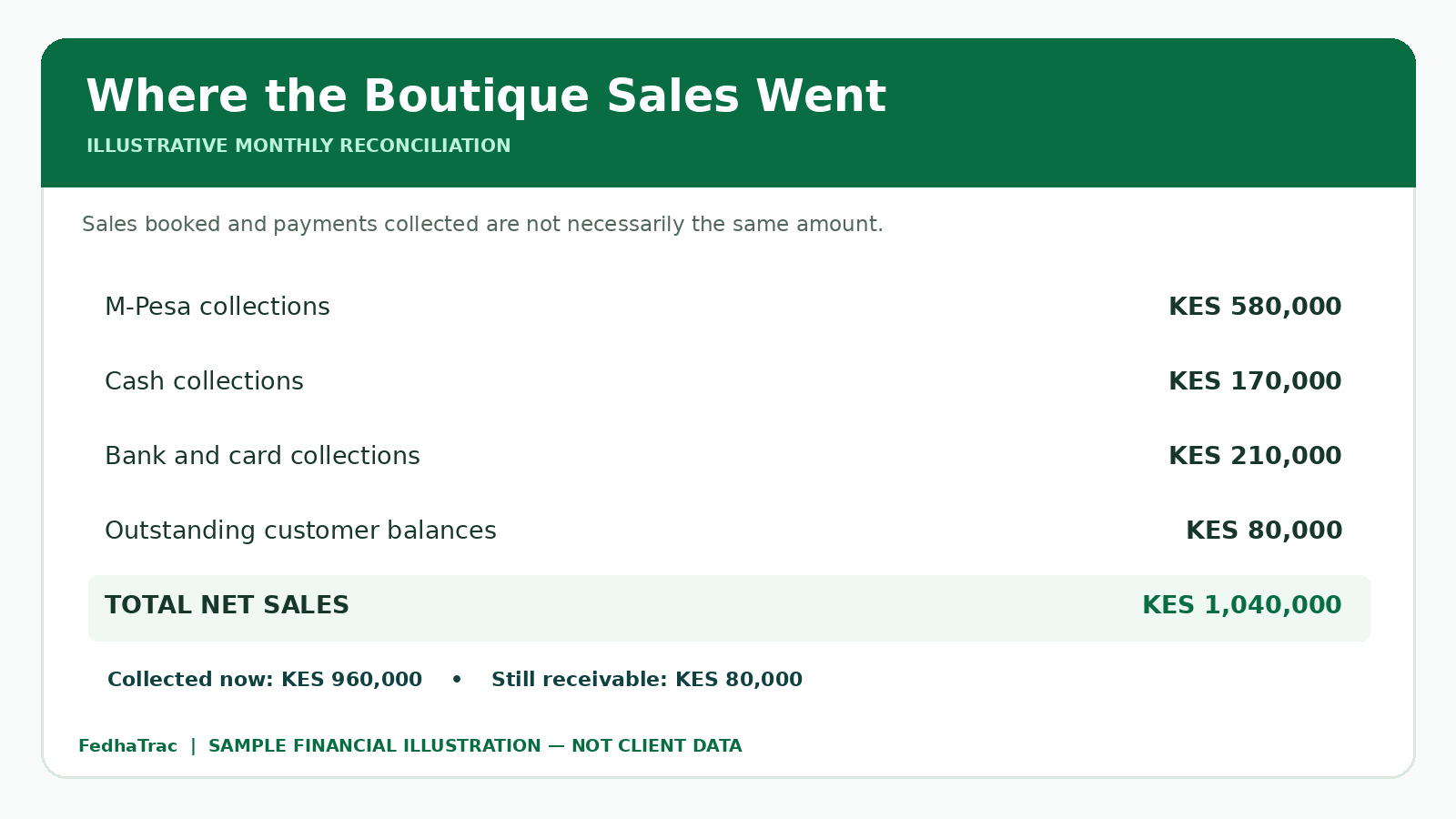
Illustrative payment breakdown totaling KSh 1,040,000 in sales
3. Keep Supplier Purchases and Payables Under Control
Fashion retailers often buy from wholesalers, local designers, importers, and independent suppliers. Some orders are paid immediately, while others arrive with a balance due after delivery. Purchase prices can also change between restocking cycles. Boutique accounting in Kenya brings those supplier commitments into the same financial picture as sales.
FedhaTrac can organize supplier invoices, payment proofs, purchase records, credit notes, and accounts payable schedules. For a boutique importing shoes or handbags, the supporting paperwork may also include freight and other directly attributable costs that an accountant reviews when determining inventory cost. The proper treatment depends on the actual purchase and the accounting basis used.
Suppose Zuri receives a clothing delivery and pays only a deposit. The unpaid amount remains a supplier obligation, not an expense that can safely be ignored. A payment schedule reveals upcoming cash needs and helps prevent duplicate payments.
Clear supplier records also make boutique accounting in Kenya more actionable: staff can discuss discrepancies with a supplier using invoice numbers and delivery records, and the owner can decide when to reorder without guessing what remains payable.
4. Connect Clothing Stock Records to Inventory Value
A full clothing rack does not necessarily mean a financially healthy boutique. Stock purchased six months ago may still occupy cash that could have funded fast-selling items. Damaged goods, missing pieces, and returned items can further complicate the stock count. Boutique accounting in Kenya must therefore connect the stock records provided by the shop to reasonable inventory values.
FedhaTrac’s accounting support can review purchase costs, closing stock schedules, and adjustments supplied by the business. Employees or the boutique’s retail system remain responsible for recording physical quantities, product variants, and movements. FedhaTrac should not be described as automatically scanning barcodes, identifying size variants, or counting garments unless that function is separately verified.

Shop staff checking clothing quantities and variants during a stock review
A monthly count might distinguish 16 dresses in one style from 12 that the system reports. Staff would investigate sales not posted, customer returns, transfers, damage, and possible losses before an approved correction is made. The resulting cost and stock information supports better financial statements.
For a simplified periodic-inventory example, the cost of goods sold equals opening inventory plus purchases, less closing inventory. Boutique accounting in Kenya can use that relationship as a cross-check, while the actual year-end treatment follows the chosen accounting policies and evidence.
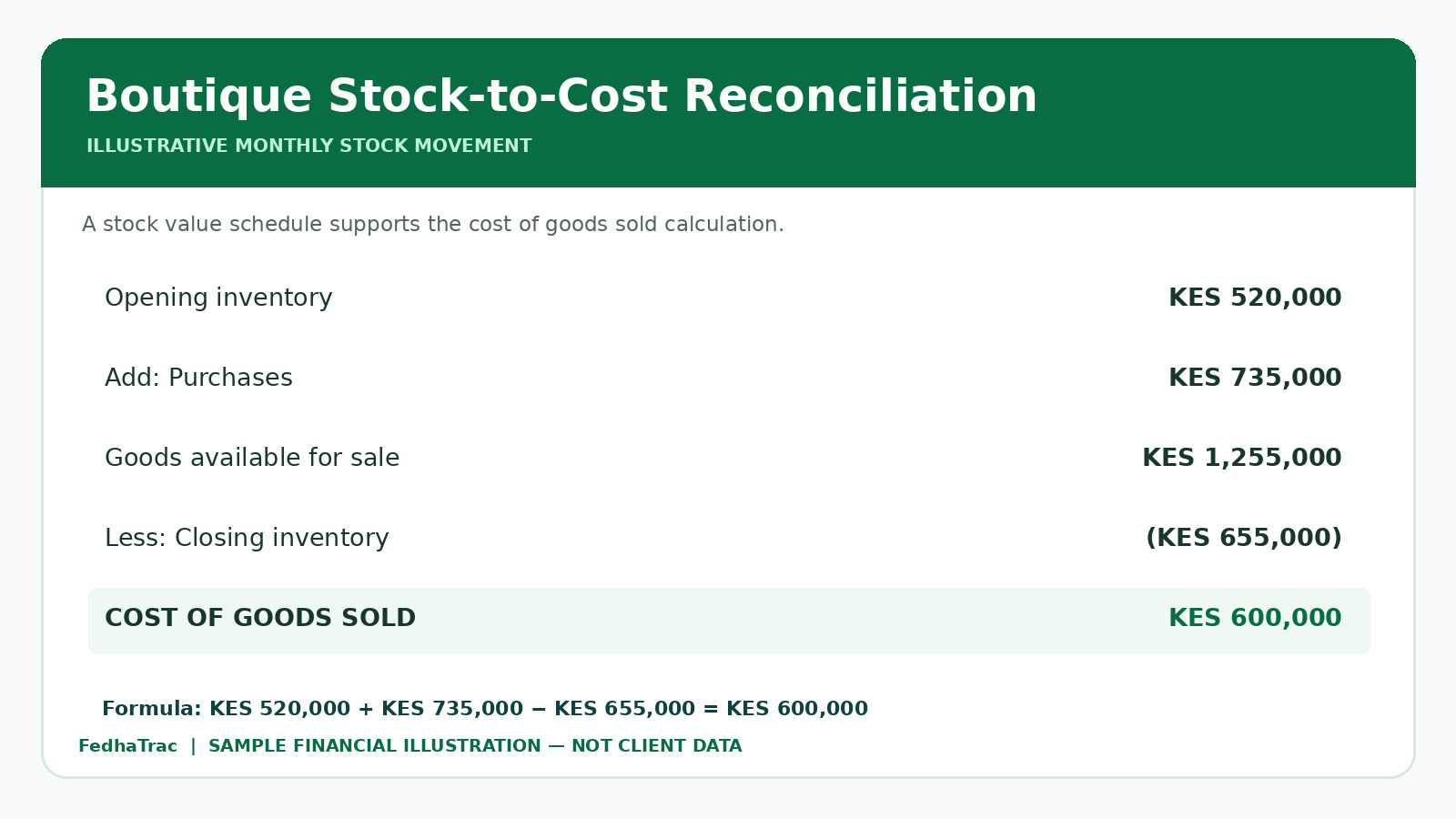
Illustrative stock movement: opening stock plus purchases less closing stock
5. Record Discounts, Exchanges, Returns, and Customer Deposits
Fashion retail has a characteristic complication: the same garment may leave the shop, return because of fit, and be exchanged for a different size. Meanwhile, a customer might pay a deposit for an item that is still being sourced. Without documentation, gross sales, cash received, and actual income can become mixed up.
FedhaTrac helps organize the financial evidence around those events. The boutique supplies the original transaction, refund or exchange authorization, relevant proof of payment, and updated stock record. The accounting team can record the financial effect using the appropriate entries and supporting documents. Boutique accounting in Kenya is especially valuable when the shop runs frequent promotions or accepts advance payments.
For example, a KSh 6,000 handbag sold with a KSh 600 approved discount contributes KSh 5,400 of sales revenue before other adjustments, not KSh 6,000. If an item is returned, the team must distinguish a cash refund from a replacement and correct the relevant revenue, tax, and inventory records where applicable.
A fair return policy remains essential. Boutique accounting in Kenya ensures the financial records reflect what happened.
6. Track Operating Expenses Without Confusing Them with Stock Purchases
Clothing shops pay for rent, shop attendants, electricity, internet bundles, photography, packaging, social-media advertisements, and deliveries. Other spending goes directly into obtaining saleable stock. Treating all of those payments as the same kind of cost makes margins difficult to interpret. Boutique accounting in Kenya separates operating expenses from stock-related costs according to the business’s accounting policies.
FedhaTrac offers expense classification, bill organization, and monthly bookkeeping. The boutique can submit rent receipts, staff payroll schedules, advertising invoices, transport expenses, and supplier documents. Those records are reviewed and assigned to the right categories, with questionable items flagged for clarification.
A social-media campaign, for instance, may create a flood of inquiries without enough completed sales to justify its cost. Tracking advertising costs separately allows the owner to compare campaigns over time without assuming every inquiry becomes a purchase. Similarly, owner withdrawals should not quietly be mixed into ordinary shop expenses.
Here boutique accounting in Kenya clarifies the recurring costs that come before reinvestment.
7. Understand Profit by Clothing Category and Pricing Decision
A shop that sells many shoes may still earn less gross profit from shoes than from a smaller number of accessories. That is why revenue alone is a poor way to judge what should occupy limited shelf space. Boutique accounting in Kenya helps compare category sales with their corresponding costs when the underlying sales and stock information is reliable.
FedhaTrac can prepare reports using categories agreed with the boutique. The owner may want to distinguish dresses, shoes, handbags, and accessories, or compare full-price sales with promotional sales. The financial team can use source records to determine margins, explain adjustments, and investigate unusual changes.
The key calculation is gross profit = net sales − cost of goods sold. Gross margin is gross profit divided by net sales. A higher sales price does not guarantee a higher margin if freight, damage, or purchase costs have also increased. For products obtained in foreign currencies, the relevant cost records need appropriate accounting treatment rather than a guessed exchange rate.
With boutique accounting in Kenya, the retailer can make purchasing and pricing decisions from organized evidence rather than relying only on what appeared popular on social media that week.
8. Receive Financial Reports That Support Real Decisions
Owners need more than a bank balance. A bank balance may include money needed for overdue suppliers, payroll, or new stock. Profitable sales may also include customer amounts not yet collected. Boutique accounting in Kenya brings these distinctions into monthly reporting.
FedhaTrac publishes outsourced accounting services including profit-and-loss reports, balance sheets, cash-flow reports, supplier and customer account reviews, and budget-versus-actual information. A boutique owner can use those reports to discuss what happened during the month and what actions to prioritize next.
An Illustrative Monthly Boutique Financial Summary
The following figures model Zuri Fashion House for teaching purposes. They are not actual FedhaTrac client results. Amounts are in Kenyan shillings, exclude any applicable tax for simplicity, and assume consistent inventory records.
| Illustration | Amount (KSh) |
| Dresses – net sales | 420,000 |
| Shoes – net sales | 260,000 |
| Handbags – net sales | 200,000 |
| Accessories – net sales | 160,000 |
| Total net sales | 1,040,000 |
| Cost of goods sold | (600,000) |
| Gross profit | 440,000 |
| Operating expenses | (282,000) |
| Illustrative operating profit | 158,000 |
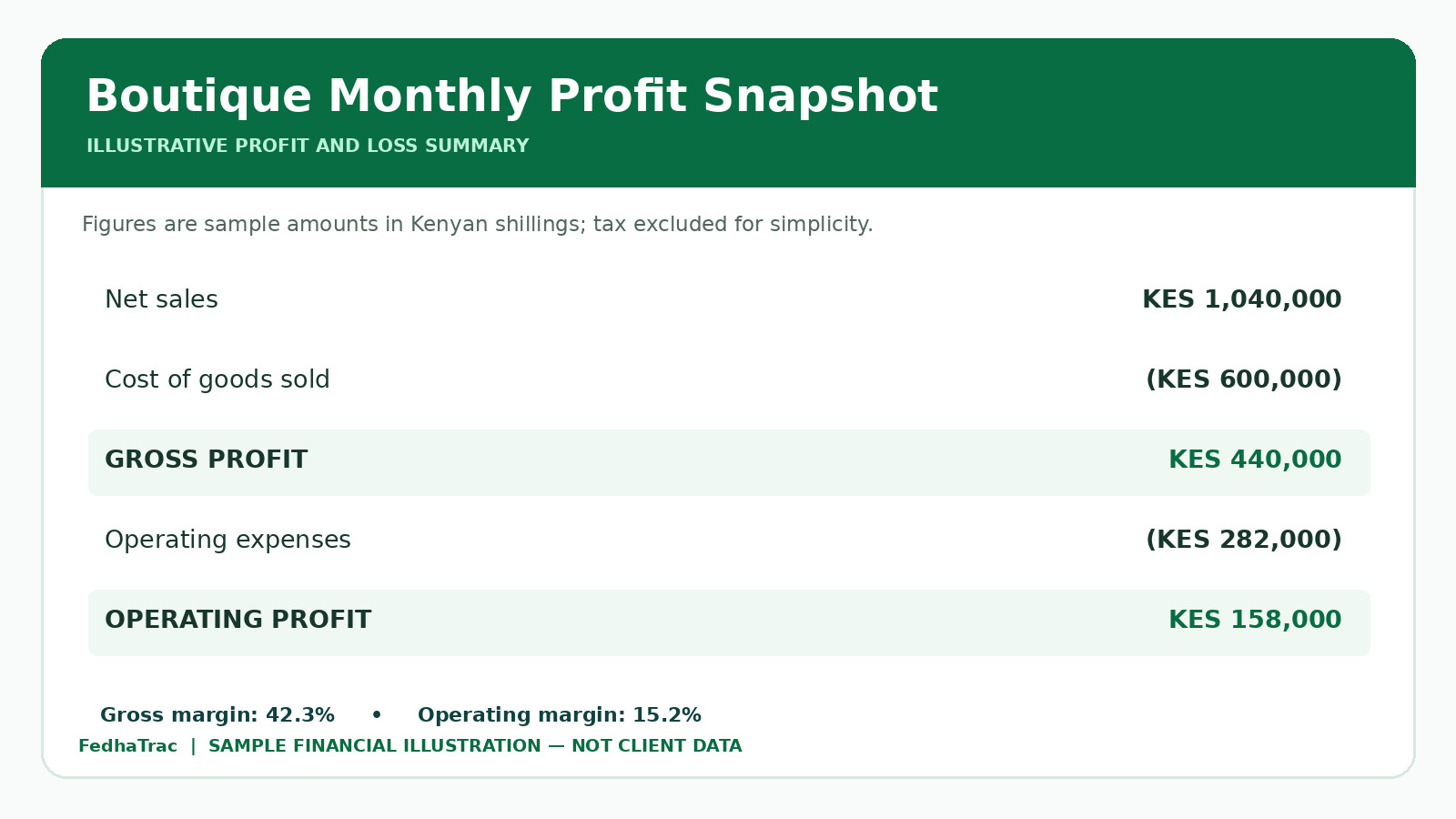
Sample fashion boutique profit report with KSh 158,000 operating profit
The cost of goods sold is consistent with an opening inventory of KSh 520,000, purchases of KSh 735,000, and closing inventory of KSh 655,000. The operating-expense illustration includes rent of KSh 90,000, wages of KSh 112,000, delivery costs of KSh 19,000, marketing of KSh 26,000, utilities and data of KSh 12,000, and other expenses of KSh 23,000. The gross margin is approximately 42.3%, while the operating margin is approximately 15.2%.
Net sales of KSh 1,040,000 could comprise KSh 580,000 through M-Pesa, KSh 170,000 in cash, KSh 210,000 through bank or card, and KSh 80,000 in unpaid customer balances. This is a reconciliation illustration, not a cash-flow statement.
The real benefit of boutique accounting in Kenya is having figures that agree with the underlying documents. An owner can ask whether new stock is affordable, whether wage costs are sustainable, and whether a popular category is actually profitable before making commitments.
9. Prepare for eTIMS, Tax Filing, and Seasonal Growth
Boutique owners should keep supporting purchase invoices, issue the electronic invoices applicable to their business, and maintain organized records for tax reporting. The Kenya Revenue Authority’s eTIMS guidance explains electronic invoicing expectations for people carrying on business, including many non-VAT-registered businesses. Separately, KRA’s VAT guidance explains when VAT registration is required and the relevant filing duties. Boutique accounting in Kenya must respect each business’s actual tax status.
FedhaTrac advertises tax filing and compliance support, as well as financial records that make tax preparation more manageable. The precise filing obligations depend on the business’s turnover, registration, transactions, and current law; a boutique should not assume every retailer has identical VAT or income-tax obligations.
Good books also support business planning. Fashion demand may shift around holidays, wedding seasons, school openings, and special promotions. Accounting information can help evaluate whether the boutique should keep extra cash for supplier deposits, reduce slow-moving stock, or test a new product line. Boutique accounting in Kenya is most useful when the owner reviews those reports regularly rather than waiting until tax season.
How FedhaTrac Works with a Fashion Shop
FedhaTrac begins by understanding the boutique’s sources of information and agreed service scope. The shop shares its payment statements, sales records, supplier documents, expense receipts, and available stock schedules. The accounting team can then classify transactions, reconcile accounts, review missing information, and produce management reports through its supported workflow. This reflects FedhaTrac’s published accounting services and its broader business-finance features.

Financial records review for a Kenyan clothing boutique
FedhaTrac can work within agreed existing accounting systems. The retailer remains responsible for accurate operational information and for decisions about cashiers, deliveries, and refunds.
For shops that need to catch up on past records, FedhaTrac’s pricing and service information describes both ongoing bookkeeping and separate cleanup work. Fees depend on the requested scope and current published terms. Boutique accounting in Kenya works best when responsibilities, reporting frequency, and documents are agreed from the start.
Frequently Asked Questions About Boutique Accounting in Kenya
Can FedhaTrac work with a small boutique that sells through WhatsApp?
Yes. FedhaTrac offers bookkeeping and accounting support to small businesses. A shop selling through WhatsApp, Instagram, and walk-in visits can supply its order register, invoices, receipts, and payment statements for reconciliation. Boutique accounting in Kenya requires usable supporting records regardless of where an order begins.
Does FedhaTrac automatically count clothing by size and color?
Automatic product-variant scanning or a dedicated boutique POS is not a verified FedhaTrac feature. Staff should continue maintaining reliable SKU, size, color, quantity, and stock-movement records through their existing process. FedhaTrac can use those records for financial stock valuation and reconciliation support, subject to the engagement scope.
How often should a boutique review its finances?
Daily collection checks and regular stock counts help catch operational errors. A monthly accounting review is useful for assessing margins, supplier balances, expenses, and cash needs. The exact schedule depends on the boutique’s transaction volume and the reporting arrangement. Boutique accounting in Kenya is more effective when records are submitted promptly.
What if the boutique has incomplete records from previous months?
FedhaTrac advertises catch-up bookkeeping alongside ongoing services. The team can review the available information, identify gaps, and agree on the work needed to reconstruct records where possible. Missing evidence should be documented rather than replaced with invented figures. Boutique accounting in Kenya depends on transparent limitations as well as accurate entries.
Can FedhaTrac guarantee higher sales or profits?
No accountant can guarantee commercial results merely by organizing records. FedhaTrac provides services that can improve financial visibility and support better decisions. Sales and profits still depend on demand, pricing, purchasing choices, staffing, and execution. Boutique accounting in Kenya helps the owner evaluate those decisions using more dependable numbers.
Give Your Boutique Financial Clarity with FedhaTrac
Beautiful collections attract customers, but reliable numbers help a fashion shop stay in business. Boutique accounting in Kenya brings daily sales, M-Pesa collections, clothing stock costs, discounts, supplier obligations, and monthly financial reports into a more coherent picture. It gives boutique owners a way to distinguish busy trading from genuinely sustainable performance.
FedhaTrac provides outsourced bookkeeping, accounting, reporting, and tax-support services that fashion retailers can discuss and tailor to their needs. To explore support for your shop, contact FedhaTrac and explain how you currently record sales, payments, purchases, and expenses. Start with accurate information, then use it to make decisions about your next season, your next collection, and your next stage of growth.


