

When a Busy Garage Cannot Explain Where Its Money Went
Spare parts accounting becomes complicated when one business repairs vehicles, sells parts over a counter, buys stock from several suppliers, and accepts M-Pesa, cash, bank transfers, and customer credit. A workshop can look busy throughout the day while its owner still struggles to answer a basic question: Which activities actually made money?
In this spare parts accounting example, consider Kijani AutoCare Garage & Spares, a fictional Nairobi business created to show how a practical finance system could work. The garage has three service bays, mechanics, a parts salesperson, and a small store carrying filters, brake pads, belts, engine oils, and consumables. Every morning, vehicles arrive for servicing while walk-in buyers request spare parts. The owner, Miriam, must oversee both sides of the operation.
On paper, the business is active. But a parts salesperson sometimes hands a filter to a mechanic without identifying the vehicle job. Supplier invoices are filed separately from payment messages. Customers occasionally pay a deposit before repairs are completed. At closing time, cash, M-Pesa, and credit sales are mixed into one total. Good spare parts accounting needs a more disciplined handoff between the sales counter, the workshop, and the records.
This illustrative case study follows a sample month. The people, business name, sales figures, and outcomes are invented for learning; they are not a FedhaTrac client testimonial or a claim about measured results. The aim is to show how FedhaTrac bookkeeping services, financial reporting, payment reconciliation, and customer and supplier record support could help a similar garage. The business would still use appropriate workshop, job-card, stock-count, and tax-invoicing processes where needed.
The Business: One Garage, Two Revenue Streams
For spare parts accounting, Kijani AutoCare earns money in two connected ways. First, the retail counter sells replacement parts directly to motorists, mechanics, and small fleet operators. Second, the workshop supplies parts as part of repairs and charges separately for labor and diagnostics. These streams should not be combined so early that Miriam loses the ability to assess their costs.
During the illustrative month, the counter records KSh 355,000 in parts sales. Parts installed during garage repairs contribute another KSh 265,000, while labor and diagnostics contribute KSh 290,000. Total recorded sales are therefore KSh 910,000. Those numbers represent earned sales, not necessarily cash already received. This distinction is central to spare parts accounting and avoids the common mistake of treating every invoice as a deposit into the bank.
| Illustrative monthly sales stream | KSh |
| Walk-in spare-parts sales | 355,000 |
| Spare parts fitted during repairs | 265,000 |
| Workshop labor and diagnostics | 290,000 |
| Total sales | 910,000 |
9 Smart Ways FedhaTrac Could Support Kijani AutoCare
1. Give Every Parts Sale a Clear Accounting Trail
In spare parts accounting, a customer might buy a battery, two oil filters, and a drive belt. The salesperson should record what was sold, the price, payment method, and supporting invoice or receipt. The same product may also be issued to a mechanic working on a customer’s vehicle. In that case, the issue record needs a repair-job reference so it does not disappear between the stockroom and the service bay.
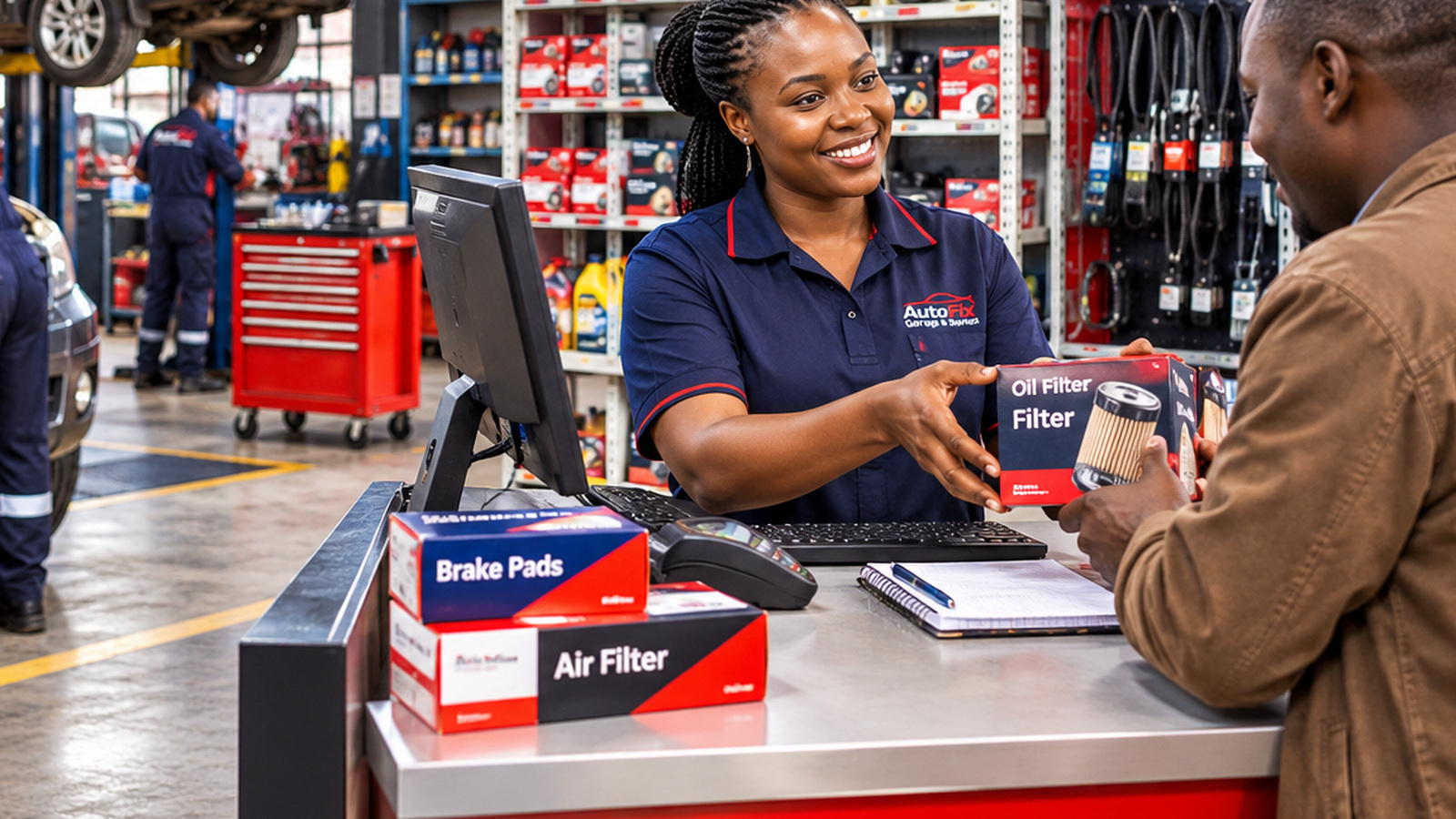
Spare-parts shop accounting in Kenya as a garage salesperson serves a customer at the counter
FedhaTrac can support the transaction-recording side by organizing sales, customer balances, invoices, and the documents supplied by the garage. Spare parts accounting then tells Miriam not only how much the counter sold, but how that sale relates to recorded revenue and receipts. The physical item and its fitment must still be controlled through the garage’s own stock and job-card procedures or compatible operational software.
2. Keep Workshop Labor Separate from Parts Revenue
For accurate spare parts accounting, one completed repair might carry KSh 10,900 in parts and KSh 7,500 in labor and diagnostics. Its final customer charge is KSh 18,400. Assume the relevant parts cost KSh 6,500 and technician time directly attributable to this job costs KSh 3,000. That leaves a KSh 8,900 illustrative contribution before allocated rent, electricity, administration, financing, and tax.
Mechanics working in a service bay while garage parts and labor costs are recorded
The contribution calculation is KSh 18,400 minus KSh 6,500 minus KSh 3,000. It is not automatically the garage’s net profit. Spare parts accounting is most useful when owners can see what a repair generated, what stock it consumed, and how much direct labor it required. Otherwise, a busy service bay may mask jobs that were underquoted or supplied with expensive parts.
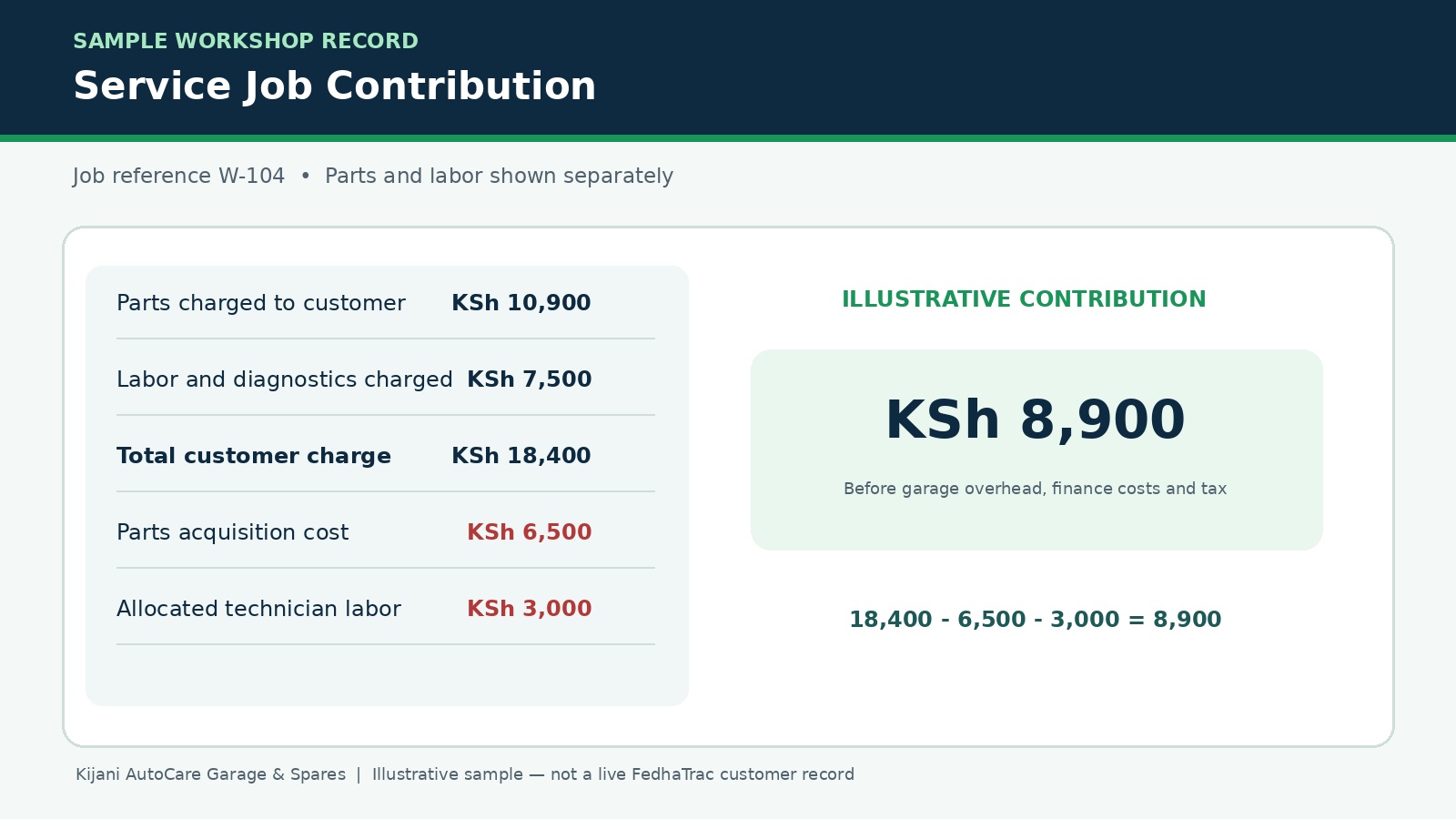
Sample garage job costing worksheet: KSh 18,400 revenue, KSh 9,500 direct cost and KSh 8,900 contribution
3. Reconcile M-Pesa, Cash, Bank, and Customer Credit
A spare parts accounting review might show the month’s KSh 910,000 sales comprise KSh 500,000 received by M-Pesa, KSh 160,000 in cash, KSh 175,000 through bank or card payments, and KSh 75,000 outstanding on customer credit. The payment totals equal the recorded sales, while only KSh 835,000 has been collected. A deposit held against unfinished work would need separate accounting until its appropriate revenue treatment is determined.
| Sales settlement channel | KSh |
| M-Pesa receipts | 500,000 |
| Cash receipts | 160,000 |
| Bank or card receipts | 175,000 |
| Customer invoices still unpaid | 75,000 |
| Sales accounted for | 910,000 |
A salesperson may show Miriam an M-Pesa confirmation message, but a screenshot alone does not prove that the transaction matches the correct sale, amount, or account. FedhaTrac publicly describes M-Pesa and bank-record capture and reconciliation support. That service can help match payment evidence with sales records and identify unmatched items for investigation. It does not eliminate the need to verify till and bank statements.
Consistent spare parts accounting also prevents a customer payment from being recorded as a second sale. If a fleet customer settles a previously issued invoice, the accountant reduces the receivable; the garage has collected money but has not made a new sale that day. For additional guidance, FedhaTrac’s bank reconciliation guide explains why transaction matching matters.
4. Turn Supplier Bills into Usable Purchasing Records
For spare parts accounting, FedhaTrac lists purchases, bills, vendor tracking, expense grouping, and supplier histories among its supported finance operations. The parts salesperson could send purchase orders, goods-received confirmations, returns, and supplier invoices to the finance team. FedhaTrac could then maintain the payable records and help Miriam see what is due, subject to the agreed service scope and the documents received.
Good spare parts accounting does not mean treating every spare-parts purchase as an immediate profit-and-loss expense. Unsold inventory is ordinarily an asset under applicable accounting policies, while the cost of parts sold or fitted is recognized when those goods are sold or consumed for the related revenue. This helps avoid a misleading dip in monthly profit simply because the garage restocked heavily before a busy season.
5. Investigate Stock Differences Instead of Hiding Them
A spare parts accounting review of the stock clerk’s count shows an important issue. A sample brake-pad line begins with 24 sets, receives 18, sells nine over the counter, and issues 13 to workshop jobs. Expected closing stock is 20 sets. Physical counting finds only 18. At an illustrative unit cost of KSh 2,400, the two-set difference has a potential cost value of KSh 4,800.
The two missing sets are not automatically proof of theft or a confirmed accounting loss. They could reflect an unrecorded issue, return, transfer, count error, or a genuine shortage. The manager should investigate the stock records before authorizing any inventory adjustment. Good spare parts accounting uses evidence from a physical inventory system; it does not magically count the shelf from a financial dashboard.
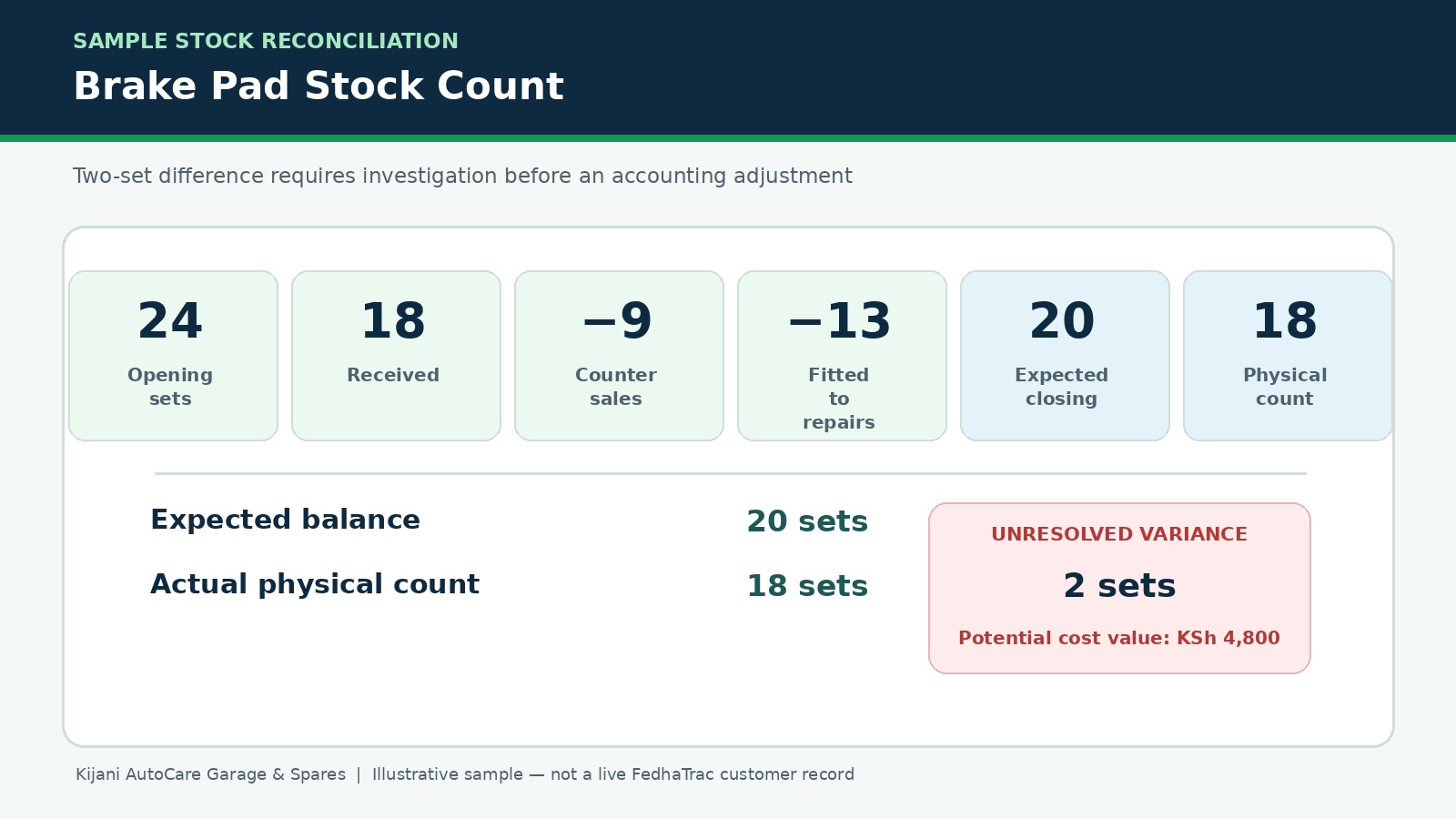
Illustrative brake-pad inventory reconciliation: expected 20, physical 18, unresolved variance of two sets
6. Know Which Customers Still Owe the Garage
In spare parts accounting, not every workshop sale is settled immediately. Fleet operators may pay on account after an approved service, and a loyal customer may settle a remaining balance later. In the illustration, the garage’s KSh 75,000 receivable consists of a KSh 45,000 fleet account, KSh 18,000 owed by a corporate buyer, and KSh 12,000 on another customer account.
A proper aging view places KSh 52,000 in the current-to-30-day bucket, KSh 18,000 in the 31–60-day bucket, and KSh 5,000 beyond 60 days. These buckets total KSh 75,000. The balance is a claim to collect, not money available for rent or supplier payments today.
7. Bring Mechanic Costs and Overhead into the Profit Picture
Without reliable spare parts accounting, a workshop can seem profitable if the owner subtracts only the invoice cost of oil, filters, and brake pads. But technician pay, workshop rent, utilities, security, administrative payroll, marketing, and financing also affect results. In the sample month, the cost of sales totals KSh 497,000: KSh 218,000 for counter parts, KSh 159,000 for parts fitted, and KSh 120,000 for directly attributable technician labor.
Gross profit is therefore KSh 413,000. The illustration includes KSh 211,000 in operating expenses and KSh 7,000 in finance costs, leaving KSh 195,000 before income tax. These are modeled totals, not actual results achieved for a garage using FedhaTrac. Spare parts accounting gives meaning to those numbers only when purchases, direct costs, operating expenses, and financing items have been consistently classified.
| Illustrative profit summary | KSh |
| Total sales | 910,000 |
| Cost of sales, including direct technician labor | (497,000) |
| Gross profit | 413,000 |
| Operating expenses | (211,000) |
| Operating profit | 202,000 |
| Finance costs | (7,000) |
| Profit before income tax | 195,000 |
The sample operating-expense total consists of rent KSh 80,000, utilities KSh 18,000, administrative wages KSh 58,000, marketing KSh 12,000, professional and office services KSh 20,000, security and cleaning KSh 14,000, and consumable office supplies KSh 9,000. The expense components total KSh 211,000. No assumption about VAT-exclusive selling prices or tax payable is built into this illustration.
8. Keep eTIMS Documentation and Tax Records Organized
In spare parts accounting, Kenyan garage owners need to distinguish useful bookkeeping from tax compliance. According to the Kenya Revenue Authority’s eTIMS guidance, people carrying on business are generally required to issue electronic tax invoices through the applicable process, including businesses that are not VAT-registered. KRA also explains invoice-support requirements for business expenses and limited exceptions. Rules may depend on the transaction and taxpayer circumstances.
For Kijani AutoCare, a service invoice should describe work and parts accurately, while supplier documents need to be retained and matched to the corresponding transaction. If a qualifying sale is corrected or returned, the garage should use the relevant compliant invoice or credit-note process rather than erasing its accounting history. The business should confirm its actual eTIMS workflow and VAT position with a qualified adviser.
FedhaTrac advertises tax and compliance support, but spare parts accounting on its own is not a substitute for issuing a compliant electronic tax invoice. This distinction is important: a clear sales report may help prepare information for tax filings, yet a report is not itself proof that required eTIMS invoices were issued or transmitted. Owners can review the official KRA eTIMS portal and FedhaTrac’s bookkeeping and accounting support when planning an appropriate workflow.
9. Review a Practical Weekly Dashboard, Not Just Sales Totals
For spare parts accounting, FedhaTrac describes financial dashboards, reports, and a dedicated expert who helps maintain records. When the garage supplies timely, accurate information, its finance support can organize the books and provide a clearer month-end picture. The word “real-time” on a product page should not be read as a promise that the dashboard independently detects every cash sale or stock issue without source data, integration, and routine reconciliation.
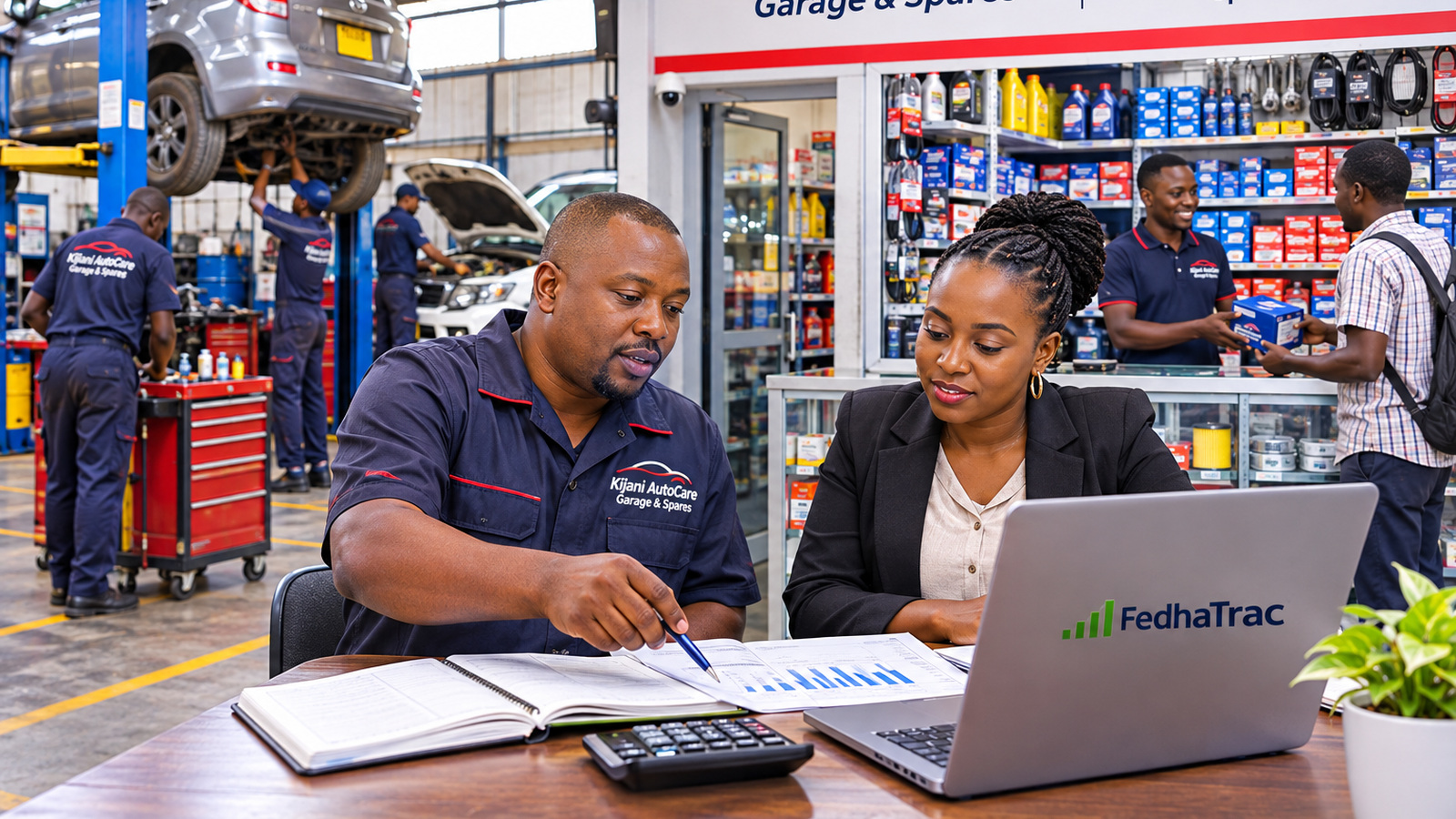
Kenyan garage owner reviewing financial records and workshop revenue with a bookkeeper
In a disciplined spare parts accounting workflow, the owner could review the KSh 75,000 unpaid customer balance, the KSh 4,800 potential stock discrepancy, and the KSh 195,000 illustrative profit before tax as three different management questions. One relates to collections, one to operational investigation, and one to performance. Their differences are as important as their totals.
How the Case Study’s Numbers Fit Together
Costs are also separated deliberately. Direct parts costs and technician labor amount to KSh 497,000, leaving a KSh 413,000 gross profit. After KSh 211,000 in overhead, the illustrative operating profit is KSh 202,000. Deducting KSh 7,000 in finance charges produces KSh 195,000 before income tax. These figures demonstrate how spare parts accounting can improve decision visibility; they do not establish the financial performance of any real business or a particular FedhaTrac customer.
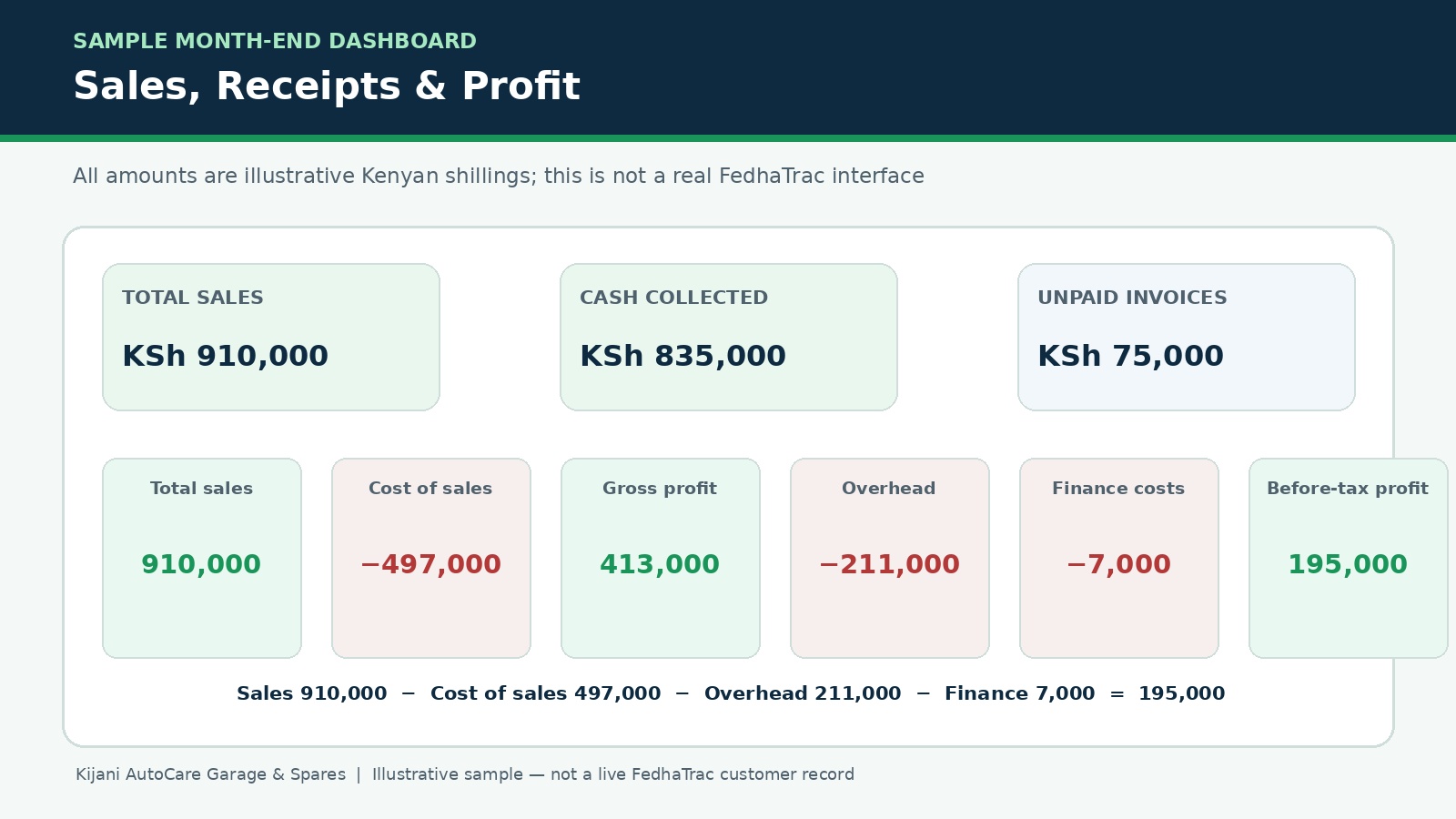
Sample garage accounting dashboard with KSh 910,000 sales and KSh 195,000 profit before tax
What the Parts Salesperson, Mechanic, and Owner Each Do
To support spare parts accounting, the spare-parts salesperson should identify every sale and issue, keep the part description and price clear, and hand over supporting documents. The mechanic should connect parts used to the correct customer job and confirm direct work completed. The service advisor should record quotations, approvals, deposits, invoices, and customer handovers. Each person contributes operational evidence; none should be expected to reconstruct the whole finance ledger after a busy month.
FedhaTrac’s role is different. Under an agreed engagement, its bookkeepers can use the evidence to maintain sales and purchases, categorize expenses, reconcile payment channels, track receivables and payables, and prepare financial views. The owner uses those views to question margins and outstanding balances. This separation of responsibilities makes spare parts accounting more reliable without claiming that accounting software replaces the storekeeper, mechanic, or service advisor.
Five Questions Garage Owners Often Ask
Can FedhaTrac manage a garage that sells spare parts and provides repairs?
FedhaTrac describes spare parts accounting support through bookkeeping, invoices, payment reconciliation, supplier and customer records, and financial reporting for Kenyan businesses. Those capabilities can support a garage with multiple income streams, provided the workshop supplies accurate operational records. Ask specifically about the integration or process for job cards and physical stock; do not assume a specialized garage POS is included.
Does spare parts accounting mean every part needs a separate invoice?
Not necessarily. Parts should be clearly identifiable within the applicable sale or repair documentation. A workshop invoice can describe parts and labor as separate lines where appropriate. Tax-invoice issuance must follow the business’s applicable KRA requirements, and internal stock movements should also have supporting references even when they are not customer sales.
Can M-Pesa receipts be reconciled to repair invoices?
FedhaTrac lists payment record capture and reconciliation as business capabilities. The garage still needs reliable transaction records, access to the appropriate statements, and controls for refunds, deposits, duplicate references, and timing differences. Spare parts accounting works best when payment matching is performed regularly rather than through an end-of-month estimate.
How can a spare-parts salesperson avoid stock discrepancies?
Use part identifiers, record every counter sale and internal issue, obtain authorization for returns, and investigate periodic stock-count differences. Accounting can record verified adjustments but cannot replace a physical count. In this case, the unresolved two-set brake-pad variance should remain open until the evidence supports a correction.
Is a finance dashboard enough to run the entire workshop?
No. A garage still needs safe repair procedures, customer approvals, technical job records, stock custody, staff management, and compliant invoicing. A dashboard helps the owner interpret organized financial records. Spare parts accounting is one essential component of a functioning garage, not a replacement for the entire operation.
A Better Way for Kijani AutoCare to Finish the Month
For effective spare parts accounting, a business combining repairs with retail parts sales, the most useful result is not a flashy graph. It is an owner who can connect the counter receipt to the correct sale, the workshop part to the correct vehicle job, the supplier bill to the correct stock receipt, and the customer invoice to the correct payment. That visibility makes it easier to investigate differences before they grow.
If your garage runs a busy service bay alongside a spare-parts counter, explore FedhaTrac’s bookkeeping support and financial management features. Ask for a workflow that fits your own sales registers, job cards, payment methods, stock processes, and tax requirements. The goal is to spend less time guessing where the money went and more time making informed business decisions.


