

A spa can fill every treatment room, sell skin-care products, collect gift vouchers and still arrive at tax time with conflicting records. A booking calendar may show a completed facial while a cash receipt is missing; a customer may pay for a future massage; a therapist’s commission may be calculated on a different amount from the invoice. Spa tax compliance in Kenya depends on bringing those events into one defensible financial record. At FedhaTrac, our verified tax filing and compliance support is backed by bookkeeping, invoice administration and financial reporting. We help businesses organize records and approach applicable KRA obligations; we do not promise every spa is on the same tax regime or that a dashboard automatically files returns.
Our example, Amani Glow Wellness Spa Ltd., is a fictional Nairobi wellness business providing massages, facials, body treatments and retail beauty products. Its numbers illustrate decisions; they are not an actual FedhaTrac case study. We will focus on nine business mistakes owners can prevent with accurate source records and review, not nine generic claims that paying tax solves everything. Strong spa tax compliance in Kenya begins before a return is prepared, when the first appointment is confirmed and the first receipt is issued.
Why a spa is not merely a hair salon with another name
For spa tax compliance in Kenya, remember that spas combine appointments, bundled services, gift vouchers, retail stock, professional products, contractor or employee compensation and sometimes online deposits. A one-hour massage is different from a sealed bottle of body oil sold across the counter. A treatment paid for today but delivered next month raises a timing question. Spa tax compliance in Kenya therefore needs clear service categories and documents that show what was supplied, when and to whom. The business should not rely on an appointment-book total as the only evidence of taxable turnover.
FedhaTrac’s visible POS interface supports products and services, customer records, receipts and payment options. It does not establish integrated online booking, automated therapist allocation, medical record management or a certified treatment program. The spa manager should maintain service authorization, price lists and staff schedules through suitable operational processes. Our role is to connect the approved commercial records to bookkeeping, financial statements and applicable tax administration, with the spa responsible for treatment safety and client care.
Misstep 1: Using booking value as earned sales
In spa tax compliance in Kenya, a booking may be reserved, rescheduled, canceled, prepaid or completed. Those statuses are not interchangeable. Spa tax compliance in Kenya is weakened when managers treat every reservation as revenue and then cannot explain canceled appointments, gift vouchers or refunds. Use a completed-service record, the approved price and invoice evidence to support recognized income. Record cash received separately. Whether an advance is earned immediately or held as a liability depends on the actual contract and applicable accounting rules.

spa staff organizing bookings and customer records
At Amani Glow, a KSh 7,000 couples package booked on Monday might be delivered the following Saturday. If the client pays in advance, the spa needs a customer-payment record and a service-delivery date rather than two unrelated sales entries. The business should agree on cancellation and refund terms and preserve any authorized change. We can help reconcile the accounts and identify open balances, but FedhaTrac does not decide whether a guest attended a session or whether a refund is commercially justified.
Misstep 2: Forgetting the difference between a treatment and a product
For spa tax compliance in Kenya, a facial may use a small quantity of serum, while a separate bottle sold for home use is retail merchandise. The transaction records should distinguish the service price, retail sale, product cost and inventory movement. Spa tax compliance in Kenya needs this distinction because tax and accounting treatment can depend on the type of supply and the business’s actual VAT registration status. Do not assume every wellness service is medically exempt, or that every product has the same treatment, without checking the applicable legislation and facts.
Staff should record sealed retail inventory received, sold, returned, damaged or used internally. The FedhaTrac inventory workspace can help show products and stock, but it has not been proven to deduct facial-serum consumption automatically for every appointment. That may require a controlled manual process. Our accountants can support cost classification and the tax team can assess documentation with the owner’s verified sales details.
Misstep 3: Issuing a payment receipt without reviewing eTIMS
For spa tax compliance in Kenya, the Kenya Revenue Authority states that persons engaged in business generally must onboard eTIMS and issue electronic tax invoices, including many non-VAT-registered businesses, subject to applicable rules and exceptions. A spa’s card slip, M-Pesa notification or internal POS receipt does not by itself establish that the correct electronic tax invoice was issued or transmitted. Spa tax compliance in Kenya therefore requires a deliberate invoicing check, not just a drawer full of receipts.
At month-end, compare completed treatments and retail sales against issued invoices, credit notes and recorded payments. Investigate missing references, reversals and duplicate invoices. KRA’s guidance for smaller businesses explains simplified options where applicable. FedhaTrac provides record preparation and tax-compliance assistance, but it should not be described as an automatic statutory invoice-submission service merely because it has a POS module.
Misstep 4: Recording gift vouchers as both cash and new service revenue
Spa tax compliance in Kenya demands particularly careful gift-voucher records. A customer may pay KSh 10,000 for a future treatment; the spa now has cash and an obligation to honor the voucher under its conditions. When the treatment takes place, the same voucher should not be recorded as a second customer cash sale. Spa tax compliance in Kenya improves when the business maintains a voucher issue, redemption, refund and outstanding-balance register, with the timing of revenue and tax recognized according to applicable requirements.
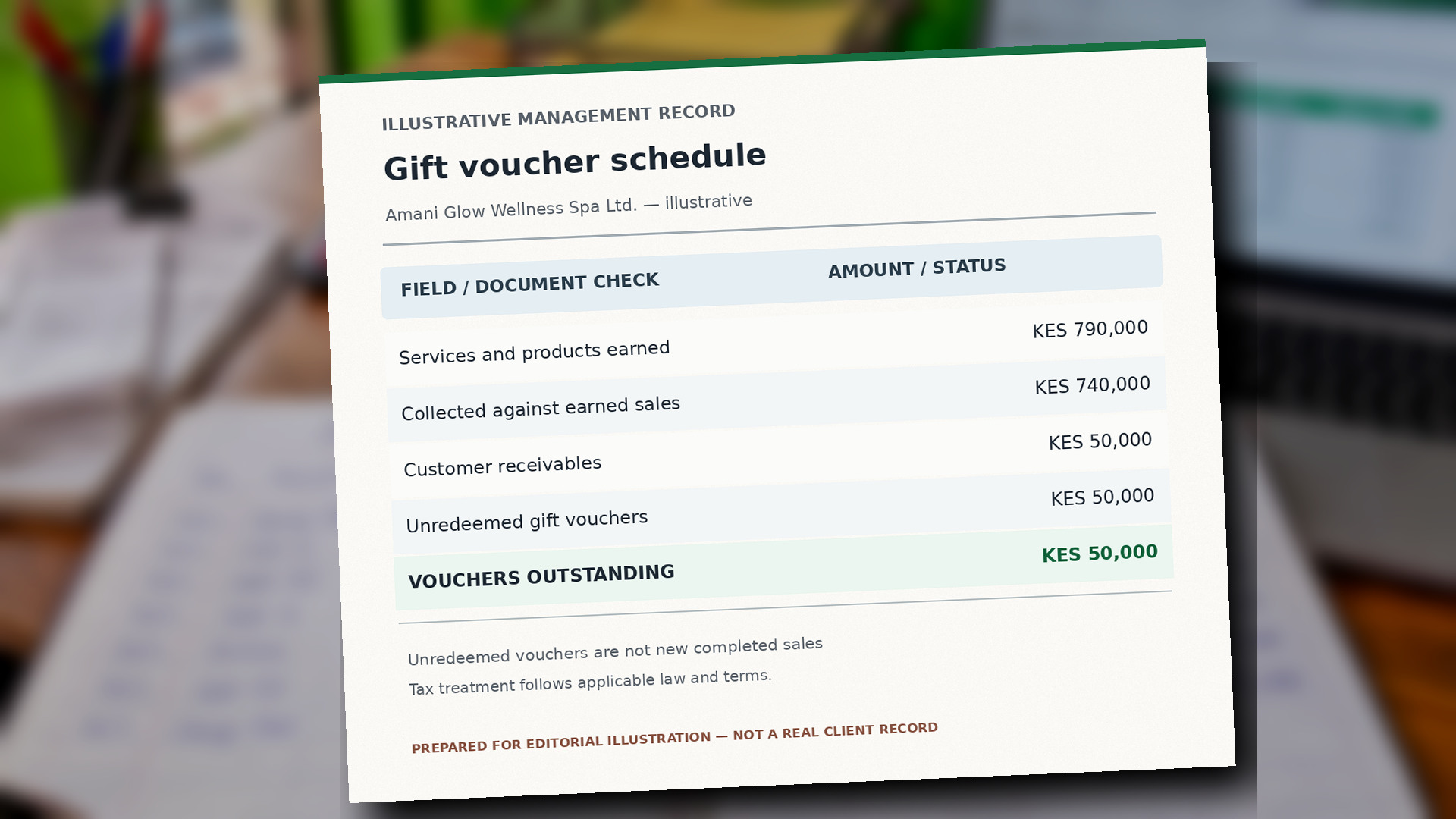
printed sample unredeemed voucher and receivables schedule
Suppose Amani Glow sells KSh 50,000 of gift vouchers still unused at month-end. In our simplified illustrative accounts, these are kept as unredeemed customer advances rather than added to KSh 790,000 in delivered-service and product revenue. The owner should review voucher terms, expiry provisions and unredeemed balances with an accountant; there may be material legal and tax nuances. Our bookkeeping and compliance team can help document the transactions, not create an unconditional policy for every spa.
Misstep 5: Treating all therapist payouts as the same kind of cost
For spa tax compliance in Kenya, some spas employ therapists, others use independent professionals under contracts, and some mix both arrangements. Spa tax compliance in Kenya requires a genuine assessment of the working relationship, not an automatic label of “contractor” to avoid payroll obligations. Payroll deductions, employment requirements and any withholding obligations depend on current law and the facts. Owner drawings, casual reimbursements and service commissions should also not be confused with one another.
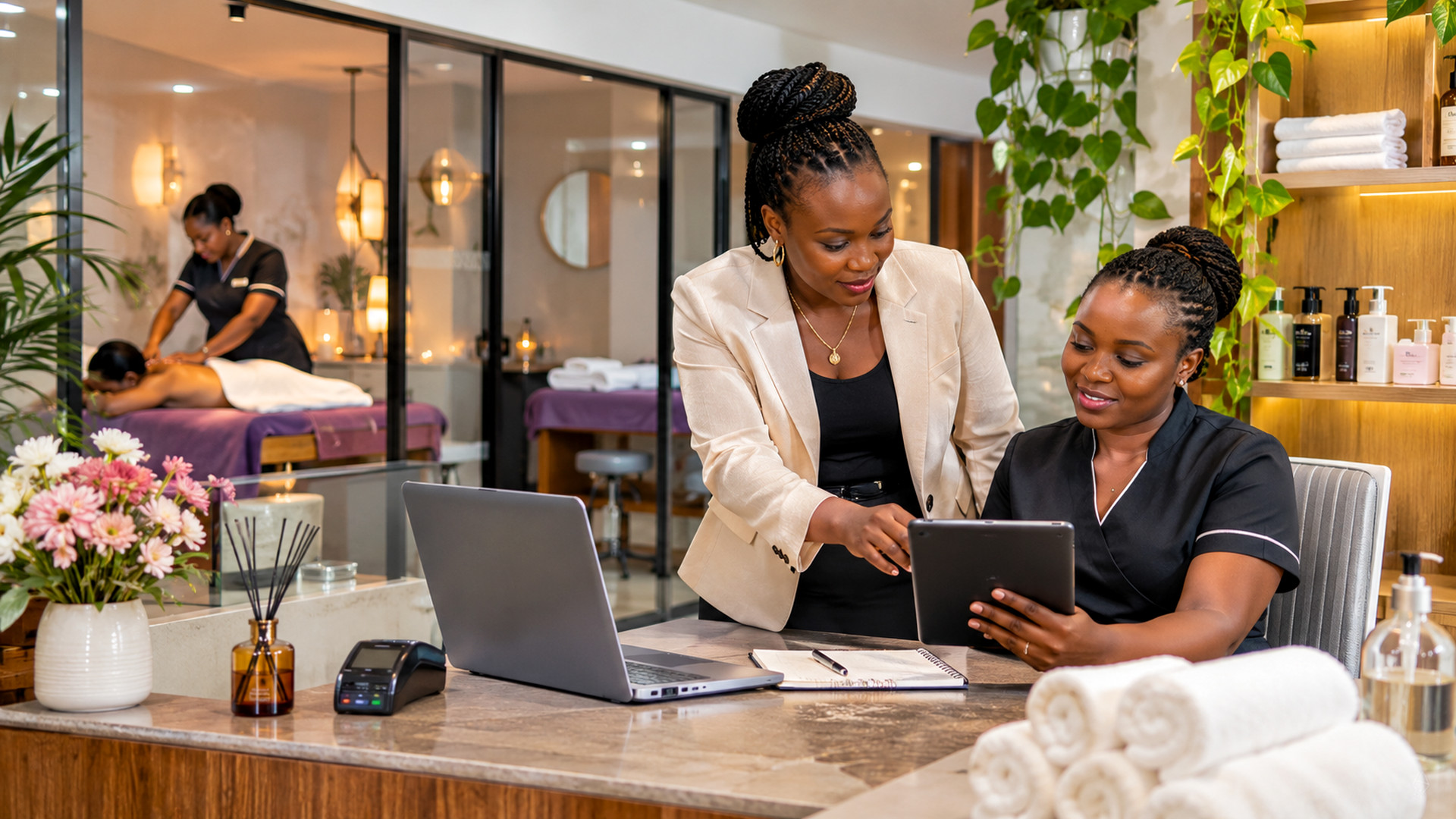
spa manager and therapist reviewing service payments
Keep approved fee schedules, attendance or completed-service records, signed compensation terms and payment evidence. FedhaTrac can help classify approved payroll figures and expense records; it does not advertise a fully automated payroll-processing service. If the spa’s business model changes, recheck its obligations. For current requirements use authoritative guidance from KRA and competent payroll or legal professionals rather than a social-media table with outdated rates.
Misstep 6: Claiming purchases without supplier evidence
A spa may buy massage oils, linens, sanitizers, treatment supplies, retail creams, towels and equipment. The tax and accounting records need to distinguish consumables from stock held for sale and long-life assets. Spa tax compliance in Kenya becomes fragile when the owner has cash withdrawal slips but no invoice identifying what was purchased or why. KRA’s rules on invoice support and expense validation need to be considered for the relevant period and taxpayer.
Compare purchase requests, supplier invoices, receiving notes, card or bank payments and stock movements. If a therapist brings in approved supplies personally, require an adequate reimbursement claim and supporting evidence. A new treatment bed may be capital expenditure, not simply another bottle of oil. FedhaTrac’s audit-preparation support can help organize source documentation and reconciliations, but that is not an independent audit opinion or a guarantee that every expense will be accepted by KRA.
Misstep 7: Ignoring refunds, no-shows and promotional discounts
A special offer may legitimately reduce the selling price; a refunded appointment may reverse revenue or settle a customer liability. Spa tax compliance in Kenya requires these events to be identified instead of being hidden as generic cash shortages. Keep the original booking, price, applicable invoice, reason for a change, approval and payment reference. A refund and an unauthorized cash withdrawal should never look identical in the accounts.
When a promotion bundles a massage with a retail product, keep a defensible allocation and report it consistently. Review seasonal offers to see whether they bring repeat clients or simply reduce margins on already busy days. Our team can help reconcile the commercial record to receipts and management reports. Management remains responsible for service quality, voucher policies, promotional claims and fair treatment of customers.
Misstep 8: Confusing gross receipts with the spa’s operating profit
For our fictional Amani Glow example, assume KSh 650,000 in delivered treatments and KSh 140,000 in retail products: total earned revenue of KSh 790,000. Suppose retail-product cost is KSh 82,000, approved therapist and direct treatment costs are KSh 210,000, and other operating expenses are KSh 310,000. The resulting illustrative operating profit is KSh 188,000, before financing and income taxes. Spa tax compliance in Kenya benefits from a clear cost classification, but a profit calculation is not a tax assessment on its own.
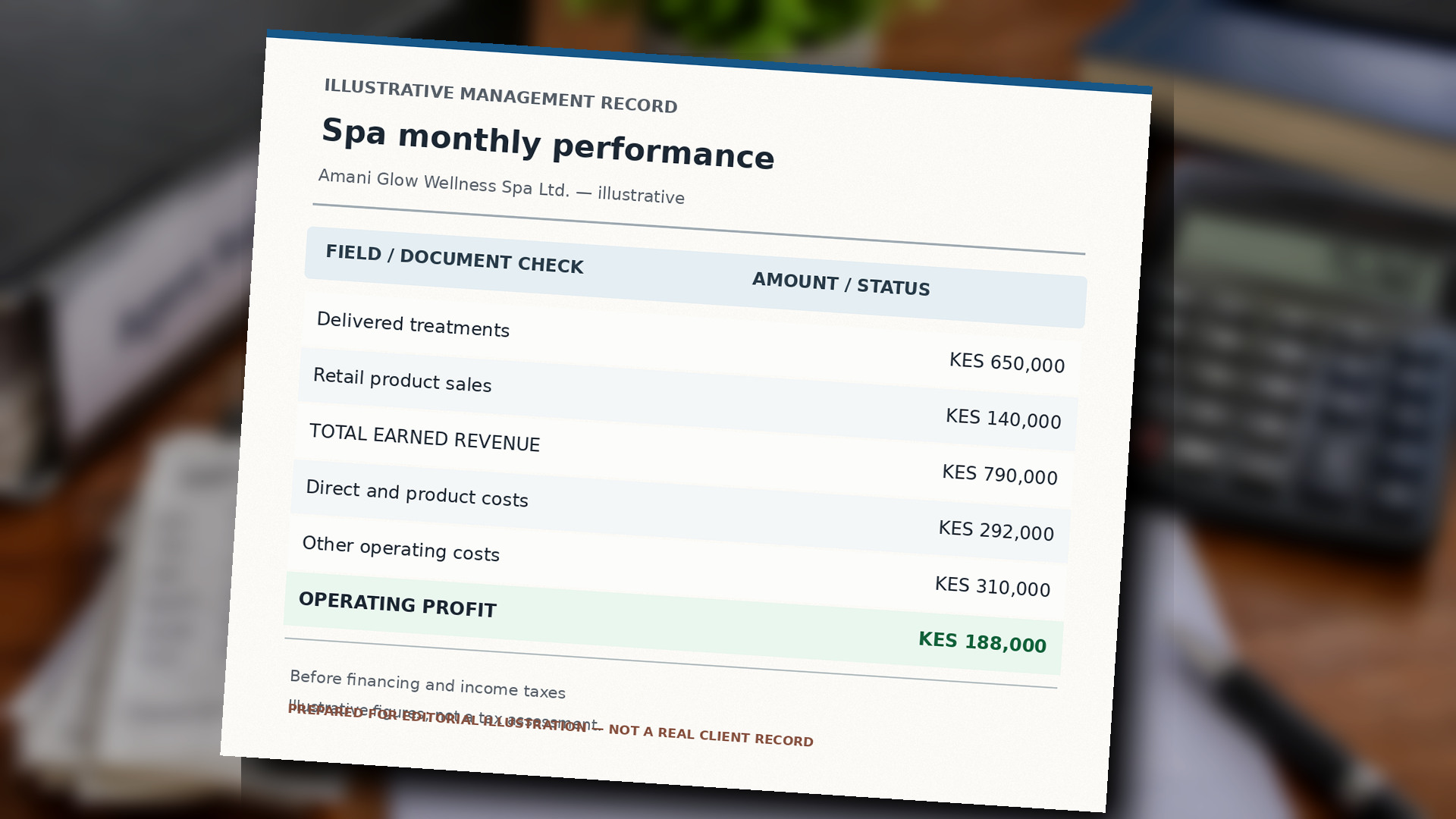
spa tax compliance in Kenya: printed sample spa sales and expense report
Assume the spa collects KSh 740,000 against completed sales and has KSh 50,000 in closing customer receivables under simplified conditions. Separately, unused gift vouchers of KSh 50,000 remain a potential service obligation in this example. Those balances should not be added together as though they were all earned income. A bank balance may be temporarily high because a client prepaid for future care. Our specialised reporting can help explain revenue, receivables, customer advances and liquidity to owners.
Spa tax compliance in Kenya: The month-end deadline trap
A month-end checklist should ask whether completed services agree with invoices, product stock has been counted, deposits and vouchers are classified, refunds have approvals, supplier bills have evidence and payroll/contractor records have been reviewed. Spa tax compliance in Kenya becomes manageable when exceptions are identified weekly. A major discrepancy found on the day a return is due is harder to resolve than one raised while staff still remember the transaction.
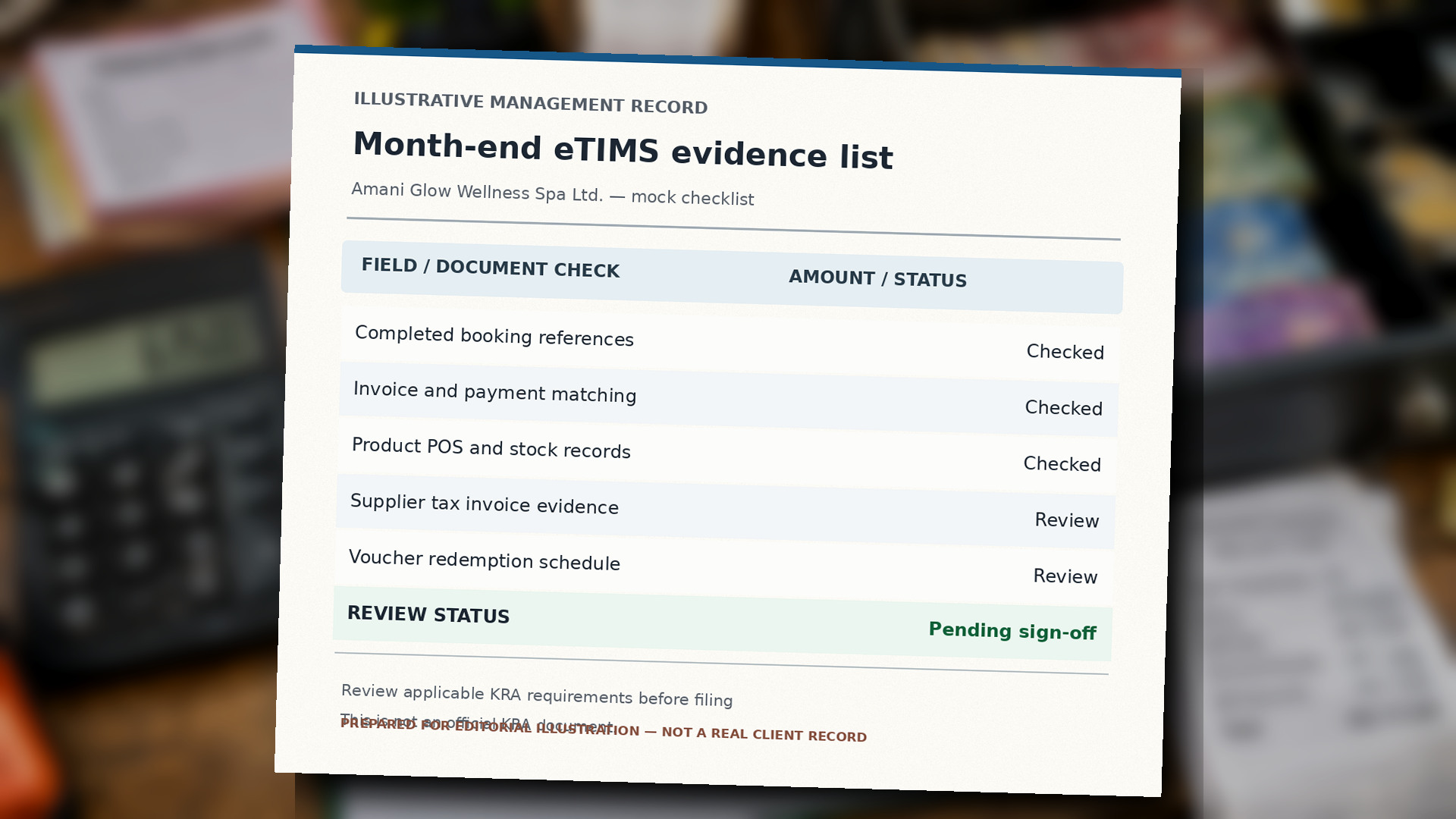
printed sample month-end eTIMS supporting-evidence checklist
Set a closing date, assign ownership and maintain an exceptions list. The accountant can then prepare draft reports and the tax specialist can assess applicable filing requirements. FedhaTrac’s tax filing support should be engaged through a defined arrangement with deadlines and responsibilities; it does not guarantee that a client who supplies documents after the deadline will meet an earlier statutory due date. Agree in advance who receives KRA notices and who checks response periods.
Safeguard client information while preparing financial records
Wellness businesses may collect names, contact details, preferences and information that can sometimes reveal health conditions. The Office of the Data Protection Commissioner explains Kenya’s Data Protection Act, 2019 and the duties relating to personal information. Spa tax compliance in Kenya does not require the accounts team to see private treatment notes or sensitive client histories. Keep commercial invoice evidence distinct from confidential intake information and limit access by role.
A receptionist may need the client name, service and payment status; the financial reviewer may need an invoice identifier, amount and correct classification. Neither necessarily needs unrelated medical or personal disclosures. Set retention and deletion practices with competent advice and the spa’s legal obligations in mind. Our finance engagement can be structured around the records necessary for reporting, while the spa remains responsible for how it collects, secures and uses customer information.
What FedhaTrac can actually take off an owner’s desk
Our bookkeeping service can organize supported income and expense entries. Our business operations support can help with invoices, receipts and supplier documents. Our tax filing and compliance service can work on applicable filing obligations, and our advisory team can help interpret margins, customer balances and expenses. Spa tax compliance in Kenya becomes more predictable when those services are coordinated under one agreed timetable instead of left to last-minute calls.

spa operations staff discussing financial records
We do not claim to provide medical licenses, certify treatments, issue every type of electronic tax invoice automatically or make an unregistered business legally compliant with one button. The owner decides operational policies; the appropriate tax professional addresses difficult legal classification questions. What we offer is a disciplined path from source documents to reviewed accounts and support for required financial administration. That is more valuable than a large list of unverified software functions.
Questions Kenyan spa owners ask
Do all spas need to register for VAT?
VAT registration depends on current law, taxable turnover, supplies and other relevant circumstances. Do not infer registration status from the word “spa.” Spa tax compliance in Kenya requires individualized review of the actual business, and the owner should confirm obligations with KRA or an appropriately qualified adviser.
Can I issue only a payment receipt?
A payment confirmation and an electronic tax invoice can serve different purposes. KRA’s eTIMS rules may require suitable invoice generation and transmission for the business. Keep invoice references consistent with booked services and payments, then review the chosen compliant solution. FedhaTrac can assist with the accounting evidence.
Are gift vouchers income when they are sold?
The answer depends on the contractual promise and applicable accounting and tax treatment. For managerial reporting, identify vouchers still unused and avoid counting a later redemption as an unrelated second cash sale. Spa tax compliance in Kenya needs the voucher ledger and invoice history to support the review.
Can FedhaTrac manage therapist schedules and patient records?
We do not claim a verified medical or spa scheduling system. Our confirmed scope is financial administration, bookkeeping, reporting and tax support. The spa should use appropriate operational and privacy controls for appointments, treatments and sensitive data.
What documents should I bring to a consultation?
Bring a sample service price list, booking summaries, POS records, payment statements, retail-stock reports, supplier invoices, voucher register and staff-payment records. We can discuss which gaps matter most and define a service scope. Spa tax compliance in Kenya begins with evidence rather than assumptions about a salon’s tax treatment.
Keep a calmer month-end, not a more complicated one
A spa should spend its time giving clients a consistent experience, not trying to reconstruct every transaction under deadline pressure. At FedhaTrac, we help organize the financial evidence behind appointments, retail products, vouchers, staff payments and tax work. Spa tax compliance in Kenya improves when the same service has a traceable booking, invoice, receipt and accounting treatment. Contact our team to review the records you have, the obligations that apply to your business and the reporting support that will make future months easier to manage.


