

The Fedha App business dashboard gives Kenyan entrepreneurs a more useful answer than a simple bank balance: what has been earned, what has been spent, what is still owed, and whether the records are ready for review. At FedhaTrac, we combine an accessible financial workspace with practical bookkeeping and accounting support, so a busy business owner can see the financial picture without personally rebuilding every spreadsheet. This guide concentrates on six monthly management checks, not the personal savings goals addressed in our earlier app articles. With a well-maintained Fedha App business dashboard, financial visibility becomes a repeatable business habit rather than a rushed end-of-year exercise.
Why a financial dashboard needs dependable records
A dashboard is only as trustworthy as the transactions behind it. A sale entered twice can exaggerate turnover, a missing supplier bill can hide a future payment, and a transfer between two business accounts can inflate gross movements without increasing income. Our FedhaTrac Dashboard is designed to bring bookkeeping records, receipts, reconciliations, reports, and financial visibility together. The Fedha App business dashboard is therefore most valuable when owners and their bookkeepers agree on a consistent process for collecting evidence, categorizing transactions, and reviewing exceptions.
Business owners need to distinguish three separate questions. First, how much revenue has the business actually earned? Second, how much cash has come into its bank, M-Pesa, or cash accounts? Third, after obligations and operating costs, how much is available for the next payroll, supplier order, or expansion? Those answers may differ even in a profitable month. We help clients interpret the differences through bookkeeping services, reconciliations, management accounts, and scheduled advisory discussions rather than assuming every dashboard figure tells the full story alone.
Check 1: Define the reporting period and the business accounts
Start each review by confirming the correct business entity, month, and source documents. The owner should know which bank accounts, petty-cash boxes, M-Pesa statements, card settlements, invoices, and expense records belong to the business. Personal transfers and owner drawings should be identified separately from normal sales. On the Fedha App business dashboard, a clear reporting period prevents a year-to-date total being mistaken for the current month’s performance. Where source systems are not connected, their statements must still be supplied and reconciled through an agreed workflow.

Kenyan finance team preparing monthly business accounts and reconciliations
A practical month-end file can contain sales summaries, outstanding invoices, supplier bills, receipts, bank and mobile-money statements, approved expense claims, and notes explaining unusual transactions. Save documents under consistent dates and references. Our team can organize those records and prepare the ledger for review, while the business owner identifies missing supporting documents. The Fedha App business dashboard should reflect a controlled period, not a mixture of unverified uploads and estimates. If a month remains unfinished, that status is a signal to investigate rather than evidence that the company made a loss.
Why the bookkeeping status matters
The dashboard shown in the supplied FedhaTrac interface includes a monthly bookkeeping-status overview with completion, in-progress, and no-data indicators. These labels help prompt follow-up, but they should not be read as an external audit opinion. We recommend an agreed closing checklist: transactions posted, bank statements received, exceptions investigated, customer and supplier balances reviewed, and reports approved. A Fedha App business dashboard backed by those steps can make management meetings shorter and more useful because the participants are discussing confirmed figures instead of unresolved entries.
Check 2: Separate money in, money out, and internal transfers
The dashboard presents money in, money out, net movement, total transactions, and a separate view of internal transfers. These are valuable cash-movement indicators, but they are not automatically profit-and-loss categories. A KSh 75,000 transfer from the business bank account to its own wallet is both a withdrawal and a deposit across accounts; it is not a new customer sale, and it is not a supplier cost. On a Fedha App business dashboard, internal movement must be excluded from operating income and expenses when interpreting business performance.
The same principle applies to loans, owner capital, refunds, asset purchases, and settlement fees. A loan creates cash and a liability rather than operating income. A customer refund reduces the appropriate sales or liability balance. A purchase of equipment may create an asset rather than being fully expensed on the purchase date. We help clients use the Fedha App business dashboard alongside accounting support to classify these differences correctly. A useful daily habit is to investigate large movements first, especially amounts that cannot be matched to a receipt, invoice, or clear explanation.
Check 3: Reconcile invoices with the payments received
Sales may be delivered before money arrives. A corporate client might receive a service invoice in October but pay in November. An online merchant might earn revenue on the date an order is fulfilled even though a payment provider settles later. The Fedha App business dashboard works best when customer invoices, receipts, and balances are reviewed together, so unpaid invoices do not disappear from the owner’s attention. We recommend a simple aging schedule showing current balances and items outstanding for 30, 60, or 90 days, with authorized follow-up actions recorded outside the accounting figures.

Team discussing invoices and expense documents in Nairobi office
For a realistic illustration, consider MtaaWorks Supplies Ltd., a completely fictional Kenyan supplier. Suppose its monthly sales earned are KSh 840,000, while cash received from customers is KSh 760,000: KSh 440,000 through M-Pesa, KSh 240,000 through the bank, and KSh 80,000 in cash. Assuming no opening receivables or adjustments, the business closes with KSh 80,000 in accounts receivable. The Fedha App business dashboard should not call KSh 760,000 the entire month’s revenue, nor should it suggest that an unpaid invoice has become cash. Both balances matter for decisions.
What to do with overdue invoices
First, verify that the service or goods were delivered and that the invoice was approved. Second, match every receipt to the correct customer and reference. Third, investigate credit notes, withholding tax, partial payments, or timing differences before sending reminders. Finally, discuss significant disputed items with the client relationship manager. We can support invoice administration and customer accounts through our business operations services. The Fedha App business dashboard supports visibility; collection strategy and commercial judgment still require human review.
Check 4: Review spending, supplier bills, and obligations
An expense is not necessarily paid on the day it is incurred. A supplier may deliver stock with a 30-day credit term, leaving a payable even after the inventory is in the store. Conversely, a payment made this month may settle a bill from the previous month. Reviewing only wallet outflows can make expense performance misleading. A Fedha App business dashboard becomes more informative when supplier invoices, approved bills, inventory purchases, recurring costs, and bank payments are reconciled with the ledger.
Return to MtaaWorks. Assume KSh 390,000 of goods were sold during the month and operating expenses totaled KSh 280,000, including KSh 20,000 of noncash depreciation. Suppliers received KSh 350,000 in payments for goods, with the remaining KSh 40,000 payable at month-end under our simplified assumptions. Cash operating expenses were KSh 260,000. These differences are not accounting mistakes: they explain why cost of goods sold, supplier payments, operating expenses, and cash spending do not match. The Fedha App business dashboard helps surface the movements, but an accurate financial statement still depends on correct classification.
A good review asks whether the business is paying for unused subscriptions, ordering inventory too early, accepting duplicate supplier bills, or missing receipt evidence for tax purposes. Kenyan businesses also need to keep suitable electronic invoicing records. The Kenya Revenue Authority’s eTIMS guidance describes electronic invoicing obligations; it does not establish that the Fedha App business dashboard files eTIMS invoices automatically. We help clients maintain supporting accounting records and coordinate applicable tax work based on the services they have engaged us to provide.

Managers reviewing financial reports and business performance
Check 5: Reconcile every account before trusting cash
A dashboard summary can look sensible while a specific account is wrong. Daily or weekly checks should compare cash counts, M-Pesa transaction listings, bank statements, card receipts, and recorded transactions. Card processing charges, bank fees, reversals, unpresented deposits, and incorrectly allocated receipts can all create differences. We recommend assigning a review date and named person to each exception. The Fedha App business dashboard is most useful when reconciliation differences are investigated and resolved rather than carried forward as an unexplained balancing number.
Continuing the MtaaWorks illustration, suppose the company began with KSh 120,000 in cash and bank balances, collected KSh 760,000, paid KSh 350,000 to suppliers, and paid KSh 260,000 in cash operating costs. Closing cash is therefore KSh 270,000. The company also has KSh 80,000 in receivables and KSh 40,000 owed to suppliers. An internal transfer between its own accounts does not affect the combined closing cash. The Fedha App business dashboard can help managers investigate these components, while the underlying reconciliation supplies the proof.
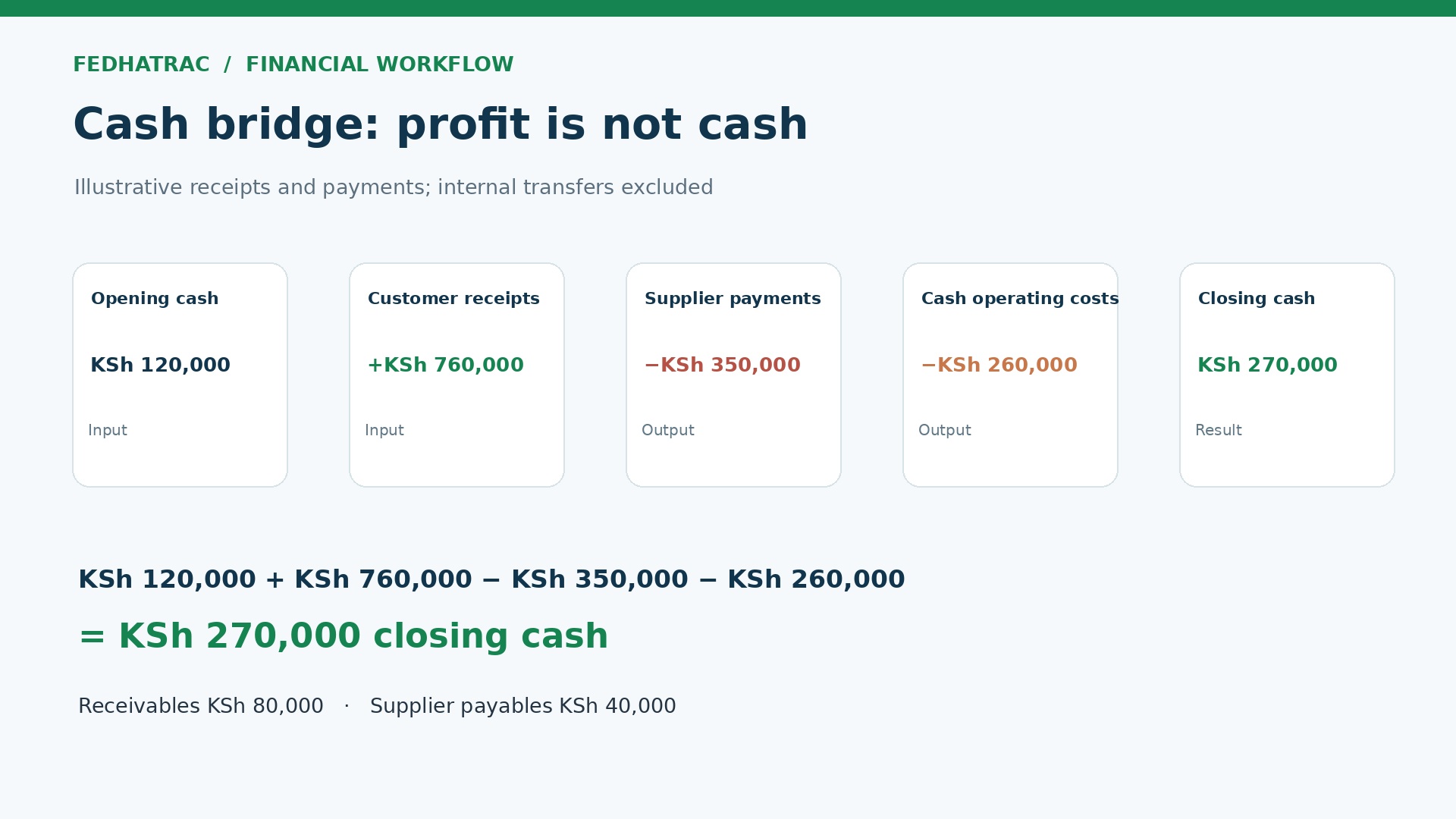
Cash reconciliation bridge for an illustrative Kenyan business
Keep transfers and authorizations visible
For every transfer, retain the transaction reference, source account, destination account, approval, and date. Treat a wallet-to-bank movement as an internal reallocation, not a sale. Review cash withdrawals against vouchers or approved purposes. Ask who created, approved, and checked larger transactions, and restrict access appropriately. An owner with two bank accounts should not double-count a transfer merely because both account statements show it. In the Fedha App business dashboard, sound controls make the displayed totals less vulnerable to misunderstanding or manipulation.
Check 6: Read profit, financial position, and cash flow together
The final check turns cleaned records into decisions. For MtaaWorks, KSh 840,000 in revenue minus KSh 390,000 cost of goods sold equals KSh 450,000 gross profit. After KSh 280,000 operating expenses, operating profit is KSh 170,000, or approximately 20.24% of revenue. That profit is different from the KSh 150,000 net increase in cash during the month. The relationship is explainable: receivables rose KSh 80,000, payables rose KSh 40,000, and depreciation of KSh 20,000 reduced accounting profit without using cash. A Fedha App business dashboard should encourage this kind of interpretation.
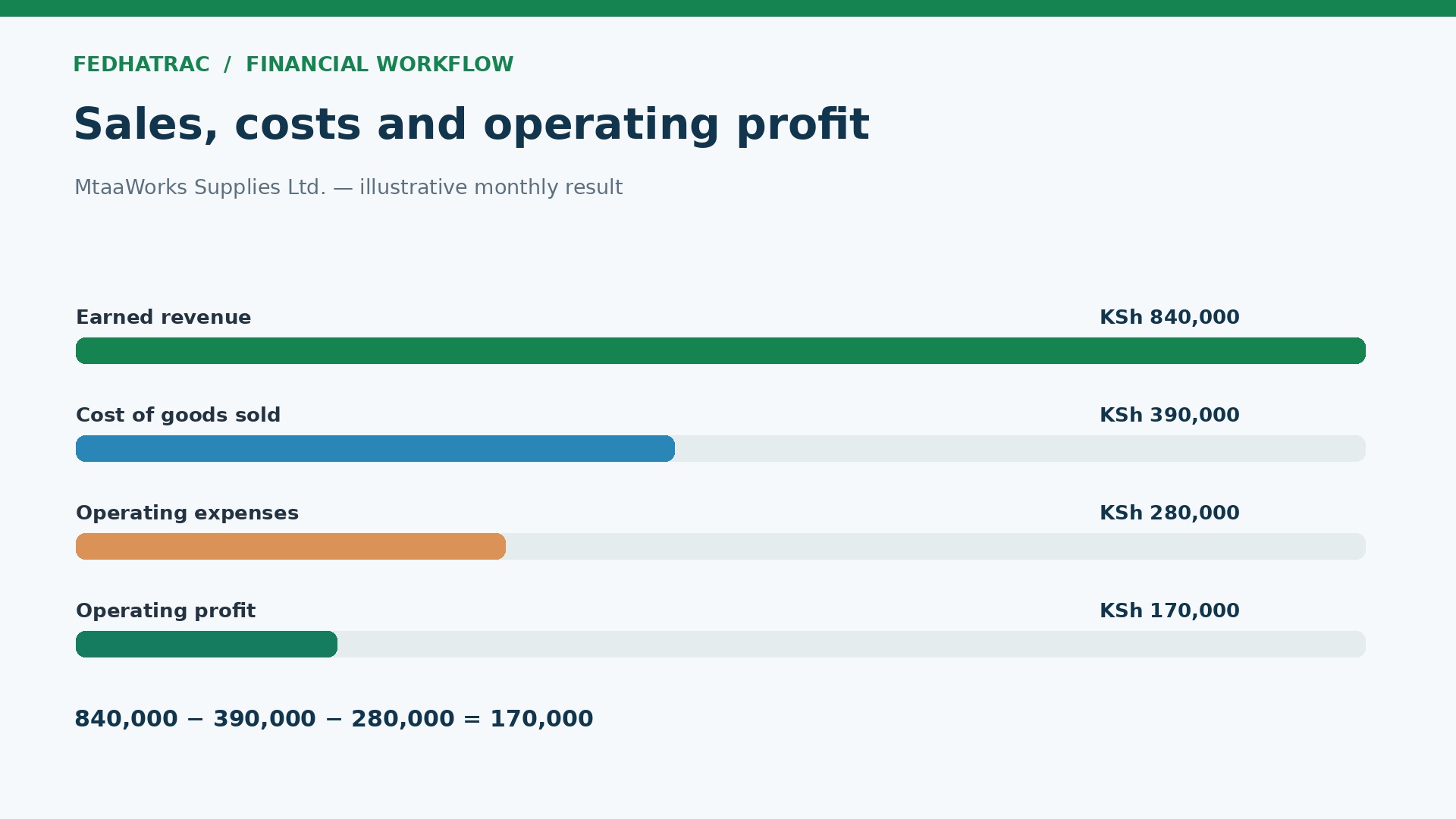
Illustrative MtaaWorks earned revenue cost and operating-profit breakdown
Profit and loss answers whether the operation earned more than it consumed. A balance sheet shows customer balances, supplier obligations, assets, loans, and capital. A cash-flow review examines timing and liquidity. Together, these reports show why a company can make a profit and still struggle to fund a new stock order. We prepare and review such statements through our specialised reporting and advisory service. The Fedha App business dashboard gives owners a practical place to see the numbers and prepare questions for their accountant.
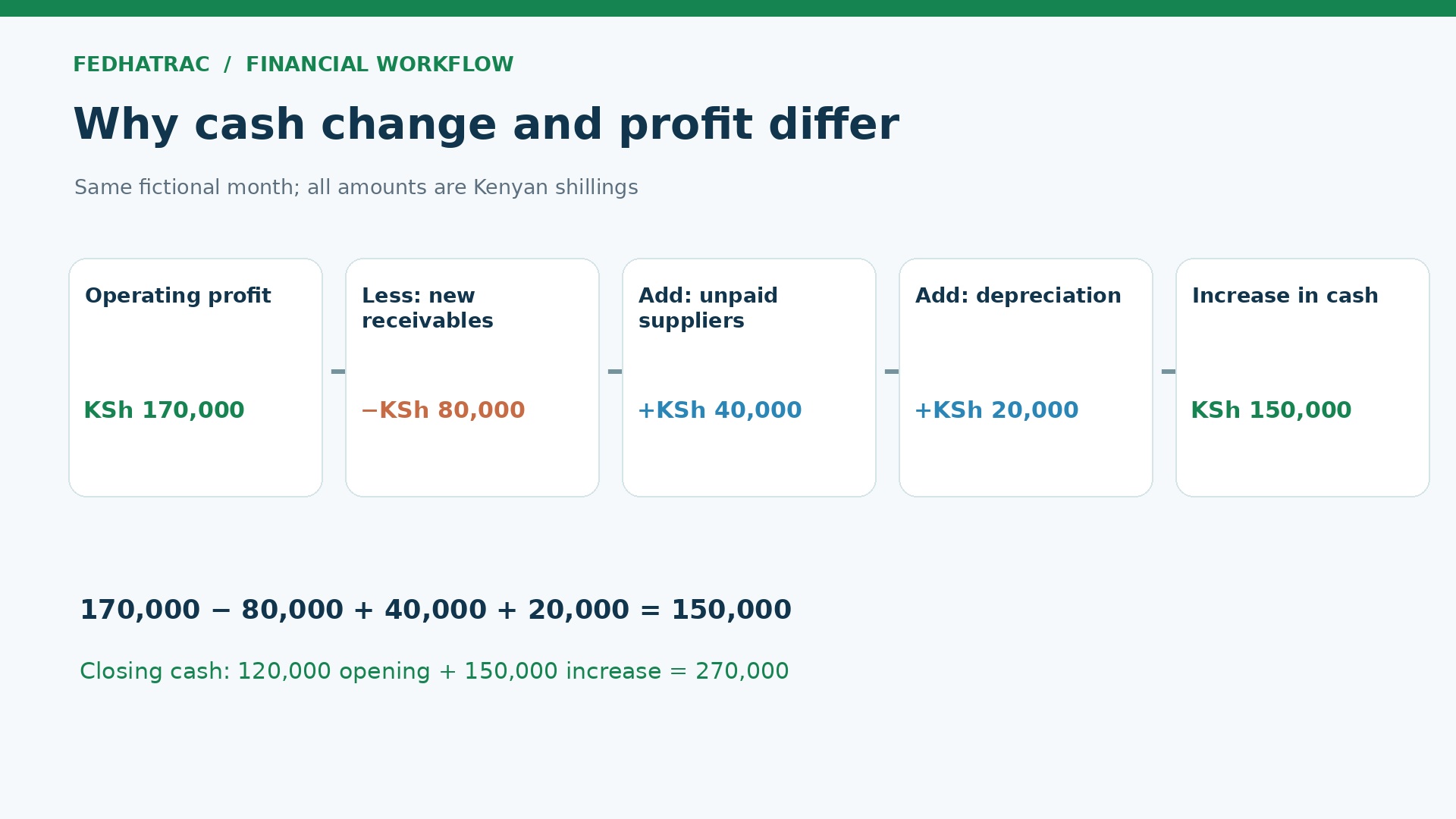
Illustrative reconciliation of operating profit and net change in cash
Turn reporting into a short management meeting
A monthly meeting should finish with actions, owners, and dates. Ask which sales channels performed best, which customers are overdue, what cash obligations fall due next month, whether costs are rising faster than revenue, and which reconciliations remain outstanding. A quarterly review can connect these findings to budgets, pricing, staffing decisions, and working-capital needs. The Fedha App business dashboard is therefore a starting point for disciplined discussions rather than a promise of instant decision-making. Our team can help explain the report and document sensible follow-up steps.
How to start a dependable FedhaTrac workflow
Begin with a discovery discussion about the business model and the records it already keeps. A retailer may bring POS exports and stock reports; a consultancy may rely on project invoices and bank statements; an NGO may need donor and fund records. We agree on the scope of bookkeeping, reporting, and communication before entering a working routine. The Fedha App business dashboard should display the relevant business information, not a generic set of categories that does not fit the operation. We can help set up and maintain the financial dashboard under an agreed service arrangement.
Assign one person to gather invoices, payments, and statements, and another to approve transactions or explain unusual activity. Establish monthly cutoffs and deadlines for missing documents. The business owner should review major balances rather than approving unexplained totals. Our role is to support reconciliations, document organization, accounting reports, and advisory reviews; we do not describe every available menu as an automatic bank integration or tax-submission service. The Fedha App business dashboard benefits from dependable records and clear responsibilities much more than from a long feature checklist.
The dashboard’s wallet controls and money-in/out summaries should also be understood on their own terms. A visible top-up or withdraw button does not prove that every bank, mobile-money service, or external platform is automatically connected. Before relying on any payment workflow, confirm the active account configuration, available channels, fees, and approval controls. We advise clients to test new workflows with ordinary transactions and reconcile the results. The Fedha App business dashboard remains a financial-visibility tool whether some source information arrives automatically or through an approved manual process.
Five questions Kenyan business owners ask
Is the Fedha App only for large companies?
No. The central accounting habits apply to startups and growing SMEs as much as established organizations. The right scope depends on transaction volume, reporting obligations, and how complicated the accounts are. We can discuss practical support for an owner who wants to understand receivables, costs, and cash. The Fedha App business dashboard is particularly useful when the owner wants one consistent place to review work without personally acting as the bookkeeper.
Does it replace an accountant or bookkeeper?
No. Software displays and organizes information, while the quality of coding, reconciliations, judgments, and review remains important. FedhaTrac combines a dashboard with professional bookkeeping and accounting support under the agreed engagement. The Fedha App business dashboard is strongest when human review is built into the workflow, not when the owner assumes that every visible metric has been independently verified.
Can I see invoices, expenses, and monthly performance?
FedhaTrac’s published dashboard service includes bookkeeping, reports, receipts, reconciliations, and financial visibility, while the supplied interface also shows accounts, expenses, and invoice-related modules. The exact view and data available depend on the business account and completed setup. We help clients organize relevant reports and supporting records. The Fedha App business dashboard should make each important number traceable to a transaction or document.
Does the app automatically submit KRA returns?
Do not assume so. KRA filing and eTIMS requirements depend on the taxpayer and the applicable law. FedhaTrac offers tax filing and compliance assistance, but a dashboard view is not proof of automated statutory submission. Our tax filing and compliance team can discuss the necessary returns and documentation. A Fedha App business dashboard supports record preparation while the tax process follows the appropriate channels.
What if I have not kept accurate records for months?
Start with statements, sales records, invoices, expense evidence, and known balances. We can agree on a catch-up or cleanup scope, prioritize missing periods, and identify differences requiring the owner’s confirmation. It is better to label an incomplete month honestly than to produce a misleading profit figure. The Fedha App business dashboard becomes more reliable as backlogged records are corrected and the business settles into a regular closing routine.
Make the numbers useful every month
At FedhaTrac, we believe a financial dashboard should answer real business questions: what earned revenue looks like, which customers owe money, whether supplier obligations are covered, and how much cash can safely be used. The Fedha App business dashboard provides a practical way to discuss those answers through one financial-management workflow, supported by our bookkeeping, accounting, reporting, and advisory services. Contact FedhaTrac to discuss your records, reporting needs, and dashboard setup so the next business decision begins with clearer figures.


