

A private clinic can deliver careful patient care and still face a stressful financial review if consultation fees, insurer claims, supplier invoices and stock records do not agree. That risk becomes more serious when the person requesting evidence is an auditor, lender, insurer or regulator. Private clinic audit preparation in Kenya begins long before anyone arrives to examine the books.
At FedhaTrac, we help healthcare businesses organize reconciled financial records and supporting schedules so a review is efficient and defensible. We are not a medical regulator, and our financial support does not replace clinical governance or licensed care. The facility itself remains responsible for patient confidentiality, treatment decisions and its required regulatory licenses.
This article looks beyond the general clinic-bookkeeping topic already covered on the FedhaTrac blog. It uses a fictional practice, UzimaBridge Family Clinic Ltd., to explain what evidence should be available, how clinic managers can reduce preventable financial questions and why aggregate, privacy-conscious records matter.
Build an audit-ready revenue map for every income stream
Consultations, laboratory tests, procedures, vaccination services and insurer reimbursements can follow different booking and payment journeys. A receipt issued at reception does not always represent the same event as a claim submitted to a payer. When each team uses different reference numbers, an auditor struggles to trace total revenue from the service record to the invoice and finally the bank statement.

People reviewing operations and customer records for private clinic audit preparation in Kenya
Keep a chart of revenue categories, approved tariff schedules and daily transaction summaries. Match those summaries to the financial ledger, adjustments, approved refunds and deposits. Give every billed service a nonclinical identifier usable by the accounts team. Avoid placing diagnoses or identifiable treatment notes into a general accounting pack when aggregated financial evidence is enough. That discipline strengthens private clinic audit preparation in Kenya.
The revenue map should also distinguish a service that was performed from a claim rejected because of missing billing documentation. Private clinic audit preparation in Kenya becomes easier when corrections are dated, approved and explained rather than posted as unexplained offsets. A reviewer can then trace a day’s total activity to recognized fees and actual receipts without assuming the finance department must read patient diagnoses or clinical records. The financial objective is completeness with appropriate confidentiality.
FedhaTrac helps reconcile financial totals and prepare a transaction trail from the clinic’s approved exports. Private clinic audit preparation in Kenya should respect health-data boundaries while still giving reviewers clear evidence of completeness.
Reconcile insurer claims, patient balances and actual receipts
A claim sent to an insurer may be disputed, partially approved or paid weeks later. Treating the full submitted value as cash can exaggerate liquidity. Conversely, writing off a claim merely because payment is delayed can hide collections that staff should follow up. The reconciliation must distinguish claim status, recognized revenue, contractual deductions and funds actually received.
Photographed-style sample claims reconciliation documentation
Maintain a claims control account with submission reference, amount, approval, adjustment, payer remittance and outstanding balance. Have authorized staff investigate unmatched remittances and post approved write-offs with dated evidence. Patient statements and insurer schedules should be shared only with those who need them, applying the facility’s privacy rules. That distinction matters for private clinic audit preparation in Kenya.
Aging claims are more helpful when split into categories that staff can act on: not yet submitted, accepted but unpaid, queried, partially rejected and written off after approval. Private clinic audit preparation in Kenya can then show a reviewer why outstanding balances remain and who is investigating them. Separate an administrative delay from a substantive coverage dispute. Finance personnel can reconcile amounts and timing, while clinical coding and insurer eligibility determinations stay with qualified staff.
We support customer-balance and payment reporting from appropriate records; we do not claim to make medical insurance adjudication decisions. Private clinic audit preparation in Kenya is stronger when receivables can be explained without exposing a patient’s sensitive history.
Tie medicines and consumables to receiving documentation
Even a small clinic may purchase gloves, syringes, tests, dressings and medicines from different suppliers. Stock cards, supplier invoices and physical counts often record different units or dates. A rushed month-end total can conceal expired stock, missing deliveries or supplies moved between treatment rooms. Financial reviewers need approved explanations for movements, not merely a final inventory value.

Kenyan business team reviewing approved records
Record purchase orders where used, delivery notes, invoice references, stock codes, batch and expiry information managed by the clinical team, and authorized write-offs. Reconcile financial inventory values and supplier balances, but leave prescribing, dispensing and medicine custody to qualified personnel. Confirm any special pharmaceutical licensing obligations separately from the finance review. Such evidence supports private clinic audit preparation in Kenya.
An inventory exception deserves a dated explanation while the event is fresh. A damaged carton, an expired test kit and a delivery shortage are different commercial problems with different evidence and potentially different supplier remedies. Private clinic audit preparation in Kenya is stronger when the finance schedule refers to an authorized operational record rather than a casual handwritten reduction. The clinic’s professional supervisors should remain responsible for medicine handling and patient safety decisions.
Our inventory-related financial and purchase-order support can prepare the accounting schedules. Private clinic audit preparation in Kenya never turns an accounting adviser into a pharmacist, clinical storekeeper or medicines regulator.
Separate supplier commitments from payments already made
A facility might order laboratory reagents, receive them this month and pay next month. If management looks only at the bank statement, it may believe spending is lower than it truly is. Supplier statements can also contain duplicates, disputed prices or credits that staff failed to record. These issues become visible during an audit only if someone reconciles the underlying commitments.
Photographed-style sample approved supplier schedule records
Compare approved purchase evidence, supplier invoices and goods-received documentation to creditor balances. Obtain statements from material suppliers and investigate differences by reference before closing the reporting period. Retain proof of who authorized unusual purchases or changed supplier banking details, while keeping medical information outside general supplier files. These approvals underpin private clinic audit preparation in Kenya.
Payment terms should not be guessed from the supplier’s most recent demand. Review the agreement, approved credit notes and dated invoices, then compare them with the ledger. Private clinic audit preparation in Kenya should disclose disputed balances separately instead of quietly deleting them. That clarity can prevent the facility from overpaying, underestimating upcoming cash needs or obscuring a procurement issue that needs the proprietor’s attention before another order is placed.
FedhaTrac can help build accounts-payable schedules and review expense evidence. Strong private clinic audit preparation in Kenya gives owners a credible view of obligations that will consume cash after month-end.
Protect cash, M-Pesa and card reconciliation controls
Front-desk collections can include cash, mobile money, bank transfer and card payments. One mistaken payment reference may be small, but repeated unresolved differences undermine confidence in daily revenue. Refunds create additional risk when the same employee can collect, authorize and reverse transactions without review. Segregation of duties matters even when the clinic has a small staff.

Professional activity and financial decision-making at a Kenyan business
Use a daily close showing billed services, authorized discounts, refunds by approval, receipts by channel, bank or provider settlement, and unresolved differences. Escalate exceptions promptly; do not force an account to balance with an unexplained journal entry. Restrict viewing rights to financial details necessary for reconciliation rather than distributing full patient files. That schedule improves private clinic audit preparation in Kenya.
Where several cashiers or shifts share a collection point, the closing record should identify handover times and independent review. Private clinic audit preparation in Kenya benefits from a routine that can detect a missing settlement without assigning blame before evidence is gathered. A variance might reflect bank processing time, an incorrect reference or a genuine collection problem. Record the explanation and closure date so the same item does not reappear as a fresh discrepancy every month.
Our bookkeeping and reconciliation service can compare the money trail with summarized clinic records. That routine supports private clinic audit preparation in Kenya while the clinic maintains clinical and privacy safeguards.
Prepare approved staffing costs without overstating payroll services
A clinician’s time, locum agreement, receptionist wages and outsourced cleaning contract can be presented differently in clinic reports. Payroll taxes and employer deductions may create liabilities even if the bank payment was already made. Financial reviewers need to understand classification and authorization, not the personal details of every individual employee.
Photographed-style sample monthly audit exceptions report
Use payroll summaries approved by the employer, employment or contractor agreements where appropriate, statutory remittance evidence and a mapping from payroll expense to the financial ledger. Protect personal identifiers and obtain specialized advice where a contract blurs employment and independent service. Do not claim payroll processing by FedhaTrac unless separately arranged and verified. That review strengthens private clinic audit preparation in Kenya.
The employer should retain a controlled bridge from its approved payroll or contractor summary to the expense accounts and tax-related liabilities. Private clinic audit preparation in Kenya does not require the financial reporting pack to expose every employee’s private information to all managers. A reviewer may need authorization evidence and totals, while payroll administrators retain detailed personal records according to access rules. Any unusual locum arrangement should be assessed using its actual contract and circumstances.
At FedhaTrac we can reconcile approved payroll figures and related expense accounts as part of financial reporting. Private clinic audit preparation in Kenya requires clear financial treatment, not unsupervised access to personnel files.
Keep licenses, eTIMS records and sensitive data in separate files
The Kenya Medical Practitioners and Dentists Council explains that private health facilities must be registered and hold relevant annual licenses. That regulatory file is different from the financial audit file. The Office of the Data Protection Commissioner also provides guidance on health-data processing. Accountants should not mistake a financial review for permission to inspect all patient charts.
Keep current facility license evidence, approved insurer contracts, applicable KRA eTIMS records, tax filings and a document-retention policy. Use an access-controlled audit index so reviewers receive the least sensitive evidence needed for the financial purpose. Check official regulator guidance when licensing status, premises scope or data processing arrangements change. The same safeguards support private clinic audit preparation in Kenya.
Financial evidence and facility compliance should share a checklist but not the same unrestricted folder. Private clinic audit preparation in Kenya can use document references that prove a license renewal occurred without duplicating sensitive regulator correspondence across every finance workstation. The same approach applies to patient data: use a minimum-necessary extract for reconciliation and retain an approved way to retrieve additional evidence if a lawful, specific request later requires it.
We help organize tax and financial schedules, while licensed healthcare and privacy professionals own their specialized responsibilities. That distinction is central to private clinic audit preparation in Kenya.
Use monthly management reviews to prevent year-end surprises
A tidy year-end file is difficult to create if each month closes with unexplained payment differences and unsigned stock adjustments. Managers should review aging claims, supplier commitments, revenue mix, cost changes and cash forecasts as a recurring discipline. Audit readiness improves when questions are resolved while the people who handled the transactions still remember what happened.
Assign a closing checklist to named finance and operations staff. Require approval of significant adjustments and track open exceptions to resolution. Share financial dashboards with management and discuss trends during quarterly reviews, but never invent clinical quality scores from accounting information or assume audit preparation guarantees a clean opinion. Managers should expect this from private clinic audit preparation in Kenya.
At the review meeting, distinguish a problem already corrected from a control weakness likely to recur. Private clinic audit preparation in Kenya improves when management asks why an exception happened, how it was approved and whether a future close will catch it sooner. Agree on realistic deadlines for unresolved supplier or insurer items. A monthly close then becomes a series of accountable decisions rather than a year-end effort to reconstruct missing explanations.
FedhaTrac provides audit preparation, financial reporting and consultations that make private clinic audit preparation in Kenya a repeatable management process. The final audit opinion remains the independent auditor’s responsibility.
A financial example: UzimaBridge Family Clinic Ltd.
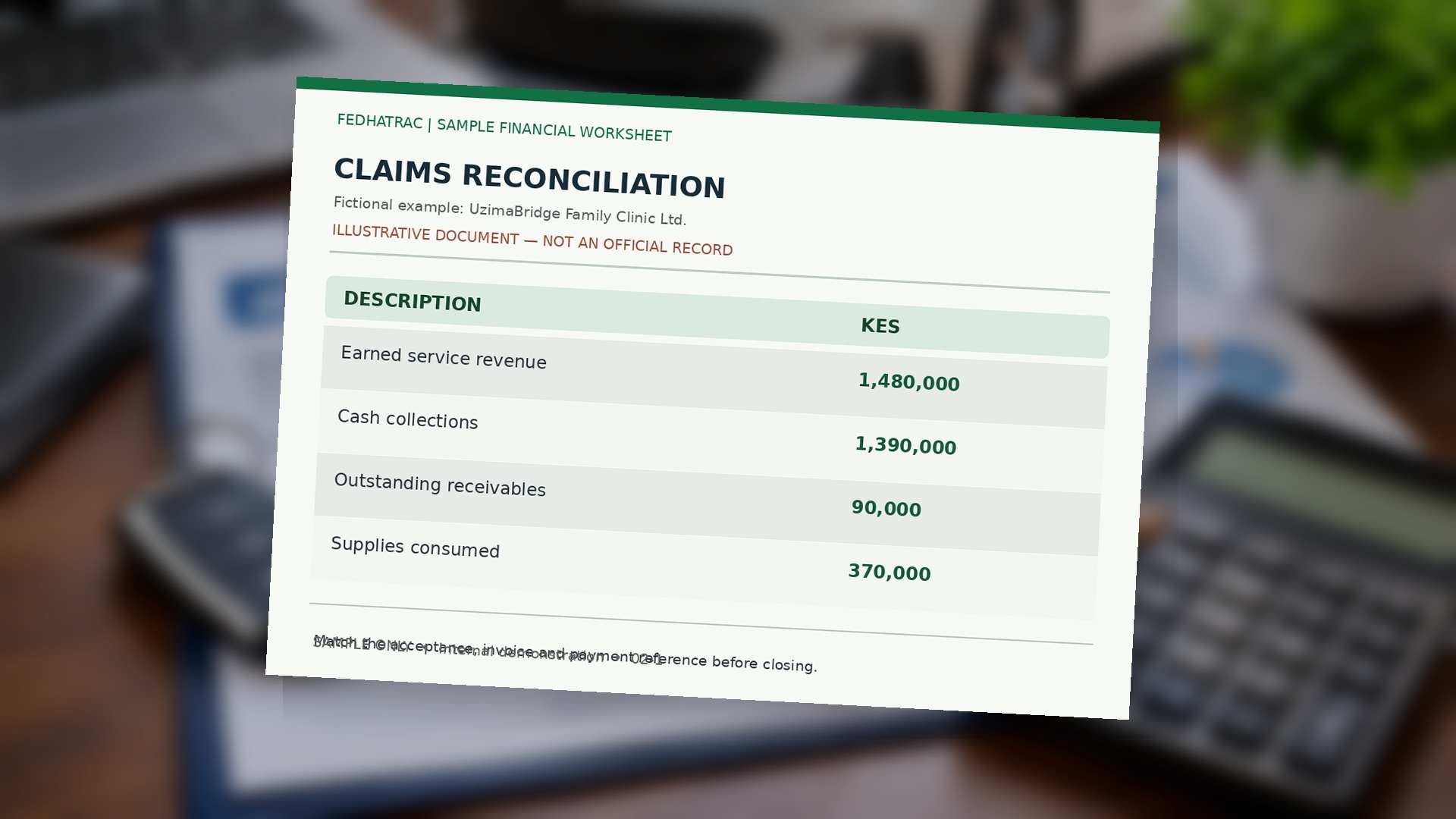
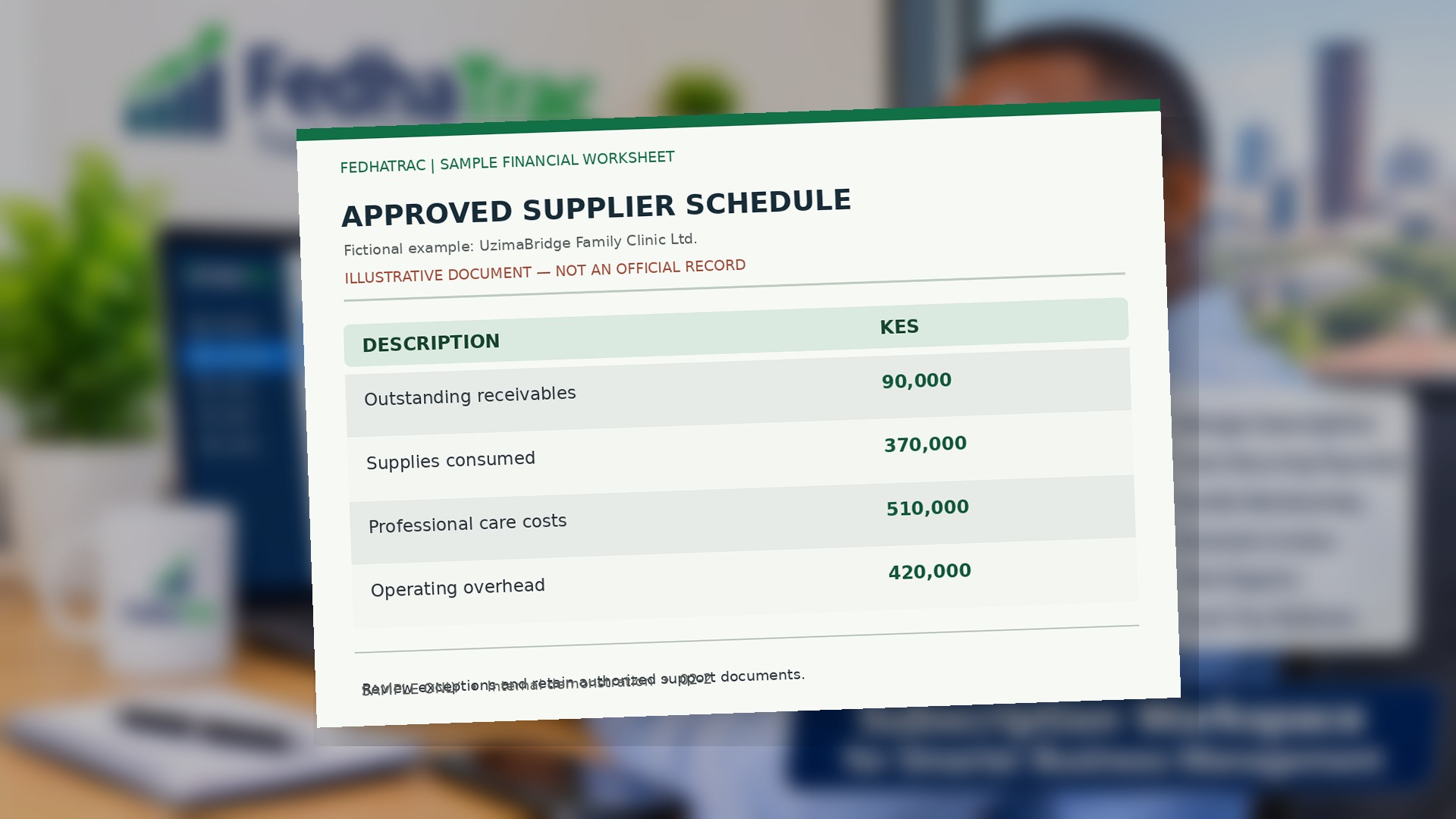
Consider UzimaBridge Family Clinic Ltd., a completely fictional outpatient clinic preparing for a financial review. Its hypothetical month includes KSh 1,480,000 in recognized consultation, laboratory and approved third-party revenue. Actual collections total KSh 1,390,000, leaving KSh 90,000 in outstanding approved balances. Submitted but disputed claims would require separate assessment rather than automatic inclusion in these totals.
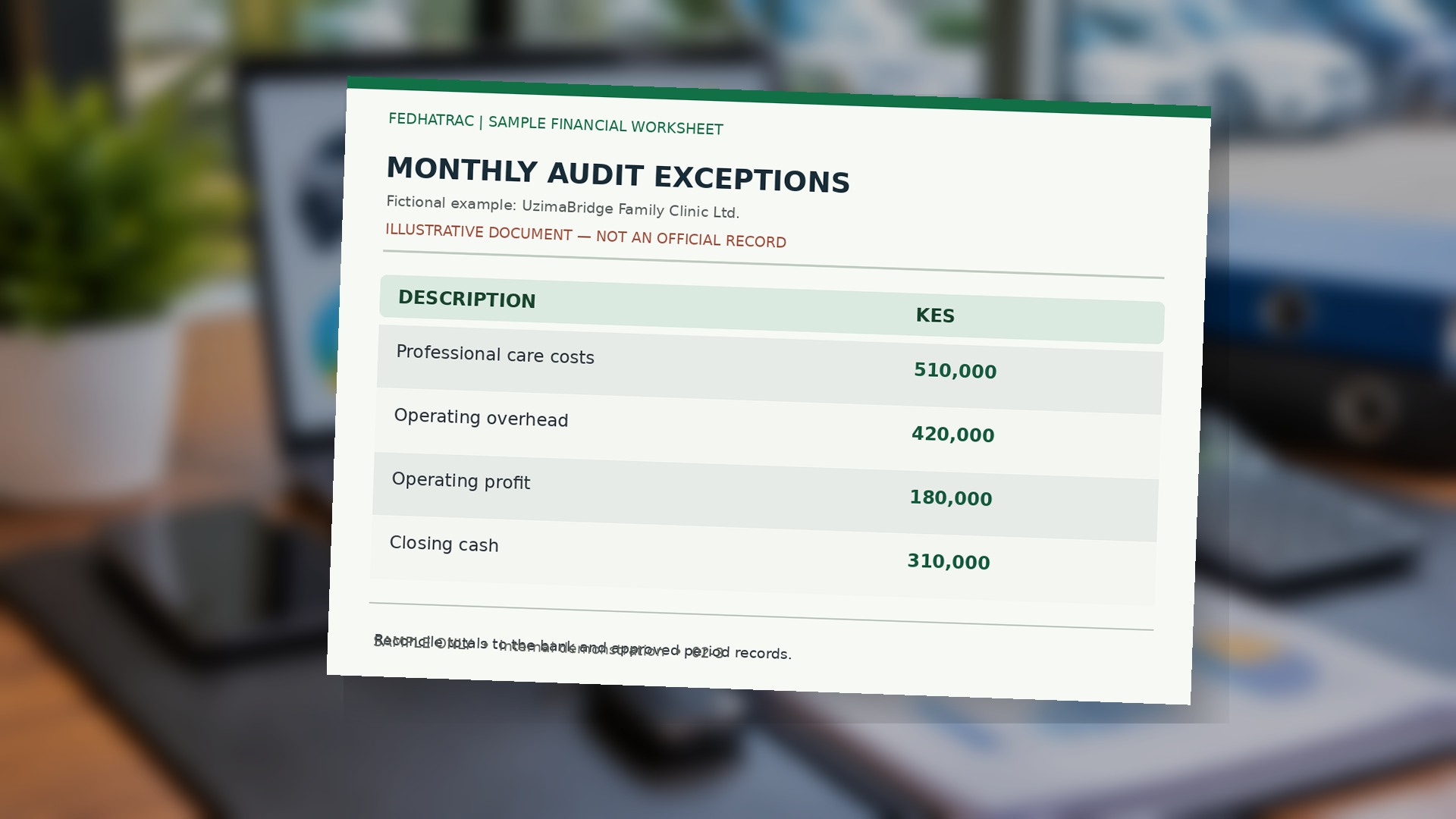
Clinical supplies consumed cost KSh 370,000, approved professional-care costs were KSh 510,000 and other operating overhead was KSh 420,000, including KSh 40,000 in noncash depreciation. Operating profit is KSh 180,000. Assume KSh 40,000 of supply costs remain payable and all professional-care costs were paid during the period.
| Illustrative financial indicator | KES |
| Earned service revenue | 1,480,000 |
| Cash collections | 1,390,000 |
| Outstanding receivables | 90,000 |
| Supplies consumed | 370,000 |
| Professional care costs | 510,000 |
| Operating overhead | 420,000 |
| Operating profit | 180,000 |
| Closing cash | 310,000 |
The cash check starts with KSh 140,000, adds KSh 1,390,000 in collections and subtracts KSh 330,000 paid for supplies, KSh 510,000 for care costs and KSh 380,000 for cash overhead. Closing cash is KSh 310,000. A reviewer can follow the KSh 90,000 receivable and KSh 40,000 payable without inventing patient-level clinical records.
FedhaTrac would help reconcile those totals to invoices, settlements and approved cost summaries, then prepare exception schedules for a qualified auditor or owner review. The facility remains in charge of care, licensing and privacy.
Frequently asked questions
Does FedhaTrac audit or license clinics?
No. We help prepare reconciled financial records and supporting schedules. Independent auditors provide audit opinions where appointed, and the relevant regulatory bodies handle licensing. Our support is intended to make those separate reviews more organized, not replace them.
Will your accountants access patient treatment files?
A financial reconciliation normally works from appropriately minimized transaction data, approved service summaries and payer reports. Patient health information is sensitive, so access and disclosure must follow the facility’s privacy obligations and purpose. The clinic should never send clinical records merely because a general cash report is being reviewed.
Can you reconcile insurer reimbursements and M-Pesa collections?
We can help compare approved claims and invoice balances with insurer remittance records, mobile-money statements and bank deposits. Rejected or contested claims should be escalated to the clinic’s authorized billing or insurance team, which remains responsible for substantive payer decisions.
What documents should a small private clinic prepare monthly?
Start with sales and receipts summaries, claim aging, supplier ledger, stock movement approvals, cost summaries, bank and mobile-money reconciliations, and a documented exceptions register. Make sure the file can be recreated and reviewed after staff changes.
How do we start working with FedhaTrac?
Share an overview of your existing financial reporting process and the specific bottlenecks, rather than patient medical information. We can discuss bookkeeping, reconciliations, audit support and reporting that fit your facility’s actual scale and reporting responsibilities.
Build a reporting habit that supports growth
Strong private clinic audit preparation in Kenya is a repeatable business habit, not a one-off spreadsheet cleanup. At FedhaTrac, we combine suitable accounting records, advisory conversations and reconciliations around the decisions owners genuinely need to make. Begin with the most significant missing evidence, name the person responsible for each exception and compare next month’s progress with this month’s facts. Better records can strengthen cash planning and business choices; no adviser can guarantee profits, tax outcomes or operational performance.
For a practical next step, explore our verified service offering and review the official sector guidance that applies to your situation. We can explain the financial records we help prepare, what your team needs to supply and which questions belong to a separately licensed or regulated specialist. That clear division of responsibility is an important part of private clinic audit preparation in Kenya.
For related financial support and official requirements, see KMPDC private facility registration guidance; ODPC health data guidance; FedhaTrac audit preparation services; KRA eTIMS guidance. These resources explain separate services and regulations; no affiliation or endorsement is implied.


