

A courier may deliver a parcel on time yet lose the commercial argument over it weeks later. The sender says a package was handed over, the rider says the recipient signed, the customer disputes a cash-on-delivery amount, and the finance team finds only a motorcycle fuel receipt. Local courier audit preparation in Kenya begins long before an annual audit. It connects who accepted the parcel, who moved it, what was delivered, who paid, and which funds belong to merchants rather than the courier. At FedhaTrac, our audit preparation and support helps businesses organize supporting records, reconciliations, schedules and financial statements for scrutiny. We do not operate a parcel network, issue courier licenses or promise an independent audit opinion.
We will use SwiftMtaa Courier Services Ltd., a fictional local delivery company serving shops, offices and households in Kenya. It is not a named FedhaTrac client and the figures in this article are illustrations. Unlike our earlier transport-accounting article, the focus here is chain-of-custody evidence, cash collected for merchants, delivery disputes and an audit-ready record trail. Good local courier audit preparation in Kenya should help a manager answer an auditor’s question without searching dozens of riders’ private chat histories.
Why courier records are different from ordinary sales invoices
A courier’s financial service is the transportation or handling it provides; the item inside the parcel usually belongs to the sender or recipient. When the business collects cash on delivery for a merchant, it may temporarily handle customer funds that are not its revenue. A delivery record may also prove contract fulfillment, damage responsibility or a payment obligation. Local courier audit preparation in Kenya must link those operational events to accurate financial records without assuming that every parcel movement creates income or that a package value belongs on the courier’s sales ledger.
Different delivery models have different risks. A contracted office route, an app-dispatched bike, a same-day retail delivery and a cash-on-delivery arrangement need distinct evidence. The company should define who owns the parcel, when custody transfers, how fees are calculated and what a failed delivery means before setting up the accounts. FedhaTrac works with supported evidence and accounting records; proof of physical delivery remains the courier operator’s responsibility.
Record 1: Customer agreement and the applicable service price
For local courier audit preparation in Kenya, before accepting parcels document which service was ordered, the service area, pricing basis, pickup and delivery conditions, service exclusions and agreed payment terms. Local courier audit preparation in Kenya weakens when a company invoices a monthly client using a rate that cannot be traced to a signed agreement or authorized schedule. An office may pay per trip, per parcel or by monthly contract. Keep changes and promotional rates documented rather than revising old invoices until their history disappears.
For local courier audit preparation in Kenya, a SwiftMtaa contract customer receives a reference and agreed invoice schedule. An ad-hoc sender receives a separate price confirmation. The accounting team can then compare actual trip references with billed amounts. FedhaTrac’s business operations support helps with invoice administration, customer records and payment tracking; it is not evidence of a dispatch engine that automatically prices every route or enforces service-level agreements.
Record 2: Collection acknowledgment before the rider departs
In local courier audit preparation in Kenya, the pickup record should identify an authorized sender, parcel reference, receipt time, number of packages and observable outer condition. Avoid collecting or exposing unnecessary private information about a shipment. Local courier audit preparation in Kenya is stronger when the company can establish where responsibility began. A rushed verbal handover with no parcel count may lead to later disagreements over missing items. Where reasonable, note sealed packages and handling restrictions without opening customer property without authority.

courier staff preparing parcels at the dispatch hub
A rider’s app or paper form can record the reference, signature or other permitted confirmation. If no verified digital system is in use, a controlled manual register is acceptable. The owner should review exceptions at the end of the shift rather than waiting for complaints. FedhaTrac can use a summarized delivery record for invoicing and reconciliation; it does not need customers’ private messages or the contents of every sealed package.
Record 3: Rider assignments and custody changes
Under local courier audit preparation in Kenya, a parcel may pass from a collection rider to a sorting point, another driver and a final-delivery rider. Each handover should be identifiable by the parcel reference, date, time, custodian and condition exception. Local courier audit preparation in Kenya is difficult when staff merely say “the other rider took it.” A company may work with employees or contractors; the actual relationship affects responsibilities and cost records. The dispatch process should record transfers independently of how the rider is paid.

courier worker handing parcel to local customer
Managers should not treat a delivery app’s green status as conclusive evidence if the recipient contests the transfer. Ask which step was confirmed and by whom. When parcels are delayed, distinguish a route change from loss, damage or return to sender. Our team helps organize related expense and financial schedules, but operators must establish safe custody, route supervision and legitimate customer communications.
Record 4: Proof of delivery and exceptions
For local courier audit preparation in Kenya, a final-delivery record could include a permitted signature, timestamp, delivery confirmation reference or other evidence suited to the contract and privacy law. If the recipient refuses the parcel, record the reason and what happened next. Local courier audit preparation in Kenya should not allow failed deliveries to disappear from the active queue or generate invoices inconsistent with the contract. The business may owe a return, another attempt or a refund depending on agreed terms.
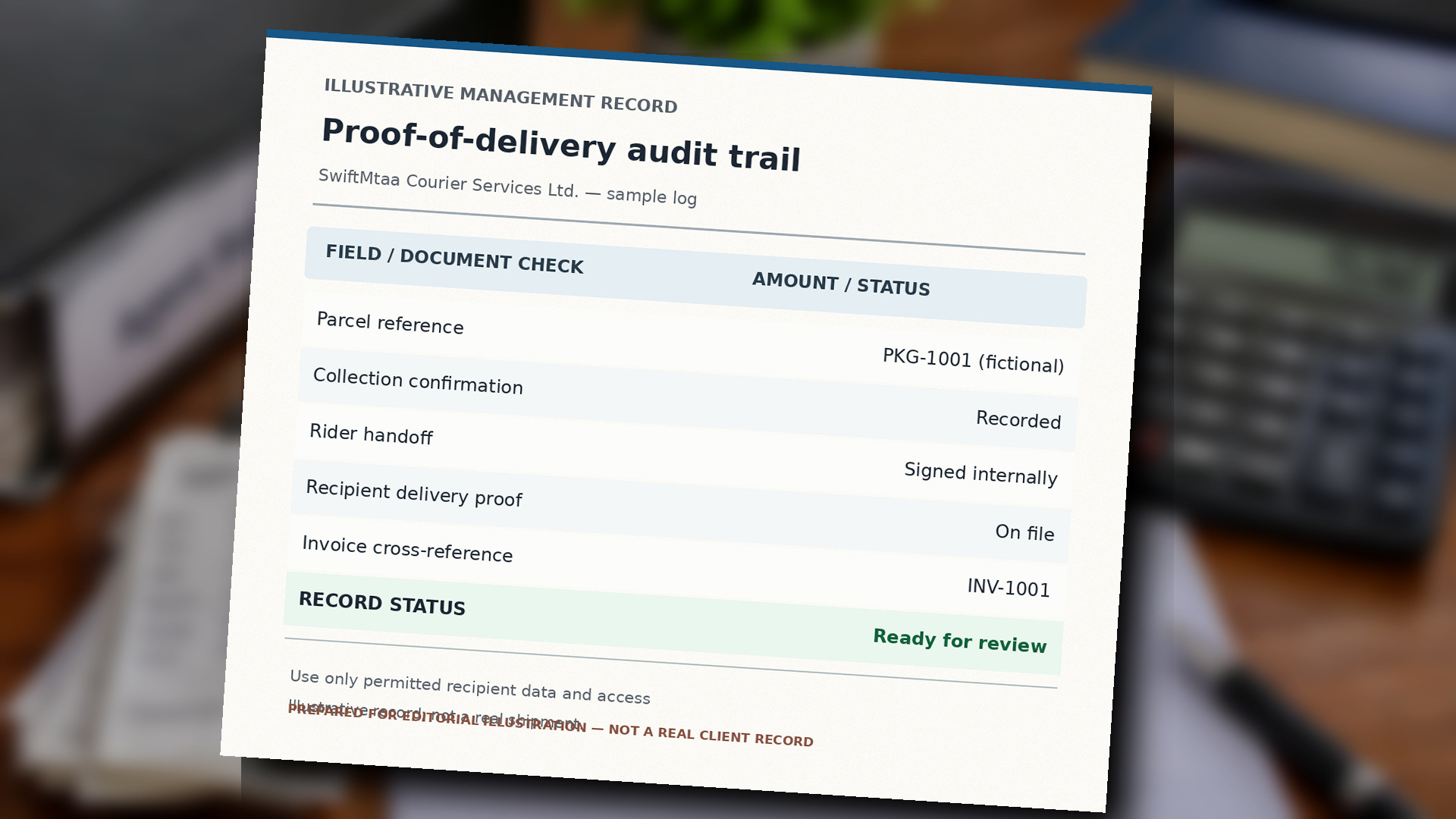
local courier audit preparation in Kenya: printed sample courier proof-of-delivery audit trail
Build an exceptions list for failed addresses, damaged packaging, disputes and uncollected parcels. Give each item an owner and a resolution status. Do not collect more personal data than necessary or publish recipient information in group chats. For privacy principles consult Kenya’s ODPC guidance. The finance team can recognize the resulting valid charge or credit when operational responsibility has been resolved.
Record 5: Daily cash collected on behalf of merchants
Local courier audit preparation in Kenya starts with an especially important cash-on-delivery distinction. A courier may collect the purchase price for merchandise plus its own delivery charge, or the merchant may separately pay the delivery fee. The amount collected for the merchant is generally not the courier’s own earned revenue under an agency arrangement. Local courier audit preparation in Kenya should show customer funds received, any authorized deductions, merchant amounts payable and remittances made. The contract determines legal rights and the accountant confirms the appropriate treatment.
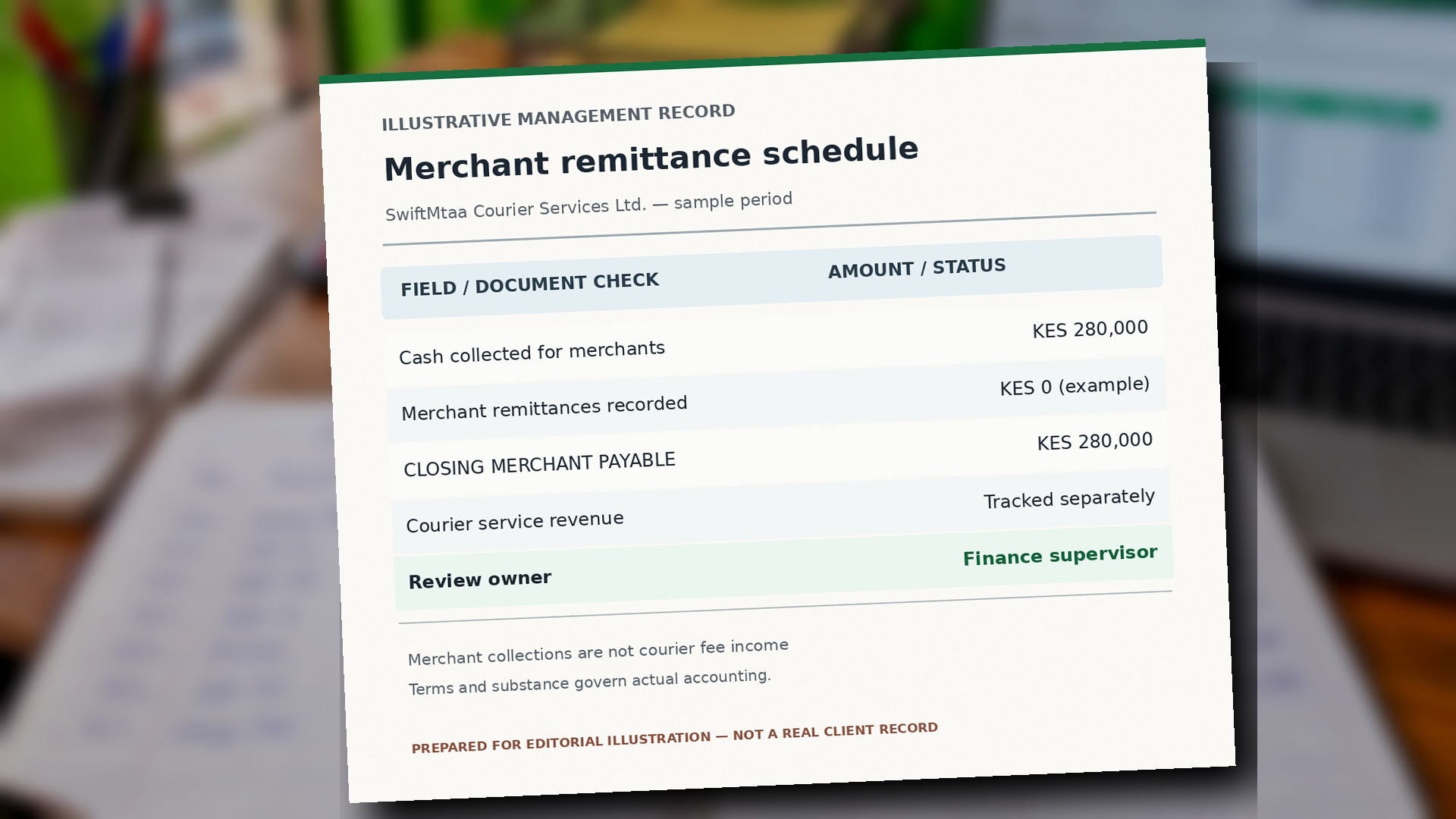
printed sample merchant cash-on-delivery remittance schedule
At SwiftMtaa, suppose KSh 280,000 is collected during the month for merchants and not yet remitted at period-end under the simplified scenario. That amount remains separately tracked as a merchant payable rather than appearing in the KSh 910,000 service revenue. A receipt should identify which amount belongs to the courier and which is held for the merchant. A balance sheet that omits this payable could exaggerate the company’s financial strength. FedhaTrac can help reconcile those liabilities and bank movements, but it cannot authorize merchant-fund use outside the contract.
Record 6: The invoice trail from delivery to customer statement
For account customers, match completed delivery references to an agreed rate schedule and the customer invoice. Local courier audit preparation in Kenya is easier when a disputed line can be traced to a pickup record, delivery confirmation, agreed price and any authorized extra mileage or return charge. Separate genuine credit notes from an unrecorded discount and ensure the customer statement shows what remains owed.
If a customer queries ten deliveries, provide the specific supporting references instead of sending a PDF of all company routes. Under our business operations support, FedhaTrac can help prepare invoices, track balances and document credit adjustments. The operator must decide whether the physical service was performed and whether a disputed charge is valid. That human review prevents financial records from becoming a substitute for proper customer service.
Record 7: Rider expenses, fuel and equipment evidence
Courier costs often involve fuel, rider compensation, vehicle maintenance, packaging, data bundles, insurance, permits and occasional subcontracted trips. A fuel payment may relate to several journeys, while a contractor fee may cover a route rather than one parcel. Local courier audit preparation in Kenya requires approved claims, receipts and an allocation policy reasonable for the business. Avoid guessing every journey’s cost from the month’s total bank withdrawals.
A route-level summary can indicate which delivery types are profitable after practical expenses. Keep vehicle and helmet purchases separate from normal running costs when accounting treatment requires it. FedhaTrac can help with expense categorization, reconciliations and fixed-asset records, but we do not track live GPS by default or certify roadworthiness. Safety, employment and licensing matters remain the courier operator’s duties.
Local courier audit preparation in Kenya: Route and bank reconciliations
The dispatch register, billed deliveries, customer receipts, card or M-Pesa settlements, bank statements and merchant-remittance schedule should agree or have explained differences. Local courier audit preparation in Kenya is weakened when internal transfers are called income, or when a merchant remittance is recorded as a courier expense. Prepare a reconciled list of deposits in transit and disputed receipts, and ask a separate reviewer to confirm material exceptions.
A good financial close identifies amounts still owed by contract customers, unremitted merchant funds, approved rider reimbursements and supplier obligations. The balance sheet must show those obligations even when operating cash looks comfortable. FedhaTrac’s accounting service can help with the ledger and account reconciliations, while its audit preparation service can organize the supporting schedules needed by independent auditors or lenders.
Record 9: A clear income statement with no parcel-value inflation
Assume SwiftMtaa earns KSh 910,000 from legitimate delivery and handling services during an illustrative month. Direct rider and subcontractor costs are KSh 330,000, fuel and transport-related costs are KSh 155,000, and other operating expenses total KSh 255,000. The simplified operating profit is KSh 170,000 before financing, income tax and unmodeled costs. Local courier audit preparation in Kenya should permit each amount to be traced to invoices, delivery references, claims or supplier statements. Parcel values do not belong in this service-income total merely because the courier touched the parcels.
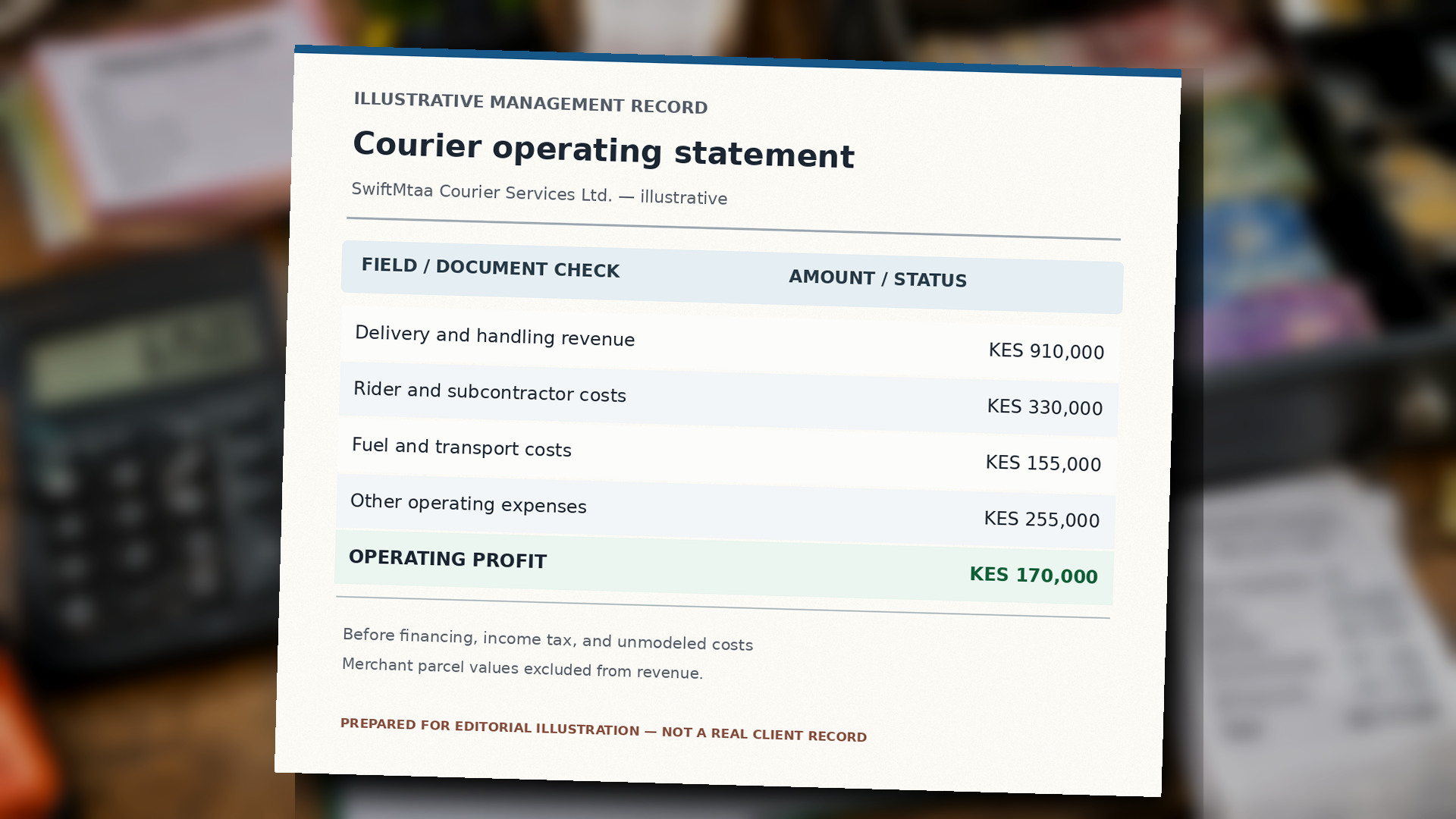
printed sample courier operating statement and costs
Separately, KSh 280,000 of customer cash collected for merchants may remain payable. The cash is physically in the business’s control but economically owed to others. The illustrated operating profit is not the same as unrestricted cash available for fleet expansion. A report that combines the merchant’s sales proceeds with the courier’s revenue would be misleading. Our specialised reporting and advisory can help owners distinguish operating margin, working capital and fiduciary balances in management discussions.
Record 10: The archive that survives staff turnover
A rider or dispatcher may leave, but delivery evidence should remain accessible to authorized management for the applicable retention period. Local courier audit preparation in Kenya calls for an organized archive of commercial contracts, parcel references, proof of delivery, returns, invoices, credit notes, cash-on-delivery schedules, merchant remittances, expense claims and reconciliations. Use role-based access and appropriate data retention rather than copying everyone’s personal documents to an unsecured drive.
Make a routine month-end checklist and record who prepared, checked and approved the pack. If a dispute is open, preserve the relevant evidence under lawful procedures instead of deleting it with ordinary old messages. FedhaTrac can assist in organizing the financial and audit-supporting files; it is not a legal evidence vault or a substitute for data-protection advice. The objective is a coherent trail that a new accountant can understand without inventing missing history.
Courier licensing and tax rules require their own review
Kenya’s Communications Authority is responsible for postal and courier operator licensing. Its market structure information and licensed-operator listings help businesses confirm the relevant category and current obligations. Local courier audit preparation in Kenya can preserve license evidence and operating records, but a FedhaTrac invoice or accounting engagement is not a courier license. A business should verify how the applicable 2026 market structure and license conditions affect its specific service.
On tax, the KRA eTIMS service describes electronic invoicing requirements for persons conducting business, while the actual treatment of deliveries, merchant collections and withholding questions depends on the contract and law. Prepare correct source documents and avoid invoices that falsely depict a parcel’s full merchandise value as the courier’s own service income. FedhaTrac can support applicable tax records and filings, but specialist legal or licensing advice may also be needed.
Turn audit readiness into a customer service advantage
An operator with reliable records can answer a merchant’s question about which parcels were delivered, what charges are valid and when cash will be remitted. Local courier audit preparation in Kenya can improve management’s ability to locate the underlying evidence quickly. It also helps owners compare repeat customers, costs per route, failed-delivery frequency and cash-collection risks. None of those decisions requires a claim that FedhaTrac runs GPS dispatch, barcode scanning or automated rider settlements.

Courier operations team reviewing deliveries
At FedhaTrac, we help the business organize the financial side through reconciliations, supporting schedules, customer balances, tax support and management reports. The courier company remains responsible for transport operations, rider safety, recipient privacy and regulatory status. A clear boundary protects trust: our reports are only as reliable as the operational records supplied and verified by the business. This arrangement can be especially useful when managers are expanding routes faster than their administrative staff can keep up.
Questions delivery operators ask
Is a signed delivery receipt enough for an audit?
It is useful evidence but may not establish the correct charge, customer payment, merchant remittance or expense allocation by itself. Local courier audit preparation in Kenya links proof of delivery to contractual terms, invoices and reconciled records, with any unresolved exceptions clearly disclosed.
Can FedhaTrac issue my courier operating license?
No. Verify the relevant licensing requirements with the Communications Authority and qualified advisers. We can help organize financial records and support tax obligations, but regulatory permission to operate comes from the competent authority.
Is cash collected on delivery my revenue?
Under an agency arrangement, the merchandise payment collected for a merchant is generally a liability until properly remitted, rather than the courier’s own revenue. The agreement and actual substance determine the treatment. Local courier audit preparation in Kenya should show that distinction and preserve the remittance schedule.
How should failed deliveries appear in the accounts?
Apply the customer contract and recorded operational outcome. An authorized return fee may be chargeable, while a disputed service could require review or credit. Keep the failed-delivery reference, customer communication and decision. Do not record a service as completed merely because the rider ended a shift.
What can FedhaTrac do if our records are behind?
We can discuss a cleanup and audit-preparation scope covering financial statements, customer invoices, payable balances and supporting schedules. The operator must help recover and confirm missing operational evidence. Local courier audit preparation in Kenya is more effective when unresolved gaps are reported honestly, not filled with guessed signatures or invented receipts.
Make every parcel leave a reliable trail
A courier’s reputation rests on delivery, but its financial resilience rests on knowing what each delivery earned and what obligations remain. At FedhaTrac, we help owners prepare evidence, reconciliations and reports that withstand routine business review. Local courier audit preparation in Kenya turns scattered parcel slips and payment messages into a better-managed set of financial records while leaving physical operations with the courier team. Contact us to discuss how your company currently handles deliveries, invoices, merchant funds and audit preparation before those records become difficult to reconstruct.


