

A study of 5,250 decided tax cases has delivered a warning Kenyan businesses cannot afford to ignore: the Kenya Revenue Authority (KRA) won 52% outright, taxpayers won 36%, and the other 12% ended in split or partial decisions. Tarra Agility Africa’s research, The Silent Liability, examined decisions issued between 2011 and part of 2026. Its most useful finding is not that every KRA assessment is correct. It is that missing documents, unsupported tax positions, and missed statutory deadlines repeatedly weakened businesses’ ability to defend themselves. For companies concerned about KRA tax disputes in Kenya, those failures are preventable priorities for financial management. Business Daily Africa’s November 22, 2026 report explains the analysis.
At FedhaTrac, we see a practical lesson in these findings. A business needs reliable books, traceable transactions, organized supporting evidence, and a defined process for responding to correspondence from tax authorities. Our bookkeeping, accounting, tax compliance, and audit-preparation support help clients build that discipline before questions arise. We do not promise that our services eliminate KRA tax disputes in Kenya or guarantee success before a tribunal.
What Tarra Agility Africa’s 5,250-case study found
The study’s reported 52% KRA win rate compares with 36% outright taxpayer wins and 12% mixed outcomes. Media coverage says KRA’s annual win rate increased from roughly 34% in 2020 to close to 59% during the part of 2026 assessed. That is a trend within the decided-case sample, not a prediction that an individual business has a 52% chance of losing an objection. The analysis excludes cases resolved without a tribunal or court decision, and 2026 is not a complete calendar-year sample. Such distinctions matter when drawing conclusions about KRA tax disputes in Kenya.
According to the summary of the research shared by Mwango Capital, missing or inadequate documentation was associated with 47% of KRA victories, failure to discharge the burden of proof with 35%, and missed filing or appeal deadlines with 23%. Contemporary reporting independently describes the first figure as nearly half and confirms the latter two percentages. These factors overlap: the same dispute may involve both missing records and insufficient proof. They are analytical associations within judgments, not three mutually exclusive causes or proof that the problem alone determined a case.
The findings are especially relevant because the KRA’s explanation of the burden of proof emphasizes that taxpayers normally need competent, verifiable evidence to challenge a tax decision. KRA tax disputes in Kenya often turn on whether a business can demonstrate what actually happened, not merely state what its accounts say.
The three weaknesses that can turn a tax question into a costly dispute
Missing invoices, contracts, and supporting documents
An expense entry without a corresponding invoice may not explain what was bought, who supplied it, whether goods were delivered, or how payment was made. A bank transfer alone may prove money changed hands without proving the commercial purpose. Purchase orders, signed delivery notes, supplier statements, receipts, stock records, contracts, and correspondence help tell the full transaction story. In KRA tax disputes in Kenya, an evidence trail can be more valuable than a well-formatted spreadsheet without attachments.

Kenyan business adviser and client reviewing tax supporting documentation in a modern office
Businesses should also distinguish missing evidence from legitimate statutory exceptions. Since January 1, 2026, KRA has described validation of income and expenses against TIMS/eTIMS, withholding-tax, and customs information when relevant returns are submitted, subject to applicable exceptions. Its public notice on income and expense validation is a timely reason to review invoice capture and reporting data regularly, not an assertion that every possible business payment has identical tax-document requirements.
Claims that cannot meet the burden of proof
A taxpayer might believe that an input VAT claim, deduction, credit, or exemption is justified. The question in a challenge is whether the evidence and the applicable law support that position. Under section 56 of the Tax Procedures Act, the taxpayer generally bears the burden of showing a tax decision is incorrect, though that evidentiary burden can shift as material is presented and challenged. Our accounting role is to help records withstand scrutiny; legal interpretation and formal litigation strategy may require a qualified tax specialist or advocate. KRA tax disputes in Kenya require both factual evidence and sound legal analysis.
Objections or appeals filed after the deadline
A strong explanation may arrive too late. KRA’s published guidance says a taxpayer generally has 30 days after notification to lodge an objection to a tax decision, with prescribed procedures and supporting documents. Special rules and extensions may apply depending on the circumstances, so every live notice deserves prompt individual review. The KRA notice on service of objections describes the prescribed route. KRA tax disputes in Kenya can become harder to contest if internal teams assume a letter can wait until the next month-end meeting.
What the sector results mean for businesses
The reported KRA victory rate was 63% in construction and real-estate disputes, 61% in retail and wholesale cases, and 59% in VAT disputes. These groups do not form a single comparable industry table: VAT is a tax category that can occur across multiple sectors. The study does not imply that every construction contractor or retailer is noncompliant. It does signal where tax-record quality deserves focused attention, particularly around complex supplier relationships, input-tax evidence, delivery documentation, stock adjustments, and project payments. KRA tax disputes in Kenya have different commercial facts even when the same proof principles apply.

Kenyan wholesaler checking purchase and stock records in a warehouse back office
For builders, useful records include contract variations, milestone certifications, subcontractor invoices, retention accounts, and payment approvals. Retailers should connect purchase invoices with goods received, stock movements, returns, and customer receipts. VAT-registered businesses need to review applicable tax invoices and the nature of each transaction, including supplies eligible or ineligible for input-tax claims. At FedhaTrac, we help build the financial schedules behind these records, but we do not describe every tax claim as automatically valid because it appears in a ledger.
What a credible tax evidence file contains
A practical file should allow a reviewer to follow a transaction from its commercial origin to its accounting entry and payment. It might contain the agreement or order, supplier invoice, goods-received note or completion certificate, payment record, correct ledger entry, relevant eTIMS details, and any credit note or adjustment. The same reference should connect these items. For KRA tax disputes in Kenya, that continuity can help avoid frantic searches after a formal request arrives.
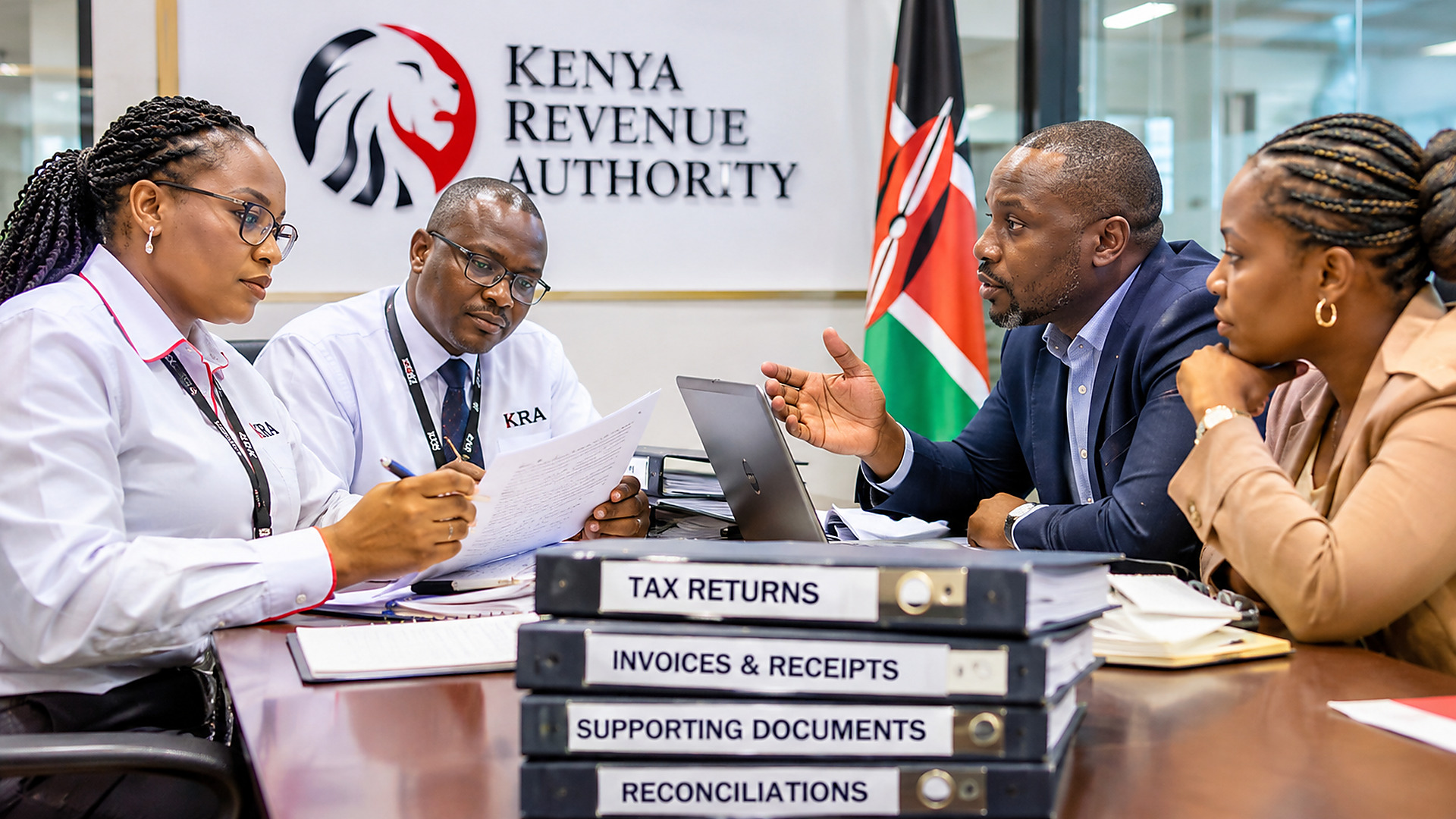
Photorealistic desk with tax return binders invoices receipts and reconciliation documents
KRA’s guidance states that tax records generally must be retained for at least five years; longer retention may be necessary where proceedings or other legal obligations are ongoing. Cloud storage is useful only when documents are complete, accessible, backed up, and protected from unauthorized changes. Sensitive financial and personnel files should be shared through appropriate permissions. A named staff member should be responsible for locating an original record and explaining any discrepancy rather than relying on a folder titled “miscellaneous.”
How FedhaTrac helps businesses build better tax readiness
1. Keep transaction records current rather than reconstructing them later
Our bookkeeping service supports consistent recording of income, purchases, business expenses, customer receipts, and supplier obligations. We identify missing descriptions and seek approved supporting evidence during routine work. When businesses treat bookkeeping as a monthly responsibility, they are less likely to enter KRA tax disputes in Kenya with years of unclassified activity.
2. Match sales to customer payments and invoices
A sales total must reconcile to receipts and amounts still owed. We can help compare invoice registers with bank deposits, M-Pesa statements, cash summaries, credit notes, and customer balances. Differences may represent timing, partial collections, reversals, or errors. Clear customer accounting reduces the possibility that a deposit, loan, internal transfer, or refund is incorrectly presented as ordinary trading revenue in records used during KRA tax disputes in Kenya.
3. Tie purchases to real supplier and delivery evidence
We help organizations maintain supplier accounts, payment histories, and supporting schedules. A complete purchase file should explain what was ordered, invoiced, delivered, approved, and paid. It should also flag a duplicate invoice or a credit note not yet reflected in the books. This is particularly important for KRA tax disputes in Kenya involving disputed costs, inventory, or VAT input claims, where a payment record on its own might be insufficient.
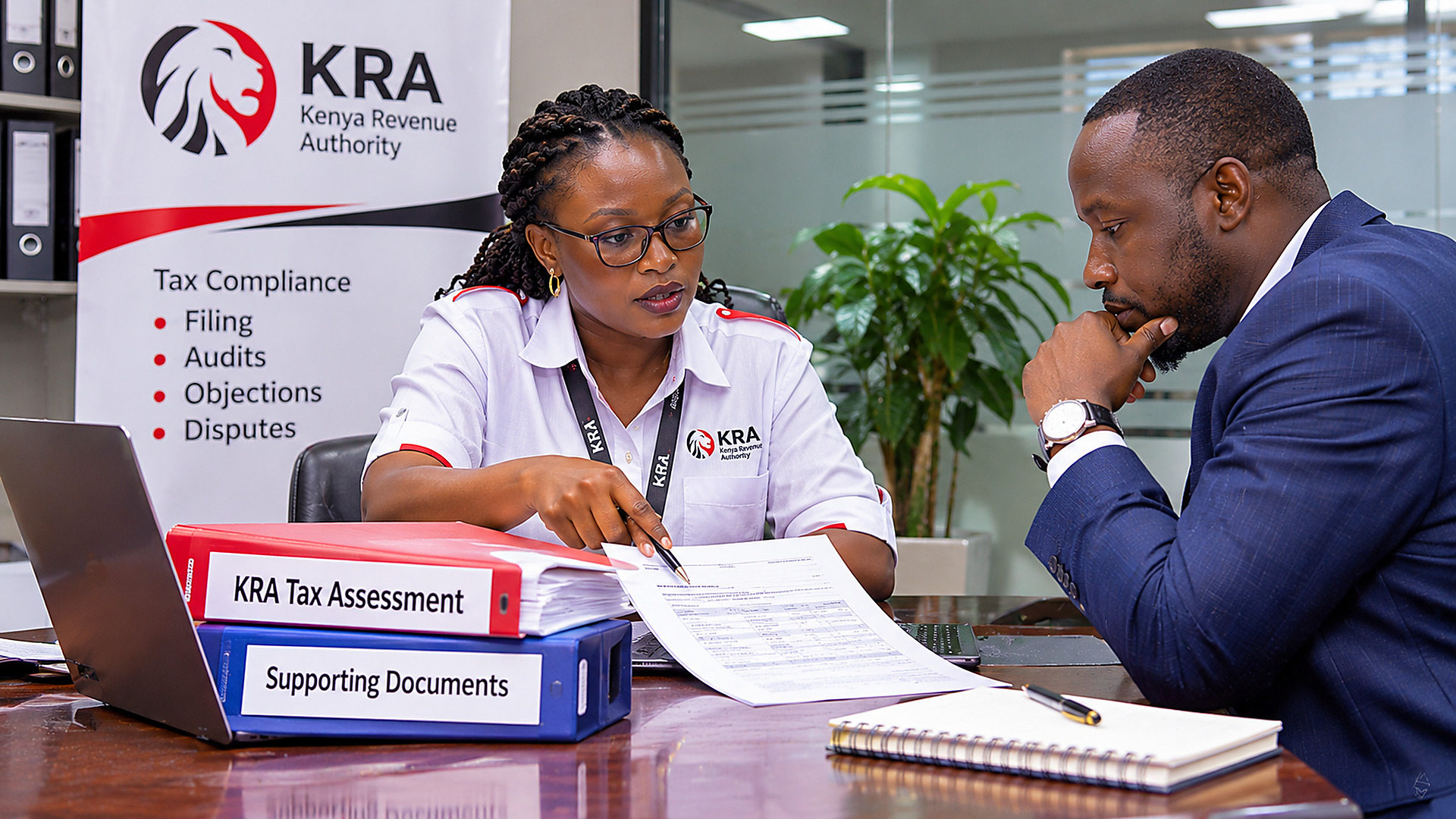
Kenyan tax assessment discussion with business representative and supporting files
4. Reconcile cash, bank, and mobile-money accounts
Our audit-preparation support includes bank, mobile-money, and account reconciliations. Matching balances to statements can surface missing transactions, unexplained fees, duplicated entries, and incorrect customer allocations. We investigate differences rather than hiding them in a balancing adjustment. Reconciled accounts provide a stronger starting point when KRA tax disputes in Kenya require a taxpayer to show exactly how money moved.
5. Organize eTIMS and other tax-supporting documents
Our tax filing and compliance assistance can support review of tax-related schedules and documentation needed for applicable returns. We can help identify invoice or transaction mismatches that require the client’s confirmation. FedhaTrac does not claim that its dashboard automatically transmits every eTIMS invoice or files every tax return. KRA tax disputes in Kenya are easier to analyze when submitted returns can be traced to the underlying accounting records.
6. Prepare schedules for independent review or audit
A reviewer may need a VAT purchase schedule, accounts-receivable aging, supplier reconciliation, payroll-cost summary, fixed-asset register, or detailed ledger extract. We can help prepare coherent supporting schedules and document the explanation for major movements. This is audit preparation and support—not a guarantee of an independent audit opinion. KRA tax disputes in Kenya require records that remain understandable to someone who did not originally enter the transactions.
7. Identify unresolved anomalies before a filing period closes
We encourage a routine review of missing supplier documents, unapplied payments, unusual journal entries, long-outstanding balances, and unexplained sales differences. Correcting an error before a return is submitted can be simpler than defending an inconsistent record afterward. Where legal or tax treatment is uncertain, we flag the issue for appropriate professional advice instead of inventing a rule. Good preparation can reduce weaknesses relevant to KRA tax disputes in Kenya.
8. Support filing preparation and calendar discipline
Our tax-compliance support can be combined with an agreed responsibility calendar for the returns and reviews included in a client’s engagement. A specific person should monitor iTax correspondence, preserve the date of receipt, alert management immediately, and escalate objection or appeal notices to a qualified adviser. We do not guarantee automated legal-deadline notifications. Deadline discipline is particularly relevant to KRA tax disputes in Kenya because a late response may limit the available procedural options.
9. Explain financial reports and prepare management for questions
Our specialised reporting and advisory helps owners review performance, cash flow, liabilities, and unusual account movements. A quarterly meeting can identify what needs documentary follow-up and who must approve corrective action. The FedhaTrac Dashboard supports financial visibility, but a dashboard indicator is not proof that KRA has approved a return. A documented management review improves readiness for KRA tax disputes in Kenya.
A fictional wholesale example: one expense, several pieces of evidence
Consider Jirani Crest Distributors Ltd., an entirely fictional wholesaler. Its accountant finds an expense entry of KSh 95,000 for a delivery service used during a busy sales period. The bank statement confirms a KSh 95,000 payment, but the invoice and signed delivery note are missing from the file. The payment alone may not establish the service, correct supplier, contractual purpose, or treatment for tax. This example illustrates an evidentiary weakness, not a conclusion that KRA would automatically disallow the amount.

Finance professional reviewing a ledger bank statement and supporting financial records
The finance team requests the supplier invoice, delivery confirmation, agreement or order reference, supplier statement, and any relevant electronic tax-invoice information. It checks that the ledger describes the correct service and that the bank payment matches the supplier’s settlement record. If valid documentation cannot be obtained, the transaction is flagged for professional review before a claim is made. This is how we would approach the recordkeeping problem highlighted by KRA tax disputes in Kenya, without portraying Jirani Crest as a real FedhaTrac client.
A short transaction-control record might show: invoice KSh 95,000; matching bank transfer KSh 95,000; verified supplier and delivery evidence pending; assigned reviewer; and a decision date. The arithmetic is simple, but its value lies in preventing an unsupported entry from being treated as fully verified. A business with hundreds of monthly suppliers can use the same approach systematically. Good evidence does not predetermine the result of KRA tax disputes in Kenya; it helps the business explain and substantiate what happened.
A workable monthly tax-readiness routine
During the first week after month-end, collect bank and mobile-money statements, cash counts, purchase invoices, issued sales invoices, credit notes, stock summaries, and relevant payroll records. Match these documents against the accounts, investigate gaps, and prepare a list of unresolved items with owners and deadlines. Before filing applicable returns, confirm that relevant classifications and documentary requirements have been reviewed. Close the month only after designated staff approve the reconciliations. This routine is a practical response to the weaknesses highlighted by KRA tax disputes in Kenya.
A quarterly management review can then test older balances, recurring supplier problems, missing receipts, and documentation for significant tax positions. Protect source records from accidental deletion and confirm that staff know where to retrieve them. KRA tax disputes in Kenya are sometimes discussed only after an assessment arrives, but sustainable readiness comes from routine finance practices rather than last-minute document collection.
What to do if a KRA assessment or objection notice arrives
First, record the exact date of notification and preserve the full notice. Second, identify the taxes, periods, adjustments, and stated reasons in question. Third, secure the relevant records and compare the assessment with returns, transaction schedules, and payment evidence. Fourth, escalate promptly to a qualified tax professional or advocate who can evaluate the applicable statutory procedure and deadlines. Do not assume that requesting documents informally pauses a legal time limit.

Kenyan finance manager reviewing a tax notice with a calendar and supporting papers
FedhaTrac can support the accounting side of that response by organizing ledgers, reconciliations, reports, and supporting schedules. A tax adviser should direct formal objections, appeals, and legal arguments where specialist representation is necessary. Businesses responding to KRA tax disputes in Kenya deserve precise guidance and realistic expectations—not assurances that any accountant can make an assessment disappear.
Questions business owners frequently ask
Will good bookkeeping guarantee that KRA cannot assess my business?
No. KRA may examine or assess a taxpayer despite well-maintained records, and genuine differences of legal interpretation may remain. Good records help identify errors, support legitimate tax positions, and make responding more efficient. They do not immunize a business against KRA tax disputes in Kenya.
Is an eTIMS invoice enough to prove every expense or VAT claim?
Not necessarily. The correct tax treatment depends on the transaction and applicable law. Other evidence—including contracts, delivery records, business purpose, and payment confirmations—may matter. KRA tax disputes in Kenya can turn on whether the underlying transaction actually occurred and meets the relevant statutory conditions.
How long should our company keep financial records?
KRA’s published guidance generally refers to at least five years for relevant tax records, with additional retention where proceedings or specific obligations require it. Confirm the rule for each record category and preserve files that relate to an unresolved matter. Our team can help organize the underlying records, while advisers clarify the retention obligations governing KRA tax disputes in Kenya.
Does FedhaTrac represent clients in tax litigation?
Our verified services include bookkeeping, accounting, tax-filing assistance, financial reporting, and audit preparation. We do not describe the company as a law firm or promise courtroom representation. We can support a client’s appointed tax specialist with financial schedules and evidence where agreed. This distinction matters in KRA tax disputes in Kenya.
Better records today, stronger answers tomorrow
The message from Tarra Agility Africa’s reported research is both concerning and actionable: many decided cases involved documentary and procedural weaknesses that a disciplined finance function should take seriously. The 52% KRA outright win rate does not mean businesses should abandon legitimate objections; it means they should prepare evidence and meet deadlines with care. At FedhaTrac, we help businesses create accurate financial records, maintain reconciliations, organize supporting documentation, prepare reports, and seek timely advice. Contact FedhaTrac to discuss a tailored bookkeeping, tax-compliance, or audit-preparation workflow that reduces avoidable weaknesses linked to KRA tax disputes in Kenya.


