

Tour operator accounting in Kenya becomes complicated long before a safari vehicle leaves Nairobi. A client pays a deposit for a December trip, a lodge requests an advance, a guide needs transport money, and the remaining customer balance may arrive in dollars. The bank account looks active, but how much of that money belongs to trips not yet delivered? At FedhaTrac, we help safari companies answer that question with organized records, reconciliations, financial reports, and practical business support.
Good tour operator accounting in Kenya follows each booking from the quotation to the final supplier payment and post-trip review. It distinguishes money received from revenue earned, supplier advances from completed-service costs, and a healthy booking pipeline from actual profitability. Our team supports this work without pretending that accounting replaces your booking platform, tour guide, or regulatory obligations.
Why Tour Operator Accounting in Kenya Needs Its Own Financial Controls
A tour package is a bundle of promises: rooms, park access, transfers, meals, guides, activities, and sometimes domestic flights. Different suppliers may require payment on different dates, while international clients pay in installments and different currencies. A single unallocated expense can distort the result of a whole itinerary. That is why tour operator accounting in Kenya needs booking-level identification, not just a general monthly expenses total.
At FedhaTrac, we use the records your business actually has: quotations, booking confirmations, supplier invoices, bank and M-Pesa statements, credit notes, receipts, and agreed spreadsheets or exports. We help organize those records through our bookkeeping services and investigate differences before they become month-end surprises. The seven controls below make the numbers useful for real decisions.
1. Record Safari Deposits Without Confusing Cash With Earned Revenue
A deposit is useful cash, but it does not automatically mean a trip has been delivered or a profit has been earned. Suppose a family books a KSh 1,200,000 itinerary and pays 40% today: the business receives KSh 480,000, while KSh 720,000 remains due under its booking terms. The receipt, outstanding balance, cancellation terms, and expected departure date should be connected to that booking.

Kenyan tourism finance team checking a safari customer deposit and booking documents
In tour operator accounting in Kenya, the correct revenue timing depends on the contracts and applicable accounting policies. Where an advance is for services still owed, it may be recorded as a customer advance or contract liability until performance obligations are satisfied. We help maintain the evidence so the accountant can assess the appropriate treatment instead of treating every deposit as unrestricted profit.
Our business operations support includes invoice administration, payment tracking, and customer records. We can support an agreed reminder process for outstanding balances, while your team retains control of whether a booking is confirmed, amended, or canceled.
2. Match Lodge, Park, Vehicle, and Guide Costs to Each Booking
Hotels and lodges may take advance payments; park fees may depend on destination, visitor category, or booking date; transport operators may charge per day; and guides may submit supporting claims after the trip. Tour operator accounting in Kenya works best when these costs are connected to a booking reference and a supplier document, rather than mixed into an unexplained “travel costs” account.
For example, an advance paid to a lodge before a trip is not necessarily the same as an expense for accommodation already consumed. We help distinguish supplier prepayments, outstanding supplier bills, and costs relating to completed trips. This makes it easier to compare projected itinerary costs with actual costs after the travelers return.
Our team can organize supplier records, invoice evidence, payment dates, and approval notes. FedhaTrac does not claim to issue park permits, reserve rooms automatically, or connect directly to every lodge or safari system. We work with the reports, documents, and agreed processes that support your accounting records.

Tour company staff reviewing safari supplier cost records and receipts
3. Calculate Profit for Every Safari Package, Not Only the Whole Company
A busy tour company can sell many safaris and still price particular itineraries badly. Tour operator accounting in Kenya should show the contribution from each package before shared office expenses, followed by a sensible allocation of overhead when management needs a fuller profitability view. A group tour to the Maasai Mara and a private Amboseli itinerary should not be judged by one blended margin.
Consider this hypothetical illustration, not a FedhaTrac client result. A group safari sells for KSh 1,200,000, excluding any separate tax analysis. Direct costs include accommodation of KSh 500,000, park fees of KSh 120,000, vehicle and fuel costs of KSh 155,000, guide and support costs of KSh 85,000, activities and meals of KSh 60,000, and payment charges of KSh 20,000. The total direct cost is KSh 940,000, leaving KSh 260,000 in trip contribution. After an illustrative KSh 95,000 allocation of office overhead, estimated operating profit is KSh 165,000: a 13.75% margin on the package price.
| Illustrative trip profitability | Amount (KES) |
| Package sales | 1,200,000 |
| Accommodation | (500,000) |
| Park fees | (120,000) |
| Vehicle and fuel | (155,000) |
| Guides and support | (85,000) |
| Meals and activities | (60,000) |
| Payment charges | (20,000) |
| Total direct costs | (940,000) |
| Trip contribution | 260,000 |
| Allocated office overhead | (95,000) |
| Illustrative operating profit | 165,000 |
Through our specialised reporting and advisory service, we help owners compare package performance and investigate overruns. Accurate tour operator accounting in Kenya turns pricing decisions into a review of evidence rather than a guess based on how much cash came in.
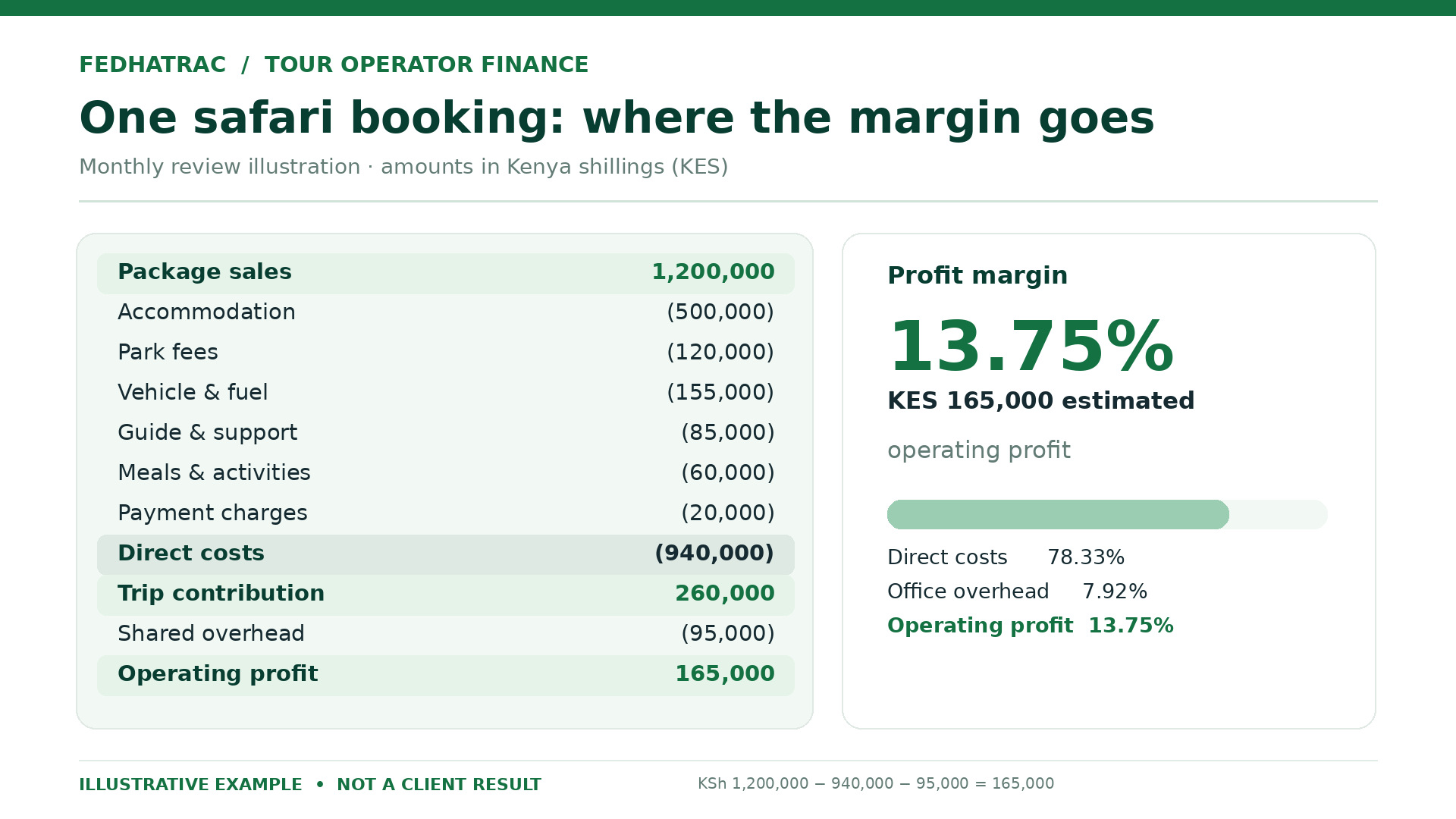
Illustrative safari package profitability with KSh 165000 operating profit and 13.75 percent margin
4. Reconcile M-Pesa, Bank, Card, and Foreign-Currency Receipts
Safari clients may pay by local transfer, M-Pesa, card, or overseas bank settlement. A payment processor can deduct a fee before remitting cash; a foreign-currency payment may also be converted at a rate different from the quotation assumption. Tour operator accounting in Kenya should connect the original customer obligation, payment evidence, deductions, and final settlement.
In a simplified example, a customer pays USD 4,000 and the agreed illustrative bookkeeping rate is KSh 130 per dollar. The gross payment equals KSh 520,000. If a provider deducts USD 40, the charge is KSh 5,200 and the net amount is USD 3,960, or KSh 514,800 at the same assumed rate. The KSh 5,200 difference is a charge, not missing customer revenue. Actual exchange rates, bank dates, and accounting treatment must be verified against the records.
FedhaTrac’s accounting services include reconciliation and financial-statement support. We can work from authorized bank, mobile-money, and processor records; we do not promise an automatic connection to every gateway. Good tour operator accounting in Kenya makes every payment traceable from guest invoice to settlement.
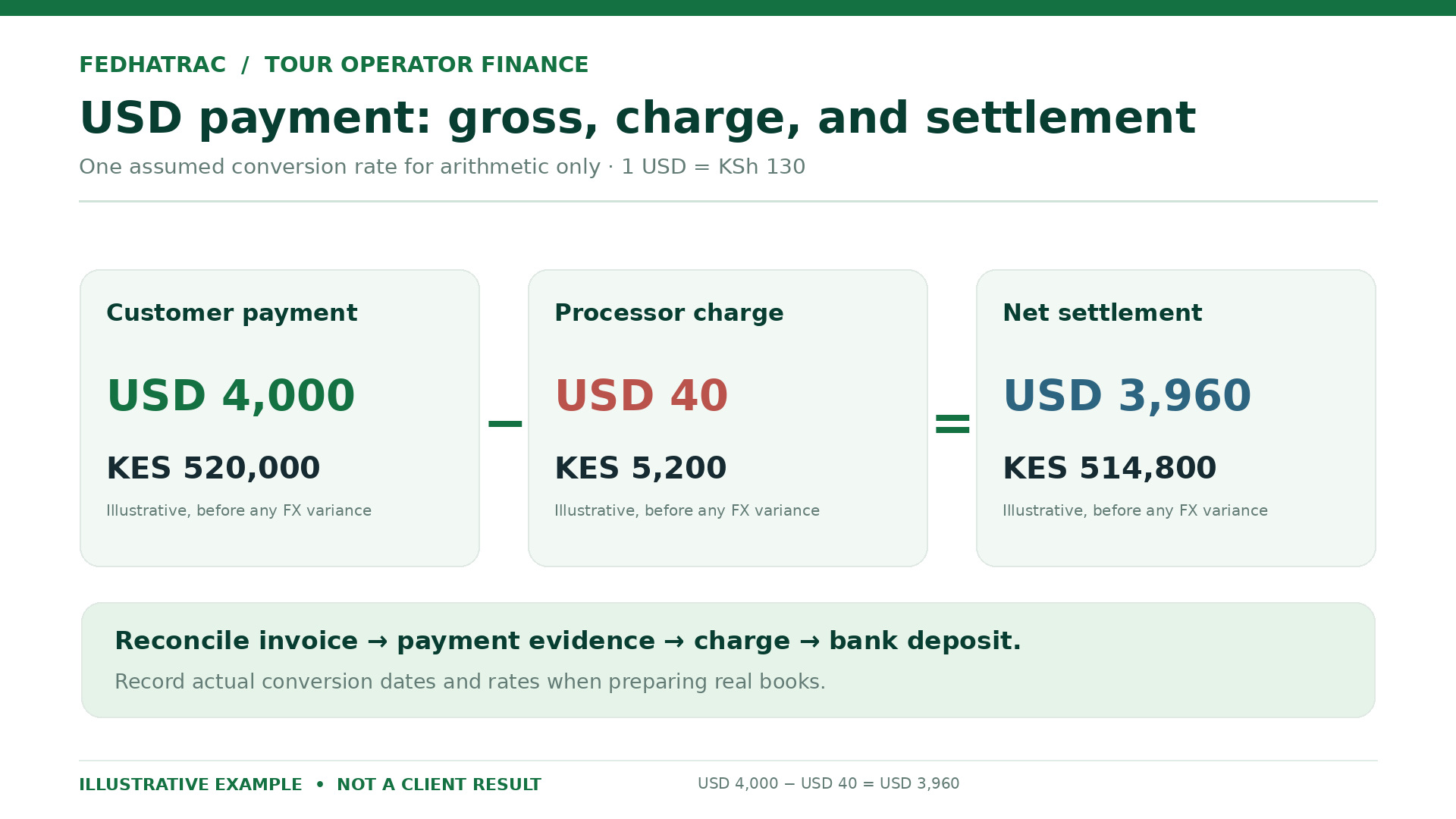
Illustrative USD 4000 safari remittance less USD 40 fee equals USD 3960 net
5. Plan Cash Around Trip Dates and Supplier Deadlines
Money can arrive weeks before guests travel, while a lodge, airline, or transport supplier expects payment immediately. That timing mismatch is why tour operator accounting in Kenya needs a forward-looking cash schedule alongside the profit report. A trip can be profitable when delivered but cause a short-term cash squeeze if deposits are spent without considering supplier commitments and refunds.
Return to the hypothetical KSh 1,200,000 booking. If opening available cash is KSh 300,000, the KSh 480,000 customer deposit raises cash to KSh 780,000. Then the company pays a KSh 210,000 lodge advance, a KSh 100,000 park-related reservation amount, and a KSh 75,000 vehicle deposit. Cash falls to KSh 395,000. That remaining balance is not all free cash: the business still owes services to the customer and may have other upcoming obligations.
We help prepare cash-flow schedules and review expected collections, supplier deadlines, recurring overhead, and contingency needs. FedhaTrac can discuss these reports at quarterly or annual financial reviews so tour managers see a future funding gap early instead of discovering it on departure week.
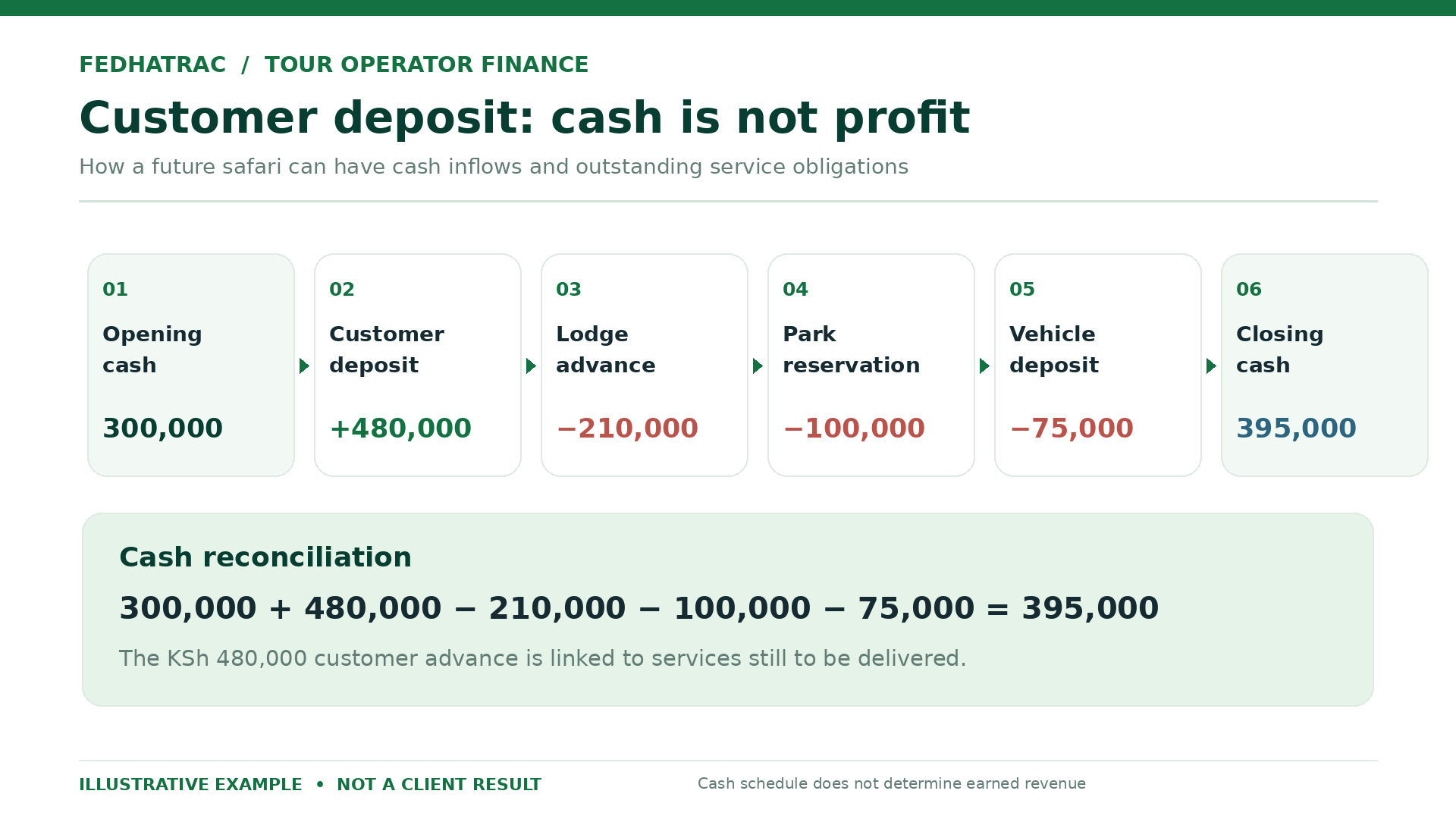
Illustrative safari deposit cash bridge from opening KSh 300000 to closing KSh 395000
6. Keep Cancellations, Refunds, and Credit Notes Documented
Changes happen: a flight is delayed, a traveler reduces the group size, a lodge changes availability, or a safari is canceled. A deposit paid by the guest, a deposit paid to the supplier, and a refund owed under the booking contract are three different records. Tour operator accounting in Kenya requires each one to be supported independently.
For every changed booking, keep the original quotation, updated terms, supplier cancellation rules, customer correspondence, credit note where applicable, and evidence of any money returned or retained. Do not assume all retained deposits are automatically earned revenue or that all supplier penalties are immediately recoverable from guests. The accounting and tax outcome depends on the actual contract and event.
Our team can organize outstanding customer balances, supplier credits, revised documents, and bank reconciliations. With dependable tour operator accounting in Kenya, management can distinguish a genuine booking gain from an unresolved refund liability.

Travel business team reviewing safari invoices and booking changes
7. Prepare KRA and Tourism Compliance Records Without Guesswork
Tourism operators must consider both tax and sector-specific obligations. The Tourism Regulatory Authority’s license verification service supports checks of tourism licenses. The Tourism Act also establishes licensing requirements for regulated tourism activities. A license check is not the same as a tax filing, and neither should be inferred from a bookkeeping dashboard.
The Kenya Revenue Authority’s eTIMS guidance explains electronic invoicing, including obligations affecting businesses that are not registered for VAT. VAT, income tax, payroll obligations, and tourism-related charges depend on the company, the nature of supply, and applicable rules. In tour operator accounting in Kenya, we therefore preserve sales invoices, supplier documents, tax records, reconciliations, and supporting schedules for informed review.
FedhaTrac offers tax filing and compliance support, but our bookkeeping does not automatically issue KRA invoices, guarantee regulatory compliance, or determine every tax outcome without assessment. A tour business should confirm current requirements directly with the relevant authorities and professional advisers before making filing or licensing decisions.
Keep Safari Quotes and Overseas Agent Commissions Consistent
A quotation can change between the first inquiry and a confirmed booking. Guest numbers change; a lodge replaces another property; the season changes; or a foreign agent negotiates a different net rate. Tour operator accounting in Kenya should preserve the approved quotation version, currency, inclusions, exclusions, and later amendments. Otherwise, a finance officer may compare an old selling price with new supplier costs and believe the trip is profitable when it is not. Our team can help retain the financial records and cross-reference approved revisions without claiming to manage itineraries or authorize commercial price changes.
Another common challenge is a booking introduced by an overseas travel agent. The travel company may owe a commission, receive a net rate from an agent, or act only as an intermediary for part of an itinerary. Those contracts are not interchangeable. Whether a business reports gross package revenue or only a commission depends on the contractual rights, obligations, and appropriate accounting policy. For this reason, we do not automatically treat every amount passing through the bank as revenue belonging to the tour company. We review the documents with the responsible accountant and maintain the supporting calculations.
Where there are several booking channels, tour operator accounting in Kenya should also identify which channel generated the booking and the commissions or collection fees associated with it. A simple monthly breakdown helps owners see whether a direct website booking, a repeat customer, or an agency referral delivers a worthwhile margin after acquisition and service costs. FedhaTrac’s reporting team can assist with that analysis from properly maintained source records.
How FedhaTrac Organizes the Tour Operator Accounting Workflow
Our starting point is a practical conversation about your business: direct bookings or overseas agents, private or group trips, destinations, payment channels, suppliers, accounting software, and the reports you want. Tour operator accounting in Kenya can then be organized around seven simple record categories: customer bookings, customer receipts, supplier commitments, supplier payments, trip expenses, adjustments, and management reports.
A useful monthly close checks that bookings agree to invoices; customer receipts agree to bank, M-Pesa, and card statements; advances and supplier balances agree to supporting documents; and completed trips have cost allocations that can be reviewed. We investigate unexplained items before they become permanent suspense balances. Where the business uses a booking system or spreadsheets, we can work with approved exports and documents rather than promising a native integration.
Our FedhaTrac dashboard provides financial views such as money in, money out, bookkeeping status, and transaction movement. Our professionals add reconciliations, explanations, and management reporting. The outcome we aim for in tour operator accounting in Kenya is clarity over cash, obligations, and profit—without misrepresenting the software as an itinerary or hotel reservation engine.
What Should Safari Business Owners Review Every Month?
Owners should compare the booking pipeline with balances actually collected, identify departures that still need supplier funding, review trips completed during the month, and check whether promised margins survived real-world costs. Tour operator accounting in Kenya also benefits from a short list of overdue customer balances, supplier prepayments, unreconciled transactions, and canceled bookings awaiting final adjustment.
At FedhaTrac, we can prepare management reports and discuss variances through an agreed consultation or financial review. A higher booking value is encouraging, but the more useful questions are whether the company can deliver those bookings, what they will cost, and how much profit remains after properly supported expenses.
Frequently Asked Questions About Tour Operator Accounting in Kenya
Can FedhaTrac work with our current tour booking software?
Yes, we can discuss a workflow using the existing exports, invoices, and other records your business can provide. Our tour operator accounting in Kenya service is based on bookkeeping, reconciliation, and reporting support; specific software integration must be confirmed rather than assumed.
Do you help track payments made in dollars or other currencies?
We can help organize and reconcile foreign-currency transaction evidence, including receipts, settlement charges, and conversion records. For tour operator accounting in Kenya, we review the actual transaction dates and applicable accounting policies instead of applying an invented exchange rate.
Can you help distinguish safari deposits from profit?
Yes. We organize client receipts and outstanding obligations so their accounting treatment can be assessed correctly. Tour operator accounting in Kenya should not report a future trip as fully profitable simply because the customer has prepaid before the service is delivered.
Will FedhaTrac calculate our park charges or obtain tourism licenses?
We help record and review documentation for park-related expenses and compliance reporting; we do not claim to set official park fees, issue permits, or obtain TRA licenses automatically. Tour operator accounting in Kenya complements the bookings and regulatory decisions your authorized staff make.
Can your team explain the reports rather than only send spreadsheets?
Yes. Our reporting and advisory services include consultations and financial-review discussions. Through tour operator accounting in Kenya, we aim to help owners understand the figures behind pricing, cash requirements, supplier liabilities, and trip margins.
Grow Safari Revenue With Clearer Financial Decisions
A safari company should know more than its total bookings. It should know which trips are funded, which supplier commitments are outstanding, what customers still owe, which refunds need action, and where profit is being made or lost. Good tour operator accounting in Kenya supports those answers with evidence rather than optimism.
At FedhaTrac, we combine hands-on bookkeeping, accounting, payment tracking, reporting, and advisory support. Contact FedhaTrac to explain your booking process and discuss a practical tour operator accounting in Kenya workflow for your travel business.


