

E-commerce businesses in Kenya can make sales all day and still struggle to explain how much money they actually earned. An order arrives through a website, a customer confirms it on WhatsApp, payment comes through M-Pesa, and a courier collects the parcel. Each step leaves a different record. Without a reliable method of bringing those records together, a busy store can mistake incoming payments for profit. At FedhaTrac, we make e-commerce accounting in Kenya practical by organizing online sales, receipts, operating expenses, inventory movements, and financial reports around the way merchants actually trade.
We combine hands-on bookkeeping support, accounting oversight, and dashboard visibility. Whether you sell on Instagram, your own website, or a marketplace, we help connect deliveries, payments, supplier balances, and product performance. Our approach to e-commerce accounting in Kenya starts with reliable source records rather than promises of automatic integrations.
Why Online Sales Need More Than a Payment Statement
An M-Pesa statement confirms movements of money; it does not, on its own, identify the product sold, the delivery cost, the tax treatment, or whether a customer later returned the order. A bank deposit from a marketplace may combine dozens of orders after commissions have been deducted. A website report might count an order immediately, even when the buyer has not paid. Those differences are why e-commerce accounting in Kenya needs an order-to-payment trail rather than a single list of deposits.
We review order numbers, invoices, payment references, fulfillment status, refunds, and eventual settlement, including cash-on-delivery collections where relevant. When a payment cannot be matched, our team investigates rather than assuming the books are complete. This becomes especially important as order volumes grow.

E-commerce accounting in Kenya with a merchant reviewing orders alongside fulfillment workers
How FedhaTrac Builds a Reliable E-Commerce Record
At FedhaTrac, e-commerce accounting in Kenya is a coordinated service, not simply a software download. Our published business operations support includes invoice administration, payment tracking, supplier and customer accounts, and supporting documents. Our accounting team can then use those organized records to prepare reconciliations and meaningful financial statements. The precise reporting schedule and responsibilities are agreed with each client, because a small Instagram seller and a multi-channel fulfillment business do not have identical needs.
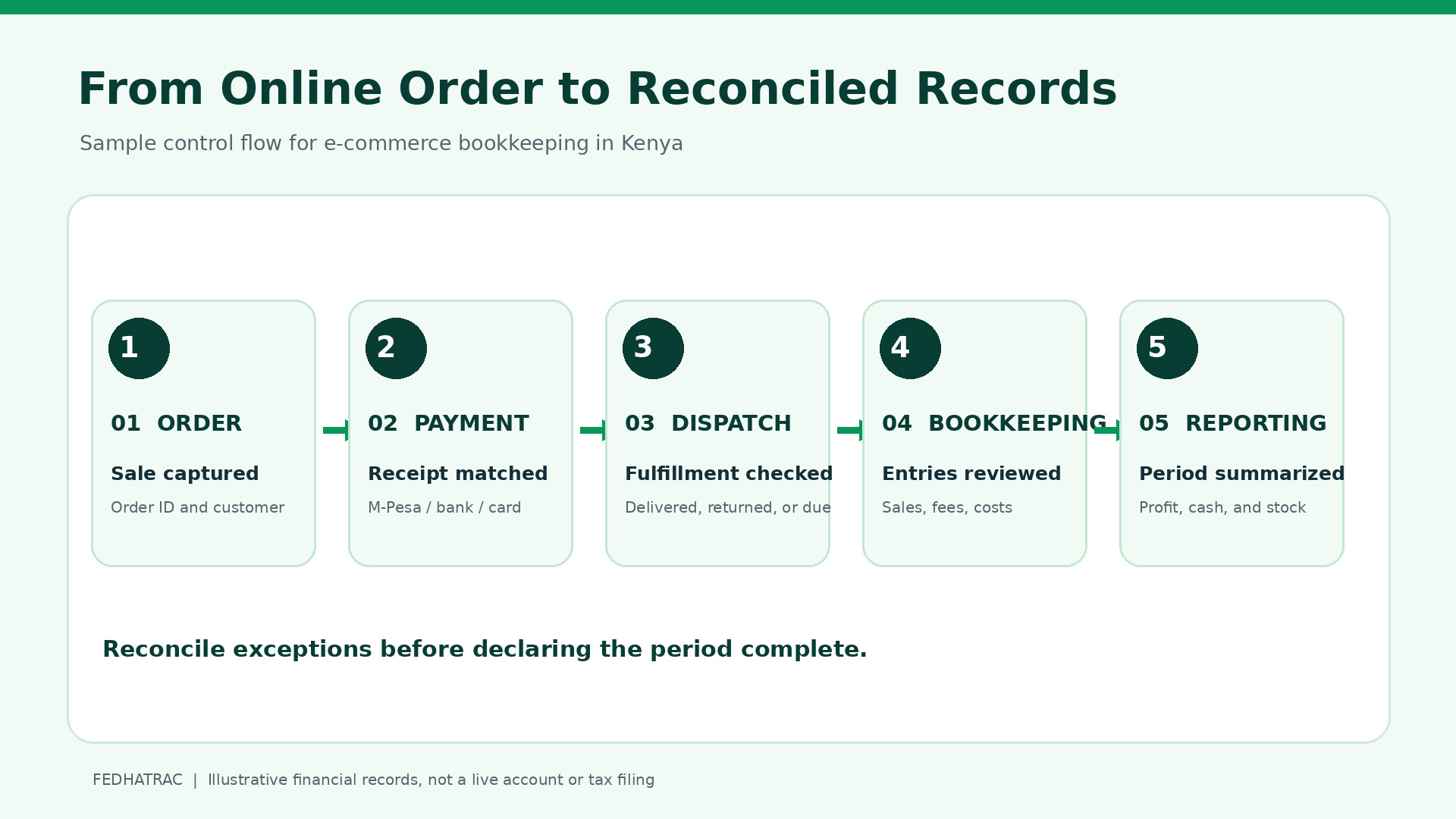
Illustrative flow diagram linking online orders, payments, dispatch, bookkeeping, and reports
Start With Orders and Evidence
We ask merchants to retain order exports, invoices, payment notifications, supplier bills, credit notes, courier statements, and bank or mobile-money statements. Where sales originate from an existing website, POS system, marketplace, or spreadsheet, we can work with the reports the client provides and agreed processes. A customer message alone may help trace an order but should not replace complete sales and payment evidence. This disciplined first stage makes e-commerce accounting in Kenya easier to review when the volume of transactions rises.
Match Sales, Receipts, and Settlement Dates
A delivered order and the cash collected for that order are related, but they are not always recorded on the same day. We distinguish an outstanding customer balance from a settled sale, and we distinguish a payment intermediary’s fees from the value of the goods. If a marketplace collects KSh 10,000 and remits KSh 9,600 after a KSh 400 charge, the sale is not automatically KSh 9,600: the records may need KSh 10,000 in gross sale value and KSh 400 as a separate charge, subject to the contract and applicable accounting treatment. This distinction is central to e-commerce accounting in Kenya.
M-Pesa, Bank, Card, and Marketplace Reconciliation
Online merchants often receive money through several channels, making duplicate recording surprisingly easy. A customer pays into M-Pesa; the proprietor later transfers those funds into a bank account; the bank statement then shows a second inflow. If both entries are treated as new customer revenue, sales are overstated. We help classify the second movement as an internal transfer when the evidence supports it. Our existing guide to M-Pesa bookkeeping in Kenya explains the underlying discipline, while e-commerce accounting in Kenya applies it to order and settlement records.
We review reversals, unexplained receipts, processing fees, and settlement delays. If a buyer pays KSh 10,000, incurs a documented KSh 120 transaction fee, and KSh 9,880 is transferred to the business bank, that transfer is not another sale. We link the receipt, fee, and transfer for accurate bank reconciliation, a vital part of e-commerce accounting in Kenya.

Online business owner reviewing sales records and order packing activities
Inventory, Supplier Purchases, and Cost of Goods Sold
Profit becomes unreliable if stock purchases and stock sold are confused. Buying 100 phone chargers affects inventory; it does not necessarily mean all 100 chargers became a current-period expense. We help clients maintain purchase, sales, stock, and supplier records, then use appropriate accounting treatment for goods sold. Inventory-related work forms an important part of e-commerce accounting in Kenya, especially for importers, wholesalers, and stores carrying many product variations.
A practical stock movement example starts with 120 units, adds 80 purchased units and five saleable returned units, and deducts 150 units sold. Closing stock is therefore 55 units. A damaged returned item would not automatically be added to saleable stock, and a customer refund must be evaluated separately from the physical movement of goods. We compare purchase evidence, records of dispatched goods, returns, and the closing quantities so that the financial reports do not count the same goods twice. This evidence trail is essential to e-commerce accounting in Kenya.
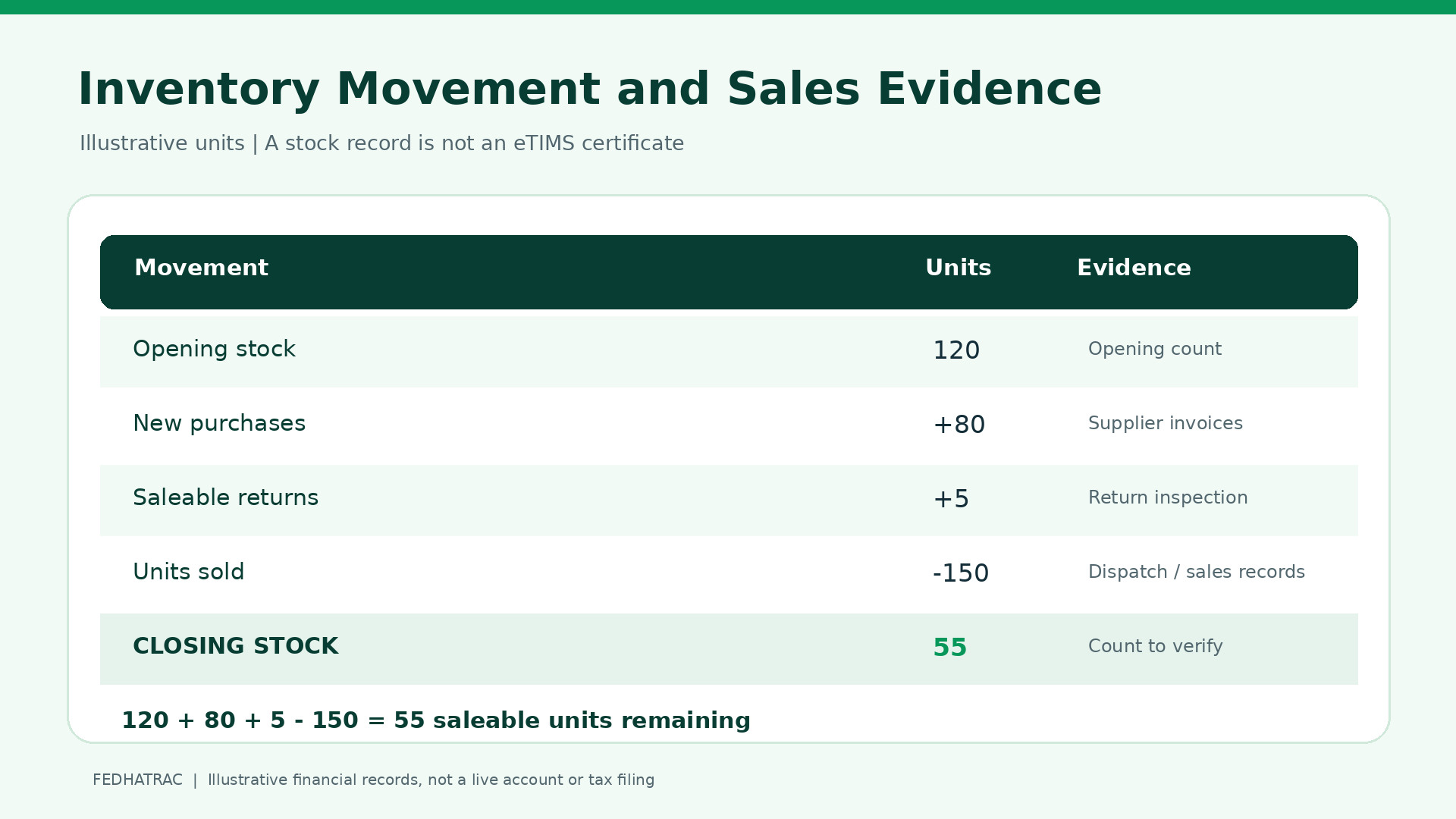
Illustrative inventory movement record showing 55 closing stock units
Keep Supplier and Product Costs Visible
Purchase costs are only part of an online retailer’s economics. Packaging materials, inbound freight, courier charges, payment-processing fees, marketplace commissions, advertising, storage, and staff time affect the outcome differently. We help merchants categorize these items consistently, keeping inventory cost separate from operating costs where appropriate. For e-commerce accounting in Kenya, product-level analysis can expose a low-margin item that looks successful because it generates many orders, while a slower-selling product contributes more profit per delivery.
Delivery Fees, Failed Orders, and Customer Returns
Returns and failed deliveries are common sources of hidden loss. A courier may charge for an attempted delivery, a seller may pay for a return shipment, or a buyer may ask for an exchange after the original parcel has left the warehouse. The order status, the cash movement, and the inventory outcome must agree. We help merchants organize the refund record, any credit adjustment, the delivery charge, and the stock’s condition. This is a service-led part of e-commerce accounting in Kenya, not a claim that every courier system integrates automatically with FedhaTrac.

Fulfillment worker scanning parcels and a courier completing a delivery handover
For each sales channel, we can help track cancellations, returns, unpaid deliveries, replacement shipments, and seller-paid shipping. Comparing placed orders with retained sales and the cost of delivery is one way e-commerce accounting in Kenya can inform courier and marketing decisions.
An Illustrative Online Store Profit Statement
Consider a hypothetical Kenyan online retailer for one reporting period. The figures below are an illustration, not a FedhaTrac customer result or a tax computation. Assume all amounts are presented exclusive of any applicable VAT, and that the accounting recognition assumptions stated in the table are satisfied. This simple example shows why e-commerce accounting in Kenya needs to connect orders, returns, inventory cost, and operating expenses before anyone declares a profit.
|
Item |
KSh |
Explanation |
|
Orders placed |
1,200,000 |
Initial order value |
|
Cancelled before fulfillment |
(80,000) |
Not recognized as delivered sales |
|
Delivered sales before returns |
1,120,000 |
Orders fulfilled |
|
Refunds and sales returns |
(40,000) |
Reduces recognized sales |
|
Net sales |
1,080,000 |
Revenue after cancellations and returns |
|
Cost of goods sold |
(648,000) |
Cost attributable to net sales |
|
Gross profit |
432,000 |
Net sales less goods sold |
|
Payment and marketplace fees |
(32,400) |
Operating expenses |
|
Seller-paid delivery |
(76,000) |
Operating expenses |
|
Packaging |
(21,600) |
Operating expenses |
|
Advertising |
(64,000) |
Operating expenses |
|
Staff and other overhead |
(108,000) |
Operating expenses |
|
Total operating expenses |
(302,000) |
Combined expense lines |
|
Illustrative operating profit |
130,000 |
Before finance costs and tax |
Here, KSh 1.2 million in orders becomes KSh 1.08 million in net sales; after goods and operating costs, illustrative operating profit is KSh 130,000. Neither order totals nor cash settlements alone explain this result. Good e-commerce accounting in Kenya ties the figures to evidence and applicable accounting policies.
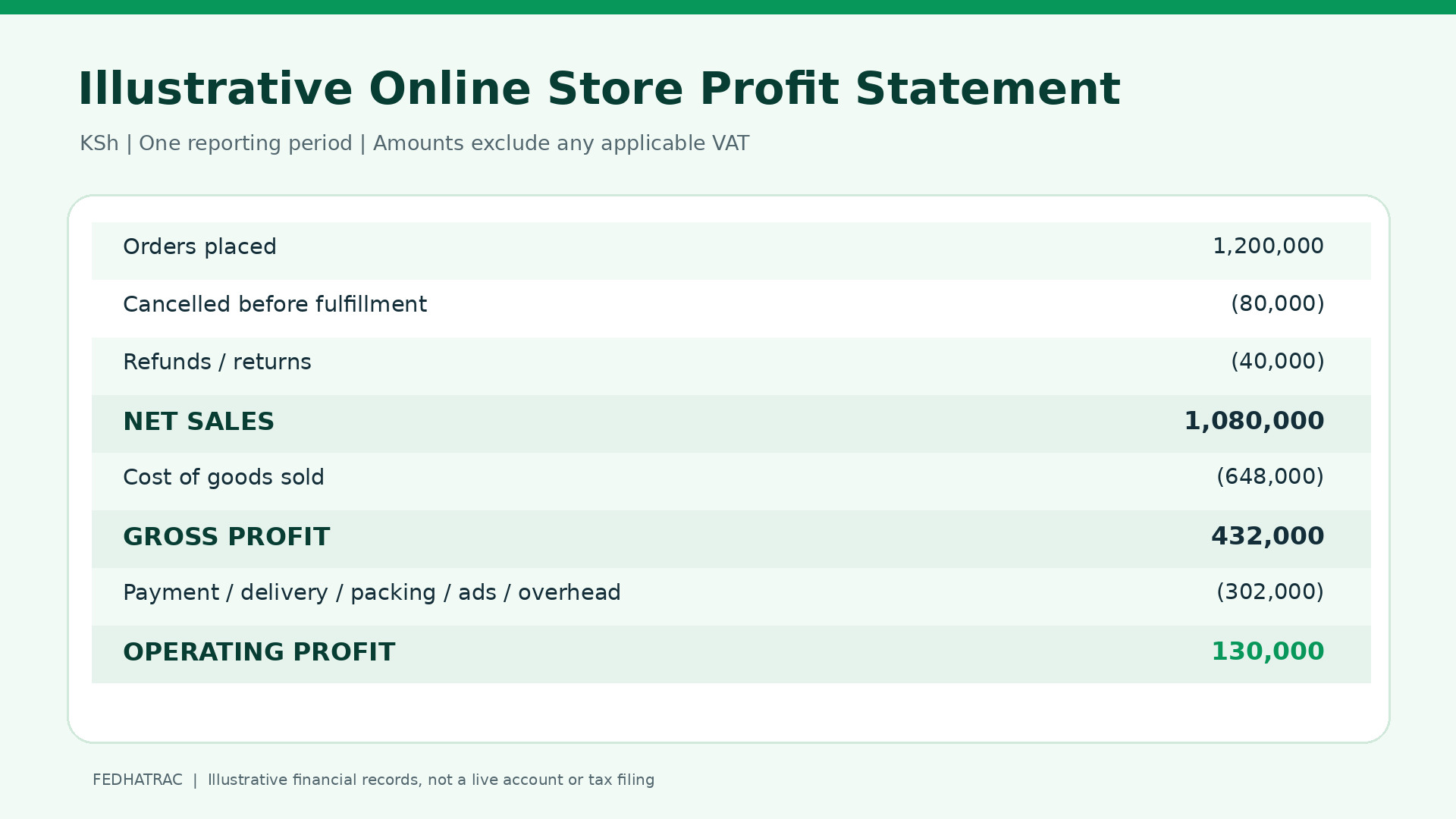
Illustrative online store operating profit statement in Kenyan shillings
Cash Flow Is Not the Same as Online Store Profit
A profitable month does not guarantee enough money to buy the next consignment. The business may have outstanding customer balances, stock paid for in advance, supplier debts, and marketplace funds that have not yet settled. Equally, a cash-rich week can reflect a loan, an owner’s contribution, or a transfer from another account rather than new sales. We help merchants look at cash movement alongside receivables, payables, and inventory commitments. That wider view makes e-commerce accounting in Kenya useful for decisions about restocking, promotions, and growth.
Our financial reporting and advisory support can include management accounts, cash-flow analysis, budgets, and forecasts where agreed. Instead of reacting only to the latest wallet balance, a merchant can ask whether expected collections will cover freight, suppliers, wages, and advertising. We can also support periodic financial review meetings that translate reports into practical business decisions without promising a particular profit result.
KRA eTIMS and Stock Record Responsibilities
Online selling does not remove a business’s obligation to assess its Kenyan tax and invoicing responsibilities. The Kenya Revenue Authority’s eTIMS guidance explains electronic invoicing obligations for persons conducting business, including many businesses not registered for VAT, subject to the applicable exceptions. The business must assess its own registration, tax type, invoicing, and record requirements; whether VAT applies is not decided simply by selling on Instagram or receiving M-Pesa payments.
KRA has also emphasized accurate and current stock records in connection with electronic invoicing stock management. We help organize purchase invoices, sales records, reconciliation schedules, and supporting documents for tax review and filing support. In e-commerce accounting in Kenya, reliable records make it easier to explain how inventory and recorded sales relate; they do not by themselves prove that an external POS, payment gateway, or website is certified or directly connected to eTIMS.
Our tax filing and compliance support can help a business review the documents needed for applicable filings, including VAT, income tax, and other obligations relevant to its circumstances. The right treatment depends on the business’s facts and current law. We do not describe ordinary bookkeeping as an automatic submission to KRA, and we encourage merchants to verify their current obligations with official guidance rather than relying on a generalized social-media checklist.
What Merchants Can See Through FedhaTrac
Our FedhaTrac dashboard gives clients visibility into recorded money in and out, bookkeeping status, movements, and financial information. The platform also includes sales, products and stock, supplier, and purchasing workspaces, subject to the functions and processes agreed for the client’s setup. We combine that visibility with a team that helps collect, organize, reconcile, and interpret the records. This is the advantage of service-backed e-commerce accounting in Kenya: merchants are not expected to become accountants to understand where their business stands.
If a client already uses a POS or online store, we can review exports and supporting reports as part of the agreed service. We do not promise direct APIs, automated settlement matching, or instant marketplace synchronization without validating the particular system. Where merchants require assistance with existing QuickBooks accounts, we can discuss appropriate support as well. The essential objective remains consistent records and understandable decisions, whichever approved workflow provides the evidence.
Which Online Businesses Benefit Most?
We work with businesses at different stages, from a founder handling social-media orders to a merchant managing several stock locations or selling wholesale and retail. Fashion sellers need clear variant and return records; electronics shops need unit cost and warranty-related documentation; beauty retailers need purchase batches and fulfillment records; subscription sellers need careful treatment of what has been billed versus collected. For all of them, e-commerce accounting in Kenya should fit the actual sales journey rather than force unrelated businesses into a single template.
Start with order IDs, receipts, labeled collections, and a regular review rather than waiting for hundreds of orders. If records are behind, we can discuss catch-up bookkeeping using available documents, while highlighting gaps that need client clarification.
How Our E-Commerce Accounting Engagement Works
Understand the Sales Channels
We begin by learning which channels generate orders, who receives payments, how parcels are delivered, where inventory is held, and how refunds are authorized. We identify the people and reports needed for bookkeeping and agree on priorities. A seller with a single M-Pesa till may need a simpler process than a marketplace merchant working with card settlements and several couriers. Scoping the work this way keeps e-commerce accounting in Kenya relevant to actual operations.
Organize, Reconcile, and Review
We categorize transactions, match receipts to orders, review suppliers, and reconcile payment accounts before preparing agreed reports. Missing invoices, inconsistent stock counts, and unidentified deposits are flagged for the business owner. That review strengthens e-commerce accounting in Kenya. A monthly close must support decisions, not just look tidy.
Use Reports to Make Better Decisions
A practical review can compare sales channels, gross margins, delivery and advertising costs, refunds, and available cash. If the data supports it, we can help identify which categories deserve restocking, which costs need attention, and where the order process may be losing money. Our role is to improve financial clarity and provide useful advice; commercial decisions remain with the client. That is the business value we seek to deliver through e-commerce accounting in Kenya.
Frequently Asked Questions
Do I Need E-Commerce Accounting in Kenya if I Sell Only on WhatsApp?
Yes, selling through messages still creates orders, customer receipts, expenses, and potentially tax and inventory obligations. We can help establish a practical record using order references, payment statements, purchase evidence, and delivery information. E-commerce accounting in Kenya does not require a sophisticated website; it requires accurate information about the business that exists.
Can FedhaTrac Work With My Existing Website or POS?
We can work with suitable reports and exports from a client’s existing systems under an agreed process, and we can discuss our own POS offering where appropriate. We first confirm what data the system provides and what support is required. We will not claim that a particular website, marketplace, payment provider, or POS automatically integrates with our platform unless that connection has been verified.
How Are M-Pesa Payments and Customer Refunds Handled?
We review the payment evidence against the relevant order, classify fees and transfers correctly, and retain supporting details for reversals or refunds. A refund is not a reason to erase the original transaction without a trace. For e-commerce accounting in Kenya, a complete history helps the merchant see gross sales, returned sales, actual collections, and outstanding balances separately.
Does FedhaTrac Help With eTIMS and Tax Filings?
Yes. Our published tax filing and compliance service supports preparation and filing processes appropriate to a client’s obligations, along with related records and eTIMS documentation. We assess the required work against current KRA guidance and the client’s actual situation. We do not promise automatic tax compliance merely because sales and payments appear in a dashboard.
When Should an Online Seller Contact FedhaTrac?
Contact us when order totals do not match receipts, marketplace settlements are confusing, inventory figures are unreliable, or your business is expanding beyond an informal cashbook. Earlier support can help prevent repeated errors; catch-up support can address existing gaps where documents are available. Professional e-commerce accounting in Kenya becomes more valuable as more people, channels, and product categories are involved.
Put Your Online Business Numbers to Work
Your next milestone should not be based only on the number of orders appearing on a phone screen. It should be supported by reliable sales records, reconciled payments, sensible expense categories, accurate inventory information, and understandable reports. At FedhaTrac, we bring practical bookkeeping, accounting, business operations support, financial reporting, and Kenyan tax documentation together for merchants who need better financial control. Our approach to e-commerce accounting in Kenya is built around the evidence your business already generates and the decisions you need to make next.
Talk to FedhaTrac about your online store, current reporting challenges, and the support your team needs. We can discuss an appropriate bookkeeping and accounting arrangement that helps you track what matters while you focus on serving customers and growing the business responsibly.


