
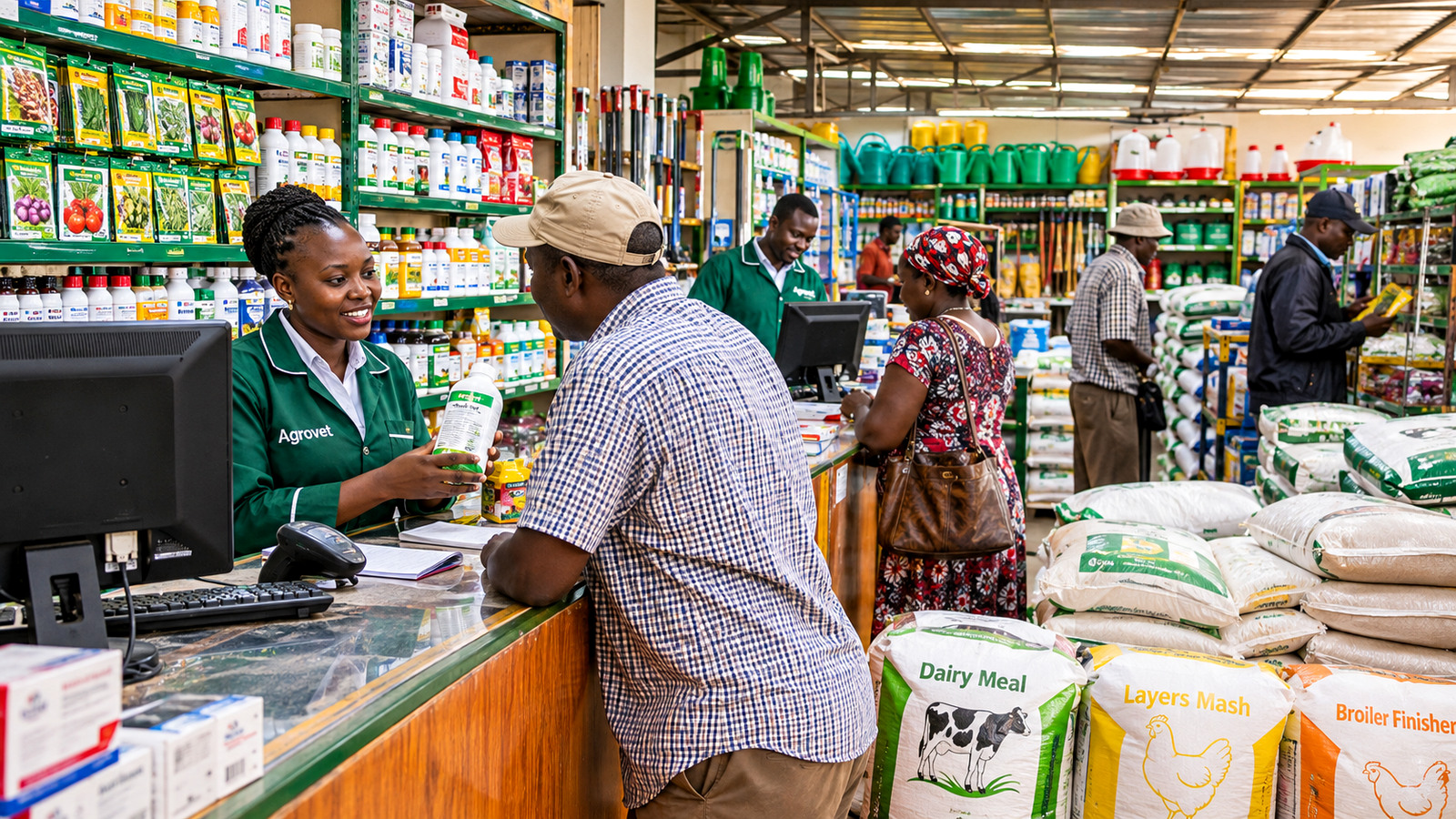
Agrovet shop accounting in Kenya is easier to manage when every sale, supplier invoice, customer balance and operating expense leads to a reliable financial record. A shop may serve dairy farmers at dawn, sell vegetable seeds before lunch and receive a delivery of animal feeds in the afternoon. The products are varied, but the financial question stays the same: what was sold, what did it cost, what has been paid and what is still owed?
FedhaTrac already provides outsourced bookkeeping, accounting, reconciliations, reporting and tax-compliance support to Kenyan businesses. Those services fit an agrovet business that wants stronger daily controls without hiring an entire finance department. Think of GreenFields Agrovet & Farm Supplies in Nakuru as an illustrative shop: its employees handle customers and physical stock, while FedhaTrac’s professional finance workflow turns the resulting records into useful numbers. GreenFields is an example, not a claim about an existing customer relationship.
Why Agrovet Shop Accounting in Kenya Needs a Dedicated Financial Routine
For agrovet shop accounting in Kenya, an agrovet combines several activities that should not disappear into a single “daily sales” number. Bags of dairy meal may sell in high volumes at modest margins; veterinary supplies may require careful product-level documentation; and seed demand changes with planting seasons. A farmer may pay through M-Pesa, a cooperative may request an invoice, and a supplier may deliver goods on credit. Bookkeeping must preserve these distinctions while keeping the owner’s view simple.
FedhaTrac’s bookkeeping services cover transaction classification, record organization and account reconciliations. Its accounting services turn those records into financial reports. For agrovet shop accounting in Kenya, that combination matters because a busy counter is not the same thing as a profitable business. The following nine areas show how the services operate in practice.
1. FedhaTrac Organizes Sales From Every Agrovet Counter
The first job in agrovet shop accounting in Kenya is to capture revenue consistently. At GreenFields, staff can identify sales of feeds, seeds, fertilizers, equipment and other merchandise in their existing till, POS or sales register. They provide the agreed sales summaries, invoices, receipts and supporting records to FedhaTrac. Its bookkeeping team then posts and reviews the transactions according to an agreed chart of accounts.
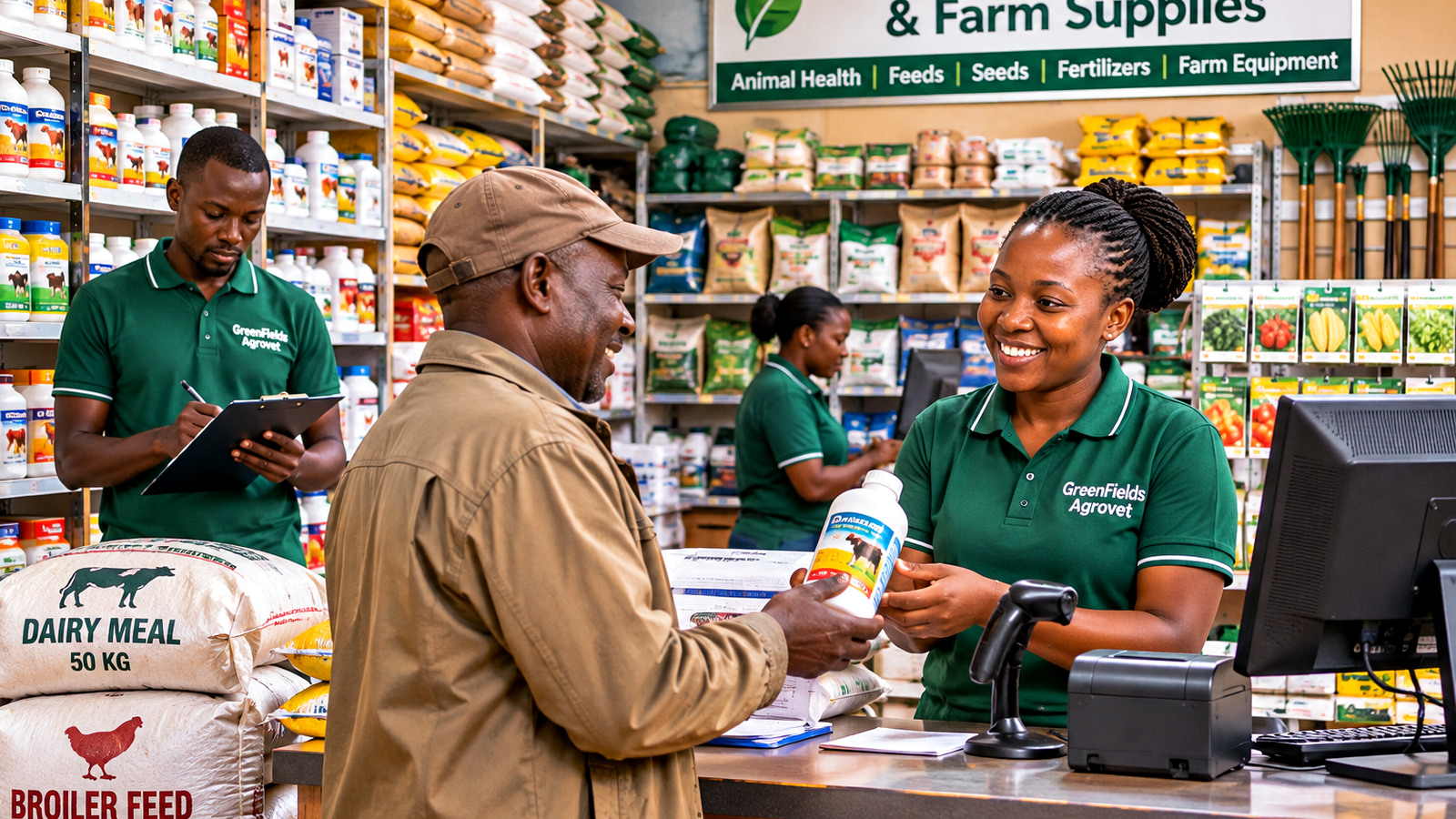
GreenFields agrovet salesperson serves a customer and records a farm supply purchase in Kenya.
Separating product lines gives the owner a more meaningful picture than one combined sales total. It can reveal that animal feeds contribute most of the revenue while a different category earns a stronger gross margin. A genuine category margin calculation also needs dependable product costs; sales records alone cannot answer that question. FedhaTrac can use the shop’s documented stock and purchase information to prepare cost and margin reports as part of the agreed engagement.
The result is a consistent trail from a customer transaction to the monthly financial statements. That is what makes agrovet shop accounting in Kenya actionable: the shop continues selling, while its financial records remain reviewable rather than being reconstructed from memory.
2. Cash, M-Pesa and Bank Payments Are Reconciled
In agrovet shop accounting in Kenya, one receipt can be paid in several ways, and a till total is not a bank statement. FedhaTrac supports reconciliations by matching recorded sales and receipts against M-Pesa statements, bank deposits and other available payment records. Missing transaction references, deposits recorded twice and payments posted to the wrong customer can then be investigated with the shop team.
For example, a cashier may record KSh 24,000 of M-Pesa sales while the statement shows KSh 23,500 associated with those orders. The KSh 500 difference requires checking; it should not automatically be labeled theft, a fee or a loss. The amount might reflect timing, a refund, a missing receipt or an entry mistake. Agrovet shop accounting in Kenya improves when such differences become specific questions supported by evidence.
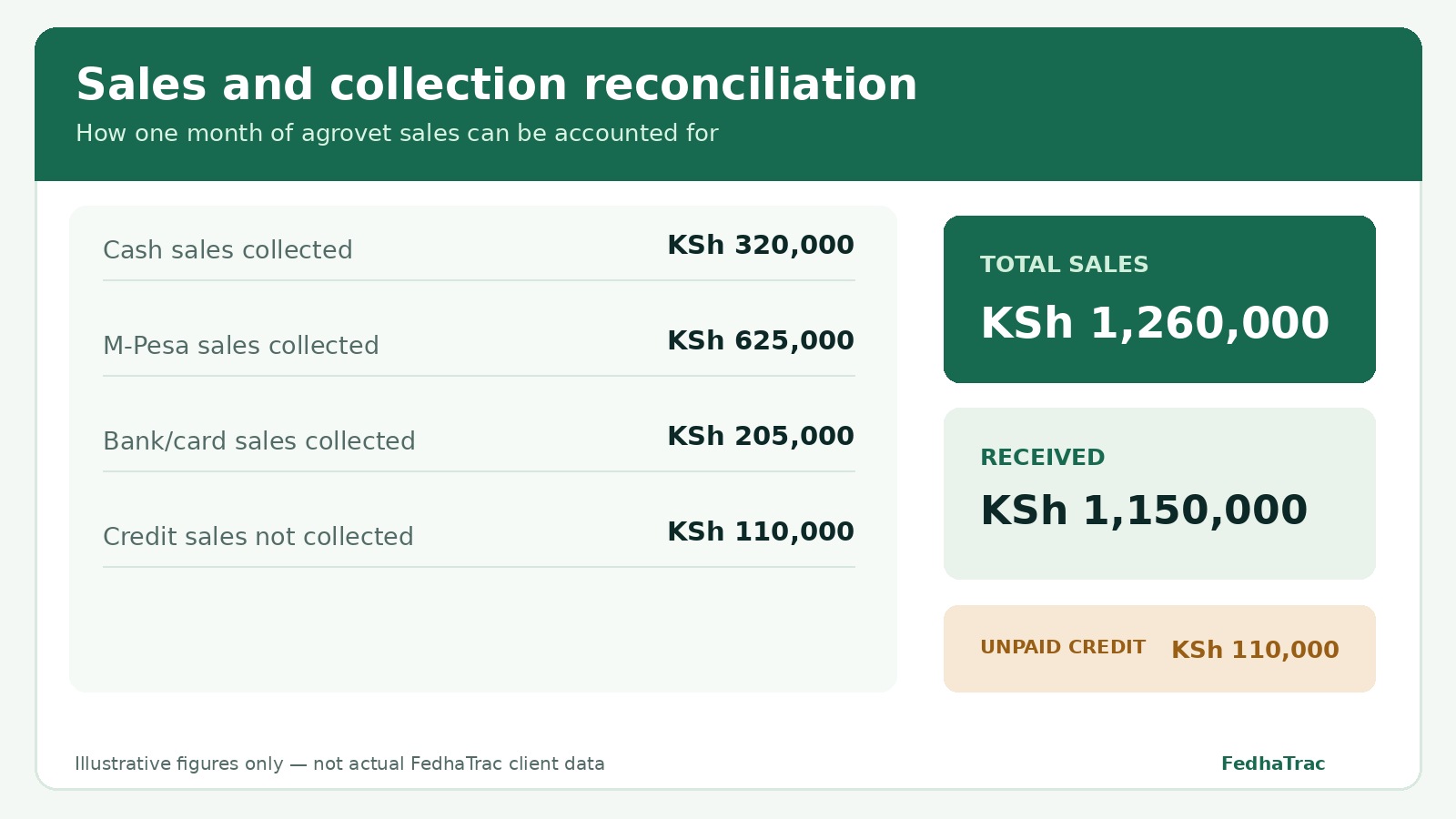
Sample agrovet shop accounting in Kenya sales reconciliation for cash, M-Pesa, bank and credit sales.
FedhaTrac’s published business features include sales and payment records, reconciliation and reporting. Connection and import options depend on the chosen workflow; an agrovet should confirm the payment integrations required before implementation.
3. Supplier Bills, Purchases and Credit Terms Stay Visible
For agrovet shop accounting in Kenya, retailers purchase from feed manufacturers, seed distributors, wholesalers and other suppliers. A business can be short of cash even when shelves are full if several large supplier invoices fall due in the same week. FedhaTrac’s bookkeeping and expense-management services help classify purchases, organize supporting supplier invoices, maintain vendor balances and track payable amounts.
For GreenFields, the purchase file can show the supplier name, delivery reference, date, products, invoice amount, credit terms and payment history. The store manager still checks quantities and product condition when goods arrive. FedhaTrac works from the verified purchase and receiving records; it does not replace that physical receiving control.
Agrovet shop accounting in Kenya benefits from an agreed payables review each week. The shop can decide which undisputed bills are due, which deliveries need clarification and which purchases must wait until collections improve. When the records are current, supplier discussions can be based on facts rather than an assortment of phone messages and loose receipts.
4. Farmer Credit and Cooperative Balances Are Tracked
Agrovet shop accounting in Kenya also covers approved customer short-term credit. That is a business policy decision, not an automatic entitlement, and the shop should document who may buy on account. FedhaTrac can maintain customer ledgers, record invoices and receipts, and prepare outstanding-balance schedules for the shop’s review.
Imagine a dairy farmer purchasing KSh 18,000 of feed on approved credit and later paying KSh 12,000. The remaining KSh 6,000 should appear in the customer’s balance, with the invoice and payment reference available for checking. A monthly aged-debtors report can help the owner distinguish new balances from overdue accounts. Any reminder or credit restriction is approved and handled under the shop’s own customer policy.
Reliable agrovet shop accounting in Kenya separates a sale from a collection. An invoice may contribute to revenue under the applicable accounting basis before the cash arrives. FedhaTrac’s receivables records help owners see the gap, while its financial reports show why sales growth does not always produce cash for the next supplier order.
5. Stock Costs and Physical Inventory Records Are Reconciled
In agrovet shop accounting in Kenya, feeds, seeds and veterinary products can tie up substantial working capital. FedhaTrac’s accounting team can reconcile stock-value schedules, purchase totals and cost-of-goods-sold calculations when the shop provides reliable opening balances, receipts, sales quantities and physical-count results. This supports financial inventory reporting; it is not a promise that FedhaTrac automatically scans batches or tracks product expiry in a specialist agrovet POS.

Agrovet staff compare delivery notes and count animal feed sacks in a Kenyan stockroom.
Suppose GreenFields starts a month with KSh 460,000 of inventory at cost, records KSh 950,000 in purchases and counts KSh 570,000 of closing stock at cost. On that illustrative basis, cost of goods sold is KSh 840,000: opening stock plus purchases minus closing stock. If the physical count differs from the stock ledger, the owner must investigate returns, damaged goods, timing and recording errors before approving an adjustment.
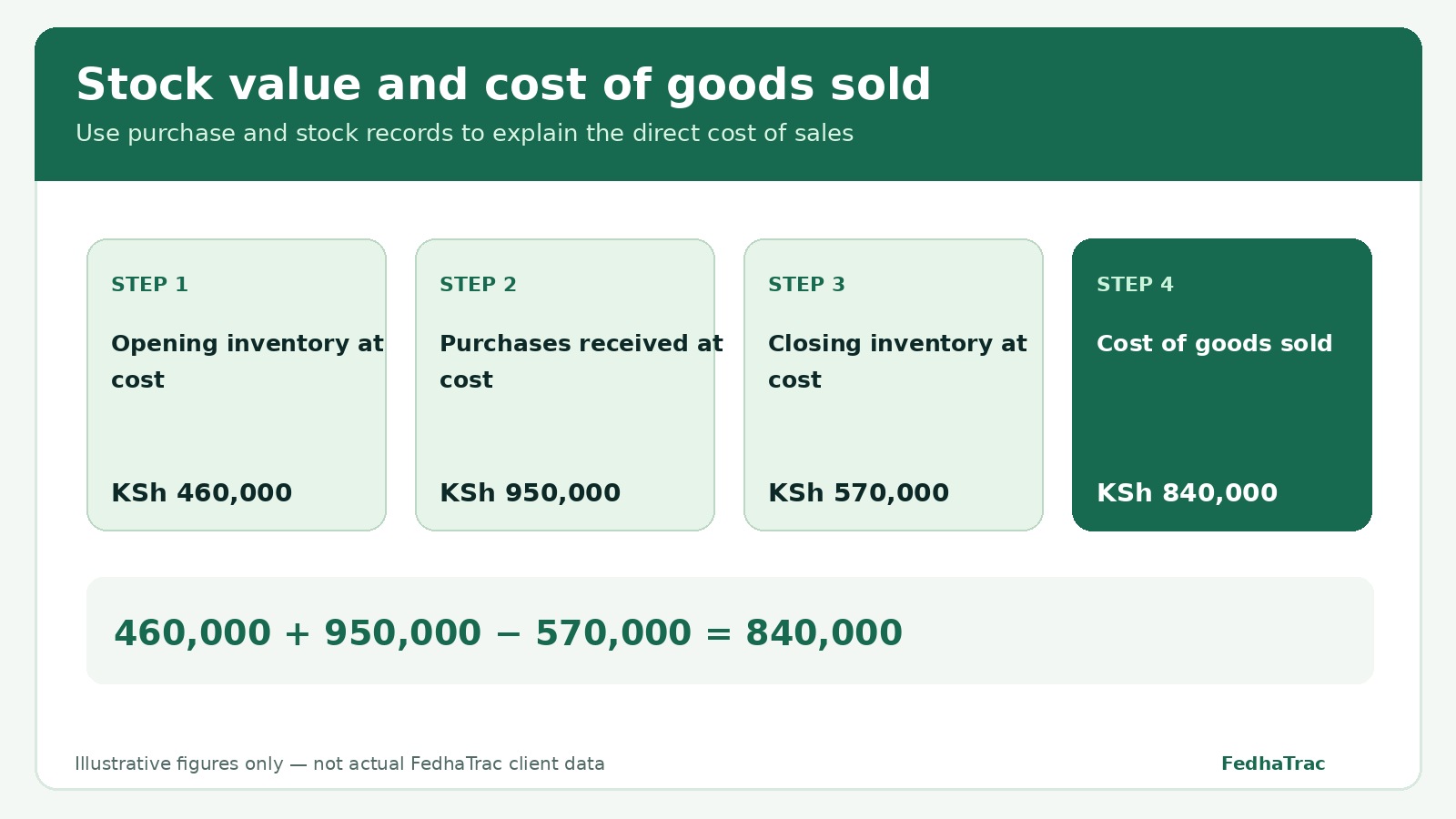
Sample cost of goods sold worksheet for a Kenyan agrovet showing stock and purchase reconciliation.
That discipline improves agrovet shop accounting in Kenya because it connects purchases to the cost of actual sales. Physical batch numbers, expiry dates, storage requirements and regulated product controls remain responsibilities of the shop and its appropriate inventory or compliance systems. FedhaTrac can account for verified write-offs and adjustments when properly documented.
6. Every Operating Expense Has a Proper Category
Agrovet shop accounting in Kenya includes money spent beyond the goods sold: rent, staff costs, electricity, deliveries, security, packaging, repairs and communication bills. FedhaTrac offers expense tracking and categorization so that these payments are not hidden inside a single “miscellaneous” line. Documents such as supplier receipts, payroll summaries and payment confirmations support the entries.
A delivery payment that carries animal feed from a supplier should be classified according to the agreed accounting policy, rather than casually mixed with marketing expenditure or a personal withdrawal. The owner also needs a clear distinction between business spending and money taken out for private use. With clean categories, agrovet shop accounting in Kenya can show which operating costs are rising and whether they are proportionate to sales.
The shop still approves purchases and provides valid records. FedhaTrac handles the financial processing, reconciliation and agreed review. This separation of duties helps people ask better questions without implying that bookkeeping alone prevents every unauthorized expense.
7. Cash-Flow Planning Reflects Planting and Livestock Seasons
With agrovet shop accounting in Kenya, a business may have strong sales during planting season and slower collections in the following weeks. Feed demand may follow a different pattern from seed demand. FedhaTrac’s financial reporting and advisory services support cash-flow analysis and management reports so owners can compare upcoming obligations with expected receipts.
For GreenFields, that means examining the next supplier payment, rent date, payroll commitment and likely collections before placing another large order. If KSh 110,000 of the month’s sales is still unpaid, it should not be counted as money already in the bank. A forecast can show a best-supported expected collection date, while maintaining a cautious scenario if customers pay late.
Good agrovet shop accounting in Kenya links the forecast to actual ledgers. FedhaTrac can assist with the financial view and highlight pressures; the proprietor decides how much to buy, which supplier terms to negotiate and when to expand product lines. A forecast is a planning tool, not a guaranteed prediction.
8. Owners Receive Profit, Expense and Balance Reports
FedhaTrac’s dashboard and reporting services give a business access to structured financial information, including profit-and-loss and cash-flow insights. Instead of judging performance by how full the cash drawer feels, GreenFields’ owner can review documented sales, direct costs, expenses, customer balances and supplier obligations.
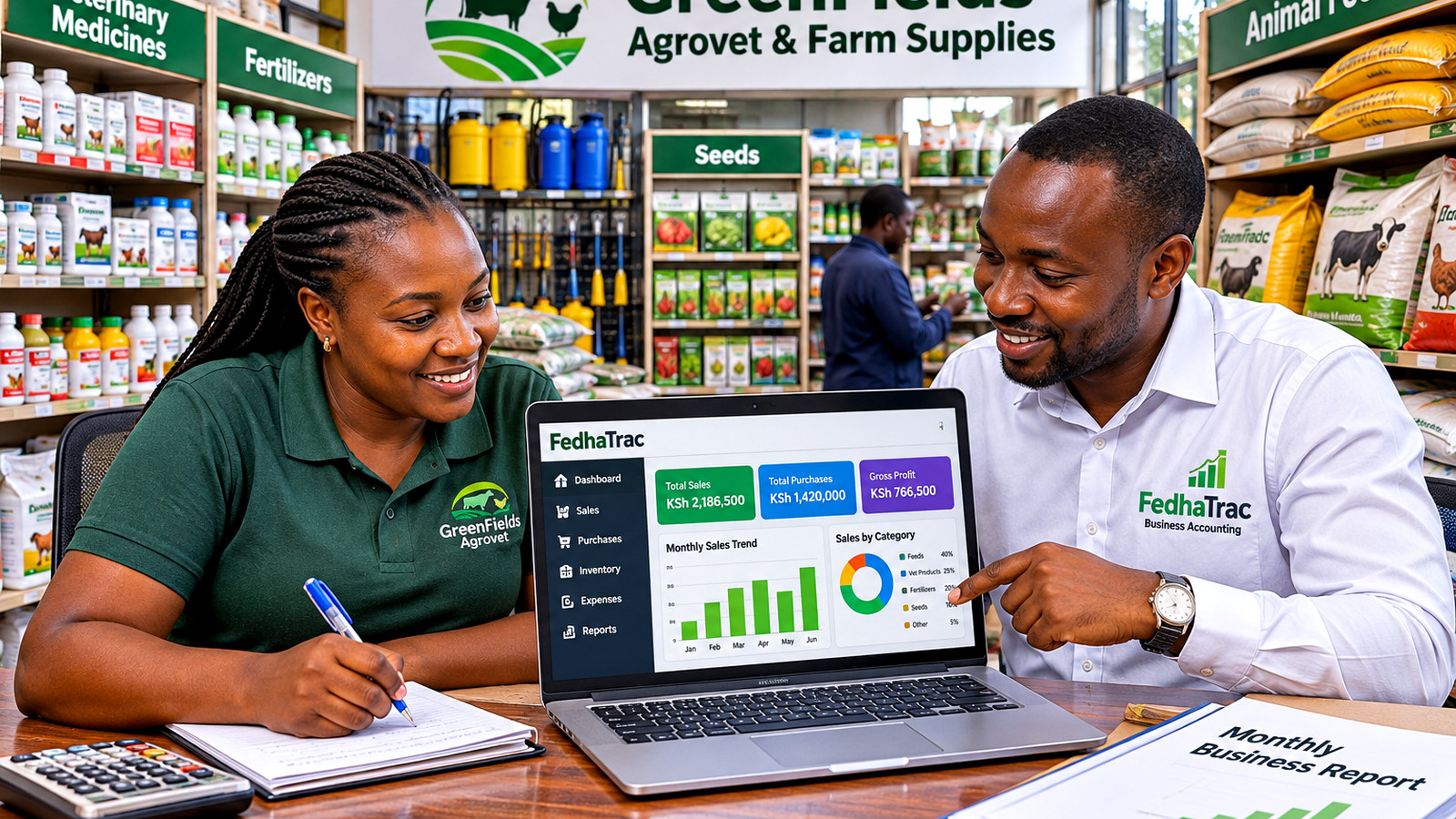
Agrovet manager reviews financial reports with an accounting professional at the farm supply shop.
The most useful agrovet shop accounting in Kenya report is one the owner can act on. A fall in feed margins may prompt a review of purchase costs and selling prices. An increase in overdue receivables may call for a tighter credit policy. Higher delivery expenses may suggest combining supplier orders. Such decisions should be based on reconciled data and realistic business context, not one unusual day’s sales.
FedhaTrac also works with existing accounting environments such as Excel-based records, QuickBooks and other agreed systems. The shop does not automatically need to abandon its current till or stock program to receive outsourced bookkeeping support. The exact data-sharing and reporting arrangements should be agreed at onboarding.
9. Tax Records and eTIMS Support Are Prepared Properly
Agrovet shop accounting in Kenya requires dependable sales and purchase documents for the tax obligations that apply to their individual businesses. FedhaTrac offers tax filing and compliance support, including eTIMS assistance and record preparation. The Kenya Revenue Authority’s eTIMS guidance explains the electronic invoicing framework for persons carrying on business, including those outside VAT registration, subject to applicable rules and exceptions.
An agrovet selling several categories must not assume that every item has the same VAT treatment. KRA distinguishes standard-rated, zero-rated and exempt supplies in its VAT guidance. The current treatment of each product should be checked against the law, the product’s classification and the business’s tax position. This article does not assign tax rates to individual feeds, seeds, veterinary products or fertilizers.
For agrovet shop accounting in Kenya, FedhaTrac can organize the purchase and sales evidence, identify missing support and assist with the agreed filings. The owner remains responsible for supplying accurate information, making commercial decisions and confirming the scope of professional support.
What a Clear Agrovet Month Looks Like on Paper
A useful illustration of agrovet shop accounting in Kenya is a management snapshot that separates sales collection, stock cost and expenses. The figures below are hypothetical, exclude any assumption about VAT treatment and do not describe GreenFields’ actual trading results.
| Illustrative monthly measure | Amount (KSh) |
| Cash sales collected | 320,000 |
| M-Pesa sales collected | 625,000 |
| Bank/card sales collected | 205,000 |
| Credit sales not yet collected | 110,000 |
| Total sales | 1,260,000 |
| Cost of goods sold | (840,000) |
| Gross profit | 420,000 |
| Operating expenses | (265,000) |
| Illustrative profit before tax | 155,000 |
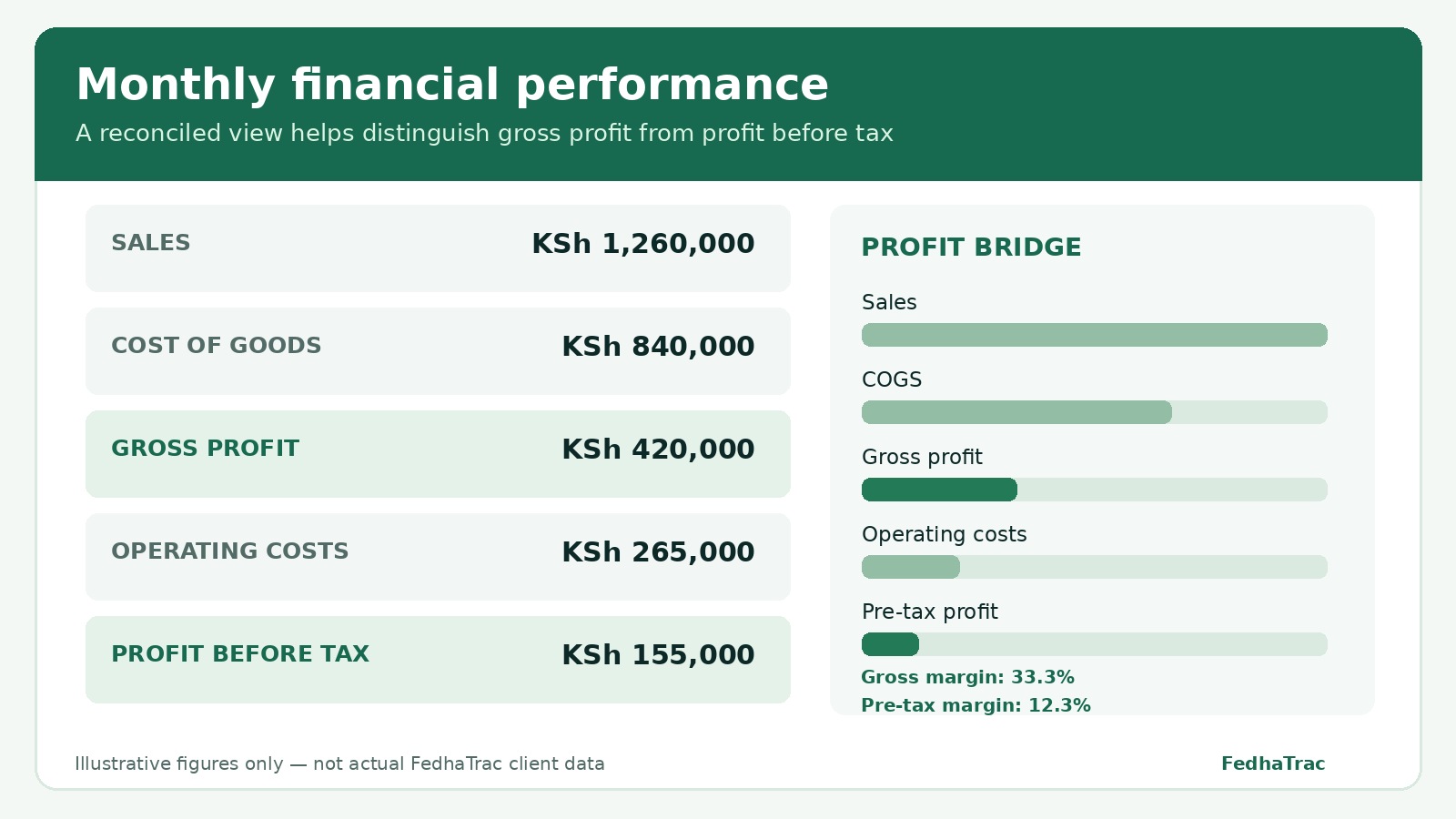
Illustrative Kenyan agrovet profit and loss dashboard showing sales, costs and profit before tax.
In this example, KSh 1,150,000 has been collected against the month’s sales and KSh 110,000 remains outstanding. Gross profit is KSh 1,260,000 less KSh 840,000. The KSh 155,000 profit before tax is the KSh 420,000 gross profit less KSh 265,000 in operating expenses. Opening stock of KSh 460,000 plus KSh 950,000 of purchases minus KSh 570,000 of closing stock explains the KSh 840,000 cost of goods sold. No figure should be presented as an actual FedhaTrac client result.
This is the value of agrovet shop accounting in Kenya: the business can distinguish what it sold from what it collected, what stock cost from what it purchased, and accounting profit from cash available for tomorrow’s bills.
How an Agrovet Works With FedhaTrac Each Week
The starting point is a consultation and an agreed scope. GreenFields, or another agrovet operating in a similar way, would designate people to share daily sales reports, payment statements, purchase invoices, approved credit records and stock count summaries. FedhaTrac’s team reviews and records transactions, asks for clarification where needed, and reconciles the relevant accounts. The shop remains responsible for physical stock, product compliance and approvals.
At the end of each week, the owner can review unpaid customers, bills approaching their due dates, unexplained settlement differences and missing documents. At month-end, reconciled records support a profit-and-loss statement, a balance overview and agreed performance reporting. The FedhaTrac bookkeeping process is designed around those practical responsibilities rather than asking the owner to become a full-time accountant.
Agrovet shop accounting in Kenya works best when responsibilities are explicit. The shop supplies honest source data and answers operational questions; FedhaTrac supplies the agreed finance support and visibility. That arrangement helps the owner spend more time serving farmers and less time rebuilding records after a deadline has passed.
Frequently Asked Questions About Agrovet Shop Accounting in Kenya
Can FedhaTrac work with an agrovet that already uses a POS?
Yes. FedhaTrac publicly describes support for businesses using their existing bookkeeping and accounting systems. The shop can agree how POS summaries, stock reports and payment records will be exported or shared; compatibility and any required integration should be confirmed before onboarding. Agrovet shop accounting in Kenya does not require promising an unverified automatic POS connection.
Does FedhaTrac track medicine expiry dates and stock batches automatically?
FedhaTrac’s verified services cover accounting, records and financial reporting. The agrovet should use its physical controls and suitable inventory software for batch and expiry monitoring. FedhaTrac can reflect documented stock adjustments in the books under the agreed workflow.
Can FedhaTrac help with M-Pesa and farmer credit?
Yes. FedhaTrac describes mobile-money reconciliation, sales records and customer balances among its business finance services. The shop must provide statement access or exports, customer invoices and evidence of receipts so the balances can be checked.
Can one accountant manage an agrovet’s entire tax position?
The answer depends on the agreed engagement and the shop’s obligations. FedhaTrac offers tax preparation and filing support, but product-specific tax classification, registration status and regulated activities require the appropriate evidence and professional review. Agrovet shop accounting in Kenya should never treat all products as one tax category by default.
How does a shop get started with FedhaTrac?
The business can contact FedhaTrac to discuss transaction volumes, payment channels, current records, supplier accounts and reporting needs. FedhaTrac can then propose the appropriate bookkeeping and reporting scope. A realistic setup begins with documents, responsibilities and a monthly review rhythm—not an unsupported guarantee of instant integration.
Build a Stronger Agrovet Finance Routine With FedhaTrac
An agrovet serves farmers best when its people can focus on getting the right products to customers, while the accounting behind the business stays current. FedhaTrac already offers the bookkeeping, reconciliation, reporting and tax-support services that make this possible. In agrovet shop accounting in Kenya, those services connect the sales counter, supplier invoices, credit accounts, operating expenses and financial statements into one understandable picture.
If your shop needs reliable records without expanding its internal finance team, explore FedhaTrac’s services or request a consultation. Better decisions begin with dependable numbers and a clear understanding of what the business really earns, owes and can afford.


