

A lodge can appear full over a holiday weekend yet produce disappointing monthly profit. A booking platform may retain commission, a canceled reservation may generate a refund, and kitchen, laundry and maintenance costs continue during quiet weekdays. Guesthouse financial reporting in Kenya connects room nights, other guest services and operating commitments so the owner can make better choices than simply chasing occupancy.
At FedhaTrac, we prepare management accounts, cash-flow analysis, financial reports and business reviews that help hospitality owners understand their numbers. We do not advertise a hotel property-management system, channel-manager integration or automated booking-engine capability. A lodge’s reception team supplies accurate booking and payment evidence; our financial support explains what those records mean.
Our fictional example, Mawingu Rest Lodge Ltd., is a small Kenyan property serving domestic visitors and occasional international guests. The article adds a revenue-management and advisory perspective rather than repeating general hotel bookkeeping. It distinguishes a confirmed stay, a guest deposit, an OTA settlement and the actual cash available for bills.
Begin with occupied room nights, not gross reservation clicks
An online reservation request is not always a completed stay. Some guests cancel, some postpone, others fail to arrive and a booking can span two accounting periods. If management uses all listed bookings as earned revenue, room performance and cash forecasts become misleading. The agreed cancellation rules and the applicable revenue-recognition policy determine the treatment of each event.

People reviewing operations and customer records for guesthouse financial reporting in Kenya
Prepare a nightly occupancy summary showing available rooms, rooms occupied, rate type, complimentary stays, cancellations and service dates. Reconcile the total to the front-desk folio and approved accounting entries. Use consistent room categories so a premium suite and a basic room do not disappear inside one unhelpful average. That discipline strengthens guesthouse financial reporting in Kenya.
Occupancy also needs a stable denominator. Guesthouse financial reporting in Kenya should distinguish rooms genuinely available for sale from rooms closed for maintenance and separately report complimentary or staff-use nights where relevant. Otherwise occupancy percentages change simply because different employees used different room counts. When the definition is documented, managers can compare seasons with more confidence and avoid celebrating a rate improvement caused by taking poor-quality rooms out of the denominator.
FedhaTrac helps convert approved operational summaries into revenue reports. Guesthouse financial reporting in Kenya should show what guests actually received, not only what the booking calendar once promised.
Separate guest deposits from revenue already earned
A guest may prepay an advance for a future weekend. That money may improve the bank balance now, but the lodge still owes accommodation or a valid refund under its terms. Treating all advances as current profit can lead management to spend cash needed to fulfill future bookings. Refundable security deposits can create an additional liability and should not be mixed with room income.
Photographed-style sample occupancy and stay revenue documentation
Maintain a deposit schedule by reservation reference, stay dates, amount paid, amount earned, approved cancellation charges and any balance owed. Review deposits against the booking list and bank statements monthly. If an advance covers several stays or a long corporate reservation, obtain a clear accounting assessment rather than applying an arbitrary recognition rule. That distinction matters for guesthouse financial reporting in Kenya.
Advance-payment reporting should be reviewed with the reservations team so the owner understands the work still owed to future guests. Guesthouse financial reporting in Kenya can identify balances refundable under booking terms and amounts to be recognized as stays occur. A deposit statement should reconcile to the bank while remaining separate from the earned-revenue schedule. That prevents a peak booking week from creating a false impression of permanently available cash.
Our bookkeeping and customer-statement support helps distinguish deferred or refundable balances from earned income. Good guesthouse financial reporting in Kenya should explain future service obligations as well as money currently held.
Reveal the real cost of online travel agents and payment fees
A booking site may charge commission, deduct fees before remittance or pay after a guest checks out. If the lodge records only the net settlement as room revenue, comparisons with direct bookings become unreliable. Some channels deliver valuable occupancy in low periods, but their cost must be evaluated against the actual contribution from each booked room night.

Kenyan business team reviewing approved records
Keep the guest folio amount, channel commission, platform charge, legitimate adjustment, remittance date and bank receipt together. Compare direct and third-party sales on a consistent basis and separate tax treatment from marketing analysis. When a settlement is late, carry an appropriate receivable rather than assuming the guest never stayed. Such evidence supports guesthouse financial reporting in Kenya.
Platform commissions and settlement differences should be compared at the reservation level before aggregating totals. Guesthouse financial reporting in Kenya can show that a channel with lower gross rates sometimes provides better off-peak contribution, while an apparently premium booking may carry high fees. The decision is commercial, not simply accounting: management can negotiate, improve its direct-booking experience or reserve certain room categories for more profitable demand when lawful and appropriate.
FedhaTrac can prepare channel-level revenue and cost reports using supplied booking records. Guesthouse financial reporting in Kenya is more useful when owners can test the net return of a channel before changing room prices.
Compare room revenue with food, tours and other services
Guests may purchase meals, laundry, conference use or transfers. Some services are included in the room rate while others should appear separately on the folio. If a breakfast package is counted once as room revenue and again as restaurant sales, management can overstate performance. Conversely, unrecorded complimentary meals conceal food costs that influence margin.
Photographed-style sample ota commission reconciliation records
Write clear package definitions and preserve approved guest folios, POS summaries, complimentary-service authorizations and department cost records. Use reasonable allocations for bundled packages according to policy. Show food, room and service margins separately where the operating data supports doing so rather than inventing precise numbers from a general supplier bill. These approvals underpin guesthouse financial reporting in Kenya.
Food and other extras deserve sensible portion and cost controls rather than an arbitrary allocation from the total grocery bill. Guesthouse financial reporting in Kenya can compare meal packages and stand-alone orders to approved kitchen costs without claiming to manage recipes or food safety. When a free breakfast promotion changes, the report should show the resulting room-rate and meal-cost effects together. That is more useful than judging restaurant sales in isolation.
Our financial reporting and POS-related records can support departmental summaries. Guesthouse financial reporting in Kenya works best when revenue lines explain the guest experience and the related cost of serving it.
Track utilities, housekeeping, repairs and room downtime
A room with a broken water heater is not necessarily available for sale, and a leaking tap increases operating cost even before a guest complains. Owners should know the financial effect of laundry, cleaning supplies, electricity, water, maintenance and equipment replacement. Average monthly costs alone can hide the price of repeated repairs or weak control over consumables.

Professional activity and financial decision-making at a Kenyan business
Maintain approved maintenance requests, supplier invoices, room-out-of-service dates and expenditure by property area. Compare cost per occupied room with sensible prior periods while recognizing seasonality and tariff changes. Separate repairs from capital improvements under the appropriate accounting policy and preserve invoices for insurance or financial review where needed. That schedule improves guesthouse financial reporting in Kenya.
Preventive maintenance decisions can be evaluated on both cash and guest impact. Guesthouse financial reporting in Kenya may reveal that repeated plumbing callouts cost more than one properly planned replacement, or that an unusable room loses high-season revenue. Keep authorization and work evidence for the financial file, but leave technical inspections to qualified professionals. The owner can then prioritize repairs based on risk, service quality and realistic affordability.
FedhaTrac can organize expense records, fixed-asset schedules and management analysis; we do not claim to repair equipment or inspect room safety. Guesthouse financial reporting in Kenya should signal when preventive maintenance protects both guest satisfaction and profit.
Connect staffing, supplier commitments and available cash
A small lodge needs reception cover, cleaners, security, kitchen staff and periodic external services. Some staffing costs remain fixed even in the low season. Supplier credit for food and linen can temporarily protect bank cash but create obligations payable next month. Management cannot safely declare a surplus by subtracting only cash payments from recent guest receipts.
Photographed-style sample cash and supplier forecast report
Use employer-approved staffing cost summaries, supplier statements, bank and M-Pesa reconciliations and a short rolling cash forecast. Show due dates for material bills and seasonal commitments. Review the cash effect of advance guest deposits separately from revenue and avoid claiming FedhaTrac runs payroll processing unless that service is explicitly verified. That review strengthens guesthouse financial reporting in Kenya.
A rolling cash forecast should include low-season supplier bills and staff obligations, not just expected weekend deposits. Guesthouse financial reporting in Kenya helps identify when current cash includes payments for future stays or when OTA balances have not yet settled. Managers can then decide whether to delay discretionary spending, adjust purchasing or negotiate legitimate payment terms. A plan that respects existing obligations is more useful than a headline bank balance.
Our accounting support and quarterly consultations help owners discuss financing and scheduling decisions with realistic cash information. Guesthouse financial reporting in Kenya puts the timing of obligations alongside operating performance.
Maintain licensing and tax evidence without confusing roles
Kenya’s Tourism Regulatory Authority oversees the licensing and regulation of relevant accommodation enterprises, while KRA provides electronic-invoicing guidance. The classification and specific permits applicable to a property depend on its activity and location. A financial consultant should not claim that tidy accounts automatically certify a property’s safety, hygiene or tourism compliance.
Keep license correspondence, approved tax records, guest billing evidence, supplier invoices and authorized refunds in organized but appropriately restricted files. Confirm the current license class and applicable local requirements directly with the competent bodies. Review invoicing and tax treatment for accommodation and other services according to the actual transaction rather than relying on general assumptions. The same safeguards support guesthouse financial reporting in Kenya.
A licensing checklist should identify who in the business confirms each requirement and the date it was last checked. Guesthouse financial reporting in Kenya can point to the relevant records needed for tax and financial review, but it is not a substitute for a tourism inspection or a legal interpretation of property classification. Storing the renewal evidence in an accessible, controlled folder reduces avoidable administrative risk without overstating the accountant’s authority.
FedhaTrac assists with financial documentation, tax compliance and reporting, while the lodge and relevant professional advisers retain operational and licensing duties. Guesthouse financial reporting in Kenya supports accountability without replacing a tourism regulator.
Use owner and board reviews to turn data into decisions
The best report answers a business question. Should the lodge advertise midweek packages, raise a seasonal rate, negotiate a lower booking commission or invest in a new water-heating system? Those decisions need occupied room nights, average realized rate, channel charges, room downtime, departmental contribution and cash availability on one consistent page.
Prepare a monthly scorecard with comparable periods and clearly stated definitions. Discuss trends at quarterly or annual meetings, record agreed actions and follow up with evidence. Avoid copying a large hotel’s indicators without considering the scale and seasonality of the property. One reliable occupancy measure is better than five conflicting occupancy percentages. Managers should expect this from guesthouse financial reporting in Kenya.
The twelve questions in a strong ownership review need not appear as twelve pages of graphs. Guesthouse financial reporting in Kenya can ask: how many nights were occupied; at what realized rate; through which channel; at what commission; with what service cost; with how much downtime; and with what cash left for obligations? Add receivables, deposits, supplier commitments, upcoming maintenance and the prior period comparison. A concise discussion of those answers is what turns reports into financial management.
FedhaTrac supports management reports, consultations and board-style presentations that can transform guesthouse financial reporting in Kenya into purposeful decisions. The goal is a stable property business, not merely a prettier dashboard.
A financial example: Mawingu Rest Lodge Ltd.
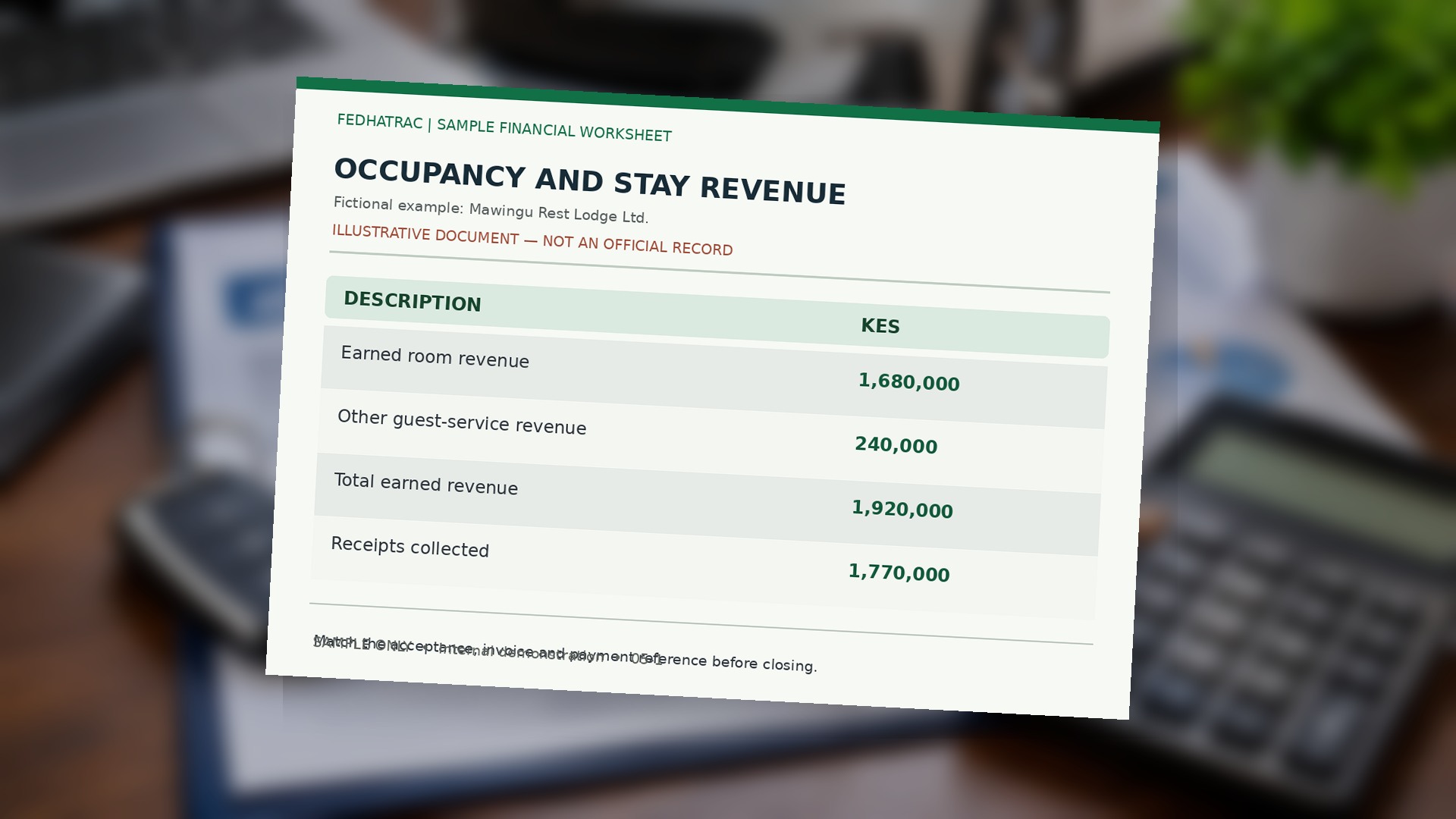
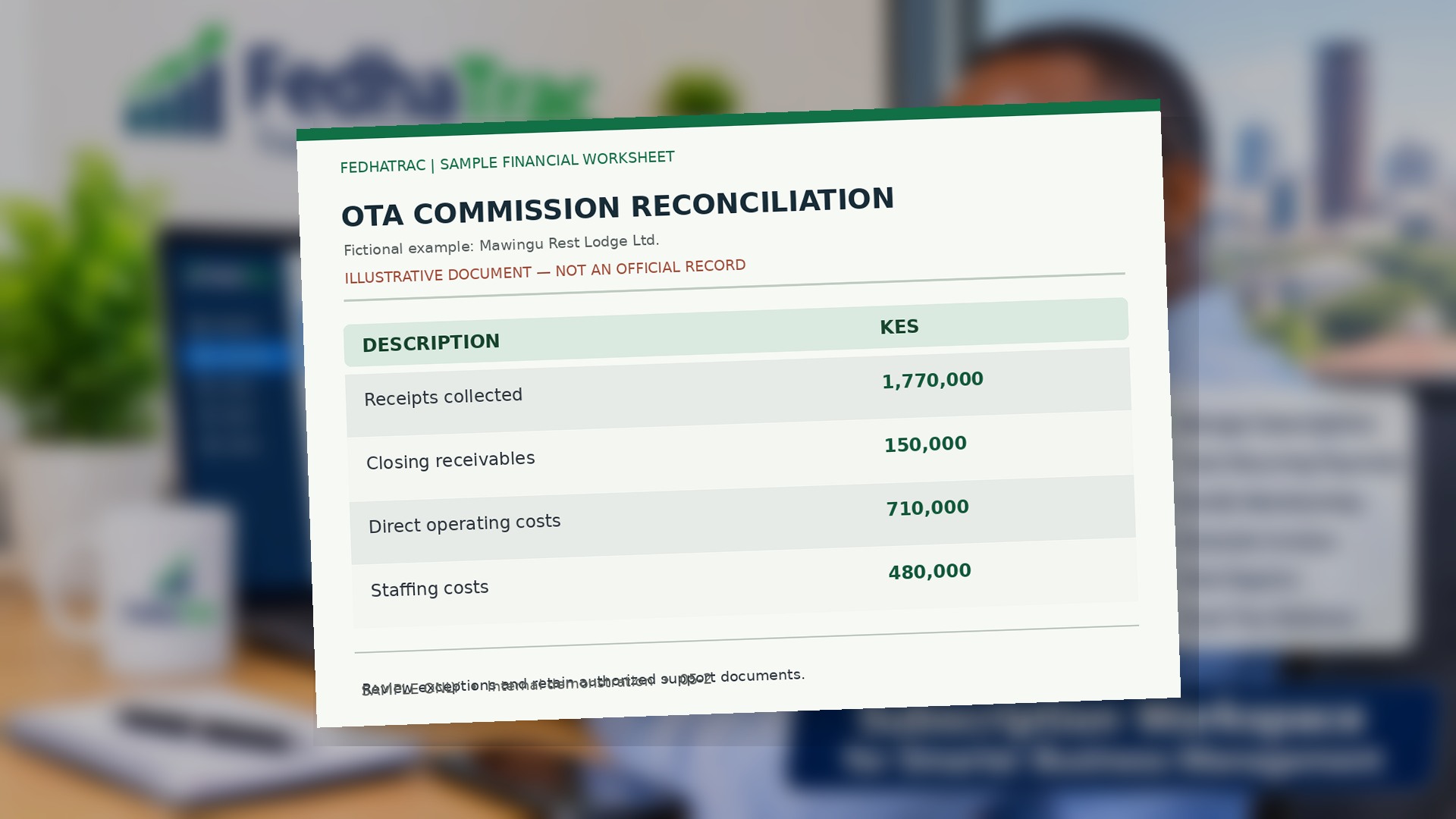
Mawingu Rest Lodge Ltd., a fictional guesthouse, reports KSh 1,680,000 in earned room revenue and KSh 240,000 in earned meals and guest services. Total revenue is KSh 1,920,000. It collected KSh 1,770,000 of that amount during the month, leaving KSh 150,000 in customer and channel receivables. Any unearned advance deposits would be tracked separately rather than automatically added to earned revenue.
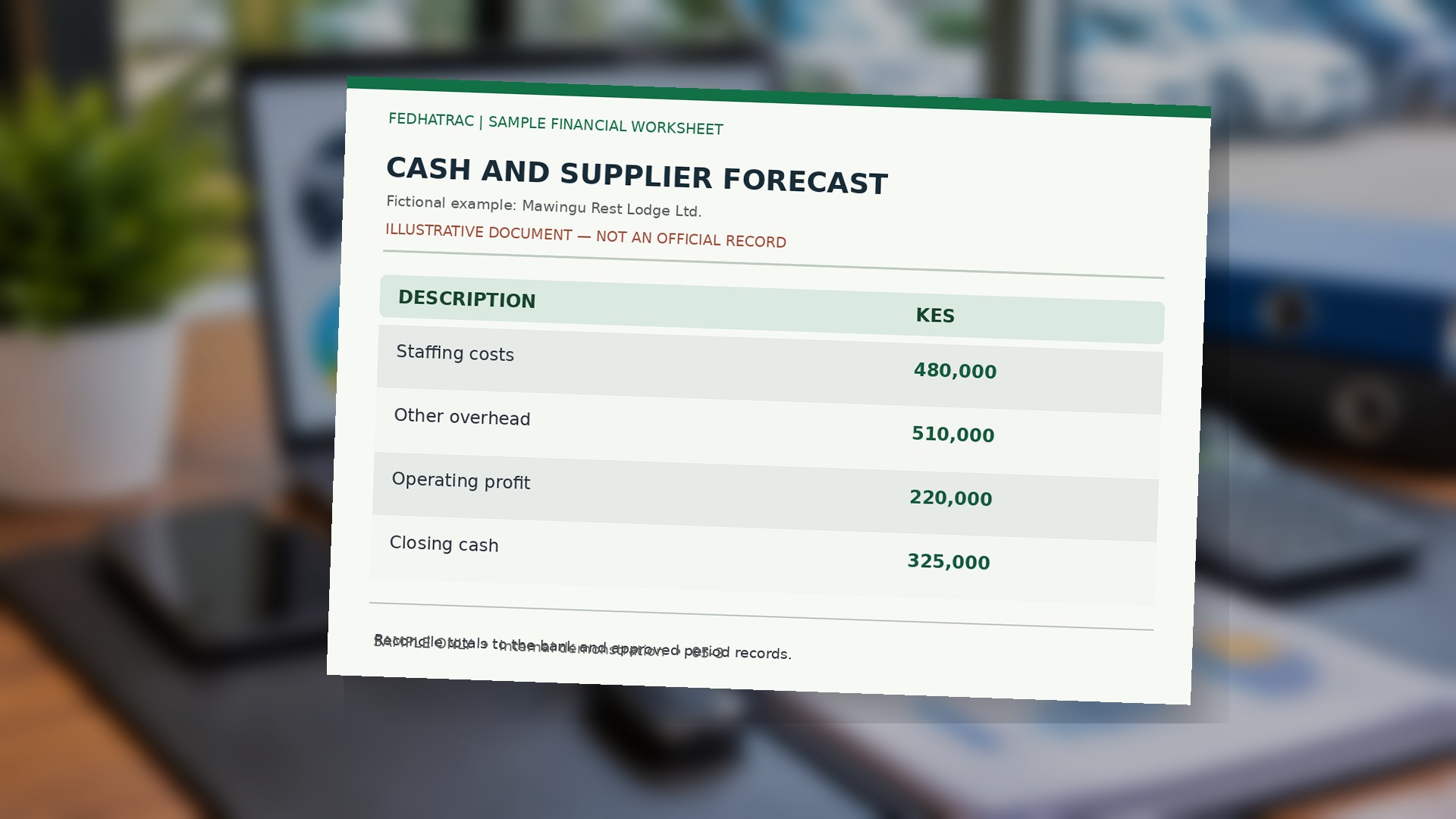
Direct accommodation and service costs were KSh 710,000, staffing costs KSh 480,000 and other overhead KSh 510,000, including KSh 60,000 in noncash depreciation. Operating profit was KSh 220,000. The fictional example assumes KSh 20,000 in direct operating costs remain unpaid and all staffing costs were paid during the month.
| Illustrative financial indicator | KES |
| Earned room revenue | 1,680,000 |
| Other guest-service revenue | 240,000 |
| Total earned revenue | 1,920,000 |
| Receipts collected | 1,770,000 |
| Closing receivables | 150,000 |
| Direct operating costs | 710,000 |
| Staffing costs | 480,000 |
| Other overhead | 510,000 |
| Operating profit | 220,000 |
| Closing cash | 325,000 |
Opening cash was KSh 175,000. Add guest and platform receipts of KSh 1,770,000 and subtract KSh 690,000 of paid direct costs, KSh 480,000 in staffing payments and KSh 450,000 in cash overhead. Closing cash is KSh 325,000. Management can see why KSh 220,000 profit and KSh 325,000 closing cash are not interchangeable figures.
At our review meeting we would compare channel costs, room downtime, pending receivables and cash needed for the quieter period. These assumptions are for illustration only and must not be presented as outcomes achieved for an actual FedhaTrac client.
Frequently asked questions
Does FedhaTrac provide an automated hotel reservation engine?
We provide financial reporting, invoices, reconciliations and advisory support. We do not promise an unverified hotel booking engine or automatic channel-manager integration. The property’s operational systems remain the source of approved reservation and folio records.
Can the business be profitable with low bank cash?
Yes. Customer receivables, supplier payment timing, capital spending and advance service obligations can make cash and operating profit differ. We help examine those bridges so the owner can plan bills without confusing booked revenue with a bank balance.
Can you compare direct and platform bookings?
We can prepare reporting schedules from suitable guest folios, OTA statements, commission charges and bank remittances. A good comparison accounts for the same room service and related channel costs instead of treating the higher gross price as the automatically better booking.
Do guesthouses need tourism licenses and eTIMS?
The applicable licensing depends on the accommodation activity and relevant classification. Confirm it with the Tourism Regulatory Authority and other responsible offices. KRA’s electronic-invoicing requirements also need to be considered against the real transactions. We help with financial records, not licensing decisions.
When should the owner ask for a financial review?
Monthly management reporting is useful even for small properties; quarterly strategic reviews can assess seasonality, maintenance spending, cash needs and channel profitability. We can discuss a level of service appropriate to the property’s record quality and operating size.
Build a reporting habit that supports growth
Strong guesthouse financial reporting in Kenya is a repeatable business habit, not a one-off spreadsheet cleanup. At FedhaTrac, we combine suitable accounting records, advisory conversations and reconciliations around the decisions owners genuinely need to make. Begin with the most significant missing evidence, name the person responsible for each exception and compare next month’s progress with this month’s facts. Better records can strengthen cash planning and business choices; no adviser can guarantee profits, tax outcomes or operational performance.
For a practical next step, explore our verified service offering and review the official sector guidance that applies to your situation. We can explain the financial records we help prepare, what your team needs to supply and which questions belong to a separately licensed or regulated specialist. That clear division of responsibility is an important part of guesthouse financial reporting in Kenya.
For related financial support and official requirements, see FedhaTrac specialised reporting and advisory services; Tourism Regulatory Authority official website; KRA electronic invoicing guidance; FedhaTrac hospitality and accounting services. These resources explain separate services and regulations; no affiliation or endorsement is implied.


