

Pharmacy Back Office in Kenya: The Work That Keeps a Chemist Financially Healthy
A customer sees a quick transaction at the counter: a product is selected, payment is made, and a receipt is issued. Behind that simple exchange sits a much larger financial operation. A reliable pharmacy back office in Kenya must bring together retail sales, payment channels, medicine deliveries, supplier credit, physical stock, approved adjustments, tax documentation, and management reports. When those records disagree, even a busy chemist can struggle to pay wholesalers or explain where its margin went.
At FedhaTrac, we help pharmacies turn operational evidence into dependable bookkeeping, reconciliations, financial statements, and practical management decisions. Our role is financial; appropriately licensed pharmacy professionals retain responsibility for dispensing, product suitability, batch handling, storage, and regulatory permissions. This article explains the behind-the-counter workflow, not another general guide to how to record chemist sales.
For illustration, meet AfyaBridge Pharmacy Ltd., an entirely fictional Nairobi retail pharmacy. Its numbers and routines below are examples, not actual FedhaTrac client results. We will follow the documents that move through its pharmacy back office in Kenya and the checks its management should expect before closing each month.
1. Define the Pharmacy Back Office in Kenya Before Choosing Software
The phrase pharmacy back office in Kenya refers to the records and controls that keep a pharmacy’s business running after, and often before, a sale. The dispensary and front counter deal with customer service and professional pharmacy work; the pharmacy back office in Kenya deals with how that activity becomes verifiable purchases, sales, stock balances, payables, tax documentation, and business results.
A useful starting point is to assign clear responsibility. An authorized pharmacy employee may document a delivery; a licensed professional may determine the lawful status of a returned or expired product; an owner may approve a stock write-off; and the accounts function records the financial outcome. Those duties should not silently merge merely because the business is small.
FedhaTrac’s visible POS and inventory workspaces include products and stock, suppliers, purchase orders, sales, customers, and payment-method options. Our published services also cover supplier records, bookkeeping, account reconciliation, business operations support, and specialized reports. We can work from relevant exports, invoices, and approved source records. None of these statements means that FedhaTrac is a licensed dispensing system, a pharmaceutical batch-traceability solution, or an automatically integrated KRA invoicing gateway.
2. Reconcile the Closing Till to Real Money Received
For a pharmacy back office in Kenya, a cash-up report is not the same as a profit-and-loss report. A POS may show sales of KSh 80,000 during the day, but the bank, till, and mobile money wallets may settle at different times. Cash discounts, refunds, card fees, reversals, and credit transactions can all explain why the day’s sales total is not equal to money immediately available.

Daily pharmacy POS and payment reconciliation meeting at a Kenyan chemist
AfyaBridge’s illustrative November sales were KSh 2,400,000, split between cash KSh 520,000, M-Pesa KSh 1,110,000, card KSh 450,000, bank transfers KSh 240,000, and KSh 80,000 of approved customer credit. Collected receipts were therefore KSh 2,320,000, with KSh 80,000 still receivable. These are sales and receipt classifications for the example, before considering any tax-specific treatment.
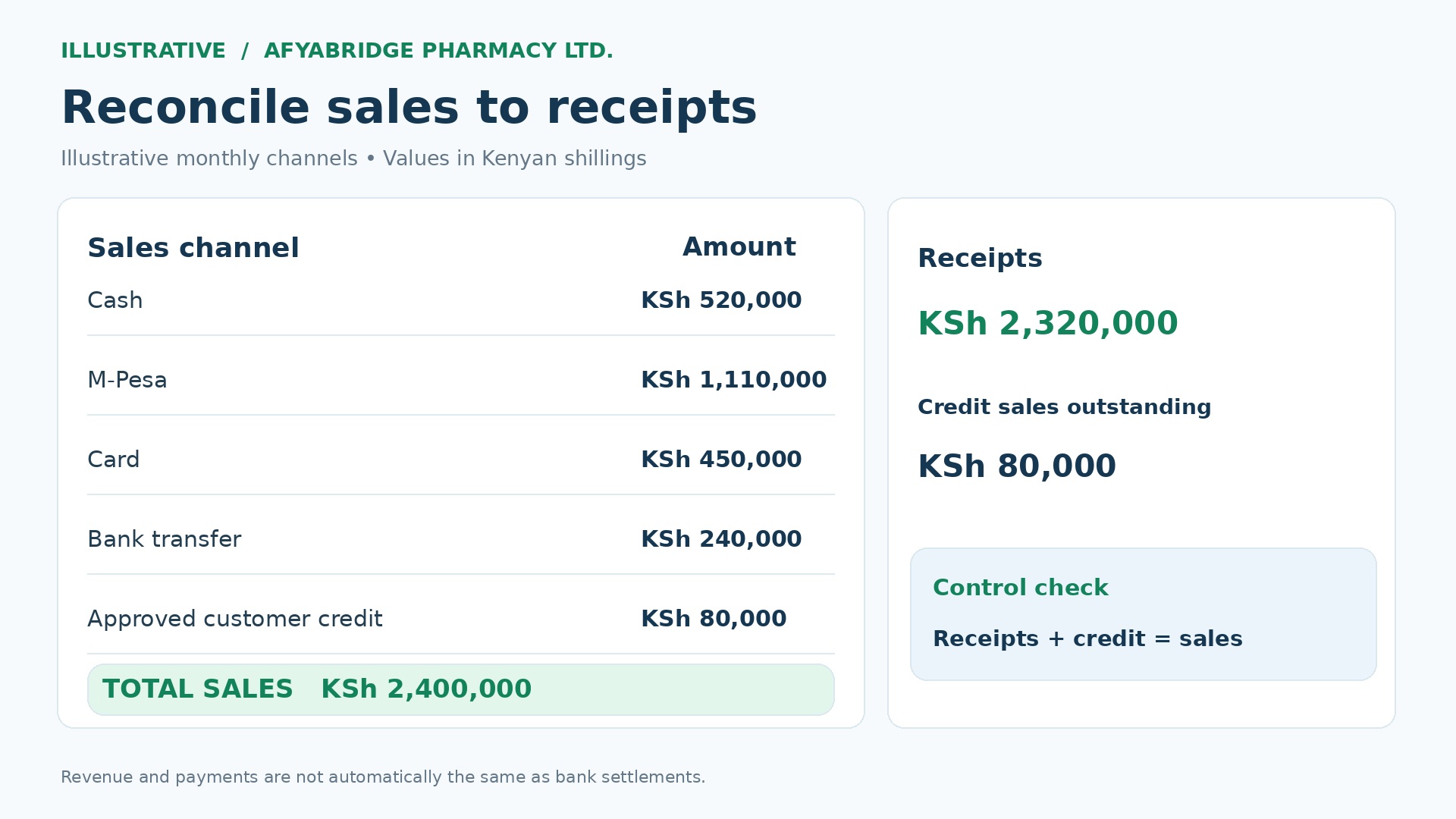
Pharmacy back office in Kenya sales and payments reconciliation chart
We would ask the pharmacy to keep a daily close sheet showing the POS sales report, refunds, each payment channel, physical cash counted, settlement timing, and exceptions. FedhaTrac can help reconcile the resulting books against supporting evidence and investigate a difference rather than make an unsupported balancing entry.
When the pharmacy back office in Kenya sees a bank credit for a previous day’s card sale, it should clear a settlement balance instead of creating a second sale. Likewise, transferring money from M-Pesa to the bank is usually an internal movement, not fresh revenue. Small repeated mistakes of this kind can create deceptively impressive turnover figures while cash remains scarce.
3. Match Every Supplier Delivery to Its Financial Paper Trail
Stock arriving at the rear door creates more than boxes to place on shelves. An effective pharmacy back office in Kenya connects the purchase request or purchase order, the supplier delivery note, a receiving confirmation, the supplier invoice, and any later credit note. An unresolved mismatch should remain visible until an authorized person explains it.

Qualified pharmacy personnel reviewing supplier invoices and purchasing records
Consider an order for 200 units at KSh 300 each. If only 190 acceptable units arrive, a purchase invoice for KSh 60,000 cannot automatically be treated as 200 units of available stock. The receiving evidence supports KSh 57,000 of accepted goods, subject to the supplier’s adjustment and the accounting policy. The missing ten units require a query, not an invented receiving entry.
Our business operations support and purchase-order guidance help establish a practical document trail. Where a pharmacy has an existing inventory or POS system, we can work from its approved reports without assuming a direct, real-time connection. The licensed pharmacy team retains control over whether incoming goods are genuine, suitable, correctly stored, and lawful to supply.
Supplier ledgers also need dates. The pharmacy back office in Kenya should show the original invoice, approved credits, partial payments, and outstanding balance for each wholesaler. At month-end, an aging report helps management distinguish a legitimate payment due tomorrow from an invoice still disputed because of a short delivery.
4. Keep Physical Stock, Accounting Value, and Professional Safety Separate
Inventory quantities and inventory values answer different questions. The pharmacy back office in Kenya must know what the stock register reports, what staff actually count, and what the accounts say that stock costs. A variance could reflect an unrecorded sale, a return, an authorized transfer, breakage, theft, a delayed delivery posting, or an incorrect unit of measure. It is not enough to adjust the spreadsheet until it matches the shelf.

Pharmacy staff checking medicine stock against a receiving document
A medicine’s expiry date and batch details are vital operational controls for qualified pharmacy personnel. Financial staff should receive authorized evidence of a return or write-off and record the amount affected; they should not independently decide that a medicine may be dispensed or reintroduced to saleable stock. Correct procedures under the Pharmacy and Poisons Board’s guidance take precedence over recovering purchase cost.
For AfyaBridge, the illustrative stock-value bridge is deliberately simple: opening inventory KSh 1,080,000, accepted purchases KSh 1,760,000, cost of items sold KSh 1,620,000, and properly approved unsaleable-stock write-offs KSh 35,000. The accounting closing inventory is KSh 1,185,000. Those figures do not establish the actual physical count, which must be verified separately.
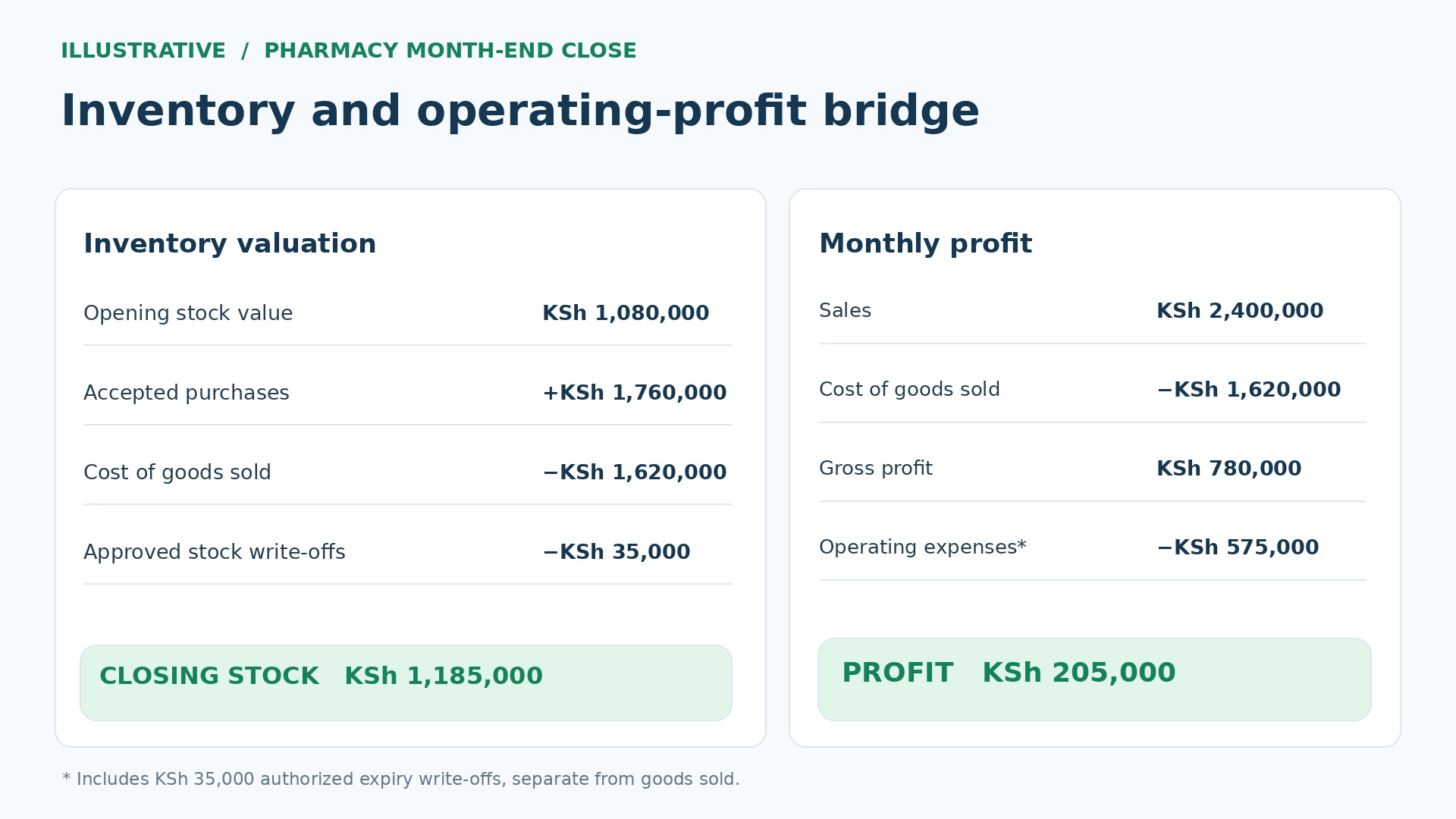
Pharmacy inventory and gross-margin calculation for a fictional Kenyan business
This makes the pharmacy back office in Kenya a management tool, not just a compliance file. Management can review stock days, slow movers, losses, and purchase concentration while licensed staff make the regulated product decisions. FedhaTrac helps explain the financial cost of those outcomes and supports reconciliations, but does not replace pharmaceutical inventory-safety controls.
5. Protect Gross Margin Without Confusing Purchases With Cost of Sales
A pharmacy may buy KSh 1.76 million of stock during a month without consuming that amount in customer sales. The pharmacy back office in Kenya must distinguish purchases that increase inventory from the cost attached to products actually sold. Otherwise, monthly profits can swing simply because a large wholesaler order happened before month-end.
AfyaBridge’s illustrative sales of KSh 2,400,000 less KSh 1,620,000 in cost of goods sold produce KSh 780,000 gross profit, or 32.5% gross margin. Its operating expenses then include staff-related costs KSh 245,000, rent KSh 150,000, utilities and refrigeration KSh 55,000, transaction charges KSh 22,000, other administration KSh 68,000, and authorized expiry-related write-offs KSh 35,000. These add to KSh 575,000, leaving KSh 205,000 operating profit, approximately 8.54% of sales.
The figures are illustrative, exclude separately modeled income tax and financing effects, and should not be treated as industry benchmarks. Their value is to show why the pharmacy back office in Kenya needs both inventory movement and operating-expense records before management judges performance. A higher sales month can produce a lower operating margin if the product mix or costs change.
FedhaTrac’s accounting services and specialized reporting and advisory can help the business interpret reconciled margins, cost trends, and stock losses. Our earlier pharmacy bookkeeping article explains general chemist recordkeeping; this back-office guide focuses on the daily control chain and management handoff.
6. Plan Supplier Payments and Cash Needs Ahead of the Deadline
The pharmacy back office in Kenya should not schedule supplier payments using yesterday’s POS sales alone. A profitable trading month can still include an urgent shortage of available money if customers owe balances, payment providers have not settled, new inventory has been purchased, or wholesalers are demanding payment before receipts arrive.
To illustrate, AfyaBridge starts with KSh 210,000 of cash and bank balances. It collects KSh 2,320,000, pays suppliers KSh 1,430,000, and settles KSh 540,000 of cash operating expenses. Closing cash is KSh 560,000, an increase of KSh 350,000. This does not equal its KSh 205,000 operating profit because receivables, inventory, and payables moved during the same month.
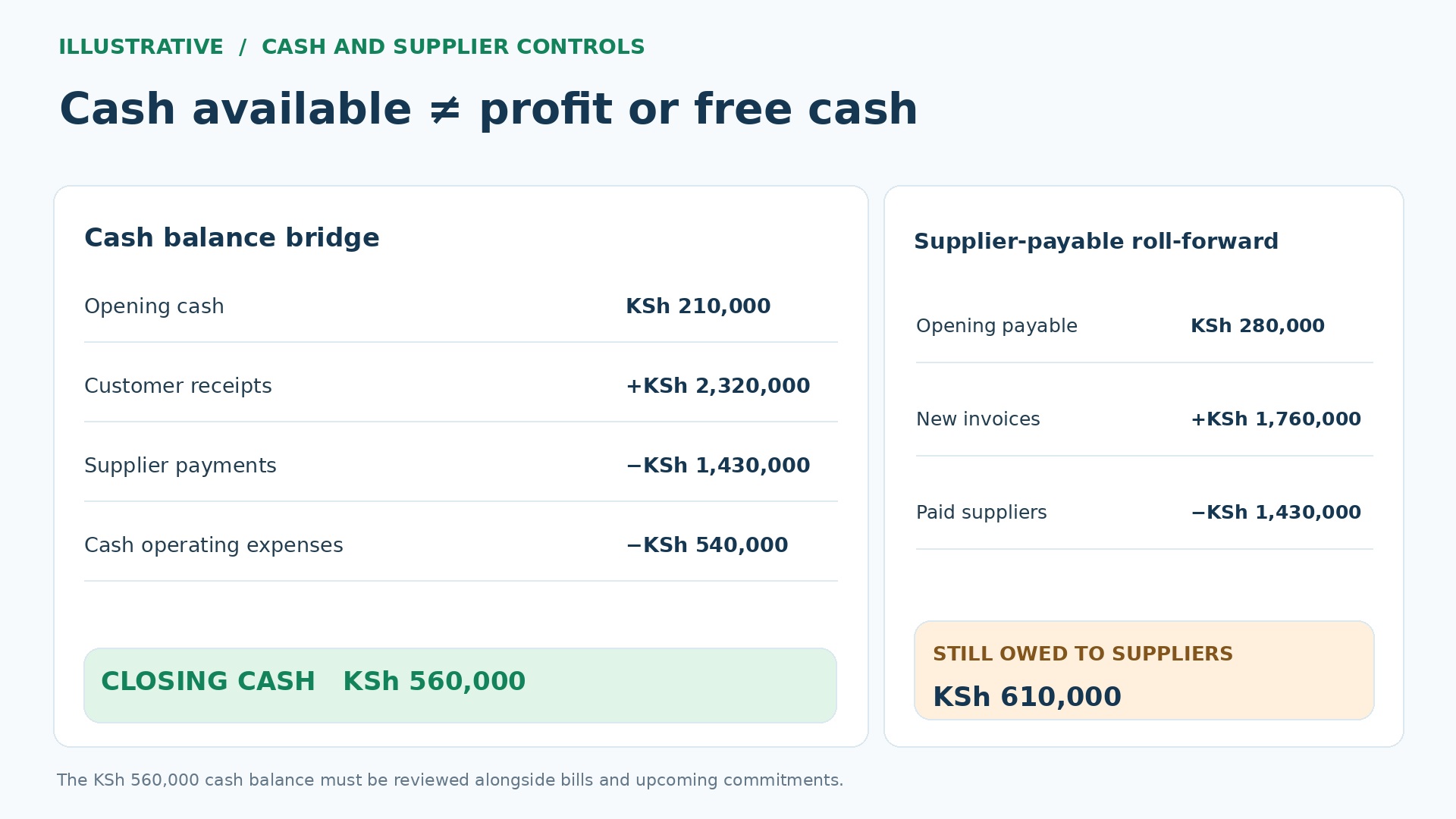
Pharmacy cash balance bridge and supplier payables example
Suppose opening supplier payables were KSh 280,000, with KSh 1,760,000 of new accepted invoices and KSh 1,430,000 paid. Closing supplier payables would be KSh 610,000. That liability is not missing cash; it represents bills still owed. It also means management should be cautious about treating the KSh 560,000 closing balance as unrestricted surplus.
A weekly schedule should therefore connect due supplier invoices, payroll funding, rent, utilities, tax dates, and expected settlements. In the pharmacy back office in Kenya, comparing the next 14 days of commitments against realistic available cash can prevent rushed purchases and late supplier disputes. FedhaTrac can help prepare and explain cash-flow schedules using the pharmacy’s approved records.
7. Prepare Tax and Licensing Evidence Without Assuming Every Product Is Taxed Alike
Kenya’s KRA eTIMS guidance covers electronic invoicing obligations for persons carrying on business, including businesses that are not VAT-registered. KRA’s stock-management guidance also calls for accurate records of stock received, purchased, sold, transferred, returned, adjusted, and otherwise disposed of. A pharmacy back office in Kenya should keep source records organized so tax documents can be supported and explained.
A pharmacy’s mix of medicines, other health products, and ancillary goods can carry different tax treatments. It would be unsafe to assign a single VAT rate to every product without checking the specific item and current law. FedhaTrac can assist with bookkeeping and applicable tax-support records; it does not decide medicines’ regulatory classification or promise that a general POS screen automatically generates compliant electronic invoices.
The Pharmacy and Poisons Board regulates pharmaceutical practice and premises approval. Its licensing rules concern who may lawfully operate the business and under what conditions. The pharmacy back office in Kenya can maintain supporting fee and renewal documentation, but the superintendent and relevant licensed professionals remain accountable for pharmacy-practice obligations. Accounting support is not a substitute for PPB authorization.
Keep financial evidence proportionate and secure. Customer billing and payment records should contain what accounting requires, not unnecessary clinical details. Restrict staff access according to roles, retain approved adjustment evidence, and avoid circulating personal health information in general bookkeeping reports. This protects the records that the pharmacy back office in Kenya needs without pretending that accounting software is a clinical records platform.
8. Close the Month With an Exception Report, Not Just a Sales Total
A productive pharmacy back office in Kenya needs a repeatable closing process that produces decisions. The owner and professional superintendent should know which exceptions remain open, which stock adjustments were approved, which suppliers require attention, and whether margin changed for understandable reasons.
Start with reconciled sales by channel and documented reversals. Next, check invoices, deliveries, supplier balances, credit notes, and approved inventory adjustments. Then review cash and bank movement, closing receivables, outstanding payables, staff-cost records, operating expenses, and relevant tax documents. Finally, prepare a profit-and-loss statement, balance sheet, cash position, and short list of issues requiring owner action.
A simple monthly exception log might show: a KSh 12,000 supplier invoice without satisfactory receiving evidence; KSh 7,500 in card settlements still in transit; KSh 4,000 of stock variance awaiting authorization; and a late wholesale account scheduled for review. These are illustrative exception amounts, not additions to AfyaBridge’s completed financial example. They show how a pharmacy back office in Kenya can report uncertainty openly rather than hide it inside forced adjustments.
FedhaTrac’s bookkeeping service and dashboard offering support a clearer view of transactions, reconciliations, and financial reports. The pharmacy owner can then use regular meetings to question gross margin, inventory tied up, supplier terms, and cash commitments. The output should be a practical action list with owners and deadlines—not another unread report.
How FedhaTrac Supports a Pharmacy Back Office in Kenya
We begin by mapping the pharmacy’s actual information flow. What POS or till report is produced? Where do M-Pesa and card settlements appear? Who authorizes returns and write-offs? How are supplier invoices filed? What inventory evidence does the licensed team maintain? These questions establish a sensible financial control framework before we discuss monthly reporting.
Our team can help organize source records, record approved transactions, reconcile accounts, support supplier and expense documentation, prepare management statements, and explain the results. Where appropriate, we also provide tax-filing and compliance assistance and periodic financial consultations. We work with documented processes and available records; we do not claim to independently verify drug quality, dispense medicines, guarantee stock automation, or replace a licensed pharmacy professional.
This is also how a pharmacy back office in Kenya becomes more scalable. When daily reconciliations are understandable, a second branch or busier retail counter no longer has to mean lost paperwork. Managers can review consistent reports across locations, provided each business site and its records are properly identified and consolidated using an appropriate accounting approach.
Questions Pharmacy Owners Ask
Is a pharmacy back office in Kenya the same as a dispensing system?
No. The pharmacy back office in Kenya described here covers financial records, purchasing evidence, payment reconciliation, inventory valuation, and business reporting. Dispensing and professional stock-safety controls belong to authorized pharmaceutical personnel and compliant pharmacy systems. FedhaTrac’s financial support does not replace those responsibilities.
Can FedhaTrac use reports from my existing pharmacy POS?
We can discuss an agreed workflow using suitable POS exports, supplier invoices, bank statements, and other approved reports. The exact compatibility and method must be confirmed for your setup. We do not promise automatic software synchronization based only on the presence of a POS menu.
What if my supplier invoice and stock count do not agree?
Record the difference, preserve the original invoice and receiving evidence, and ask authorized staff to investigate. The pharmacy back office in Kenya should avoid changing records without a documented reason. After the operational issue is resolved and approved, accounting can reflect the appropriate financial adjustment.
Do you calculate tax for all medicines using one rate?
No. Product categories and transactions need the correct current tax treatment. We support accounting and applicable tax documentation using the evidence provided and relevant KRA guidance. Pharmaceutical and tax classification questions should be resolved by qualified specialists rather than inferred from a generic product label.
What should management receive from FedhaTrac each month?
The agreed reporting package can include reconciled financial statements, sales and payment analysis, supplier balances, cash-flow visibility, inventory-related financial adjustments, and an exception list. We will define the scope around the records and services your business needs, so each review ends with clear next actions.
Put the Pharmacy’s Financial Operations in Order
A well-run pharmacy back office in Kenya cannot be judged by a single sales screen. The real test is whether sales agree to receipts, purchases agree to accepted deliveries, stock movements are explained, suppliers are paid with visibility, and the monthly financial statements tell a consistent story. Those controls help a pharmacy protect working capital while the licensed team concentrates on safe, lawful service.
At FedhaTrac, we help business owners make their numbers usable through bookkeeping, accounting, reconciliation, reporting, and practical financial advice. If your pharmacy’s behind-the-counter records have become difficult to control, contact our team to discuss a back-office accounting workflow that fits your systems, transaction volumes, and reporting needs.


