
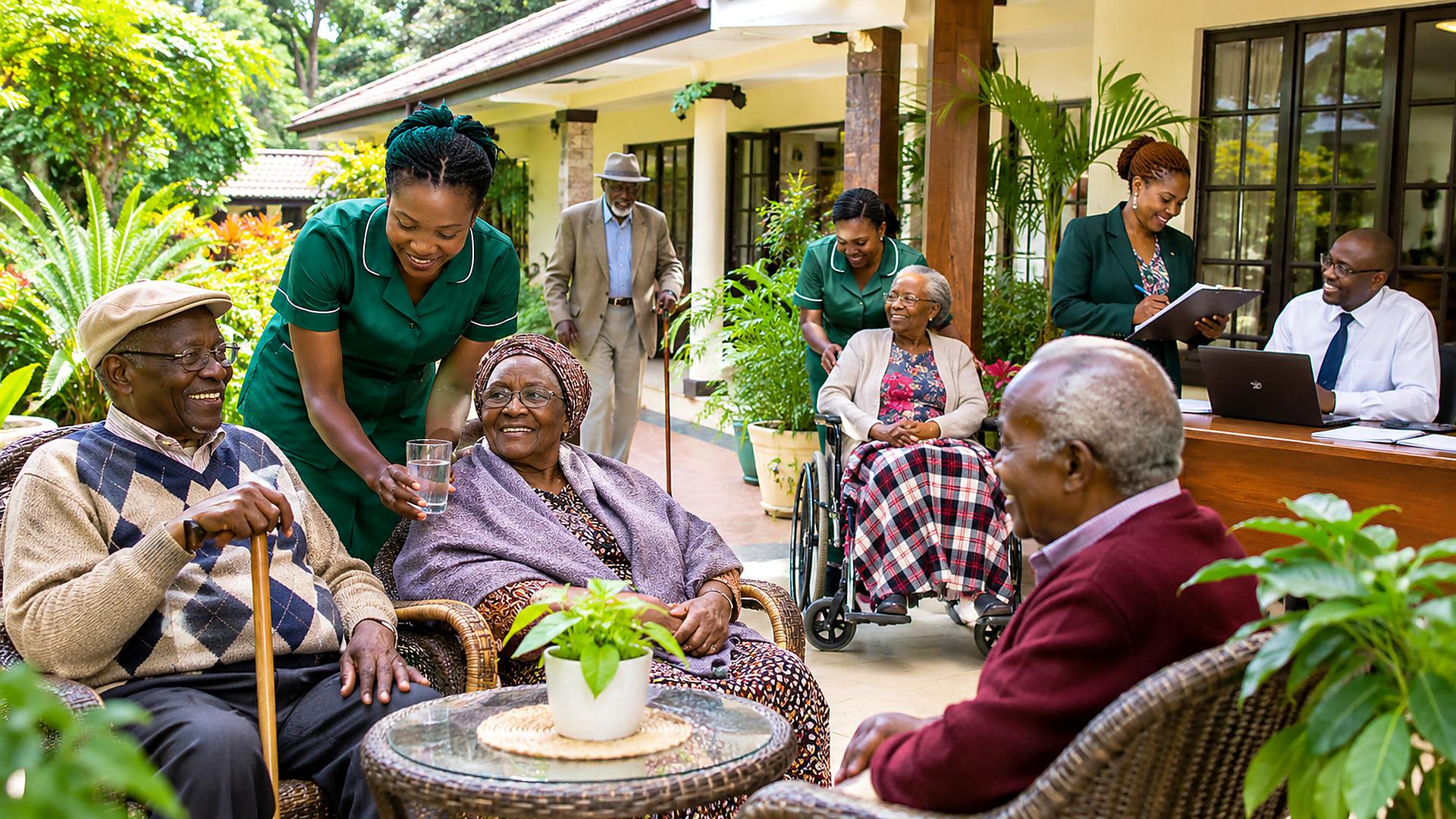
Retirement Home Accounting in Kenya: Make Every Shilling Support Better Care
A retirement home is more than a building with bedrooms and a monthly fee. It is a promise of safe accommodation, nourishing meals, respectful assistance, dependable staff, and honest communication with older residents and their families. Behind that promise are invoices, supplier bills, caregiver costs, maintenance commitments, and decisions that cannot be postponed because a customer pays late. Retirement home accounting in Kenya connects those responsibilities to dependable financial records.
At FedhaTrac, we help care facilities organize transactions, reconcile payments, maintain useful accounting records, and prepare management reports. Our role is financial: we do not replace nurses, supervise clinical treatment, license residential homes, or process payroll. We support managers with clearer numbers so they can protect care budgets and discuss decisions with confidence. For an operator serving residents in Nairobi, Nakuru, Nyeri, Mombasa, or another county, retirement home accounting in Kenya deserves the same attention as everyday caregiving.
A residential home may collect recurring room-and-board fees, charge separately for additional assistance, and receive donations or grants. Those receipts have different accounting meanings. The eight checks below show how retirement home accounting in Kenya can distinguish earned revenue, money held for residents, genuine operating expenses, and cash needed for tomorrow’s services.
Check 1: Match Every Resident Agreement to a Clear Billing Record
A family should understand what is included in the resident’s fee before the first invoice is issued. Accommodation, meals, routine assistance, laundry, social activities, and transport might be bundled differently across care packages. We recommend a signed fee schedule, documented effective dates, approved changes, and one reference for each resident’s financial account. A care agreement and the resident’s medical file are not substitutes for an accounting ledger.
In retirement home accounting in Kenya, monthly billing records should identify the service period, payer, agreed rate, additional approved services, credits, and amount due. Families may share responsibility for payments, but the home should not silently divide one debt among relatives without the underlying agreement. Staff should record who is authorized to receive statements and approve changes.
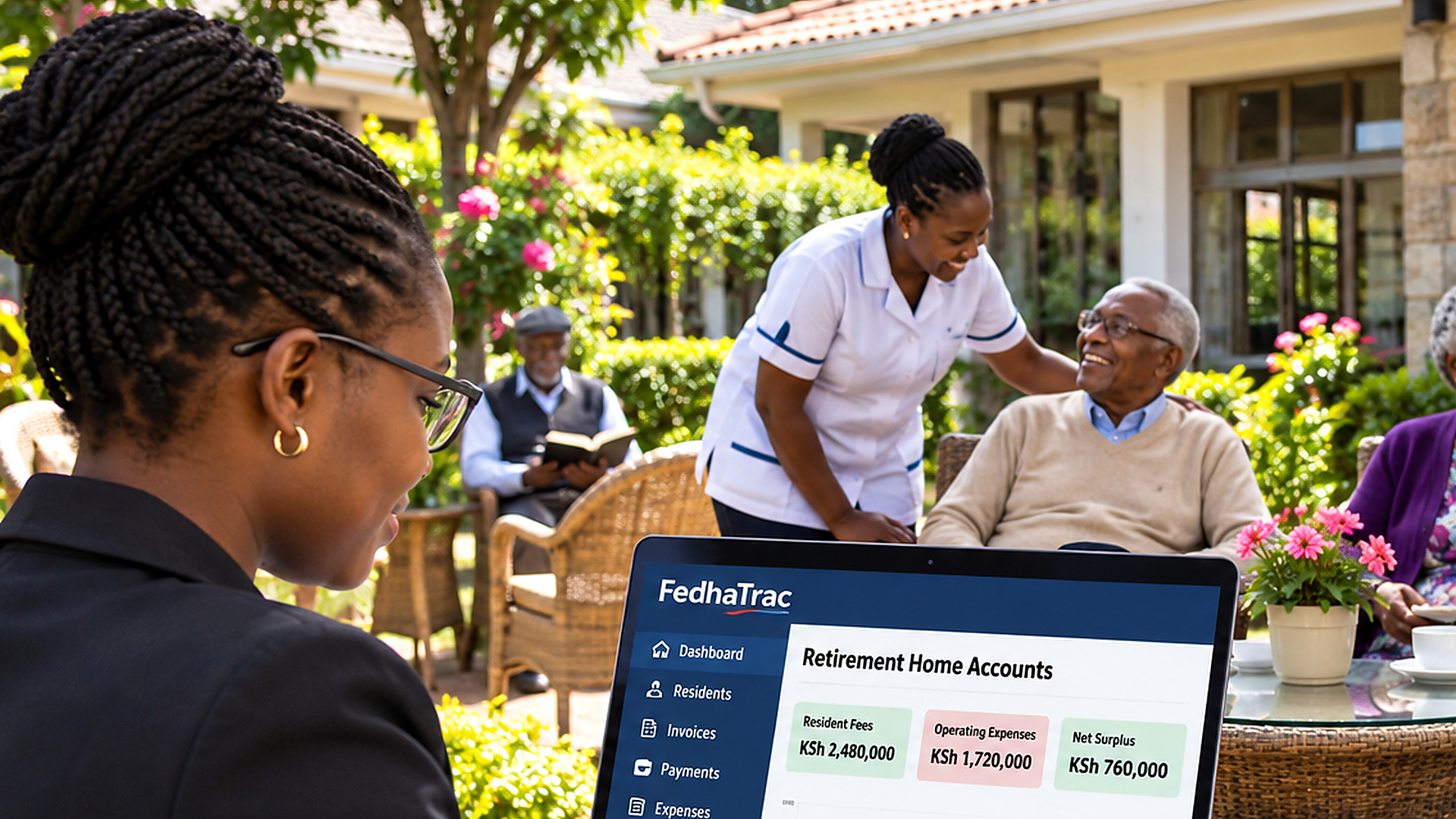
Accounts officer reviewing family billing and senior residence payments
FedhaTrac’s business operations support can help organize invoicing and payment records within an agreed workflow. Our bookkeeping service keeps the related transactions understandable. When retirement home accounting in Kenya begins with a reliable billing list, owners are less likely to mistake an unbilled service for a cash shortage.
Check 2: Separate Family Payments, Refundable Deposits, and Donations
A bank credit may represent a monthly residence fee, a family prepayment, a refundable security deposit, a donation, or reimbursement for an approved purchase. These should not all appear as current-month sales. Good care-home bookkeeping must recognize what the facility has earned and what it still owes or must deliver.
Consider a new resident whose family pays a KSh 40,000 refundable deposit together with the first month’s care fee. The deposit may be a liability until the contractual conditions for refund or use are met; it is not automatically profit. Likewise, money received for a future month may require deferred-revenue treatment, depending on the accounting arrangement and service obligations. A donation designated for a particular activity should be monitored against its purpose rather than absorbed into unrestricted operating income.
We help reconcile receipts from bank, M-Pesa, and other documented channels to invoices and the appropriate ledgers. Retirement home accounting in Kenya becomes especially useful when relatives pay from different locations or one payment covers several items. Approved statement adjustments should always leave a trace that managers and families can understand.
Check 3: Understand Staffing Costs Without Confusing Bookkeeping With Payroll Processing
Residential care depends on caregivers, nurses where applicable, cooks, cleaners, security workers, maintenance personnel, and administrators. Their costs often continue even when some rooms are vacant. A manager needs to know the approved staffing budget, hours or shifts worked, overtime authorizations, and the full expense recorded for each period. Retirement home accounting in Kenya should give staffing costs a clearly identified place in the monthly accounts.

Caregiver supporting an older resident with respectful attention
FedhaTrac can incorporate approved payroll summaries, employer-related costs, and payment evidence into bookkeeping and reporting. We do not claim to run the home’s payroll engine, schedule caregivers, or make clinical staffing decisions. Those remain the responsibility of the employer and appropriately qualified managers. Where necessary, the home should also review applicable labor and professional requirements with the proper advisers.
For PAYE, the Kenya Revenue Authority states that employers generally deduct and remit the tax by the ninth day of the following month. Other statutory obligations need their own current checks. Retirement home accounting in Kenya helps keep approved payroll inputs, expense postings, remittance evidence, and reconciliations accessible for reviews; it does not itself certify legal compliance.
Check 4: Budget Meals, Supplies, Equipment, and Maintenance Separately
A retirement home cannot simply postpone meals or basic hygiene because collections were slower than expected. Food, water, utilities, laundry, cleaning supplies, mobility aids, bedding, fuel, and repairs need separate categories. Items purchased for residents should be distinguishable from general facility costs, particularly when a family has agreed to reimburse a specific expense.

Resident dining and meal service illustrating care-home operating costs
We recommend supplier records showing the purchase authorization, invoice, receiving evidence, payment date, and expense category. For higher-value equipment, management should consider whether the item belongs in a fixed-asset register rather than treating it as an ordinary monthly supply. A repair is not necessarily the same as a new asset; an accountant should assess the correct treatment. These records become more useful when each category supports a purchasing decision.
Our accounting service can turn those records into meaningful financial statements. With retirement home accounting in Kenya, the manager can compare the cost of meals and routine care across periods without reducing a resident to a number or disclosing sensitive personal information in a general management report.
Check 5: Monitor Occupancy and Cost per Resident Without Sacrificing Care
A home’s capacity and actual occupancy are not the same. A facility with 30 available places and 24 residents has 80% occupancy, but that percentage alone says nothing about the support each person needs. Different care packages carry different labor and supply requirements, and basic facilities and staffing may remain necessary even when occupancy falls. Retirement home accounting in Kenya should help managers see this difference.
Useful measures include occupied beds, billed service days, average revenue per occupied place, total direct-care costs, approved staffing-to-budget variance, unpaid invoices, and cash coverage for essential expenses. These are financial management indicators, not a formula for reducing staff below safe levels. Any clinical or care adequacy judgment must remain with suitably qualified personnel.
Through specialised reporting and advisory, we can help shape appropriate financial indicators. Retirement home accounting in Kenya can then highlight whether low occupancy, high repairs, or an unfavorable service mix is pressuring the budget, while management protects minimum care commitments.
Check 6: Reconcile Receivables and Build a Practical Cash Reserve
A retirement home may report a profitable month and still struggle to pay its food supplier or meet its wage commitments. That happens when care fees have been earned but families have not yet paid, or when the facility has committed cash to a major repair. Retirement home accounting in Kenya should separate an income statement from a cash-flow view.
At month-end, a useful routine matches every receipt to a resident invoice, lists current and overdue balances, confirms approved credits, checks bank and M-Pesa statements, and identifies expenses falling due. We recommend that overdue-balance discussions remain discreet, accurate, and consistent with each agreement. A resident’s well-being should never be reduced to an aggressive collection target.
Our financial services and reporting support can help management prepare a cash forecast based on documented timing assumptions. In retirement home accounting in Kenya, a reserve planning conversation can cover essential meals, payroll-related payments, medication suppliers where applicable, transport, utilities, and emergency maintenance, rather than simply applying a universal cash target to every facility.
Check 7: Preserve Tax Evidence and Respect the Boundaries of Care Regulation
The tax treatment of accommodation, care, clinical services, donations, and other charges can depend on the actual supplies, legal entity, and current law. It would be misleading to label every retirement-home charge automatically VAT-exempt or VAT-taxable. Retirement home accounting in Kenya should preserve enough detail for the accountant to review each revenue stream correctly.
KRA explains that people carrying on business, including those who are not VAT-registered, generally fall within eTIMS electronic invoicing requirements, subject to applicable rules. At FedhaTrac, our tax filing and compliance support helps prepare relevant records and agreed filings, without claiming that the platform automatically issues KRA-compliant invoices for every setup.
Care regulation is a separate subject. Kenya’s State Department for Social Protection identifies national standards and guidelines for institutions for older persons and clarifies that the department itself does not register elderly homes. Operators should confirm their actual county and service-specific obligations with the competent authorities rather than treating a proposed Bill as enacted law. Retirement home accounting in Kenya supports documentation; it does not replace care-facility licensing or inspection.
Check 8: Protect Resident Information and Review the Accounts With Management
Financial transparency should not mean broadcasting residents’ private information. A statement sent to a designated family payer may need a resident reference and charges, but a board report normally needs aggregated figures, trends, and exceptions rather than personal care histories. The Office of the Data Protection Commissioner identifies health information as sensitive personal data and explains obligations that may apply to organizations processing it.
Our financial workflow should use approved access, appropriate confidentiality, and clear records of who is authorized to handle billing information. The home’s own care team should manage medical documentation within its professional systems. Retirement home accounting in Kenya works best when accounting records and clinical files are purposefully separated.
At monthly and quarterly reviews, management can examine collections, aged debtors, cost trends, budget variances, occupancy indicators, restricted funds, upcoming repairs, and cash runway. FedhaTrac can prepare reporting and support advisory conversations with management and boards. The monthly accounts then become a repeatable discussion about sustainability, not a folder of receipts opened only when an audit is due.
A Fictional Case Study: Tumaini Oaks Retirement Home Ltd.
To show how retirement home accounting in Kenya works, consider Tumaini Oaks Retirement Home Ltd., a completely fictional facility with 24 residents. This is an illustrative calculation, not a real FedhaTrac client, a quoted care-home price list, or a market average. Assume 18 residents use a standard package at KSh 75,000 a month, while six need a higher-support package billed at KSh 110,000. Approved additional services earned during the month total KSh 60,000.
| Illustrative monthly item | Amount (KSh) |
| Standard packages: 18 × 75,000 | 1,350,000 |
| Higher-support packages: 6 × 110,000 | 660,000 |
| Approved additional services | 60,000 |
| Total earned revenue | 2,070,000 |
| Direct caregiving, nursing and support staff costs | 780,000 |
| Food and kitchen provisions | 320,000 |
| Care consumables and approved supplies | 145,000 |
| Housekeeping and laundry costs | 120,000 |
| Transport and resident activities | 70,000 |
| Total direct costs | 1,435,000 |
| Contribution after direct costs | 635,000 |
| Shared administration, facilities and depreciation | 480,000 |
| Illustrative operating profit | 155,000 |
The operating margin is approximately 7.49% (KSh 155,000 divided by KSh 2,070,000). This figure comes from assumptions, not observed market performance. Retirement home accounting in Kenya should also ask how much cash arrived, not merely whether this table shows a surplus.
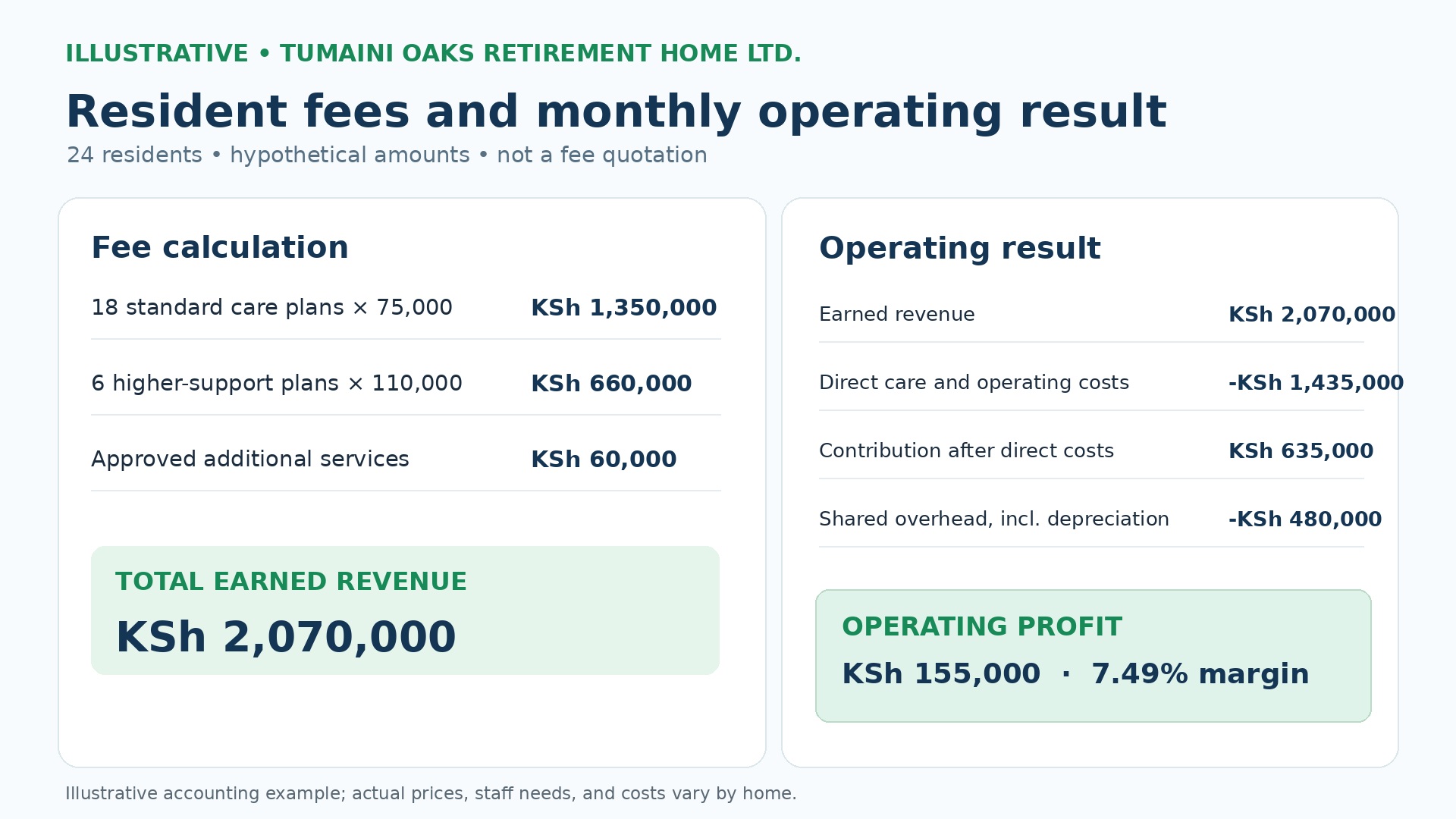
Retirement home accounting in Kenya fee calculation and profit example
Assume the home collects KSh 1,890,000 against this month’s charges and KSh 60,000 of old receivables, so total cash receipts are KSh 1,950,000. If opening cash is KSh 210,000 and cash operating payments are KSh 1,835,000, closing cash is KSh 325,000. The KSh 480,000 shared-cost line includes KSh 80,000 of illustrative noncash depreciation; the other costs are assumed paid. Current invoices left unpaid are KSh 180,000, while opening receivables of KSh 60,000 were collected. The increase in receivables is therefore KSh 120,000, and the cash movement of KSh 115,000 equals KSh 155,000 profit plus KSh 80,000 depreciation less KSh 120,000 additional receivables.
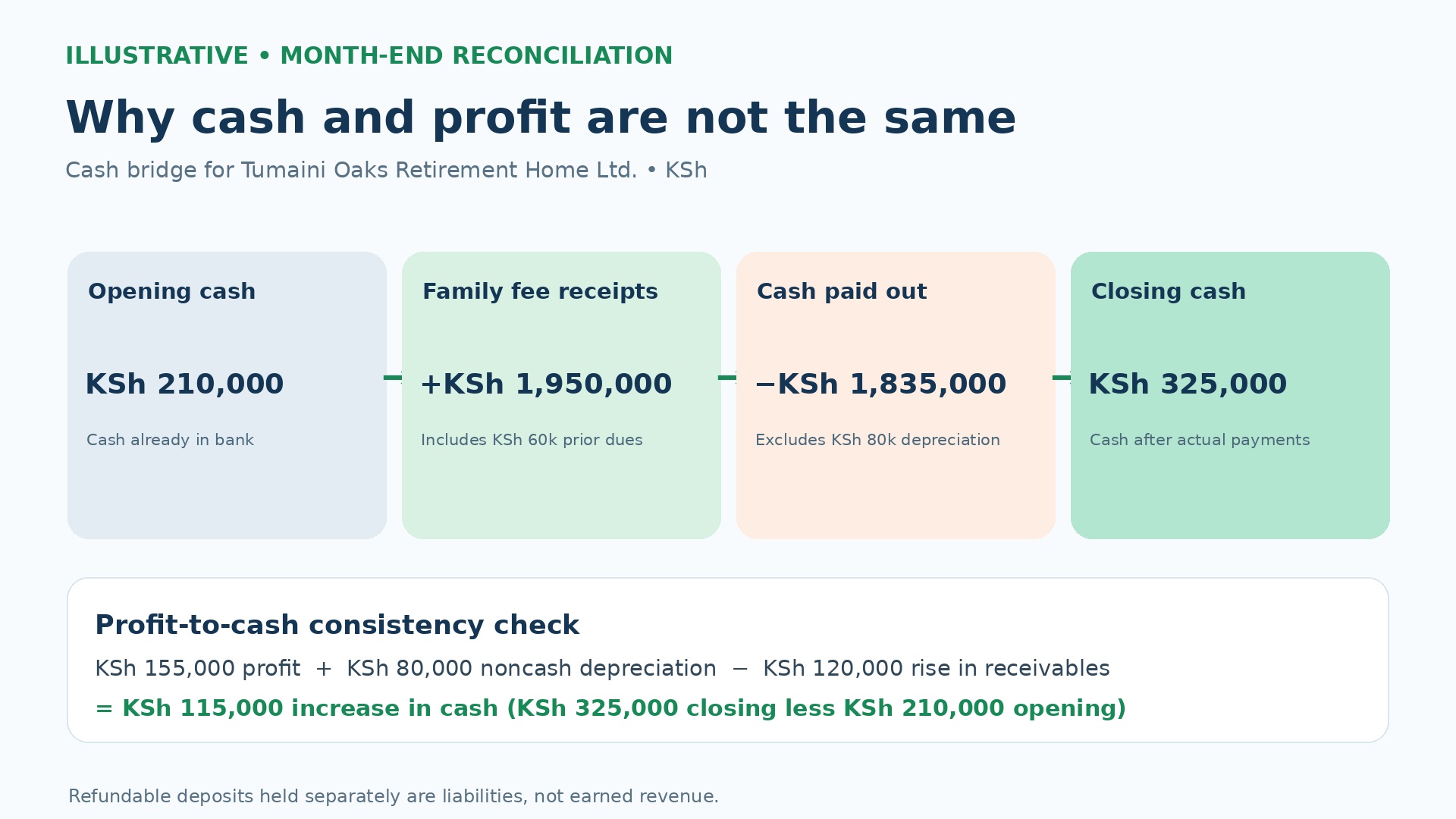
llustrative retirement-home cash reconciliation for earned fees and payments
Suppose Tumaini Oaks separately holds KSh 120,000 of refundable resident deposits from earlier admissions. That amount is a liability, not additional earned revenue. It may also limit how much of the KSh 325,000 bank balance is economically available for general spending. This is why retirement home accounting in Kenya needs a balance-sheet view alongside profit and cash figures.
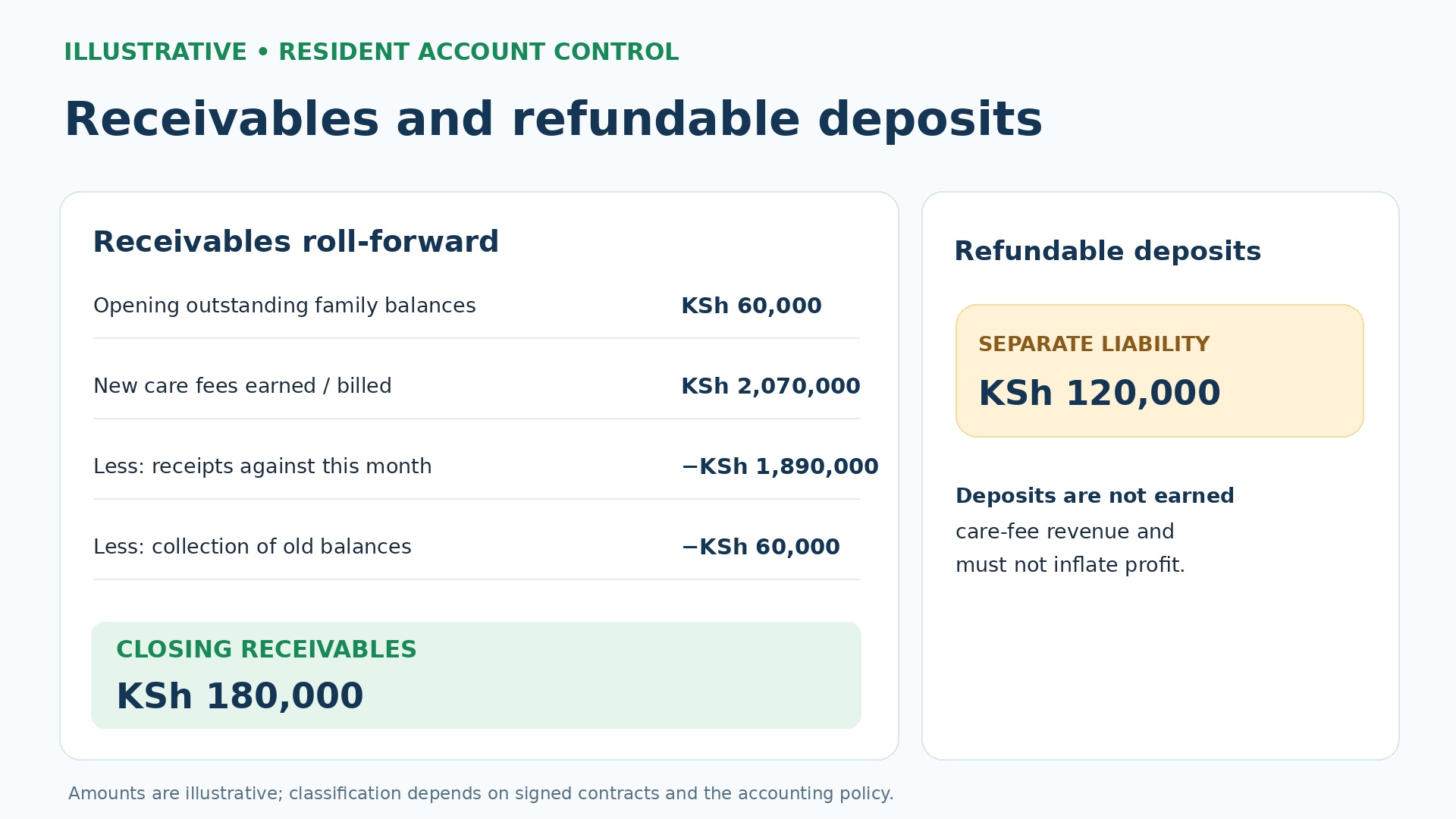
esident account receivables and refundable deposits accounting example
How FedhaTrac Can Support a Retirement Home Month After Month
Our engagement begins by learning how the facility actually works. We discuss payer arrangements, service packages, transaction volume, existing accounting tools, approved payroll information, supplier records, bank accounts, and the reporting needs of owners or trustees. We agree responsibilities and approval steps before maintaining books or communicating financial results.
In a typical retirement home accounting in Kenya workflow, the home’s team approves charges and expenses; we organize the corresponding evidence, reconcile accounts, identify unexplained items, and prepare the agreed management reports. Where the facility needs a specific workflow in FedhaTrac’s dashboard or its own accounting package, we verify actual capabilities instead of promising an automatic connection or medical-record feature.
The result is a financial picture that connects service commitments with practical decisions: which receivables need tactful follow-up, what food and staffing costs were incurred, how much is reserved for resident deposits, and whether planned improvements fit the cash forecast. Retirement home accounting in Kenya should make those questions easier to answer without presenting care standards as a line item to cut.
Common Questions About Retirement Home Accounting in Kenya
Can FedhaTrac help a small retirement home with only a few residents?
Yes. We can discuss a bookkeeping and reporting arrangement that reflects the facility’s real volume, available records, and required review frequency. Retirement home accounting in Kenya is valuable even before a home expands because basic billing, reconciliations, cost visibility, and cash planning become harder to reconstruct later.
Can family members receive statements for an older resident?
Statements can be prepared for authorized payers in accordance with the resident agreement and appropriate data protections. We recommend confirming which person may receive billing details, how corrections are approved, and where payment evidence is stored. Retirement home accounting in Kenya should support family clarity without exposing private medical information.
Does FedhaTrac process caregiver salaries or schedule clinical staff?
No payroll-processing or clinical scheduling service is promised here. We can record and reconcile approved payroll summaries and support management reporting or agreed tax documentation. The employer remains responsible for payroll preparation, staffing decisions, and statutory obligations. This distinction matters for care homes because financial support and professional caregiving are separate functions.
How should a home record refundable admission deposits?
The answer depends on the signed agreement and the conditions for refund or application. An ordinarily refundable amount is generally presented as a liability until the conditions change; it should not automatically increase earned care revenue. We can help organize the ledger evidence so retirement home accounting in Kenya distinguishes money collected from money earned.
Can FedhaTrac replace a care-home license or a qualified medical team?
No. Our services focus on bookkeeping, accounting, tax support, operations records, reporting, and financial advice. Facility approvals, inspection requirements, health-care decisions, and resident safeguarding are separate responsibilities. Retirement home accounting in Kenya can support managers with reliable records, but it cannot substitute for appropriate care professionals or regulators.
Build Financial Stability Around the People You Care For
At FedhaTrac, we believe good financial management should make a retirement home’s obligations clearer, not make its residents feel like numbers. Accurate fee records, reconciled payments, supported expenses, and realistic cash forecasts help management plan services responsibly. Retirement home accounting in Kenya is ultimately about sustaining a dependable environment for older people and the teams who serve them.
If your facility needs organized books, clearer family billing records, reconciliations, tax-documentation support, or board-ready reports, contact FedhaTrac. We can discuss a scope tailored to your records, reporting needs, and obligations, then help build a financial routine your management team can use.


